
How To Fix AI Vocals: Without Making Them Sound Even More Artificial
Most AI vocals sound surprisingly convincing for the first few seconds. The pitch feels stable, the words are easy to understand, and nothing immediately gives the illusion away. Then the second verse arrives—or even the second sentence—and something starts to feel wrong. Most listeners can't describe exactly what changed. They simply stop believing the performance.
That reaction rarely comes from poor audio quality alone. In many AI-generated songs, the voice is clean enough. It isn't buried in noise or overwhelmed by distortion. The problem is subtler. The singer no longer behaves like a person. Tiny pauses feel misplaced. Certain words receive identical emphasis. Emotional intensity stays frozen from one phrase to the next. Instead of following a performance, the listener begins noticing a system repeating patterns.
The natural response is understandable: polish the vocal. Make it smoother. Make it cleaner. Yet a cleaner version of an artificial performance often sounds even less convincing because the underlying behavior hasn't changed. Technical refinement can expose unrealistic phrasing instead of hiding it.
This is why we separate vocal realism from vocal performance. A recording can sound technically polished while still feeling emotionally disconnected. That distinction matters because successful repair starts with identifying why the vocal feels artificial before deciding whether it actually needs intervention.
The most convincing AI vocals rarely come from making the voice cleaner. They become believable when the performance itself begins to behave more like a real singer—one whose phrasing, pronunciation, and musical intention evolve naturally from line to line instead of repeating the same predictable patterns.
Why AI Vocals Can Sound Technically Clean Yet Emotionally Artificial
 One of the biggest surprises for people working with AI-generated vocals is that obvious audio flaws aren't always the reason the voice feels unnatural. A vocal can be clean, intelligible, and remarkably free of distracting noise, yet listeners still recognize within seconds that something doesn't feel like a real performance. They're reacting to behavior, not just sound.
Human hearing is remarkably sensitive to expression. Long before we consciously evaluate vocal tone, our brains begin tracking intent. Is the singer leaning into an important lyric? Does a phrase naturally build toward the chorus? Does the emotion change as the story unfolds? Real performances constantly answer those questions through subtle variations that most listeners never actively notice. When those variations disappear, the vocal may remain technically impressive while becoming emotionally distant.
As a result perfectly clean AI vocals often receive comments such as "robotic," "lifeless," or "synthetic," even when the recording itself sounds polished. Those words rarely describe frequency balance or recording quality. More often, they describe the way the performance behaves. Every sentence carries similar energy. Every phrase begins and ends with nearly identical confidence. Words that should feel spontaneous arrive with mechanical precision instead of natural intention.
Unnatural phrasing contributes heavily to that reaction. Human singers rarely deliver consecutive lines with identical pacing or emphasis because every lyric carries a different emotional weight. AI systems, however, often distribute attention too evenly across an entire performance. A reflective verse may receive the same vocal intensity as a climactic chorus. Questions don't sound curious. Confessions don't become more vulnerable. Climactic moments fail to expand naturally. The performance remains consistent—but not in the way people expect from another human being.
Pitch creates another common misunderstanding. Many users assume that if every note lands accurately, the vocal should automatically sound convincing. In reality, pitch accuracy is only one small part of what makes a singer believable. Countless iconic vocal performances contain tiny imperfections that actually strengthen emotional connection. Slight hesitation before a phrase, a gentle shift in emphasis, or a naturally uneven transition between words often communicates far more than mathematical precision ever could.
We've seen projects where clients spent hours trying to understand why an AI vocal still sounded artificial despite being "perfect." Nothing appeared obviously wrong. The melody matched. The lyrics were clear. Yet after listening through the full song, a pattern emerged: every emotional moment was delivered with almost exactly the same vocal attitude. Once that repetitive behavior became noticeable, it was impossible to ignore. The issue wasn't technical cleanliness—it was the absence of believable human variation.
Interestingly, different clients often describe the same underlying vocal problem using completely different language. One hears robotic phrasing. Another says the vocal feels emotionally empty. Someone else simply says it doesn't sound real. Although the descriptions vary, the underlying performance behavior is often remarkably similar.
That distinction changes how AI vocals should be evaluated. Instead of asking whether the recording sounds clean, a more useful question is whether the singer behaves like someone responding naturally to the music. Listeners don't connect with flawless consistency. They connect with performances that feel alive, where phrasing evolves, emphasis shifts, and emotion follows the song rather than repeating a predictable formula. When AI vocals fail, it is usually because those human behaviors never fully develop, regardless of how polished the recording itself may appear.
Interestingly, many listeners identify artificial vocals without being able to explain why. They simply describe the performance as "off." That reaction usually appears before they notice pronunciation, pitch, or individual phrases because the brain evaluates vocal behavior long before it analyzes technical quality.
The Small Performance Details That Make AI Singing Feel Unnatural
Most listeners never stop a song to analyze pronunciation, breathing, or phrasing. They simply decide whether the singer feels believable. That judgment happens almost instantly and almost entirely below conscious awareness. By the time someone says, "The vocal sounds fake," their brain has already noticed dozens of tiny inconsistencies working together. Individually, each one may seem insignificant. Combined, they quietly erode the illusion of a real performance.
Pronunciation is one of the first clues. AI vocals often pronounce every word correctly while still sounding unnatural. Certain vowels become unusually long, consonants appear too sharp or too soft, and emphasis falls on unexpected syllables. Nothing sounds dramatically wrong in isolation, yet the flow of language begins to feel unfamiliar. Native speakers are especially sensitive to these details because natural speech follows patterns that are difficult to describe but immediately recognizable when they are missing.
Word endings create another recurring problem. Human singers rarely finish every phrase with identical precision. Some endings trail off gently. Others become more forceful to reinforce meaning. AI-generated performances, however, often treat sentence endings with the same predictable shape throughout an entire song. After a few verses, those repeated patterns become surprisingly noticeable, even though most listeners would struggle to explain exactly what changed.
Breathing contributes to realism in ways that are easy to underestimate. Real singers don't inhale according to a fixed pattern. Their breathing follows emotion, phrasing, and physical effort. An intimate verse naturally leaves different spaces than an energetic chorus. AI vocals frequently imitate breathing rather than responding to musical context. The result is a performance that appears technically complete while lacking the subtle physical rhythm people expect from a human voice.
Disconnected syllables create a different kind of discomfort. Instead of flowing naturally from one sound to the next, individual syllables sometimes feel assembled rather than sung. The melody remains intact, but words lose their internal continuity. Rather than hearing complete thoughts, listeners begin hearing separate pieces joined together. The transition is often too subtle to identify consciously, yet it changes how believable the vocal feels from phrase to phrase.
Another pattern we encounter regularly is identical phrase intensity. Every line seems to arrive with nearly the same emotional weight, regardless of its role in the song. A reflective lyric receives the same confidence as a dramatic climax. A passing observation carries the same emphasis as the emotional peak. Human singers constantly reshape their delivery as the story develops. AI systems often remain far more uniform, making the performance feel emotionally static even when every note is technically correct.
Perhaps the hardest issue to define is missing vocal intention. Real performances always sound as though the singer is trying to communicate something beyond the words themselves. There is hesitation before an honest confession, urgency before an important line, relief after emotional tension. AI vocals often reproduce the language accurately without fully expressing why each phrase exists. Listeners may not consciously identify that absence, but they instinctively recognize when a performance stops feeling personal.
Across AI-generated projects submitted to our studio, these behavioral patterns appear far more consistently than dramatic technical failures. They also explain why two vocals with similar sound quality can create completely different emotional reactions. One feels alive. The other feels assembled. Understanding those recurring behaviors is far more valuable than chasing isolated symptoms because AI vocals represent only one category of issues found in generated music. Our AI music repair guide explains how vocal behavior relates to other common AI-generated music problems and how to identify which issue should be addressed first.
The most convincing AI vocals rarely succeed because every technical detail has been perfected. They succeed because dozens of small behavioral cues work together closely enough that listeners stop evaluating the technology and start believing the performance.
| What You Hear | What It Usually Indicates |
|---|---|
| Robotic pronunciation | Artificial articulation |
| Every phrase feels equally emotional | Missing performance variation |
| Breathing sounds unnatural | Generated vocal transitions |
| Words feel disconnected | Vocal continuity problem |
| Singing feels technically correct but emotionally empty | Limited vocal realism |
| Certain syllables sound exaggerated | Pronunciation instability |
Why Cleaning The Vocal Doesn't Always Make It Feel More Human
One of the most common misconceptions surrounding AI vocals is the belief that better sound quality automatically creates a more believable performance. It's an understandable assumption. If the vocal becomes cleaner, smoother, and more polished, surely it should also sound more natural. In practice, those are two very different outcomes. A vocal can become technically impressive while remaining emotionally unconvincing.
Listeners don't evaluate a performance the way software evaluates an audio file. They rarely ask whether every syllable is perfectly formed or whether every transition sounds clean. Instead, they instinctively search for signs of intention. Does the singer seem to react to the lyric? Does each phrase feel connected to the previous one? Is there a sense that a real person is making choices from moment to moment? If those cues are missing, improving the surface quality simply makes the artificial behavior easier to hear.
We've seen this pattern repeatedly in AI-generated songs submitted for evaluation. A creator spends hours refining the vocal because it still feels "off." The recording becomes cleaner with every revision, yet the performance never becomes more believable. Eventually, frustration sets in because the expected improvement never arrives. Looking back, the issue wasn't that the vocal lacked clarity—it lacked natural variation. Once that distinction becomes obvious, the earlier edits suddenly make sense. They addressed the presentation instead of the performance.
This is why people often confuse cleaner with more natural. Human ears associate high-quality recordings with professional productions, so it's easy to assume that removing imperfections also removes artificiality. Real singers, however, are not convincing because they are flawless. They are convincing because they constantly make subtle adjustments that reflect meaning, emotion, and musical context. Those adjustments don't disappear simply because the recording sounds polished—they define the performance itself.
Realism also depends on relationships between many small behaviors rather than on one isolated characteristic. Pronunciation, phrasing, breathing, emphasis, emotional pacing, and vocal intention all influence one another throughout a song. If one element begins to feel mechanical, the surrounding details often become more noticeable as well. Conversely, when these behaviors support each other naturally, listeners stop analyzing the voice altogether and simply accept the performance as authentic.
This explains why two AI vocals with nearly identical recording quality can create completely different reactions. One immediately draws attention because something feels calculated. The other allows listeners to focus on the lyrics instead of questioning the singer. The difference usually isn't found in technical cleanliness. It's found in how consistently the vocal behaves like a person rather than a system repeating learned patterns.
Believable singing emerges from dozens of subtle interactions that reinforce one another over the course of an entire performance. Improving only the outer appearance rarely changes that perception. Lasting realism comes from restoring natural musical behavior—because no amount of technical polish can replace the feeling that a real human voice is communicating with genuine intention.
Natural Vocal Expression Depends On Consistency Rather Than Perfection
 One of the paradoxes of vocal performance is that people rarely expect perfection from a real singer. Live recordings, studio sessions, and even iconic commercial releases all contain tiny inconsistencies that make the performance feel authentic. A phrase may begin a fraction more gently than the previous one. A single word might carry unexpected emotion. One vowel stretches slightly longer because the singer instinctively reacts to the lyric. None of these moments are mistakes. They are signs that a person is responding naturally to the music instead of repeating a fixed pattern.
AI vocals often approach the same challenge from the opposite direction. Rather than varying naturally, they tend to maintain an unusually stable level of expression throughout an entire performance. Every line receives similar emphasis. Every emotional transition unfolds with nearly identical confidence. The voice becomes remarkably predictable, and that predictability is exactly what begins to feel artificial. Listeners may never consciously identify the pattern, but they instinctively notice when every phrase seems to follow the same emotional template.
Small variations are surprisingly important because they create the illusion of thought. Real singers constantly adjust their delivery based on the meaning of individual words, the surrounding arrangement, and the emotional direction of the song. They don't perform every sentence with the same intention. Even within a single chorus, certain lines naturally receive more weight than others because the performance evolves in real time. Those subtle changes tell listeners that someone is interpreting the music rather than simply reproducing it.
Consistency certainly has value, but only when it supports the performance instead of replacing it. A believable vocal maintains a recognizable identity from beginning to end while still allowing each phrase to develop its own character. AI-generated performances frequently confuse those ideas. Instead of preserving identity, they preserve repetition. The result is a voice that sounds controlled yet strangely detached, as though every emotional decision has already been made before the song even begins.
We've encountered projects where clients described an AI vocal as "too perfect," despite being unable to point to a specific flaw. After listening through the full performance, the explanation became obvious. Every verse, every chorus, and every transition carried almost exactly the same emotional intensity. Nothing stood out because nothing genuinely changed. Once that repetitive behavior became apparent, the vocal immediately felt less like a performance and more like a highly accurate simulation.
Listeners naturally trust performances that contain subtle human variation because real communication is never perfectly uniform. Conversation changes from sentence to sentence. Singing follows the same principle. Emotion rises and falls, confidence shifts, and emphasis moves toward the words that matter most. Those tiny fluctuations create credibility. Remove them, and the performance may become technically consistent while losing the spontaneity that makes people believe another human is actually behind the microphone.
Once AI vocals begin behaving more naturally, another question becomes increasingly important: how they interact with everything else in the production. A believable performance can still lose its impact if it doesn't relate properly to the surrounding instruments and arrangement. That broader relationship belongs to the mixing stage and is explored in our guide to vocal mixing, where the focus shifts from improving vocal behavior to helping a convincing vocal work naturally within the complete song.
Not Every AI Vocal Needs More Editing—Some Need Better Diagnosis
Many AI vocals become less believable after repeated attempts to "fix" them because the wrong problem is being addressed. Before investing more time into revisions, identify whether the vocal itself is limiting the result or whether another issue is shaping how listeners perceive the performance.
Professional evaluation starts with identifying the real limitation—not guessing which edit to make next.
Studio Observations: The Vocal Problems We See Repeatedly In AI-Generated Songs
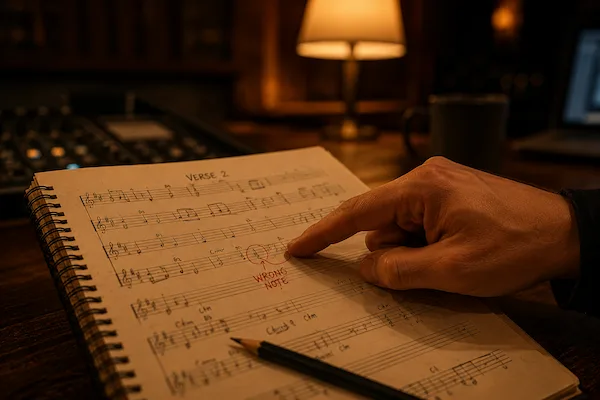 After evaluating a growing number of AI-generated songs, one pattern has become impossible to ignore: the problem clients notice first is rarely the one that has the greatest influence on how believable the vocal actually feels. People usually arrive with a specific concern—perhaps a strange pronunciation or a phrase that sounds robotic. Those details certainly matter, but they often distract attention from broader performance patterns that have been affecting the entire vocal from the beginning.
Pronunciation is probably the issue clients mention most often. Clients frequently ask whether a few awkward words can be corrected because those moments immediately stand out during playback. Yet after listening to the complete performance, the pronunciation itself often proves to be only a symptom. The larger issue is that the singer delivers nearly every sentence with the same emotional attitude. Once that repetitive behavior becomes apparent, correcting individual words changes surprisingly little because the vocal still lacks convincing expression from one phrase to the next.
In many cases, creators spend hours revisiting isolated words because those moments are easy to hear. After listening through the complete song, however, we often discover that the perceived vocal problem disappears once a broader performance pattern is addressed. The individual word was never the primary issue—it was simply the easiest symptom to notice.
Another recurring observation involves phrase length. Many AI vocals sound remarkably convincing during short lines. The illusion holds together for a sentence or two before gradually becoming less natural as longer phrases develop. Instead of flowing naturally, the performance begins to feel calculated. Listeners may never identify the exact moment this happens, but they instinctively sense that the singer has stopped reacting to the music and started repeating learned patterns. The transition is subtle, yet it consistently changes how the performance is perceived.
The chorus often exposes these behaviors even more clearly than the verses. During quieter sections, limited vocal variation may remain relatively unnoticed because fewer emotional demands are placed on the performance. Once the chorus arrives, expectations change. Listeners naturally anticipate greater intensity, stronger commitment, or a shift in emotional perspective. AI vocals frequently respond with nearly the same delivery used throughout the rest of the song. Nothing sounds obviously broken, yet the emotional peak never truly arrives. The performance remains stable when it should evolve.
We've also observed that improving one weakness often reveals another that had previously gone unnoticed. A client may focus entirely on awkward pronunciation because it dominates the first listening session. Once that issue becomes less distracting, attention shifts toward repetitive phrasing. After the phrasing feels more convincing, limited emotional development suddenly becomes obvious. This progression surprises many creators, but it reflects how people actually experience performances. Our ears naturally move toward the next most noticeable inconsistency as previous distractions disappear.
Perhaps the most important lesson is that similar symptoms do not always originate from the same underlying behavior. Two AI vocals can both sound "robotic" for completely different reasons. One may struggle because every phrase carries identical emotional weight. Another may feel artificial because words fail to connect naturally into complete thoughts. A third may simply lack the subtle variation that makes a singer feel present inside the story being told. The surface description remains the same, but the musical behavior underneath is entirely different.
That is why isolated fixes rarely produce consistently believable results. The strongest repair decisions begin by recognizing recurring behavioral patterns instead of reacting to whichever moment feels most distracting during the first playback. Across the AI-generated songs submitted to our studio, this pattern appears again and again: once the underlying behavior is correctly identified, individual vocal problems become far easier to understand because they are no longer viewed as unrelated defects. They become connected parts of the same performance, and that shift in perspective leads to far more predictable decisions than chasing one symptom after another.
Knowing When Repair Stops Helping And Regeneration Becomes The Better Choice
Not every AI vocal is waiting to be improved. Some simply don't contain enough musical information to become convincing, no matter how carefully they're refined. Recognizing that point can save hours of unnecessary work. One of the most valuable decisions isn't choosing what to improve—it's recognizing when improvement has reached its practical limit.
The first question isn't whether the vocal sounds artificial. Almost every AI-generated vocal does to some degree. The more useful question is whether a believable performance already exists beneath those imperfections. If the phrasing carries natural direction, the words connect logically, and the emotional flow feels reasonably coherent, there is usually something worth preserving. Those performances often respond well because the musical foundation is already present, even if it isn't fully convincing yet.
The situation changes when essential performance information never existed in the first place. Sometimes the vocal doesn't simply deliver the wrong emotion—it doesn't establish one at all. Important words receive the same emphasis as unimportant ones. Longer phrases never develop naturally. Emotional transitions remain flat from beginning to end. At that stage, the issue isn't hidden beneath the surface waiting to be revealed. The performance lacks material that can be strengthened because the underlying musical intent was never established.
This distinction separates refinement from replacement. Refinement builds on existing strengths. It helps listeners notice qualities that are already present but not fully communicated. Replacement becomes the better choice when those qualities never existed to begin with. Continuing to polish an incomplete performance rarely changes how people experience it because the core behavior remains exactly the same.
We occasionally receive projects where nearly every visible issue has already been addressed before the files arrive. Pronunciation has been revisited. Individual phrases have been adjusted. Countless small revisions have been made over several days. Yet the vocal still feels strangely detached. Listening from start to finish usually reveals why. Every revision improved isolated moments, but none of them changed the overall behavior of the performance. The singer still reacts to the song with the same limited emotional range, making the entire vocal feel static despite extensive work.
In many cases, fewer edits would actually have produced a stronger result. The vocal wasn't suffering from a lack of processing—it was suffering from the wrong repair priorities.
Knowing when to stop is often more productive than making another round of corrections. Endless polishing creates the illusion of progress because each revision changes something. The problem is that visible change isn't always meaningful improvement. Once the remaining limitations originate in the generated performance itself rather than in how it is presented, additional refinement produces steadily smaller returns while consuming more time and attention.
That is why we evaluate AI vocals as complete performances instead of isolated moments. Rather than asking whether another adjustment is possible, we ask a different question: does the vocal already contain enough believable musical behavior to justify further refinement? If the answer is yes, improvement usually follows a clear direction. If the answer is no, replacing part of the performance often produces a stronger result than extending a repair process that has already reached its natural limit.
This broader decision-making process applies well beyond vocals. Our guide on fixing AI-generated music explains how similar evaluation principles help identify which problems deserve repair, which require replacement, and how those priorities fit into a complete AI music repair strategy before additional time is invested.
Why Listeners Accept Slight Imperfections But Reject Artificial Behavior
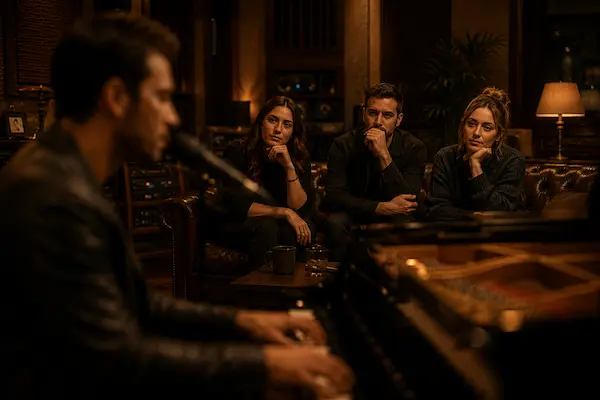 People don't expect singers to sound perfect. In fact, many of the performances that stay with us for years contain tiny imperfections. A phrase arrives slightly ahead of expectation. One word carries a little more emotion than the next. A note isn't held for exactly the same length as it was during the previous chorus. These details rarely weaken the performance. More often, they make it feel alive.
Artificial behavior creates a very different reaction. Listeners are surprisingly tolerant of small mistakes because they associate them with human performance. What they struggle to accept is consistency that feels too calculated. When every phrase follows the same emotional curve, every sentence ends with the same confidence, and every line seems equally important, the voice begins to lose its human identity. Nothing sounds obviously wrong, yet something never feels completely believable.
This difference explains why technically accurate AI vocals can still leave people emotionally disconnected. Human communication has never been perfectly uniform. Conversation changes naturally depending on the situation, and singing follows exactly the same principle. A singer doesn't react to every lyric with identical commitment. Certain words deserve more weight. Others are intentionally understated. Those constant adjustments make listeners feel that someone is responding to the story rather than simply reciting it.
Our brains are remarkably good at recognizing those patterns without conscious effort. Most people cannot explain why one vocal feels authentic while another feels synthetic, but they make that decision within seconds. Instead of analyzing isolated notes, they evaluate continuity. Does the emotional direction develop naturally? Does the performance seem connected from one phrase to the next? Does the singer appear to understand what each line is trying to communicate? Those questions are answered instinctively long before listeners begin judging technical quality.
This is why small imperfections often strengthen credibility instead of reducing it. They suggest that the performance is unfolding naturally rather than being generated from a fixed template. A slightly restrained phrase before an emotional chorus can feel more convincing than absolute consistency throughout the entire song. A brief hesitation before an important lyric can communicate vulnerability far more effectively than flawless repetition. These subtle moments are difficult to measure, yet they strongly influence whether listeners trust the voice they are hearing.
Believable singing depends less on technical precision than on emotional continuity. Listeners want to follow a performer whose delivery evolves with the meaning of the song. They are willing to forgive minor irregularities because those irregularities resemble real human behavior. What they rarely forgive is a performance that feels emotionally static from beginning to end. Once the vocal stops behaving like a person making choices in real time, no amount of technical polish can fully restore the sense that someone is genuinely behind the words.
Convincing AI Vocals Begin With Understanding Why They Feel Artificial
People often search for ways to make AI vocals sound more realistic, yet the more useful question comes earlier: why does the performance feel artificial in the first place? Until that answer becomes clear, every correction is little more than an educated guess. Once the underlying behavior has been identified, however, repair decisions become far more consistent because they are guided by the performance itself rather than by the latest symptom.
Vocal realism is rarely created by one dramatic improvement. It emerges when pronunciation, phrasing, emotional direction, and musical intention all reinforce one another instead of competing for attention. Listeners don't consciously evaluate each of those elements. They simply decide whether they believe the singer. That judgment depends far more on natural musical behavior than on technical perfection.
Every successful evaluation begins with realistic expectations. AI vocals do not all fail for the same reason, and they should not all be approached the same way. Some already contain enough believable expression to justify careful refinement. Others reveal deeper limitations that no amount of additional polishing can overcome. Recognizing that difference transforms repair from trial and error into a predictable process built on diagnosis rather than assumption.
Realistic AI Vocals Come From Better Musical Behavior Rather Than Cleaner Audio
The goal isn't simply to improve the recording. It's to remove the moments that constantly remind listeners they're hearing a generated performance. It's to reach the point where they stop questioning the voice altogether. That shift rarely happens because every surface detail has been refined. It happens because the performance begins behaving like something created by a real singer rather than generated by an algorithm.
One pattern appears in nearly every convincing AI vocal we've evaluated. The performance succeeds because its musical behavior stays believable from beginning to end—not because every technical detail is perfect.
The opposite approach is surprisingly common. A creator notices the first unusual phrase, corrects it, then moves to the next one, and then another. Hours later, dozens of individual moments may have changed, yet the vocal still feels strangely synthetic. The reason is simple: isolated improvements rarely solve a performance-wide behavior. Without understanding which limitation influences the rest of the vocal, priorities become scattered and every new revision risks solving the wrong problem.
Everything changes once the real limitation becomes obvious. Decisions become simpler because every adjustment now serves the same purpose instead of solving isolated symptoms. Instead of asking, "What should be fixed next?" the question becomes, "What behavior is preventing this vocal from feeling believable?" Once that answer is clear, repair decisions become far more predictable because they support a single objective instead of reacting to isolated symptoms. The result is usually a stronger performance with fewer unnecessary revisions.
Every AI vocal carries its own strengths and limitations. Some already contain enough human expression to become convincing with thoughtful refinement. Others reveal deeper performance issues that cannot be hidden by making the recording cleaner. Recognizing that distinction is often the difference between endless experimentation and meaningful progress.
That broader perspective is exactly why successful AI vocal repair begins with evaluation rather than correction. Our guide on fixing AI-generated music expands this approach beyond vocals, showing how identifying the dominant limitation first helps establish the right repair priorities across the entire project. Once the real problem has a name, every decision that follows becomes clearer—and far more likely to produce a vocal that listeners simply accept as part of the music.
A Better AI Vocal Starts With The Right Diagnosis—Not More Guesswork
Many AI vocals continue to sound artificial because creators keep refining symptoms instead of identifying the limitation that shapes the entire performance. Before investing more time in revisions, determine whether the vocal has enough natural behavior to improve—or whether a different repair direction will produce a stronger result.
Clear diagnosis. Realistic expectations. Professional decisions before unnecessary revisions.
Frequently Asked Questions About Fixing AI Vocals
Why do AI vocals sound convincing in short clips but artificial during a full song?
Short excerpts rarely give listeners enough time to notice recurring vocal behavior. Across an entire performance, repeated phrasing patterns, identical emotional intensity, and predictable articulation become much easier to recognize. The longer the vocal continues without meaningful variation, the more artificial it tends to feel.
Can a perfectly in-tune AI vocal still sound unrealistic?
Yes. Accurate pitch alone does not create a believable performance. Listeners respond to phrasing, emotional direction, pronunciation, and the natural flow between ideas. A technically accurate vocal can still feel synthetic if those musical behaviors remain too uniform.
Why do certain words sound unnatural even when the lyrics are correct?
AI systems often understand the words themselves but struggle with how people naturally emphasize them in context. Slightly unusual stress, extended vowels, or overly consistent articulation can make otherwise correct lyrics sound unfamiliar to native listeners.
Do realistic breathing patterns really influence how believable AI vocals feel?
Very much so. Human breathing naturally follows emotion, phrasing, and physical effort. When breaths appear at predictable intervals or feel disconnected from the performance, listeners may not consciously notice them, but the vocal often becomes less convincing overall.
Can every AI-generated vocal be repaired successfully?
Not always. Some performances already contain enough natural musical behavior to justify refinement, while others lack essential expressive information from the start. Understanding that difference early prevents creators from spending hours improving a performance that simply doesn't contain enough musical information to become convincing.
Why do choruses reveal artificial vocals more easily than verses?
A chorus usually asks for greater emotional commitment and stronger musical development. If the vocal responds with the same level of expression used throughout the verse, the contrast becomes obvious. The performance may remain technically stable while feeling emotionally unchanged.
How can you tell whether the vocal is actually the main problem?
A useful approach is to evaluate the complete performance rather than isolated phrases. If the same unnatural behavior appears throughout different sections of the song, the vocal itself is likely responsible. If the issue changes depending on the musical context, another element may be influencing how the vocal is perceived.
When is it more practical to replace part of an AI vocal instead of continuing to improve it?
If repeated revisions no longer make the performance feel more believable, the limitation may exist within the generated vocal itself rather than in its presentation. At that point, replacing part of the performance often produces a stronger result than continuing to refine the same material.