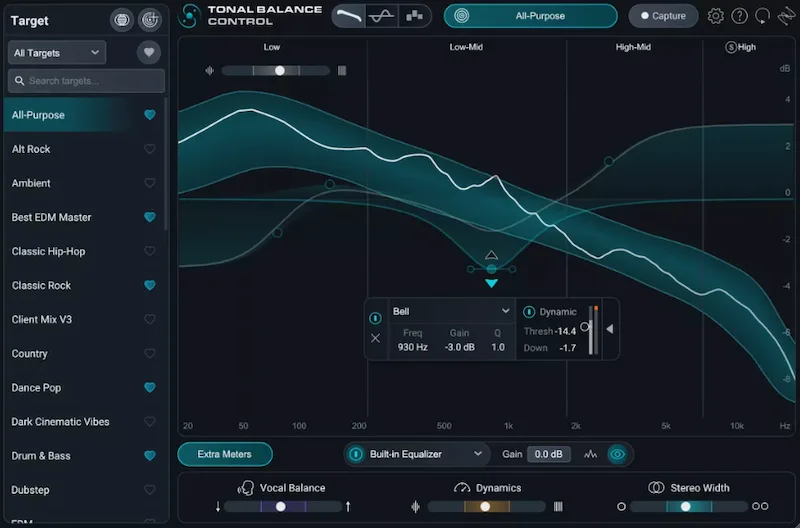
iZotope has released Tonal Balance Control 3, a major update to its mix analysis and referencing tool. Unlike previous versions that focused mainly on frequency balance, the new release targets a more critical problem: how your mix translates after streaming processing.
The key addition is a standalone desktop application that allows you to capture reference tracks directly from platforms like Spotify, YouTube, and Apple Music. This means you’re no longer comparing your mix to pristine source files — you’re analyzing the actual encoded signal that listeners hear.
This shift is fundamental. Modern streaming platforms apply loudness normalization, compression, and codec processing, which significantly alters tonal balance and dynamics. A mix that sounds correct in the studio can fall apart once uploaded. Tonal Balance Control 3 helps identify these issues before release.
What’s new compared to Tonal Balance Control 2
The previous version functioned primarily as a visual analyzer. Version 3 expands this into a more actionable tool:
- Streaming reference capture from real platforms
- New metering: vocal balance, dynamics, stereo width
- Built-in hybrid EQ for immediate corrections
- Expanded target library based on real commercial tracks
- Target Blender for combining multiple tonal profiles
This turns the plugin into a decision-support system rather than just a passive visual guide.
Leveled View — remove loudness bias
One of the biggest issues in referencing is loudness bias: louder tracks seem better. The new Leveled View compensates for this and provides a more objective comparison of tonal balance.
This is especially important for streaming, where loudness normalization is standard across platforms.
Advanced metering: beyond frequency balance
Tonal Balance Control 3 introduces three new meters that provide deeper insight:
- Vocal Balance — evaluates vocal presence relative to the mix
- Dynamics — analyzes compression and transient behavior
- Stereo Width — measures spatial distribution
These tools help detect issues that are often missed in untreated rooms or on consumer playback systems.
Target Library and Target Blender
The updated target library includes genre-specific profiles derived from real-world productions. These are not arbitrary presets but statistically averaged tonal signatures.
Target Blender allows you to merge multiple profiles, which is especially useful for hybrid genres and modern production styles that don’t fit into a single category.
Built-in EQ — faster workflow
The addition of a built-in EQ allows immediate corrections without switching between plugins. This speeds up workflow significantly, especially during final mix adjustments.
However, it should be treated as a quick correction tool rather than a replacement for a full mastering chain.
Integration with Ozone and Neutron
When used alongside Ozone and Neutron, Tonal Balance Control 3 becomes a central control hub. You can directly adjust EQ settings in those plugins based on target curves and analysis data.
This improves efficiency but also increases the risk of over-processing if used blindly.
Real-world use cases
- Final mix validation before mastering
- Matching tonal balance to commercial releases
- Ensuring translation across streaming platforms
- Maintaining consistency across albums and EPs
- Diagnosing mix issues quickly
It’s important to understand: this tool does not fix your mix — it highlights where decisions need to be made.
Common mistakes when using Tonal Balance Control
- Blindly matching target curves
- Ignoring arrangement and genre context
- Over-relying on visual feedback
- Forcing the mix into a predefined shape
A professional mix is not defined by a curve — it’s defined by how it translates and serves the track.
Why streaming changes everything
Streaming platforms apply normalization and lossy encoding, which affect transients, low-end clarity, and stereo perception.
If your mix isn’t optimized for these conditions, it will lose impact and definition.
Tonal Balance Control 3 allows you to anticipate these changes and adjust your mix accordingly.
If you need a release-ready result without guesswork, you can order professional mixing and mastering here: online mixing and mastering.
Compatibility and pricing
Available for Windows 10+ and macOS 14.7+. Supported formats: VST3, AU, AAX.
Price: €139. Upgrade options are available.