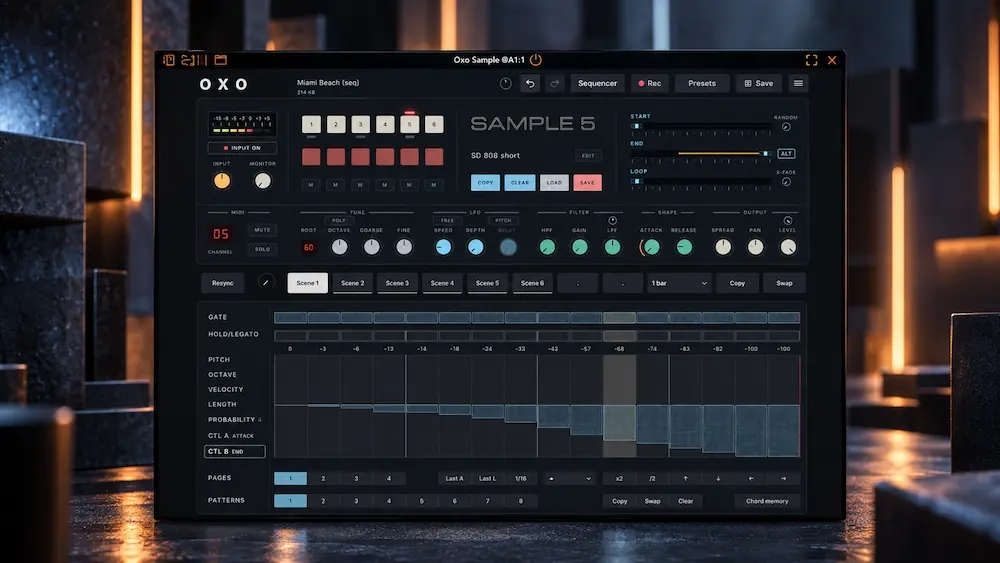
MEY Audio Engineering has announced three audio software products: ROB, a virtual analog polysynth; PLAY, a sampler for legacy Akai and Kurzweil libraries; and Sonata, a MIDI expression tool for orchestral instruments. The announcement covers two previously released products alongside the new Sonata, which handles MIDI expression and performance control for virtual orchestral instruments.
MEY ROB: A 16-Voice Virtual Analog Synthesizer
ROB features 16 voices, each with four oscillators and its own modeled analog-style voice card. Each card has slightly different tuning, filter cutoff, resonance, envelope speed, and pulse width. Notes rotate between the cards, introducing subtle variations in tone and response when the same note is played repeatedly.
The oscillators offer saw, triangle, pulse, sine, white and pink noise, and wavetable waveforms. A 4 x 4 routing matrix handles oscillator sync, FM, and cross-modulation. The filter section combines a transistor ladder low-pass filter with high-pass, band-pass, and notch modes.
Modulation options include four envelopes, four LFOs, 17 modulation sources, and a 32-slot modulation matrix. ROB also features an eight-track sequencer, an arpeggiator, built-in effects, and text-based sound generation. Its factory library contains 272 presets organized into 17 banks.
MEY PLAY: Access to Legacy Akai and Kurzweil Libraries
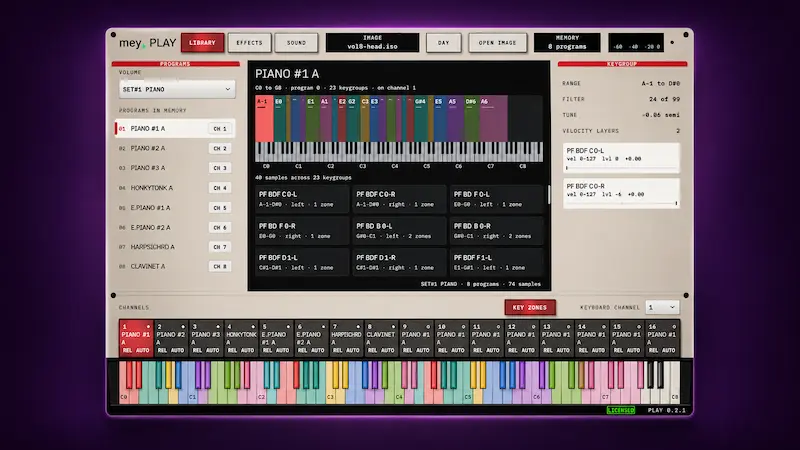
MEY PLAY is designed to work with older sampler formats. It supports Akai S1000/S1100 and Kurzweil K2000/K2500 disk images and program files, along with SoundFont 2 files. Programs and samples are loaded into memory and played through MEY PLAY’s own 64-voice engine.
Rather than emulating the original hardware, PLAY reads the supported file formats and uses its own playback engine. It also incorporates selected processing features from ROB, including a ladder filter, envelopes, two delays, and reverb.
PLAY supports 16 MIDI channels and provides ten audio outputs: a stereo output and eight individual outputs. One practical limitation is that physical floppy disks must first be converted into disk image files before they can be opened in PLAY.
Sonata: MIDI Expression for Orchestral Instruments
Sonata is designed to simplify expressive MIDI programming for strings, woodwinds, and brass. Its main feature is a single controller wheel that can adjust two MIDI parameters at once, each with its own response curve.
By default, Sonata controls MIDI CC11 (Expression) and CC1 (Modulation), but users can assign different controllers. Its note-aware engine analyzes incoming MIDI data, including note onsets, velocity, and legato transitions, to shape expression and vibrato. This is intended to make sustained passages and dynamic changes sound less mechanical.
Sonata also includes a Performer function for processing MIDI files and shaping orchestral phrases. It works with existing virtual instruments and sample libraries; it does not include its own sounds.
Pricing and Availability
All three products are available for Windows and macOS. ROB and PLAY support VST3 on Windows and VST3 and AU on macOS, with standalone versions also available. Sonata is offered as a VST3 plugin and standalone application.
- MEY ROB: €24.95, with a seven-day free trial.
- MEY PLAY: €25 introductory price (regularly €49.50), with a seven-day free trial.
- Sonata: €10, with a one-day free trial.
All three products use perpetual licenses rather than subscriptions. Purchase options and further product details are available from MEY Audio Engineering.
ROB is aimed at synthesizer users and sound designers, while PLAY provides access to legacy sampler libraries through a modern software engine. Sonata serves a different purpose, giving composers and producers more control over orchestral MIDI expression. The three tools address distinct needs, from sound design and sample playback to performance shaping.