
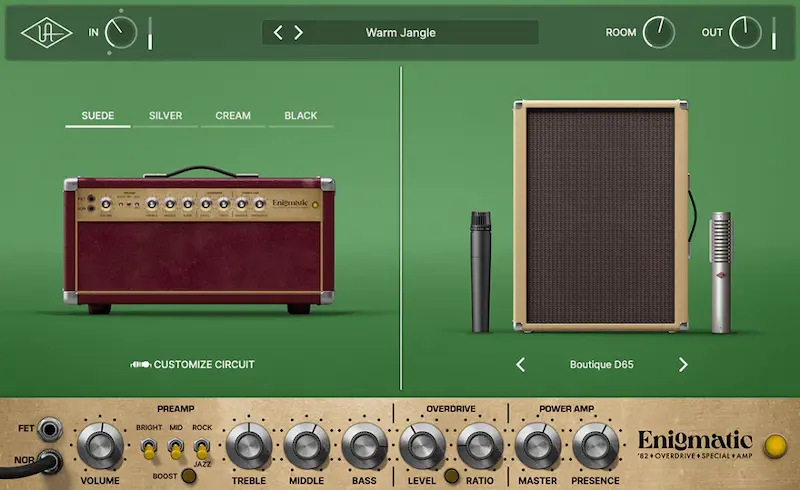
UAD Enigmatic ’82 Overdrive Special Amp plugin released — focused Dumble modeling goes native
Key takeaway: a Dumble-style amp plugin focused on signal behavior, not model count or flexibility.
Universal Audio has released the UAD Enigmatic ’82 Overdrive Special Amp plugin, bringing Dumble-style circuit modeling to native DAW environments. Available from May 1, 2026, the plugin runs on CPU (VST3, AU, AAX) with no DSP requirement.
UAD Enigmatic ’82 Overdrive Special Amp is not a multi-amp suite. It models a narrow range of Dumble-type behaviors — midrange emphasis, soft clipping, and input-dependent compression — with adjustable circuit parameters rather than discrete amp models.
Updated May 2, 2026: initial release details confirmed by Universal Audio.
What’s new in the UAD Enigmatic ’82 Overdrive Special Amp plugin
UAD Enigmatic ’82 Overdrive Special Amp plugin avoids the typical multi-amp approach. It centers on component-level modeling, where gain stages, saturation, and compression shift with input level rather than switching between static models.
- Dumble-type circuit ranges — variation in gain structure, not separate amp models
- HRM (Hot Rubber Monkey) stage — post-overdrive EQ shaping inside the circuit
- Power amp / tone stack interaction — affects transient response and low-end behavior
- Fixed cab/mic setups — mix-ready but not deeply editable
- Preset library — starting points, not final tones
Key difference: the plugin models signal behavior under load, not just tone. Output depends on input dynamics, not preset selection.
Release focus: single-circuit modeling instead of multi-amp expansion.
Dumble-style processing becomes relevant at the mastering stage, where midrange stability and saturation control directly affect translation. See how this is handled in real workflows: professional mastering services.
Why this release matters in the current amp sim market
The amp sim market is saturated with flexible, multi-model platforms optimized for speed and coverage. Neural DSP and Line 6 dominate that space with broad feature sets and fast recall. UAD Enigmatic ’82 Overdrive Special Amp moves in the opposite direction — limiting scope to control how the signal behaves under real mix conditions.
This is less about tone selection and more about predictable translation. By constraining the model to a single circuit family, the plugin prioritizes midrange stability, controlled saturation, and consistent response under level changes — factors that directly impact how guitars sit in dense productions.
How it impacts mixing and mastering workflows
 In practice, the UAD Enigmatic ’82 Overdrive Special Amp plugin front-loads spectral shaping and compression, reducing the need for corrective processing later in the chain. The midrange is centered roughly in the 700 Hz–1.5 kHz range, which keeps guitars present without competing directly with vocals or upper-mid instruments.
From a mastering perspective, this changes how the signal behaves under limiting and normalization:
- less corrective EQ — fewer resonances and midrange conflicts
- more predictable loudness response — stable behavior under LUFS normalization
- reduced distortion artifacts — smoother saturation translates better after limiting
Limitations and trade-offs
UAD Enigmatic ’82 Overdrive Special Amp is deliberately constrained. It does not extend into modern high-gain territory — low-end control is loose under heavy drive, and transient attack lacks the definition required for tight rhythm work in metal or djent.
The cab section is functional but closed. The included setups are mix-ready, but there’s no deep mic positioning or IR-level control. In professional workflows, external impulse responses will still be the preferred option.
Net effect: strong behavior within a narrow operating range, limited adaptability outside it. That’s a design decision, not a missing feature set.
Positioning against competing plugins
Against Neural DSP, UAD Enigmatic ’82 Overdrive Special Amp trades speed for behavior. Neural DSP delivers immediate, genre-ready tones; UAD prioritizes input-dependent response and midrange control. One is faster to deploy, the other is more predictable under mix pressure.
Against Line 6 Helix Native, UAD gives up routing and model breadth. Helix remains the better choice for complex chains and multi-amp setups. UAD is effectively a single-circuit tool with adjustable parameters.
Against IK Multimedia AmpliTube, the difference is consistency versus coverage. AmpliTube offers scale; UAD focuses on a narrower, more controlled behavior profile.
Positioning: this is a specialist plugin for engineers who want a specific response curve and dynamic behavior. It is not designed to replace full amp ecosystems.
Pricing and availability
UAD Enigmatic ’82 Overdrive Special Amp plugin is available now at an introductory price of $49, with a standard price set at $99. It is also included in the UAD Spark subscription.
Deployment: native (no DSP required), with support for Windows 10+ and macOS 11+. Formats include VST3, AU, and AAX.
Positioning: the pricing undercuts most boutique-focused amp sims, indicating a push toward wider adoption rather than premium exclusivity.
Verdict
UAD Enigmatic ’82 Overdrive Special Amp is a constrained design in a category built around flexibility. It doesn’t aim to replace multi-amp platforms — it aims to control how a guitar signal behaves in a mix.
Within that scope, it performs: stable midrange, predictable saturation, and consistent response under level changes. That makes it useful for DI workflows where translation matters more than tonal range.
Outside that scope, it drops off. It’s not fast, not flexible, and not suited for modern high-gain production.
Verdict: a specialist tool for engineers who care about signal behavior over feature count. If that’s the requirement, it holds up. If not, it’s the wrong tool.
In practical terms, tools like this only make sense when the upstream signal is already under control — see how professional mastering actually works in real-world workflows.
Final-stage processing exposes weaknesses in the source signal — especially under limiting and normalization. This is where controlled input behavior becomes critical in real mastering workflows.

FAQ
What is the UAD Enigmatic ’82 Overdrive Special Amp plugin used for?
UAD Enigmatic ’82 Overdrive Special Amp plugin is a native amp sim designed to model Dumble-style circuit behavior. It focuses on dynamic response, midrange shaping, and input-dependent saturation rather than offering multiple amp types.
Does the UAD Enigmatic ’82 plugin require DSP hardware?
No. The plugin runs in UAD Native format and operates entirely on CPU without requiring Apollo or other DSP systems.
Is the UAD Enigmatic ’82 Overdrive Special Amp suitable for modern metal?
No. The plugin is not designed for high-gain applications. It lacks the low-end tightness and transient attack required for metal or djent production.
How does it compare to Neural DSP or Helix Native?
Compared to Neural DSP, it is slower to dial in but offers more controlled signal behavior. Compared to Helix Native, it lacks routing flexibility and model variety. It is designed as a specialist tool, not a replacement.
Can it be used in professional mixing and mastering workflows?
Yes, within its scope. The plugin is useful for shaping DI guitar signals that translate predictably in a mix and require less corrective processing at the mastering stage.