Oeksound Soothe3 Review: Better Than Soothe2 for Mixing and Mastering?
Last updated: May 2026
Oeksound’s Soothe3 enters a market that no longer treats spectral suppression as a niche corrective process. What started as a surgical solution for harsh vocals and unstable upper mids has become embedded in mainstream mixing workflows across pop, EDM, metal, cinematic production and mastering. The result is easy to recognize: cleaner balances, fewer resonances — and increasingly flattened tonal behavior.
Soothe2 helped define that sound. It also exposed the downside of aggressive adaptive suppression. Push it too hard and mixes begin to lose edge definition, transient contrast and harmonic tension. Vocals sit flatter. Cymbals lose movement. Guitars become smoother but smaller. The processing works technically while slowly stripping away the instability that makes a mix feel alive.
That is the real context behind Soothe3.
This release is less about adding features and more about correcting the limitations of modern spectral processing itself. Oeksound is introducing redesigned suppression algorithms, a new adaptive Soft mode, low-latency operation for tracking workflows, expanded multichannel support and deeper control over frequency-dependent response behavior. More importantly, the plugin appears engineered to reduce the audible “Soothe fingerprint” that became increasingly common in professional sessions over the last several years.
The core question is no longer whether Soothe3 can remove harshness. Most high-end resonance suppressors already can. The real question is whether it can control spectral buildup without collapsing depth, motion and transient realism in the process.
- Why Resonance Suppression Became a Core Part of Modern Mixing
- What Actually Changed in Soothe3
- Soothe3 vs Soothe2
- Low Latency Mode and Real-Time Workflow
- The New Detail Control
- Advanced Controls and Immersive Mixing
- Where Soothe3 Still Becomes Dangerous
- Soothe3 vs Dynamic EQ
- CPU Usage and Playback Translation
- Who Soothe3 Is Actually Built For
- Real-World Studio Perspective
- Verdict
- FAQ
Why Resonance Suppression Became a Core Part of Modern Mixing
 Modern mixes generate far more spectral instability than most engineers were dealing with even ten years ago. Productions are denser, brighter and more compressed at every stage of the chain. Layered synthesizers, hyper-detailed sample libraries, aggressive saturation, clipped drum buses, bright condenser microphones and loudness-first production workflows all compete for the same upper-midrange space.
The result is not simply “harshness.” It is dynamic resonance buildup that changes moment to moment depending on arrangement density, transient activity and playback level.
Traditional EQ was never designed to solve that kind of problem efficiently. Static cuts work when a resonance remains relatively stable. Modern productions rarely behave that way. A vocal can shift from controlled to abrasive within a single phrase. Distorted guitars generate moving upper harmonics that change with articulation. Cymbals and synth stacks create broadband buildup that reacts differently once saturation and limiting enter the chain.
That production environment is exactly why spectral suppressors became standard workflow tools instead of niche corrective processors.
Playback translation made the problem worse. Earbuds exaggerate narrow upper-mid spikes. Phone speakers collapse dense arrangements into aggressive midrange energy. Many of the same issues appear later during mastering when engineers attempt to fix harsh highs in a master that were already baked into the mix structure itself.
Soothe2 gained traction because it addressed those issues faster than manual automation or multi-band dynamic EQ workflows. Engineers could insert a single plugin and dynamically control resonant buildup across vocals, guitars, synths or full buses without chasing individual frequencies across an entire session.
But the industry eventually hit the downside of that convenience.
As spectral suppression became normalized, mixes started carrying the same polished-but-flattened tonal signature. Upper mids became smoother while transient contrast became weaker. Vocal edges softened. Cymbals lost movement. Dense productions felt cleaner but less physical. In many cases, resonance suppression stopped functioning as corrective processing and became part of the aesthetic itself.
Soothe3 enters the market directly against that criticism. The new processing architecture appears focused less on removing more harshness and more on reducing the audible side effects that earlier spectral suppression workflows introduced into modern mixing and mastering.
What Actually Changed in Soothe3
The most important change in Soothe3 is not the redesigned interface or the expanded workflow controls. It is the shift in how the plugin handles suppression behavior internally.
Soothe2 was extremely effective at controlling harshness, but its processing often became identifiable under heavier settings. Push the depth too far and the plugin could start flattening transient movement, softening articulation and creating the “over-stabilized” tone that became common across modern vocal and mix bus chains.
Soothe3 appears designed specifically to reduce those side effects.
The problem is that modern spectral suppression often removes movement along with harshness.
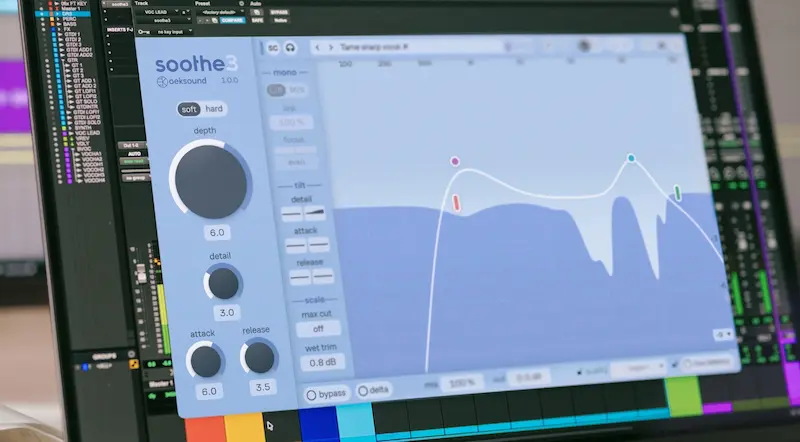
The biggest architectural change is the introduction of two separate processing behaviors: Soft and Hard mode.
Soft mode uses adaptive thresholding instead of relying on a more static suppression response. In practice, that means the plugin reacts differently depending on incoming dynamics, transient density and spectral movement rather than applying the same suppression intensity across every moment of the signal.
That matters because older spectral suppressors often generate two recognizable problems during complex material:
- microdynamic collapse during louder passages;
- tonal “breathing” when arrangements become sparse or exposed.
Adaptive threshold behavior can potentially reduce both issues by scaling suppression more proportionally to the source instead of forcing the signal into a constantly controlled spectral profile.
In real-world mixing sessions, Soft mode is likely to matter most on sources where transient realism and harmonic movement are critical:
- lead vocals with unstable upper mids;
- acoustic guitars and piano;
- live drum overheads;
- orchestral layering;
- mix bus processing;
- parallel ambience chains.
The difference is subtle but important. Instead of aggressively “correcting” resonance, Soft mode appears aimed at preserving motion while reducing buildup.
Hard mode, by comparison, stays much closer to the original Soothe2 philosophy. The suppression response behaves more consistently with a fixed-threshold structure that delivers tighter and more predictable control under aggressive settings.
That makes Hard mode more appropriate for:
- modern pop vocals;
- distorted guitars;
- EDM synth stacks;
- spectral sidechain ducking;
- heavily compressed productions;
- problematic recordings requiring assertive correction.
The distinction matters because many engineers were never using Soothe2 as a transparent corrective processor in the first place. They were using it almost like a spectral compressor — shaping density, smoothing transients and controlling perceived aggression inside already-limited mixes.
Soothe3 does not abandon that workflow. Instead, it separates transparent resonance management from intentional spectral control more clearly than the previous version did.
Soothe3 vs Soothe2: What Actually Improved?
For existing users, the biggest question is not whether Soothe3 adds more features. It is whether the new version solves the sonic and workflow limitations that became increasingly obvious in Soothe2 during heavy real-world use.
| Feature | Soothe2 | Soothe3 |
|---|---|---|
| Core suppression behavior | Fixed-threshold adaptive suppression | Adaptive Soft mode + fixed Hard mode |
| Transparency under heavy processing | Can become audible during aggressive suppression | Improved transient preservation and less obvious spectral flattening |
| Latency performance | Primarily mixing and post-production use | Low Latency mode suitable for tracking and monitoring |
| Workflow speed | More parameter interaction and manual fine-tuning | Simplified Detail control and faster macro adjustment |
| Multichannel support | Limited immersive workflow integration | Full support up to 9.1.6 immersive configurations |
| Frequency-dependent control | More globally uniform suppression behavior | Tilt-based frequency-dependent timing and detail scaling |
| Best use case | Aggressive resonance reduction and spectral smoothing | More transparent stabilization across modern production workflows |
Soothe3 does not completely replace the sound or behavior of Soothe2. Instead, it appears designed to separate transparent resonance management from intentionally aggressive spectral control. For engineers already relying heavily on adaptive suppression, that distinction may be the most important upgrade in the entire release.
- Formats: VST3, AU, AAX
- Platforms: macOS and Windows
- Immersive Support: up to 9.1.6 channel configurations
- Low Latency Mode: zero samples at base sample rates, approximately 1 ms at higher sample rates
- Primary Workflows: mixing, mastering, vocal production, immersive audio, tracking
Low Latency Mode Expands Soothe3 Beyond Traditional Mixing Workflows
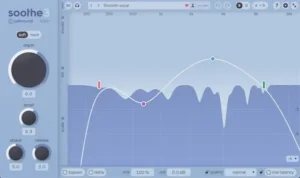 One of the most significant changes in Soothe3 is not tonal — it is operational. The new Low Latency mode pushes the plugin into workflows where spectral suppression was previously impractical.
That matters because most adaptive resonance processors are inherently slow by design. Spectral analysis depends on FFT-based processing, overlapping windows and predictive lookahead. The deeper the analysis, the more latency the plugin typically introduces.
That tradeoff kept most resonance suppressors confined to post-production tasks:
- mix cleanup;
- master bus correction;
- vocal polishing;
- offline mastering adjustments.
Soothe3 changes that equation by operating at zero samples of latency at standard sample rates and roughly 1 ms at higher rates while running in Low Latency mode.
In practical terms, this makes the plugin viable inside real-time environments where Soothe2 was often too cumbersome to deploy comfortably.
That includes:
- live vocal monitoring;
- real-time instrument tracking;
- broadcast dialogue chains;
- streaming and content creation rigs;
- live playback systems;
- hybrid production setups with hardware monitoring.
The impact is larger than simple convenience. Monitoring directly affects performance decisions. Vocalists react differently when aggressive upper mids are hitting the headphone mix. Guitarists change articulation when harmonic spikes become exaggerated through close monitoring. Reducing resonance buildup before the performer compensates for it can improve consistency long before the mixing stage begins.
There is also a broader industry angle here. Modern production workflows increasingly blur the line between tracking, mixing and live processing. Engineers now expect mastering-grade tools to function in low-latency environments without destroying session responsiveness.
Still, the technical compromise should not be ignored.
Low-latency spectral processing never comes entirely free. Reduced analysis windows typically mean less temporal depth and lower frequency resolution. The plugin may react faster, but potentially with less precision during dense transient material or broadband suppression tasks.
The real benchmark for Soothe3 will not be whether it achieves low latency. It already does. The more important question is whether the reduced-latency architecture preserves enough transparency and stability under aggressive settings to remain trustworthy in professional tracking and mixing sessions.
The New Detail Control Fixes One of Soothe2’s Biggest Workflow Problems
One of the less discussed weaknesses of Soothe2 was not the sound of the plugin itself, but the way its control structure encouraged inconsistent decisions under real production conditions.
The interaction between Sharpness and Selectivity could become unintuitive quickly, especially during dense sessions where engineers were making fast corrective moves across multiple sources. Small parameter changes often altered suppression behavior more dramatically than expected, particularly when transient-heavy material entered the detector.
That created a common workflow problem: engineers would dial in settings that sounded impressive in solo mode but translated unpredictably once the full arrangement returned.
Soothe3 replaces that relationship with a consolidated Detail control.
At first glance, this looks like a simple usability refinement. In practice, it reflects a larger shift happening across high-end plugin development: reducing parameter friction without stripping away processing depth.
The issue with many advanced spectral processors is not capability. It is control density. Too many interdependent parameters slow decision-making and encourage overfitting — especially when engineers start chasing microscopic resonances that barely matter once the mix leaves the studio environment.
That becomes dangerous in mastering workflows where excessive micro-correction can destabilize translation across playback systems. Narrow spectral adjustments that sound “cleaner” inside a treated room often create phase imbalance, tonal inconsistency or codec-related harshness after streaming conversion.
The new Detail control appears designed to make suppression behavior more predictable at a macro level instead of forcing engineers into constant fine-grained recalibration.
That is a more important improvement than it may initially seem.
Most professional mixers are not looking for more parameters anymore. They are looking for tools that make reliable decisions faster under deadline pressure without collapsing into oversurgical processing. Soothe3’s revised control structure appears aimed directly at that reality.
Advanced Controls Push Soothe3 Into Serious Mixing and Immersive Production Workflows
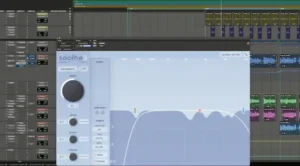 The expanded control architecture in Soothe3 makes it clear that Oeksound is targeting far more than corrective vocal cleanup or bedroom production chains.
The redesigned node system, additional filter shapes and multichannel support shift the plugin closer to a full-scale adaptive spectral processor rather than a dedicated harshness suppressor.
That distinction matters because resonance problems rarely behave uniformly across the spectrum. Earlier spectral processors often applied broadly similar timing behavior to every frequency range, which created obvious compromises during complex material.
Low-frequency buildup typically requires slower recovery to avoid pumping and tonal instability. Upper-midrange suppression needs significantly faster response to control harshness without blurring articulation or transient definition. Applying identical behavior across both regions rarely sounds natural.
Oeksound’s new tilt controls directly address that limitation.
By allowing frequency-dependent scaling for attack, release and Detail behavior, the plugin gives engineers far more control over how suppression reacts across different spectral regions instead of forcing globally uniform processing.
That becomes especially important in dense modern productions where low-end stability, upper-mid aggression and transient preservation are all competing simultaneously inside the same mix.
The updated node system also expands the plugin’s flexibility considerably. Engineers can now create or remove nodes freely while choosing between multiple filter shapes, including tilt and bandpass structures.
In practical workflow terms, that allows Soothe3 to move beyond simple resonance reduction into more selective spectral contour management:
- stabilizing harsh vocal ranges without dulling air frequencies;
- controlling cymbal density while preserving snare attack;
- tightening distorted guitars without collapsing harmonic width;
- managing low-mid buildup on mix buses more transparently.
The multichannel support up to 9.1.6 may ultimately matter even more than the interface improvements.
Immersive production environments expose spectral instability differently than stereo playback. That is one reason immersive mixing workflows increasingly require adaptive spectral processing that can maintain spatial consistency across large multichannel environments. Resonances distributed across multiple spatial channels can accumulate unpredictably, especially once objects move dynamically inside Atmos or other immersive formats. Harshness that feels controlled in stereo monitoring can become exaggerated once spatial separation increases.
At the same time, independent suppression across channels introduces another risk: unstable imaging.
If spectral reduction behaves inconsistently between linked channels, the stereo or immersive field can shift subtly as the detector reacts in real time. The decision reflects how aggressively Oeksound is positioning Soothe3 toward high-end mastering and immersive production workflows rather than simple corrective mixing tasks.
Used carefully, linear phase mode can help preserve image stability during independent spectral control. Used aggressively, it can also introduce pre-ringing, transient softening and reduced punch — especially on rhythm-heavy material.
That tradeoff is important because Soothe3 increasingly operates in the same territory as mastering-grade processing tools. In many modern workflows, adaptive spectral suppression now sits directly inside complex limiter, saturation and stereo enhancement chains rather than functioning as isolated corrective processing. That broader routing context matters when understanding how a modern mastering chain actually behaves under real production conditions. The plugin is no longer positioned as a simple corrective utility. It is becoming part of the broader ecosystem of adaptive mix stabilization processors used in high-density commercial production.
Where Soothe3 Still Becomes Dangerous
The biggest risk with Soothe3 is not artifact generation. It is how easy the plugin makes overprocessing sound acceptable.
That has always been the central problem with advanced spectral suppression.
Harshness reduction creates an immediate perception of polish because the ear naturally interprets smoother upper mids as more “finished.” In short listening bursts, aggressive suppression often sounds cleaner, more controlled and less fatiguing.
But long-term translation tells a different story.
Push spectral suppression too far and the mix starts losing the instability that creates physicality and emotional tension in the first place. The result is rarely dramatic at first. It usually appears as a gradual collapse of movement:
- vocals lose intimacy and edge definition;
- modern pop vocals start sitting behind the snare transient instead of driving the front of the mix;
- drums feel flatter and less dimensional;
- kick and snare transients lose physical separation once broadband suppression starts reacting too aggressively;
- guitars become smoother but smaller;
- cymbals stop interacting naturally with the room;
- dense mixes lose front-to-back depth;
- EDM drops can sound louder but emotionally smaller because harmonic aggression becomes overly controlled;
- upper harmonics become unnaturally static.
The dangerous part is that none of those changes necessarily sound “wrong” during the adjustment process itself. In fact, many common mastering failures begin exactly this way: local improvements gradually create larger translation problems once the mix leaves the studio environment. That pattern appears constantly in real-world mastering problem diagnosis workflows. In fact, they often sound more expensive in isolation.
That is why spectral processors are frequently overused in modern production. The plugin keeps solving local problems while quietly damaging global energy.
This becomes even more critical in mastering workflows where broadband suppression affects the entire stereo image simultaneously.
Unlike narrow corrective EQ moves, adaptive spectral reduction continuously reshapes harmonic behavior across the mix. Excessive suppression can reduce spatial contrast, weaken transient localization and create translation inconsistencies once the master hits streaming codecs or low-resolution playback systems.
Codec behavior is especially important here. Over-stabilized upper mids can interact unpredictably with lossy encoding, sometimes producing smeared transients or lifeless high-frequency response after conversion.
That is the paradox of modern spectral processing: the cleaner the algorithm becomes, the easier it is to misuse.
Soothe3 may significantly reduce the audible artifacts associated with earlier suppression engines. But greater transparency does not automatically create better engineering decisions. In many cases, it simply lowers the warning signs that tell an engineer they have already gone too far.
Some resonance instability is supposed to exist. Vocals are not meant to remain perfectly controlled at every syllable. Cymbals are not supposed to behave like static white noise. Aggressive electronic productions often depend on harmonic aggression and transient unpredictability to feel exciting at all.
Soothe3 works best when used as a stabilization tool rather than a permanent smoothing layer across every channel in a session.
Soothe3 vs Dynamic EQ and Modern Spectral Processors
Soothe3 still occupies a category that most traditional EQ plugins do not fully cover. It is not a standard dynamic EQ, but it is also not a forensic spectral repair tool in the RX sense. Its behavior sits somewhere between adaptive resonance control, broadband spectral compression and intelligent suppression.
That distinction matters because many engineers misuse Soothe-type processors expecting them to behave like deterministic EQ systems.
Dynamic EQ plugins such as:
- FabFilter Pro-Q 4;
- TDR Nova GE;
- Waves F6;
- iZotope Neutron;
operate through explicitly defined band behavior. The engineer selects exact frequencies, threshold response, Q width and timing characteristics. The processing remains predictable because the plugin only reacts inside clearly assigned ranges.
Soothe3 works differently.
Its suppression engine continuously analyzes changing spectral energy across the signal and reacts adaptively rather than through fixed band logic. That allows it to catch unstable resonances that would otherwise require multiple automated dynamic EQ nodes moving simultaneously throughout the mix.
In real-world sessions, that creates several major advantages:
- faster corrective workflow;
- better handling of moving resonances;
- less manual automation;
- more natural broadband suppression behavior;
- reduced need for stacked dynamic EQ instances.
But the adaptive architecture also introduces tradeoffs that become increasingly important at professional mixing and mastering levels.
- suppression behavior becomes less predictable;
- gain reduction is harder to evaluate analytically;
- microdynamic changes accumulate invisibly;
- overprocessing can remain hidden until translation testing;
- mastering decisions become less deterministic.
That is why many mastering engineers still prefer dynamic EQ for highly targeted corrective work. A deterministic EQ move may sound less “impressive” initially, but it often produces more stable translation because the processing remains intentionally constrained.
Compared to competitors like DSEQ3 or Smooth Operator Pro, Soothe3 appears focused less on aggressive correction and more on adaptive transparency.
DSEQ3 tends to lean toward deeper surgical suppression with stronger analytical control over spectral buildup. Smooth Operator Pro moves closer to spectral balancing and tonal smoothing. Soothe3 continues to position itself somewhere in the middle — prioritizing musical integration over forensic precision.
That positioning makes it especially effective for:
- modern vocal chains;
- mix bus resonance management;
- acoustic instruments with unstable upper mids;
- dense EDM and pop production;
- hybrid orchestral layering;
- cinematic mixes with heavy harmonic congestion.
It may remain less ideal for extreme restoration work, surgical mastering correction or situations where engineers need rigidly repeatable frequency behavior instead of adaptive suppression.
Ultimately, Soothe3 is strongest when the source material is dynamic, dense and constantly shifting. Traditional dynamic EQ still wins when precision and predictability matter more than intelligent adaptation.
CPU Load, Playback Translation and Real-World Production Workflow
No matter how optimized modern spectral processors become, adaptive suppression still carries a significant computational cost compared to traditional EQ or dynamics processing.
Soothe3 may improve efficiency internally, but its processing architecture remains fundamentally heavier than standard dynamic EQ workflows because the plugin is continuously analyzing and reshaping spectral energy in real time rather than reacting to a handful of fixed bands.
That becomes relevant quickly inside modern production sessions where CPU overhead is already under pressure from:
- oversampled saturation chains;
- linear phase mastering processors;
- convolution reverbs;
- AI-assisted source separation tools;
- multiband dynamics;
- immersive routing environments;
- high-sample-rate playback systems.
In smaller sessions, the load may feel manageable. In larger commercial projects running high sample rates, immersive routing and oversampled mastering chains simultaneously, multiple Soothe3 instances can still become a meaningful part of overall CPU allocation. That becomes especially noticeable during real-time playback at lower buffer settings.
But CPU usage is not the most important production issue surrounding Soothe3.
In mastering, the bigger issue is not CPU load. It is translation.
The more important question is whether adaptive suppression actually improves playback translation once the mix leaves the studio environment.
That distinction matters because spectral smoothing often creates a misleading sense of polish inside highly controlled monitoring conditions. A mix can sound cleaner, softer and more “finished” while simultaneously losing the transient contrast and harmonic instability that help music survive consumer playback systems.
Streaming normalization complicates this further. The problem becomes even more obvious in modern loudness-first workflows where clipping, limiting and spectral suppression all start interacting simultaneously. Many engineers chasing louder masters end up masking clipping artifacts temporarily while creating flatter long-term translation behavior. That relationship becomes especially important when understanding how loudness and clipping interact during mastering.
Once platforms apply loudness management and lossy codec conversion, overly stabilized upper mids can become less engaging rather than more refined. Excessive suppression reduces contrast before encoding even begins. After normalization and compression artifacts enter the equation, the result can feel flatter than intended — especially on earbuds, phones and small Bluetooth playback systems where upper-mid energy is already constrained.
This is one reason many experienced mastering engineers use spectral suppression conservatively even when the tools themselves become more transparent.
Cleaner algorithms do not eliminate the underlying tradeoff. Every stage of adaptive suppression still alters transient relationships, harmonic density and spatial perception to some degree.
In practice, some engineers may benefit more from reducing overall dependence on spectral suppression rather than upgrading to increasingly transparent versions of the same workflow.
Soothe3 works best as a precision stabilization processor — a tool for controlling unstable buildup that cannot be solved efficiently elsewhere in the chain.
It is not a replacement for:
- proper arrangement balance;
- accurate monitoring;
- microphone selection;
- source control;
- intelligent saturation decisions;
- or strong tonal balance upstream.
The cleaner the processor becomes, the more discipline the engineer still needs.
“The cleaner spectral suppression becomes, the easier it is to overuse.”
Who Soothe3 Is Actually Built For
Soothe3 makes the most sense in production environments where resonance problems are constant, cumulative and difficult to control manually at scale.
That usually means modern sessions with dense layering, aggressive loudness targets, bright source material and heavy spectral competition in the upper mids.
For engineers working inside those conditions, adaptive suppression can save enormous amounts of manual corrective work.
Soothe3 is especially well suited for:
- professional vocal mixing;
- EDM and pop production;
- metal and dense guitar-driven mixes;
- hybrid orchestral scoring;
- Atmos and immersive post-production;
- mastering workflows handling inconsistent client mixes;
- high-volume commercial sessions under deadline pressure.
Those are the environments where unstable resonances move too dynamically for static EQ alone to remain efficient.
The plugin makes less sense in workflows built around tonal imperfection, analog movement or minimal processing philosophy.
That includes:
- minimal acoustic recordings;
- jazz and vintage-oriented productions;
- organic live-band workflows;
- engineers prioritizing natural harmonic instability;
- mixers relying heavily on analog compression and saturation behavior;
- users expecting automatic “professional polish.”
That last category matters more than it sounds.
Soothe3 is not a shortcut for weak arrangements, brittle recordings or poor tonal decisions upstream. Inexperienced users often deploy spectral suppression globally because the immediate smoothing effect feels impressive during short listening passes. Over time, that approach tends to reduce contrast, depth and emotional intensity rather than improve them.
The plugin is most effective when the engineer already understands what should remain uncontrolled.
Pricing reinforces the fact that Oeksound is targeting professional workflows rather than casual experimentation. At $259, Soothe3 sits firmly in the high-end plugin category alongside mastering-grade processors and advanced spectral tools.
For existing Soothe2 users, the upgrade path is easier to justify — especially for engineers already depending on the plugin daily across vocals, buses and mastering chains.
For occasional users, the value proposition becomes less obvious.
If Soothe only appears a few times per month inside a session, the practical gains from the new algorithms and low-latency architecture may not fundamentally change workflow outcomes. But for engineers already relying heavily on adaptive suppression, Soothe3 appears designed to reduce some of the sonic penalties that accumulated with earlier spectral processing approaches.
Real-World Studio Perspective
In practical mastering environments, spectral suppression behaves very differently depending on monitoring conditions and playback level. A Soothe3 setting that feels transparent on nearfields at moderate SPL can become noticeably over-controlled once checked on headphones, consumer earbuds or small Bluetooth playback systems.
During dense mastering sessions, the difference between Soft and Hard mode becomes most obvious once the mix is level-matched and checked across multiple playback systems. On full-range monitors, aggressive suppression may initially sound cleaner. On earbuds and consumer headphones, the same settings can start reducing vocal projection and transient separation faster than expected.
In dense commercial productions, excessive suppression often reveals itself through spatial collapse rather than obvious tonal damage. Vocals begin sitting further back in the mix, cymbals lose air movement and transient depth becomes less stable once the master passes through streaming normalization and codec conversion.
That is why many mastering engineers use adaptive spectral processing conservatively inside full-range monitoring environments such as ATC, Barefoot or PMC systems while constantly checking translation on smaller playback references. The plugin can solve extremely difficult resonance problems, but it can also reduce emotional impact faster than most engineers realize during short listening sessions.
Verdict
Soothe3 does not radically redefine spectral suppression. What it does attempt is arguably more important: reducing the sonic damage that adaptive resonance control can introduce once it becomes deeply embedded in modern mixing workflows. Modern resonance suppression tools are no longer operating as isolated corrective plugins. They now influence the tonal identity and transient behavior of entire commercial productions.
“Soothe3 is at its best when stabilizing resonances, not redesigning tone.”
That distinction matters because the industry no longer uses spectral suppression sparingly. Tools like Soothe moved from occasional corrective processing into everyday production infrastructure across vocals, buses, mastering chains and immersive sessions. The downside is that entire mixes increasingly carry the same stabilized tonal behavior — smoother upper mids, reduced transient aggression and less harmonic unpredictability.
Soothe3 appears engineered directly against that problem.
The adaptive Soft mode, lower-latency architecture, expanded multichannel support and frequency-dependent control system all point toward a more context-aware suppression engine that prioritizes transparency over brute-force smoothing.
In practical use, that likely makes Soothe3 one of the most refined resonance management tools currently available for dense modern production.
But the underlying tradeoff has not disappeared.
Spectral suppression still alters movement, contrast and harmonic behavior every time it reacts. Cleaner algorithms do not change the fact that aggressive resonance control can slowly flatten a mix while sounding “better” during the process.
That is why Soothe3 works best when treated as a stabilization processor rather than a tonal identity.
Used selectively, it can solve resonance buildup that would otherwise require excessive automation or destructive EQ decisions. Used indiscriminately, it can remove the same instability that gives vocals urgency, drums dimension and dense productions physical impact.
For professional mixers, mastering engineers and post-production workflows operating under modern loudness and translation pressures, Soothe3 may become one of the strongest adaptive spectral processors currently available.
For inexperienced users chasing smoothness as a substitute for balance, arrangement or source quality, it remains just as capable of flattening emotion out of a mix as any spectral tool before it.

Yurii Ariefiev is a mastering engineer and audio production editor specializing in spectral balance, playback translation and modern mastering workflow analysis. His editorial work focuses on how adaptive processing, loudness normalization, codec behavior and monitoring decisions affect real-world music translation across streaming platforms and consumer playback systems.
This article was written from the perspective of practical mixing and mastering workflows rather than marketing copy. The analysis focuses on resonance suppression behavior, transient preservation, spectral stability and the long-term impact adaptive processing can have on modern commercial productions.
FAQ
Is Soothe3 actually safer for mastering than Soothe2?
Potentially, yes — but only if used conservatively. The new adaptive Soft mode appears better at avoiding the exaggerated flattening and upper-mid smearing that could happen with aggressive Soothe2 settings on stereo masters. That said, broadband spectral suppression can still reduce depth and transient realism if pushed too far.
Can Soothe3 replace dynamic EQ in professional mixing sessions?
Not entirely. Dynamic EQ remains more precise and predictable for targeted corrective work. Soothe3 is stronger when resonances move constantly and become difficult to track manually across changing performances or dense arrangements.
Does the new low latency mode make Soothe3 viable for recording vocals?
Yes. The reduced-latency architecture finally makes real-time monitoring practical without introducing the kind of delay that traditionally limited spectral processors during tracking sessions.
How heavy is Soothe3 on CPU compared to standard EQ plugins?
It is still significantly heavier than traditional EQ or compression because the plugin continuously performs adaptive spectral analysis rather than static band processing. Session scale and sample rate will matter.
Is Soothe3 useful on the mix bus?
It can be extremely effective in moderation, particularly for stabilizing dense upper mids or controlling harsh buildup in aggressive productions. Overuse on the mix bus can quickly reduce punch, depth and stereo energy.
What is the real difference between Soft mode and Hard mode?
Soft mode appears optimized for transparency and adaptive behavior that follows the source more organically. Hard mode behaves more like classic Soothe2 processing with firmer, more aggressive suppression and tighter control over problematic resonances.
Does Soothe3 support Dolby Atmos and immersive mixing workflows?
Yes. The plugin now supports multichannel configurations up to 9.1.6 with adjustable channel linking, making it usable inside Atmos, film and immersive post-production environments.
Can Soothe3 damage a mix even if it sounds smoother?
Absolutely. Spectral suppression often sounds impressive before it sounds correct. Excessive processing can reduce harmonic movement, transient contrast and emotional intensity while still appearing “cleaner” during short listening passes.
Is Soothe3 worth upgrading to from Soothe2?
For engineers already relying heavily on Soothe2 across vocals, buses or mastering chains, probably yes. The transparency improvements and low-latency operation address two of the biggest workflow limitations of the previous version.
What are the strongest alternatives to Soothe3 right now?
DSEQ3 remains one of the closest competitors for deeper surgical suppression. Smooth Operator Pro leans more toward tonal balancing and spectral smoothing. Dynamic EQ solutions like FabFilter Pro-Q remain stronger for deterministic corrective control.
Does Soothe3 replace Gullfoss?
No. Gullfoss focuses more on broad tonal rebalancing and perceptual spectral optimization, while Soothe3 is designed primarily for dynamic resonance suppression and harshness control.
Can Soothe3 fix harsh vocals?
It can reduce unstable upper-mid buildup and aggressive resonances very effectively, but it will not repair poor microphone choice, bad vocal recording technique or excessive saturation upstream.
Does Soothe3 affect stereo width?
Yes, potentially. Aggressive spectral suppression can alter spatial perception and reduce apparent stereo depth, especially when processing complex mix buses or unlinked stereo material.
Should Soothe3 be used before or after compression?
That depends on the workflow. Before compression, Soothe3 can prevent harsh resonances from over-triggering dynamics processors. After compression, it can smooth resonances exaggerated by aggressive gain reduction.
Is Soothe3 useful for mastering EDM?
Yes, particularly for controlling harsh upper mids and stabilizing dense synth layers. But aggressive settings can also reduce impact and energy during drops if transient movement becomes over-controlled.