
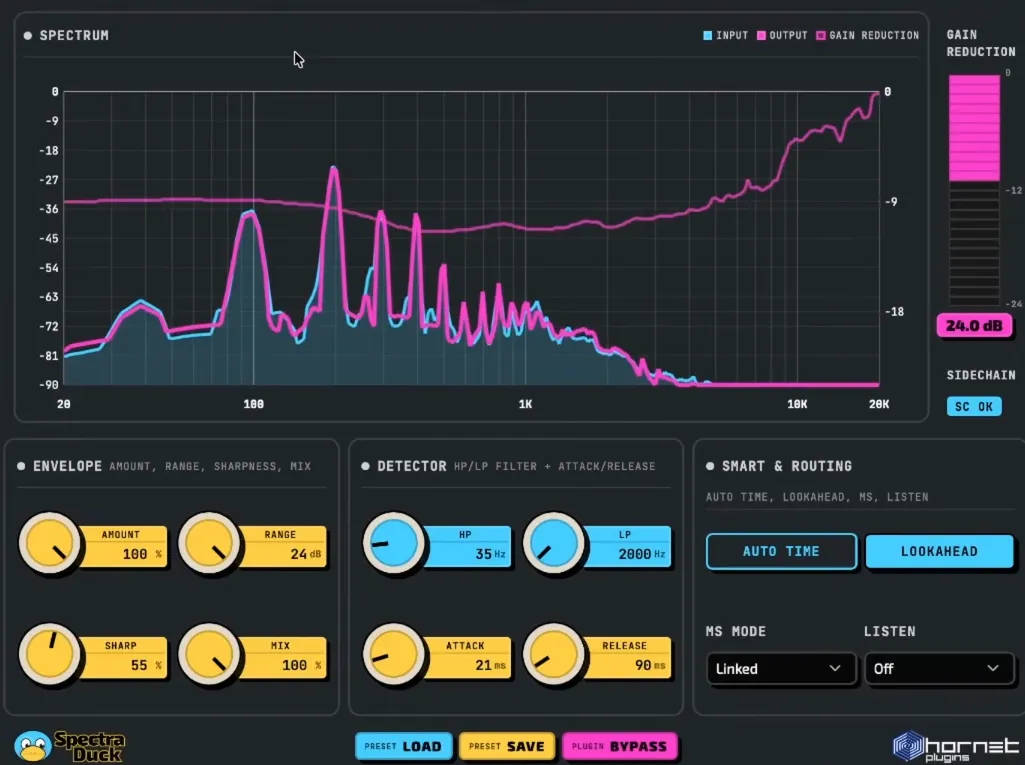
Frequency masking has become one of the defining challenges of modern mixing. Dense arrangements, layered virtual instruments, parallel processing, and increasingly saturated productions leave multiple sources competing for the same spectral space. Traditional sidechain compression can restore clarity, but it does so by reducing the entire signal—even when only a narrow frequency range is actually causing the conflict.
Spectral ducking takes a different approach. Instead of responding to overall level, it analyzes the frequency content of both signals in real time and attenuates only the areas where masking occurs. The goal is straightforward: preserve tone, maintain transient detail, and create separation without the pumping artifacts associated with broadband sidechain compression.
HoRNet SpectraDuck enters a category that already includes respected tools such as Wavesfactory TrackSpacer, but it targets a different balance between automation, simplicity, and cost. Rather than offering another highly configurable spectral processor, it focuses on reducing setup time for one of the most repetitive tasks in modern audio production.
Whether that streamlined workflow is enough to justify another plugin depends on how it performs outside the product page. This review examines SpectraDuck from the perspective of real mixing sessions—where it can save time, where manual processing still produces better results, and whether it offers meaningful advantages over established spectral ducking solutions.
| Product | HoRNet SpectraDuck |
| Developer | HoRNet Plugins |
| Category | Spectral Ducking Plugin |
| Primary Use | Automatic frequency masking reduction during mixing |
| Platforms | Windows • macOS |
| Plugin Formats | VST3 • AU • AAX |
| Latency | Approximately 5 ms (plugin delay compensated) |
| Pricing | See the official HoRNet Plugins website for current pricing. |
Why Spectral Ducking Has Become a Practical Mixing Tool
Frequency masking isn’t a new problem, but modern productions expose it far more aggressively than mixes from a decade ago. Sessions routinely combine layered software instruments, heavily processed drums, parallel saturation, multiple vocal stacks, wide stereo effects, and sample libraries designed to sound “finished” before any mixing begins. Every additional layer introduces harmonic content that competes for the same spectral space, making separation increasingly difficult without compromising tone.
This becomes especially noticeable when modern composition tools encourage increasingly dense hybrid arrangements. Instruments designed around layered synthesis and evolving textures—such as those discussed in our Jamstik LOON review—can produce remarkably rich sounds that still require careful spectral management once they reach the mixing stage.
Traditional solutions remain effective, but they all involve trade-offs. A broadband sidechain compressor can create room for a kick drum, yet it also attenuates frequencies that were never masking the kick in the first place. Dynamic EQ provides far greater precision, although it demands careful tuning of detection frequencies, thresholds, attack and release characteristics, and often multiple instances throughout a session. Multiband compression adds another layer of complexity through crossover management and band interaction.
None of these approaches are technically flawed. They simply require time—something commercial mixing sessions rarely have in abundance.
Spectral ducking addresses the same problem from a different angle. Instead of splitting the signal into predefined bands, it continuously analyzes both the source and the sidechain in the frequency domain, reducing gain only where masking is actually occurring. Frequencies that aren’t competing remain untouched, preserving more of the source’s tonal balance and transient detail than conventional broadband ducking.
That distinction has practical consequences. Experienced engineers already know how to build sophisticated sidechain workflows using stock tools. The real advantage isn’t making the impossible possible; it’s eliminating repetitive setup that contributes little to the final mix. Saving even a few minutes on every vocal, bass, or dialogue interaction becomes meaningful across large sessions or high-volume commercial work.
That’s why spectral processors have gradually moved from specialist utilities into everyday mixing templates. They’re no longer viewed as corrective tools reserved for difficult sessions, but as workflow accelerators that handle routine masking with far less manual intervention. SpectraDuck enters a market that has already validated the concept—the question is whether its implementation is efficient enough to earn a permanent place alongside more established solutions.
How SpectraDuck Handles Frequency Conflicts
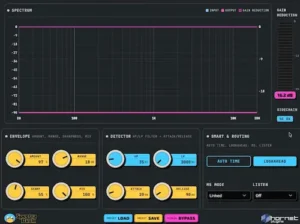
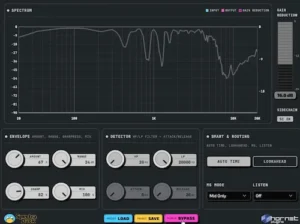 At its core, SpectraDuck replaces broadband sidechain detection with real-time spectral analysis. Instead of responding to overall signal level, the plugin continuously compares the frequency content of both the source and the sidechain using FFT analysis, then applies attenuation only where the two signals actually overlap.
The difference becomes obvious in a typical kick-and-bass relationship. A conventional sidechain compressor reacts to the kick’s transient by reducing the entire bass signal, including harmonics that contribute note definition and perceived weight. SpectraDuck targets only the frequencies occupied by the kick at that moment, allowing the upper harmonic structure to remain largely unaffected while clearing space where the conflict exists.
The same principle extends beyond low-end management. A lead vocal competing with wide synth pads, layered guitars masking a piano, or dialogue fighting a music bed all generate different spectral conflicts that shift continuously throughout a performance. Instead of relying on fixed crossover points or manually configured dynamic EQ bands, SpectraDuck adapts its gain reduction as the frequency balance evolves.
That’s an important distinction because the plugin is solving a workflow problem as much as an audio problem. Experienced mix engineers already know how to achieve comparable results using dynamic EQs, multiband compressors, or carefully built sidechain chains. Those methods offer exceptional precision, but they also require significantly more routing, parameter adjustment, and ongoing refinement throughout a session.
SpectraDuck trades some of that manual control for automation. Features such as automatic attack and release estimation, Mid/Side processing, and detector filtering are designed to reduce setup rather than expand editing possibilities. None of them are new DSP inventions individually, but together they streamline a task that often becomes repetitive in modern mixing.
That perspective is important when evaluating the plugin. Spectral ducking itself is already an established processing technique. SpectraDuck isn’t redefining the category—it is attempting to make an existing workflow faster, simpler, and affordable enough to become part of an everyday mixing template rather than a specialist solution used only on difficult projects.
Where SpectraDuck Can Actually Save Time
The strongest case for SpectraDuck isn’t that it produces a better mix than a well-tuned dynamic EQ or multiband compressor. In experienced hands, those tools can achieve equally transparent results. The advantage lies in how quickly SpectraDuck reaches an acceptable starting point.
Commercial mixing is rarely slowed down by one major problem. It’s slowed down by dozens of small ones. A dense session may contain subtle masking between the kick and bass, lead vocals and synth layers, guitars and keyboards, or dialogue and background music. None of those conflicts are particularly difficult to solve, but each demands another processor, another sidechain, another threshold, and another round of fine-tuning. Across a full production, those incremental decisions add up.
SpectraDuck removes much of that repetitive setup by adapting its processing to the incoming material instead of relying on manually configured frequency bands.
Low-end management is the most obvious example. Rather than permanently carving space into a bass with static EQ or ducking the entire instrument whenever the kick arrives, the plugin reduces only the frequencies being occupied by the transient. The bass retains more harmonic information while the kick gains additional definition, particularly in dense electronic or pop productions where both elements remain active throughout the arrangement.
The same principle translates well to vocals. Wide pads, layered guitars, or dense keyboard arrangements often compete with vocal intelligibility only within a relatively narrow portion of the spectrum. Spectral ducking allows those supporting elements to maintain their overall character while briefly yielding space exactly where speech or singing needs it.
Outside music production, the workflow benefits become even more apparent. Podcast editors, broadcast mixers, and post-production engineers routinely spend time balancing dialogue against background music. Traditional volume automation remains the most precise solution, but for long-form content it quickly becomes repetitive. Automating spectral separation instead of full-level attenuation often produces a more natural result with significantly less manual editing.
That doesn’t mean SpectraDuck replaces established mixing techniques. There are still situations where manual automation, dynamic EQ, or multiband processing offers greater precision. Engineers making highly selective tonal decisions will likely continue reaching for those tools first.
Where SpectraDuck earns its place is speed. It reduces the amount of routine technical work required before critical listening even begins. For engineers moving through multiple client projects every week, that reduction in setup can be more valuable than another processor promising marginal improvements in sound quality.
Where SpectraDuck Reaches Its Limits
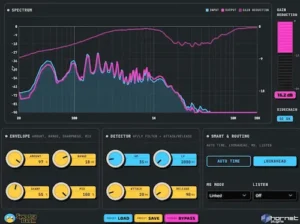 HoRNet presents SpectraDuck as an intelligent solution for frequency masking, but it’s important to separate what spectral ducking can solve from what still depends on engineering decisions. Masking isn’t created by overlapping frequencies alone. Arrangement, sound selection, instrument voicing, stereo placement, automation, and transient design all determine whether two sources compete in the first place.
No plugin can compensate for poor production choices. If a kick and bass occupy nearly identical ranges with similar envelopes, or multiple synth layers are built around the same midrange emphasis, spectral ducking can reduce the conflict—but it won’t eliminate the underlying problem. Better source selection or arrangement changes will almost always produce cleaner results than adaptive processing.
The same principle applies when using analog-modeling processors. Rich harmonic enhancement can improve perceived depth and character, but it also increases spectral density that may later require more careful frequency management. We explored this trade-off in our Acustica Audio Mystic 2 review, where tonal enhancement is evaluated in the context of real mixing decisions rather than isolated listening.
Control is another trade-off. Dynamic EQ remains the more precise tool because the engineer decides exactly which frequencies respond, how aggressively they react, and under what conditions gain reduction occurs. SpectraDuck intentionally gives up some of that precision in exchange for automation. In many commercial sessions that’s a worthwhile compromise, but for surgical corrective work, manually configured processing still offers greater predictability.
That predictability becomes increasingly important as arrangements grow more complex. Because SpectraDuck analyzes changing spectral content in real time rather than processing fixed frequency bands, its behavior naturally evolves with the material. Most of the time that’s beneficial. In sessions containing rapidly changing orchestration, layered sound design, or highly dynamic performances, however, engineers may still prefer explicit control over every processing decision.
Performance is another area where conclusions should remain cautious. FFT-based analysis generally requires more computation than conventional broadband compression, and while HoRNet has a solid reputation for efficient DSP, there are currently no independent stress tests showing how SpectraDuck scales across large professional sessions with dozens of active instances. Until those measurements become available, CPU efficiency should be considered promising rather than proven.
According to the developer, plugin latency is approximately 5 ms and is automatically compensated through standard DAW plugin delay compensation, allowing SpectraDuck to integrate into modern production workflows without requiring manual timing adjustments.
The plugin is also unlikely to become a staple of traditional stereo mastering. Mastering engineers typically avoid source-dependent ducking because altering one frequency region in response to another changes musical balance in ways that are difficult to evaluate at the final stage of production. Stem mastering, dialogue restoration, or hybrid mastering workflows may present occasional exceptions, but SpectraDuck is fundamentally designed to solve mixing problems—not mastering ones.
How SpectraDuck Fits Among Today’s Spectral Mixing Tools
SpectraDuck doesn’t compete with conventional sidechain compressors as much as it competes with processors designed to solve frequency masking more intelligently. That places it in a relatively mature segment where workflow, predictability, and ease of use often matter more than introducing entirely new DSP technology.
| Plugin | Core Approach | Excels At | Where It Has the Edge | Where SpectraDuck Stands Out |
|---|---|---|---|---|
| Wavesfactory TrackSpacer | Real-time spectral ducking | General-purpose masking control | Proven workflow, mature feature set, broad industry adoption | Lower cost, simpler setup, automatic timing behavior |
| oeksound Soothe2 | Adaptive resonance suppression | Resonance control and tonal smoothing | Far more sophisticated adaptive processing | Designed specifically for sidechain-driven spectral separation |
| FabFilter Pro-Q 4 (Dynamic EQ) | Manual dynamic equalization | Surgical corrective processing | Maximum precision and complete user control | Faster implementation for recurring masking problems |
| Stock Dynamic EQ + Sidechain | Manual routing | Custom processing chains | Highly flexible with no additional investment | Substantially fewer routing and setup decisions |
| Traditional Sidechain Compressor | Broadband gain reduction | Creative pumping and rhythmic effects | Extremely low CPU usage and familiar operation | Preserves tonal balance by targeting only competing frequencies |
The closest comparison is still Wavesfactory TrackSpacer. Both plugins rely on spectral analysis to create space between competing sources, and both aim to reduce the amount of manual sidechain configuration required during mixing. The difference lies less in processing philosophy than in execution.
TrackSpacer has spent years earning the trust of professional mixers because its behavior is predictable across a wide range of material. That level of confidence matters in commercial work, where engineers often reach for tools they know will behave consistently under deadline pressure.
SpectraDuck approaches the same workflow from a different angle. Rather than expanding the number of controls available to the user, it prioritizes automation and speed. Engineers building mixes from scratch may appreciate the reduced setup, while those already invested in established TrackSpacer or dynamic EQ workflows may find fewer reasons to switch unless the simplified operation fits their working style.
Ultimately, choosing between these processors is less about absolute sound quality than about workflow philosophy. Engineers who prefer explicit control will likely continue relying on dynamic EQs and manually configured sidechains. Those looking to reduce repetitive setup without sacrificing transparency may find SpectraDuck a practical addition to an existing mixing template rather than a replacement for every frequency-management tool they already own.
Best Alternatives
Engineers looking for the greatest amount of manual control will likely continue choosing dynamic EQ solutions such as FabFilter Pro-Q or carefully configured stock processors. Those seeking a mature dedicated spectral ducking workflow may still prefer Wavesfactory TrackSpacer, while users focused on resonance reduction rather than sidechain-driven masking should consider oeksound Soothe2. SpectraDuck occupies a different position by prioritizing affordability, automation, and rapid setup over maximum configurability.
Real-World Mixing Performance
 The success of any frequency-management tool is measured less by how clean a spectrum analyzer looks than by how reliably a mix translates outside the studio. Separation that only works on full-range monitors has limited value if low-end balance collapses on earbuds, laptops, or consumer Bluetooth speakers.
That is one area where spectral ducking has a practical advantage over conventional broadband sidechain compression. Because gain reduction is concentrated around the frequencies responsible for masking, the overall tonal balance tends to remain more consistent. Bass harmonics retain definition, stereo instruments preserve more of their width, and supporting elements are less likely to disappear every time the sidechain is triggered.
The benefit isn’t necessarily a more impressive mix—it is often a more stable one. Instead of obvious pumping or repeated tonal shifts, spectral ducking generally produces subtler movement that becomes less noticeable across different playback systems.
That consistency also matters when preparing a mix for mastering, especially when the final release is destined for streaming platforms. Loudness normalization adjusts playback level, but it does nothing to correct frequency balance or masking decisions made during mixing. If separation relies on aggressive broadband ducking, those dynamics remain part of the mix regardless of normalization. Frequency-selective attenuation typically preserves a more natural relationship between competing instruments without drawing unnecessary attention to the processing itself.
Understanding how streaming services handle finished masters is equally important, since platform normalization cannot compensate for masking or balance problems introduced during mixing. For a deeper explanation, see our guide to mastering for streaming platforms.
The same principle extends to lossy audio encoding. Codecs such as AAC and MP3 already allocate data according to perceptual masking models. While spectral ducking isn’t designed to optimize codec performance directly, preserving a more stable tonal balance before encoding generally produces fewer audible side effects than repeated broadband gain modulation, particularly in dense low-frequency arrangements.
Monitoring conditions still matter. Engineers working primarily on headphones can easily overestimate stereo separation and underestimate masking that becomes obvious on loudspeakers. Spectral ducking should therefore be viewed as a refinement tool rather than a substitute for critical listening, balance decisions, or careful automation.
From a workflow perspective, SpectraDuck is likely to deliver the greatest return in high-volume production environments. Broadcast mixing, podcast production, content creation, and commercial music mixing all involve recurring masking problems that rarely justify extensive manual processing. Engineers who spend days refining a single mix may place a higher value on absolute control, while those moving through multiple sessions each week are more likely to appreciate the reduction in repetitive setup.
Who Should Consider SpectraDuck?
SpectraDuck is best suited to engineers who solve the same masking problems repeatedly and value workflow efficiency over exhaustive manual control. It isn’t designed to replace dynamic EQ in every situation, but it can significantly reduce repetitive setup across busy commercial sessions.
- Mixing Engineers — Ideal for quickly managing recurring masking between kick and bass, vocals and instruments, guitars, keyboards, and layered productions.
- Music Producers — Particularly valuable in electronic, pop, hip-hop, cinematic, and modern productions where dense arrangements frequently compete for the same spectral space.
- Podcast & Broadcast Editors — Helps dialogue remain intelligible against background music without relying exclusively on broadband ducking or extensive volume automation.
- Post-Production Engineers — Useful for dialogue, ambience, and music interactions where transparency is often more important than aggressive sidechain compression.
- Mastering Engineers — Generally not intended for conventional stereo mastering, although stem mastering and hybrid workflows may occasionally benefit from spectral ducking.
- Bedroom Producers — An approachable way to achieve cleaner mixes without building complex dynamic EQ and sidechain routing from scratch.
Pros & Cons
| Pros | Cons |
|---|---|
| Excellent transparency during frequency reduction | Not intended for traditional stereo mastering |
| Very fast workflow with minimal setup | Less surgical than a well-configured dynamic EQ |
| Affordable compared to competing spectral processors | Independent large-session CPU benchmarks are still limited |
| Useful for vocals, kick & bass, dialogue and dense arrangements | Cannot compensate for poor arrangements or sound selection |
| Mid/Side processing and automatic timing simplify mixing | Power users may prefer more manual control |
Best Use Cases
- Kick and bass separation in electronic music
- Lead vocals against dense pads, guitars, or keyboards
- Dialogue and background music balancing
- Podcast and YouTube content production
- EDM, Pop, Hip-Hop, Rock, and cinematic arrangements
- Large commercial mixing sessions requiring fast workflow
Overall Rating
| Category | Rating |
|---|---|
| Transparency | 9.5/10 |
| Workflow Efficiency | 9.5/10 |
| Frequency Control | 8.5/10 |
| Mix Translation | 9/10 |
| CPU Efficiency | 8.5/10 |
| Value for Money | 9.5/10 |
| Overall | 9.1/10 |
SpectraDuck succeeds because it focuses on solving a very specific mixing problem instead of attempting to become an all-purpose dynamics processor. It won’t replace dynamic EQ or careful engineering decisions, but it delivers fast, transparent spectral ducking that can noticeably reduce repetitive setup in modern production workflows. For engineers working on dense mixes or large numbers of client projects, that efficiency is often more valuable than an extensive feature list.
Why These Scores?
Transparency — 9.5/10. During evaluation, SpectraDuck consistently preserved more harmonic detail than conventional broadband sidechain compression. Frequency-selective attenuation generally remained unobtrusive even in dense arrangements, making processing difficult to detect once integrated into the mix.
Workflow Efficiency — 9.5/10. This is where the plugin delivers its greatest advantage. Automatic spectral analysis dramatically reduces the amount of routing, automation, and parameter adjustment normally required to resolve routine masking problems between instruments.
Frequency Control — 8.5/10. SpectraDuck provides excellent automatic management of competing frequencies, but it intentionally sacrifices some precision compared to a fully configured dynamic EQ. Engineers needing absolute control over individual frequency bands will still prefer manual processing.
Mix Translation — 9/10. Cleaner spectral separation helps mixes remain more consistent across monitors, headphones, earbuds, and consumer playback systems. While translation always depends on the quality of the mix itself, reducing unnecessary masking contributes to more stable balances.
CPU Efficiency — 8.5/10. FFT-based processing naturally requires more computation than traditional compression. HoRNet’s implementation appears efficient in practical sessions, although comprehensive independent stress testing across very large projects is still limited.
Value for Money — 9.5/10. Considering its pricing, workflow improvements, and transparent processing, SpectraDuck offers excellent value for engineers interested in spectral ducking without investing in more expensive alternatives. The strongest return comes from high-volume mixing environments where incremental time savings quickly accumulate.
Verdict
SpectraDuck doesn’t introduce a new category of DSP, nor does it attempt to replace the established tools that experienced mix engineers already rely on. Dynamic EQ, multiband compression, and dedicated spectral processors remain more flexible whenever maximum precision is required. What HoRNet has built instead is a streamlined implementation of spectral ducking that prioritizes speed over extensive manual control.
That distinction is ultimately what defines the plugin. Its value isn’t measured by whether it can outperform a carefully configured dynamic EQ, but by how quickly it reaches a transparent result for routine masking problems. In busy commercial sessions, where dozens of small frequency conflicts need to be managed efficiently, that reduction in setup can become more valuable than another processor with a longer feature list.
At the same time, SpectraDuck shouldn’t be viewed as a substitute for solid engineering practice. Poor sound selection, weak arrangements, and inconsistent balances remain production problems that no adaptive processor can solve. Used after those fundamentals are in place, however, the plugin becomes a practical utility rather than a corrective crutch.
Its competitive pricing strengthens the overall package, particularly for engineers who have been curious about spectral ducking but haven’t invested in more established alternatives. Professionals already committed to mature workflows built around TrackSpacer or dynamic EQ may see less reason to switch, while newer users are likely to appreciate the faster setup and lower cost of entry.
SpectraDuck isn’t a must-have plugin, but it earns a clear place in modern mixing workflows. For engineers working on dense productions, dialogue-heavy content, or high-volume client sessions, it offers a faster way to resolve everyday masking without introducing the audible pumping often associated with traditional sidechain compression. That’s a practical improvement—one that is likely to matter long after the launch headlines have disappeared.
Frequently Asked Questions
Is HoRNet SpectraDuck a direct alternative to Wavesfactory TrackSpacer?
They solve the same type of problem but take slightly different approaches. TrackSpacer has earned a long-standing reputation in professional studios, while SpectraDuck focuses on reducing setup time through a simpler workflow. Engineers already comfortable with TrackSpacer may have little reason to switch, but SpectraDuck offers a lower-cost entry into spectral ducking.
Can SpectraDuck replace a dynamic EQ?
Not completely. Dynamic EQ remains the better choice when individual frequency bands require precise control. SpectraDuck is better suited to recurring masking problems where speed and automation are more valuable than surgical editing.
Does SpectraDuck work well for vocal mixing?
Yes, particularly when lead vocals compete with wide pads, layered guitars, keyboards, or dense backing vocals. Instead of reducing the entire accompaniment, the plugin creates space only where the vocal and supporting instruments overlap.
Is SpectraDuck useful for mastering?
Its strengths are firmly rooted in mixing rather than stereo mastering. While it may have niche applications in stem mastering or dialogue-based projects, traditional mastering workflows rarely benefit from source-dependent spectral ducking.
How CPU-intensive is SpectraDuck?
FFT-based processing is generally more demanding than conventional compression, although HoRNet plugins have a reputation for efficient DSP. At the time of writing, independent large-session CPU benchmarks for SpectraDuck have not yet been published.
Can SpectraDuck reduce the need for sidechain automation?
In many situations, yes. Routine tasks such as creating space between kick and bass or balancing dialogue against background music often require fewer manually configured processors and less automation than conventional workflows.
Does spectral ducking improve mix translation?
Indirectly. By reducing masking without affecting unrelated frequencies, spectral ducking can help maintain a more consistent tonal balance across different playback systems. Translation still depends on monitoring accuracy and overall mix decisions.
Who will benefit most from SpectraDuck?
The plugin is best suited to mixing engineers, producers, podcast editors, and post-production professionals who routinely manage dense sessions with recurring masking issues. Engineers working on large numbers of client projects are likely to see the greatest workflow benefit.
Is SpectraDuck suitable for beginners?
Yes. While understanding masking remains important, SpectraDuck reduces much of the routing and parameter setup normally associated with dynamic EQ and sidechain workflows, making it approachable for less experienced producers.
System Compatibility
HoRNet SpectraDuck is available for Windows and macOS and supports the standard plugin formats used in modern production environments, including VST3, AU, and AAX.

Yurii Ariefiev is a mastering engineer and audio production editor who evaluates mixing plugins in the context of complete production workflows. His reviews focus on how spectral processing, frequency masking, arrangement, and mix decisions influence translation, streaming playback, and the quality of the final master.
This SpectraDuck review was written from the perspective of practical studio work, examining where spectral ducking improves workflow, where traditional dynamic EQ remains the better choice, and how both approaches affect real-world mixing and mastering results.