
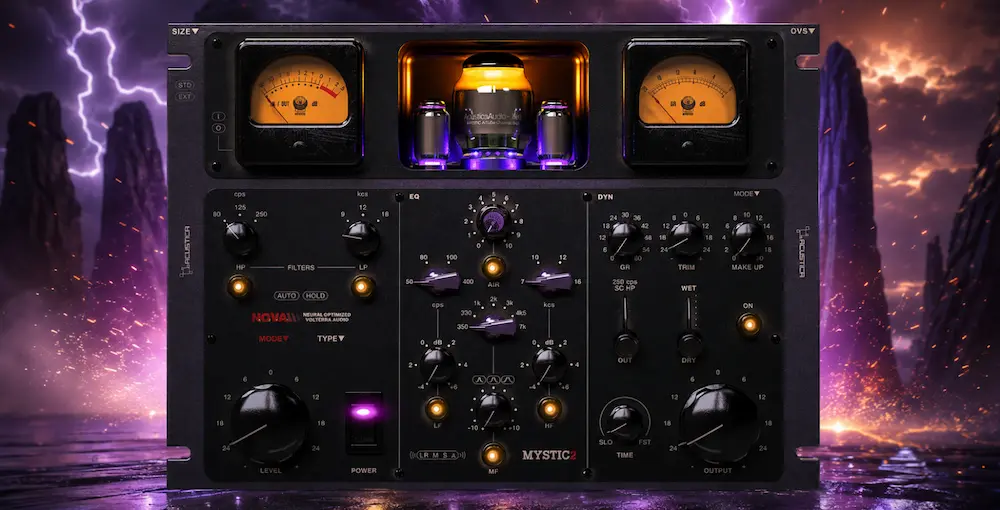
The market for analog channel strip plugins is more competitive than ever. Engineers can choose from SSL, Neve, API, and countless boutique emulations, many of which promise authentic console tone while offering nearly identical processing chains. As a result, the real differences are no longer found in feature lists but in how a plugin behaves inside an actual mix.
Quick Verdict
If you’re wondering whether Acustica Audio Mystic 2 is worth buying, the short answer is yes. It is one of the strongest analog-style channel strip plugins for engineers who value harmonic realism, musical workflow, and cohesive mixing rather than maximum CPU efficiency. If your priority is transparent corrective processing or the lightest possible plugin footprint, there are better alternatives. For engineers seeking analog character throughout the mixing process, however, Mystic 2 is an easy recommendation.
From a review perspective, Mystic 2 is not a ground-up redesign. It is a significant update to Acustica Audio’s tube-inspired channel strip, introducing the company’s newer NOVA processing engine, three selectable preamp models, an expanded EQ section, and refinements intended to make the plugin more practical in day-to-day production. The goal is less about adding features than improving how harmonic saturation, dynamics, and tonal shaping interact under real working conditions.
That makes Mystic 2 worth evaluating before making a buying decision beyond the usual marketing language surrounding analog emulation. The relevant questions are straightforward: Does it help engineers reach better mix decisions faster? Does the updated processing justify its heavier CPU footprint compared to algorithmic competitors? And does it offer enough sonic character to earn a permanent place alongside established channel strips from SSL Native, Brainworx, Softube, Waves, or UAD? Those answers matter far more than another claim of “analog warmth.”
Quick Specs
| Plugin Type | Analog Channel Strip |
| Processing Style | Tube Saturation • EQ • Optical Compression |
| Primary Purpose | Professional Mixing |
| Best For | Vocals, Bass, Guitars, Mix Buses |
| Less Suitable For | Transparent Mastering |
| Formats | VST3 • AU • AAX |
| Platforms | Windows • macOS |
Why Mystic 2 Still Matters in Modern Mixing
 DAWs have removed most technical limitations from the mixing process. Running dozens of EQs, compressors, saturators, and utility plugins on a single session is no longer unusual. The downside is option overload. Every additional processor introduces another decision, another gain stage, and another opportunity to lose perspective on the mix itself.
That is precisely why channel strips continue to earn a place in professional workflows. A well-designed strip encourages engineers to shape tone, dynamics, and gain structure as one continuous process instead of assembling a signal chain one plugin at a time. The workflow is closer to mixing on a console, where decisions happen in context rather than through endless plugin comparisons.
This philosophy becomes even more valuable as sessions grow larger. Consistently using the same channel strip across vocals, guitars, drums, or keyboards creates predictable behavior from track to track. EQ curves become familiar, gain staging stays under control, and harmonic coloration develops more naturally across the entire mix instead of feeling pieced together from unrelated processors.
Acustica Audio has built its reputation around capturing the nonlinear behavior of analog hardware rather than simply reproducing EQ curves or compressor ratios. Unlike purely algorithmic plugins, its processing has traditionally relied on dynamic convolution to model how hardware responds as signal levels change. The tradeoff has always been obvious: convincing harmonic complexity at the expense of heavier CPU usage and slower workflow.
Mystic 2 reflects Acustica’s attempt to reduce that compromise. The introduction of the NOVA engine combines the company’s established Volterra-based processing with neural modeling, aiming to preserve the dynamic behavior users expect while making the plugin more practical in everyday production. It is an engineering refinement rather than a complete change in philosophy.
That direction mirrors a broader shift across the plugin industry. Developers are no longer chasing the most convincing analog model at any computational cost. The challenge today is delivering hardware-like behavior that remains practical inside sessions containing hundreds of tracks, virtual instruments, oversampled processors, and increasingly demanding production templates.
Perhaps the strongest argument for channel strips has little to do with analog nostalgia. Experienced mix engineers rarely select a different EQ and compressor for every source simply because they can. Most rely on a small group of trusted processors whose behavior is predictable under pressure. Familiar tools reduce hesitation, speed up decision-making, and produce more consistent results from project to project.
That is ultimately where Mystic 2 should be judged. The quality of its tube saturation matters, but not in isolation. What determines its long-term value is whether engineers can leave it on dozens of channels without fighting the workflow, second-guessing every adjustment, or sacrificing system performance for incremental sonic gains.
What’s New in Mystic 2?
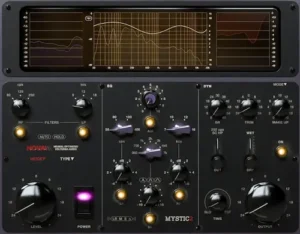
On paper, Mystic 2 still looks like a familiar analog channel strip. A tube-style preamp feeds filters, a four-band EQ, and an optical compressor before the signal returns to the mix. The architecture itself isn’t new, and that’s not where the update becomes interesting. The real changes are found in how the processing behaves under varying signal levels and how much flexibility engineers gain without disrupting an established workflow.
The biggest technical change is Acustica Audio’s transition to the NOVA engine. Earlier Acustica plugins relied heavily on dynamic convolution to reproduce nonlinear analog behavior with impressive realism, but often at the expense of CPU efficiency. NOVA combines that Volterra-based approach with neural processing, aiming to preserve the complex harmonic response while producing smoother transitions as material moves from clean operation into saturation.
That isn’t just a technical footnote. In real sessions, vocals, bass, acoustic instruments, and live drums rarely maintain a consistent input level. The same applies to expressive hybrid instruments such as Sonuscore Elysion Elements, where evolving timbres can quickly expose unnatural saturation. Smoother nonlinear behavior tends to sound less like an effect and more like a natural extension of the source, particularly when multiple instances are spread across an entire mix.
The expanded preamp section is equally practical. Rather than forcing every source through a single harmonic profile, Mystic 2 offers three distinct operating modes that cover noticeably different production scenarios.
Original retains the familiar response of the first version and remains the safest choice for general-purpose mixing.
Vintage increases harmonic density and develops upper overtones more aggressively, making it particularly effective on rock vocals, electric guitars, bass, parallel drums, and sources that benefit from stronger midrange presence.
Modern moves in the opposite direction. It keeps harmonic enhancement under tighter control while preserving cleaner transient behavior, making it easier to integrate into contemporary pop, orchestral productions, electronic music, or dialogue where excessive coloration can quickly become distracting.
This additional flexibility solves a common limitation found in many analog emulations. A channel strip with one fixed personality often sounds excellent on individual tracks but becomes difficult to use across an entire project because every source starts acquiring the same tonal fingerprint. Mystic 2 gives engineers more room to adapt its character without abandoning a consistent workflow.
The EQ has also become more versatile. The added Mid Q control provides greater precision through the critical midrange, while the dedicated Air band allows subtle top-end enhancement without forcing engineers toward separate high-frequency processors. It still behaves like a musical analog EQ rather than a surgical corrective tool, but the additional control broadens its usefulness across modern productions where tonal shaping and corrective work frequently overlap.
The optical compressor follows the same philosophy. It favors smooth, progressive gain reduction over fast transient control, making it particularly effective on vocals, bass, keyboards, and sustained instruments. Engineers looking for aggressive VCA punch or FET-style attack shaping will still reach for dedicated compressors, but Mystic 2 was never intended to compete in that category.
Just as important are the features Acustica chose not to add. There are no AI assistants, automatic source detection, or adaptive processing trying to make creative decisions on behalf of the user. Every adjustment still depends on engineering judgment, which will likely appeal to professionals who prefer predictable tools over increasingly automated production workflows.
The Standard and Extended interface modes reinforce that philosophy. The simplified layout supports quick tonal decisions, while the expanded view exposes additional controls without interrupting the signal flow. It is a thoughtful usability improvement rather than a cosmetic redesign.
Perhaps the most significant takeaway is that Mystic 2 doesn’t attempt to reinvent channel-strip processing. Instead, it refines a workflow that experienced engineers already understand. Those kinds of improvements rarely dominate marketing headlines, but they tend to have a far greater impact over months of daily production work than another long list of headline features. The same principle applies later in the production process, where a well-balanced mastering chain usually delivers better results than adding more processors without a clear purpose.
Where Mystic 2 Delivers—and Where the Marketing Goes Too Far
 Analog modeling has matured to the point where convincing saturation is no longer enough to differentiate a plugin. Most established developers can reproduce the broad tonal characteristics of vintage hardware. The real question is how naturally those processors respond under changing signal levels, how efficiently they fit into large sessions, and whether they help engineers work faster instead of adding complexity.
That is where Mystic 2 makes its strongest case. The move to Acustica’s NOVA engine is more than a cosmetic update. Combining dynamic convolution with neural processing is a legitimate engineering refinement intended to smooth the transition between clean and saturated operation. Unlike a redesigned interface or a collection of new presets, this change affects how the processor behaves while engineers are actually mixing.
At the same time, expectations should remain realistic. NOVA does not transform Mystic 2 into a fundamentally different plugin. The improvements are incremental rather than dramatic, and they become most apparent on dynamic material such as vocals, bass, acoustic instruments, or live drums where harmonic content continuously evolves with performance level. Engineers expecting an obvious before-and-after difference on every source may be disappointed.
The same applies to the three preamp modes. They offer genuinely useful tonal variation, but they are not separate console emulations competing with SSL, API, or Neve. Think of them as different levels of harmonic attitude within the same design philosophy rather than three completely independent analog circuits.
The updated EQ follows that philosophy. The additional Mid Q control and dedicated Air band increase flexibility without changing the plugin’s identity. Mystic 2 still favors broad musical shaping over surgical correction. Tasks such as resonance removal, narrow notching, or transparent mastering EQ remain better suited to dedicated precision processors.
The optical compressor is equally focused. Its smooth gain reduction complements vocals, bass, keyboards, and sustained instruments exceptionally well, but it is not intended to replace fast VCA or FET compressors when aggressive transient control is the priority. Treating it as an all-purpose dynamics processor misses the point of its design.
The largest compromise remains computational efficiency. NOVA improves performance compared to earlier Acustica releases, yet convolution-based processing still demands more CPU resources than lightweight algorithmic alternatives from developers such as FabFilter, SSL Native, or Waves. On a modern workstation that difference is rarely problematic, but large orchestral templates or high-track-count sessions can still expose the gap.
Loading speed follows a similar pattern. Mystic 2 feels noticeably faster than older Acustica plugins, though it still lacks the instant responsiveness of simpler algorithmic processors. Individually the delay is insignificant, but across hundreds of plugin instances it becomes part of the overall workflow equation.
None of these tradeoffs are deal-breakers. They simply define the audience. Mystic 2 is built for engineers who are willing to spend additional CPU resources in exchange for richer nonlinear behavior and a more analog-like mixing experience. Anyone looking for maximum efficiency or transparent utility processing will likely find better options elsewhere.
Mystic 2 vs Other Channel Strip Plugins
Choosing a channel strip is rarely about finding the “best” plugin. Most professional options already deliver excellent results. The real decision comes down to workflow, tonal philosophy, and how consistently a processor performs across an entire mix. Mystic 2 enters a highly competitive category, but it doesn’t compete by recreating another famous console. Instead, it offers a tube-focused channel strip with enough tonal flexibility to cover a wider range of sources than many fixed-emulation designs.
That makes its competition more nuanced than a simple feature comparison. SSL-inspired channel strips emphasize speed, transient control, and predictable console behavior. API models favor punch and forward midrange. Neve-inspired processors lean toward thicker harmonic content. Modular solutions such as Scheps Omni Channel prioritize routing flexibility over analog authenticity. Mystic 2 sits somewhere between those approaches, combining integrated workflow with adjustable harmonic character instead of committing to a single console identity.
| Plugin | Primary Strength | Ideal Use Case | Main Tradeoff |
|---|---|---|---|
| Acustica Audio Mystic 2 | Tube saturation with flexible tonal modes | Vocals, bass, guitars, mix channels | Higher CPU usage |
| SSL Native Channel Strip 2 | Console workflow and fast transient control | Large commercial mixing sessions | More clinical harmonic character |
| Waves Scheps Omni Channel | Flexible routing and utility processing | General-purpose mixing | Less convincing analog coloration |
| Softube American Class A | Classic vintage console tone | Rock productions and live instruments | Less tonal flexibility |
| Brainworx bx_console Series | Dedicated console emulations | Engineers committed to a specific console workflow | Each plugin offers one distinct sonic identity |
| UAD API Vision / Neve 1073 | Premium hardware-inspired processing | Tracking and professional mixing | Requires commitment to the UAD ecosystem for maximum value |
Mystic 2 is arguably most appealing for engineers who prefer committing to a channel strip early instead of building every processing chain from individual plugins. Saturation, EQ, filtering, and dynamics remain part of one coherent signal path, encouraging faster tonal decisions and more consistent gain staging throughout a project.
That said, it should not be viewed as a replacement for every specialist processor. Transparent mastering EQs, dynamic spectral processors, surgical corrective tools, and advanced multiband compressors still occupy a different role. Mystic 2 is designed to shape tone rather than solve technical problems.
Its strongest competitive advantage is balance. It delivers noticeably more harmonic personality than many workflow-oriented channel strips without locking engineers into the sound of a single console emulation. For producers who want analog character but don’t want every track to inherit the exact same sonic fingerprint, that flexibility may prove more valuable than another meticulously modeled vintage desk.
Mystic 2 in Real-World Mixing Sessions
 The easiest way to overestimate a channel strip is to judge it in solo mode. Harmonic enhancement almost always sounds impressive in isolation. The real test comes after fifty or sixty plugin instances are spread across a session, buses begin interacting, and every tonal decision has to survive playback on systems that extend well beyond studio monitors.
Mystic 2 performs best on sources that naturally benefit from progressive harmonic development rather than aggressive processing. Vocals are a good example. The combination of tube saturation and optical compression adds density without flattening articulation or forcing consonants unnaturally forward. That often reduces the amount of corrective EQ and secondary compression needed later in the mix.
Bass instruments benefit for a different reason. Moderate harmonic enhancement improves note definition without relying exclusively on upper-mid EQ boosts, helping bass translate more consistently on headphones, laptops, and consumer speakers where true sub-bass reproduction is limited. The result is usually better perceived clarity rather than simply more distortion.
Electric guitars require a more restrained approach. Conservative drive settings preserve articulation while adding harmonic complexity, but pushing the preamp too hard can quickly crowd the low-midrange when multiple rhythm layers compete for space. Like most analog-style saturation, Mystic 2 rewards moderation more often than extremes.
The three preamp modes also prove more useful in practice than they initially appear. Vintage complements rock drums, guitars, and energetic vocal performances by introducing additional harmonic density, while Modern keeps transients cleaner for contemporary pop, electronic productions, orchestral arrangements, and dialogue. Producers building modern synth-based arrangements with instruments such as Native Instruments Super*Saw will often find that the cleaner voicing integrates more naturally into dense mixes. Switching between the modes frequently proves more effective than reaching for an entirely different channel strip.
Perhaps the plugin’s greatest strength only becomes obvious at the mix level. Using Mystic 2 across multiple tracks creates a subtle sense of cohesion because saturation, EQ, and dynamics all follow the same underlying design philosophy. Individual channels retain their identity, yet the mix develops a more unified tonal character than projects assembled from unrelated processors chosen one track at a time.
Mastering is a different conversation. Mystic 2 can certainly add tasteful harmonic color to stems or analog-inspired mastering chains, but it is not designed for transparent corrective work. Precision equalization, dynamic spectral processing, and transparent loudness optimization remain better handled by dedicated mastering tools.
Translation is generally one of the plugin’s stronger qualities. Moderate harmonic enhancement tends to survive lossy streaming codecs more gracefully than aggressive high-frequency boosting or excessive peak processing. As long as saturation remains under control before the limiter, mixes retain their balance well across streaming services and consumer playback devices.
Workflow improvements are equally noticeable during long sessions. Keeping saturation, filtering, EQ, and compression inside one interface reduces plugin swapping and encourages engineers to commit to decisions earlier instead of endlessly rebuilding processing chains. That discipline often contributes more to finishing better mixes than adding another specialized processor.
The remaining compromise is computational cost. Although NOVA is considerably more efficient than earlier Acustica architectures, Mystic 2 still demands more CPU resources than lightweight algorithmic channel strips. Modern desktop systems handle multiple instances comfortably, but engineers working on dense orchestral templates or high-track-count productions should still manage resources carefully.
Viewed as a complete production tool rather than a collection of individual modules, Mystic 2 succeeds because it encourages decisive mixing. It rewards engineers who build tone from the beginning of the signal chain instead of relying on corrective processing later—a workflow that also makes it easier to prepare a mix for mastering with fewer technical compromises.
Who Should Buy Mystic 2?
Not every channel strip is designed for the same type of engineer. Mystic 2 is best suited to producers who deliberately shape tone while mixing rather than relying on corrective processing later in the production chain.
| Best For | Less Suitable For |
|---|---|
| Professional mixing engineers | Transparent mastering workflows |
| Rock and alternative productions | Surgical corrective processing |
| Vocals and live instruments | Ultra-lightweight laptop sessions |
| Analog workflow enthusiasts | Engineers seeking automatic mixing tools |
| Engineers mixing complete albums | Fast utility processing only |
If your buying decision is based on obtaining richer harmonic character, smoother optical compression, and a channel strip that encourages faster mix decisions, Mystic 2 deserves serious consideration. If your workflow revolves around transparent mastering or maximum CPU efficiency, a lighter algorithmic processor will likely be the better investment.
Pros & Cons
| Pros | Cons |
|---|---|
| Excellent harmonic realism | Higher CPU usage than algorithmic plugins |
| Natural tube saturation | Longer loading times |
| Flexible three-mode preamp section | Not intended for transparent mastering |
| Musical EQ and smooth optical compression | Less suitable for surgical corrective work |
| Excellent mix cohesion across large sessions | Requires a modern multi-core CPU for large sessions |
Who Should Skip Mystic 2?
Mystic 2 is not the right purchase for every studio. Engineers whose work depends primarily on transparent mastering, narrow corrective equalization, or extremely CPU-efficient production templates may achieve better results with lighter algorithmic processors. Likewise, producers who already rely heavily on SSL-style console workflows may not find enough tonal difference to justify replacing their existing channel strip.
On the other hand, anyone searching for a premium analog-style channel strip that combines tube coloration, musical dynamics, and cohesive workflow will likely find Mystic 2 a worthwhile long-term investment.
Final Verdict: Is Acustica Audio Mystic 2 Worth Buying?
Mystic 2 is not trying to reinvent the channel strip. Its strength lies in refining a workflow that has remained effective for decades: shaping gain, EQ, dynamics, and harmonic character within a single processor instead of assembling a chain of unrelated plugins. That philosophy feels just as relevant in today’s DAWs as it did on large-format analog consoles.
The benefits become more apparent as projects grow. Consistent gain staging, familiar EQ behavior, and coherent harmonic development across dozens of tracks help engineers reach decisions faster while reducing unnecessary plugin swapping. Those incremental improvements rarely attract marketing headlines, but they often have a greater impact on finished mixes than another collection of headline features.
The introduction of the NOVA engine represents a meaningful technical step rather than a cosmetic update. Although independent benchmarking remains limited, the hybrid processing architecture produces smoother nonlinear behavior and expands the plugin’s versatility without abandoning the analog character that has long defined Acustica’s products.
That said, Mystic 2 is not intended for every workflow. Engineers looking for transparent mastering, highly surgical corrective processing, or the lightest possible CPU footprint will find better-suited alternatives elsewhere. Mystic 2 is designed to shape tone, not disappear behind it.
Where it excels is everyday mixing. Vocals, bass, guitars, keyboards, acoustic instruments, and mix buses all benefit from its combination of harmonic enhancement, musical EQ, and smooth optical compression. The decision to avoid AI-assisted automation also reinforces its appeal to engineers who prefer making creative choices by ear rather than accepting algorithmic suggestions.
Perhaps the most impressive aspect of Mystic 2 is its restraint. Instead of chasing industry buzzwords or radically reinventing an already successful concept, Acustica Audio focused on improving the parts that matter most in daily production: smoother processing, greater tonal flexibility, and a more efficient workflow. Those are the kinds of refinements that continue paying dividends long after the excitement of a product launch has faded.
If you already rely on Acustica plugins, Mystic 2 is an easy upgrade to justify. If you’re searching for a premium analog-style channel strip, it deserves serious consideration alongside established offerings from SSL Native, Brainworx, Softube, Waves, and UAD. It will not replace every processor in your template, but it offers a compelling balance of harmonic character, musical workflow, and modern usability that many engineers will appreciate.
Overall Rating
| Category | Rating |
|---|---|
| Sound Quality | 9.6/10 |
| Workflow | 9.5/10 |
| Harmonic Character | 9.7/10 |
| Mix Translation | 9.4/10 |
| CPU Efficiency | 8.4/10 |
| Value for Money | 9.1/10 |
| Overall | 9.3/10 |
Mystic 2 is one of the strongest tube-oriented channel strip plugins currently available for professional mixing. It combines convincing harmonic behavior, an intuitive workflow, and flexible tonal shaping without trying to imitate a single vintage console. While its CPU requirements remain higher than algorithmic competitors, the overall sonic performance and day-to-day usability justify its place among today’s premium analog-style channel strips.
Why These Scores?
Sound Quality — 9.6/10
Mystic 2 consistently delivers rich harmonic detail without sounding exaggerated. The updated NOVA engine produces smoother saturation than previous Acustica releases, particularly on vocals, bass, guitars, and acoustic instruments where nonlinear behavior becomes part of the musical performance rather than an obvious effect.
Workflow — 9.5/10
The channel-strip layout encourages quick decisions and minimizes unnecessary plugin swapping. The addition of multiple preamp modes expands versatility while preserving a familiar signal flow that remains comfortable during long mixing sessions.
Harmonic Character — 9.7/10
This is where Mystic 2 stands out. The interaction between the tube preamps, optical compressor, and EQ creates a cohesive analog presentation that feels natural across multiple tracks instead of sounding like separate processing stages stacked together.
Mix Translation — 9.4/10
Used conservatively, Mystic 2 helps mixes retain clarity across studio monitors, headphones, and streaming playback. Its saturation enhances perceived detail without relying on excessive high-frequency boosts that often become harsh after encoding.
CPU Efficiency — 8.4/10
NOVA represents a meaningful improvement over earlier Acustica products, but convolution-based processing remains noticeably heavier than most algorithmic channel strips. Modern desktop systems handle it well, although very large sessions still require sensible resource management.
Value for Money — 9.1/10
For engineers seeking a premium analog channel strip with genuine harmonic personality, Mystic 2 offers strong long-term value. It is unlikely to replace every processor in an existing template, but it fills a distinct role that many competing channel strips do not.

Frequently Asked Questions
Is Mystic 2 designed for mixing or mastering?
Mystic 2 is primarily a mixing tool. Its tube preamps, optical compressor, and musical EQ are intended to shape tone and harmonic character rather than provide transparent mastering-grade processing. If you’re unsure where that distinction begins, our guide on what audio mastering actually involves explains why mastering requires a different set of priorities. Mystic 2 can work well in stem mastering or analog-inspired mastering chains, but dedicated mastering EQs and compressors remain the better choice for critical final adjustments.
How does Mystic 2 compare to SSL-style channel strip plugins?
They target different workflows. SSL-style channel strips emphasize speed, transient control, and console precision, while Mystic 2 focuses on harmonic richness, tube coloration, and a smoother analog response. Neither approach is objectively better—it depends on the sound and workflow you’re after.
Does the NOVA engine significantly improve performance?
Compared to earlier Acustica releases, yes. Mystic 2 feels noticeably more responsive and efficient, although it still requires more CPU resources than lightweight algorithmic channel strips from developers such as SSL Native, FabFilter, or Waves.
Can Mystic 2 replace separate EQ, compressor, and saturation plugins?
For many mixing sessions, absolutely. Its integrated signal path covers the core processing required on vocals, bass, guitars, keyboards, and many drum tracks. Engineers will still reach for dedicated tools when surgical EQ, dynamic spectral processing, or transparent mastering becomes necessary.
Which instruments benefit most from Mystic 2?
Vocals, bass guitars, electric guitars, keyboards, acoustic instruments, and drum buses consistently suit its design. Any source that benefits from gradual harmonic enhancement and smooth optical compression is likely to produce convincing results.
Is Mystic 2 a good channel strip for electronic music?
Yes. Modern mode works particularly well for contemporary electronic productions because it maintains cleaner transients while still adding subtle harmonic movement. Vintage mode is often a better fit for basses, leads, and parallel drum processing that need additional density.
Does Mystic 2 add noticeable latency?
Latency is generally well managed and compensated automatically by modern DAWs during mixing. For real-time recording, engineers should still verify buffer settings and confirm that the session remains comfortable for live monitoring.
How does Mystic 2 compare with Waves Scheps Omni Channel?
Scheps Omni Channel prioritizes routing flexibility, utility processing, and CPU efficiency. Mystic 2 focuses more heavily on analog-style saturation, tube character, and cohesive channel-strip workflow. The better choice depends on whether you value flexibility or analog personality.
Is Mystic 2 worth buying if you already own other channel strip plugins?
If your current collection already covers SSL-, API-, or Neve-style workflows, Mystic 2 should be viewed as a complementary tonal option rather than a replacement. Engineers looking for a tube-oriented channel strip with Acustica’s distinctive analog approach will find the biggest benefit.
Will Mystic 2 remain relevant as AI-assisted mixing becomes more common?
Probably. AI can speed up repetitive production tasks, but it cannot replace subjective tonal decisions. A well-designed analog channel strip remains valuable because it gives engineers direct control over the sound instead of making creative choices automatically.

Yurii Ariefiev is a mastering engineer and audio production editor who evaluates channel strip plugins inside complete production workflows rather than in isolated demonstrations. His reviews examine harmonic behavior, dynamic response, CPU efficiency, and how analog processing influences real mixing decisions before a project reaches mastering.
This review explores how Acustica Audio Mystic 2 performs across vocals, bass, guitars, drums, and mix buses, with particular attention to tube saturation, optical compression, workflow efficiency, and long-term translation from mixing through professional mastering.