Super*Saw is Native Instruments’ latest software synthesizer, developed in collaboration with Grammy-winning producer A. G. Cook. On paper, it revolves around one of electronic music’s most familiar building blocks: stacked, detuned sawtooth oscillators. That alone isn’t enough to justify another synth in a market already dominated by mature platforms like Serum, Pigments, Phase Plant, and Massive X. The real question isn’t whether Super*Saw sounds good—it clearly does. The real question is whether its workflow improvements are significant enough to justify another synthesizer in a professional studio.
Most experienced producers no longer struggle to create convincing supersaw sounds. The challenge is maintaining creative momentum while programming layered patches, assigning modulation, building automation, and adapting those sounds across an arrangement. In modern commercial production, efficiency often has a greater impact than adding another synthesis engine.
Super*Saw approaches that problem through specialization rather than feature expansion. Instead of competing as a general-purpose synthesizer, it focuses on accelerating one of the most common workflows in contemporary electronic music. The result is an instrument that should be evaluated less by oscillator specifications and more by how effectively it reduces repetitive programming inside real production sessions.
Why Workflow Matters More Than Ever for Software Synths
 Software synthesis has largely matured. Whether you’re working in Serum, Pigments, Massive X, Phase Plant, or Vital, raw sound quality is rarely the deciding factor anymore. Most flagship instruments already deliver excellent oscillators, flexible modulation, high-quality filters, and polished onboard effects. For experienced producers, the bigger constraint is no longer sound generation—it’s the time required to build, automate, and refine complex patches.
That shift has changed how new instruments compete. Instead of adding another synthesis method or oscillator model, developers increasingly focus on reducing repetitive work. Faster sound design, fewer automation lanes, and immediate access to production-ready patches often provide greater practical value than another page of advanced parameters.
Supersaw programming is a good example. While the underlying synthesis technique has changed very little over the past two decades, expectations inside modern productions have changed dramatically. A single static patch is rarely enough. Today’s arrangements demand evolving harmonic movement, dynamic stereo width, controlled glide behavior, and continuous variation between song sections.
Building those transitions inside a traditional synthesizer usually means assigning multiple macros, creating automation for individual parameters, balancing stacked oscillator layers, and refining effects throughout the arrangement. None of those tasks is technically difficult, but together they slow the writing process and interrupt creative momentum.
Super*Saw is built around that production reality. Rather than competing as another fully featured virtual synthesizer, it narrows its focus to one of electronic music’s most common sound architectures and attempts to remove much of the repetitive programming that surrounds it.
Whether that approach justifies adding another instrument to an established studio ultimately depends on one question: does it allow producers to spend more time making musical decisions and less time rebuilding the same supersaw workflow from project to project?
Inside Native Instruments Super*Saw
Super*Saw isn’t trying to reinvent subtractive synthesis. Its design targets a much narrower problem: reducing the repetitive programming that typically comes before writing music. That distinction defines both the instrument’s strengths and its limitations.
Building a polished supersaw patch inside a modern synthesizer usually follows the same routine. Configure multiple unison voices, dial in detune, balance stereo spread, assign macros, route modulation, add spatial effects, then automate the patch so it evolves throughout the arrangement. Experienced producers can complete those steps quickly, but they still consume time before composition begins.
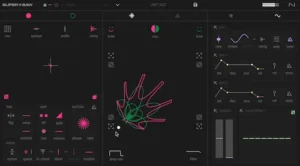
Super*Saw compresses much of that process into a dedicated environment. Its dual 16-voice oscillator banks provide the foundation immediately, allowing producers to focus on phrasing, harmony, and arrangement instead of constructing the oscillator stack from scratch every time.
This is also why direct comparisons with Serum, Pigments, Massive X, or Phase Plant can be misleading. Those synthesizers are designed as open-ended sound design platforms with significantly deeper modulation, routing, and oscillator capabilities. Super*Saw is intentionally narrower. It assumes the destination—a modern supersaw texture—and concentrates on reaching it with fewer production steps.
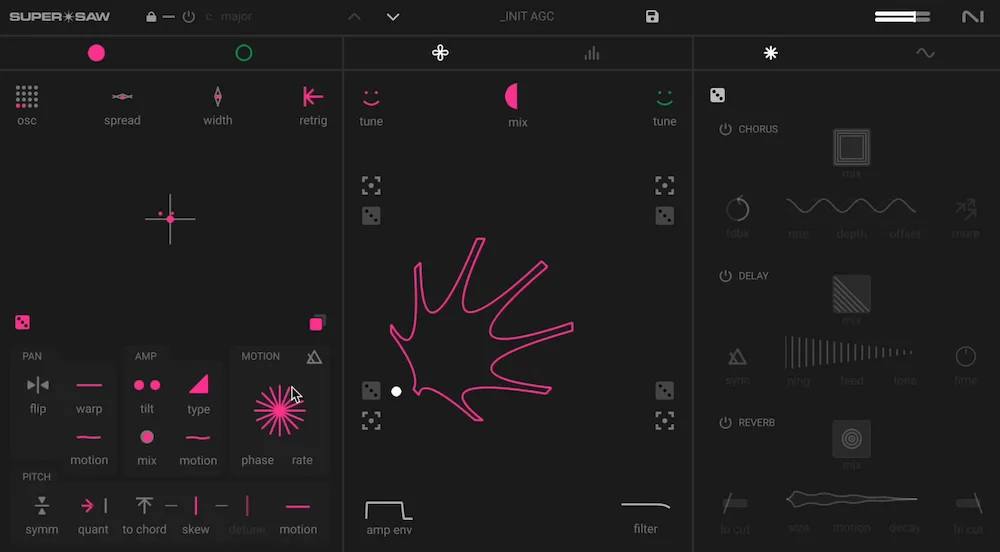
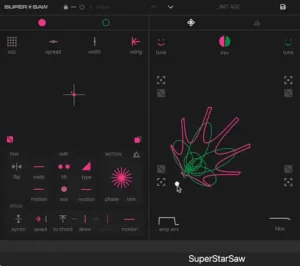
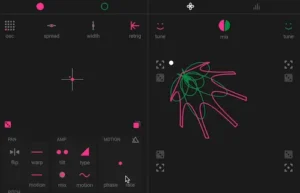
The most distinctive part of the instrument is its four-state morphing system. Instead of drawing automation across dozens of independent parameters, producers can interpolate between four complete sound variations using a single XY controller. In practice, that makes transitions between verses, choruses, breakdowns, and drops considerably easier to manage, particularly in productions where the lead synth continues evolving throughout the song.
The concept itself isn’t new. Parameter morphing has existed in software synthesis for years. What feels different here is the implementation. The feature sits at the center of the workflow rather than being buried inside a modulation matrix, encouraging producers to perform transitions instead of programming every movement manually.
Per-voice Glide and Offset controls address another common weakness of supersaw programming: excessive uniformity. Perfectly synchronized voices often sound impressive in isolation but can become static over the course of a full arrangement. Introducing subtle variation between voices creates movement that feels less mechanical without requiring elaborate modulation routing.
Chord, Scale, and Quantize functions continue the same philosophy. None of them expands the synthesizer’s capabilities in a technical sense, but each reduces interruptions during writing sessions. Instead of switching between MIDI editing, scale references, and synthesis parameters, producers can remain focused on composition. Producers interested in speeding up harmonic writing itself may also enjoy our Dystopian Waves Noesis review, which explores a complementary approach to generating chord progressions before they reach the synthesis stage.
The onboard effects are intentionally conservative. Chorus, delay, reverb, and a high-pass filter provide enough processing to sketch production-ready ideas, but they stop short of replacing dedicated mixing tools. That restraint is a sensible design decision. Professional productions rarely rely on stock synth effects alone, and keeping source generation separate from mix processing generally leads to more flexible sessions.
Integration with Komplete Kontrol and Maschine follows the same practical approach. Producers already invested in the Native Instruments ecosystem gain immediate hardware mapping and performance control, while users outside that ecosystem lose very little beyond additional convenience.
Perhaps the clearest indication of Super*Saw’s design philosophy is what it deliberately leaves out. There is no attempt to compete through wavetable innovation, granular synthesis, physical modeling, spectral processing, or AI-assisted sound generation. Native Instruments has focused on refining an established production workflow rather than expanding the boundaries of software synthesis.
Whether that specialization justifies another instrument ultimately depends on the producer. If supersaw textures appear in nearly every project, the workflow improvements are tangible. If they’re only an occasional requirement, broader synthesizers remain the more versatile long-term investment.
How Does Native Instruments Super*Saw Actually Sound?
Super*Saw doesn’t attempt to introduce a radically new sonic identity. Its character is immediately recognizable: dense, polished, wide, and intentionally modern. The instrument is clearly voiced for contemporary electronic production, where supersaw layers often carry the emotional weight of a chorus or drop.
Transient response is smooth rather than aggressive, allowing stacked voices to blend naturally without sounding brittle. Harmonic density is rich across the upper midrange, while stereo imaging feels expansive without becoming artificially exaggerated. Even heavily detuned patches retain definition, making them easier to position inside dense arrangements.
Pads benefit from the morphing architecture by evolving smoothly over time, while lead sounds maintain consistent energy throughout dynamic performances. Bass-oriented patches remain usable, although the synthesizer is not designed primarily as a dedicated low-frequency instrument.
Perhaps the strongest aspect of Super*Saw’s sound is consistency. The instrument produces polished source material with very little effort, allowing producers to spend less time correcting oscillator balance and more time refining arrangement, automation, and mixing decisions. From a mastering perspective, cleaner source sounds almost always translate into more predictable final results.
Super*Saw Advantages and Limitations
 Artist collaborations often generate more attention than meaningful engineering advances. Super*Saw avoids that trap to some extent. While A. G. Cook’s influence is visible in the instrument’s sonic direction and preset design, its real value comes from workflow decisions rather than celebrity branding.
The biggest advantage isn’t a new oscillator architecture or a breakthrough synthesis method. It’s the reduction of repetitive setup. Producers who regularly build layered supersaw patches already know the routine: configure unison voices, refine detune, balance stereo width, assign modulation, shape effects, then automate the entire patch as the arrangement develops. None of those steps is difficult, but repeating them across multiple projects adds measurable overhead.
Super*Saw reduces that preparation by starting much closer to the finished result. Instead of constructing a supersaw architecture from the ground up, producers can move directly into arrangement, performance, and automation. For commercial production where deadlines often matter more than experimentation, that’s a legitimate productivity gain.
The four-state morphing system is the clearest example. Rather than managing dozens of automation lanes independently, entire sound variations can evolve through a single performance control. That approach encourages producers to think about musical sections instead of individual parameter changes, simplifying projects that rely heavily on evolving synth textures.
None of this should be confused with a major DSP breakthrough. Parameter morphing, stacked oscillator synthesis, and per-voice modulation are all well-established techniques. Super*Saw’s contribution lies in packaging those ideas into a workflow that demands fewer repetitive decisions during composition.
That distinction becomes particularly important when comparing the instrument with established synthesizers. Producers expecting deeper wavetable editing, FM synthesis, modular routing, or experimental sound design will quickly reach the limits of its architecture. Those capabilities were never the design goal, and judging Super*Saw against them misses the point.
Sound quality deserves a similarly measured assessment. Native Instruments has delivered a polished synthesizer, but it has not fundamentally changed what modern software instruments are capable of producing. Well-programmed patches in Serum, Pigments, Phase Plant, or even Vital can achieve comparable harmonic density and stereo width. The differences heard in finished records are far more likely to come from arrangement choices, processing decisions, and mix execution than from the synthesizer itself.
That perspective also tempers expectations surrounding the A. G. Cook collaboration. His production aesthetic influences the instrument’s creative direction, but software cannot package artistic judgment. The records associated with his work reflect countless production decisions that extend well beyond oscillator design or preset selection.
In practice, Super*Saw succeeds not because it creates sounds unavailable elsewhere, but because it reaches familiar results with less preparation. Producers who spend much of their time writing modern electronic music will appreciate that efficiency. Those looking for the next major leap in synthesis technology are unlikely to find it here.
Native Instruments Super*Saw vs Other Software Synths
Comparing Super*Saw directly with flagship synthesizers can be misleading because the products solve different problems. Serum, Pigments, Massive X, Phase Plant, and Vital are designed as open-ended synthesis platforms. Super*Saw is a workflow instrument. The question isn’t which synth is more powerful—it’s whether reducing programming time justifies adding another instrument to an established production setup.
| Instrument | Core Focus | Workflow Speed | Sound Design Flexibility | Best Fit |
|---|---|---|---|---|
| Native Instruments Super*Saw | Dedicated supersaw production | Excellent | Moderate | Hyperpop, EDM, modern pop |
| Xfer Serum | Wavetable synthesis | Very Good | Excellent | Professional electronic production |
| Arturia Pigments | Hybrid synthesis | Good | Excellent | Broad sound design workflows |
| Kilohearts Phase Plant | Modular sound design | Moderate | Exceptional | Advanced synthesis |
| Vital | Modern wavetable synthesis | Very Good | Very High | Budget-conscious producers |
| Massive X | Complex routing and modulation | Moderate | Excellent | Experienced NI users |
Quick Specifications
| Specification | Details |
|---|---|
| Developer | Native Instruments |
| Product Type | Virtual Software Synthesizer |
| Primary Focus | Supersaw Production |
| Sound Engine | Dual 16-Voice Oscillator Architecture |
| Best Genres | Hyperpop, EDM, Trance, Synth-Pop, Modern Pop |
| Platform | macOS / Windows |
| Plugin Formats | VST3, AU, AAX |
| Copy Protection | Native Instruments Licensing |
| Biggest Strength | Workflow Efficiency |
| Main Limitation | Limited Sound Design Scope |
The comparison highlights Super*Saw’s biggest advantage: fewer decisions before music starts. Producers who regularly build supersaw-based arrangements can reach a usable sound significantly faster because much of the underlying architecture is already in place. That efficiency becomes increasingly valuable when writing under deadlines or moving through multiple revisions.
The equation changes for producers who already rely on carefully built Serum or Pigments templates. Many experienced users have spent years refining preset libraries, macro assignments, modulation schemes, and reusable session templates. In those studios, the practical time savings may be noticeable, but they are unlikely to transform an already efficient workflow.
Super*Saw also occupies a narrower creative space than its competitors. If a project demands wavetable editing, FM synthesis, granular processing, modular routing, or experimental sound design, broader synthesis platforms remain the better choice. The instrument is optimized for a specific production language rather than unrestricted exploration.
That specialization naturally defines its audience. Producers working in hyperpop, melodic EDM, trance, synth-pop, and modern commercial pop are far more likely to benefit than engineers whose work centers on recording bands, orchestral scoring, post-production, or mastering.
Viewed in context, Super*Saw isn’t competing to become the only synthesizer in a professional studio. Its role is much more focused: reducing the amount of repetitive programming required to create one of electronic music’s most widely used sound architectures.
Who Should Buy Native Instruments Super*Saw?
Super*Saw is designed for producers who build modern electronic music around evolving supersaw textures and value production speed as much as synthesis depth. While it won’t replace a full-featured flagship synthesizer, it can significantly reduce repetitive programming in genres where these sounds appear in almost every project.
Ideal For
- Hyperpop producers
- EDM and festival music producers
- Trance producers
- Modern pop songwriters
- Creators working under tight production deadlines
- Native Instruments ecosystem users
Probably Not Ideal For
- Experimental sound designers
- Modular synthesis enthusiasts
- Film and orchestral composers
- Producers seeking one all-purpose synthesizer
Best Uses
| Application | Rating |
|---|---|
| Hyperpop | ★★★★★ |
| EDM | ★★★★★ |
| Trance | ★★★★★ |
| Synth-Pop | ★★★★☆ |
| Commercial Pop | ★★★★☆ |
| Cinematic | ★★★☆☆ |
| Experimental Sound Design | ★★★☆☆ |
Mixing and Mastering With Super*Saw
 A synthesizer shouldn’t be judged solely by how it sounds in solo mode. The more revealing test comes later, when the arrangement fills out and every instrument begins competing for space. That’s where supersaw patches often become difficult to manage.
Large unison stacks naturally generate dense harmonic content across the upper midrange while occupying substantial stereo width. In sparse arrangements that can sound impressive. In fully developed productions, however, the same characteristics frequently compete with lead vocals, layered guitars, synth arpeggios, reverbs, and cymbal energy. Without careful arrangement, a supersaw can dominate far more of the mix than intended. If the arrangement also relies on synthesized low end, our Baby Audio SubCulture review examines another workflow-focused tool designed to reinforce bass while maintaining musical tracking and mix control.
Super*Saw doesn’t solve those problems automatically, nor should it. Good source material still requires disciplined engineering. High-pass filtering, dynamic EQ, automation, stereo management, and selective saturation remain essential tools for keeping dense synthesizer layers under control.
Where the instrument offers a practical advantage is earlier in the production process. Its morphing workflow encourages movement within a single performance rather than relying on duplicated tracks and multiple synth instances. That often results in cleaner sessions with fewer overlapping layers competing for the same frequency range.
From a mixing perspective, fewer redundant layers generally translate into faster decision-making. Managing one evolving instrument is usually more efficient than balancing several nearly identical supersaw tracks spread across the arrangement.
Translation remains the real benchmark. Wide supersaw patches that feel immersive on studio monitors can lose definition on headphones, compact Bluetooth speakers, laptops, and smartphones if the midrange becomes overcrowded. Mono compatibility also deserves attention, particularly when aggressive stereo widening and chorus processing are involved.
Nothing about Super*Saw changes those fundamentals. Professional mixers should continue checking mono fold-down, monitoring spectral balance, and evaluating how layered synths interact with vocals throughout the song rather than in isolation.
The same principle extends into mastering. Dense supersaw arrangements can consume headroom surprisingly quickly because sustained harmonic content continuously drives broadband energy into compressors and limiters. If those layers are not controlled during production and mixing, achieving competitive loudness without sacrificing clarity becomes noticeably more difficult. Preparing those synth-heavy mixes correctly before mastering is often more important than fixing problems later—something we explore in our Prepare Mix for Mastering guide.
CPU performance appears consistent with expectations for a modern unison-based synthesizer. Native Instruments has not introduced an unusually demanding synthesis architecture, although comprehensive third-party benchmark testing across large production sessions remains limited. Until broader independent measurements become available, workflow improvements should not be confused with measurable gains in CPU efficiency or project scalability.
Viewed from a production and mastering perspective, Super*Saw’s strongest contribution is indirect. It doesn’t improve translation, increase loudness, or replace careful mix engineering. Its value lies in producing cleaner source material earlier in the workflow, giving producers fewer technical problems to solve once the project reaches the mixing and mastering stages.
Pros & Cons
| Pros | Cons |
|---|---|
| Excellent workflow optimization | Limited synthesis depth |
| Fast supersaw programming | Narrow creative focus |
| Intuitive four-state morphing | Not intended for experimental sound design |
| Mix-ready source material | Premium pricing compared to some alternatives |
| Strong integration with Komplete Kontrol and Maschine | Best suited to a specific group of producers |
Verdict: Is Native Instruments Super*Saw Worth Buying?
Super*Saw succeeds because it solves a practical production problem rather than chasing another headline feature. Electronic producers have never lacked ways to build convincing supersaw sounds. What they often lack is a faster path from an initial idea to a finished arrangement without rebuilding the same oscillator stacks, modulation assignments, and automation from scratch.
Native Instruments has deliberately optimized that workflow instead of competing for the deepest synthesis engine. The result is a focused instrument that trades flexibility for efficiency. Whether that trade-off makes sense depends entirely on the type of music being produced.
For hyperpop, modern pop, trance, melodic EDM, and other synth-driven genres where layered supersaws appear in nearly every session, the time savings are genuine. The instrument reaches production-ready results quickly, encourages more performance-oriented automation, and keeps writing sessions moving without constant technical interruption. For independent producers building complete tracks in home studios, many of these workflow decisions also affect how well a mix translates into mastering, as discussed in our Mastering for Bedroom Producers guide.
Outside that niche, the value proposition becomes less compelling. Producers who already rely on well-developed Serum, Pigments, or Phase Plant workflows may discover that Super*Saw improves convenience more than capability. It complements those synthesizers rather than replacing them.
Its pricing reflects that specialization. At around $99, Super*Saw is unlikely to become an impulse purchase for every producer, particularly when powerful alternatives already exist. The investment is easiest to justify for writers who repeatedly build supersaw-based arrangements and place a premium on workflow efficiency.
Perhaps the most important conclusion is that Super*Saw should not be judged by the standards of a flagship synthesizer. It was never designed to compete through oscillator count, synthesis depth, or experimental sound design. Its purpose is considerably narrower—and within that scope, it performs well.
Native Instruments hasn’t introduced a new chapter in software synthesis. It has refined an existing production workflow. For the right producer, that may prove far more valuable than another long list of features.
Overall Rating
| Category | Rating |
|---|---|
| Sound Quality | 9.0/10 |
| Workflow | 9.7/10 |
| Mix Translation | 9.2/10 |
| CPU Efficiency | 8.8/10 |
| Sound Design Flexibility | 7.8/10 |
| Value for Money | 8.8/10 |
| Overall | 9.0/10 |
Super*Saw is not intended to replace flagship synthesizers or redefine software synthesis. Its strength lies in removing repetitive programming, accelerating supersaw production, and delivering polished source material that integrates naturally into modern electronic mixes. Producers working in EDM, hyperpop, trance, and contemporary pop will benefit the most from its focused design philosophy.
Why We Gave These Scores
Sound Quality — 9.0/10
The oscillator engine delivers dense, polished supersaw textures that compete comfortably with today’s leading software synthesizers. While it doesn’t introduce a fundamentally new sonic character, the instrument consistently produces professional-quality source material suitable for commercial releases.
Workflow — 9.7/10
This is where Super*Saw clearly distinguishes itself. Four-state morphing, dedicated supersaw controls, and streamlined performance features reduce repetitive programming and keep composition moving. For producers writing synth-driven music every day, the workflow improvements are immediately noticeable.
Mix Translation — 9.2/10
The instrument generates well-balanced source material that responds predictably during mixing. Dense supersaw layers still require proper EQ, automation, and stereo management, but Super*Saw avoids many of the inconsistencies that often appear in manually constructed oscillator stacks.
CPU Efficiency — 8.8/10
Considering the number of stacked voices and real-time modulation options, CPU performance remains well within expectations. Larger projects will naturally demand more processing power, but the instrument never feels unusually heavy compared to other modern software synths.
Sound Design Flexibility — 7.8/10
This is intentionally not an all-purpose synthesis platform. Producers seeking advanced wavetable editing, FM synthesis, granular processing, or modular routing will quickly encounter the boundaries of its architecture. The lower score reflects deliberate specialization rather than poor implementation.
Value for Money — 8.8/10
For producers who build supersaw-based arrangements regularly, the time saved across multiple projects can easily justify the purchase price. Those who only occasionally use this type of sound may find broader synthesizers offer better long-term value.

Yurii Ariefiev is a mastering engineer and audio production editor specializing in music production workflows, mixing translation, and mastering. His software reviews evaluate how instruments perform inside complete recording and production environments rather than focusing solely on specifications or marketing claims.
This review examines Native Instruments Super*Saw from the perspective of real-world electronic music production, assessing workflow efficiency, supersaw implementation, mix integration, and how source material ultimately affects the mastering stage and release-ready results.
Frequently Asked Questions
Is Super*Saw a replacement for Serum or Pigments?
No. Super*Saw is a specialized workflow instrument, not a full-featured synthesis platform. Serum, Pigments, Massive X, and Phase Plant remain better choices for advanced sound design, while Super*Saw focuses on creating polished supersaw textures with less programming.
What makes Super*Saw different from other software synths?
Its main advantage is workflow. Instead of offering the deepest synthesis engine, Super*Saw reduces the time required to build evolving supersaw patches through dedicated controls, four-state morphing, and performance-oriented design.
Does Super*Saw sound better than competing synthesizers?
Not inherently. Modern flagship synthesizers already deliver excellent sound quality. The practical difference is how quickly producers can reach usable results rather than any fundamental improvement in oscillator fidelity.
Which genres benefit most from Super*Saw?
The instrument is best suited to hyperpop, EDM, trance, synth-pop, melodic techno, and modern commercial pop, where layered supersaw textures regularly play a central role in the arrangement. Producers releasing electronic music may also find our EDM Mastering guide useful for understanding how dense synth arrangements behave during the mastering stage.
Is Super*Saw suitable for beginners?
It can be, but beginners interested in learning synthesis from first principles may gain more long-term value from broader instruments such as Serum, Pigments, or Vital before moving to specialized workflow tools.
How demanding is Super*Saw on CPU resources?
Current evidence suggests moderate CPU usage for a modern unison-based synthesizer. Independent benchmark testing across large production sessions is still limited, so exact performance will depend on patch complexity and host system.
Does Super*Saw work well with Komplete Kontrol and Maschine?
Yes. Native Instruments has integrated the instrument closely with both platforms, allowing immediate hardware control and a smoother production workflow for users already invested in the NI ecosystem.
Can professional producers recreate the same sounds with other synths?
Yes. Comparable supersaw sounds can be created in Serum, Pigments, Vital, Massive X, and similar synthesizers. Super*Saw’s advantage lies in reaching those results with fewer programming steps.
Is Super*Saw worth buying?
If supersaw-based production is part of your everyday workflow, the time savings can justify the price. Producers who only occasionally use these sounds may find a general-purpose synthesizer offers better overall value.