The Pultec EQP-1A remains one of the most influential equalizers ever built—not because it offers surgical precision, but because its passive EQ curves shape low-end and upper frequencies in ways that still sound remarkably musical. Those characteristics have made Pultec-style processing a fixture in professional mixing and audio mastering for decades.
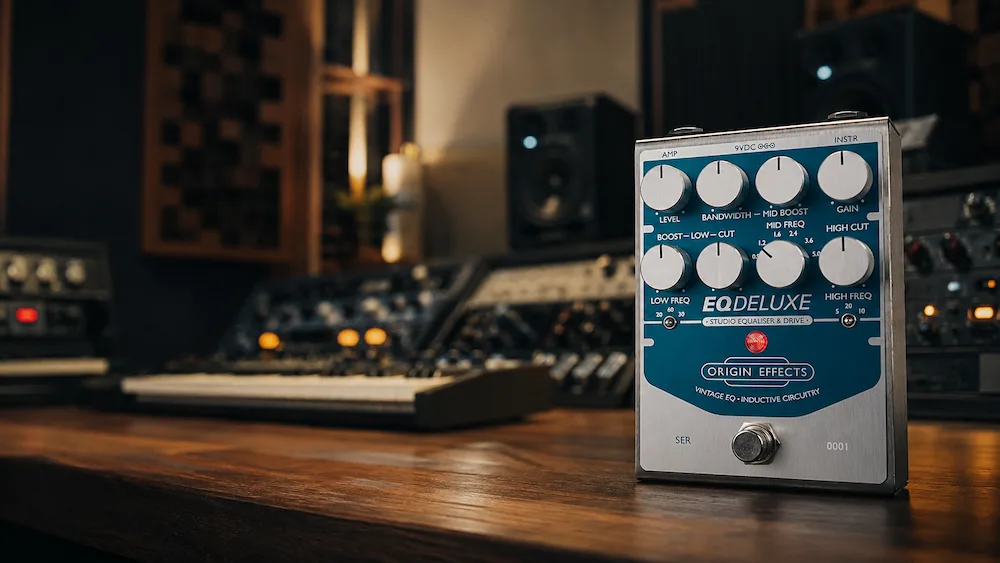
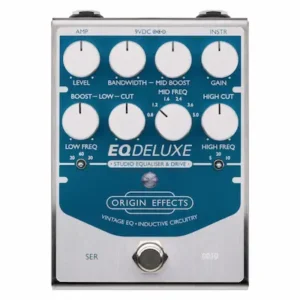
Origin Effects takes a different approach than most pedal manufacturers. Instead of building another flexible instrument EQ, EQDELUXE adapts the core workflow of a passive Pultec-style equalizer into an all-analog pedal designed for guitar and bass. It combines inductive EQ circuitry with a high-headroom analog signal path, making it suitable not only for pedalboards but also for recording interfaces, reamping chains, and hybrid studio setups.
The more important question isn’t how closely EQDELUXE resembles vintage rack hardware. It’s whether committing broad analog EQ before the signal reaches the DAW produces better recordings—and reduces the amount of corrective processing required during mixing. That distinction is also one of the practical differences between mixing and mastering, where tonal decisions become progressively broader as production moves toward the final release. That distinction ultimately determines whether EQDELUXE is a useful production tool or simply another boutique pedal aimed at vintage enthusiasts.
Why Studio-Grade Tone Shaping Is Moving Upstream in Modern Guitar Recording
 Modern guitar production has shifted from amplifier-first workflows to source-first workflows. High-quality amp simulators, convolution speaker cabinets, and professional DI recording have made it possible to postpone amplifier decisions until mixing. As a result, engineers increasingly focus on capturing a better signal before it reaches the converter rather than relying entirely on corrective processing later.
That shift has renewed interest in analog front-end processing. Instead of inserting hardware across an entire mix, many producers now reserve analog equipment for the recording stage, where subtle EQ, compression, and harmonic enhancement influence every processor that follows. A well-shaped source generally requires fewer corrective plugins, fewer aggressive EQ moves, and less time spent chasing balance during mixing.
Origin Effects has consistently targeted this workflow. Products like the Cali76 compressor earned a reputation by adapting respected studio circuits for instrument-level recording rather than simply recreating familiar hardware aesthetics. EQDELUXE follows the same philosophy, but with a more ambitious reference point: the passive equalization topology of the Pultec EQP-1A.
That choice is significant because a Pultec was never designed as a corrective equalizer. Its passive inductive filters produce broad, overlapping curves that shape tone without sounding overly processed. Engineers reach for a Pultec to add weight, smooth upper frequencies, or improve tonal balance—not to remove narrow resonances or perform surgical frequency repair. Those characteristics remain just as relevant in today’s hybrid recording environments as they were in traditional analog studios.
Modern digital equalizers excel at precision, but precision is not always the goal. Extremely narrow filters, steep slopes, and visually driven editing often solve technical problems while making instruments feel less cohesive. Passive equalization takes the opposite approach. Wide curves alter the spectral balance more organically, allowing instruments to retain their natural dynamics and harmonic relationships instead of sounding aggressively reshaped.
This philosophy has become increasingly attractive as pedalboards evolve into portable recording front ends. Compressors, studio preamps, console-inspired circuits, tape saturation, and transformer-based coloration now appear alongside traditional effects because many players want to capture a finished sound instead of building it entirely inside the DAW. The line between a pedalboard and a recording signal chain is becoming increasingly difficult to define.
EQDELUXE enters this market as a dedicated tone-shaping processor rather than a conventional EQ pedal. Its strongest application is during tracking, particularly for clean guitar and bass DI recordings where broad analog contouring influences everything that follows, from amplifier modeling to compression and final mix decisions.
That positioning also explains why the pedal should not be evaluated against traditional stompboxes alone. Its real competition includes software Pultec emulations, studio equalizers, and hybrid recording workflows that postpone tonal decisions until mixing. The practical question is whether committing analog EQ before conversion produces a better foundation than relying exclusively on plugins after the recording is complete.
Hear What Better Source Material Can Become
Even the best analog front-end can’t replace professional mastering. If you’ve invested time in capturing great performances and shaping your tone at the source, upload up to 35 seconds of your mix and receive a free mastering demo. Compare your original mix with a professionally mastered version and hear how much more detail, balance, and translation your track can achieve.
Request your free mastering demo →
Inside EQDELUXE: What the Analog Circuit Actually Brings to a Recording Session
EQDELUXE deliberately avoids the feature-rich approach of modern EQ pedals. Instead of offering continuously variable bands, programmable presets, or surgical control, it focuses on reproducing the broad, interactive behavior that made passive Pultec equalizers valuable in recording studios. Whether that limitation is a strength or a weakness depends entirely on how you approach tracking.
At the center of the design is an all-analog inductive equalizer. Unlike active EQ circuits that generate highly controlled filter shapes through op-amp networks, inductive filters interact more broadly across the frequency spectrum. Their response is less precise, but often more forgiving, making tonal adjustments feel integrated rather than imposed. That characteristic explains why passive EQs remain common on mix buses and individual instruments despite the availability of technically superior digital equalizers.
The defining feature is the independent low-frequency boost and attenuation controls inherited from the original Pultec concept. Used together, they create a broad resonant contour rather than a simple bass boost. In practical terms, the technique can increase perceived weight while preventing uncontrolled sub-bass buildup—a balance that is particularly useful for bass guitar and clean electric guitar entering an amp simulator.
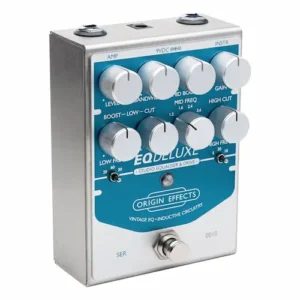
Unlike the original rack unit, EQDELUXE limits frequency choices to values that make sense for guitar and bass. The reduced control set inevitably sacrifices flexibility, but it also speeds up decision-making during recording. Instead of searching through dozens of frequencies, engineers are encouraged to make tonal choices quickly and move on to performance.
The midrange section follows the same philosophy. Rather than functioning as a corrective equalizer, it emphasizes broad presence shaping across the frequencies responsible for articulation, pick definition, and note separation. It is designed to influence how an instrument occupies space in a mix—not to solve resonance problems.
The treble section is arguably the most unconventional part of the pedal. Rather than providing a high-frequency boost, it offers shelving attenuation, mirroring the workflow of classic passive equalizers. Engineers accustomed to modern plugin EQs may initially see this as a limitation, but gentle top-end reduction often produces smoother results than aggressive high-frequency enhancement, particularly with bright single-coil pickups or direct-recorded bass.
Beyond equalization, EQDELUXE incorporates a discrete analog output stage intended to emulate the behavior of the original push-pull tube amplifier. The effect is subtle. It does not function as a saturation processor or console emulator, but the additional harmonic content can slightly increase perceived density before the signal reaches compression, amplifier modeling, or further analog processing.
Another design choice with genuine studio relevance is its high internal headroom. Unlike many instrument pedals that become difficult to integrate into professional recording chains, EQDELUXE is capable of operating comfortably with interfaces, reamping systems, and line-level studio equipment. That makes it equally viable on a pedalboard or as part of a hybrid recording setup.
In practice, the pedal is likely to benefit bass recording more than heavily distorted guitar. A clean DI bass captured with carefully shaped low end often requires less corrective EQ later, while pre-EQ before an amp simulator can influence distortion characteristics in a way that post-processing cannot fully replicate. The same principle applies to gain staging with fuzz circuits, as explored in our Electro-Harmonix Deluxe Big Muff Pi 2 review, where the signal entering the circuit has a significant impact on the final texture and harmonic response.
That also defines the pedal’s limitations. EQDELUXE is not intended for resonance removal, detailed tonal correction, or fully recallable production workflows. Engineers who rely on automation, precise frequency targeting, stereo processing, or instant session recall will continue to accomplish those tasks more efficiently with software. EQDELUXE is designed for committing musical decisions during tracking—not replacing a modern parametric equalizer.
The Trade-Offs: Where EQDELUXE Excels—and Where It Doesn’t
 EQDELUXE is easy to misunderstand if you approach it like a conventional EQ pedal. It isn’t designed to fix problematic recordings, remove cabinet resonances, tame harsh microphones, or replace a fully parametric equalizer. Like the original Pultec, its strength lies in shaping an already solid source rather than repairing a flawed one.
That distinction is often lost in discussions surrounding Pultec-inspired hardware. The reputation of the original EQP-1A has created the impression that its curves somehow improve everything they touch. In practice, experienced engineers reach for passive EQ only after the recording already sounds fundamentally right. It is a finishing tool, not a corrective one.
EQDELUXE follows the same principle. Broad inductive curves can add weight to a bass DI, soften an aggressive top end, or improve the balance of a clean guitar before it reaches an amplifier or interface. They cannot compensate for poor microphone placement, inconsistent playing, excessive room coloration, or an instrument that simply doesn’t sound good to begin with.
The simplified control layout also deserves a realistic assessment. Fixed frequency selections make the pedal fast to operate, but they also define its limitations. If the problem sits between available frequency points—or requires a narrow corrective cut—there is little the pedal can do. Those tasks remain firmly in the domain of a modern parametric EQ.
Its output stage should be viewed with similar restraint. The additional harmonic content is subtle enough to influence the feel of a recording, but not enough to replace a dedicated preamp, tape machine, console channel, or saturation processor. Engineers expecting obvious analog coloration may find the effect more restrained than anticipated.
The largest unanswered question concerns authenticity. Origin Effects states that EQDELUXE recreates the behavior of a Pultec EQP-1A, but no independent laboratory measurements currently verify how closely the pedal matches the frequency response, phase characteristics, harmonic structure, or transformer behavior of an original unit. Until controlled comparisons become available, the claim should be viewed as a design objective rather than a measurable conclusion.
Workflow presents another compromise. In an era of instant project recall, analog hardware inevitably introduces friction. EQDELUXE offers no presets, automation, or session integration, meaning every adjustment must be recreated manually if a client requests revisions weeks later. Engineers who routinely manage large commercial projects may see that as a meaningful drawback, while those who prefer committing sounds during tracking are unlikely to consider it an issue.
Price is equally dependent on perspective. Compared with premium analog hardware, EQDELUXE is relatively accessible. Compared with today’s software ecosystem, however, it occupies a niche where several high-quality Pultec emulations cost considerably less while offering unlimited instances, total recall, stereo processing, and deeper control.
None of these compromises undermine the pedal’s purpose. They simply define it more clearly. EQDELUXE is built for engineers who believe the best place to shape tone is before recording—not during mix revision. Outside that workflow, its advantages become considerably less compelling.
Independent Measurements: What We Know—and What Still Needs Verification
Origin Effects describes EQDELUXE as a faithful analog interpretation of the classic Pultec EQP-1A, but detailed laboratory measurements have not yet been published. Without independent bench testing, several important engineering characteristics remain unverified.
| Measurement | Status | Why It Matters |
|---|---|---|
| Frequency Response | Not independently published | Shows how closely the EQ curves follow a traditional passive Pultec topology. |
| Total Harmonic Distortion (THD) | Not independently published | Quantifies harmonic coloration introduced by the analog output stage. |
| Noise Floor | Not independently published | Determines suitability for clean DI recording and high-gain workflows. |
| Maximum Headroom | Manufacturer claims high headroom | Defines compatibility with line-level studio equipment and reamping chains. |
| Dynamic Range | Not independently published | Indicates how comfortably transient-rich sources can be processed. |
| Phase Response | Not independently published | Helps explain the musical behavior associated with passive inductive equalizers. |
None of these missing measurements prevent EQDELUXE from being useful in professional recording sessions. They simply limit how closely its behavior can be compared with vintage Pultec hardware until independent laboratory testing becomes available.
What We’d Still Like to Measure
EQDELUXE makes several engineering claims that deserve independent verification. Future laboratory testing would provide a clearer picture of how closely the pedal follows the behavior of classic passive studio equalizers.
- Frequency sweeps using Audio Precision APx555 or equivalent analyzer
- REW frequency-response measurements at multiple gain settings
- THD and harmonic spectrum analysis across different output levels
- Phase-response comparison against an original Pultec EQP-1A
- Noise-floor measurements for DI recording applications
- Maximum input and output headroom before clipping
- Output-stage saturation curve at progressive drive levels
- Blind listening comparison against leading software Pultec emulations
Those results would make it easier to distinguish measurable engineering performance from subjective listening impressions.
Where EQDELUXE Fits Among Today’s Analog and Digital EQ Options
EQDELUXE doesn’t compete with every EQ on the market. It occupies a much narrower space where tracking decisions take priority over post-production flexibility. Comparing it directly with a modern parametric EQ—or even with a software Pultec emulation—can be misleading because each tool is designed for a different stage of the production process.
The closest hardware comparison is the Empress ParaEQ Deluxe. Both are premium analog pedals, but they solve different problems. The ParaEQ functions as a precision instrument with fully parametric bands and adjustable Q, making it better suited for corrective work, live rigs, and detailed tonal control. EQDELUXE, by contrast, trades precision for broad musical shaping. It is less flexible, but considerably faster when the goal is committing a finished sound during tracking.
Digital multi-effects platforms such as the Line 6 HX Stomp, Neural DSP Quad Cortex, and Fractal Audio Axe-Fx offer an entirely different value proposition. Their EQ blocks can approximate similar tonal balances while adding amp modeling, effects, automation, presets, and complex routing. From a purely functional standpoint, they are vastly more capable. What they cannot replicate is the workflow of committing analog processing before A/D conversion or the subtle interaction between analog circuitry and the instrument feeding it.
The comparison becomes more interesting when software Pultec emulations enter the discussion. Plugins from Universal Audio, Softube, Acustica Audio, and Pulsar Audio provide exceptional recreations of passive equalization with the advantages of total recall, stereo processing, oversampling, and unlimited instances. For mixing and mastering, those plugins remain the more practical solution.
EQDELUXE serves a different purpose. It shapes the instrument before recording, influencing every processor that follows—from amp simulators and compressors to transient response and harmonic development. That isn’t inherently better than software, but it is fundamentally different. Engineers who routinely build tones at the tracking stage will recognize the advantage immediately. Those who prefer making every tonal decision during mixing probably won’t.
| Product | Best For | Where It Excels | Where EQDELUXE Has the Edge |
|---|---|---|---|
| Origin Effects EQDELUXE | Analog tracking | Broad passive EQ, zero latency, front-end tone shaping | — |
| Empress ParaEQ Deluxe | Precision EQ | Fully parametric control, corrective work, live flexibility | More musical passive curves during tracking |
| Boss EQ-200 | Digital pedalboards | Presets, MIDI, stereo operation, extensive routing | Entirely analog signal path with no conversion |
| Line 6 HX Stomp | Complete guitar production | Amp modeling, effects, snapshots, automation | Dedicated analog front-end processing |
| UAD Pultec EQ Collection | Professional mixing | Recall, stereo processing, multiple instances | Shapes tone before recording rather than afterward |
| Softube Passive-Active Pack / Pulsar Massive | Passive EQ mixing workflows | Studio recall, oversampling, mastering applications | Hardware integration during tracking |
Viewed through that lens, EQDELUXE is neither the most versatile nor the most economical option. Its value depends almost entirely on workflow. Engineers who routinely commit analog tone while recording will likely appreciate what it offers. Those working almost exclusively inside the DAW will achieve similar tonal results with considerably more flexibility using software.
Studio Test Scenarios
| Recording Scenario | Recommendation | Engineering Perspective |
|---|---|---|
| Clean DI Bass | Highly Recommended | Excellent application for broad passive low-end shaping before compression or amp simulation. |
| Clean Electric Guitar | Highly Recommended | Improves harmonic balance before entering an amplifier or amp simulator. |
| Edge-of-Breakup Guitar | Recommended | Pre-EQ changes gain structure more naturally than corrective EQ after distortion. |
| High-Gain Metal Guitar | Situational | Benefits become less obvious once heavy distortion dominates the harmonic content. |
| Acoustic Guitar | Situational | Useful for subtle tonal shaping but not a substitute for microphone placement. |
| Stereo Mix Bus | Not Recommended | Software or dedicated mastering hardware offers greater precision and recall. |
| Master Bus | Not Recommended | Outside the intended application of the pedal. |
Example Signal Chains
The following examples illustrate where EQDELUXE fits most naturally within a modern hybrid recording workflow.
| Application | Typical Signal Chain |
|---|---|
| Bass DI Recording | Bass → EQDELUXE → FET Compressor → Audio Interface → DAW |
| Guitar with Amp Simulator | Guitar → EQDELUXE → Audio Interface → Amp Simulator → Cabinet IR → DAW |
| Reamping Workflow | Recorded DI → Reamp Box → EQDELUXE → Guitar Amplifier → Microphone → Interface |
| Hybrid Analog Tracking | Instrument → EQDELUXE → Analog Preamp → Audio Interface → DAW |
How EQDELUXE Fits Into a Professional Recording Workflow
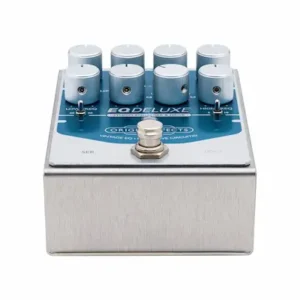 EQDELUXE delivers its greatest value during tracking rather than mixing. Instead of treating equalization as a corrective step after recording, the pedal encourages engineers to establish tonal balance before the signal reaches the converter. That approach doesn’t eliminate mixing decisions, but it often reduces the amount of corrective processing required later.
The effect is most apparent on bass. Broad passive low-frequency shaping can produce a fuller foundation without introducing the narrow resonances that frequently require additional cleanup during mixing. Capturing that balance at the source often leaves compressors, amp simulators, and subsequent EQ stages working with a more stable signal.
Guitar recording benefits differently. Because amplifiers and amp simulators respond dynamically to frequency content, even subtle changes before the gain stage influence harmonic development, transient response, and perceived articulation. Controlling excessive low end before distortion typically produces a tighter result than attempting to repair the sound after saturation has already been generated.
Those advantages depend heavily on monitoring accuracy. Engineers working in well-calibrated rooms are far more likely to hear the subtle tonal changes introduced by broad passive equalization. In less controlled environments, the differences may be too small to justify dedicated analog hardware over a high-quality software EQ.
EQDELUXE has little direct application during mastering. It is neither intended nor configured for stereo bus processing, and software equalizers remain substantially more practical at the final stage of production. Its contribution is indirect: stronger source material generally requires fewer broad tonal corrections later in the production chain—a principle discussed in our Prepare Mix for Mastering guide.
The pedal also reflects a different production philosophy. Modern software emphasizes flexibility through unlimited revisions, automation, and instant recall. EQDELUXE encourages commitment instead. That same engineering mindset appears in our Drawmer OC1 vs FC1 review, where tracking decisions prove just as important as processing choices later in the mix. Engineers who prefer shaping sounds during recording will likely appreciate this workflow, while those who postpone tonal decisions until mixing may see little practical advantage over existing plugins.
Viewed in that context, EQDELUXE is less an alternative to digital equalization than an analog front-end processor designed to improve source material before mixing begins. For studios that still prioritize recording quality over post-production correction, that remains a relevant—and increasingly uncommon—approach.
Verdict: Built for Engineers Who Commit Tone at the Source
EQDELUXE isn’t trying to replace the equalizers already living inside your DAW. Its purpose is much narrower: shaping the instrument before recording so that every processor downstream starts with a stronger signal. Whether that philosophy makes sense depends almost entirely on how you build a production.
If your workflow revolves around editing, automation, instant recall, and making tonal decisions during mixing, software remains the more practical choice. Modern plugins provide greater precision, lower cost, and virtually unlimited flexibility.
EQDELUXE becomes far more compelling in studios where source quality takes priority over post-production correction. Broad passive EQ combined with subtle harmonic enhancement can influence amplifier response, compression, and overall instrument balance in ways that are difficult to recreate once the performance has already been recorded.
Its limitations are equally clear. This is not a corrective equalizer, a mastering processor, or a replacement for a modern parametric EQ. Fixed frequency selections, the absence of recall, and a premium price make it a specialized tool rather than a universal recommendation.
For engineers who regularly track guitar and bass, however, specialization is exactly the point. EQDELUXE encourages decisions that many modern workflows postpone until mixing. When those decisions are made well, the reward isn’t a dramatically different sound—it’s a recording that requires fewer compromises throughout the rest of the production process.
Viewed through that lens, EQDELUXE succeeds on its own terms. It doesn’t modernize the Pultec concept or attempt to outperform software. Instead, it applies a proven studio philosophy to instrument tracking in a way that feels practical, thoughtfully engineered, and likely to remain relevant long after the excitement surrounding a new product release has faded.
Who Should Skip EQDELUXE—and Buy Software Instead?
EQDELUXE isn’t a universal recommendation. Engineers working almost entirely inside the DAW will generally achieve better value with high-quality Pultec-style plugins that offer total recall, stereo processing, unlimited instances, and far greater flexibility.
The pedal is also difficult to justify if your workflow depends on precise corrective equalization, detailed automation, or rapid client revisions across multiple projects. Likewise, producers who rarely record live guitar or bass are unlikely to benefit from a dedicated analog front-end processor.
If your productions begin with virtual instruments rather than microphones or DI recordings, software remains the more efficient and economical choice.
Independent Engineering Rating
| Category | Rating |
|---|---|
| Analog Tone Shaping | 9.5/10 |
| Tracking Workflow | 9.5/10 |
| Studio Integration | 8.5/10 |
| Versatility | 7.5/10 |
| Build & Engineering | 9.5/10 |
| Value for Money | 8.5/10 |
| Overall | 8.8/10 |
Analog Tone Shaping — 9.5/10
EQDELUXE delivers exactly what a passive Pultec-inspired circuit is expected to do: broad, musical contouring that enhances guitars and bass without sounding exaggerated. It isn’t designed for corrective work, but within its intended role the tonal results are consistently convincing.
Tracking Workflow — 9.5/10
The pedal encourages engineers to make confident decisions before recording instead of relying on extensive corrective processing later. That workflow aligns closely with professional tracking practices and can reduce unnecessary plugin processing throughout a project.
Studio Integration — 8.5/10
Its high-headroom analog design allows EQDELUXE to work comfortably with interfaces, reamping systems, and hybrid recording chains rather than functioning only as a traditional pedal. The lack of presets and instant recall prevents a higher score in modern production environments.
Versatility — 7.5/10
This is a specialized processor, not a universal equalizer. Fixed frequency selections, the absence of parametric control, and its instrument-focused design intentionally limit its range of applications.
Build & Engineering — 9.5/10
Origin Effects has earned a strong reputation for manufacturing quality, and EQDELUXE follows that standard. The analog circuit design, premium components, and thoughtful implementation reflect long-term studio use rather than short-lived product trends.
Value for Money — 8.5/10
For engineers who regularly track guitar and bass through analog front-end equipment, the investment is justified by workflow and source quality. Producers working almost entirely inside the DAW will likely achieve a better return from high-quality Pultec-style plugins.
Overall — 8.8/10
EQDELUXE succeeds because it focuses on one job instead of trying to replace an entire studio toolbox. It won’t outperform modern software in flexibility, but it offers a genuinely musical analog workflow that rewards engineers who prefer shaping tone before the recording stage rather than fixing it afterward.
Great Recordings Still Need Great Mastering
Capturing better tone at the source is one of the smartest production decisions you can make—but it isn’t the final one. A professional master refines balance, depth, dynamics, and translation so your music performs consistently across studio monitors, headphones, cars, and streaming platforms without sacrificing the character you worked to create.
The easiest way to judge the difference is by listening. Upload up to 35 seconds of your mix and receive a free mastering demo prepared by a professional mastering engineer. Hear what your track can sound like before committing to a full master.
Request your free mastering demo →
Frequently Asked Questions
Can EQDELUXE be used before an amp simulator?
Yes. In fact, that’s one of its strongest use cases. Applying broad passive EQ before an amp simulator changes how the virtual amplifier responds, often producing tighter low end and more natural harmonic development than applying EQ after distortion.
Is EQDELUXE better for bass or guitar?
Both benefit, but bass is likely to show the biggest improvement. The Pultec-style low-frequency boost-and-cut interaction can add weight while maintaining definition, making it particularly effective for clean DI bass recordings.
Can EQDELUXE replace a studio Pultec EQ?
No. It borrows the operating philosophy of the original EQP-1A but is optimized for instrument-level processing rather than full-range studio applications. Mixing and mastering still benefit from dedicated hardware or software Pultec equalizers.
Where should EQDELUXE be placed in a signal chain?
For recording, it generally works best before an amplifier, amp simulator, or recording interface. Placing broad EQ ahead of gain stages changes how later processors respond instead of simply altering the finished tone.
Does EQDELUXE work well for reamping?
Yes. Because it supports higher signal levels than many traditional pedals, it integrates well into reamping workflows where engineers want to shape tone before feeding an amplifier or amp simulator.
Is EQDELUXE useful for live performance?
It can be, but its strengths are easier to appreciate in a controlled recording environment. Live players needing extensive flexibility, presets, or rapid scene changes may find digital processors more practical.
Does EQDELUXE require additional EQ during mixing?
Usually yes. The pedal is intended to improve source material, not eliminate mixing decisions. Most recordings will still benefit from context-specific EQ once they sit alongside the rest of the arrangement.
Who should consider software instead?
Engineers working entirely inside the DAW, producers who depend on instant recall, and users requiring surgical frequency correction will generally achieve better value with modern Pultec-style plugins.
Is EQDELUXE worth the price?
For studios that routinely record guitar and bass through analog front-end equipment, the investment can be justified by workflow and source quality. For predominantly software-based production, plugins deliver greater flexibility at a significantly lower cost.
Is EQDELUXE likely to remain relevant over the long term?
Probably. The pedal is built around a recording technique that has remained useful for decades rather than a temporary production trend. Its longevity will depend more on changing studio workflows than on changing technology.

Yurii Ariefiev is a mastering engineer and audio production editor specializing in recording, mixing, and mastering workflows. His reviews examine how analog hardware, studio tools, and production techniques affect source quality, mix translation, and the final master rather than focusing solely on specifications or marketing claims.
This editorial evaluates Origin Effects EQDELUXE from the perspective of real recording sessions, exploring where passive analog EQ improves guitar and bass tracking, where software remains the better choice, and how stronger source material influences every stage of production through to mastering.