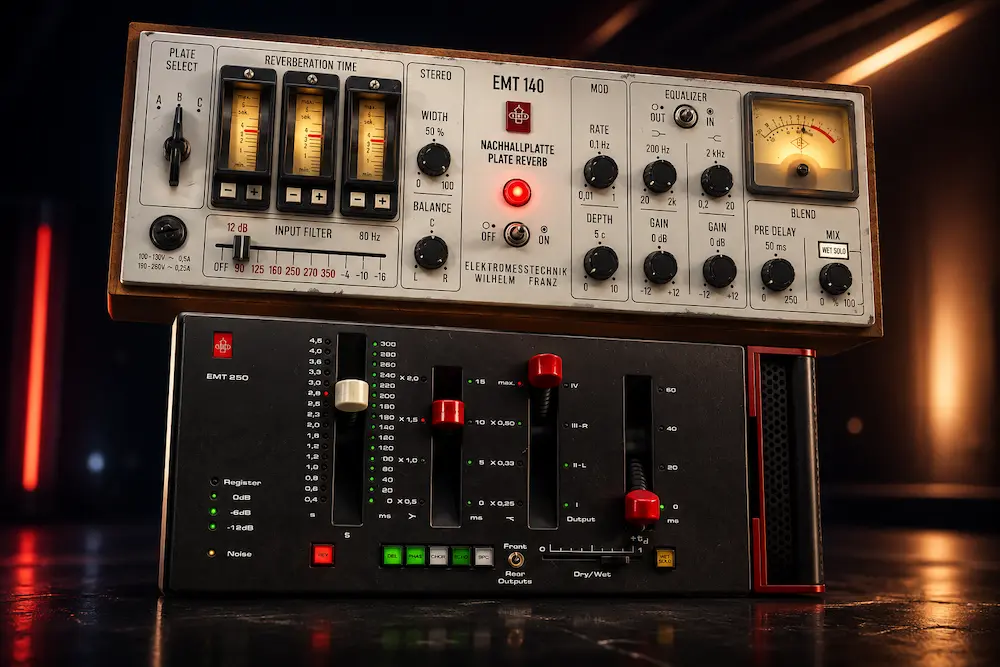
Few software reverbs have earned the long-term reputation of Universal Audio’s EMT 140 Classic Plate Reverberator and EMT 250 Classic Electronic Reverb. Their sound has never been the issue. Availability has. For nearly two decades, both plugins remained exclusive to Apollo interfaces and UAD-2 DSP systems, placing them outside the workflow of many engineers who had already standardized on native processing.
That restriction is now gone. The EMT 140 and EMT 250 run as native VST3, AU, and AAX plugins without dedicated DSP hardware, putting them in direct competition with established reverb platforms from Valhalla DSP, LiquidSonics, Relab Development, Softube, and Eventide. This isn’t a new generation of processing or a redesigned algorithm. It’s the same modeling released into a completely different market.
That shift raises a more practical question than whether the reverbs sound good—they already proved that years ago. The real question is whether they still earn a place in a modern mixing, mastering, and audio production workflow where high-end native reverbs are no longer difficult to find.
This review looks beyond the native release itself. Instead of repeating Universal Audio’s feature list, we’ll examine how both plugins perform in contemporary production, where they continue to excel, where newer alternatives offer clear advantages, and whether their reputation still translates into measurable value inside a professional mix.
Technical Specifications
| Developer | Universal Audio |
| Products | EMT 140 Classic Plate Reverberator, EMT 250 Classic Electronic Reverb |
| Plugin Formats | VST3, AU, AAX |
| Platforms | macOS, Windows |
| Apple Silicon | Native supported |
| Processing | Native CPU (no Apollo or UAD-2 required) |
| Authorization | iLok Cloud or UA Connect |
| Upgrade | Discount available for existing UAD DSP owners |
| Release Type | Native migration of existing DSP plugins |
System Compatibility
| Supported DAWs | Pro Tools, Logic Pro, Cubase, Nuendo, Studio One, REAPER, Ableton Live, FL Studio and other VST3, AU or AAX compatible hosts |
| Operating Systems | Current supported versions of macOS and Windows |
| Apple Silicon | Supported |
| Intel CPUs | Supported |
On This Page
Why Native Availability Changes the Conversation Around the EMT 140 and EMT 250
 Reverb plugins no longer compete on sound quality alone. Most professional engineers already own several excellent options, whether algorithmic, convolution-based, or physically modeled. The buying decision has shifted toward workflow, consistency, CPU efficiency, and how quickly a processor delivers a result inside a real production session.
That shift explains why Universal Audio’s native release matters more than the addition of another vintage reverb. The EMT 140 and EMT 250 have been respected studio tools for years, but they remained tied to Apollo interfaces and UAD-2 DSP cards. For engineers working across commercial studios, remote sessions, laptops, or hybrid production environments, that dependency often outweighed the benefits of the reverbs themselves.
Running natively removes that limitation. Projects can move freely between systems without dedicated hardware, revisions become easier to exchange, and mobile production no longer requires planning around DSP availability. None of those changes affects the sound, but all of them affect how often the plugins are actually used.
That distinction is increasingly important because today’s production environment looks very different from the one these plugins entered nearly two decades ago. Large sessions routinely exceed one hundred tracks, parallel processing has become standard practice, and engineers often move the same project between multiple studios before release. Under those conditions, portability is no longer a convenience—it is part of the production workflow.
The competitive landscape has changed just as dramatically. Valhalla DSP established a new benchmark for affordable algorithmic reverbs. LiquidSonics pushed convolution realism closer to high-end hardware. Relab Development recreated classic Lexicon processors with remarkable accuracy, while Eventide continues to dominate creative spatial effects. Universal Audio is no longer competing against limited software options; it is entering one of the most mature plugin categories in professional audio.
That makes the real question surprisingly simple. Does authentic EMT modeling still provide something engineers cannot easily replace with newer alternatives?
For the EMT 140, the answer remains largely yes. Plate reverbs occupy a unique position in modern mixing because they reinforce depth without introducing the obvious room reflections associated with realistic acoustic spaces. Dense vocal productions, close-miked drums, electric guitars, and acoustic instruments often benefit from a plate that extends sustain while preserving forward presence. Even in mixes targeting aggressive streaming loudness, a well-tuned plate typically occupies less spectral space than a conventional room or hall algorithm, making it easier to preserve clarity while meeting modern LUFS targets.
The EMT 140’s character is also unusually practical. Rather than chasing absolute realism, it creates a controlled decay that remains stable under heavy compression and parallel processing. That predictability explains why plate reverbs continue to appear in commercial productions despite enormous advances in room simulation.
The EMT 250 serves an entirely different purpose. Released during the earliest generation of digital reverbs, it never attempted to recreate physical spaces with complete accuracy. Instead, its modulation became part of the effect itself. Vocals, synthesizers, orchestral textures, guitars, and pads gain movement that feels integrated into the source rather than layered on top of it.
Ironically, that character has become more distinctive over time. Many modern reverbs pursue transparency and realism, while the EMT 250 deliberately embraces coloration. Instead of disappearing into a mix, it contributes depth, width, and motion in ways that remain immediately recognizable to experienced engineers.
Neither plugin survives because of nostalgia alone. Both continue to solve production problems efficiently. Engineers rarely choose them to simulate physical rooms with scientific precision. They choose them because they reach a familiar musical result quickly, behave consistently across different material, and require surprisingly little corrective processing after the initial setup.
That may be the strongest argument for their continued relevance. In an era where flagship reverbs offer hundreds of parameters, modulation systems, and routing possibilities, the EMT 140 and EMT 250 remain focused tools. They ask for fewer decisions, encourage faster mixing, and reward engineers who already know the sound they’re chasing. The native release doesn’t change that philosophy—it simply removes the last major obstacle that kept these classic reverbs outside many modern production workflows.
What Has Actually Changed?
Despite the attention surrounding this release, the underlying reverb engines remain the same. Universal Audio has not redesigned the EMT 140 or EMT 250, introduced new algorithms, or altered their sonic character. The primary change is how the plugins fit into a modern production workflow.
| Previous Release | Native Release |
|---|---|
| Apollo / UAD-2 DSP required | Runs directly on native CPU |
| Hardware-dependent sessions | Portable across any compatible DAW |
| Limited mobile workflow | Laptop-friendly production |
| DSP resource limitations | Limited only by available CPU power |
| Existing UAD licensing | Upgrade pricing for DSP owners |
For engineers already familiar with the original DSP versions, this is fundamentally a workflow update rather than a sound update. The value comes from removing hardware dependency—not changing the behavior of the reverbs themselves.
Hear What Professional Mastering Can Add to Your Mix
A great mix doesn’t always become a great master on its own. Subtle adjustments to tonal balance, stereo depth, dynamics, and translation can make the difference between a track that only sounds good in the studio and one that holds up across streaming platforms and real-world playback systems. Upload up to 35 seconds of your mix and receive a free mastering demo prepared by a mastering engineer. Compare the result with your original mix before deciding whether to move forward.
Request your free mastering demo →
Why the EMT 140 and EMT 250 Still Belong in Professional Mixes
Although Universal Audio released the EMT 140 and EMT 250 together, they serve fundamentally different purposes. Treating them as interchangeable reverbs misses the point. The EMT 140 is designed to reinforce a source without calling attention to itself, while the EMT 250 introduces movement and personality as part of the effect. In practice, they solve different mixing problems.
The EMT 140 remains one of the strongest examples of why plate reverbs have survived every major shift in audio production. Unlike rooms or halls, a well-designed plate adds sustain and depth without pushing the source backward in the mix. Lead vocals stay present, snare drums gain weight without excessive ambience, and guitars or pianos sit deeper in the stereo image while retaining definition. That balance is difficult to achieve with larger algorithmic spaces, particularly in dense modern productions.
Universal Audio based the plugin on three individual EMT 140 plates from The Plant Studios rather than averaging the characteristics of multiple units into a single model. That decision proves more useful than it initially sounds because each plate behaves like a separate piece of hardware instead of a tonal variation hidden behind preset names.
Plates A and B deliver the darker, slightly softer response associated with older EMT electronics. Their decay naturally stays out of the way of bright vocal chains, distorted guitars, and modern drum production, often requiring little or no additional EQ on the return channel.
Plate C, modeled after a fully restored unit fitted with Martech electronics, offers noticeably greater top-end extension and transient definition. On cleaner arrangements, acoustic recordings, or productions that depend on vocal clarity, it preserves more detail without becoming brittle. Rather than simply sounding brighter, it responds like a better-maintained piece of hardware.
The practical advantage is consistency. Instead of reaching for corrective equalizers after inserting the reverb, engineers can often choose the plate whose natural frequency balance already complements the source. That shortens decision-making, reduces unnecessary processing, and keeps the ambience sounding more cohesive throughout the mix.
Universal Audio wisely resisted the temptation to modernize the EMT 140 beyond recognition. The plugin adds practical controls—pre-delay, stereo width, balance, modulation, and a two-band shelving EQ—but leaves the core behavior of the original plate intact. These additions aren’t about expanding the sound; they’re about reducing the amount of corrective processing needed once the reverb is already sitting in the mix.
The damping controls remain one of the EMT 140’s defining strengths. Because they influence the decay itself rather than simply filtering the return signal, tonal adjustments feel more natural than applying aggressive EQ after the fact. In practice, vocals, acoustic instruments, and snare drums often require less additional shaping before the reverb finds its place.
Versatility has never been the EMT 140’s objective. It isn’t built to cover every reverb application, nor does it compete with feature-rich spatial processors aimed at post-production or immersive audio. Its value comes from consistency. Insert it on the right source, make a handful of adjustments, and it reaches a finished result with very little effort.
The EMT 250 follows a different philosophy altogether. Rather than simulating a believable acoustic environment, it uses modulation as part of the reverb’s musical character. Vocals gain motion without becoming unstable, sustained guitars remain wide without sounding detached, and synthesizers develop depth that feels integrated into the performance instead of layered on afterward.
Universal Audio modeled the plugin from a vintage EMT 250 at Ocean Way Recording while adding a handful of workflow improvements expected in a modern DAW. Integrated Dry/Wet control, Wet Solo, and Hard Bypass eliminate routing work that engineers previously handled outside the plugin. They’re small additions individually, but together they make the software considerably easier to use during fast-paced mix sessions.
The EMT 250 also includes delay, chorus, phasing, and echo modes derived from the same processing architecture. While dedicated modulation plugins provide greater flexibility, these effects share the same tonal character as the reverb, making them useful when a production benefits from a cohesive spatial signature instead of combining unrelated processors.
Neither plugin attempts to simplify mixing by making creative decisions on the user’s behalf. Parameter choices still matter, and achieving the best results depends on understanding source material, arrangement, and gain structure. That may seem old-fashioned compared to increasingly automated processors, but experienced engineers often prefer tools that respond predictably instead of trying to interpret artistic intent.
That predictability is ultimately what keeps both reverbs relevant. Modern flagship reverbs continue to accumulate features, modulation systems, dynamic controls, and increasingly complex interfaces. The EMT 140 and EMT 250 move in the opposite direction. They encourage fast decisions, reward familiarity, and rarely require extensive tweaking once inserted into a session.
The same strengths carry into mastering, although in much narrower roles. Neither plugin is intended to become an always-on mastering reverb. Used sparingly, however, the EMT 140 can restore depth without masking transients, while the EMT 250 adds subtle dimensional movement to ambient, orchestral, and cinematic material. Both remain easy to control under subsequent limiting because they avoid exaggerated resonances and overly bright decay tails.
The native release also improves everyday production in ways that have nothing to do with sound quality. Multiple instances are practical on current desktop CPUs, projects open without waiting for external DSP hardware, and sessions move freely between studios, laptops, and remote collaborators. Those workflow improvements may not be as exciting as new DSP technology, but they remove one of the few remaining reasons engineers avoided incorporating these reverbs into native production environments.
Where the EMT Reverbs Show Their Age
 Universal Audio isn’t selling a new generation of reverb processing. It’s bringing two established processors into a native workflow. That distinction matters because expectations around this release often exceed what the plugins actually aim to deliver.
The core DSP has not been redesigned. Engineers already familiar with the Apollo versions will hear essentially the same reverberation, the same modulation, and the same tonal behavior. The improvement is operational rather than sonic. Projects become easier to move between systems, but the character of the reverbs remains unchanged.
That also means the EMT 140 and EMT 250 don’t compete by offering the longest feature list. Modern flagship reverbs routinely include dynamic ducking, multiband decay shaping, immersive formats, sophisticated modulation systems, and extensive automation options. Universal Audio deliberately avoids that direction. Both plugins remain focused on reproducing the behavior of specific hardware rather than becoming comprehensive spatial design tools.
Whether that feels limiting depends entirely on the workflow. Engineers who prefer a processor that reaches a finished sound quickly will likely appreciate the restrained control set. Those working in immersive audio, complex post-production, or cinematic sound design may find themselves reaching for more flexible alternatives.
The interface reflects the same philosophy. Universal Audio has preserved the familiar layout instead of redesigning the plugins around modern workflow trends. The controls remain straightforward, but users accustomed to advanced preset management, deeper visual feedback, or highly customizable interfaces may find the experience comparatively traditional.
Another consideration is redundancy. Few professional engineers purchase these plugins as their first reverb. More often, they already own products from Valhalla DSP, LiquidSonics, Relab Development, Eventide, or similar developers. In that context, the EMT collection rarely replaces existing tools. Instead, it adds another recognizable texture to an already established palette.
Pricing reinforces that position. Even with Universal Audio’s frequent promotions, the EMT plugins remain premium products. For engineers building a studio from scratch, the same budget may deliver greater overall value through a more versatile flagship reverb. The EMT 140 and EMT 250 become easier to justify once the core reverb toolbox is already in place.
Viewed realistically, the native release is less about discovering a new sound than removing the last practical barrier to using an old one. That may not sound revolutionary, but for engineers who have wanted the EMT character without committing to dedicated DSP hardware, it is arguably the most meaningful improvement Universal Audio could have made without changing the reverbs themselves.
How the EMT 140 and EMT 250 Stack Up Against Today’s Leading Native Reverbs
Native compatibility places the EMT 140 and EMT 250 in direct competition with some of the strongest reverb plugins currently available. Unlike twenty years ago, professional engineers rarely choose between a hardware ecosystem and native processing—they choose between several mature, highly capable reverbs that each solve different production problems.
That makes direct comparisons more useful than broad claims about sound quality. The EMT plugins are not designed to outperform every modern reverb. They succeed because they occupy a very specific place within a professional mixing workflow.
| Plugin | Excels At | Best Applications | Where the EMT Plugins Have the Edge | Where the Alternative Pulls Ahead |
|---|---|---|---|---|
| Valhalla Plate | Flexible modern plate processing | General mixing | More authentic vintage plate behavior | Greater flexibility and lower cost |
| Valhalla VintageVerb | Broad algorithm selection | All-purpose production | More recognizable EMT character | Far wider range of reverb types |
| LiquidSonics Seventh Heaven | Realistic acoustic depth | Orchestral, film scoring | More focused plate coloration | Superior room realism |
| Relab LX480 Complete | Classic Lexicon ambience | Large mix spaces | Denser plate texture and simpler workflow | Greater routing and modulation flexibility |
| Eventide Blackhole | Creative spatial effects | Sound design, cinematic production | More natural integration into conventional mixes | Far more experimental processing |
The comparison highlights an important point: the EMT plugins are rarely chosen because they offer the largest feature set. They are chosen because they require remarkably little work once inserted into a mix. Vocals settle naturally without excessive EQ, snare drums gain sustain without becoming washed out, and instruments retain definition even when the decay becomes relatively long.
That behavior is difficult to quantify in a specification sheet, yet it explains why many experienced engineers continue using these reverbs alongside significantly newer processors. They are reliable, predictable, and easy to place inside dense arrangements where more configurable reverbs often encourage unnecessary tweaking.
The opposite is equally true. Engineers looking for immersive formats, advanced modulation, dynamic ducking, or highly configurable room design will find more capable options elsewhere. Producers whose work leans toward cinematic sound design or experimental convolution processing may also want to consider tools like Heavyocity VAST, which approaches spatial processing from an entirely different creative angle.
Ultimately, these plugins complement rather than replace a modern reverb collection. A producer building a first professional toolkit will often achieve better overall value with a versatile flagship reverb. Engineers who already own comprehensive spatial processors are far more likely to appreciate what the EMT plugins actually contribute: a familiar tonal signature, consistent behavior under demanding mix conditions, and a workflow that reaches finished results with very little intervention.
How the EMT Reverbs Perform in Real Mixing Sessions
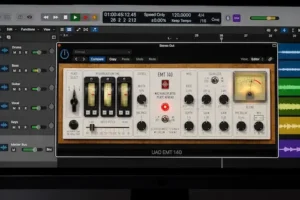 A great reverb isn’t judged in solo. It earns its place once the mix becomes dense, buses start compressing, the limiter comes online, and the project goes through multiple client revisions. That’s where the EMT 140 and EMT 250 continue to justify their reputation.
The EMT 140 remains particularly effective on heavily compressed vocals. Modern vocal chains often include serial compression, saturation, automation, and parallel processing before the reverb is even introduced. Many contemporary reverbs become overly bright or develop an upper-mid haze under those conditions. Engineers looking for a more adaptive approach to vocal ambience may also find it useful to compare this classic plate workflow with newer processors such as FRCTL Audio AURA, which tackles vocal clarity from a very different perspective.
The same applies to snare drums. Instead of producing an obvious reverb tail, the plate reinforces body and sustain while preserving transient impact. That balance tends to survive limiting and AAC or Ogg Vorbis encoding better than brighter algorithmic reverbs, which can become noticeably harsher after streaming conversion—a behavior that’s also important when mastering for streaming platforms.
The EMT 250 succeeds for different reasons. It isn’t the first choice when realism is the goal, but it excels whenever controlled movement is more valuable than an accurate room simulation. Pads, synthesizers, electric guitars, and orchestral layers gain width and subtle modulation that remains musical instead of drawing attention to the effect itself.
Both reverbs also translate remarkably well across different monitoring systems. Nearfields, headphones, consumer speakers, and streaming playback all emphasize different parts of the reverb spectrum, yet neither plugin tends to produce unpleasant surprises when a mix leaves the studio. That consistency is one of the reasons experienced engineers continue returning to these processors despite having access to newer alternatives.
Mastering applications are naturally more limited. Neither plugin belongs on every project, but both can solve specific spatial problems when used conservatively. The EMT 140 is particularly effective for restoring perceived depth after dense mix processing, while the EMT 250 can introduce subtle dimensional movement to ambient, orchestral, or cinematic material without destabilizing the stereo image before final limiting. Placement matters as much as processor choice, especially within the overall mastering chain.
Performance has also improved in practical ways now that the plugins run natively. Multiple instances are no longer constrained by available DSP, session templates open without external hardware checks, and archived projects are considerably easier to revisit years later. None of those improvements changes the sound, but all of them remove friction from day-to-day production.
Best Applications
While both reverbs overlap in some situations, each has clear strengths depending on the source material. The summary below reflects where the EMT 140 and EMT 250 consistently perform best in real-world mixing sessions rather than isolated listening tests.
| Source | EMT 140 | EMT 250 |
|---|---|---|
| Lead Vocals | ★★★★★ | ★★★★☆ |
| Snare Drum | ★★★★★ | ★★★☆☆ |
| Electric Guitar | ★★★★★ | ★★★★☆ |
| Piano | ★★★★★ | ★★★★☆ |
| Synth Pads | ★★★☆☆ | ★★★★★ |
| Orchestral | ★★★☆☆ | ★★★★★ |
| Film Scoring | ★★★☆☆ | ★★★★★ |
| Mastering | ★★★☆☆ | ★★☆☆☆ |
Who Should Buy the EMT 140, the EMT 250, or Both?
| Recommended If… | Consider Other Options If… | |
|---|---|---|
| EMT 140 | You primarily mix vocals, drums, guitars, acoustic instruments, or want a classic plate that requires minimal adjustment. | You need one highly flexible reverb covering rooms, halls, immersive formats, and sound design. |
| EMT 250 | You want vintage digital modulation, width, and movement for synths, orchestral material, ambient production, or cinematic work. | Your priority is transparent room simulation or realistic acoustic spaces. |
| Both Plugins | You already own general-purpose reverbs and want two classic studio processors with distinctive personalities. | You’re building your very first professional reverb collection. |
No single option is objectively better. The right choice depends on whether you need a dependable vintage plate, a character-rich digital reverb, or simply want to expand an already mature collection with two processors that have remained relevant for decades.
Verdict
The native release doesn’t change what the EMT 140 and EMT 250 sound like. It changes who can realistically use them. By removing the Apollo and UAD-2 requirement, Universal Audio has turned two respected studio processors into practical options for any modern native workflow.
That alone doesn’t make them the best reverbs on the market. They aren’t designed to compete with highly configurable spatial processors or replace every room, hall, or atmospheric effect in a session. Their strength lies elsewhere: they solve familiar mixing problems quickly, predictably, and with very little corrective work.
The EMT 140 remains one of the finest software plate reverbs available, particularly for vocals, snare drums, guitars, and acoustic instruments that need depth without sacrificing presence. The EMT 250 continues to offer something many contemporary reverbs intentionally avoid—a distinctive sense of movement and musical coloration that still feels relevant in modern productions.
Engineers building a first reverb collection may achieve better overall value from a more versatile flagship processor. Those who already own a comprehensive toolkit are far more likely to appreciate what the EMT plugins actually contribute: a proven sound, consistent behavior across different material, and the ability to reach finished mixes with minimal adjustment.
Universal Audio didn’t reinvent these reverbs because they didn’t need reinventing. The native release simply removes the last practical obstacle to using two processors that have already proven their value in professional studios. For experienced mix engineers, that’s a far more meaningful improvement than another headline feature.
Your Mix Is Only Half the Story
Even the best reverbs can’t compensate for problems that only become obvious during mastering. Stereo depth, tonal balance, low-end control, transient impact, and streaming translation are determined by the final decisions—not by adding another plugin to the mix.
If you’re curious how much your track can improve before release, upload up to 35 seconds and receive a free mastering demo created by a professional mastering engineer. Compare your original mix with the mastered version and judge the difference using your own monitors, headphones, or speakers before committing to a full project.
Request your free mastering demo →
FAQ
Does the UAD EMT 140 or EMT 250 require an Apollo interface?
No. The native versions run as VST3, AU, and AAX plugins on macOS and Windows without Apollo hardware or a UAD-2 DSP accelerator.
Is the EMT 140 still one of the best plate reverb plugins?
Yes. Despite its age, the EMT 140 remains one of the strongest software plate reverbs for vocals, snare drums, guitars, and acoustic instruments. Its dense decay and predictable tonal balance continue to make it a favorite among professional mix engineers.
What’s the difference between the EMT 140 and EMT 250?
The EMT 140 is a classic plate reverb designed to add depth while preserving source clarity. The EMT 250 is an early digital algorithmic reverb that emphasizes modulation, movement, and musical coloration rather than realistic room simulation.
Is the EMT 250 good for modern music production?
Yes. While it originated in the 1970s, its modulation remains effective on modern vocals, synthesizers, guitars, pads, and cinematic productions where subtle movement is more desirable than transparent ambience.
How does the EMT 140 compare to Valhalla Plate?
Valhalla Plate offers greater flexibility and lower cost, while the EMT 140 focuses on authentic vintage plate behavior. Engineers seeking classic EMT character often prefer Universal Audio’s modeling, whereas producers looking for a wider range of plate sounds may find Valhalla Plate more versatile.
Can the EMT 140 or EMT 250 be used for mastering?
Yes, but selectively. Both plugins work best for subtle spatial enhancement rather than obvious ambience. Conservative settings can restore depth without compromising stereo stability or loudness during final limiting.
Do the native versions sound different from the original UAD DSP plugins?
No. Universal Audio retained the original DSP models. The native release changes how the plugins run, not how they sound.
Are the EMT plugins worth buying if you already own other premium reverbs?
That depends on your workflow. They are unlikely to replace a modern flagship reverb, but they remain valuable for engineers who want authentic EMT character, predictable behavior, and faster decision-making during mixing.
Who benefits most from the native release?
Mix engineers, producers, and studio professionals who work across multiple computers or collaborate remotely gain the most. Native compatibility removes the hardware dependency that previously limited where the plugins could be used.

Yurii Ariefiev is a mastering engineer and audio production editor specializing in critical evaluations of mixing and mastering tools used in professional studio workflows. His reviews focus on how plugins behave inside finished productions rather than how they perform in isolated demonstrations or manufacturer feature lists.
This analysis examines the UAD EMT 140 and EMT 250 from the perspective of real-world mixing, stereo translation, mastering compatibility, workflow efficiency, and long-term production value, helping engineers determine where these classic reverbs still outperform newer alternatives.