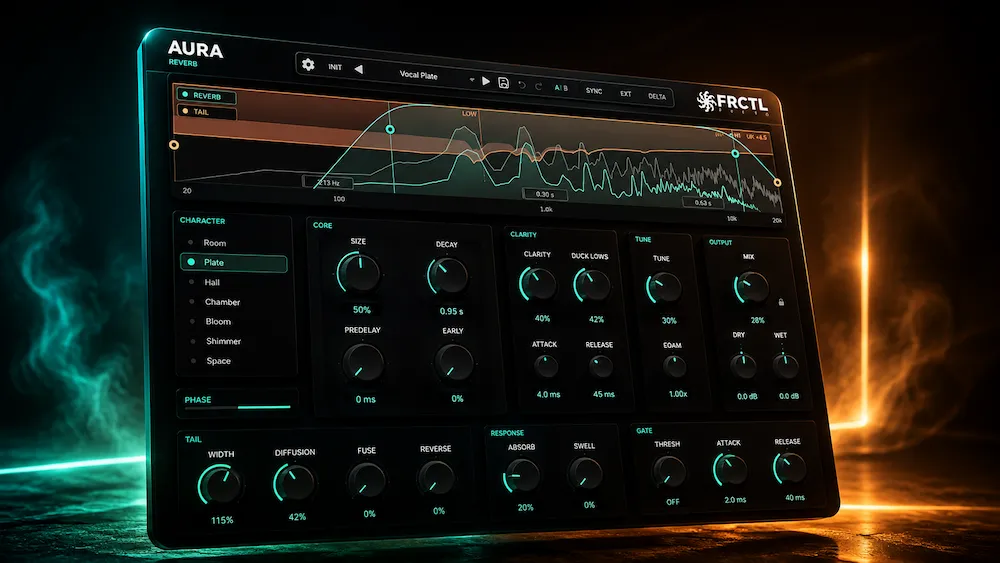
Reverb rarely ruins a mix because it sounds bad. More often, it creates masking that blurs vocal articulation, softens transients, and forces engineers into an increasingly complex chain of corrective processing. A modern vocal reverb bus commonly includes dynamic EQ, sidechain compression, return automation, and multiple tonal adjustments—not to improve the reverb itself, but to stop it from competing with the source.
FRCTL Audio AURA approaches that problem from a different angle. Rather than treating ducking, masking control, and decay management as separate tasks, it builds them directly into the reverb engine. Its adaptive processing continuously reshapes the tail according to the incoming signal, aiming to preserve clarity without relying on external routing or automation.
That’s a meaningful distinction, but it also raises an obvious question: does AURA introduce a genuinely more efficient mixing workflow, or does it simply consolidate techniques engineers already achieve with existing tools? The answer matters because today’s productions demand both speed and repeatability. Dense vocal arrangements, layered synths, and loud commercial mixes leave little room for ambience that isn’t carefully controlled.
This review focuses on practical studio use rather than launch-day claims. Instead of repeating the feature list, we’ll examine how AURA performs inside real mixing sessions, where its adaptive DSP offers measurable advantages, where traditional workflows remain more effective, and whether it earns a place alongside established reverb plugins used in professional audio production.
Contents
Why Modern Mixes Demand More Than Static Reverb
 Algorithmic reverb has matured to the point where raw sound quality is rarely the deciding factor. Whether you’re using a flagship processor or a budget plugin, convincing halls, plates, chambers, and rooms are no longer difficult to find. The real challenge isn’t generating an impressive space—it’s preventing that space from competing with the mix.
Today’s productions are considerably denser than those of a decade ago. A typical pop or hip-hop session may include stacked lead vocals, doubles, harmonies, layered synths, programmed drums, parallel effects, and multiple ambience buses, all sharing the same spectral real estate. In that environment, reverb is no longer just an effect; it’s another element fighting for clarity.
Traditional algorithmic reverbs are fundamentally passive processors. Once a decay is generated, it follows the parameters you’ve defined, regardless of whether the arrangement suddenly becomes denser, a vocal phrase begins, or a snare fill briefly dominates the mix. The algorithm has no awareness of musical context—it simply reproduces the same acoustic behavior throughout the session.
Engineers compensate by building increasingly sophisticated control chains around the reverb rather than relying on the reverb itself. A modern vocal return commonly includes corrective EQ, dynamic EQ, sidechain compression, automation, and additional tonal shaping before the ambience reaches the mix bus.
- Pre-EQ to remove unnecessary low-frequency energy.
- Dynamic EQ to reduce frequency-specific masking.
- Sidechain compression keyed from the lead vocal.
- Automation for phrase-by-phrase decay control.
- Post-processing to refine the return without affecting the dry signal.
None of these processors make the reverb sound inherently better. They exist to solve problems created by static ambience inside increasingly complex productions.
The issue becomes even more apparent in commercial pop, hip-hop, EDM, and spoken-word production, where vocal intelligibility must survive aggressive limiting, streaming normalization, and lossy codec encoding. A reverb that feels balanced on full-range studio monitors can quickly become smeared on earbuds, smartphones, or Bluetooth speakers once the mix is encoded for distribution.
As a result, engineers increasingly treat ambience as a dynamic process rather than a fixed acoustic environment. Instead of asking, “How does this hall sound?” the more relevant question becomes, “How does this hall behave as the arrangement changes?”
Several developers have addressed portions of that problem through dynamic reverbs, intelligent ducking, or spectral masking control. What’s far less common is designing those behaviors into the reverb engine itself instead of relying on external processors.
That is the design philosophy behind AURA.
Rather than presenting adaptive processing as an optional enhancement, AURA treats it as part of the room model. The goal isn’t to decide how much reverb a mix should have—that remains a creative choice—but to manage how that reverb interacts with constantly changing musical material.
Whether that approach succeeds depends entirely on implementation. Audio production has no shortage of processors promising to automate engineering decisions, yet experienced mixers have learned that automation is only valuable when it consistently reaches the same conclusion they would have reached manually. Adaptive DSP earns its place by eliminating repetitive technical work, not by replacing critical listening or creative judgment.
Hear What Better Mix Translation Really Sounds Like
Plugins can help control masking, but they can’t replace experienced mastering decisions. If you want to hear how much more clarity, depth, punch, and translation your mix can achieve, upload up to 35 seconds of your track and receive a free professional mastering demo. Compare your original mix with a professionally mastered version before deciding whether to move forward.
Request your free mastering demo →
Inside AURA’s DSP: Practical Innovation or Smarter Packaging?
Most algorithmic reverbs still follow the same operating model they’ve used for decades. Size, decay, damping, diffusion, modulation, predelay, and EQ define the acoustic space before playback begins, but the room itself remains static. Aside from internal modulation, the algorithm has no awareness of whether the arrangement becomes denser, a vocal enters, or a transient suddenly dominates the mix.
AURA takes a different approach. Instead of introducing another collection of room algorithms, it treats adaptation as part of the reverb engine itself. The question isn’t whether it generates a better hall or plate, but whether it reduces the amount of processing normally required to keep those spaces under control.
The centerpiece of that workflow is CLARITY. Although it resembles a conventional ducking control, its underlying objective is more ambitious. Traditional sidechain ducking attenuates the entire return whenever the source exceeds a threshold, regardless of which frequencies are actually creating the conflict. That often removes useful ambience along with the masking, causing the reverb to pump unnaturally or collapse during prominent vocal passages.
FRCTL instead describes CLARITY as frequency-dependent masking control. Rather than lowering the complete return, the processor dynamically reduces only the spectral regions occupied by the dry signal while leaving unrelated portions of the decay intact. If the implementation performs as advertised, this represents a meaningful shift from broadband attenuation to adaptive spectral management.
The practical difference becomes obvious in a vocal mix. Conventional ducking suppresses low-end warmth, upper-air reflections, and stereo width together because the entire return follows the sidechain. A frequency-aware approach can preserve much of that spatial information while selectively reducing only the bands competing with vocal intelligibility. The perceived room remains stable instead of audibly ducking between phrases.
That same principle extends beyond lead vocals. Electric guitars, orchestral brass, solo strings, synth leads, and spoken dialogue all create localized masking that changes continuously throughout an arrangement. Spectral adaptation addresses the conflict itself rather than reducing ambience indiscriminately.
AURA also separates itself from conventional dynamic reverbs by adapting decay time instead of output level. Its ABSORB and SWELL controls reportedly modify RT60 in real time as musical density changes. That’s an important distinction because many engineers don’t actually want less reverb—they want a room that behaves differently as the arrangement evolves.
Traditional automation achieves that by riding send levels or muting long tails during busy passages. Adjusting decay instead produces a subtler result. The ambience contracts naturally when the mix becomes crowded and expands again as space opens up, preserving a sense of depth without obvious level modulation. From a psychoacoustic perspective, that more closely resembles how listeners perceive changing acoustic environments than simple gain reduction.
The most technically ambitious feature is TUNE. According to FRCTL, it tracks incoming pitch and reshapes the decay around harmonic content instead of relying solely on static equalization. In theory, that allows the processor to reduce masking between successive notes without permanently removing those frequencies from the reverb itself.
If implemented accurately, harmonic-aware decay shaping could solve one of the long-standing compromises of static EQ. A fixed cut that improves clarity for one note often removes desirable ambience from the next. Dynamic harmonic processing offers a more elegant solution, although its success will ultimately depend on tracking accuracy, processing speed, and artifact-free behavior under complex musical material. Those claims still require independent verification.
Equally important is understanding what AURA is not trying to become. It isn’t presented as a vintage Lexicon emulation, an EMT plate recreation, or a convolution processor competing with meticulously sampled acoustic spaces. Engineers seeking iconic hardware tone or absolute room realism will continue to reach for specialized reverbs built around those goals.
AURA targets a different problem altogether. Its primary value lies in reducing the amount of manual intervention required to keep ambience transparent inside dense modern productions. In that sense, it behaves less like another algorithmic reverb and more like an intelligent workflow processor that happens to generate reverb.
How AURA Changes the Mixing Workflow in Practice
 AURA shouldn’t be judged solely by the character of its reverb algorithms. Its more significant contribution is workflow. Premium reverbs already deliver convincing halls, plates, and chambers; the time-consuming part of modern mixing is rarely selecting a reverb but managing its interaction with an increasingly dense arrangement.
A contemporary vocal session often includes multiple lead takes, doubles, harmonies, ad-libs, delays, and several ambience returns. Keeping those effects transparent typically requires a combination of automation, sidechain compression, dynamic EQ, and repeated fine-tuning as the arrangement evolves.
Most of that work isn’t creative. It’s corrective. Engineers aren’t shaping the artistic character of the reverb—they’re preventing it from masking lyrics, blurring transients, or accumulating energy during dense sections.
That shift reflects a broader change in plugin design. Rather than offering more controls, many newer processors attempt to eliminate repetitive mix maintenance while leaving creative decisions in the engineer’s hands. We discussed the same philosophy in our Emetic DSP Parametic & Smile Bus 3000 review, where intelligent processing was evaluated primarily by the amount of routine work it could remove from a modern mixing session.
If AURA’s adaptive processing performs consistently, it has the potential to remove a substantial portion of those routine adjustments. That doesn’t eliminate automation altogether. Throw effects, dramatic reverb swells, and transitions between song sections remain creative decisions that benefit from manual control. What adaptive DSP can reduce is the repetitive maintenance required to keep ambience out of the way.
That distinction is more important than it first appears. Modern commercial production is increasingly driven by efficiency. Sessions continue growing in track count while revision cycles become shorter, leaving less time for engineers to rebuild supporting processing every time a vocal is replaced or an arrangement changes.
Under a traditional workflow, even relatively small revisions often require checking sidechain thresholds, automation timing, dynamic EQ behavior, and return balance. Because AURA reacts directly to the incoming material, those secondary processors may require fewer manual adjustments after each revision, particularly in vocal-heavy productions.
The practical benefit depends on musical context. Sparse acoustic arrangements rarely demand complex ambience management, so adaptive processing offers only incremental gains. Dense pop, hip-hop, EDM, and hybrid cinematic productions present a much stronger use case because masking changes continuously as instruments enter and leave the mix.
The same principle applies outside vocal production. Lead synthesizers competing with wide atmospheric effects, orchestral sections sharing long reverbs, or spoken-word recordings that require space without sacrificing intelligibility all present variations of the same engineering problem: preserving information while maintaining depth.
Whether experienced mixers ultimately trust those decisions depends less on the adaptive processing itself than on transparency. Professional engineers are generally skeptical of processors that make hidden decisions on their behalf. AURA addresses that concern with DELTA monitoring, allowing engineers to audition only the material removed by the CLARITY algorithm instead of accepting the result as a black box.
That may prove to be one of the plugin’s most valuable design choices. Exposing the processor’s decisions makes adaptive DSP easier to evaluate, troubleshoot, and trust during critical mixing work—an advantage that extends well beyond visual metering or marketing terminology.
Which Innovations Are Real—and Which Still Need Proof?
“Adaptive” has become one of the most overused terms in audio software. It’s now attached to everything from EQs and transient processors to AI-assisted mixing tools, often describing automation rather than a fundamentally different DSP architecture. The result is understandable skepticism. Experienced engineers have learned that streamlined workflows don’t always translate into better mixes.
AURA stands on firmer ground because it addresses a genuine production problem rather than creating a new marketing category. Engineers have been building adaptive reverb chains for years using sidechain compressors, dynamic EQs, multiband processing, and automation. The concept isn’t new—the integration is.
Instead of coordinating several independent processors, AURA moves those decisions into the reverb engine itself. That’s more significant than it may sound. Conventional processors operate in isolation: a sidechain compressor has no awareness of harmonic masking, a dynamic EQ can’t reshape RT60, and automation reacts only to instructions written by the engineer. Integrating those behaviors into a single algorithm allows the processor to respond to musical context rather than a collection of unrelated control signals.
The most technically convincing feature is frequency-dependent masking control. Masking is primarily a spectral phenomenon, not simply a matter of level. Broadly reducing an entire reverb return often removes ambience that wasn’t interfering with the source in the first place. By targeting only competing frequency regions, AURA follows principles that are already well established in psychoacoustics, even if the implementation itself is new.
That philosophy mirrors a broader trend in modern DSP. Rather than applying static correction across the entire signal, newer processors increasingly target only the material responsible for the problem. We observed a similar engineering approach in our ToneVeil review, where adaptive spectral suppression was designed to reduce resonances without permanently reshaping the source.
TUNE, however, remains more difficult to assess. Harmonic-aware decay shaping is an intriguing idea, but FRCTL has yet to publish technical documentation explaining how pitch detection interacts with the reverb engine or how reliably it performs under complex musical conditions.
Several practical questions remain unanswered. How quickly does the tracking respond? Can it distinguish overlapping harmonic material? How stable is it during rapid melodic movement or dense polyphonic passages? Until independent measurements and long-term user testing become available, those questions deserve cautious rather than enthusiastic answers.
The same applies to AURA’s references to perceived loudness rather than conventional level detection. Psychoacoustic loudness models can improve adaptive decisions, but their effectiveness depends entirely on implementation. Without objective analysis or third-party validation, those claims remain technically plausible rather than technically verified.
That distinction is worth emphasizing because modern plugin marketing often blurs the line between engineering and terminology. AURA appears to introduce several credible DSP concepts, but some of its most ambitious features still require independent testing before they can be considered proven workflow improvements rather than well-reasoned design goals.
Where AURA Still Falls Short
 AURA solves a specific workflow problem, not every reverb problem. That distinction is important because its adaptive processing addresses mix management rather than the pursuit of a particular sonic character.
Engineers looking for the unmistakable modulation of a Lexicon, the density of a classic EMT plate, or the realism of high-end convolution libraries will still find dedicated processors better suited to those roles. Those products are designed to reproduce a recognizable acoustic signature, whereas AURA is designed to make that signature easier to manage inside a busy mix.
The difference becomes particularly relevant in orchestral, acoustic, and classical production, where preserving a stable acoustic environment often takes priority over maximizing separation. In those genres, subtle changes in decay behavior may be less desirable than maintaining a consistent sense of physical space. Likewise, vintage-inspired productions frequently rely on the coloration and imperfections of classic reverbs as part of the arrangement itself rather than something to be dynamically optimized.
Predictability is another consideration. Conventional reverbs behave consistently because identical settings produce essentially the same result regardless of program material. Adaptive processors deliberately move away from that model. The same preset may respond differently depending on spectral density, musical phrasing, or arrangement complexity.
For many engineers, that flexibility is exactly the point. Others—particularly those working in tightly controlled commercial environments or managing complex revision cycles—may prefer the certainty of processors whose behavior remains completely deterministic. Adaptive DSP inevitably introduces another variable that must be evaluated during critical listening.
Performance is another area that deserves cautious evaluation. Real-time spectral analysis, harmonic tracking, and continuously changing decay models are computationally more demanding than conventional algorithmic reverb. FRCTL’s zero-latency architecture is valuable for tracking and live monitoring, but latency and CPU efficiency are separate engineering considerations. Until independent benchmarks become available, it’s difficult to predict how dozens of AURA instances will behave inside large production templates.
Finally, AURA enters one of the most competitive categories in professional audio. Established reverbs such as FabFilter Pro-R 2, Valhalla VintageVerb, LiquidSonics Seventh Heaven, and Relab LX480 have earned their reputations through years of commercial use rather than launch-day innovation. Their workflows, stability, and sonic behavior are well understood across thousands of professional studios.
AURA introduces an interesting alternative rather than an outright replacement. Its adaptive architecture may prove genuinely valuable, but long-term adoption will depend less on feature lists than on whether engineers continue trusting its decisions after hundreds of real-world mixing sessions. In professional audio, consistency ultimately carries more weight than novelty.
AURA vs Other Professional Reverb Plugins
Comparing AURA directly with established reverb plugins is less straightforward than it first appears because the products are solving different problems. Most flagship reverbs compete on the realism of their acoustic spaces, the character of their algorithms, or the flexibility of their room design. AURA competes on something else entirely: reducing the engineering required to keep ambience transparent in complex mixes.
That distinction makes feature-by-feature comparisons misleading. AURA isn’t trying to replace every hall, plate, or chamber already sitting in a professional engineer’s template. Instead, it targets the growing amount of corrective processing surrounding those reverbs—sidechain compression, dynamic EQ, automation, and spectral cleanup—that has become standard practice in modern vocal production.
| Plugin | Primary Focus | Where It Excels | Where AURA Differs |
|---|---|---|---|
| FabFilter Pro-R 2 | Flexible algorithmic reverb | Natural spaces, intuitive controls, broad mixing applications | Places greater emphasis on adaptive masking management than room design. |
| Valhalla VintageVerb | Vintage algorithmic character | Rich modulation, classic digital coloration, electronic music | Focuses on maintaining clarity rather than recreating iconic hardware tones. |
| LiquidSonics Seventh Heaven | Convolution-based realism | Orchestral, cinematic, and acoustic productions | Prioritizes dynamic interaction over physical room authenticity. |
| iZotope Neoverb | Assisted workflow | Fast environment selection and mix guidance | Takes a more processor-centric approach to adaptive reverb behavior. |
| Relab LX480 | Lexicon hardware emulation | Recognizable vintage ambience and modulation | Targets modern mix management instead of hardware recreation. |
The more useful comparison is not whether AURA sounds better than these processors, but whether it reduces the amount of supporting work required after choosing a reverb. If your typical vocal bus already relies on automation, dynamic EQ, and sidechain ducking to maintain intelligibility, AURA offers a fundamentally different workflow. If your priority is reproducing the character of a specific hardware unit or concert hall, established competitors remain stronger choices.
That also explains why AURA is unlikely to replace an engineer’s primary reverb. It’s better viewed as a complementary processor for productions where spectral masking changes continuously throughout the arrangement. Modern pop, hip-hop, EDM, commercial voice work, podcasts, and dense hybrid productions fit that description far more often than orchestral, jazz, or traditional acoustic recordings.
Dynamic EQ offers a useful historical comparison. It didn’t replace conventional equalizers—it became another essential tool for situations where static processing proved insufficient. AURA may follow a similar path, earning its place not because it renders traditional reverbs obsolete, but because it reduces the amount of manual intervention required to keep them working inside contemporary mixes.
Workflow Comparison: Traditional Reverb vs AURA
| Workflow Task | Traditional Reverb | AURA |
|---|---|---|
| Vocal masking control | Usually requires sidechain compression or dynamic EQ. | Integrated spectral masking management. |
| Reverb automation | Often programmed manually between song sections. | Adaptive decay reduces routine automation. |
| Supporting processors | Multiple utility plugins are commonly required. | Several corrective tasks are consolidated inside one processor. |
| Session revisions | Supporting processors often require recalibration. | Adaptive behavior can reduce repetitive adjustments. |
| Creative control | Fully manual. | Creative decisions remain manual while routine corrections become automated. |
| Best suited for | Any production requiring traditional reverb workflows. | Dense vocal-driven productions where clarity is critical. |
Real-World Production Perspective
AURA is clearly designed for contemporary production rather than traditional recording workflows. Its adaptive processing addresses the realities of modern sessions, where dense arrangements, frequent revisions, and vocal-heavy mixes often require engineers to spend as much time managing ambience as creating it.
That approach aligns well with current streaming practices. Loudness normalization has reduced the pressure to maximize level, but it hasn’t eliminated masking. Dense reverberation can still reduce vocal intelligibility after perceptual encoding, particularly on consumer playback systems where limited bandwidth and small drivers exaggerate spectral congestion. Improving separation before export generally translates more reliably than attempting to correct those problems later.
Streaming services expose translation problems rather than create them. Excessive ambience, spectral buildup, and unstable vocal balance often become more obvious after encoding and loudness normalization, making mastering for streaming platforms as much about preserving clarity as achieving competitive loudness.
This doesn’t mean AURA somehow improves AAC or Ogg Vorbis encoding. Codec performance depends on the source material, not the plugin itself. The potential advantage comes from delivering a cleaner signal into the encoder by reducing unnecessary spectral overlap inside the mix.
That principle extends beyond mixing. Delivering a cleaner, less congested mix into mastering generally produces more predictable results than trying to correct masking after limiting has already been applied. Many of the issues discussed here begin long before the mastering stage, which is why proper mix preparation before mastering has a greater impact than many producers expect.
The same principle applies to playback translation. Wide reverbs that remain unobtrusive in a treated control room may become diffuse or overpowering on earbuds, Bluetooth speakers, or mono-compatible playback systems. Managing masking before those playback limitations become part of the listening chain is generally more effective than compensating afterward.
Monitoring conditions remain equally important. No adaptive processor can compensate for an untreated room or inaccurate monitoring environment, and AURA shouldn’t be viewed as a substitute for critical listening. It may reduce masking inside the reverb itself, but it cannot correct decisions made from an unreliable monitoring position.
From a practical standpoint, AURA’s zero-latency architecture makes it suitable for tracking and real-time monitoring, avoiding the delay introduced by look-ahead processing. That could make it attractive in recording sessions where performers expect immediate ambience while tracking.
CPU efficiency is the remaining unknown. Adaptive spectral analysis, harmonic tracking, and continuously changing decay models inevitably require additional processing compared to conventional algorithmic reverbs. FRCTL has published no detailed CPU benchmarks, and independent large-session testing has yet to appear. Engineers building templates with dozens of reverb instances should treat performance expectations cautiously until objective measurements become available.
Technical Specifications
| Developer | FRCTL Audio |
| Plugin Type | Algorithmic Adaptive Reverb |
| Formats | VST3, AU, CLAP, Standalone |
| Operating Systems | Windows, macOS (Intel & Apple Silicon), Linux |
| Latency | Zero latency |
| License | Perpetual license, no iLok required |
| Free Version | Yes (AURA Lite) |
| Trial | 14-day trial |
| Launch Price | $24.99 (Intro), $34.99 MSRP |
Pros & Cons
| Pros | Cons |
|---|---|
|
|
Who Should Buy AURA?
| Recommended For | Not Ideal For |
|---|---|
|
|
Overall Rating
| Category | Rating |
|---|---|
| Sound Quality | 9/10 |
| Workflow | 9.8/10 |
| Mix Clarity & Translation | 9.5/10 |
| CPU Efficiency | 8.5/10 |
| Innovation | 9.5/10 |
| Value for Money | 9/10 |
| Overall | 9.2/10 |
Sound Quality — 9/10. AURA delivers polished algorithmic reverb with a modern presentation that remains clean even in busy arrangements. While it isn’t intended to replace premium vintage emulations or convolution libraries, its ambience sits naturally in contemporary productions.
Workflow — 9.8/10. This is where AURA clearly separates itself from most competitors. Adaptive masking control, dynamic decay, and integrated DSP significantly reduce the amount of sidechain routing, automation, and utility processing normally required to keep vocal reverbs under control.
Mix Clarity & Translation — 9.5/10. Maintaining vocal intelligibility while preserving depth is one of the plugin’s biggest strengths. Spectral ducking produces a more transparent result than conventional broadband ducking, helping dense mixes translate more consistently across different playback systems.
CPU Efficiency — 8.5/10. Zero-latency operation is a clear advantage during recording and monitoring, but adaptive spectral analysis is inherently more demanding than conventional algorithmic reverb. Until independent large-session benchmarks become available, CPU performance remains one of the few unanswered questions.
Innovation — 9.5/10. The individual concepts behind AURA are not entirely new, but integrating adaptive masking control, dynamic decay, and harmonic-aware processing directly into the reverb engine represents one of the more thoughtful workflow-oriented DSP designs released in recent years.
Value for Money — 9/10. Engineers working with modern vocal productions, podcasts, EDM, or commercial music are likely to recover the investment through faster sessions and reduced mix maintenance. Producers focused mainly on traditional acoustic recording may see fewer practical advantages.
Overall — 9.2/10. Rather than trying to become another character reverb, AURA tackles one of modern mixing’s most persistent workflow problems: keeping ambience spacious without sacrificing clarity. It won’t replace every reverb in a professional template, but it introduces a genuinely useful engineering approach that deserves serious consideration from mixers working on dense contemporary productions.
Verdict
FRCTL Audio AURA doesn’t redefine what an algorithmic reverb sounds like—it rethinks how an algorithmic reverb behaves inside a mix. That’s a far more practical goal than chasing another vintage emulation or another collection of room algorithms.
Its biggest contribution isn’t a new hall, plate, or chamber. It’s the possibility of eliminating part of the corrective processing that modern engineers routinely build around those reverbs. When adaptive masking reduction, dynamic decay management, and harmonic-aware processing work as intended, the result is less time spent managing ambience and more time making creative mixing decisions.
Cleaner ambience also benefits the stages that follow. Reverb masking left unresolved during mixing cannot simply be “fixed” later in the processing chain, which is why effective ambience control supports every stage of a professional mastering chain rather than replacing it.
That doesn’t make AURA a universal replacement for established reverbs. Engineers seeking the unmistakable character of classic hardware, the realism of premium convolution libraries, or highly specialized room modeling will still find stronger options elsewhere. Those products solve different problems.
The unanswered question isn’t whether the underlying concept makes sense—it does. The real test is consistency. Adaptive DSP only earns a permanent place in professional sessions if its decisions remain predictable across different genres, arrangements, revision cycles, and long production schedules. That level of confidence can only come from sustained real-world use.
Viewed through that lens, AURA stands out as one of the more thoughtful reverb releases in recent years. Rather than adding another variation of a familiar algorithm, it attempts to reduce one of the most persistent sources of engineering overhead in modern mixing. Whether it ultimately becomes a staple alongside established reverbs will depend less on marketing claims than on how reliably it performs once the novelty of a new release has faded.
The Best Plugin Can’t Fix Every Mix
AURA can reduce masking and simplify reverb management, but no plugin can compensate for balance issues, tonal inconsistencies, or translation problems already built into a mix. Professional mastering is about making objective decisions that help your music translate consistently across streaming platforms, headphones, studio monitors, cars, and consumer speakers.
Before buying another plugin or committing to a full mastering session, hear what experienced mastering can actually change. Upload up to 35 seconds of your mix and receive a free mastering demo created by a real mastering engineer—so you can judge the results with your own ears.
Request your free mastering demo →
FAQ
Can AURA be used as an insert effect, or is it better on a send?
For most mixing applications, AURA is more effective on an auxiliary send, where its adaptive processing can manage shared ambience without affecting the dry signal. Insert use is practical for creative sound design or heavily processed effects.
Does AURA eliminate the need for dynamic EQ on a vocal reverb?
Not entirely. Its adaptive masking controls can reduce the need for additional processing, but engineers may still prefer dynamic EQ for precise tonal shaping or solving mix-specific problems.
Is AURA designed primarily for vocals?
Vocals are the most obvious application, but the underlying approach works anywhere masking develops between a dry source and its ambience. Lead synths, solo instruments, dialogue, and cinematic effects can benefit from the same adaptive processing.
How does AURA differ from a traditional ducking reverb?
Conventional ducking lowers the entire reverb return whenever the source becomes louder. AURA instead attempts to reduce only the spectral regions competing with the source while leaving the remaining ambience largely intact.
Can AURA replace convolution reverb?
No. Convolution reverbs are designed to reproduce real acoustic spaces with maximum realism. AURA focuses on adaptive room management rather than recreating specific environments.
Does zero latency make AURA suitable for recording?
Yes. Because the plugin operates without look-ahead latency, it can be used while tracking or monitoring performers, assuming CPU performance remains acceptable for the session.
Is AURA Lite functionally different from the paid version?
The Lite edition uses the same core reverb engine but offers a reduced control set. Advanced adaptive features such as TUNE, ABSORB, SWELL, and external sidechain support remain exclusive to the full version.
Does AURA support modern plugin formats?
Yes. It supports VST3, AU, CLAP, and standalone operation across Windows, macOS, and Linux, making it compatible with most current production environments.
Will AURA reduce CPU usage compared to a complex vocal effects chain?
That depends on the session. Replacing several utility processors with a single adaptive reverb could simplify routing, but independent CPU benchmarks are still needed before drawing firm conclusions about overall efficiency.
Who benefits most from AURA?
Mixing engineers working on dense vocal productions, commercial pop, hip-hop, EDM, podcasts, and other dialogue-focused content are likely to gain the greatest advantage. Engineers focused on classical recording or vintage reverb emulation may find fewer reasons to change established workflows.

Yurii Ariefiev is a mastering engineer and audio production editor specializing in critical evaluations of professional audio software. His reviews focus on measurable workflow improvements, DSP design, mix translation, and how processing decisions affect real-world releases across streaming platforms, broadcast, and commercial production.
This editorial examines FRCTL Audio AURA from the perspective of modern mixing practice, evaluating adaptive reverb not as a feature list but as a practical engineering tool for reducing masking, improving vocal clarity, and simplifying complex production workflows.