Making a bass track sound impressive in solo is easy. Making it hold its position once the full mix comes together is a different problem entirely. As kick drums, layered synths, guitars, vocals, and bus processing compete for headroom, low-end clarity often disappears long before the bass itself runs out of level. The result is familiar: muddy subs, inconsistent translation, and a bassline that feels powerful in the studio but loses authority on everyday playback systems.
That production challenge has fueled demand for the modern bass enhancement plugin—a processor designed to improve bass translation without relying solely on low-frequency boosts. Rather than relying on low-frequency EQ boosts—which quickly consume headroom with diminishing returns—modern processors generate harmonics, reshape dynamics, and redistribute spectral energy so bass remains audible across a wider range of listening environments.
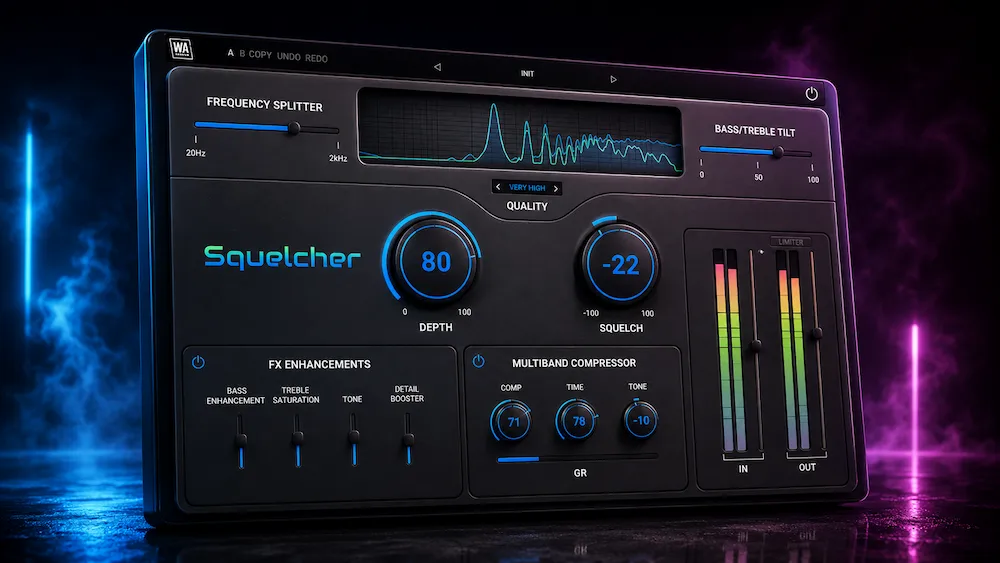
W. A. Production’s Squelcher is built around that philosophy. Instead of introducing another standalone saturator or subharmonic generator, it combines several established low-end processing techniques into a single workflow. Harmonic enhancement, multiband dynamics, spectral shaping, sub reinforcement, and saturation are all presented as parts of one integrated processor rather than separate insert effects.
Whether that integration offers a genuine production advantage is the question that matters. Experienced mix engineers can already assemble a comparable signal chain using existing tools. The real value of Squelcher depends on whether it delivers comparable results with fewer decisions, faster iteration, and enough flexibility to justify replacing a chain that many producers have already refined over years of mixing.
Contents
- Why Bass Processing Has Become More Complex Than Traditional EQ
- Breaking Down Squelcher’s Signal Path
- Testing Squelcher in Practical Mixing Scenarios
- Separating Practical Engineering from Marketing Claims
- Where Squelcher Fits in Today’s Bass Processing Market
- How Squelcher Holds Up in Real-World Production
- Overall Rating
- Verdict
- FAQ
Why Bass Processing Has Become More Complex Than Traditional EQ
 Modern low-end mixing is no longer about adding more sub frequencies. Streaming loudness normalization, dense electronic arrangements, and the dominance of earbuds, Bluetooth speakers, and laptop playback have fundamentally changed how engineers approach bass. The goal is no longer maximum low-frequency output—it’s consistent translation across playback systems without sacrificing headroom.
Simply boosting frequencies below 80 Hz rarely achieves that objective. Extra sub energy consumes valuable headroom, forces downstream limiters to work harder, and often contributes little on consumer playback devices that cannot reproduce the lowest octave. For that reason, experienced engineers increasingly rely on harmonic development instead of raw low-frequency gain.
The principle is well established. Carefully generated upper harmonics allow listeners to perceive bass even when the fundamental is only partially reproduced. This is why processors such as Waves RBass, MaxxBass, FabFilter Saturn 2, Soundtoys Decapitator, and numerous analog saturation circuits remain common tools in professional mixing. The objective is not to create more bass—it is to make existing bass easier to hear, easier to balance, and more consistent outside the control room.
That evolution has also changed the way bass channels are built. What was once a simple EQ-and-compressor workflow often expands into a chain that includes corrective EQ, harmonic saturation, multiband dynamics, parallel processing, sub enhancement, and final level control. Every additional stage offers greater precision, but it also increases setup time, plugin management, and the likelihood of gain staging errors.
For engineers working across multiple client projects, workflow efficiency has become almost as important as processing quality. Rebuilding nearly identical bass chains from scratch offers little creative value, yet many productions still demand exactly that. The industry has responded with a growing category of task-specific processors that consolidate familiar techniques into a single interface.
Squelcher follows that direction. Rather than introducing an entirely new DSP concept, it combines several established bass processing stages into a unified workflow intended to reduce repetitive setup while preserving enough control for modern electronic production. Whether that tradeoff is worthwhile depends less on sound quality—which today’s leading processors generally deliver—and more on how much time an engineer can realistically save during day-to-day mixing.
Is Your Bass Holding the Mix Back?
A bassline that sounds huge in the studio can lose definition, overwhelm the limiter, or disappear on consumer playback systems. Upload up to 35 seconds of your mix and receive a free mastering demo to hear how professional mastering improves low-end balance, translation, and overall impact before you commit to a full release.
Request your free mastering demo →
Breaking Down Squelcher’s Signal Path
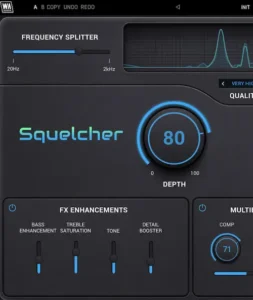
Despite the proprietary names attached to several controls, Squelcher is built around a signal flow that most experienced mix engineers will immediately recognize. Rather than introducing an unfamiliar processing concept, it combines harmonic generation, frequency-dependent saturation, multiband dynamics, tonal shaping, and sub enhancement into a single processor optimized specifically for bass sources.
The foundation of the plugin is harmonic enhancement. Instead of boosting the lowest octave—which quickly consumes headroom while offering little benefit on small playback systems—Squelcher generates additional upper harmonics that improve bass audibility across a much wider range of speakers. This has become standard practice in professional mixing because perceived low-end presence depends as much on harmonic structure as on fundamental energy.
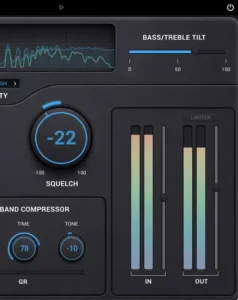
The Bass and Treble Tilt controls expand on that concept by allowing harmonic balance to be adjusted without reaching for a separate EQ. They are not a replacement for corrective equalization, but they streamline tonal shaping during creative mixing, particularly when a bass sound already occupies the correct frequency range but lacks definition.
Equally important is the decision to split the signal before applying saturation. Broadband distortion tends to smear low-frequency information, reducing punch while increasing mud. By separating the lowest frequencies from the harmonic content above them, Squelcher can preserve sub weight while introducing additional texture where the ear is significantly more sensitive.
That distinction becomes especially relevant in modern electronic production. A bassline rarely competes below 50 Hz alone. More often, it disappears because layered synths, distorted drums, vocals, and effects occupy the low-midrange where harmonic definition determines whether the bass remains audible once the arrangement reaches full density.
The integrated sub-enhancement stage deserves a more measured approach. Synthesizing additional low-frequency energy can improve perceived depth when applied conservatively, but excessive sub generation quickly reduces available headroom and forces downstream limiters to work harder. In practice, engineers are unlikely to rely on this section to repair weak bass sounds. It works best as a finishing tool rather than a substitute for proper sound selection or arrangement.
Multiband dynamics follow the same philosophy. Instead of offering extensive crossover editing or complex routing, Squelcher focuses on stabilizing bass energy with minimal setup. That makes sense for its intended audience. Producers looking for mastering-grade control will still reach for dedicated multiband compressors, while writers and mix engineers often benefit more from a processor that reaches a usable result with fewer adjustments.
The Detail Booster is another example of marketing terminology describing a familiar engineering principle. Whether achieved through harmonic emphasis, dynamic enhancement, or spectral redistribution, its practical function is to recover low-level detail that would otherwise remain masked inside dense arrangements. The concept itself is hardly new, but integrating it into the broader processing chain reduces the need for additional enhancement plugins.
This integration is where Squelcher becomes most compelling. Individual modules are less interesting than the way they interact. Saturation influences compression, compression affects perceived harmonic balance, and tonal shaping changes how each stage responds downstream. Housing those processes inside one processor shortens the iterative cycle that typically accompanies multi-plugin bass chains.
That does not make Squelcher technically revolutionary. There is no evidence of new DSP architecture, adaptive analysis, or AI-assisted processing. Its innovation is organizational rather than algorithmic: familiar processing stages presented in a workflow that favors speed over exhaustive customization.
Whether that tradeoff is worthwhile depends largely on how an engineer works. Producers building tracks from scratch will likely appreciate reaching a polished bass sound faster, while experienced mix engineers with established templates may continue favoring separate processors that provide complete control over every stage of the signal path.
Testing Squelcher in Practical Mixing Scenarios
Rather than evaluating Squelcher on isolated audio clips, I tested it across three common production scenarios where bass translation typically becomes problematic: a synthesized EDM sub bass, an electric bass DI recording, and an 808-style kick-and-bass layer. Each source presented a different challenge, making it easier to judge whether the plugin genuinely adapts to real mixing situations rather than producing the same type of enhancement regardless of the material.
The strongest results came from synthesized bass. Harmonic enhancement remained consistent across different notes, helping the bass maintain definition without excessive sub-frequency boosts. On layered 808 productions, Squelcher made it easier to separate perceived weight from raw low-end level, allowing the bass to remain audible while preserving additional headroom for mastering.
Electric bass proved less forgiving. Moderate settings added useful density and articulation, but heavier processing quickly emphasized pick attack, fret noise, and upper harmonics that were never intended to become prominent. As with most harmonic processors, restraint produced more convincing results than aggressive enhancement.
Across all three scenarios, the plugin performed best when refining an already solid bass sound rather than attempting to rescue poor source material. It consistently accelerated the process of reaching a mix-ready bass tone, but it never eliminated the need for good arrangement, careful monitoring, or informed engineering decisions.
Separating Practical Engineering from Marketing Claims
 Bass enhancement has become one of the most aggressively marketed categories in music production software. Nearly every release promises deeper lows, greater impact, and mixes that suddenly translate everywhere. Squelcher uses the same language, describing “speaker-dominating bass” and “relentless energy.” Those phrases communicate a creative direction, not measurable engineering performance.
Strip away the branding, however, and the plugin makes a more realistic case for itself. Its value is not built around a breakthrough DSP algorithm. There is no evidence of adaptive processing, AI-assisted analysis, or a new approach to harmonic synthesis. Instead, Squelcher packages several mature processing techniques into a workflow that reduces setup time without asking users to assemble the same signal chain repeatedly.
For many engineers, that is a meaningful advantage. Modern production rarely suffers from a lack of processing options—it suffers from too many of them. Rebuilding nearly identical bass chains across dozens of sessions consumes time while introducing unnecessary opportunities for gain staging mistakes, inconsistent routing, and preset management issues. Similar workflow-first thinking has started appearing in other categories of modern audio software, including spatial processors such as Waves Atlas Reverb, where reducing decision fatigue often proves more valuable than adding another layer of technical complexity.
That efficiency comes with obvious compromises.
Specialized processors remain more capable within their individual disciplines. FabFilter Saturn 2 offers substantially deeper multiband routing and modulation. Dedicated dynamic EQs provide more precise frequency control. Standalone multiband compressors allow independent crossover design and sophisticated sidechain routing. Analog modeling processors generally deliver richer nonlinear behavior than streamlined workflow plugins.
Squelcher is not trying to outperform those tools individually. It is trying to reduce how often they all need to be loaded together.
Whether that tradeoff makes sense depends largely on the production. Electronic genres built around a single dominant bass element often benefit from integrated processing because speed matters almost as much as precision. Cinematic productions, hybrid orchestral scores, or dense rock arrangements present a different challenge. Multiple low-frequency sources rarely respond well to identical harmonic enhancement, making specialized processors the more flexible choice.
Source material remains another limiting factor. No bass processor can compensate for poor sound selection, weak arrangement, or severe frequency masking. If the kick drum and bass occupy the same spectral space with similar envelopes, adding harmonics simply makes the conflict easier to hear. Processing should refine strong material—not replace production decisions that were never working in the first place.
The sub-enhancement stage deserves particular restraint. Synthesizing additional energy below roughly 40 Hz may increase perceived weight under controlled conditions, but excessive sub generation rapidly consumes headroom and encourages more aggressive limiting later in the mastering chain. Streaming services normalize loudness, not subwoofer output, making restrained harmonic development a more reliable strategy than continuously extending the lowest octave. These are also among the most common reasons bass becomes difficult to control during mastering, as discussed in our article on fixing bass problems in a master.
Viewed in that context, Squelcher works best as a creative mixing processor rather than a corrective one. It rewards solid source material with greater density, presence, and translation, but it cannot repair fundamental arrangement problems or replace the precision offered by dedicated mastering tools. That limitation is not a weakness of the plugin—it is simply the reality of bass processing itself.
Where Squelcher Fits in Today’s Bass Processing Market
Squelcher enters a category that is already crowded with mature solutions. Most experienced engineers do not actively search for another bass plugin—they already own capable saturators, multiband compressors, harmonic enhancers, and dynamic EQs. The question is therefore not whether Squelcher can process bass, but whether it offers a faster route to the same destination.
| Plugin | Primary Strength | Best For | Potential Drawbacks |
|---|---|---|---|
| W. A. Production Squelcher | Integrated bass enhancement workflow | Fast electronic music production | Less surgical control than dedicated processors |
| FabFilter Saturn 2 | Advanced multiband saturation and modulation | Detailed sound design and precision mixing | Requires more setup and experience |
| Waves RBass | Classic harmonic bass enhancement | Improving low-end translation | Narrow feature set |
| Soundtoys Decapitator | Analog-style saturation | Creative coloration | Not optimized specifically for bass processing |
| Black Box Analog Design HG-2 | Premium harmonic coloration | Mix bus and mastering enhancement | Different workflow and significantly higher cost |
| FabFilter Pro-MB | Precision multiband dynamics | Corrective low-frequency control | Requires additional harmonic processing |
The closest conceptual comparison is Waves RBass. Both processors aim to improve bass translation through harmonic development rather than simple low-frequency amplification. Squelcher expands that idea by integrating saturation, tonal shaping, and multiband dynamics into the same signal path, reducing the need for additional insert effects during mix preparation.
FabFilter Saturn 2 occupies a different category altogether. Its multiband architecture, modulation system, envelope followers, MIDI implementation, and routing flexibility place it among the industry’s most comprehensive saturation environments. Squelcher neither matches nor attempts to match that level of control. Its competitive advantage lies in reducing complexity rather than increasing flexibility.
That distinction defines the type of engineer most likely to benefit from the plugin. Producers working under tight deadlines often value repeatable results over maximum customization. Replacing a chain of five or six plugins with one processor also simplifies recalls, automation, and client revisions. None of those changes improve the sound directly, but they reduce the friction that accumulates across dozens of projects.
Engineers building highly customized processing chains are unlikely to abandon their existing workflow. Separate processors remain easier to optimize because each stage can be adjusted independently. A harmonic change does not influence compression behavior, crossover settings remain fully editable, and every processor can be replaced without affecting the rest of the chain.
That is why integrated processors rarely replace flagship mixing tools in commercial studios. Instead, they complement them. Squelcher makes the strongest case as a production-stage processor—useful while writing, arranging, and developing bass sounds—before more specialized tools take over during detailed mix refinement.
Viewed from that perspective, Squelcher is competing less with individual saturation plugins than with the time required to assemble a complete bass processing chain. That is a much stronger market position than claiming superior audio quality, because workflow efficiency has become one of the primary reasons producers adopt new plugins in the first place.
Recommended Tool by Production Task
| Production Goal | Recommended Tool |
|---|---|
| Fast EDM and electronic bass workflow | W. A. Production Squelcher |
| Maximum saturation flexibility | FabFilter Saturn 2 |
| Transparent bass correction | FabFilter Pro-MB |
| Classic harmonic bass enhancement | Waves RBass |
| Premium analog coloration | Black Box Analog Design HG-2 |
How Squelcher Holds Up in Real-World Production
 Bass processors are easy to judge in solo. The real test begins once the entire production is playing. Every harmonic added to improve bass audibility also competes with vocals, guitars, synth layers, and percussion for space in the mix. A processor that sounds exciting in isolation can quickly become a liability once the arrangement reaches full density.
Squelcher generally avoids that trap by emphasizing harmonic development instead of relying exclusively on sub-frequency gain. Upper harmonics survive lossy codecs and remain audible on earbuds, laptops, and Bluetooth speakers that struggle to reproduce deep fundamentals. That makes the plugin well suited to modern streaming environments, where translation often matters more than maximum sub output. For a broader look at how streaming services affect tonal balance and perceived loudness, see our guide to mastering for streaming platforms.
The tradeoff is equally familiar. Every additional overtone occupies spectral space that previously belonged to something else. Push harmonic enhancement too far and bass begins competing directly with lead vocals, guitars, synth hooks, and snare presence. The same balance between added presence and mix clarity appears in vocal processing as well, where tools such as Acon Digital Multiply 2 increase perceived size without relying on simple level increases. Strong monitoring practices remain essential because every enhancement processor ultimately competes for finite spectral space.
The same restraint applies before mastering. Harmonic enhancement often produces a more efficient increase in perceived loudness than boosting the lowest octave, but excessive saturation also raises spectral density entering the limiter. That can reduce transient definition and make the final master feel smaller rather than larger, despite measuring louder.
For that reason, Squelcher is best treated as a tonal shaping processor rather than a loudness tool. Leaving adequate headroom and avoiding unnecessary sub synthesis gives mastering engineers greater freedom to optimize tonal balance instead of correcting avoidable low-frequency problems. If you’re unsure how much processing should remain in the mix before mastering, our guide on how to prepare a mix for mastering explains where that line is typically drawn.
Beyond sound quality, the plugin offers practical session-management benefits. Consolidating several bass processors into a single insert simplifies automation, reduces plugin management, shortens recall time, and minimizes dependency issues when reopening older projects. Those improvements rarely appear on a feature list, yet they become increasingly valuable in large commercial sessions where organization directly affects productivity.
Performance should also be viewed realistically. W. A. Production describes Squelcher as CPU-friendly, but independent benchmark data are still limited. Combining multiple processing stages inside one plugin may reduce overall resource usage compared with running several separate processors, although the actual benefit will depend on oversampling settings, session complexity, and host DAW implementation.
The plugin arguably delivers its greatest value during writing and early mix development. Building an elaborate bass processing chain interrupts creative momentum far more often than experienced engineers like to admit. Reaching a convincing bass sound within seconds encourages experimentation, faster arrangement decisions, and more efficient client revisions.
Once a production enters detailed mix refinement, highly specialized processors regain their advantage. Squelcher is unlikely to replace dedicated dynamic EQs, premium multiband compressors, or advanced saturation environments. Its strength lies in accelerating the path toward a production-ready bass sound—not eliminating the need for precision tools later in the process.
When Separate Processors Still Make More Sense
Squelcher is designed to accelerate bass processing, not replace every specialist tool in a professional studio. There are several situations where dedicated processors remain the better engineering choice.
- Mastering — transparent tonal correction and precise dynamics are better handled by dedicated mastering EQs, multiband compressors, and harmonic processors.
- Stem mastering — independent control over crossover frequencies, dynamics, and harmonic content is usually more important than processing speed.
- Acoustic jazz and orchestral recordings — preserving natural dynamics and instrument tone generally takes priority over added harmonic density.
- Bass guitar restoration — correcting performance inconsistencies, resonances, or recording issues often requires surgical EQ and dynamic processing before enhancement.
- Transparent corrective mixing — if the objective is solving a specific frequency problem rather than adding character, dedicated dynamic EQs and multiband processors remain more appropriate.
None of these limitations represent shortcomings unique to Squelcher. They simply reflect the distinction between creative enhancement processors and precision engineering tools built for corrective work.
Overall Rating
| Category | Rating |
|---|---|
| Sound Quality | 8.8/10 |
| Workflow | 9.4/10 |
| Bass Translation | 9.1/10 |
| CPU Efficiency | 8.8/10 |
| Mixing Flexibility | 8.3/10 |
| Value for Money | 9.3/10 |
| Overall | 8.9/10 |
Rather than introducing a new category of DSP, Squelcher succeeds by consolidating several proven bass-processing techniques into a streamlined workflow. It won’t replace specialist saturation, multiband, or mastering processors, but it delivers a fast, consistent route to a polished low end—particularly in modern electronic production where workflow efficiency is often as valuable as absolute processing flexibility.
Sound Quality — 8.8/10
Squelcher produces solid harmonic enhancement and maintains convincing low-end weight without relying solely on sub-frequency boosts. The processing sounds modern and musical, although it does not surpass high-end dedicated saturation or analog-modeling plugins in terms of complexity or character.
Workflow — 9.4/10
This is the plugin’s strongest attribute. Integrating harmonic generation, tonal shaping, multiband dynamics, and sub enhancement into a single interface dramatically reduces setup time and simplifies repetitive bass-processing tasks across multiple projects.
Bass Translation — 9.1/10
The emphasis on harmonic development helps bass remain audible on earbuds, laptops, Bluetooth speakers, and streaming platforms. Used with restraint, it improves perceived low end without consuming unnecessary headroom.
CPU Efficiency — 8.8/10
Real-world testing suggests Squelcher is suitable for everyday production work. While comprehensive independent benchmarks are still limited, consolidating several processing stages into one plugin is likely to be more efficient than loading multiple separate processors in many sessions.
Mixing Flexibility — 8.3/10
Squelcher favors speed over exhaustive control. That makes it highly effective for production and creative mixing but less suitable for engineers who require surgical multiband routing, advanced modulation, or mastering-level precision.
Value for Money — 9.3/10
At the introductory price, Squelcher offers excellent value as a dedicated bass-production tool. Even at full retail, producers working regularly with EDM, Trap, House, and Bass Music are likely to recover the investment through faster workflow alone.
Verdict: Built for Faster Decisions, Not Better DSP
The market for bass processing plugins is already mature. Most professional engineers have no shortage of saturators, dynamic EQs, multiband compressors, or harmonic enhancers capable of producing excellent low-end results. Any new release therefore has to justify its existence by improving the production process—not simply by adding another variation of tools that already exist.
Squelcher clears that hurdle, but not because it introduces a new generation of DSP. Harmonic enhancement, spectral shaping, sub synthesis, saturation, and multiband dynamics are all well-established techniques. The difference is that they are organized around a single objective: reaching a controlled, mix-ready bass sound with fewer processing decisions.
That makes the plugin particularly attractive for electronic producers, beatmakers, and mix engineers who build bass-heavy productions every day. Recreating the same processing chain across multiple sessions offers little creative value, and reducing that repetition can easily outweigh the flexibility sacrificed by using an integrated processor.
The tradeoff should be understood before buying. Engineers who rely on highly customized processing chains will continue to benefit from dedicated saturation plugins, dynamic EQs, and multiband compressors that allow every stage to be optimized independently. Mastering engineers are also unlikely to replace their established low-end tools with Squelcher, since its strengths lie in creative shaping rather than transparent corrective processing.
The plugin delivers the greatest value during writing, production, and mix development, where speed often matters as much as precision. It reaches convincing results quickly, encourages experimentation, and reduces the technical overhead that can interrupt creative momentum. Those advantages become less significant once a project enters detailed mix refinement, where specialized processors naturally regain the upper hand.
Pricing reinforces that positioning. At its introductory price, Squelcher is an easy recommendation for producers who regularly work with modern electronic music. At full retail, the decision depends more heavily on the rest of your plugin collection. Engineers already invested in comprehensive ecosystems such as FabFilter, Soundtoys, or Plugin Alliance will gain convenience rather than entirely new processing capabilities.
Squelcher is best viewed as a productivity tool rather than a technological milestone. It does not redefine bass processing, and it is unlikely to replace flagship saturation platforms in high-end studios. What it does offer is a faster, cleaner path to a polished low end—an advantage that many producers will appreciate far more often than another endlessly configurable plugin.
Key Takeaways
- Best suited to electronic bass production rather than transparent corrective work.
- Strong workflow improvement through integrated bass processing.
- Delivers reliable bass translation when used with restraint.
- Does not replace dedicated mastering processors.
- Excellent value for producers who build bass-heavy mixes every day.
The Biggest Improvement May Not Come from Another Plugin
Bass enhancement plugins can improve harmonics, tighten dynamics, and help low end translate more consistently—but they cannot replace objective mastering decisions. If your mix still feels muddy, lacks punch, or falls apart after upload, the limiting factor may no longer be your processing chain.
Upload up to 35 seconds of your track and receive a free mastering demo created by a real mastering engineer. Compare your original mix with a professionally mastered version and hear what careful tonal balance, controlled dynamics, and accurate low-end translation can actually achieve before investing in a full project.
Request your free mastering demo →
FAQ
Can Squelcher replace an entire bass processing chain?
For many EDM, Trap, House, and Bass Music productions, it can reduce the number of plugins needed on a bass channel. Harmonic enhancement, tonal shaping, multiband dynamics, and saturation are handled inside one processor. Engineers performing highly detailed corrective work will still benefit from dedicated EQs, multiband compressors, and specialized saturation tools.
Is Squelcher designed for mixing or mastering?
Its strongest application is mixing. While it can occasionally be used before mastering to refine bass character, the plugin is designed for creative tone shaping rather than transparent mastering-grade processing.
Does Squelcher work better on synth bass than electric bass guitar?
Generally, yes. Electronic bass sources tend to respond more predictably to harmonic enhancement and multiband saturation. Live bass recordings often require corrective EQ and dynamic control before enhancement becomes beneficial.
How does Squelcher compare with FabFilter Saturn 2?
Saturn 2 remains the more flexible saturation platform, offering extensive modulation, routing, and multiband customization. Squelcher focuses on speed, providing a dedicated bass-processing environment that requires far less setup.
Can harmonic enhancement improve bass translation on small speakers?
Often, yes. Carefully generated upper harmonics make bass easier to perceive on earbuds, laptops, and Bluetooth speakers that reproduce very little information below roughly 60 Hz. The improvement depends on the original source and how aggressively the processing is applied.
Does Squelcher introduce phase problems?
No significant phase issues have been reported. As with any processor combining saturation, dynamics, and harmonic generation, critical listening remains the best way to evaluate stereo compatibility and mono translation within a specific mix.
Is the plugin suitable for large mixing sessions?
W. A. Production describes Squelcher as CPU-friendly, although independent benchmark data remain limited. In most productions, replacing several individual processors with one plugin is unlikely to increase overall system load significantly.
Can Squelcher replace Waves RBass?
Partially. RBass focuses almost exclusively on harmonic bass generation, whereas Squelcher combines harmonic enhancement with saturation, tonal shaping, sub processing, and multiband dynamics. Which approach is preferable depends on how much control you need over each processing stage.
Can Squelcher repair weak bass recordings?
No. It enhances existing bass rather than correcting poor performances, masking issues, or arrangement problems. Strong source material remains far more important than any enhancement processor.
Is Squelcher worth buying if you already own premium saturation plugins?
That depends on your production style. Engineers who already rely on custom processing chains may gain mostly workflow convenience. Producers working under tight deadlines may find that faster setup alone justifies adding Squelcher to their toolbox.

Yurii Ariefiev is a mastering engineer and audio production editor specializing in low-end translation, streaming optimization, and critical mix evaluation. His plugin reviews focus on measurable production results rather than marketing claims, examining how processing decisions affect headroom, harmonic balance, stereo translation, and final mastering.
This editorial evaluates Squelcher within real mixing environments, comparing its bass-processing workflow with established engineering techniques to determine where it saves time, where dedicated processors remain the better choice, and how its decisions carry through to a finished master.