Most software synthesizers generate sound from familiar sources such as oscillators, wavetables, samples, or mathematical waveforms. Imaginando COLAPSO takes a different approach. Its additive synthesis engine draws on atomic emission spectra, using data associated with 22 chemical elements as the basis for constructing sound. It combines this spectral material with granular processing, partial-level modulation, and conventional subtractive filtering.
Rather than starting with familiar waveforms such as sawtooth or square waves, COLAPSO lets producers explore the frequency relationships represented in atomic emission spectra and shape them into playable, evolving sounds. This approach provides an alternative starting point for building complex harmonic and inharmonic timbres.
Released on October 7, 2026, COLAPSO combines additive, granular, and subtractive synthesis in a single instrument. Its architecture is aimed at electronic music producers, sound designers, and composers interested in evolving pads, inharmonic textures, metallic timbres, and experimental soundscapes.
However, the scientific basis of a synthesizer does not, by itself, demonstrate superior sound quality or greater production efficiency. The more relevant question is whether COLAPSO’s atomic-spectrum approach offers practical sound-design capabilities that are difficult or less convenient to achieve with conventional additive and granular synthesizers.
What Is Imaginando COLAPSO?
 COLAPSO is a polyphonic software synthesizer developed by Imaginando, a Portuguese music software company known for instruments such as DRC and FRMS. Its sound engine combines three synthesis methods: additive synthesis built around atomic emission spectra, pitch-synchronized granular processing, and subtractive filtering.
The instrument’s central concept is its use of spectral data associated with 22 chemical elements. According to Imaginando, COLAPSO incorporates 422 emission lines derived from atomic spectroscopy data, with the NIST Atomic Spectra Database used as a reference.
These emission lines provide frequency and amplitude information for constructing oscillator spectra. Unlike conventional oscillators based on standard waveforms or simple harmonic series, this approach gives COLAPSO access to more complex spectral arrangements, including inharmonic frequency relationships.
Each voice contains three oscillators, each capable of generating up to 16 partials. With a maximum polyphony of eight voices, the instrument can theoretically generate up to 384 partials simultaneously (3 oscillators × 16 partials × 8 voices), before accounting for the additional processing involved in granular synthesis, filtering, modulation, and effects.
Key specifications include:
- Synthesis architecture: Additive, granular, and subtractive synthesis.
- Spectral sources: Data associated with 22 chemical elements.
- Emission data: 422 spectral lines, according to the manufacturer.
- Oscillators: Three per voice.
- Partial capacity: Up to 16 per oscillator.
- Maximum polyphony: Eight voices.
- Filters: Nine filter circuits.
- Modulation: Four drawable LFOs, four drawable envelopes, and four macros.
- Effects: Two serial insert slots and one parallel send slot.
- Presets: More than 200.
COLAPSO is therefore more than an additive synthesizer with an unconventional oscillator source. Its defining feature is the combination of atomic-spectrum-based sound generation, time-frequency manipulation, and independent control over spectral components.
How Atomic Additive Synthesis Works
Traditional additive synthesis builds complex sounds by combining individual sinusoidal components at different frequencies and amplitudes. Each partial contributes to the resulting waveform, allowing the synthesizer to construct a wide range of harmonic and inharmonic timbres.
In a harmonic spectrum, partial frequencies occur at integer multiples of a fundamental frequency. This relationship produces the regular spectral structures associated with many acoustic instruments and conventional synthesizer waveforms. Inharmonic spectra, by contrast, contain partials that do not follow this integer-multiple relationship.
COLAPSO takes a different approach to spectral construction. Its oscillator architecture draws on the emission spectra of chemical elements. In atomic spectroscopy, individual spectral lines correspond to electromagnetic radiation associated with transitions between atomic energy levels.
These lines provide frequency and intensity data that can be used to define the spectral components of an oscillator. Imaginando also describes lifetime information associated with the spectral data, which is incorporated into COLAPSO’s partial-evolution system.
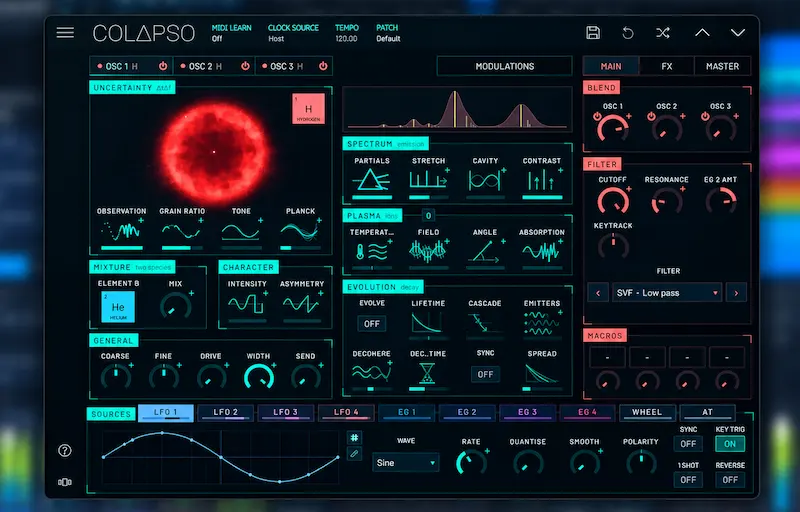
COLAPSO also provides several controls for reshaping the source spectrum. Partials determines how many emission lines are used, while Stretch expands or compresses the frequency intervals between them. Cavity moves the components toward a conventional harmonic series, and Contrast adjusts their relative levels. The separate Character section can add odd and even harmonics above each partial, providing another way to move beyond the original measured spectrum.
The practical result is access to spectral distributions that do not necessarily follow conventional harmonic relationships. Depending on the selected spectral source and subsequent processing, these structures can form the basis of metallic, bell-like, resonant, dissonant, or more abstract timbres.
COLAPSO does not play recordings of chemical elements. It uses atomic emission data as input for a synthesis engine that generates audio electronically. The spectral information determines aspects of the oscillator’s frequency and amplitude structure; it is not a recording of the radiation itself.
This distinction is important: the scientific origin of the source data should not be confused with acoustic realism. COLAPSO uses atomic spectroscopy as a framework for sound design, not as a physical simulation of how chemical elements would sound.
Make Complex Synth Textures Work in the Mix
Detailed additive spectra, evolving partials, and inharmonic textures can introduce complexity that needs careful control within a full production. A professional mastering process considers how tonal balance, transient definition, low-end clarity, stereo image, and dynamics interact across the entire mix. Submit up to 40 seconds of your track and get a free mastering demo to evaluate how your mix translates through a dedicated mastering chain.
Request Your Free Mastering Demo →
Three Oscillators and Element Morphing
Each COLAPSO voice contains three independent oscillators, each capable of generating up to 16 partials. When all three operate at maximum capacity, they provide up to 48 partials per voice.
This configuration allows producers to combine different spectral sources within a single voice. For example, each oscillator can use a different chemical element, creating layered timbres with distinct frequency and amplitude distributions.
Combining multiple spectra within one instrument can provide a more direct approach to building complex sounds than stacking separate synthesizer instances. The three oscillators can contribute different spectral characteristics while remaining part of the same voice.
One of the instrument’s key features is the Mixture control, which enables morphing between two selected elements. According to the product documentation, corresponding spectral lines can be matched, allowing their frequencies and amplitudes to transition between the selected sources.
This differs from a conventional crossfade between two complete oscillator signals. Rather than simply blending two finished waveforms, the transition operates on the spectral components themselves, changing the oscillator’s timbral structure at the partial level.
For sound designers, this provides a way to move between different spectral configurations within a single oscillator, without relying entirely on external automation or multiple layered instruments.
The musical usefulness of this process depends on the selected spectra and the way the transition is configured. More complex spectral relationships do not automatically produce more effective sounds; some combinations may create dense or difficult-to-control frequency structures.
Observation: The Time-Frequency Engine
One of COLAPSO’s distinctive controls is Observation, which shapes the time-frequency behavior of its synthesis engine.
The relevant signal-processing concept is the Gabor limit: temporal precision and frequency resolution are interdependent. A shorter grain window provides better temporal localization but spreads energy across a wider frequency range. A longer window improves frequency resolution while making it harder to represent rapid changes in time. This is an audio-domain time-frequency trade-off, not a direct implementation of quantum uncertainty.
In audio synthesis, this trade-off affects how clearly a sound expresses short-term transients, sustained pitched components, and evolving spectral detail.
Shorter grain windows can produce sharper, more transient textures with broader spectral content. Longer windows can preserve more clearly defined frequency components and produce more stable pitched material. Imaginando describes COLAPSO’s granular processing as synchronized to the played note’s pitch, rather than relying solely on conventional unsynchronized grain playback.
The Planck control provides an additional way to shape the process by adjusting the degree of pitch smearing.
Together, these controls offer several sound-design possibilities:
- Shorter grain windows: Sharper temporal detail, transient emphasis, and potentially broader spectral content.
- Longer grain windows: Greater frequency resolution and more clearly defined pitched components.
- Increased pitch smearing: Less precise pitch definition and more diffuse spectral textures.
- Modulated Observation: Continuously changing time-frequency behavior and evolving textures.
- Stereo processing: Different pitch-smearing behavior across the stereo field.
Observation is therefore more than a conventional grain-size parameter. Its role in COLAPSO’s pitch-synchronized granular architecture connects the temporal and spectral characteristics of the generated sound.
For electronic music production, this can be useful when creating sounds that shift between clearly pitched material and less defined textures. It offers an integrated way to explore these transitions without necessarily building the same behavior from separate granular processors, filters, and modulation sources.
Evolution: Creating Changing Spectral Structures
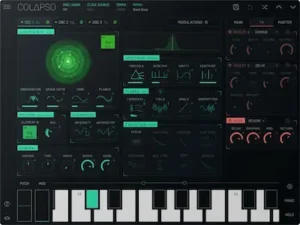 Many synthesizers create movement by modulating parameters such as amplitude, filter cutoff, pitch, or wavetable position. The Swarm’s flocking-based wavetable approach, for example, uses moving oscillator groups to scan a two-dimensional grid of waveforms. COLAPSO adds another layer of control by allowing individual partials to evolve and decay independently over time.
Its Evolution section provides several controls for shaping the behavior of these spectral components:
- Evolve: Enables partial evolution.
- Lifetime: Controls the duration of partial decay.
- Cascade: Introduces staggered timing between partial attacks.
- Emitters: Controls how individual partials terminate.
- Decohere: Transitions between Observation settings.
- Spread: Introduces variation in partial decay times.
According to Imaginando, the default partial lifetimes are derived from the underlying spectral data. This connects the atomic source material not only to the oscillator’s frequency structure but also to the way its spectral components change over time.
As a result, a sound does not need to retain the same spectral composition throughout its duration. Individual partials can decay at different rates, changing the frequency distribution even when the overall amplitude envelope remains relatively stable.
This approach is particularly relevant to evolving pads, drones, cinematic transitions, and experimental sound effects. A sustained note can gradually lose selected spectral components while retaining others, creating timbral movement that goes beyond applying a conventional filter envelope to a static oscillator.
For producers who routinely automate multiple parameters to create evolving textures, partial-level decay provides an additional source of movement directly within the synthesis engine.
Plasma: Spectral Manipulation and Noise-Based Textures
The Plasma section extends COLAPSO’s sound-design capabilities beyond the original atomic spectra. Its four controls—Temperature, Field, Angle, and Absorption—provide additional ways to reshape the generated spectral material.
One of its more distinctive features is Field. According to the product documentation, this control splits individual partials into three frequency components. The two outer components can be shifted by up to 12 semitones above or below the central frequency.
This creates additional spectral complexity through frequency separation and detuning, producing denser timbres with more pronounced inharmonic characteristics.
Temperature changes the relative levels of the spectral lines, with additional random detuning introduced above its central position. Angle controls the balance between the central component and the two side components created by Field, while also determining how widely the side components can be spread across the stereo image.
Absorption shifts the sound from its original emission-spectrum structure toward broadband noise, with spectral notches corresponding to the positions of the emission lines. This provides a way to move between clearly defined additive components and more noise-oriented textures.
Combined with the three-oscillator architecture and Observation controls, the Plasma section gives users additional ways to transform the source spectra rather than simply reproduce their original frequency structures.
These controls serve a creative sound-design purpose rather than a corrective one. They are intended to reshape the synthesized signal, not to replace conventional equalization or spectral-repair tools.
Filters, Modulation, and Effects
Although COLAPSO’s additive and granular architecture is its main distinction, conventional synthesis tools remain important to its overall sound-design workflow.
The instrument includes nine filter circuits with controls for cutoff, resonance, envelope modulation, keytracking, and drive. These provide familiar subtractive-synthesis options for shaping the complex spectra generated by its oscillators.
Filtering is particularly useful when working with dense additive spectra, where individual frequency components can create competing resonances or an overly complex tonal balance. A conventional filter stage offers a straightforward way to reshape the overall frequency distribution. However, shaping the synthesizer’s output is only part of the process; its interaction with other instruments also contributes to the overall frequency balance in the mix.
COLAPSO’s modulation system includes four drawable LFOs, four drawable envelopes, and four macros. Additional performance-oriented modulation sources include the mod wheel and aftertouch.
Documented modulation and control capabilities include:
- Per-voice LFO and envelope operation.
- Polyphonic aftertouch.
- MPE support.
- MIDI Learn.
- Tempo-synchronized modulation.
- Key-triggered modulation.
- One-shot LFO operation.
- Custom and random modulation shapes.
- Up to 32 host-automatable modulation-depth slots.
These features support both detailed patch programming and performance-oriented sound design. MPE and polyphonic aftertouch are particularly useful with compatible MIDI controllers, allowing expressive gestures to influence individual notes rather than applying the same response across the entire voice.
The effects section provides two serial insert slots and one parallel send slot. Available processors include chorus, phaser, distortion, bitcrusher, filter, EQ, delay, and reverb. A master-bus compressor called Glue is also included.
These processors make it possible to shape and process sounds without immediately relying on external effects. However, the effects section is best viewed as part of the instrument’s sound-design workflow rather than its primary selling point. Producers who need more specialized processing or detailed control over their mix may prefer to use dedicated external plugins.
Practical Applications in Music Production and Sound Design
COLAPSO is particularly suited to sound-design tasks that call for unconventional spectral structures and timbres that evolve over time. Its architecture makes it relevant to electronic music production, experimental composition, cinematic sound design, and other applications where distinctive synthesized textures are more important than conventional instrument emulation.
Evolving Pads and Atmospheric Textures
The combination of element morphing, partial evolution, and granular time-frequency controls provides several ways to create pads with changing spectral characteristics rather than static harmonic content.
These capabilities are relevant to ambient music, electronic arrangements, cinematic backgrounds, and transitions that benefit from gradual timbral development. They also allow producers to build complex movement within a single instrument instead of coordinating automation across multiple synthesizer instances.
Metallic and Inharmonic Sounds
The atomic emission spectra used by COLAPSO provide source material with frequency relationships that do not necessarily follow conventional harmonic structures. This makes the instrument an interesting option for designing bell-like tones, metallic textures, unusual resonances, and experimental percussion.
Partial-level manipulation and the additional frequency components available through Plasma provide further ways to reshape these spectral structures and develop more complex timbres.
Cinematic and Game Audio
Sound designers working on drones, transitions, abstract impacts, and evolving environmental textures may find COLAPSO’s combination of additive and granular synthesis useful.
Rather than relying exclusively on samples or layering several conventional synthesizers, users can generate complex spectral movement within a single instrument. This makes it a potential source of original textures for cinematic scoring, game audio, and sound effects.
Experimental Electronic Music
Producers working in IDM, ambient, experimental electronic music, and other sound-design-focused styles may appreciate COLAPSO’s unconventional approach to spectral construction.
Its controls encourage experimentation with unusual frequency relationships and evolving timbres. This can be useful during sound exploration, although the instrument may require more adjustment when a production calls for a precisely defined and repeatable sound.
Workflow and Usability: An Instrument for Exploration
COLAPSO’s unconventional architecture introduces a learning curve that prospective users should consider before purchasing the instrument.
Some of its controls are built around concepts from atomic spectroscopy and time-frequency analysis. Although these concepts have established technical foundations, their practical relationship to familiar synthesizer parameters may not be immediately obvious to users accustomed to conventional subtractive or wavetable instruments.
An independent hands-on review published by Decoded Magazine on November 13, 2026, described an initial adjustment period while learning how the instrument’s scientific terminology relates to its audible behavior.
The reviewer also reported difficulty isolating the contribution of individual oscillators when all three were active. Some presets responded noticeably to relatively small parameter changes, while mapping controls to an Ableton Push 3 provided a more immediate, hands-on approach to sound exploration.
These observations point to COLAPSO’s strongest workflow orientation: exploratory sound design rather than rapid, highly predictable patch programming.
This distinction matters in professional production environments. A synthesizer can offer substantial creative flexibility without necessarily being the most efficient choice for every task.
Producers who prefer familiar oscillator, filter, and envelope workflows may find COLAPSO less immediate than conventional subtractive synthesizers. Sound designers who enjoy learning unfamiliar synthesis architectures, however, may find its spectral approach a useful addition to their existing toolkit.
COLAPSO vs. RAZOR, Loom II, and Pigments
COLAPSO occupies a specialized position in the software synthesizer market. Its most relevant alternatives are not necessarily instruments with identical architectures, but synthesizers that offer comparable additive, granular, or advanced spectral sound-design capabilities.
| Instrument | Main Approach | Primary Strength | Best-Suited Workflow |
|---|---|---|---|
| Imaginando COLAPSO | Atomic additive, granular, and subtractive synthesis | Atomic spectral sources and evolving partials | Experimental sound design and evolving textures |
| Native Instruments RAZOR | Additive synthesis | Detailed partial manipulation and spectral processing | Complex synthetic leads, basses, and textures |
| AIR Loom II | Modular additive synthesis | Extensive harmonic construction and module-based processing | Layered additive sounds and evolving timbres |
| Arturia Pigments | Multi-engine synthesis | Multiple synthesis methods and extensive modulation | General-purpose electronic music production |
Native Instruments RAZOR
RAZOR is a dedicated additive synthesizer with extensive control over individual partials and spectral processing. Its documented architecture supports up to 320 partials, compared with COLAPSO’s maximum of 48 partials per voice across its three oscillators.
For producers interested in detailed control over harmonic structures, formants, and complex additive timbres, RAZOR remains a relevant alternative.
COLAPSO takes a different approach through its atomic spectral sources, integrated partial evolution, and pitch-synchronized granular processing. The choice between the two is therefore less about comparing maximum partial counts and more about the type of spectral manipulation and sound-design workflow required.
AIR Loom II
Loom II uses a modular approach to additive synthesis, with support for up to 512 harmonic partials per patch and 34 editable synthesis modules. Its architecture is aimed at producers who want to construct complex sounds by combining and routing different additive synthesis processes.
Compared with COLAPSO, Loom II places greater emphasis on modular synthesis and harmonic construction rather than atomic emission spectra and partial-evolution behavior derived from spectral data.
Producers looking for a modular additive environment may prefer Loom II. Those more interested in COLAPSO’s combination of atomic spectral sources, time-frequency processing, and evolving partials may find its approach more relevant to their sound-design needs.
Arturia Pigments
Pigments is a broader multi-engine synthesizer designed to cover several synthesis approaches within one instrument. Its architecture combines multiple sound-generation engines with extensive modulation and integrated effects.
For producers who need a general-purpose synthesizer for basses, leads, pads, sequences, and other common production tasks, Pigments offers a broader range of applications.
COLAPSO is more specialized. Its purpose is not to replace a comprehensive multi-engine synthesizer, but to provide a distinct approach to generating and manipulating spectral material.
Producers who already own Pigments, RAZOR, or Loom II should not view COLAPSO as an automatic upgrade. It is better evaluated as a complementary sound-design instrument with a different synthesis architecture and creative focus.
System Requirements and Compatibility
COLAPSO is available for macOS and Windows as both a standalone application and a plugin in several widely used audio formats.
- macOS: macOS 13 or later.
- Apple Silicon: Native universal binary support.
- Windows: Windows 10 or later (64-bit).
- Plugin formats: VST, VST3, and AU.
- Standalone: Available.
AAX is not included in the manufacturer’s documented list of supported formats. Pro Tools users should therefore not assume that COLAPSO can be loaded natively as an AAX plugin.
COLAPSO supports up to eight voices of polyphony. However, its theoretical maximum partial count does not indicate actual CPU consumption. Imaginando warns that increasing the voice count raises processing demands and recommends reducing polyphony if audio dropouts occur.
No controlled independent CPU benchmarks or latency measurements were identified during the research. Producers planning to run multiple instances in demanding sessions should test the demo in their own DAW environment, taking buffer size, sample rate, and system hardware into account.
COLAPSO Pricing and Licensing
At the time of research, Imaginando listed COLAPSO at €89 for a standard direct purchase. Plugin Boutique listed it at €92.71, with the final price potentially varying by retailer and region.
Imaginando also offered a rent-to-own option at €8.90 per month and a Synth Bundle priced at €189.
The introductory price of €69, available around the original release, expired on November 1, 2026. It should not be confused with the standard purchase price.
Each license supports activation on up to five computers, and an internet connection is required for activation.
A time-unlimited demo is available with access to the full set of parameters. Its limitations include a short noise burst every 60 seconds and disabled preset saving until activation.
For a specialized synthesizer, the ability to explore its full parameter set before purchasing is particularly valuable. The key consideration is whether COLAPSO’s synthesis architecture offers practical sound-design capabilities that justify adding another instrument to an existing production setup.
Pros and Cons of Imaginando COLAPSO
Pros
- Distinctive additive synthesis architecture built around atomic emission spectra.
- Three independent oscillators per voice, each supporting up to 16 partials.
- Integrated granular processing with pitch-synchronized grain behavior.
- Independent partial-evolution and decay controls.
- Element morphing for transitions between different spectral sources.
- Extensive modulation capabilities, including MPE and polyphonic aftertouch support.
- Nine filter circuits and an integrated effects section.
- Strong sound-design potential for evolving pads, metallic textures, drones, and cinematic soundscapes.
- Time-unlimited demo with access to the full parameter set.
Cons and Limitations
- Unconventional terminology and synthesis architecture introduce a learning curve.
- Individual oscillator contributions can be difficult to isolate when multiple oscillators are active.
- Some presets are sensitive to relatively small parameter adjustments.
- Theoretical maximum polyphony and partial count do not establish practical CPU performance.
- No independent CPU, latency, aliasing, or distortion measurements were identified during the research.
- AAX support is not listed among the documented plugin formats.
- Limited independent user feedback makes it difficult to assess long-term reliability and stability.
Frequently Asked Questions
What makes Imaginando COLAPSO different from a conventional synthesizer?
COLAPSO uses atomic emission spectra as the basis for additive synthesis. It combines this spectral approach with pitch-synchronized granular processing and independent partial evolution, rather than relying solely on conventional oscillator waveforms and subtractive filtering.
How many oscillators does COLAPSO have?
COLAPSO provides three independent oscillators per voice, each supporting up to 16 partials. This gives a maximum theoretical capacity of 48 partials per voice.
Is COLAPSO suitable for ambient music?
Yes. Its partial-evolution controls, element morphing, and granular processing are well suited to evolving pads, drones, atmospheric textures, and other sustained sounds.
Can COLAPSO be used for conventional electronic music production?
Yes. Its oscillators, filters, modulation system, and effects support conventional synthesizer workflows. However, its distinctive capabilities are more closely associated with experimental spectral sound design than with replacing a general-purpose synthesizer.
Does COLAPSO support MPE?
Yes. COLAPSO supports MPE and polyphonic aftertouch, allowing expressive MIDI controllers to apply independent modulation to individual notes.
Does COLAPSO work with Pro Tools?
Native AAX support is not listed in the available compatibility information. Pro Tools users should check the manufacturer’s current supported-format documentation rather than assume direct plugin compatibility.
Is COLAPSO CPU-intensive?
The manufacturer warns that CPU demand increases with higher polyphony. However, no controlled independent benchmark was located. The most reliable way to assess performance is to test the demo in the intended DAW and hardware configuration.
Is COLAPSO an alternative to Arturia Pigments?
To some extent, but the instruments have different design priorities. Pigments is a broader multi-engine synthesizer, while COLAPSO focuses on atomic additive synthesis, granular processing, and evolving spectral structures.
Is COLAPSO worth buying?
COLAPSO is worth considering for producers who regularly create experimental timbres, evolving pads, inharmonic sounds, and cinematic textures. Those who primarily need conventional synthesizer sounds may find a broader instrument more versatile. The unrestricted demo provides an opportunity to evaluate its sound-design workflow and performance before purchasing.
Overall Rating
This rating is an editorial assessment of COLAPSO’s documented synthesis architecture, control range, and intended applications. It is not based on independent listening tests, CPU benchmarks, or laboratory measurements.
| Category | Rating |
|---|---|
| Synthesis Architecture | 9.0/10 |
| Element Morphing & Oscillator Design | 8.6/10 |
| Partial Evolution | 8.7/10 |
| Granular Time-Frequency Processing | 8.5/10 |
| Modulation & Performance Control | 8.4/10 |
| Workflow & Usability | 7.0/10 |
| Overall | 8.4/10 |
The atomic-spectrum-based oscillator architecture provides a distinctive foundation for generating harmonic and inharmonic material beyond conventional waveform-based synthesis.
Matching and morphing spectral lines between selected elements offers more detailed timbral transitions than a conventional crossfade between complete oscillator signals.
Independent partial decay and staggered attacks allow spectral content to change over time, creating movement that cannot be reduced to conventional amplitude or filter-envelope modulation alone.
Pitch-synchronized granular processing, combined with Observation and Planck controls, provides useful ways to move between transient detail, defined pitched material, and more diffuse textures.
MPE, polyphonic aftertouch, multiple modulation sources, and host-automatable modulation-depth slots provide substantial control options, although the practical performance benefits depend on compatible controllers and the user’s modulation workflow.
The unconventional terminology and reported difficulty isolating individual oscillator contributions introduce a learning curve, while preset sensitivity may make precise and repeatable patch programming less immediate.
COLAPSO’s strongest asset is its integrated approach to atomic additive synthesis, partial evolution, and pitch-synchronized granular processing, which gives sound designers a distinctive environment for developing evolving and inharmonic textures. Its specialized architecture and learning curve make it less straightforward than a conventional general-purpose synthesizer. It is best suited to producers who value experimental spectral sound design and are prepared to explore an unfamiliar synthesis workflow.
Final Verdict: A Specialized Synthesizer With a Distinctive Sound Engine
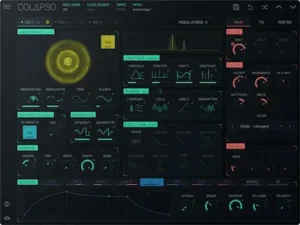 Imaginando COLAPSO stands out because its synthesis architecture is built around a specific technical concept rather than simply combining familiar features into another general-purpose synthesizer.
Its use of atomic emission spectra provides an unusual foundation for additive synthesis. Pitch-synchronized granular processing and partial-level evolution extend this approach into more complex sound-design possibilities.
The instrument is particularly relevant to producers working with evolving pads, metallic textures, drones, experimental electronic music, and cinematic sound design. Its three-oscillator architecture, extensive modulation options, MPE support, filters, and integrated effects also make it a relatively comprehensive instrument rather than a narrowly focused synthesis experiment.
However, COLAPSO should not be judged by its scientific terminology alone. Its documented architecture is distinctive, but independent performance measurements remain limited. The learning curve and specialized workflow may also make it less efficient for producers who primarily need conventional synthesizer sounds.
For users who already own established general-purpose synthesizers, COLAPSO is best viewed as a complementary instrument rather than a replacement. Its main appeal lies in its alternative approach to spectral sound generation and the creative possibilities it offers.
Overall assessment: COLAPSO is a compelling specialized synthesizer for sound designers and electronic music producers interested in unusual spectral structures and evolving timbres. Its technical concept gives it a clear identity, but its practical value ultimately depends on whether its sound-generation approach fits the user’s production workflow.
Hear What Your Mix Reveals Beyond the Sound Design
Complex inharmonic spectra, evolving partials, and layered granular textures can give a production its character, but they also create challenges when those sounds compete with other elements in the arrangement. A synthesizer patch that sounds impressive on its own may behave differently in a dense mix, where frequency masking, transient definition, low-end balance, and stereo placement all influence the final result. Instead of adding another processor without knowing what the mix actually needs, compare your original production with a mastering version prepared by a real mastering engineer. Upload up to 40 seconds of your mix and receive a free mastering demo to hear the difference for yourself, assess what changes are useful, and decide how your track should move forward.
Upload Your Mix and Get a Free Mastering Comparison →

When evaluating an instrument built around additive and granular synthesis, the important questions extend beyond the number of partials or available modulation sources. Spectral relationships, transient definition, pitch stability, and the ability to shape evolving timbres all affect how reliably a patch can serve an arrangement. These considerations help distinguish an interesting synthesis concept from a practical sound-design tool.
Enjoyed this review?
If you found it useful, you can support independent audio research with a coffee. ☕
Buy me a coffee