Building a convincing vocal ensemble from a single performance is a different challenge from conventional vocal doubling or pitch-shifted harmonies. IK Multimedia ReSing Choir addresses this workflow by transforming one monophonic vocal recording into an ensemble of up to five distinct modeled singers per section. The application is designed to build additional vocal parts from a single melodic source rather than combine multiple recorded vocal tracks into a choir.
Rather than simply duplicating the source and shifting its pitch, ReSing Choir combines voice modeling, chord-aware harmonization, note-level editing, and performance variation in a standalone application. The objective is to create independently editable backing vocal parts without recording every singer separately.
Announced in November 2026, ReSing Choir extends IK Multimedia’s existing ReSing ecosystem with a dedicated environment for multi-part vocal arrangement. Its intended applications include pop, R&B, gospel, soul, and cinematic production, where layered backing vocals often require several complementary melodic parts and distinct vocal characters.
The critical question, however, is not how many voices the software can generate, but how convincingly they behave as an ensemble. Natural articulation, formant consistency, pitch stability, and timing variation will ultimately determine whether the generated parts are suitable for finished productions or primarily useful for arrangement development. The documented feature set establishes considerable editing flexibility, but independent evidence of the resulting audio quality remains limited.
What Is IK Multimedia ReSing Choir?
 IK Multimedia ReSing Choir is a standalone application for generating and arranging AI-modeled vocal ensembles from an existing vocal performance. It uses voice models from the ReSing ecosystem to create additional parts with different modeled singer identities, rather than relying exclusively on pitch-shifted copies of the original recording.
Each section supports up to five singers, with individual voice assignments, harmony generation, note editing, and performance variation controls. Completed arrangements can be exported as a full ensemble mix or individual vocal stems for further processing in a DAW.
The distinction from conventional vocal harmonizers lies in how additional voices are generated. Traditional harmonizers typically derive their output from the incoming vocal signal, modifying its pitch and, depending on the processor, formant characteristics. ReSing Choir uses modeled voices to generate separate vocal parts based on the source performance and arrangement settings.
This makes ReSing Choir an arrangement environment rather than simply a pitch-shifting processor. Its purpose is to build a multi-part vocal performance from a single source while retaining control over individual singers and their melodic contributions.
The application extends IK Multimedia’s existing ReSing ecosystem, which includes voice modeling and vocal doubling tools. Its defining addition is a dedicated workflow for assigning multiple modeled singers, constructing harmonies, and editing the resulting ensemble.
How the AI Vocal Ensemble System Works
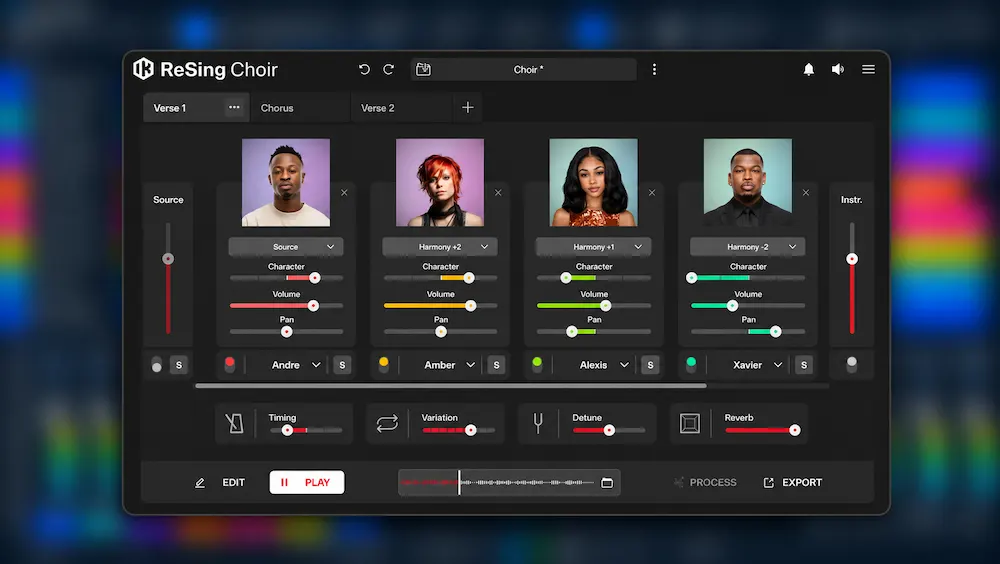
ReSing Choir organizes its vocal arrangements through a Voice Card system. Each Voice Card represents an individual singer and provides controls for selecting a voice model, defining its vocal role, and adjusting its contribution to the ensemble.
The application offers three main vocal part types:
- Source: Follows the original vocal melody and pitch performance.
- Unison: Generates an additional modeled performance that follows the source melody.
- Harmony: Creates an upper or lower melodic part relative to the original vocal line.
Harmony parts can be assigned one of six relative positions: +1, +2, +3, -1, -2, or -3. These settings define the intended harmonic relationship to the source melody and provide a starting point for building multi-part arrangements.
Different voice models can be assigned to individual singers, allowing producers to combine distinct modeled vocal identities within the same section. This is an important part of the system’s design: instead of relying on several copies of one processed recording, the arrangement can use multiple voice models to introduce tonal and timbral variation.
ReSing Choir also allows users to replace an assigned singer without rebuilding the entire part. The existing arrangement settings, mixing parameters, and manual note edits can be retained when changing the voice model. This makes it easier to compare different singer combinations while keeping the underlying vocal arrangement intact.
For example, a producer could build a five-singer chorus and then replace one voice model to change the ensemble’s tonal balance. The melodic arrangement and existing edits can remain in place, making voice selection an iterative part of the production process rather than a reason to reconstruct the section.
Make Every Vocal Layer Work as Part of the Mix
A layered vocal arrangement needs more than well-constructed harmonies. Each part must sit in the right place, retain clear articulation, and contribute to the overall depth without masking the lead or creating unnecessary frequency buildup. Our professional mastering service focuses on tonal balance, dynamics, stereo image, and translation across playback systems. Upload up to 40 seconds of your mix and receive a free mastering demo to hear how your production translates through a dedicated mastering process.
Submit Your Mix for a Free Mastering Demo →
Chord-Aware Harmonization and Automatic Vocal Arrangements
One of ReSing Choir’s key arrangement features is its Harmonize engine, which can use chord progressions entered in a dedicated Chords Lane to guide the generation of additional vocal parts. This provides a harmonic reference beyond simply shifting the source melody by a fixed pitch interval.
The Harmonize control adds another layer of flexibility by adjusting the relationship between the original melody and the chord tones supplied in the Chords Lane. This allows producers to influence whether generated harmony lines remain closer to the source melody or follow the harmonic structure more strongly. The result is a more adjustable starting point for voice leading, rather than a fixed interval-based transformation.
This approach is particularly useful when a melody moves through changing chords. A harmony that works over one chord may produce an unsuitable note over the next, even if the same interval is maintained throughout. By taking the supplied chord progression into account, ReSing Choir can generate parts that follow the intended harmonic context more closely.
For example, a melody performed over a progression that alternates between major and minor chords may need different scale degrees to maintain an appropriate harmonic relationship. Chord-aware generation offers more flexibility than building parallel voices at a constant interval, although the musical result still depends on the accuracy of the chord information and the source arrangement.
Generated parts can also be refined manually. Users can adjust individual notes, split notes, and work with controls for vibrato and note transitions. This note-level editing is important because automatic harmony generation does not necessarily produce the most appropriate melodic movement for every phrase.
Another useful feature is the ability to preserve manual note edits during subsequent reharmonization. Producers can therefore correct specific melodic movements and regenerate the arrangement around a revised chord progression without automatically losing those adjustments.
Even with chord-aware processing, automatic harmonization is best treated as an arrangement starting point rather than a replacement for musical judgment. Complex chord substitutions, chromatic passages, passing tones, and unconventional melodic movements may still require manual editing to achieve the intended voice leading and harmonic behavior.
Humanization: Making Multiple AI Singers Sound Less Mechanical
Generating multiple vocal parts does not automatically create a convincing ensemble. If every singer follows identical timing and pitch behavior, the arrangement can sound like a layered version of one performance rather than a group of distinct vocalists. ReSing Choir addresses this with several controls designed to introduce variation between modeled singers.
- Auto-character: Introduces changes in vocal character throughout the performance.
- Timing: Adjusts each singer’s rhythmic placement, with settings ranging from Ahead to Behind.
- Variation: Introduces micro-timing differences in word and phoneme onsets.
- Detune: Adds pitch variation between singers, with Low, Medium, and High settings.
- Pan: Positions individual voices across the stereo field, giving producers control over their spatial placement and the overall stereo width of the arrangement.
- Reverb: Adds reverberation to help place the ensemble in a shared acoustic space.
These controls address an important aspect of vocal production: real singers do not reproduce every consonant, onset, pitch movement, or phrase ending in exactly the same way. Subtle differences in timing, intonation, and articulation help distinguish individual performances and prevent a vocal stack from sounding overly uniform.
However, variation needs to be controlled carefully. Excessive timing offsets can compromise rhythmic tightness, while too much detuning can blur chord definition and weaken the ensemble’s pitch center. The appropriate balance depends on the arrangement, tempo, musical style, and the intended degree of precision.
It is also important to distinguish between adjustable variation and genuinely natural ensemble behavior. The presence of humanization controls does not establish that the generated singers interact like independently recorded performers. Auto-character, timing, and detune therefore need to be evaluated by listening to the actual output, particularly for consonant alignment, phrase transitions, sustained notes, and pitch consistency.
ReSing Choir provides a useful set of parameters for shaping the differences between modeled singers. Whether those controls produce convincing results in a finished mix remains a question of audio quality and musical context, not simply the number of available settings.
Individual Note Editing and Vocal Arrangement Control
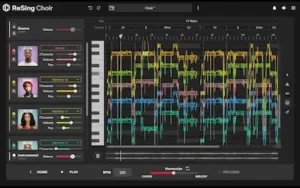
Automatic harmonization can establish the foundation of a vocal arrangement, but finished productions often require more precise melodic and performance adjustments. ReSing Choir addresses this with an integrated, color-coded piano roll that allows users to edit the generated vocal parts at the note level.
The editing environment allows producers to:
- Adjust individual note pitches and harmonic movements.
- Split existing note blocks to create more detailed melodic phrasing.
- Modify vibrato and note transitions.
- Shape alternative melodic lines and counter-melodies.
- Refine individual vocal parts after automatic harmonization.
This level of control distinguishes ReSing Choir from a basic automatic harmonizer. Instead of treating generated harmonies as fixed output, producers can use them as editable musical material and make corrections directly within the arrangement.
For example, an automatically generated pop chorus might contain upper and lower harmony parts based on the supplied chord progression. A producer could then adjust selected notes to create more interesting melodic movement, emphasize specific lyrics, or avoid clashes with the lead vocal and other arrangement elements.
This makes ReSing Choir potentially useful not only for generating backing vocals, but also for developing and refining vocal arrangements. The practical advantage depends on how efficiently the piano roll supports detailed editing and how naturally the modeled voices reproduce the resulting note changes.
Ten Included Voice Models and Expandable Vocal Options
IK Multimedia includes ten starter voice models with ReSing Choir. Each model has a documented vocal classification, stylistic profile, and pitch range, giving producers several starting points for building multi-singer arrangements.
| Voice Model | Vocal Character | Documented Range |
|---|---|---|
| Neil | Baritone, Rock, Blues | G3–A4 |
| Jenny | Soprano, Pop, Musical, Jazz | E2–C4 |
| Leyla | Mezzo-Soprano, Pop, EDM | G2–D4 |
| Alex | Tenor, Pop, Ballad | G3–C5 |
| Rika | Mezzo-Soprano, Dance, Jazz, Pop, Rock | E2–C4 |
| Aaron | Baritone, Rock, Blues, Soul | G3–A4 |
| Vixy | Alto, Trap, R&B | G2–D4 |
| Bob | Tenor, Pop, Blues | C3–B4 |
| Maya | Alto, Jazz | D3–D6 |
| Amber | Mezzo-Soprano, Punk | E2–C4 |
The included collection covers several vocal classifications and stylistic categories, allowing producers to combine models with contrasting profiles. This provides a foundation for building ensembles suited to different production styles, from pop and R&B to rock, jazz, and electronic music.
The available selection is not limited to the ten included models. ReSing Choir also supports compatible voice models from the wider ReSing ecosystem, including additional models and custom voices created with ReSing Modeler. IK Multimedia advertises a library of more than 66 voice models across its collections, with language coverage that includes English, Spanish, Japanese, and Portuguese.
Voice model provenance is also relevant when evaluating AI-based vocal production tools. IK Multimedia states that its professional singer models are created with the full participation, consent, and fair compensation of the original artists. This provides useful information about how the included professional voices are sourced, although it should not be confused with a complete explanation of the licensing terms governing every possible use of generated vocal performances.
However, a larger model library does not automatically translate into greater sonic diversity. Vocal classifications, stylistic labels, and model names describe the intended characteristics of each voice, but they do not establish how distinctly the models perform in practice. Their actual differences in timbre, articulation, phrasing, and pitch behavior are particularly important when several singers are combined in a dense arrangement.
Project Organization and Individual Vocal Stem Export
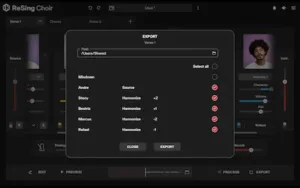 ReSing Choir supports up to ten independent sections within a project. These sections can represent different parts of a song, such as verses, pre-choruses, choruses, bridges, and outros.
Each section can have its own vocal source, singer configuration, and arrangement. This makes it easier to manage songs in which the backing vocal structure changes between sections, without having to treat the entire production as one continuous arrangement.
Export options are particularly important for producers who plan to complete the mix in a conventional digital audio workstation. ReSing Choir provides two main export formats:
- Full ensemble mixdown: Exports the processed ensemble with its individual volume settings, panning, and master reverb applied.
- Individual dry processed stems: Exports each generated singer as a separate file, without the application’s gain and pan settings.
Individual stem export offers greater flexibility in a professional vocal mixing workflow. Rather than committing to a single premixed ensemble balance, engineers can process and position each generated voice independently in their DAW.
For example, lower and upper harmonies may require different EQ curves and compression settings to occupy their own space in the mix. Managing these interactions is part of maintaining proper frequency balance when several vocal layers are combined. Individual de-essing can also help control accumulated sibilance when several generated voices are layered together. Further processing, including saturation, reverb, delay, and stereo placement, can then be tailored to the role of each singer.
This separation gives the mixing engineer more control over the final vocal balance and allows ReSing Choir to function as an arrangement and voice-generation stage within a broader production workflow, rather than requiring the entire vocal mix to be completed inside the application.
ReSing Choir vs. Waves Harmony vs. Antares Harmony Engine
IK Multimedia ReSing Choir, Waves Harmony, and Antares Harmony Engine all generate vocal harmonies from a single source performance, but they approach the task differently. The main distinction is between building an ensemble from separate modeled singer identities and generating additional harmony voices through real-time vocal processing.
Antares Harmony Engine is a real-time vocal harmony plugin with four independently adjustable harmony voices. Producers can create arrangements automatically, control individual notes manually, or use MIDI input. Its Humanize controls and built-in Choir feature provide additional ways to introduce variation and multiply the harmony voices into larger unison groups. However, this is not the same as assigning a separate AI voice model to each singer.
Waves Harmony generates up to eight harmony voices from a single vocal input. It offers three control methods: automatic harmony generation, MIDI performance, and graphical note editing. Each voice has adjustable pitch, formant, panning, delay, filtering, and modulation parameters. Its real-time operation makes it particularly convenient for producers who want to create and modify harmonies directly inside a DAW session.
ReSing Choir takes a more specialized approach. It combines up to five distinct modeled singers per section with chord-aware harmony generation, individual note editing, and performance variation controls. Rather than functioning as a real-time insert effect, it provides a standalone workspace for constructing vocal arrangements and exporting the results for further mixing.
I AM CHOIR from AM I AUDIO is another relevant alternative, but its approach is different. Instead of assembling an ensemble from individually assigned ReSing voice models, it uses recorded choir models, including Gospel, Children’s Choir, and Gang Vocals. It operates as a VST3, AU, and AAX plugin within a DAW, making it more directly integrated into an existing production session. ReSing Choir offers more explicit control over individual modeled singers and note-level harmony arrangements, while I AM CHOIR focuses on generating performances from established group-vocal models.
| Capability | ReSing Choir | Antares Harmony Engine | Waves Harmony |
|---|---|---|---|
| Generated harmony voices | Up to 5 modeled singers per section | 4 harmony voices, with additional Choir multiplication | Up to 8 voices |
| Separate modeled singer identities | Yes, using ReSing voice models | No equivalent documented | No equivalent documented |
| Automatic harmonization | Yes, chord-aware | Yes | Yes |
| Manual note and harmony control | Yes, piano roll editing | Yes, including MIDI control | Yes, including graphical and MIDI control |
| Humanization and performance variation | Yes | Yes | Modulation and per-voice controls |
| Real-time DAW processing | No | Yes | Yes |
| Standalone arrangement workspace | Yes | No | No |
| Individual dry vocal stem export | Yes | Not documented as a dedicated export feature | Not documented as a dedicated export feature |
The comparison reveals that the number of generated voices alone is not a reliable measure of capability. Antares Harmony Engine, for example, can multiply its four harmony voices through its Choir feature, while Waves Harmony provides up to eight independently adjustable harmony voices. ReSing Choir’s distinguishing feature is the use of separate modeled singer identities, combined with a dedicated arrangement and export workflow.
For producers who need harmonies during recording or want to work directly inside a DAW, Waves Harmony and Antares Harmony Engine offer a more immediate workflow. ReSing Choir is better suited to building a structured multi-singer arrangement, editing individual parts, and exporting separate vocal stems for detailed mixing.
Other products address related but different production needs. Klevgrand Altitude Harmony focuses on fast pitch correction and the generation of up to three additional harmony voices. iZotope VocalSynth 2 is primarily a creative vocal processing and synthesis effect rather than a dedicated multi-singer arrangement environment. Synthesizer V Studio 2 Pro takes a different approach again, generating singing performances from entered notes and lyrics instead of transforming an existing recorded vocal performance.
These tools are therefore not interchangeable alternatives. The right choice depends on the intended workflow: real-time harmonization, detailed plugin-based voice processing, AI-modeled singer arrangements, or synthesis of an entirely new vocal performance.
System Requirements and Standalone Workflow Limitations
IK Multimedia ReSing Choir is a standalone application for macOS and Windows. The following minimum specifications are listed in IK Multimedia’s ReSing platform documentation; however, the manufacturer does not separately identify them as ReSing Choir-specific requirements in the product information currently available.
| Requirement | macOS | Windows |
|---|---|---|
| Processor | Apple M1 or Intel Core i5 | Intel Core i5 or equivalent |
| RAM | 8 GB | 8 GB |
| Operating system | macOS 13.7 or later | Windows 10 64-bit or later |
| Storage | 9 GB | 9 GB |
| Graphics | OpenGL 2 compatible | OpenGL 2 compatible |
IK Multimedia specifies an ASIO-compatible audio interface or sound card for Windows. ReSing Choir uses installed and authorized ReSing voice models through IK Product Manager, while the manufacturer describes the audio processing itself as fully local, without cloud credits or usage quotas. Internet authorization requirements should be confirmed against the current Choir-specific documentation.
The standalone architecture has a direct impact on the production workflow. ReSing Choir does not function as a conventional real-time insert plugin inside a DAW. Vocal arrangements must be created in the separate application and then exported into the main production session for further editing and mixing.
This separation is not necessarily a problem when vocal arrangement is treated as a dedicated production stage. However, it adds an export-and-import step whenever the source performance, melody, timing, or chord progression needs to be revised. Changes made in the DAW do not automatically update the corresponding arrangement in ReSing Choir.
For engineers who frequently revise vocal performances during mixing, this workflow can introduce additional file management and version-control work. It is therefore worth considering how often the source recording and arrangement are likely to change before choosing a standalone tool over a real-time plugin.
The published minimum requirements also provide no reliable indication of how efficiently ReSing Choir handles larger projects or multiple simultaneous singers. The available specifications do not establish CPU usage, rendering times, memory consumption under sustained load, or performance differences between supported processor platforms. These aspects require independent testing before any conclusions about the application’s processing efficiency can be made.
Audio Quality: What Still Needs Independent Testing?
The most important unanswered question about IK Multimedia ReSing Choir is how convincingly its modeled singers reproduce natural vocal performances.
The application offers extensive arrangement, editing, and humanization controls, but feature availability alone does not demonstrate that the generated vocals will meet the sonic expectations of a finished commercial production. That requires evaluating the actual audio output under different musical and technical conditions.
Several aspects deserve particular attention in an independent assessment:
- Vocal identity: Whether the modeled singers retain clearly distinguishable timbral characteristics when combined in the same arrangement.
- Formant behavior: Whether vowel formants and consonant characteristics remain natural across different pitches and registers.
- Pitch accuracy: Whether generated harmony parts maintain stable intonation through wide melodic intervals, sustained notes, and changing chord progressions.
- Articulation: Whether consonants, word endings, syllable transitions, and phrase boundaries retain convincing definition.
- Timing variation: Whether humanization controls create believable differences between singers without compromising rhythmic cohesion.
- Dynamic expression: Whether changes in the source performance’s intensity and phrasing are reflected naturally in the generated voices.
- Processing artifacts: Whether voice generation introduces metallic textures, transient smearing, unnatural vibrato, unstable sibilance, or other audible artifacts.
These factors become especially important when several generated voices occupy overlapping frequency ranges. Individual parts may sound acceptable in isolation but become congested when combined, particularly around consonant attacks, sustained vowels, and overlapping phrase endings. The quality of the ensemble therefore needs to be assessed both at the individual-stem level and in the context of a complete mix.
Individual stem export provides a useful degree of control because engineers can apply corrective EQ, compression, de-essing, and spatial processing to each voice independently. However, conventional mixing cannot reliably eliminate artifacts that are already embedded in the generated vocal performance. Processing can improve balance and integration, but it cannot necessarily restore missing articulation or correct unnatural vocal behavior.
A meaningful evaluation should include controlled comparisons using the same source performance, musical arrangement, and comparable output levels. Tests against traditionally recorded backing vocals and competing harmonization systems would help establish where ReSing Choir performs well and where its limitations become apparent.
Product demonstrations can illustrate the interface and arrangement workflow, but they are not a substitute for independent listening tests. Without controlled comparisons and repeatable listening evidence, claims about vocal realism, production readiness, and sonic superiority should remain provisional.
Pricing and Value for Money
IK Multimedia announced ReSing Choir with an introductory price of $149.99, compared with a regular price of $199.99. Existing ReSing owners who meet the upgrade eligibility requirements can purchase it for $99.99.
| Purchase Option | Price |
|---|---|
| Introductory price | $149.99 |
| Regular price | $199.99 |
| Eligible ReSing owner upgrade | $99.99 |
ReSing Choir uses a perpetual licensing model, with no recurring subscription fee. The introductory price is 25% below the announced regular price. However, promotional availability, upgrade eligibility, and regional taxes should be verified at the time of purchase, as the final cost may vary by market.
The package includes ten voice models, providing a selection of modeled singers without requiring additional purchases to start building vocal arrangements. Users can expand their options with compatible models from the wider ReSing ecosystem, but these are optional additions rather than prerequisites for using the application.
At the introductory price of $149.99, ReSing Choir may represent reasonable value for producers who regularly create layered backing vocals and need a dedicated environment for generating, editing, and exporting multi-singer arrangements. Its value proposition is strongest when the ability to work with different modeled singer identities and export individual vocal stems can replace or reduce time-consuming arrangement work.
The financial case is less compelling for producers who only need occasional vocal doubling or straightforward harmonies. A conventional harmonizer may already cover those requirements without the additional cost or separate application workflow.
Ultimately, the purchase decision should depend on the quality of the generated performances, the amount of arrangement work the software can save, and how frequently its specialized features will be used. A large feature set alone does not establish good value if the resulting vocals require extensive correction before they can be used in a finished mix.
Who Should Consider IK Multimedia ReSing Choir?
Pop and R&B producers are among the most obvious potential users. Backing vocal stacks are common in these genres, where layered harmonies reinforce choruses, add depth to hooks, and create contrast around lead vocal phrases. ReSing Choir’s multiple voice models and editable harmony parts could help producers develop these arrangements without recording every layer individually.
Gospel and soul producers may also find the software useful for building multi-part harmony arrangements with different modeled singer identities. However, these genres often rely on expressive phrasing, dynamic interaction, and distinctive group articulation. Whether AI-generated voices can reproduce those qualities convincingly needs to be assessed through actual listening tests.
Songwriters and home-studio producers may appreciate the ability to develop backing vocal arrangements without hiring or recording additional singers. The application could be particularly useful for creating arrangement demos, testing harmony ideas, and developing layered vocal parts before committing to a final recording session.
Cinematic composers and media music producers may find ReSing Choir useful for creating layered vocal textures, atmospheric backing parts, and supporting harmonic arrangements. Its suitability will depend on whether the modeled vocal characters and generated performances fit the intended sonic aesthetic.
ReSing Choir may be less suitable for recording engineers who need real-time harmony generation during vocal tracking. In that situation, Waves Harmony or Antares Harmony Engine offers a more direct plugin-based workflow. Producers who already work with experienced backing vocalists may also prefer conventional recording when precise articulation, expressive phrasing, and natural group interaction are essential to the arrangement.
Overall Rating
This editorial rating evaluates ReSing Choir’s documented architecture, arrangement capabilities, editing controls, and production workflow. It does not represent a hands-on assessment of vocal realism, processing artifacts, rendering performance, or final audio quality, which require independent testing.
| Category | Rating |
|---|---|
| Ensemble Generation Architecture | 8.5/10 |
| Chord-Aware Harmony Design | 8.4/10 |
| Voice Model Selection | 7.8/10 |
| Performance Variation Controls | 7.8/10 |
| Note-Level Arrangement Editing | 8.6/10 |
| DAW Integration & Stem Export | 7.2/10 |
| Overall | 8.1/10 |
The ability to assign separate modeled singers within one arrangement gives ReSing Choir a more developed ensemble-generation architecture than conventional pitch-shifting harmonizers, although the actual distinction between generated voices still requires listening evaluation.
Using a supplied chord progression to guide harmony generation is a meaningful advantage over fixed-interval harmonization, while manual editing remains necessary for more complex voice leading and unconventional melodic movements.
Ten included models and compatibility with the wider ReSing ecosystem provide a useful starting selection, but the number of available models does not establish their individual realism or how convincingly they differ in a combined arrangement.
Timing, micro-variation, detuning, and Auto-character offer several ways to differentiate modeled singers, although the effectiveness of these controls in producing natural ensemble behavior cannot be established from their documented availability alone.
The color-coded piano roll, individual note adjustments, vibrato editing, and preservation of manual changes during reharmonization provide substantial control over the musical structure without requiring users to accept automatically generated parts as final.
Individual processed stem export supports detailed downstream mixing, but the absence of a real-time DAW plugin and the separate export-and-import workflow make the application less convenient for recording sessions that require frequent revisions.
ReSing Choir’s strongest proposition is its dedicated environment for constructing multi-part arrangements with separate modeled singer identities and editable harmony lines. Its main compromise is the standalone workflow, while the realism and production readiness of the generated vocals remain unverified. It is most relevant to producers who regularly build layered backing vocals and can accommodate a separate arrangement and export stage in their production process.
Final Verdict: Is ReSing Choir Worth Considering?
 IK Multimedia ReSing Choir introduces a specialized approach to AI-assisted vocal arrangement. By combining multiple modeled singer identities, chord-aware harmonization, note-level editing, humanization controls, and individual stem export, it offers a workflow that extends beyond conventional pitch-shifting harmonizers.
Its main advantage is the ability to build and edit a multi-singer vocal arrangement from a single recorded performance. For producers who regularly create backing vocal stacks, this approach offers an alternative to recording every harmony part separately and provides additional flexibility when developing an arrangement.
However, the standalone architecture makes ReSing Choir less convenient for real-time vocal tracking and rapid revisions within a DAW session. The five-singer-per-section limit and the potential cost of additional voice models are also worth considering. Most importantly, the sonic realism, consistency, and production readiness of the generated performances have yet to be established through independent testing.
ReSing Choir is best viewed as a specialized AI vocal arrangement tool, not a universal replacement for traditional backing vocal recording or conventional harmony plugins.
Producers who frequently build layered vocal arrangements should pay attention to its capabilities, particularly if the individual exported stems deliver sufficient quality for further processing in a professional mixing environment. By contrast, users who primarily need simple harmonies or real-time assistance during recording may find established plugin-based alternatives more practical.
At its announced introductory price of $149.99, ReSing Choir presents an interesting proposition for vocal-focused production workflows. Its long-term value, however, will depend on the quality of the generated performances, the amount of manual correction they require, and the time saved during arrangement and mixing. A sophisticated editing interface is only valuable if the resulting vocals hold up in an actual production.
Your Vocal Arrangement Is Built. Now Hear How It Translates in the Final Mix.
Adding modeled singers and refining individual harmony stems can create a more complex vocal arrangement, but it does not automatically guarantee clarity, separation, or a cohesive sound in the finished track. Multiple vocal layers can compete for the same frequency space, accumulate sibilance, and affect the stereo balance. Another processing plugin will not necessarily solve these mix-level interactions. The practical next step is to compare your current mix with a mastering version prepared by a real mastering engineer. Upload up to 40 seconds of your mix and receive a free mastering demo. You will be able to hear the actual before-and-after difference and judge whether the changes bring your production closer to the sound you want.
Upload Your Mix and Get a Free Mastering Demo from a Real Engineer →
Frequently Asked Questions
Can IK Multimedia ReSing Choir create a choir from a single vocal recording?
Yes. ReSing Choir can generate an ensemble of up to five modeled singers per section from a single recorded vocal performance. Each singer can be assigned a vocal role, and the generated harmony parts can be edited to refine the arrangement.
How many singers can ReSing Choir generate simultaneously?
ReSing Choir supports up to five modeled singers per section and up to ten independent sections in a project. These sections can represent different parts of a song, such as verses, pre-choruses, choruses, and bridges.
Does ReSing Choir work as a VST3 or AU plugin?
No. ReSing Choir is a standalone 64-bit application rather than a conventional real-time VST3 or AU plugin. Its workflow involves generating the vocal arrangement and exporting either the full ensemble mix or individual stems for further processing in a DAW.
Can individual singers be edited separately?
Yes. ReSing Choir uses individual Voice Cards to manage singers within an arrangement. Its color-coded piano roll allows users to edit vocal parts at the note level, including pitch, note placement, vibrato, and transitions. Individual dry, voice-processed stems can also be exported for separate mixing.
Can ReSing Choir generate harmonies automatically from chord progressions?
Yes. Users can enter chord information in the Chords Lane and use the Harmonize engine to generate vocal parts guided by the supplied harmonic structure. The generated notes remain editable, allowing users to refine individual harmony lines after automatic generation.
Does ReSing Choir require an internet connection?
IK Multimedia’s ReSing platform documentation lists an internet connection requirement for software authorization. The manufacturer describes ReSing Choir’s audio processing as local, without cloud-based processing. However, the exact authorization requirements should be confirmed against the current ReSing Choir documentation.
What is the difference between ReSing Choir and Waves Harmony?
The main difference is their approach to vocal harmonization. ReSing Choir is a standalone vocal arrangement application that builds ensembles using modeled singers, with chord-aware harmony generation and note-level editing. Waves Harmony is a real-time DAW harmonizer that generates up to eight harmony voices and provides automatic, MIDI, and graphical control. ReSing Choir emphasizes modeled vocal identities and a dedicated arrangement workflow, while Waves Harmony is designed for direct integration into a DAW session.
How much does IK Multimedia ReSing Choir cost?
The announced introductory price is $149.99, compared with a regular price of $199.99. Eligible existing ReSing owners can access an upgrade price of $99.99. These are announced prices; regional taxes, upgrade eligibility, and promotional availability may affect the final cost.
Is ReSing Choir suitable for professional music production?
Its editable vocal arrangements and individual stem exports make ReSing Choir relevant to professional vocal production and mixing workflows, particularly for creating backing vocal layers and harmonies. However, independent testing is still needed to establish how naturally its modeled singers perform, how consistently the software handles different source recordings, and whether its output meets the quality requirements of demanding commercial productions.

In vocal production, a convincing ensemble is not defined by the number of harmony parts but by how each line supports the lead without masking its articulation or creating excessive buildup. Evaluating AI-generated voices requires attention to consonant timing, formant behavior, pitch interaction, and how the combined stack responds to level and spatial processing. These are the engineering criteria that matter beyond the arrangement interface.
Enjoyed this review?
If you found it useful, you can support independent audio research with a coffee. ☕
Buy me a coffee