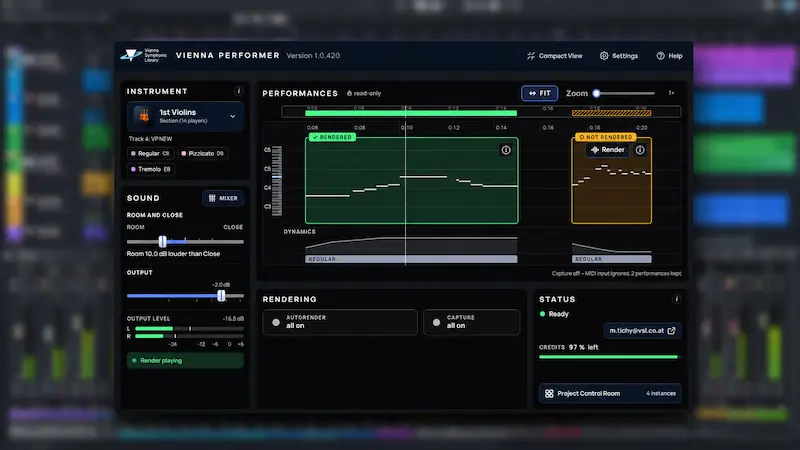
Vienna Symphonic Library (VSL) has released Vienna Performer, an AI-powered plugin that turns composer-written MIDI parts into rendered orchestral performances. Rather than generating music from text prompts, it interprets existing MIDI material using AI models trained on recordings made with professional musicians at Vienna Synchron Stage.
AI Orchestral Performance Rendering
Vienna Performer uses a different approach from conventional orchestral sample libraries. Composers create their parts in a DAW or supported notation application, specifying notes, durations, velocities, dynamics and playing techniques. The plugin analyzes the MIDI phrases and renders audio with performance details such as articulation, note transitions, vibrato and timing variations.
According to VSL, the AI models were trained on recordings made specifically for the project with professional musicians at Vienna Synchron Stage. The recordings were captured at the same facility used for the company’s Synchron sample libraries.
Vienna Performer does not compose music or generate melodies. Composers retain control over the notes, dynamics and phrasing; the AI models interpret those instructions to produce the performance. The plugin is designed for composers who want to develop more realistic orchestral performances from their own MIDI arrangements, not generate complete tracks from prompts.
Nine Instruments at Launch
The initial lineup includes five solo instruments: Violin, Cello, Flute, Clarinet and French Horn. Four ensemble models are also available: 1st Violins (14 players), 2nd Violins (12), Violas (10) and Cellos (10). VSL has announced Solo Trumpet and a Double Bass section (six players) as upcoming additions.
Each instrument provides two stereo outputs: Close and Room, the latter using a Decca Tree microphone configuration. The four-channel output lets users balance the direct and room signals in their orchestral mix. VSL says the recordings are designed to blend with its Synchron Series libraries.
There are some workflow limitations. All instruments, including the ensemble models, are monophonic, so each track can play only one note at a time. Overlapping notes and double stops require separate tracks. Rendering also requires an internet connection because the audio is processed through VSL’s online service.
Subscription Plans and Availability
Vienna Performer is available for Windows 10 and later, and macOS 12 and later. The plugin supports VST3, AU and AAX formats and requires a Vienna Symphonic Library account and an active subscription to render audio. New renders require an internet connection, although previously rendered audio can be played offline. Vienna Performer runs as a plugin inside a compatible DAW or supported notation application; it is not a standalone application.
VSL offers three subscription plans, with VAT included in the listed prices:
- Entry: €9.99 per month for 140 performance minutes.
- Standard: €19.99 per month for 360 performance minutes.
- Pro: €49.99 per month for 1,000 performance minutes.
Annual plans cost €99.90, €199.90 and €499.90, respectively, equivalent to 10 months of monthly billing. Additional credits are available in €50 packages, each providing 500 performance minutes.
Rendering is charged per instrument performance, with phrases rounded up to the next 10-second increment. A two-minute passage rendered across eight instrument tracks, for example, uses 16 performance minutes. Editing a phrase and rendering it again can consume additional credits, although unchanged renders are reused without another charge.
VSL says audio rendered during an active subscription remains licensed for commercial use indefinitely, even after the subscription ends. The plugin itself stops loading when the subscription expires. According to VSL, submitted MIDI and rendered audio are deleted from its service after delivery and are not used to train its AI models.
Vienna Performer gives orchestral composers another way to turn MIDI arrangements into performed parts without programming every articulation and transition manually. Its monophonic instrument models and internet-dependent rendering may not suit every workflow, but the combination of dedicated orchestral recordings and integration with VSL’s Synchron ecosystem makes it a notable release for composers working with virtual orchestras.