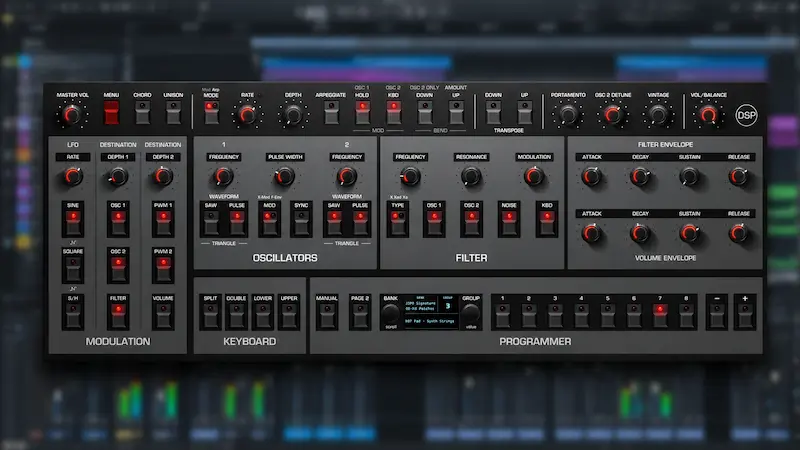
discoDSP has released OB-Xd 4, a major update to its polyphonic synthesizer. The new version features an engine developed using measurements of a physical Oberheim OB-X8, revised oscillator and filter modeling, and hardware-inspired voice behavior. It also adds a USB librarian for managing programs on the original synthesizer. Alongside OB-Xd 4, discoDSP has released Retromulator 2.4, a free update that adds two synthesizer cores.
OB-Xd 4 Introduces a New OB-X8-Based Engine
According to discoDSP, the OB-Xd 4 engine was developed using recordings and measurements from a physical Oberheim OB-X8. The process involved approximately 60 measurement sessions at 24-bit/192 kHz, covering oscillators, filter configurations, envelopes, LFOs, portamento, and variations across the instrument’s eight voices. The resulting software models were compared with the hardware recordings sample by sample.
The implementation also follows key aspects of the OB-X8 firmware, including envelope and LFO behavior, portamento, voice allocation, and arpeggiator operation. Rather than offering only an Oberheim-inspired sound, the new engine aims to reproduce the instrument’s circuit characteristics and hardware-specific behavior.
Each voice has two oscillators with saw, pulse, and triangle waveforms, along with hard sync, cross modulation, and detuning. The oscillators can also continue running between notes.
OB-X8 Filters, Layering, and Performance Features
OB-Xd 4 includes several filter configurations based on Oberheim designs:
- OB-X 2-pole filter.
- OB-Xa 2-pole and 4-pole filters.
- Modified OB-Xa 4-pole filter.
- SEM high-pass, band-pass, and notch filters.
The standard filter models use at least 4x oversampling, while the Modified OB-Xa 4-pole filter uses 8x. Three engine modes — Eco, Normal, and Max — offer different levels of processing. Offline renders with a registered license use Max mode.
The synthesizer supports Split, Double, and Binaural modes, with two program layers and different voice allocation options. Programs are organized into banks of 128. The arpeggiator offers host tempo synchronization, transpose, multiple playback directions, and chord memory.
Other features include MPE support, MIDI Learn, and MTS-ESP microtuning. OB-Xd 3 programs remain compatible through a separate Legacy engine, allowing users to load existing patches without converting them to the new synthesis engine.
USB Librarian for the Hardware OB-X8
One of OB-Xd 4’s key additions is an integrated librarian for the hardware OB-X8. With the synthesizer connected over USB, users can edit parameters from the software interface and manage program data without routing MIDI through a DAW.
The librarian supports two-way parameter editing, program changes, bank transfers, Edit Buffer access, backup and restore functions, and firmware updates. Its interface also provides access to the OB-X8’s second parameter page and hardware key combinations.
This extends OB-Xd 4 beyond software synthesis, making it useful for studios and musicians who own the hardware OB-X8.
Compatibility and Pricing
OB-Xd 4 supports Windows 10 and later, macOS 12 Monterey and later, and Debian 10 or later. Available formats include VST3, AU, AAX, and LV2, with a standalone version also provided. The software supports native Apple Silicon. The published system requirements include an Intel or AMD processor with AVX2 support and 8 GB of RAM.
The introductory price is $99 through December 31, 2026. From January 1, 2027, the regular price will be $199. Upgrade pricing is $29 for qualifying OB-Xd and TED-8 owners and $49 for other eligible discoDSP customers.
A free version is available for non-commercial use, but it comes with several limitations. Oversampling is disabled, the engine is limited to Normal mode, and AAX and LV2 offline rendering are unavailable. Offline renders using the new engine also include a short noise burst at regular intervals. The commercial license removes these restrictions.
Further details about OB-Xd 4 and its available editions are provided on the official product page.
Retromulator 2.4 Adds Nordic 2 and MiniD
Alongside OB-Xd 4, discoDSP has released Retromulator 2.4, a free update to its multi-instrument synthesizer emulation platform.
The update adds two instrument cores. Nordic 2 emulates the Clavia Nord Lead 2 without requiring the original hardware firmware or ROM data. It offers 64 voices, a four-part Performance Mode, and compatibility with Nord Lead 2 and N2X sound banks.
MiniD is a monophonic, three-oscillator synthesizer based on measurements of hardware. Its architecture includes a transistor ladder filter, oscillator and contour controls, glide, and Poly, Unison, and Double modes. The core also includes 49 factory presets.
Both additions expand Retromulator’s collection of synthesizer emulations, adding two distinct instruments to the platform.