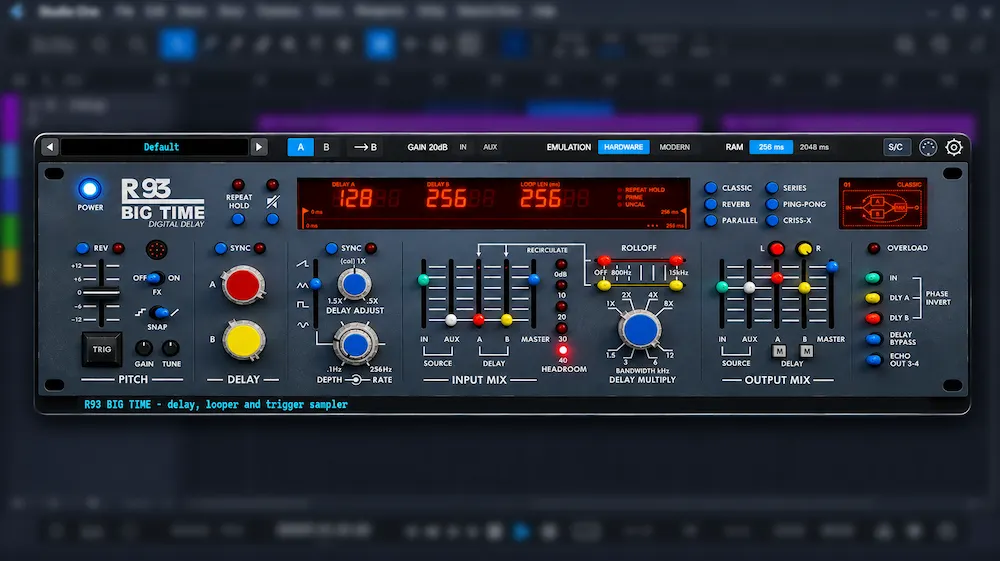
Pulsar Modular R93 Big Time combines a dual-tap digital delay with an integrated sampler that turns captured delay memory into playable audio. Inspired by the Lexicon Prime Time Model 93, the plugin brings together six feedback-routing algorithms, adjustable delay memory, modulation, and loop manipulation within a single processing environment.
Its defining feature is the relationship between the delay engine and the sampler. Repeat Hold freezes the contents of the delay memory, after which the captured material can be trimmed, pitch-shifted, reversed, and triggered via MIDI. This extends the plugin beyond conventional echo processing: the feedback network becomes a source of audio material that can be manipulated and incorporated into an arrangement.
Released on November 27, 2026, R93 Big Time belongs to Pulsar Modular’s Revival Series. Its delay architecture draws on the Lexicon Prime Time concept, while the sampling section takes inspiration from the E-mu SP-1200. The central question is whether this combination offers a meaningful advantage over established delay plugins, particularly Soundtoys PrimalTap, which already explores similar territory.
Quick Verdict
Pulsar Modular R93 Big Time is best suited to producers who want to combine vintage-inspired dual-tap delay processing with captured-loop manipulation and MIDI-triggered sampling. Its integrated TRIG section gives it a more specialized sound-design workflow than a conventional delay plugin.
Its main limitations are the absence of a full-featured independent sampler architecture, separate management of captured audio, and the lack of independently verified CPU and audio-performance measurements. Producers who primarily need conventional echoes or extensive multi-tap modulation may find more suitable alternatives in Soundtoys EchoBoy, FabFilter Timeless 3, or ValhallaDelay.
From Vintage Digital Delay to Playable Loop Processor
 The Lexicon Prime Time Model 93, introduced in 1978, combined two independently controlled delay taps with modulation, feedback, and Repeat Hold. Its significance extended beyond conventional echo processing: by manipulating delay time and recycling captured audio, it could turn short input signals into evolving rhythmic and tonal material.
Pulsar Modular R93 Big Time adapts this concept for DAW-based production. Its two delay-memory configurations and six routing algorithms determine how the taps interact within the feedback network, while the integrated sampler provides direct access to captured material for further manipulation.
Moving this architecture into software also changes how it fits into a modern production session. Delay parameters can be automated through the DAW, captured material can be edited and triggered without external hardware, and the additional routing options allow the processed signal to be integrated into more complex mixing and sound-design setups.
The distinction from earlier software interpretations is important. Soundtoys PrimalTap already brings the Prime Time approach into a plugin environment, including dual-delay processing and freeze-based manipulation. R93 Big Time’s more specific differentiator is its integrated trigger sampler, which makes captured delay material directly playable rather than limiting the workflow to repeating and manipulating the frozen buffer.
Dual-Tap Delay Architecture and Six Feedback Algorithms
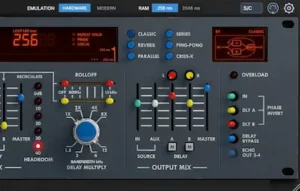
R93 Big Time is built around a dual-tap delay engine with independent delay-time, feedback, filtering, output-level, and stereo-panning controls for taps A and B. Each tap includes rolloff and low-cut filtering, allowing the repeats to be shaped independently. This architecture supports layered rhythmic patterns and contrasting feedback textures within a single plugin instance.
The six algorithms determine how the two taps interact within the feedback network. They are not simply variations in delay timing or stereo placement: each changes the internal routing of the repeated signal.
- Classic: Combines the feedback from both taps at the delay input, providing the traditional dual-tap feedback configuration.
- Reverb: Uses a feedback configuration designed to sustain repetitions without the same progressive buildup associated with conventional feedback routing.
- Parallel: Maintains separate feedback paths for taps A and B, allowing each delay pattern to develop independently.
- Series: Routes tap A into tap B, creating a sequential relationship between the two delay stages.
- Ping-Pong: Alternates feedback between taps A and B to generate movement across the stereo field.
- Criss-X: Cross-connects the feedback paths, allowing material from one tap to circulate through the other.
These routing differences become particularly important when feedback levels are increased. Adjusting delay time changes the spacing of repetitions, while adjusting feedback changes how long they persist. Switching algorithms changes how repeated material circulates between the two taps, potentially altering the rhythmic structure and density of the resulting effect.
Parallel mode is a logical choice for maintaining two distinct rhythmic patterns. Series mode introduces sequential processing between the taps, while Criss-X creates cross-feedback interactions that can produce more intricate repetition patterns. Ping-Pong is suited to arrangements where alternating stereo movement is an integral part of the delay effect.
For dub production, experimental electronic music, and sound design, these configurations offer more control over feedback behavior than a fixed-routing dual-tap delay. Their value lies in how the routing changes the relationship between repetitions, rather than in the number of algorithms alone.
Give Your Mix the Clarity and Balance It Needs to Translate
Creative delay processing, feedback layers, and evolving stereo textures can add depth and character to a production. But the final master still needs to preserve transient definition, maintain tonal balance, and keep the low end, dynamics, and stereo image working together across different playback systems. If you want to hear how your mix translates with professional mastering, submit up to 40 seconds of your track for a free mastering demo. You can evaluate the result before deciding whether to proceed.
Get Your Free Mastering Demo →
Delay Memory, Multiplication, and Filtering
R93 Big Time offers two delay-memory configurations: 256 ms and 2048 ms. The Delay Multiply control provides four settings: 1×, 2×, 4×, and 8×, extending the available delay-time range through multiplication of the selected memory configuration.
Memory capacity and delay duration are closely related in digital delay systems. The way a delay engine manages its available memory can affect the bandwidth of longer delay settings, making this an important part of the plugin’s architecture rather than just a capacity specification.
Pulsar Modular states that the 2048 ms RAM configuration retains more high-frequency detail when extending delay time. This is a manufacturer specification, not an independently verified frequency-response measurement. The larger memory option is intended to provide longer delay structures while preserving brightness, although the actual result should be evaluated in the context of the source material and processing settings.
Both taps also provide rolloff and low-cut filtering. These controls shape the frequency content of the repeats and are particularly relevant in feedback-based processing, where successive repetitions can reinforce particular frequency ranges.
Reducing high-frequency content produces progressively darker echoes, while low-cut filtering reduces the amount of low-frequency energy circulating through the feedback path. This can help keep delay repetitions from competing excessively with the original signal, particularly on vocals, percussion, and dense electronic arrangements.
Because these filters are integrated into the delay engine, users can shape the tonal character of the repeats directly within the plugin without inserting a separate EQ for each tap.
Repeat Hold and the Integrated Trigger Sampler
R93 Big Time’s defining feature is its ability to turn captured delay memory into playable audio. Rather than limiting the frozen signal to conventional delay repetitions, the plugin makes that material available for sample-based manipulation and triggering.
During normal operation, the delay engine continuously writes incoming audio into its memory. Activating Repeat Hold freezes the captured material, creating a repeating loop that can be manipulated through the TRIG section. The producer can then select a playback region, change its pitch, reverse it, or trigger it independently of the original incoming signal.
The integrated sampler provides several controls for working with the captured material:
- Loop trimming: Defines a smaller playback region within the captured audio.
- Pitch control: Changes playback pitch by up to ±12 semitones.
- Fine tuning: Provides additional pitch adjustment of up to ±100 cents.
- Reverse playback: Plays the selected material in reverse.
- One-shot triggering: Plays the selected region as a triggered sample rather than relying only on continuous looping.
- MIDI triggering: Allows the captured material to be triggered using MIDI notes.
This architecture expands the role of a delay plugin within a production session. A vocal phrase can become a short pitched sample, a synthesizer chord can be transformed into a repeating texture, and a percussion transient can be captured and retriggered to create rhythmic variations.
The TRIG section is particularly relevant to stutter effects and rhythmic sound manipulation. Instead of transferring audio to a separate sampler before working with it, the producer can capture a phrase, trim the desired region, and trigger it from a MIDI controller within the same plugin.
Captured material can also be exported as a WAV file by dragging the trimmed region into the DAW. This provides a practical bridge between real-time experimentation and conventional audio editing: once exported, the material can be arranged, processed, and reused independently of R93.
There is an important distinction, however. R93 is not a conventional multitrack looper or full-featured sampler instrument. Its sampling functionality is built around audio captured by the delay engine. It does not offer the independent sample-library management, multisampling, or broader instrument architecture found in dedicated sampling software.
There is also a session-recall limitation: captured audio is not automatically stored with DAW projects or plugin presets. Loops that need to be preserved for later use must be saved separately.
VCO Modulation and Hardware Versus Modern Modes
R93 Big Time includes a VCO-based modulation section that varies delay time to introduce pitch and timing changes. Depending on the modulation rate and depth, this can produce effects ranging from slow, chorus-like movement and vibrato to flanging, pitch variation, and more pronounced metallic textures.
The documented modulation-rate range is 0.1–256 Hz. At lower rates, modulation creates gradual changes in the delay signal. Higher rates allow faster variations that can be used for more pronounced modulation effects and experimental sound design.
R93 also provides two processing modes that offer different approaches to the character of the delay signal.
Hardware mode is designed to introduce the grit, hiss, and hard-limiting behavior associated with the original hardware concept. It is the intended choice when a more colored and less polished character is desired in the delay repetitions.
Modern mode provides cleaner repeats and a softer peak response. It offers an alternative for producers who want to use the delay routing and modulation features with less emphasis on the vintage-style processing character.
These modes should be understood as manufacturer-designed processing options, not as evidence of an exact hardware or analog reconstruction. Independent measurements of harmonic distortion, noise floor, transient response, and frequency response would be required to establish how closely either mode reproduces the behavior of the original Lexicon unit.
Routing, MIDI Control, and DAW Integration
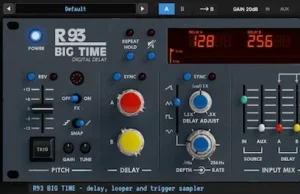 Beyond its delay and sampler functions, R93 Big Time provides routing options for integrating the plugin into more complex production sessions.
The AUX input allows an external signal to feed the delay independently of the track hosting the plugin. For example, R93 can be inserted on a vocal track while a separate percussion signal is sent to its AUX input. This allows the delay pattern to be driven by another element of the arrangement rather than exclusively by the vocal signal.
R93 also provides separate stereo echo outputs on channels 3–4. This makes it possible to route the delayed signal to another DAW track for further processing. The echoes can then receive independent equalization, compression, saturation, modulation, or other effects without applying the same processing to the original dry signal.
This separation is useful in sessions where the dry source and its delay effects need different processing chains. Rather than treating the effect as a fixed part of the original track, producers can manage and process the echoes as a separate stereo signal while considering how they contribute to the overall stereo image.
R93’s control and integration features include:
- DAW parameter automation.
- MIDI Learn.
- MIDI note triggering for captured material.
- Footswitch control.
- Tempo synchronization.
- Grid Lock for synchronized loop operations.
- A/B comparison.
- Independent saving and loading of captured loops, separate from automatic DAW project and plugin preset recall.
Pulsar Modular specifies zero samples of plugin latency. This refers to the absence of additional processing latency reported for the plugin; it does not mean that the delay effect itself produces no time offset. The intentional repetitions remain part of the signal path.
One practical detail concerns MIDI mappings: they are stored per computer unless exported. This is worth considering when transferring projects between studio systems or working across multiple machines, as the mappings may need to be transferred separately.
Practical Applications in Music Production
R93 Big Time is most compelling when its delay engine and integrated sampler are used together. Its distinctive workflow becomes less apparent when the plugin is treated simply as another tempo-synchronized delay.
Dub and Reggae Production
Dub production is a natural application for R93 Big Time. Its independent delay taps, multiple feedback-routing algorithms, filtering, and Repeat Hold provide the tools to build evolving echo patterns and sustained repetitions.
The ability to capture and retrigger audio also extends the workflow beyond conventional dub delay throws. A vocal fragment or percussion hit can be isolated, trimmed, and turned into a playable rhythmic element while the delay engine provides additional feedback-based textures.
Vocal Processing
R93 Big Time can create rhythmic vocal echoes, stereo repetitions, and pitch-shifted phrases. Its AUX input also allows an external percussion signal to feed the delay while the plugin is inserted on a vocal track, making it possible to build rhythmic echoes driven by another element of the arrangement.
The integrated sampler adds another workflow: capture a short vocal phrase, trim the desired region, and trigger it via MIDI. This can be useful for transitions, rhythmic accents, stutter effects, and experimental vocal arrangements.
For conventional vocal mixing, where placement, intelligibility, and focus within the arrangement take priority, a dedicated delay with straightforward tempo synchronization and predictable controls may be more efficient. R93 is more relevant when the delay and captured material are intended to become active elements of the arrangement rather than simply add depth.
Electronic Music and Sound Design
Electronic music producers can use Repeat Hold to capture synthesizer chords, arpeggios, and short melodic phrases, then turn them into repeating textures. Reverse playback and pitch manipulation provide additional ways to reshape the captured material.
The six feedback algorithms and VCO modulation offer further possibilities for creating evolving, metallic, and rhythmically complex sounds. These features make R93 relevant to ambient production, experimental electronic music, and cinematic sound design, particularly when conventional delay repetitions are not the intended result.
Hip-Hop and Beatmaking
The TRIG sampler provides a direct workflow for creating stutter effects, chopped percussion, and pitched rhythmic repetitions. A drum hit or short musical phrase can be captured, trimmed, and retriggered without first transferring it to a separate sampler instrument.
Pitch manipulation can also be used to create deliberately degraded or altered sample textures. This is useful when the production calls for a more experimental character rather than transparent reproduction of the original audio.
Guitar and Instrument Processing
The VCO modulation section can produce chorus-like movement, vibrato, flanging, and pitch variations by modulating delay time. This makes R93 applicable to guitar, synthesizer, and other instrument-processing workflows.
Its dual-tap architecture also supports more elaborate rhythmic repetition patterns than a conventional single-tap delay. Separate stereo echo outputs provide additional flexibility when the processed signal needs its own effects chain or dedicated routing within the DAW.
Pulsar Modular R93 Big Time vs Soundtoys PrimalTap
Soundtoys PrimalTap is the most relevant comparison for R93 Big Time. Both plugins draw on the Lexicon Prime Time concept, making PrimalTap a more useful reference than general-purpose delay processors when evaluating R93’s architecture and workflow.
PrimalTap already combines dual delay lines, freeze functionality, pitch manipulation, and VCO-based modulation. R93 is therefore not the first plugin to bring the Prime Time-inspired delay workflow into a modern software environment.
The key distinction is R93’s integrated TRIG sampler, which turns captured delay material into playable audio. Its MIDI triggering, loop trimming, reverse playback, and WAV export provide a more explicit workflow for moving from delay processing to sample-based sound design.
| Feature | Pulsar Modular R93 Big Time | Soundtoys PrimalTap |
|---|---|---|
| Prime Time-inspired design | Yes | Yes |
| Dual delay architecture | Two independently controlled taps | Dual delay lines |
| Feedback and modulation | Six feedback algorithms and VCO modulation | Feedback and VCO-based modulation |
| Freeze functionality | Repeat Hold | Freeze |
| Integrated MIDI-triggered sampler | Yes | No equivalent documented here |
| Reverse captured-loop playback | Yes | No equivalent dedicated control established here |
| Primary distinction | Delay memory combined with playable sampling | Prime Time-inspired delay processing |
For producers who already own PrimalTap, adding R93 makes the most sense when its integrated sampler, captured-loop workflow, or expanded routing addresses a specific production requirement. The two plugins share enough conceptual ground that owning both is not automatically beneficial. The decision should depend on whether R93’s additional sampling workflow offers something genuinely useful in the producer’s sessions.
How R93 Big Time Compares with FabFilter Timeless 3, EchoBoy, and ValhallaDelay
Other delay plugins approach similar production tasks from different architectural perspectives. The most useful comparison is not simply the number of features, but how each processor handles delay routing, modulation, and sound manipulation.
FabFilter Timeless 3 is a stronger option for complex modulation and multi-tap delay structures. It supports up to 16 delay taps, extensive modulation, filters, and additional processing effects. Producers who need elaborate rhythmic patterns and highly programmable modulation may find its architecture more suitable than R93’s specialized two-tap design.
Soundtoys EchoBoy offers a broad selection of echo styles and is particularly useful for conventional mixing applications involving different vintage-inspired delay characters. Its range of echo models makes it a more general-purpose choice when the priority is shaping the tonal character of repetitions rather than turning captured delay memory into playable samples.
ValhallaDelay provides multiple delay modes, modulation, diffusion, and creative echo processing at a lower price point. It is a practical alternative for producers who want a versatile delay processor without specifically needing R93’s integrated sampler workflow.
| Plugin | Main strength | Best suited to |
|---|---|---|
| Pulsar Modular R93 Big Time | Dual-tap delay with integrated captured-loop sampler | Creative sampling, feedback manipulation, and experimental delay processing |
| Soundtoys PrimalTap | Prime Time-inspired delay processing | Vintage-style digital delay workflows |
| FabFilter Timeless 3 | Extensive modulation and multi-tap processing | Complex, programmable delay structures |
| Soundtoys EchoBoy | Multiple echo styles | General-purpose mixing and vintage-inspired echoes |
| ValhallaDelay | Versatile creative delay modes at a lower price | Flexible delay processing on a tighter budget |
These processors are not interchangeable. Timeless 3 offers a more extensive modulation environment, EchoBoy covers a broader range of conventional echo characters, and ValhallaDelay provides a more economical route to creative delay processing.
R93 Big Time occupies a more specialized position. Its strongest reason to choose it is the ability to turn captured delay material into playable audio, combining delay processing and sample manipulation within one workflow.
Compatibility, Pricing, and Licensing
R93 Big Time supports several desktop operating systems and plugin formats. According to Pulsar Modular’s published specifications, the minimum requirements and supported formats are as follows:
| Platform | Minimum operating system | Supported formats |
|---|---|---|
| macOS | macOS 12 or newer | VST3, AU, AAX |
| Windows | Windows 10 or newer, x64 | VST3, AAX |
| Linux | x86-64, glibc 2.34 or newer | VST3, LV2 |
The plugin supports mono and stereo operation, an AUX input for external signal routing, and additional stereo outputs on channels 3–4. Pulsar Modular also lists 52 factory presets.
The licensing model includes one license key for two computers. A fully functional 15-day trial is also available, allowing users to evaluate the plugin before purchasing.
At launch, Pulsar Modular lists R93 Big Time at $74, reduced from its regular price of $124. The introductory offer is advertised through December 1, 2026.
At $74, R93 is easier to justify for producers who specifically need its combination of dual-tap delay processing and integrated sampling. At the regular $124 price, the decision depends more heavily on whether the captured-loop workflow offers enough practical value beyond existing delay and sampler plugins.
One documentation discrepancy deserves attention. The English user guide includes an iPad and iPhone section describing AUv3 and standalone operation, while the published product specification table lists desktop plugin formats. Buyers interested in iOS should confirm current availability and compatibility directly with Pulsar Modular rather than assume that iOS support is included in the current release.
What Is Missing from the Available Technical Evidence?
R93 Big Time has a clearly documented feature set, but its published specifications do not establish every aspect of its real-world sonic performance or processing efficiency.
The available research does not establish independent CPU benchmarks, controlled listening comparisons, or detailed measurements of the plugin’s signal behavior. As a result, several technical questions remain unanswered:
- How closely does Hardware mode reproduce the distortion and noise characteristics of the original Lexicon Prime Time?
- What are the measured harmonic distortion and noise-floor characteristics of Hardware and Modern modes?
- How does the integrated sampler perform at extreme pitch-shift settings?
- What is the plugin’s CPU consumption at different sample rates and buffer configurations?
- How does its measured audio performance compare directly with Soundtoys PrimalTap?
- What specific changes were introduced in version 1.1.0 compared with the available version 1.0.0 user manual?
Pulsar Modular specifies zero samples of plugin latency, but this figure should not be interpreted as evidence of low CPU consumption or superior processing efficiency. Latency and CPU usage are separate performance characteristics and require different measurements.
Similarly, the presence of Hardware and Modern modes does not independently demonstrate that the plugin accurately reproduces the original hardware’s sonic behavior. A meaningful comparison would require controlled level matching, equivalent delay settings, and measurements of relevant signal characteristics, including frequency response, harmonic distortion, and noise.
For prospective buyers, the distinction is important: R93 Big Time’s feature set and intended workflow are documented, but claims about its sonic accuracy, processing efficiency, and measurable advantages over established alternatives remain unverified by the available independent evidence.
Is Pulsar Modular R93 Big Time Worth Buying?
 Pulsar Modular R93 Big Time is a specialized creative-effects plugin built around a distinctive concept: delay memory becomes a playable production resource rather than simply a mechanism for generating repetitions.
Its strongest features are the dual-tap architecture, six feedback algorithms, Repeat Hold, and integrated MIDI-triggered sampler. Together, they create a workflow that connects delay processing with captured-loop manipulation, sample triggering, and sound design.
Its main limitation is its specialized focus. Producers who need extensive multi-tap modulation, a broad selection of vintage echo models, or a more conventional delay processor may find better-fitting alternatives in FabFilter Timeless 3, Soundtoys EchoBoy, or ValhallaDelay.
Existing Soundtoys PrimalTap owners should also consider whether R93’s integrated sampler, reverse playback, and additional routing options justify adding another Prime Time-inspired plugin to their collection.
R93 Big Time is worth considering for electronic music producers, sound designers, dub musicians, and mixing engineers who regularly turn delay feedback into creative source material. It is less compelling for users who simply need another general-purpose delay effect.
At the introductory price of $74, its specialized architecture makes a stronger purchasing case. At the regular $124 price, the decision depends more heavily on how frequently the captured-loop and MIDI-triggering workflow will be used.
Ultimately, R93’s strongest selling point is not another interpretation of vintage digital delay. It is the ability to capture, manipulate, and perform audio circulating inside the delay engine. That capability gives the plugin a distinct purpose alongside established delay processors.
Overall Rating
These ratings evaluate the documented feature set, architectural flexibility, and practical workflow potential of R93 Big Time. Each category is scored on a 10-point scale and weighted equally in the overall result. The scores represent an editorial assessment of the plugin’s documented capabilities, not independently measured audio quality, CPU efficiency, or sonic performance.
| Category | Rating |
|---|---|
| Dual-Tap & Feedback Architecture | 9.2/10 |
| Delay-Time & Memory Flexibility | 8.5/10 |
| Filtering & Modulation Control | 8.6/10 |
| Stereo & Signal Routing | 9.0/10 |
| Captured-Loop Sampling | 9.4/10 |
| DAW & Performance Integration | 8.2/10 |
| Overall | 8.8/10 |
The six feedback algorithms and independently controlled taps provide a well-developed architecture for shaping complex delay behavior, earning a strong rating for routing versatility.
The two memory configurations and four Delay Multiply settings offer useful timing flexibility, although the available documentation does not establish the full measured performance of the extended delay ranges.
Independent rolloff and low-cut controls, combined with a wide VCO modulation-rate range, provide substantial control over repeat coloration and modulation behavior without verified measurements of their sonic performance.
Separate stereo echo outputs, an AUX input, and independent tap panning support flexible signal routing, including processing delay returns separately from the original source.
The integrated TRIG section is the product’s strongest differentiator: captured audio can be trimmed, pitch-adjusted, reversed, and triggered via MIDI, although it lacks the independent sample-library architecture of a dedicated sampler.
DAW automation, MIDI control, tempo synchronization, and footswitch support make the plugin adaptable to production and performance setups, but the lack of automatic captured-audio recall and computer-specific MIDI mappings introduces practical limitations.
R93 Big Time stands out through the combination of dual-tap feedback processing and an integrated captured-loop sampler. Its architecture and routing options are particularly relevant to producers who use delay as a source of playable material, not just spatial effect. The main compromises are limited sampler functionality, separate loop management, and the absence of independent performance measurements; the ratings therefore assess documented capabilities rather than verified sonic quality.
Your Delay Design Is Only One Part of the Final Mix
R93 Big Time can turn feedback, frozen delay memory, and MIDI-triggered samples into distinctive musical elements. But once those layers are part of a finished arrangement, the challenge is making them work with the entire mix. Dense echoes and evolving stereo textures can affect transient definition, frequency balance, low-end clarity, dynamics, and mono compatibility. Adding another processor is not always the answer. What matters is hearing how the complete mix holds together and translates outside your production environment. Upload up to 40 seconds of your mix and receive a free mastering demo prepared by a real mastering engineer. Compare the original and mastered versions directly to hear what changes, what improves, and whether the processing is right for your track.
Upload Your Mix for a Free Mastering Demo →
Frequently Asked Questions
Is Pulsar Modular R93 Big Time based on the Lexicon Prime Time Model 93?
Yes. R93 Big Time is inspired by the Lexicon Prime Time Model 93, particularly its dual-tap delay architecture, feedback behavior, modulation, and Repeat Hold concept. It extends this approach with an integrated trigger sampler and additional DAW-oriented functionality.
Does R93 Big Time include a sampler?
Yes. Its TRIG section can play audio captured by the delay engine using Repeat Hold. Users can trim the captured region, adjust playback pitch, reverse the audio, and trigger it using MIDI. However, it is not a conventional independent multisample instrument.
What is the difference between Repeat Hold and TRIG?
Repeat Hold freezes the delay memory, preserving the captured audio as a repeating loop. TRIG provides controls for manipulating and playing the captured material, including one-shot playback and MIDI triggering.
Can R93 Big Time be used for dub and reggae production?
Yes. Its dual delay taps, six feedback algorithms, filtering, VCO modulation, and Repeat Hold functionality make it suitable for dub-style echo processing, evolving repetitions, and experimental rhythmic effects.
Can R93 Big Time save captured loops?
Yes. Captured loops can be saved independently, and trimmed material can be exported as a WAV file by dragging it into the DAW. However, captured audio is not automatically stored with DAW projects or plugin presets, so separate saving is necessary for later recall.
Does R93 Big Time support MIDI triggering?
Yes. The integrated TRIG sampler supports MIDI note triggering. The plugin also provides MIDI Learn and DAW parameter automation.
Does R93 Big Time introduce plugin latency?
Pulsar Modular specifies zero samples of plugin latency. This refers to additional processing latency reported by the manufacturer, not the intentional delay time generated by the effect.
What are the main alternatives to R93 Big Time?
Soundtoys PrimalTap is its closest conceptual competitor. FabFilter Timeless 3 is better suited to extensive multi-tap modulation, Soundtoys EchoBoy offers a broader selection of echo styles, and ValhallaDelay provides a more affordable general-purpose creative delay option.
How much does Pulsar Modular R93 Big Time cost?
The published regular price is $124, with an introductory price of $74 through December 1, 2026. Pulsar Modular also offers a fully functional 15-day trial.

Evaluating a creative delay requires more than checking its timing controls or the number of available modes. Feedback stability, frequency-dependent decay, modulation behavior, and stereo compatibility all affect how repeated signals interact with the original source and the rest of a mix. These engineering considerations are particularly important when delay processing becomes part of the sound itself rather than remaining a background spatial effect.
Enjoyed this review?
If you found it useful, you can support independent audio research with a coffee. ☕
Buy me a coffee