Bus compressors are no longer rare studio tools—they’re one of the most competitive plugin categories in modern audio production. Nearly every developer promises tighter mixes, richer harmonics, and the elusive “analog glue.” For experienced engineers, however, another compressor only matters if it offers a better workflow, a more convincing compression curve, or a sonic character that justifies another insert on the mix bus.
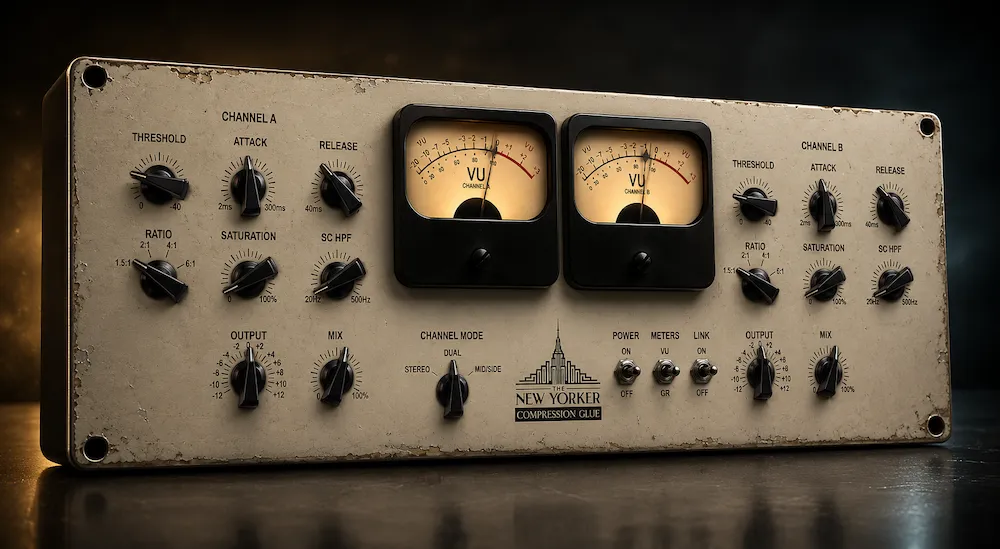
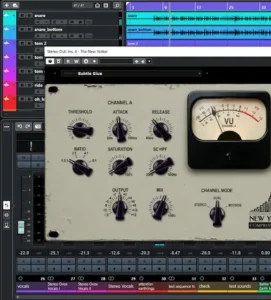
That is the challenge facing M Media Audio’s The New Yorker. It arrives as a native Vari-Mu bus compressor with Stereo, Dual Mono, and Mid-Side operation, built-in tube-style saturation, parallel Mix controls, and traditional VU metering. None of those features are unusual on their own. The question is whether their implementation creates a compressor engineers will actually reach for after the excitement of a new release fades.
Competition is particularly fierce. Well-established options such as Pulsar Mu, Klanghelm MJUC, UAD Manley Variable Mu, and IK Multimedia T-RackS Vari-Mu have already earned places in professional sessions by delivering predictable behavior across thousands of mixes. Any newcomer has to compete not only on sound quality, but also on efficiency, reliability, and long-term usability.
This review approaches The New Yorker as a production tool rather than a product launch. Instead of repeating feature lists or marketing language, we’ll examine how its design fits into real mixing workflows, where it offers genuine advantages, where it falls short, and whether it deserves a place alongside today’s established Vari-Mu compressors.
Quick Verdict
The New Yorker is a thoughtfully designed Vari-Mu bus compressor that prioritizes workflow over complexity. Its Mid-Side processing, integrated parallel compression, and straightforward interface make it a compelling option for mix engineers, although its DSP quality still requires broader independent validation before it can be considered a reference-class processor.
In This Review
Why Vari-Mu Bus Compressors Still Matter in Modern Mixing
 Software compression has reached a point where virtually every price tier offers capable dynamics processing. Yet Vari-Mu compressors continue to occupy a distinct role in professional mixing. Unlike VCA designs built around speed and precision—or optical compressors known for gentle level control—a well-tuned Vari-Mu compressor is valued for how it shapes the relationship between instruments. Its job is rarely to control peaks. Its value lies in making an already balanced mix behave like a single performance instead of a collection of individual tracks.
That role has become even more relevant as production sessions have grown in both size and complexity. A modern mix may include well over one hundred tracks, stacked virtual instruments, multiple saturation stages, clip-gain automation, parallel processing, and loudness preparation before mastering even begins. Individual elements can sound polished in isolation while the mix itself still lacks cohesion. Bus compression addresses that problem by influencing how instruments react to one another rather than simply reducing dynamic range.
Modern workflows have also changed what engineers expect from a bus compressor. Stereo linking is no longer enough. Mid-Side processing has become a practical mixing tool for controlling center energy without sacrificing width, while integrated parallel compression eliminates unnecessary routing. Features such as instant A/B comparison, preset management, and fast recall are no longer premium extras—they are expected in professional DAW environments where revisions happen constantly.
As a result, today’s market is less concerned with recreating a specific piece of vintage hardware than with adapting classic compression behavior to modern production. The best bus compressors combine musical gain reduction with efficient workflow, allowing engineers to move quickly without sacrificing precision.
The New Yorker follows that direction. Rather than presenting itself as a meticulous recreation of a famous analog unit, it combines familiar Vari-Mu behavior with Stereo, Dual Mono, Mid-Side operation, integrated saturation, and built-in parallel compression. None of those features are revolutionary on their own, but together they reflect how contemporary engineers actually build mix bus chains.
The line between mixing and mastering has also become less defined than it was a decade ago. Many mixers apply subtle bus compression throughout production to establish the final groove before the project ever reaches mastering. That makes it even more important to prepare a mix for mastering without excessive bus processing that limits downstream mastering decisions. At the same time, mastering engineers increasingly receive mixes that already include stereo bus compression, making predictability and controlled harmonic behavior more valuable than exaggerated analog coloration.
That shifts the evaluation criteria for any new Vari-Mu plugin. Experienced engineers are rarely asking whether it sounds “analog.” They want to know whether the low end remains stable under compression, whether stereo localization holds together during heavier gain reduction, whether the harmonic content stays musical instead of congested, and whether the processor solves problems faster than the tools already in daily use. Those answers—not the feature list—ultimately determine whether a compressor becomes part of a long-term workflow.
See How Your Mix Translates After Professional Mastering
A great bus compressor can improve cohesion, but it can’t replace an experienced mastering engineer. If you’re curious how much more depth, punch, clarity, and translation your mix can achieve, upload up to 35 seconds and receive a free professional mastering demo. Compare your original mix with a mastered version before deciding on the full project.
Request your free mastering demo →
Workflow Design: Does The New Yorker Solve Real Mixing Problems?
Feature count rarely determines whether a bus compressor survives beyond the demo period. Engineers keep the processors that remove friction from daily sessions, not the ones with the longest specification sheets. The New Yorker focuses on three practical areas: flexible channel routing, integrated parallel compression, and harmonic coloration. None of those ideas are new individually, but combining them inside a single processor reduces routing, utility plugins, and unnecessary session complexity.
The plugin offers three operating modes: Stereo, Dual Mono, and Mid-Side. Stereo operation behaves exactly as expected, linking both channels through a common detector to maintain image stability during bus compression. For drum buses, mix buses, and instrument groups, that remains the safest and most predictable working method.
Dual Mono shifts the focus from stereo cohesion to independent channel control. Separate threshold, ratio, timing, saturation, and output settings allow each side to react differently, making the mode useful for asymmetrical stereo recordings, hardware captures, or creative processing where linked compression becomes restrictive. It is less relevant on a stereo master, but valuable elsewhere in a production session.
Mid-Side processing is arguably the strongest workflow feature. It allows engineers to increase center density without collapsing stereo width, or control wide ambient information without disturbing kick, bass, vocals, and other centrally positioned elements. That flexibility has moved well beyond mastering. Mid-Side compression is now common on drum buses, orchestral stems, vocal groups, and electronic productions where stereo balance changes throughout an arrangement.
Like any Mid-Side processor, however, restraint matters more than flexibility. Aggressive Mid compression can narrow a mix surprisingly quickly, while excessive Side compression often destabilizes ambience and stereo depth. The controls make those decisions possible; they do not make them automatically correct.
The integrated Mix control addresses another practical concern. Traditional New York compression often requires duplicate buses, auxiliary routing, and additional gain staging. Housing parallel blending inside the compressor shortens that signal path and simplifies revisions later in the project. The time savings are modest on a single track, but become increasingly noticeable across large sessions containing multiple processing buses.
The overall signal flow deserves equal credit. Many modern dynamics processors attempt to combine compression, EQ, clipping, transient shaping, stereo imaging, saturation, and limiting inside a single interface. While that approach maximizes flexibility, it also encourages unnecessary processing simply because the controls are available. Here, the design stays focused on bus compression instead of expanding into a general-purpose channel strip.
The always-active saturation stage is more difficult to evaluate. Harmonic enhancement is fundamental to the appeal of classic Vari-Mu hardware, but saturation quality depends entirely on implementation. Some algorithms generate smooth, musically useful harmonics under increasing gain reduction, while others become congested or brittle long before the compressor itself reaches its limits. M Media Audio has published little technical information explaining how the nonlinear stage is modeled, leaving critical listening as the only reliable way to judge its behavior.
Perhaps the most interesting design decision is what has been left out. There are no AI-assisted controls, adaptive mastering modes, spectral dynamics, or automated processing assistants. Every decision remains manual. That may sound conservative, but experienced mix engineers often work faster when a processor exposes only the controls that genuinely affect the outcome instead of attempting to predict creative intent.
In practice, the plugin integrates naturally into several common workflows. Drum buses benefit from parallel compression without additional routing. Vocal groups can gain density while preserving movement. Instrument stems can receive subtle harmonic reinforcement before final summing, and Mid-Side operation provides another layer of control when balancing stereo information during mastering.
None of those applications are unique, and that is worth acknowledging. The New Yorker is not redefining bus compression or introducing a new DSP concept. Its value depends on execution. If the compression remains stable, stereo imaging holds together, and the saturation responds musically across different material, the streamlined design becomes a genuine advantage. If those fundamentals disappoint, no amount of workflow convenience will compensate.
That is where the plugin currently stands. The architecture is sensible, the feature set reflects modern production practices, and the interface avoids unnecessary complexity. Interestingly, M Media Audio seems to be developing a consistent design philosophy centered on reducing friction instead of maximizing feature count. We observed the same workflow-first approach in our Curve Control review, where faster decision-making proved more important than adding another layer of processing. Whether that philosophy ultimately succeeds here depends on the quality of the underlying Vari-Mu implementation rather than the interface itself.
Marketing Claims vs. Engineering Reality
 “Analog glue” has become one of the most overused phrases in plugin marketing. Nearly every new bus compressor promises tighter mixes, richer harmonics, and the elusive cohesion associated with vintage hardware. Those claims matter far less than the engineering underneath them. What determines a compressor’s long-term value is detector behavior, stereo stability, harmonic structure, release characteristics, and how consistently it performs across different source material.
That is where evaluating The New Yorker becomes more complicated. M Media Audio describes the plugin in highly subjective terms—phrases like “the gluiest glue imaginable” and “glue with attitude” communicate an intended sound, but they reveal almost nothing about the DSP responsible for producing it. Unlike several established developers, the company has not published meaningful technical information covering detector design, nonlinear modeling, oversampling, or internal processing architecture.
That absence is not unusual among smaller plugin developers, nor does it automatically imply weak engineering. It does, however, leave critical listening as the primary evaluation tool. Engineers are effectively asked to judge the processor by its results rather than by measurable implementation.
One technical question remains particularly relevant: oversampling. Any saturation stage capable of generating additional harmonics also has the potential to introduce aliasing when operating at lower sample rates. Without confirmation of the plugin’s oversampling strategy, users working at 44.1 or 48 kHz should pay close attention to high-frequency behavior under heavier compression and drive settings.
The same uncertainty applies to performance characteristics. There are currently no independent measurements covering CPU efficiency, latency, transfer curves, release timing, or distortion spectra. Those may sound like laboratory metrics, but they directly affect practical mixing decisions. Small inconsistencies in stereo linking or envelope behavior often become audible long before they appear in a specification sheet.
The always-active saturation stage also deserves a balanced perspective. Integrating harmonic enhancement directly into the compressor simplifies workflow and encourages decisive mixing. The trade-off is flexibility. Engineers who prefer compression and saturation as separate processing stages have fewer opportunities to tailor each independently, particularly when transparent bus compression is the goal.
Perhaps the biggest challenge has little to do with features at all. It is experience. Products like Pulsar Mu, Klanghelm MJUC, and UAD’s Manley Variable Mu have accumulated years of real-world use across commercial records, film scores, broadcast productions, and mastering sessions. Their behavior is predictable because thousands of engineers have already tested their limits. The New Yorker has yet to build that level of trust. That does not diminish its potential, but it does place it in a fundamentally different position than the category’s established benchmarks.
Ironically, one of the plugin’s strongest qualities may be its restraint. Rather than expanding into another feature-heavy channel strip filled with AI assistants, transient processors, clipping stages, dynamic EQs, and stereo enhancement, it remains focused on a single task. That kind of design is becoming increasingly uncommon. As we noted in our Acon Digital Multiply 2 review, some of the most enduring production tools succeed not because they do more, but because they solve one problem exceptionally well. The New Yorker follows a similarly focused philosophy.
The remaining question is one that no feature list can answer. Does the compressor develop a recognizable musical character that engineers choose repeatedly over time? Every respected Vari-Mu processor eventually earns its reputation through thousands of hours of real sessions—not through launch-day marketing. The New Yorker has a sensible architecture and a modern workflow. Whether it joins that group depends entirely on how its compression sounds after the novelty of a new release has disappeared.
Competitive Position: Where The New Yorker Stands in the Vari-Mu Market
Bus compressors compete on reputation as much as sound quality. Most experienced engineers already have several trusted options in their templates, so replacing one requires more than a familiar control layout. A new processor must either solve workflow problems more efficiently, deliver a distinctive compression character, or offer enough value to justify another place in the signal chain.
That puts The New Yorker in direct competition with some of the most established Vari-Mu plugins currently available. Each approaches bus compression from a different perspective, making the choice less about specifications and more about workflow priorities.
| Plugin | Workflow Focus | Primary Advantage | Trade-Off |
|---|---|---|---|
| M Media Audio The New Yorker | Modern bus processing | Integrated Mid-Side, Dual Mono, and parallel compression in a streamlined interface | Limited long-term validation and independent testing |
| Pulsar Mu | Mastering-grade precision | Highly refined analog modeling with extensive control | Higher cost and a more demanding learning curve |
| Klanghelm MJUC | Versatile everyday compression | Exceptional price-to-performance ratio with multiple compression personalities | Less optimized for Mid-Side bus workflows |
| UAD Manley Variable Mu | Hardware authenticity | Faithful recreation of a respected mastering compressor | Higher platform cost within the UAD ecosystem |
| IK Multimedia T-RackS Vari-Mu | Integrated mastering chains | Fits naturally inside the broader T-RackS environment | Less flexible as a standalone compressor |
The New Yorker does not attempt to compete through exhaustive analog modeling or mastering-grade calibration controls. Instead, its design emphasizes speed. Switching between Stereo, Dual Mono, and Mid-Side processing requires no additional routing, while integrated parallel compression keeps the signal path compact. For engineers working across multiple buses during a mix, those workflow gains are often more valuable than another page of advanced parameters.
That philosophy naturally favors mix engineers over mastering specialists. During mixing, efficiency frequently outweighs absolute precision because decisions must be made quickly across dozens of tracks and buses. Mastering, by contrast, rewards processors that expose extremely fine control over envelope timing, calibration, and nonlinear behavior. Engineers working primarily in mastering may therefore see The New Yorker as a complementary color compressor rather than the centerpiece of a mastering chain.
Price is another important differentiator. At its introductory cost, The New Yorker occupies a segment where trying a new compression character involves relatively little financial commitment. That changes the purchasing decision. Rather than replacing an established favorite, it becomes another tonal option available when a particular mix responds well to its behavior.
The strongest competition arguably comes from Klanghelm MJUC. It remains one of the industry’s best values thanks to years of proven reliability, multiple compression models, and broad professional adoption. Pulsar Mu, meanwhile, targets engineers who demand mastering-level refinement and extensive control over every stage of the compression process. The New Yorker sits between those approaches, prioritizing workflow efficiency over deep technical customization.
Viewed in that context, its market position becomes clear. This is not a flagship mastering compressor designed to outperform the category’s established benchmarks. It is a streamlined Vari-Mu processor built for engineers who value fast, practical bus processing without sacrificing the core flexibility expected in modern mixing sessions.
Real-World Mixing and Mastering Performance
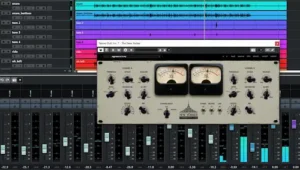 Bus compressors reveal their true value over the course of a full production, not during a thirty-second demo loop. Maintaining balance after automation, preserving low-end relationships, surviving mix revisions, and translating consistently across multiple playback systems matter far more than an initially impressive sound. That is the context in which The New Yorker should be evaluated.
On drum buses, the integrated Mix control is one of the plugin’s most practical features. Engineers can drive the compressor into stronger gain reduction while blending enough dry signal back into the path to retain transient impact. Eliminating parallel routing also simplifies gain staging and makes later revisions easier when multiple buses require similar processing.
Mid-Side operation extends well beyond stereo enhancement. Applying slightly firmer compression to the Mid channel can reinforce kick, bass, snare, and lead vocal relationships while allowing reverbs, overheads, and stereo effects to remain open. Used carefully, this approach improves mix translation without relying on excessive bus compression or stereo widening processors. Used aggressively, it can narrow the stereo field surprisingly quickly, making restraint just as important as flexibility.
Mastering applications require a different perspective. Transparent dynamics, predictable envelope behavior, and repeatable recall generally take priority over obvious harmonic coloration. As explained in our guide to mastering chains, a Vari-Mu compressor is typically one stage within a carefully balanced signal path rather than the processor responsible for the entire master. In that context, The New Yorker is better viewed as a tonal finishing compressor than as the foundation of a mastering chain. At this stage, there is simply not enough independent evidence to place it alongside long-established mastering references.
Current streaming practices reinforce that distinction. Platforms such as Spotify, Apple Music, YouTube Music, and Amazon Music normalize playback loudness, reducing the practical benefit of aggressive bus compression. Modern mixes generally translate better when compression improves cohesion rather than chasing additional level. The New Yorker’s workflow aligns well with that philosophy, encouraging moderate gain reduction instead of exaggerated loudness processing.
Performance characteristics remain one of the few unanswered questions. Independent CPU benchmarks, latency measurements, and large-session stress tests have yet to emerge. Engineers running orchestral templates, immersive productions, or high-track-count sessions should verify processor usage under their own working conditions before relying on multiple instances throughout a project.
Compatibility is less of a concern. Native support for Windows, macOS—including Apple Silicon—and Linux makes the plugin accessible across virtually every major production platform. Linux support remains relatively uncommon among commercial dynamics processors and will likely appeal to engineers working in open-source or hybrid studio environments.
The overall workflow favors decisive mixing rather than endless parameter tweaking. The interface exposes the controls that directly influence bus compression while avoiding the feature inflation common in many modern processors. That restraint keeps attention on listening instead of editing, allowing engineers to make faster decisions without sacrificing precision.
Ultimately, long-term success will depend on repeatability rather than novelty. Engineers adopt compressors because they behave predictably from one project to the next, preserve balance under changing arrangements, and continue delivering reliable results years after installation. The New Yorker demonstrates a thoughtful workflow and a sensible feature set. Whether it earns a permanent place in professional templates will depend entirely on how consistently its compression character holds up under everyday production work.
Who Should Consider The New Yorker?
| User | Recommendation | Why |
|---|---|---|
| Mix Engineers | ★★★★★ | Excellent workflow for drum buses, vocal groups, and stereo bus compression. |
| Music Producers | ★★★★★ | Integrated Mid-Side processing and parallel compression simplify everyday production. |
| Home Studios | ★★★★☆ | Strong feature set at an accessible price with an uncomplicated workflow. |
| Mastering Engineers | ★★★☆☆ | Useful as a color compressor, although long-term validation is still limited. |
| Beginners | ★★★★☆ | Straightforward interface makes learning Vari-Mu compression less intimidating. |
Technical Specifications
| Developer | M Media Audio |
| Plugin Type | Vari-Mu Bus Compressor |
| Formats | VST3, AU (macOS) |
| Platforms | Windows, macOS, Linux |
| Apple Silicon | Native |
| License | Perpetual License |
| Activations | 3 |
| Free Demo | Yes |
| Launch Price | $29 |
| Regular Price | $49 |
Technical Analysis
| Feature | Status |
|---|---|
| Stereo Mode | Supported |
| Dual Mono | Supported |
| Mid-Side Processing | Supported |
| Parallel Mix Control | Integrated |
| Tube Saturation | Integrated |
| Oversampling | Undisclosed |
| Latency | Not Published |
| External Sidechain | Not Available |
| CPU Benchmarks | Independent Tests Not Yet Available |
The table above combines manufacturer specifications with currently available independent information. Features marked as “Undisclosed” or “Not Published” indicate areas where M Media Audio has not released technical documentation or where third-party laboratory testing has not yet been published.
Verdict: A Well-Designed Vari-Mu Compressor That Still Has Something to Prove
Bus compression is one of the few areas of audio production where reputation often outweighs specifications. Engineers rarely abandon processors that have delivered consistent results across hundreds of sessions simply because another plugin offers a longer feature list. Trust is built through predictable behavior, reliable recall, and mixes that continue translating long after the excitement of a new release has faded.
From that perspective, The New Yorker makes a strong first impression. Its architecture reflects current production practices rather than nostalgia. Stereo, Dual Mono, Mid-Side processing, integrated parallel compression, and harmonic saturation are combined into a workflow that remains focused instead of becoming another oversized channel strip. The interface encourages decisive mixing rather than endless parameter adjustment, which is often the hallmark of well-designed studio software.
The unanswered questions lie beneath the interface. There is still little independent information regarding detector design, nonlinear modeling, oversampling, latency, CPU efficiency, or long-term reliability under demanding production workloads. Those unknowns do not suggest poor sound quality, but they do make careful listening far more important than feature comparisons or marketing language.
Value is where the plugin becomes particularly competitive. Its introductory pricing lowers the barrier to experimenting with Vari-Mu compression while eliminating the need for separate Mid-Side utilities or dedicated parallel routing. For producers and mix engineers building a modern in-the-box workflow, that combination is difficult to ignore.
For engineers who already rely on processors such as Pulsar Mu, Klanghelm MJUC, or UAD’s Manley Variable Mu, the decision is less straightforward. The New Yorker is unlikely to replace those mature tools overnight. Its more realistic role is as an additional color compressor—one that may prove especially effective on drum buses, mix buses, vocal groups, or instrument stems once its sonic character becomes better understood through long-term use.
It’s also worth remembering that a bus compressor is only one part of the final production process. Professional mastering involves far more than selecting a single dynamics processor, including critical evaluation of tonal balance, translation, loudness strategy, and final delivery. Our detailed guide explains how professional mastering actually works beyond individual plugin choices.
In the end, the plugin succeeds or fails for the same reason every respected Vari-Mu compressor does. Not because it promises more analog warmth, richer harmonics, or stronger glue, but because it consistently helps a mix sound more cohesive without drawing attention to itself. The New Yorker already offers a thoughtful workflow and sensible feature set. The only remaining question is whether its compression character proves compelling enough to earn a permanent place in professional sessions rather than simply another spot in the plugin browser.
Overall Rating
| Category | Rating |
|---|---|
| Compression Character | 8.5/10 |
| Workflow Efficiency | 9.3/10 |
| Mix Bus Usability | 9.0/10 |
| Mastering Suitability | 8.0/10 |
| Technical Transparency | 7.5/10 |
| Value for Money | 9.2/10 |
| Overall | 8.6/10 |
Compression Character — 8.5/10.
The New Yorker delivers the smooth, cohesive behavior expected from a modern Vari-Mu bus compressor, but its long-term sonic identity still needs broader validation across commercial productions before it can be placed alongside the category’s most respected processors.
Workflow Efficiency — 9.3/10.
Stereo, Dual Mono, Mid-Side processing, integrated parallel compression, and a clean control layout eliminate unnecessary routing and encourage faster engineering decisions. Workflow is clearly one of the plugin’s strongest assets.
Mix Bus Usability — 9.0/10.
The feature set naturally fits drum buses, vocal groups, instrument stems, and stereo mix buses. The plugin integrates into modern DAW sessions without requiring complicated setup or additional utility plugins.
Mastering Suitability — 8.0/10.
It can serve as a finishing compressor for subtle bus control, but the lack of extensive independent testing and long-term professional validation makes it difficult to recommend as a primary mastering compressor over more established Vari-Mu alternatives.
Technical Transparency — 7.5/10.
M Media Audio has disclosed relatively little information regarding detector topology, oversampling, nonlinear modeling, latency, or internal DSP architecture. For experienced engineers, those unanswered questions remain one of the plugin’s biggest limitations.
Value for Money — 9.2/10.
Considering its introductory price, integrated workflow, perpetual license, and modern feature set, The New Yorker offers excellent value for producers and mix engineers looking to add a capable Vari-Mu compressor without investing in significantly more expensive alternatives.
Overall — 8.6/10.
The New Yorker is a thoughtfully designed Vari-Mu bus compressor that prioritizes practical workflow over feature inflation. Its routing flexibility and streamlined interface make it a compelling option for modern mixing, while its long-term standing will ultimately depend on how its compression character performs after wider professional adoption.
A Better Plugin Won’t Always Deliver a Better Master
Choosing the right bus compressor is only one part of the equation. Professional mastering is about making hundreds of small decisions that improve translation, tonal balance, dynamics, stereo imaging, and consistency across every playback system. Even the best plugins can’t replace experienced critical listening.
Instead of guessing whether another plugin will solve the problem, hear what an experienced mastering engineer can achieve with your own mix. Upload up to 35 seconds and receive a free professional mastering demo. Compare your original version with the mastered result before investing in a full project.
Request your free mastering demo →
FAQ
Is The New Yorker better suited for a mix bus or individual tracks?
Its design is clearly centered on bus processing rather than individual channel compression. Drum buses, instrument groups, vocal buses, and stereo mix buses are where its Vari-Mu architecture and parallel Mix control are most likely to deliver noticeable benefits.
Can The New Yorker be used for mastering?
Yes, but with realistic expectations. Gentle gain reduction and Mid-Side processing can work well during mastering, although engineers seeking mastering-grade precision may still prefer more established Vari-Mu processors with longer professional track records.
How does The New Yorker compare with Pulsar Mu?
Pulsar Mu offers deeper control, extensive analog modeling, and years of validation in commercial mastering environments. The New Yorker takes a different approach, prioritizing streamlined workflow, integrated Mid-Side processing, and affordability over exhaustive hardware emulation.
Is Mid-Side compression useful for mixing or only for mastering?
It is valuable in both. Many mix engineers use Mid-Side compression on drum buses, orchestral stems, vocal groups, and stereo effects to control center energy while maintaining width. Success depends far more on subtle settings than on the processing mode itself.
Does the integrated Mix control replace parallel compression buses?
In most situations, yes. Blending the dry and compressed signals inside the plugin removes the need for duplicate buses and auxiliary routing, making session management simpler without changing the compression technique.
Will the built-in saturation replace a dedicated saturation plugin?
Usually not. It provides harmonic enhancement alongside compression, but dedicated saturation processors typically offer broader tonal control, multiple circuit models, and more flexible drive options when coloration becomes the primary objective.
Is The New Yorker transparent enough for acoustic or orchestral music?
That depends largely on compression depth and saturation settings. Moderate gain reduction should preserve musical dynamics, but engineers working with highly dynamic material should evaluate the plugin carefully before making it part of a mastering or orchestral workflow.
How demanding is The New Yorker on CPU resources?
Independent CPU benchmarks have not yet been published. For large sessions involving orchestral templates, immersive audio, or high track counts, testing multiple instances within your own DAW remains the most reliable way to assess performance.
Is The New Yorker a good first Vari-Mu compressor?
Its straightforward interface, integrated workflow features, perpetual license, and competitive pricing make it an accessible introduction to Vari-Mu compression. Users looking for the most extensively proven solution, however, may still lean toward more established alternatives.
Is The New Yorker worth buying?
For engineers who want an affordable bus compressor with Stereo, Dual Mono, Mid-Side processing, and integrated parallel compression, it offers good value. Whether it becomes a long-term studio tool depends less on its feature list than on how consistently its compression character performs across real-world projects.

Yurii Ariefiev reviews mixing and mastering software from the perspective of real production work, evaluating compression behavior, workflow efficiency, stereo integrity, and long-term usability instead of relying on launch-day marketing or feature lists.
This editorial examines The New Yorker as a practical Vari-Mu bus compressor for professional mixing and mastering, focusing on workflow, engineering decisions, and real-world studio applications rather than promotional claims.