Transparent analog EQs occupy a very different role today than they did a decade ago. Precision corrections, dynamic equalization, and loudness management now happen almost entirely inside the DAW, leaving analog hardware to handle the broad tonal adjustments that often prove easier to judge by ear than by measurement. That shift has made mastering equalizers less about adding character and more about preserving it.
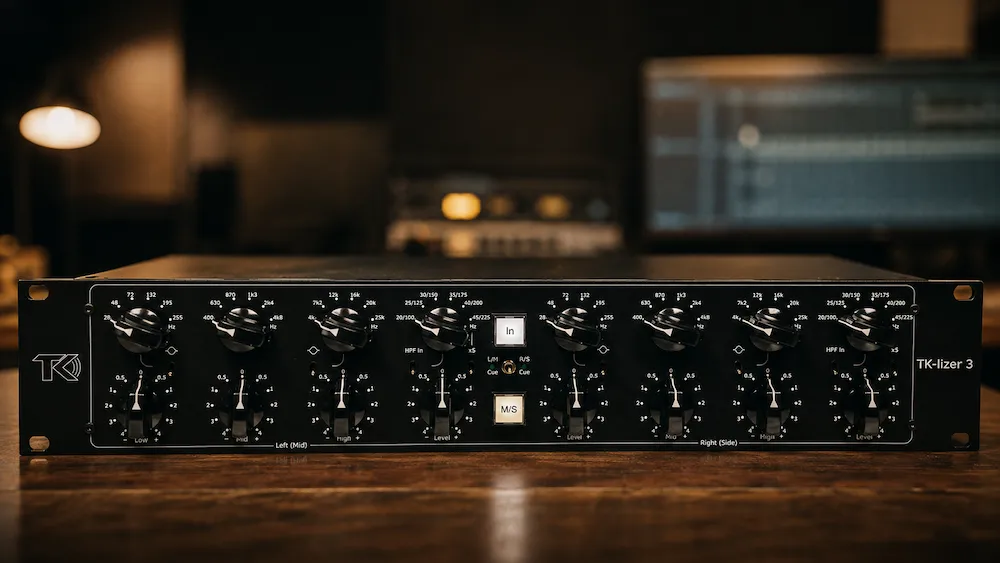
The TK Audio TK-Lizer 3 is built around that philosophy. Rather than replacing digital processing, it focuses on broad tonal shaping, integrated Mid-Side equalization, and repeatable analog recall. This third-generation model refines the existing platform with revised analog circuitry and an updated Mid-Side stage while preserving the restrained Baxandall workflow that made earlier versions a practical choice for mastering engineers.
The real question isn’t whether Baxandall equalizers still belong in professional mastering—they clearly do. The more important question is whether the TK-Lizer 3 offers enough practical advantages over competing analog mastering EQs to justify its place in a modern hybrid workflow. That depends less on new features than on how effectively it solves everyday mastering tasks without adding unnecessary complexity.
Contents
Why Baxandall EQ Still Matters in Modern Mastering
 Hybrid mastering has largely settled into a predictable workflow. Precision work—resonance control, dynamic equalization, loudness optimization, and delivery preparation—typically stays inside the DAW. Analog hardware is increasingly reserved for decisions that benefit from continuous circuitry rather than additional processing options: broad tonal balance, stereo presentation, and subtle musical contour.
This workflow mirrors a broader trend across modern analog equipment. As discussed in our SSL Odyssey review, today’s high-end studio hardware is increasingly valued for improving decision-making and tactile workflow rather than replacing digital processing. The TK-Lizer follows exactly the same philosophy, serving as a finishing tool instead of an all-in-one solution.
That shift has changed what engineers expect from an analog equalizer. Character is no longer the primary selling point. Many mastering chains already contain compressors, transformers, or tape stages that introduce harmonic color. The equalizer often has a different job: making small tonal adjustments without narrowing depth, collapsing stereo information, or drawing attention to the processing itself.
This is precisely where the Baxandall topology continues to earn its place. Unlike narrow parametric filters that emphasize individual frequency regions, Baxandall curves redistribute energy across a much wider portion of the spectrum. A modest shelf adjustment can reshape the overall tonal balance while preserving the natural relationship between instruments, making the EQ particularly effective during the final stages of mastering.
That design philosophy also explains why Baxandall equalizers have remained relevant despite the rapid evolution of digital mastering tools. They are rarely used to repair a mix. Their value lies in refining an already balanced production—opening the top end without introducing brittleness, tightening low frequencies without making the mix feel smaller, or making subtle tonal corrections that remain consistent across different playback systems.
The TK-Lizer has always been positioned around that workflow rather than maximum flexibility. Instead of offering numerous fully parametric bands, variable Q controls, or extensive filter options, it focuses on broad musical curves, stepped recall, integrated Mid-Side processing, and restrained gain ranges that encourage deliberate mastering decisions instead of excessive tweaking.
Version 3 deliberately avoids changing that formula. Externally the hardware changes very little, but internally TK Audio has revised the analog input stage, output stage, and Mid-Side circuitry to improve channel consistency and overall signal integrity. In practical terms, the update is aimed at improving signal integrity rather than expanding the feature set.
That approach may not generate dramatic marketing headlines, but it reflects how established mastering hardware usually evolves. Once the workflow has proven itself, meaningful improvements tend to come from lower noise, cleaner channel matching, better stereo accuracy, and greater long-term consistency—not from adding another row of controls to the front panel.
Hear What Your Mix Still Has to Give
Even a well-balanced mix can reveal more depth, tighter low end, and a more natural tonal balance when it’s mastered with experienced ears. Upload up to 35 seconds of your track and receive a free mastering demo. Compare your original mix with a professionally mastered version before deciding whether to move forward.
Request your free mastering demo →
Designed for Mastering Engineers, Not Feature Collectors
On paper, the TK-Lizer 3 looks conservative. Three EQ bands, stepped gain controls, switchable shelf and peak modes, dual high-pass filters, and integrated Mid-Side processing don’t stand out in a market where mastering equalizers often advertise extensive filter options, digital recall, or software integration.
That comparison misses the design objective. The TK-Lizer was never intended to replace a fully parametric mastering EQ. It addresses a different stage of the workflow: broad tonal shaping after corrective processing has already been completed.
The equalizer deliberately limits both available frequencies and gain range to ±4 dB. In mastering, those constraints are often an advantage rather than a compromise. Large EQ moves usually indicate problems that should have been solved during mixing, while subtle broadband adjustments are easier to evaluate objectively over long listening sessions and generally translate more consistently across playback systems.
The three-band layout reflects that philosophy. The mid band uses a fixed bell response, while the high and low sections can operate as either shelving or peak filters. Rather than maximizing flexibility, the design focuses on making a relatively small number of tonal decisions with confidence.
The stepped high-pass filter follows the same logic. Its primary role is not aggressive bass reduction but the removal of unnecessary subsonic energy before downstream dynamics processing or final limiting. Because every position is stepped, filter settings remain easy to document and reproduce during later revisions.
The integrated Mid-Side matrix remains one of the strongest arguments for the TK-Lizer platform. Although Mid-Side processing is routine inside modern DAWs, implementing it in an analog mastering chain often requires dedicated encoding and decoding hardware. Integrating both stages into a single unit simplifies routing, reduces additional gain stages, and minimizes unnecessary analog connections.
The updated Mid-Side circuitry in version 3 is also one of the few hardware changes likely to affect day-to-day mastering. Improved channel separation can produce cleaner stereo localization when equalizing Mid and Side information independently, although the practical significance of those refinements will ultimately depend on independent measurements rather than manufacturer specifications.
Another feature that deserves more attention than it typically receives is the dedicated cue monitor. The ability to audition the Left, Right, Mid, or Side channels independently allows engineers to identify problems that often remain hidden in normal stereo playback, including excessive ambience, uneven stereo reverbs, low-frequency imbalance, and phase-related artifacts.
Stepped controls reinforce the mastering-oriented workflow. Exact recall becomes increasingly important when projects return for streaming updates, vinyl premasters, instrumental versions, or client revisions weeks after the initial session. Unlike continuously variable controls, stepped settings dramatically reduce the time required to recreate previous mastering decisions.
The most meaningful changes in the third-generation hardware are largely invisible. Revised analog input and output stages, refinements to the shelving circuits, and updates to the Mid-Side encoder indicate that TK Audio concentrated on improving signal integrity instead of expanding the feature list. That’s a typical development path for mature mastering hardware, where lower noise, tighter channel matching, and cleaner stereo performance usually provide more long-term value than additional controls.
Viewed as a workflow tool rather than a specification sheet, the TK-Lizer 3 makes considerably more sense. It isn’t trying to become the most flexible mastering equalizer available. It’s designed for engineers who already know what they want to hear and prefer reaching that result quickly instead of navigating dozens of parameters that rarely improve the final master.
Where the TK-Lizer 3 Fits—and Where It Doesn’t
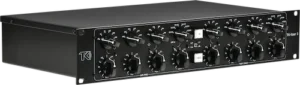 The easiest way to misjudge the TK-Lizer 3 is to evaluate it by feature count. Compared with modern mastering equalizers offering fully parametric bands, dynamic processing, digital recall, and software integration, its control set appears deliberately restrained. That comparison overlooks what the unit is actually designed to do.
The TK-Lizer is not intended to solve mix problems. It assumes the material has already been properly prepared for mastering, with corrective EQ, resonance control, and balance issues resolved before the analog chain.
This distinction is reflected throughout the hardware. The ±4 dB gain range, stepped controls, and broad Baxandall curves all discourage aggressive processing. In practical mastering sessions, that’s rarely a disadvantage. Most final EQ decisions involve fractions of a decibel, not dramatic tonal reconstruction. If a master requires large boosts or cuts, the underlying mix usually deserves another look before additional analog processing.
The integrated Mid-Side architecture also proves more valuable in practice than its specification suggests. Contemporary productions often place vocals, kick, bass, and snare firmly in the center while reverbs, guitars, synthesizers, orchestral layers, and spatial effects occupy the sides. Being able to shape those elements independently without introducing additional analog routing keeps the mastering chain both cleaner and easier to manage.
The restraint that makes the TK-Lizer effective also defines its limitations. Engineers expecting variable Q controls, dynamic equalization, digital automation, or complete session recall will not find those capabilities here. The hardware remains firmly rooted in traditional analog mastering, where repeatability comes from stepped controls rather than software snapshots.
Whether that represents a limitation depends almost entirely on the studio environment. Independent mastering engineers and hybrid project studios often require only occasional recalls, making stepped controls entirely practical. Facilities managing multiple revisions every day, however, may benefit more from digitally controlled analog systems that can restore complete sessions within seconds.
That difference is operational rather than sonic. Nothing about the TK-Lizer feels outdated from an audio perspective. Its limitations emerge only when measured against the increasing demand for automated recall and integrated hardware control in high-volume commercial mastering environments.
Viewed in that context, the TK-Lizer 3 occupies a clearly defined niche. It isn’t designed to replace precision digital processing or become the centerpiece of an all-in-one mastering solution. Instead, it serves engineers who prefer making a handful of deliberate tonal decisions through a transparent analog signal path without adding unnecessary complexity to the mastering chain.
How the TK-Lizer 3 Stacks Up Against Established Mastering EQs
Choosing a mastering equalizer is rarely about comparing specifications. Most engineers already know the type of tonal shaping they need. The real question is which workflow allows those decisions to be made faster, more consistently, and with fewer compromises. Engineers investing in dedicated mastering hardware are usually comparing workflows rather than feature lists, asking whether a particular equalizer fills a gap in an existing analog chain rather than replacing every other processor in the rack.
| Hardware | Core Strength | Limitations | Best Application |
|---|---|---|---|
| TK Audio TK-Lizer 3 | Transparent Baxandall EQ with integrated Mid-Side processing and stepped recall | Limited flexibility compared to fully parametric mastering EQs | Hybrid mastering and stereo bus finishing |
| Dangerous Music BAX EQ | Exceptionally transparent broad-stroke equalization | Requires external Mid-Side routing when independent processing is needed | Reference-grade mastering |
| Manley Massive Passive | Rich tube coloration and complex tonal shaping | Less transparent and considerably more expensive | Character-driven mastering and mix bus processing |
| Elysia xfilter Mastering Edition | Highly flexible Class-A mastering architecture | No integrated Mid-Side encoder/decoder | Mix bus and mastering |
| SPL PQ | Extensive mastering precision and control | Premium price and significantly greater operational complexity | High-end commercial mastering facilities |
Rather than competing directly with every unit in this category, the TK-Lizer occupies a distinct position. It delivers substantially more workflow integration than a traditional Baxandall equalizer through its built-in Mid-Side matrix, while remaining considerably simpler than mastering systems built around multiple fully parametric bands, digital control, and software-assisted recall.
That distinction becomes more obvious when compared with individual competitors. The Dangerous Music BAX EQ remains a benchmark for transparent tonal shaping, but engineers requiring analog Mid-Side equalization must introduce additional routing hardware. The Massive Passive approaches mastering from the opposite direction, using passive tube circuitry to add texture and harmonic complexity rather than remaining sonically neutral. SPL’s PQ and similar mastering equalizers provide far greater precision but also demand a more deliberate workflow and a significantly larger investment.
Engineers interested in classic analog equalizer philosophies may also appreciate our Origin Effects EQDELUXE review, which explores how the Pultec approach differs from the broad Baxandall curves used by mastering-oriented designs like the TK-Lizer. Although the products target different applications, they illustrate two fundamentally different ways of shaping tone in analog hardware.
For that reason, the TK-Lizer is unlikely to replace any of these processors outright. Instead, it appeals to engineers whose priority is broad tonal refinement with minimal operational overhead. Its strengths become most apparent when subtle shelving moves, reliable recall, and analog Mid-Side processing are used repeatedly across albums, EPs, or client revisions.
There are equally clear situations where another solution makes more sense. Engineers looking for transformer saturation or tube coloration will find more suitable options elsewhere. Those requiring surgical correction, dynamic equalization, or automated hardware recall remain better served by modern digital mastering tools or digitally controlled analog processors.
Ultimately, the TK-Lizer 3 isn’t trying to become the most versatile mastering equalizer on the market. Its value comes from doing a relatively small number of mastering tasks exceptionally well—precisely the reason Baxandall-based designs continue to occupy a permanent place in many professional mastering rooms.
Technical Specifications
| Specification | Details |
|---|---|
| EQ Architecture | Three-band analog Baxandall mastering equalizer |
| Gain Range | ±4 dB (stepped) |
| Frequency Selection | Six selectable frequencies per EQ band |
| High & Low Bands | Shelf or Peak operation |
| Mid Band | Fixed Peak response |
| High-Pass Filter | 12 stepped frequencies per channel |
| Mid-Side Processing | Integrated analog encoder / decoder |
| Monitoring | Left, Right, Mid and Side cue monitoring |
| Signal Path | Electronically balanced analog circuitry |
| Recall | Stepped controls for repeatable mastering settings |
| Form Factor | 19-inch rackmount hardware |
Unlike many modern mastering processors, the TK-Lizer 3 emphasizes operational simplicity over specification density. The feature set is intentionally focused on repeatable tonal refinement, making the hardware easier to integrate into established analog mastering chains rather than replacing multiple specialized processors.
Real-World Performance in Modern Mastering Workflows
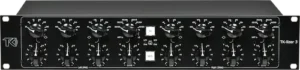 The value of the TK-Lizer 3 isn’t determined by how different it sounds from a digital EQ. It depends on where it’s placed in the mastering workflow and what job it’s expected to perform. Used as a corrective processor, it’s the wrong tool. Used as a finishing equalizer after the technical work has already been completed, it makes considerably more sense.
That distinction has become increasingly important as modern mastering has shifted toward hybrid workflows. Corrective equalization, resonance removal, dynamic processing, loudness optimization, and final delivery are now handled almost entirely inside the DAW. Analog hardware is typically reserved for broad tonal shaping, stereo refinement, and subtle adjustments that benefit from continuous analog circuitry rather than additional processing complexity.
Within that context, the TK-Lizer integrates naturally into a professional mastering chain. Broad Baxandall shelves allow small tonal corrections without dramatically altering spectral balance, making it easier to preserve the character of an already successful mix. The result is rarely a dramatic before-and-after transformation. Instead, the improvements tend to appear as greater tonal coherence, smoother top-end presentation, and more stable low-frequency balance across different monitoring systems.
Those characteristics also translate well to modern streaming platforms. As explained in our guide to Apple Digital Masters mastering, preserving tonal balance has become more important than extracting another decibel of loudness because modern AAC encoding exposes harsh spectral decisions surprisingly quickly. Broad shelving curves generally survive AAC and Ogg Vorbis encoding more gracefully than aggressive narrow-band boosts, particularly in the upper frequencies where excessive brightness can become noticeably harsher after data compression.
Mid-Side processing remains equally relevant. Music is increasingly consumed on headphones, where stereo balance and spatial consistency are immediately exposed. Small Mid-Side EQ adjustments can improve width, reduce excessive ambience, or stabilize low-frequency information without compromising the phantom center. Integrating that capability directly into the equalizer also eliminates the need for separate analog encoding and decoding hardware.
From an operational standpoint, the TK-Lizer behaves exactly as professional analog hardware should. It introduces no CPU load, no plugin latency, no firmware maintenance, and no software compatibility concerns. Whether a mastering session contains a single stereo file or a DAW project with hundreds of tracks, the hardware performs identically because its workload never changes.
That consistency becomes particularly valuable during long mastering sessions. There is no need to consider processing overhead, plugin delay compensation, operating system updates, or changing software versions. Once calibrated, the equalizer remains a stable part of the signal path and allows engineers to focus entirely on listening rather than managing computer resources.
Those benefits don’t eliminate the compromises of hybrid mastering. Every analog insert introduces additional conversion stages, making high-quality converters and accurate gain staging essential. A poorly calibrated signal path can easily outweigh the subtle improvements delivered by premium analog hardware. The TK-Lizer is therefore most effective in studios where the surrounding monitoring, conversion, and analog infrastructure are already operating at a professional level.
For engineers working in that environment, the TK-Lizer 3 functions less as a character processor and more as a precision finishing tool. It doesn’t redefine the mastering workflow or replace modern digital processing. Instead, it strengthens the final stage of the chain by making small tonal decisions easier to evaluate, easier to repeat, and more likely to translate consistently across today’s playback formats.
What We’d Like to See in a Future Revision
Digital recall remains the most obvious omission. While stepped controls make manual recall practical, software-assisted hardware control has become increasingly common in high-end mastering environments. If TK Audio eventually combines its transparent analog signal path with digital session management while preserving the simplicity of the current interface, the TK-Lizer platform would become even more competitive in commercial mastering facilities.
Verdict: A Purpose-Built Mastering EQ for Engineers Who Value Precision
The TK-Lizer 3 doesn’t attempt to redefine analog mastering, and that’s arguably its greatest strength. Rather than expanding the feature set or introducing digitally assisted workflows, TK Audio has refined an established platform that already serves a clearly defined purpose: transparent broadband equalization during the final stage of mastering.
Version 3 should be viewed as an engineering refinement rather than a new product generation. The revised analog stages and updated Mid-Side circuitry are sensible improvements, but they don’t fundamentally change how the equalizer is used. Existing TK-Lizer users shouldn’t expect a dramatically different sonic character. Instead, the emphasis is on cleaner implementation and incremental improvements to an already mature design.
That also means the TK-Lizer remains a specialized tool. It isn’t intended to replace a precision parametric EQ, dynamic equalizer, or fully integrated mastering system with digital recall. Engineers expecting a single processor to cover every stage of mastering will quickly reach its limits.
Where the unit excels is far more specific. It rewards engineers who already have a balanced mix and need broad tonal refinement without introducing obvious coloration or unnecessary complexity. Integrated Mid-Side processing, stepped recall, and restrained Baxandall curves make it particularly well suited to hybrid mastering chains where subtle decisions matter more than unlimited flexibility.
Its strongest competition may come not from other analog equalizers but from today’s high-end mastering plugins. Software solutions offer outstanding transparency, instant recall, automation, and significantly lower cost. For producers working entirely inside the DAW, those advantages are difficult to ignore, and the practical benefits of adding analog hardware may not justify the investment.
For professional mastering engineers and studios already committed to hybrid workflows, however, the calculation is different. In that environment, the TK-Lizer 3 provides a transparent finishing stage that integrates naturally into an established analog chain without adding unnecessary operational complexity.
Viewed on its own terms—not as an all-purpose mastering equalizer, but as a dedicated finishing tool—the TK-Lizer 3 succeeds. It refines a workflow that has remained relevant for decades and does so with enough transparency, repeatability, and practical usability to justify its place in modern mastering rooms.
Engineering Perspective
From a mastering engineer’s perspective, the TK-Lizer 3 isn’t valuable because it can boost or cut frequencies. Its real strength is that it encourages disciplined mastering decisions. The combination of broad Baxandall curves, restrained gain limits, and stepped controls naturally discourages over-processing, making it easier to focus on tonal balance instead of chasing incremental changes that rarely improve translation.
That philosophy may seem limiting on paper, but experienced engineers often arrive at the opposite conclusion. The fewer opportunities there are to make unnecessary adjustments, the easier it becomes to focus on what actually improves translation. In practice, that restraint is one of the reasons transparent mastering equalizers continue to occupy an important place in modern hybrid studios.
Overall Rating
| Category | Rating |
|---|---|
| Transparency | 9.5/10 |
| Tonal Shaping | 9.5/10 |
| Mastering Workflow | 9.5/10 |
| Mid-Side Implementation | 9/10 |
| Operational Flexibility | 7.5/10 |
| Value for Money | 8.5/10 |
| Overall | 9.0/10 |
Independent editorial score based on practical workflow, mastering usability, engineering value, and long-term studio relevance. No manufacturer sponsorship or affiliate influence was involved in this evaluation.
The TK Audio TK-Lizer 3 succeeds because it focuses on doing one mastering task exceptionally well instead of trying to replace an entire EQ arsenal. Its transparent Baxandall topology, integrated Mid-Side processing, and mastering-oriented ergonomics make it an excellent finishing equalizer for engineers working in hybrid analog environments. While its deliberately limited architecture won’t suit every workflow, the product delivers exactly what experienced mastering engineers expect: repeatable, musical tonal refinement without unnecessary complexity.
Who Should Buy the TK-Lizer 3?
| User Type | Recommendation | Why |
|---|---|---|
| Professional Mastering Engineers | ★★★★★ | Excellent transparency, repeatability, and integrated Mid-Side workflow. |
| Hybrid Mixing Engineers | ★★★★★ | Ideal for stereo bus finishing and analog tonal refinement. |
| Commercial Studios | ★★★★★ | Fits naturally into established mastering chains with reliable stepped recall. |
| Project Studios | ★★★★☆ | Strong choice if paired with accurate monitoring and quality conversion. |
| Hybrid Producers | ★★★☆☆ | Most producers will benefit only after building a more mature hybrid workflow. |
| Bedroom Producers | ★★☆☆☆ | Modern mastering plugins generally offer a better return on investment. |
| Electronic-Only Workflows | ★★☆☆☆ | Complete in-the-box production often benefits more from software flexibility and instant recall. |
The TK-Lizer 3 is not intended to be an engineer’s first mastering processor. It makes the most sense in studios that already rely on hybrid mastering, where transparent analog equalization is used to refine an otherwise finished mix rather than solve production problems. Engineers working entirely inside the DAW can achieve similar corrective results with high-end mastering plugins, while experienced mastering professionals are more likely to appreciate the speed, consistency, and restrained workflow that define the TK-Lizer.
Why We Gave These Scores
Transparency — 9.5/10
The TK-Lizer introduces very little audible character of its own, allowing tonal adjustments without masking detail or narrowing stereo depth. That neutrality is exactly what many mastering engineers expect from a finishing equalizer.
Tonal Shaping — 9.5/10
The Baxandall curves remain the strongest part of the design. Small shelving moves sound natural, making it easy to improve overall balance without drawing attention to the EQ itself.
Mastering Workflow — 9.5/10
Stepped controls, restrained gain ranges, integrated Mid-Side processing, and logical frequency selections support fast, repeatable mastering decisions rather than endless tweaking.
Mid-Side Implementation — 9/10
The built-in encoder, decoder, and cue monitoring eliminate extra hardware while making stereo balancing significantly more efficient. Improved channel separation is a welcome refinement, although long-term independent measurements will ultimately determine the full benefit.
Operational Flexibility — 7.5/10
The same design philosophy that makes the TK-Lizer easy to use also limits its versatility. Engineers needing parametric precision, dynamic EQ, digital recall, or software integration will quickly reach its boundaries.
Value for Money — 8.5/10
For studios already operating a professional hybrid mastering chain, the feature set and build quality justify the investment. Producers working entirely inside the DAW, however, may achieve comparable practical results with high-end mastering plugins at a substantially lower cost.
The Best Way to Judge a Master Is to Hear It
Reading about mastering hardware and techniques is useful, but the only result that ultimately matters is what comes out of your speakers. A well-executed master should improve tonal balance, low-end control, stereo stability, and translation—without making the processing obvious or changing the identity of your mix.
Upload up to 35 seconds of your track and receive a free mastering demo created by an experienced mastering engineer. Compare it with your original mix, evaluate the difference on your own monitoring system, and decide based on what you hear—not on marketing claims.
Request your free mastering demo →
Frequently Asked Questions
Is the TK Audio TK-Lizer 3 better suited to mastering or mix bus processing?
Mastering is clearly its primary application, but it also performs well on stereo mix buses where broad tonal balance is more important than surgical correction. Its restrained gain range and wide Baxandall curves make it considerably less suitable for individual tracks.
How does the TK-Lizer 3 differ from the Dangerous Music BAX EQ?
Both are designed for transparent broadband equalization rather than aggressive tone shaping. The TK-Lizer adds integrated Mid-Side processing and stepped recall, while the Dangerous BAX EQ remains one of the industry’s most respected standalone Baxandall equalizers. The choice comes down to workflow rather than overall sound quality.
Can the TK-Lizer 3 replace mastering plugins like FabFilter Pro-Q 4 or Weiss EQ?
No. Digital mastering EQs remain the better choice for corrective work, dynamic equalization, automation, and instant recall. The TK-Lizer is intended to complement those tools by handling broad analog tonal refinement after technical processing has already been completed.
Does the TK-Lizer 3 add analog color or saturation?
Not to any significant degree. Its design favors transparency over character, making it more suitable for engineers who want subtle tonal refinement than those looking for obvious transformer or tube coloration.
Is the integrated Mid-Side processing useful in real mastering sessions?
Yes. It allows independent equalization of center and side information without additional analog routing, making it easier to control stereo width, vocal focus, ambience, and low-frequency balance while maintaining a stable stereo image.
Can the TK-Lizer 3 be justified in a home studio?
Only if the rest of the mastering chain is already operating at a professional level. High-quality converters, accurate monitoring, and proper gain staging have a greater influence on the final result than adding premium analog hardware to an otherwise modest setup.
Is upgrading from the TK-Lizer 2 worthwhile?
For most owners, the answer depends on workflow rather than sound. Version 3 introduces revised analog circuitry and an updated Mid-Side stage, but it preserves the overall operating philosophy. Unless those refinements solve a specific studio requirement, existing users should expect incremental rather than dramatic improvements.
Does the TK-Lizer 3 introduce latency?
The equalizer itself does not. In hybrid mastering systems, any latency comes from the A/D and D/A conversion stages rather than the analog circuitry.
Who should consider alternatives?
Engineers who need surgical equalization, dynamic EQ, automated recall, or extensive digital integration will be better served by modern mastering plugins or digitally controlled analog hardware. The TK-Lizer is designed for broad tonal shaping, not comprehensive mastering correction.
Is the TK-Lizer 3 worth buying over mastering plugins?
For engineers working entirely inside the DAW, modern mastering plugins remain the more practical and cost-effective solution. The TK-Lizer 3 becomes a worthwhile investment only when it complements an established hybrid mastering workflow with accurate monitoring and professional conversion.

Yurii Ariefiev is a mastering engineer who evaluates analog and digital audio equipment from the perspective of real production workflows rather than manufacturer specifications. His reviews focus on how mastering tools affect tonal balance, stereo translation, recall, and long-term usability inside professional hybrid studios.
This review examines the TK Audio TK-Lizer 3 as a mastering tool—not simply as a piece of hardware—placing its Baxandall design, Mid-Side implementation, and practical workflow alongside the demands of modern professional mastering.