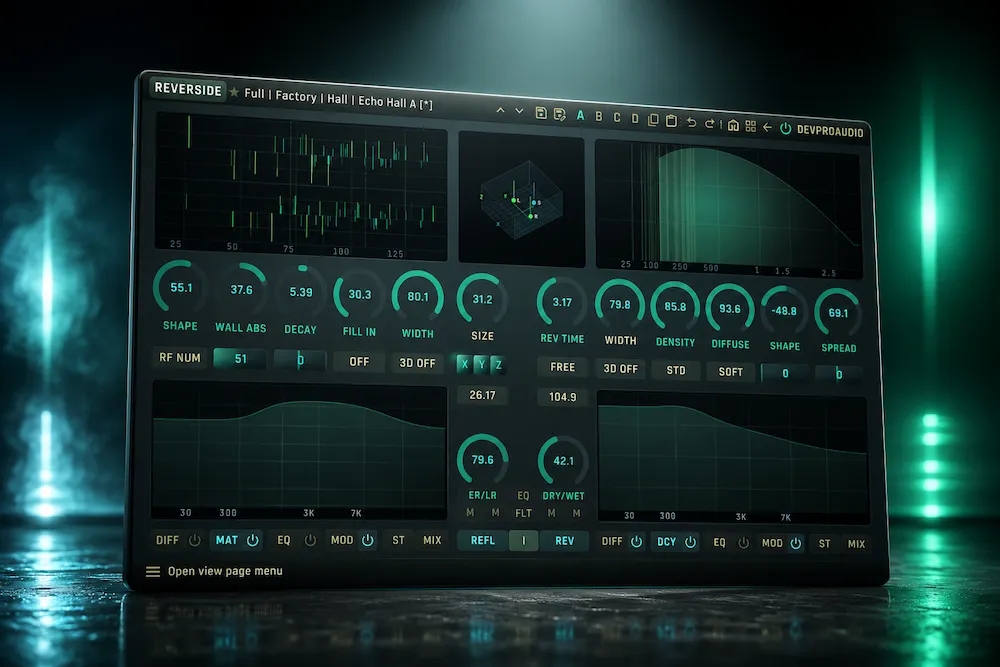
Algorithmic reverb has been part of professional production for decades. Most new releases focus on workflow refinements, expanded preset libraries, or interface updates while leaving the underlying DSP largely unchanged. DEVPROAUDIO REVERSIDE takes a different path. Instead of treating reverb as a self-contained effect, it combines independently controlled Early and Late Reflection engines with a 3D positioning system that models the relationship between the sound source, the listener, and the virtual room.
That approach raises a practical question for mix engineers rather than a marketing one: does REVERSIDE create spatial information that translates into more believable mixes, or does it simply add another layer of complexity to an already crowded workflow? In today’s production environment, where stereo imagers, room simulators, convolution reverbs, and immersive processors are readily available, any new spatial tool has to solve problems that existing plugins cannot—or solve familiar problems more efficiently.
This review evaluates REVERSIDE from a production perspective. Rather than repeating the feature list, we’ll examine how its DSP architecture affects real mixing decisions, where its workflow offers measurable advantages, where it falls short, and how it compares with today’s leading premium algorithmic reverb plugins.
On This Page
Why Modern Mixes Struggle With Depth—Even Better Reverbs Haven’t Solved It
 Creating believable depth has become harder, not easier. Modern DAWs give engineers access to virtually unlimited processing, yet many commercial mixes still sound two-dimensional. The issue isn’t a lack of high-quality reverbs—it’s the way spatial processing is typically built.
Two decades ago, engineers often relied on a handful of hardware reverbs that served an entire mix. Whether the room came from a Lexicon, Bricasti, EMT, or TC Electronic unit, multiple instruments shared the same acoustic signature. That naturally reinforced cohesion and made depth easier to establish. For a closer look at how two of the most influential EMT designs still perform in modern DAWs, see our UAD EMT 140 & EMT 250 Native review.
Today’s workflow encourages the opposite. Individual tracks routinely receive their own reverbs, delays, stereo processors, modulation effects, transient shaping, and spectral processing. Every element can sound impressive in isolation, yet the mix often loses the sense that all instruments exist within the same physical environment.
This isn’t simply a stereo imaging problem. Width is easy to create; convincing front-to-back perspective is much harder. When early reflections, late reflections, and direct sound are no longer working together, instruments tend to occupy the same apparent depth regardless of how wide the mix becomes. The result is a production that feels larger but not necessarily more realistic.
The problem becomes even more obvious in dense arrangements. Layered pop productions, hybrid orchestral scores, cinematic soundtracks, and modern electronic music may contain dozens of virtual instruments competing for spatial definition. Adding another hall or plate rarely fixes that. Once multiple reverbs begin interacting, clarity usually suffers before depth improves.
This shift has changed what many engineers expect from a reverb plugin. The goal is no longer limited to generating an attractive decay. Increasingly, spatial processors are expected to help organize a mix by defining distance, source size, localization, and the relationship between instruments. That’s why recent high-end development has focused less on longer tails and more on controlling the behavior of reflections themselves.
REVERSIDE is built around that philosophy. Instead of treating Early Reflections as a byproduct of the algorithm, it promotes them to a primary mixing tool alongside an independently configurable Late Reflection engine. The emphasis isn’t on producing a more impressive reverb tail—it’s on giving engineers finer control over how listeners perceive acoustic space before the tail becomes part of the equation.
A Great Mix Deserves a Better Master
Even the most carefully crafted mix can reveal additional depth, clarity, punch, and stereo balance during mastering. Upload up to 35 seconds of your mix and receive a free mastering demo prepared by a professional mastering engineer. Compare your original against the mastered version before deciding whether to move forward.
Get your free mastering sample →
Beyond Reverb Tails: Why REVERSIDE Is Built Around Spatial Behavior
Most algorithmic reverbs follow the same production logic. Choose a room, adjust pre-delay and decay, fine-tune damping, then blend the return into the mix. The algorithms may differ substantially under the hood, but the workflow has remained largely unchanged for decades.
REVERSIDE starts from a different premise. Instead of treating early reflections as the first stage of a reverb tail, it separates Early Reflections and Late Reflections into independently configurable processing engines. While high-end reverbs already distinguish between these components internally, very few expose them as separate environments with independent diffusion, stereo imaging, filtering, modulation, and routing.
That distinction has practical consequences during mixing. Early reflections determine where a source appears to sit, how close it feels to the listener, and how strongly it interacts with the surrounding room. Late reflections contribute ambience, sustain, and a sense of enclosure. In many conventional reverbs those behaviors remain tightly coupled, forcing engineers to trade localization for size—or vice versa.
REVERSIDE breaks that dependency. A vocal can retain precise spatial definition through controlled early reflections while the reverb tail remains restrained enough to preserve intelligibility. At the opposite extreme, cinematic effects can minimize localization and let the late field evolve into long, highly diffuse textures without fundamentally changing the perceived room.
This changes the way engineers approach spatial processing. Instead of searching for the closest preset, the focus shifts toward defining how an instrument should exist within the mix. The reverb becomes part of spatial design rather than a finishing effect applied after tonal balance has already been established.
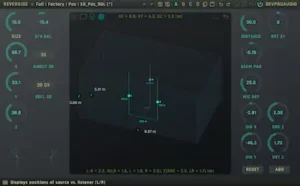
The integrated 3D positioning engine reinforces that philosophy. It isn’t another stereo widener or psychoacoustic imaging processor. Source position, listener position, room dimensions, and reflection direction all influence how the algorithm generates spatial information. Width is produced as a consequence of the acoustic model rather than added as a separate enhancement.
That distinction separates REVERSIDE from many contemporary spatial processors. Plugins based on Haas delays, decorrelation, or mid-side manipulation can create an impressive stereo image, but they don’t necessarily improve depth perception or acoustic realism. REVERSIDE is designed to address those problems directly by controlling the structure of the reflected sound instead of processing the finished stereo field.
Whether that level of control justifies the additional complexity depends on the project. Engineers building orchestral templates, immersive productions, or densely layered mixes are likely to appreciate the flexibility. For straightforward vocal or guitar processing, however, much of the available depth may never be fully exploited.
Inside REVERSIDE’s DSP: Why Separating Early and Late Reflections Changes the Mix
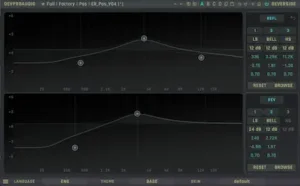 REVERSIDE’s most significant design decision isn’t the number of editable parameters—it’s how the reverb engine is structured. Instead of feeding every reflection into a single diffusion network, the plugin processes Early and Late Reflections as independent systems, each with its own behavior, stereo characteristics, filtering, modulation, and density.
That distinction goes beyond architecture diagrams. In practical terms, it gives engineers far more control over how depth is perceived inside a mix. Early reflections remain closely tied to source localization and room geometry, while the late field can evolve independently without forcing changes to the apparent position of the source.
The benefit becomes obvious in dense productions. Modern pop, hybrid orchestral arrangements, and cinematic scores often contain dozens of elements competing for the same acoustic space. Traditional reverbs frequently force a compromise: increasing decay creates a larger sense of space, but it also softens localization and increases masking. Engineers spend the rest of the session trying to recover clarity with EQ, automation, or additional processing.
REVERSIDE reduces that dependency. Early reflections can establish distance and placement while the Late Reflection engine focuses on ambience, sustain, and overall room character. Because those stages are no longer tightly coupled, spatial definition remains more consistent as the reverb tail becomes larger or more diffuse.
The plugin’s diffusion architecture follows the same philosophy. Fourteen diffusion models, together with dedicated secondary diffusers, control how reflected energy develops over time rather than simply smoothing transients. The result is a wider range of spatial behavior—from compact, highly controlled environments to dense cinematic spaces—without relying on fundamentally different reverb algorithms.
Stereo processing receives similar attention. REVERSIDE treats Early and Late Reflections independently, allowing engineers to keep localization stable while widening only the ambient field. That’s a more disciplined approach than simply expanding the entire stereo image, particularly in mixes where mono compatibility and center definition remain priorities.
None of these controls guarantee a better mix on their own. They simply expose parts of the algorithm that most reverbs keep hidden. Whether that additional control becomes an advantage depends entirely on the engineer. Users who already think in terms of acoustic perspective and depth will find considerably more room for refinement. Those looking for a fast preset-driven workflow may see diminishing returns long before they’ve explored the full architecture.
That balance defines REVERSIDE’s identity. It isn’t trying to automate spatial decisions or replace engineering judgment. Instead, it gives experienced users direct access to the underlying structure of the reverb itself—something surprisingly few commercial plugins attempt.
Where REVERSIDE Makes a Real Difference in Production
A sophisticated DSP design only matters if it changes the way engineers build a mix. That’s where REVERSIDE becomes more interesting than its feature list suggests. Its biggest advantage isn’t additional control—it’s reducing the number of compromises typically required to create believable depth.
Lead vocals are a good example. Building convincing space often means combining a short room for localization, a plate or hall for sustain, EQ before and after the return, stereo processing, and automation to keep the tail from masking intelligibility. The result can sound excellent, but the routing becomes increasingly difficult to manage as sessions grow.
REVERSIDE approaches the problem by separating spatial localization from ambience. Early Reflections establish where the vocal sits relative to the listener, while the Late Reflection engine shapes the surrounding space independently. That makes it easier to add depth without softening articulation or pushing the vocal farther back in the mix than intended.
The same principle scales well to orchestral programming. Large sample-based templates often suffer from inconsistent spatial perspective because instruments originate from different recording environments and libraries. Instead of creating multiple versions of essentially the same reverb, engineers can position individual sources within a shared acoustic space while preserving distinct front-to-back placement. The mix becomes more cohesive without every section sounding as though it occupies the exact same location.
Electronic music presents a different opportunity. REVERSIDE isn’t limited to realistic environments. Its diffusion architecture, modulation system, and extended decay controls make it equally capable of producing evolving textures that blur the line between reverb, resonator, and delay. Because the processing remains fully algorithmic, those spaces can be reshaped continuously instead of being constrained by static impulse responses.
That flexibility extends the plugin well beyond conventional mixing duties. Sound designers can build animated environments that would otherwise require multiple modulation effects feeding several reverb instances, while mix engineers gain more precise control over spatial perspective without dramatically increasing routing complexity. In both cases, the objective is the same: constructing a coherent acoustic environment instead of stacking independent effects until the mix feels spacious.
Who Should Buy REVERSIDE?
REVERSIDE isn’t a universal replacement for every algorithmic reverb. Its strongest appeal lies with engineers who treat acoustic perspective as part of the mix architecture rather than an effect applied near the end of production.
Film composers, orchestral programmers, post-production mixers, and engineers working with dense arrangements are likely to gain the most from its independent Early and Late Reflection engines. Those workflows frequently demand precise control over depth perception, room geometry, and spatial localization across dozens—or even hundreds—of simultaneous sources.
By contrast, producers whose sessions revolve around straightforward vocal chains, guitars, drums, and a handful of auxiliary effects may see fewer practical benefits. Modern reverbs such as FabFilter Pro-R 2 or Valhalla Room already deliver excellent results with significantly less setup. In those situations, REVERSIDE’s additional flexibility may simply remain unused.
The plugin ultimately rewards engineers who prefer designing virtual acoustic spaces instead of browsing presets. For that audience, its deeper room simulation and reflection architecture become production tools rather than additional complexity.
A Complex Interface That Doesn’t Get in the Way
Advanced reverbs often fail long before their DSP does. The problem isn’t the number of parameters—it’s how quickly engineers can reach the controls that matter during a session. REVERSIDE avoids much of that friction by separating routine adjustments from deeper algorithm editing.
The Easy page functions as the primary workspace rather than a simplified “beginner mode.” Core decisions such as room character, decay, source position, balance, and tonal shaping remain immediately accessible, while the more specialized controls stay out of the way until they’re actually needed.
That structure makes a noticeable difference in day-to-day mixing. Engineers can shape the overall space without navigating multiple editing pages, yet still dive into reflection density, stereo behavior, modulation, or diffusion when a production calls for more precise control. The interface scales with the complexity of the task instead of presenting every option at once.
This approach also distinguishes REVERSIDE from several older algorithmic reverbs that expose nearly every DSP parameter from the moment the plugin opens. Those designs reward experienced users but often slow routine work. REVERSIDE still demands a learning curve, but it doesn’t force engineers to think like DSP programmers every time they need a room reverb.
The visual feedback is equally functional. Position displays, reflection maps, directional indicators, and density visualization make it easier to understand how changes affect the acoustic model instead of relying solely on numerical values or repeated A/B comparisons. That becomes especially useful when making subtle spatial adjustments across complex sessions.
Not everyone will need this level of control. Engineers looking for a fast plate, room, or hall preset may never move beyond the Easy page—and that’s perfectly reasonable. The additional editing depth is designed for projects where spatial perspective becomes part of the production itself rather than just another effect on an auxiliary bus.
Performance in Real Sessions: Powerful DSP Comes at a Cost
Advanced spatial processing has never been inexpensive from a CPU perspective, and REVERSIDE follows that pattern. Its architecture is considerably more ambitious than a conventional room or plate algorithm, so expecting the same resource footprint would be unrealistic.
One unusual design choice is the GPU-rendered interface. Separating graphics from audio processing can reduce the CPU load associated with interface rendering, particularly while editing parameters in real time. That doesn’t make the reverb engine itself more efficient, however. Actual processing requirements are determined by the complexity of the reflection algorithms, diffusion networks, modulation, and stereo calculations—not by how the interface is drawn.
According to public development notes, the DSP engine underwent substantial optimization during beta testing, including vectorization work that significantly improved processing efficiency. Independent benchmark testing of the final release is still limited, so those figures should be viewed as development progress rather than definitive performance measurements.
In practical use, REVERSIDE is unlikely to cause problems in typical mixing sessions on a modern workstation. Large orchestral templates, immersive productions, or post-production projects running dozens of reverb instances will naturally demand more careful resource management. Shared effect buses, frozen tracks, or printing complex ambience returns remain sensible strategies, just as they are with many high-end convolution reverbs.
No unusual latency characteristics have been reported, but comprehensive third-party measurements are not yet available. Likewise, there is currently little independent data covering large-session stability, project loading times, or long-term reliability across a broad range of DAWs and operating systems.
None of this should be interpreted as a weakness. REVERSIDE simply belongs to a class of premium spatial processors where sonic flexibility takes priority over maximum efficiency. For most professional studios, that trade-off is already familiar.
Which Features Represent Genuine DSP Innovation—and Which Don’t
 Software developers often blur the line between new technology and new presentation. A redesigned interface, additional presets, or expanded customization options may improve the user experience, but they don’t fundamentally change how a processor sounds or behaves. REVERSIDE is interesting because most of its headline features are tied to the DSP itself rather than the surrounding workflow.
The plugin’s strongest engineering contribution is the separation of Early and Late Reflections into independently configurable processing stages. Combined with physically informed room geometry, directional reflection modeling, configurable source and listener positions, and unusually deep diffusion control, the architecture gives users access to parts of the reverb algorithm that most commercial processors keep hidden behind simplified controls.
None of those ideas are entirely new in isolation. High-end reverbs have incorporated aspects of reflection modeling, diffusion control, and room simulation for years. What distinguishes REVERSIDE is how tightly those elements are integrated into a single editing environment, allowing them to interact as part of one coherent spatial model rather than as unrelated parameters.
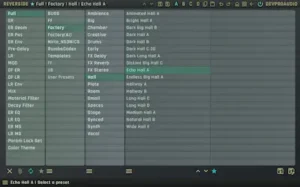
By comparison, several highly visible features belong in a different category. The GPU-rendered interface may improve graphical responsiveness, but it doesn’t change the quality of the audio processing. Color themes, interface localization, and visual customization make the software easier to use without altering the underlying DSP. Even the extensive preset library, while useful in day-to-day production, should be viewed as a workflow enhancement rather than a technical breakthrough.
That distinction is easy to overlook because audio software marketing frequently presents convenience features alongside genuine algorithmic development. REVERSIDE generally avoids making exaggerated claims, but the difference is still worth recognizing when evaluating the plugin’s actual value.
The remaining question is whether that additional engineering complexity translates into better production results. For users who routinely build sophisticated acoustic environments, the answer will often be yes. For engineers whose workflow depends on speed, predictable presets, and minimal setup, the extra control may offer diminishing returns despite the quality of the underlying DSP.
Where REVERSIDE Demands More Than It Gives
REVERSIDE asks more of the user than most premium reverbs. That isn’t necessarily a flaw, but it does define who will benefit from the plugin. Its architecture rewards engineers who enjoy building acoustic environments from the ground up. Those looking for immediate results may find themselves spending more time configuring the processor than actually making mix decisions.
The Easy page keeps everyday adjustments accessible, but the deeper editing layers assume a solid understanding of reflection behavior, diffusion, source localization, stereo perception, and room acoustics. Those controls provide genuine flexibility, yet many productions simply don’t require that level of refinement.
There’s also the question of diminishing returns. Fine-tuning subtle changes in spatial behavior can produce measurable improvements inside a treated control room, but those differences become progressively harder to hear once the mix reaches streaming services, earbuds, Bluetooth speakers, or other consumer playback systems. At some point, additional tweaking stops producing equally meaningful results.
REVERSIDE also enters a mature market. Engineers who already rely on products such as Pro-R 2, Cinematic Rooms, Seventh Heaven, or Valhalla Room have established workflows built around years of experience, trusted presets, and predictable behavior. Replacing those tools requires more than a technically impressive feature set—it requires consistent long-term development, broad industry adoption, and a reputation for reliability.
That final point remains difficult to judge. Early impressions suggest that REVERSIDE is stable, but it has yet to accumulate the extensive third-party testing and long-term production history enjoyed by its most established competitors. For some professionals, waiting until the platform matures further may be the more practical decision.
How REVERSIDE Compares With Today’s Leading Premium Reverbs
REVERSIDE isn’t trying to replace every reverb in a professional studio. Its closest competitors occupy the premium end of the market, where the discussion shifts from basic sound quality to workflow, spatial control, and production priorities. The more relevant question isn’t which processor sounds “better,” but which one solves a particular mixing problem most efficiently.
| Plugin | Where It Excels | Best Use Case | Main Trade-Off |
|---|---|---|---|
| DEVPROAUDIO REVERSIDE | Independent Early/Late Reflection control and detailed spatial modeling | Complex mixing, orchestral production, cinematic sound design | Longer learning curve and higher CPU requirements |
| FabFilter Pro-R 2 | Fast workflow with highly polished algorithmic processing | General-purpose music mixing | Less control over reflection architecture |
| LiquidSonics Seventh Heaven Professional | Exceptionally realistic Bricasti-style spaces | Vocals, acoustic instruments, orchestral recording | Less flexible than a fully algorithmic design |
| LiquidSonics Cinematic Rooms Professional | Large cinematic environments with excellent depth | Film scoring and orchestral production | Less extensive low-level editing of the reverb structure |
| Valhalla Room | Outstanding value and immediate usability | Everyday mixing across multiple genres | More limited spatial customization |
Choosing between these reverbs has less to do with overall sound quality than with the way each one approaches spatial design. Pro-R 2 and Valhalla Room prioritize speed, making them easy to integrate into fast-moving commercial sessions. Seventh Heaven focuses on recreating the character of a specific hardware reverb with remarkable realism, while Cinematic Rooms is optimized for large-scale orchestral and film work.
REVERSIDE occupies a different position. Its strength lies in giving users unusually deep control over how acoustic space is constructed rather than simply offering another collection of polished room algorithms. For productions where front-to-back depth, source localization, and room behavior play a significant creative role, that additional flexibility can justify the extra complexity.
It should not, however, be viewed as a replacement for convolution reverb. Convolution remains the better solution when accurately reproducing real acoustic spaces or hardware units. REVERSIDE’s advantage is flexibility. Because the entire environment is generated algorithmically, almost every aspect of the space can be reshaped without the limitations imposed by static impulse responses.
That distinction also explains why algorithmic and convolution reverbs continue to coexist in professional studios. Engineers looking for more experimental approaches to impulse-response processing may also be interested in our Heavyocity VAST review, which explores a very different philosophy of creating space through creative convolution rather than procedural room generation.
For many professional studios, the most realistic outcome isn’t choosing between REVERSIDE and its competitors. It’s using each where its strengths are most apparent. A convolution reverb may provide the primary room, while REVERSIDE handles spatial placement, evolving environments, or situations where conventional algorithms simply don’t offer enough control.
What REVERSIDE Is Not Designed to Replace
One of the easiest mistakes when evaluating REVERSIDE is expecting it to replace every premium reverb already in a studio. That isn’t its purpose.
It isn’t a direct substitute for convolution reverbs when authentic room capture or hardware recreation is the priority. Likewise, it doesn’t attempt to replace classic plate reverbs that are chosen primarily for their musical coloration, nor does it compete with streamlined workflow-oriented processors built around speed and simplicity.
Instead, REVERSIDE occupies a narrower but technically interesting position. It focuses on room simulation, spatial localization, and acoustic modeling at a level of detail rarely exposed inside commercial algorithmic reverbs. Rather than replacing established tools, it expands what an engineer can control when front-to-back depth becomes just as important as tonal balance.
How REVERSIDE Holds Up Beyond the Control Room
A premium reverb shouldn’t be judged solely on high-end studio monitors. The more revealing test is whether its spatial cues survive after the mix is encoded for streaming services and played back through everyday listening systems. That final stage introduces its own challenges, many of which extend beyond reverb design and are closely tied to mastering for streaming platforms. That’s where many ambitious reverb designs begin to lose their advantage.
REVERSIDE benefits from placing unusual emphasis on Early Reflections rather than relying primarily on long, impressive decay tails. Early reflections carry much of the information listeners use to judge distance and source placement, while extended reverb tails are often reduced or masked after AAC and Ogg Vorbis encoding. In practice, carefully controlled early energy is more likely to survive the journey from the control room to consumer playback devices than simply increasing the wet level.
The plugin also encourages a more disciplined stereo image. Because Early and Late Reflections can be managed independently, localization can remain stable while ambience expands around it. That’s a more reliable strategy than relying on aggressive stereo widening, which often sounds impressive on headphones but becomes less convincing in mono or on smaller playback systems.
For mastering engineers, REVERSIDE has a limited but legitimate role. It’s better suited to stem mastering than full-program processing, where introducing new spatial information across an already balanced stereo mix can create more problems than it solves. Most of its strengths are realized earlier in production, before a mix is finalized and prepared for mastering, while individual elements can still be positioned independently.
Its computational demands also encourage sensible session management. Rather than inserting multiple instances across individual tracks, REVERSIDE is often more effective as a shared ambience processor feeding groups or buses. That approach not only conserves CPU resources but also reinforces the coherent acoustic perspective the plugin is designed to create.
Ultimately, REVERSIDE delivers its greatest value to engineers who think about acoustic depth as part of the arrangement itself. Used that way, it becomes more than another premium reverb—it becomes part of the mix architecture.
Verdict: An Ambitious Reverb for Engineers Who Want More Than Presets
REVERSIDE doesn’t compete by sounding dramatically different from every premium algorithmic reverb already on the market. Its value comes from giving experienced users far more control over how acoustic space is constructed, refined, and integrated into a mix. That distinction is subtle, but for the right workflow it can be significant.
The plugin is at its best when spatial perspective is treated as part of the production rather than a finishing effect. Independent Early and Late Reflection processing, detailed room modeling, and unusually deep control over the underlying algorithm allow engineers to shape depth with a level of precision rarely found in a single processor.
That same flexibility also defines its biggest limitation. REVERSIDE asks for time, experimentation, and a willingness to move beyond preset-driven mixing. Producers looking for instant results may find faster, more mature reverbs better suited to everyday work, even if they offer fewer options beneath the surface.
Long-term success will depend on continued development and wider industry adoption as much as the quality of the DSP itself. The underlying technology is promising, but established competitors benefit from years of production use, proven stability, extensive preset ecosystems, and large user communities. Those advantages shouldn’t be underestimated.
For experienced mix engineers, orchestral composers, post-production specialists, and sound designers, REVERSIDE is one of the more compelling algorithmic reverb releases in recent years. It doesn’t replace convolution reverbs, nor does it make simpler algorithmic processors obsolete. Instead, it fills a niche that relatively few commercial plugins currently address: giving users direct control over the acoustic structure of a virtual space rather than simply the character of its decay.
REVERSIDE isn’t competing with every premium reverb on the market. It’s competing for a different role inside the mix. If your work depends on shaping acoustic perspective rather than simply adding ambience, its architecture offers capabilities that few algorithmic reverbs expose this directly. That doesn’t make it the default recommendation for every studio—but it does make it one of the more technically ambitious spatial processors currently available.
Overall Rating
| Category | Rating |
|---|---|
| Sound Quality | 9.2/10 |
| Spatial Control | 9.5/10 |
| Workflow | 8.4/10 |
| CPU Efficiency | 8.0/10 |
| Sound Design Flexibility | 9.3/10 |
| Ease of Use | 7.8/10 |
| Value for Money | 8.6/10 |
| Overall | 8.7/10 |
Sound Quality — 9.2/10. REVERSIDE can produce convincing depth without depending on oversized decay tails or aggressive stereo enhancement. The separation between Early and Late Reflections is particularly effective when localization needs to remain intact while ambience expands around the source. The score stops short of a perfect rating because long-term comparisons against established premium reverbs remain limited.
Spatial Control — 9.5/10. This is where REVERSIDE earns its strongest score. Independent reflection engines, source and listener positioning, room geometry, stereo control, and detailed diffusion behavior provide an unusual amount of authority over front-to-back perspective. Few conventional algorithmic reverbs expose this much of the underlying acoustic structure without requiring additional processors.
Workflow — 8.4/10. The Easy page keeps routine adjustments accessible, and consolidating positioning, reflection behavior, diffusion, filtering, and stereo processing inside one environment can simplify complex routing. The trade-off is depth: extracting everything REVERSIDE can do takes considerably more time than working with a streamlined preset-driven reverb.
CPU Efficiency — 8.0/10. The DSP has been optimized and the GPU-rendered interface keeps graphics work away from the main audio workload, but this remains a sophisticated spatial processor rather than a lightweight utility reverb. Shared buses make more sense than filling a large session with unnecessary individual instances. Independent performance data for the final release is still too limited to justify a higher score.
Sound Design Flexibility — 9.3/10. REVERSIDE reaches well beyond conventional rooms and halls. Its diffusion structures, modulation system, extended decay behavior, and ability to move toward resonant or delay-like effects make it useful for cinematic environments and experimental processing as well as traditional mixing.
Ease of Use — 7.8/10. The interface is intelligently organized, but the underlying concepts still require experience. Engineers familiar with room acoustics, reflection behavior, and stereo localization will understand the logic quickly; users accustomed to selecting a preset and adjusting decay may find much of the deeper architecture unnecessary.
Value for Money — 8.6/10. At $135, REVERSIDE offers substantial processing depth for the price, particularly for mix engineers, composers, and sound designers who would otherwise combine several tools to achieve similar control. The value proposition is weaker for producers who mainly need dependable rooms, plates, and halls with minimal setup.
Overall — 8.7/10. REVERSIDE is an ambitious and unusually configurable algorithmic reverb with genuine strengths in depth, localization, and acoustic design. It earns its rating through engineering flexibility rather than convenience, but its learning curve, processing demands, and still-developing track record prevent it from becoming an automatic recommendation for every studio.
Where REVERSIDE Fits in a Professional Toolkit
Professional studios rarely rely on a single reverb for every production task, and REVERSIDE doesn’t change that reality. Its strengths become most apparent when used alongside more specialized processors rather than in place of them.
A fast room reverb may still handle routine tracking sessions, a convolution processor may recreate real recording spaces, and a classic plate may remain the preferred choice for vocals. REVERSIDE complements those tools by solving a different problem: building believable three-dimensional environments through independent control of early reflections, late reflections, and virtual room behavior.
Viewed from that perspective, the plugin is less about replacing familiar reverbs and more about extending the engineer’s ability to shape spatial relationships inside increasingly complex mixes.
Hear What Your Mix Is Still Missing
Reading about better depth, clearer imaging, and improved translation is one thing. Hearing those improvements in your own mix is something else entirely. Professional mastering isn’t about making a track louder—it’s about revealing details, improving balance, and helping your music translate consistently across real-world playback systems without compromising the character of your mix.
Upload up to 35 seconds of your mix and receive a free mastering demo prepared by an experienced mastering engineer. Compare your original and mastered versions side by side, then decide if the improvement is worth taking further.
Request your free mastering demo →
Frequently Asked Questions
Is REVERSIDE designed primarily for mixing or mastering?
Its strongest applications are in mixing, sound design, and orchestral production, where individual tracks or buses can be positioned before the final stereo mix is complete. It has niche uses during stem mastering, but isn’t intended as a full-program mastering processor.
Can REVERSIDE replace a convolution reverb?
Not completely. Convolution reverbs remain the better choice for recreating specific acoustic spaces or hardware units. REVERSIDE’s advantage lies in flexibility—its algorithmic architecture allows the room itself to be reshaped without the constraints of fixed impulse responses.
Is REVERSIDE suitable for everyday vocal mixing?
Yes, particularly when vocal depth and localization need more refinement than a conventional plate or room can provide. For quick, straightforward vocal chains, however, simpler reverbs may deliver comparable results with less setup.
How CPU-intensive is REVERSIDE?
Resource usage depends on the selected algorithms and project complexity. Most modern systems should handle several instances comfortably, while larger orchestral or post-production sessions may benefit from shared effect buses or printed ambience returns.
Does REVERSIDE improve depth without making the mix noticeably wetter?
Often, yes. Independent Early Reflection processing makes it possible to strengthen distance cues while keeping the late reverb field relatively restrained, preserving clarity and intelligibility.
How does REVERSIDE compare with FabFilter Pro-R 2?
Pro-R 2 focuses on speed and immediate usability. REVERSIDE offers substantially deeper control over room behavior and reflection structure, making it a better fit for engineers who routinely build detailed acoustic environments.
Is REVERSIDE a good choice for orchestral templates?
Potentially. Its source positioning and reflection controls can help unify instruments recorded in different libraries while preserving natural front-to-back depth across large arrangements.
Will REVERSIDE help mixes translate better on streaming platforms?
It can contribute by improving depth and localization before encoding, but successful translation still depends on the overall quality of the mix, monitoring environment, and production decisions rather than the reverb alone.
Who will get the most value from REVERSIDE?
Professional mix engineers, film composers, orchestral programmers, post-production facilities, and sound designers are likely to benefit the most. Producers focused on speed and preset-driven workflows may prefer simpler premium reverbs.
Is it worth switching if you already own premium reverbs?
That depends on your workflow. If your current tools already cover everyday mixing, REVERSIDE is best viewed as a specialized addition rather than a replacement. Its biggest advantage is the level of control it offers over spatial behavior, not the promise of universally better reverb.

Yurii Ariefiev evaluates reverb plugins from a production perspective, focusing on how room modeling, early reflections, stereo localization, and acoustic depth affect real mixing decisions rather than isolated demonstrations. Every review considers workflow efficiency, mix translation, and practical use inside modern professional studios.
This REVERSIDE review examines where advanced algorithmic reverb provides measurable advantages, where additional complexity offers diminishing returns, and how the plugin compares with established solutions used in commercial mixing, post-production, and film scoring.