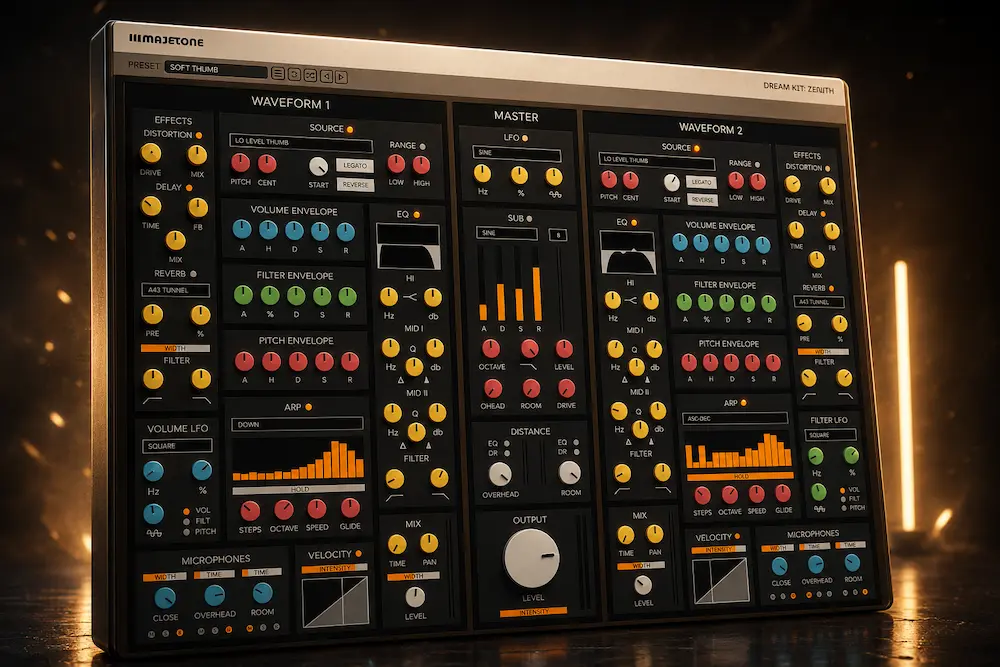
Most drum instruments are built to make a kit sound more convincing. Majetone Dream Kit: Zenith takes the opposite direction: it treats the physical components of a drum kit as raw material for a playable, heavily sampled instrument. Shells, heads, cymbals, hardware and other drum components become chromatic sources for basses, percussion, textures and synthetic-sounding tones.
That makes Zenith difficult to judge using conventional drum-library criteria. It is not trying to reproduce an acoustic kit, and it is not competing with a general-purpose synthesizer on synthesis depth. The more useful question is whether its unusual source material gets a producer to distinctive, usable sounds faster than building the same kind of material from a sampler, synthesizer and effects chain.
Zenith is fundamentally a sample-based instrument built around an unusual source concept: drum and percussion performances are treated as playable waveforms and mapped across a wide pitch range. The instrument uses 120 drum-derived waveforms, extensive multisampling, multiple round robins and Close, Overhead and Room perspectives, with the source material recorded and re-amped at Otterhead Studios.
For electronic producers, composers and sound designers, that makes Zenith more interesting than its “drum synth” description initially suggests. For mixing and mastering engineers, its relevance is further upstream: it is a sound-generation tool that can change the arrangement and the eventual mix, not a processing solution for the finished track.
How we evaluated it: This review focuses on Zenith v2 as a production instrument rather than treating it as a conventional drum library. The assessment considers source design, patch-shaping workflow, arrangement use, mix implications, compatibility and value, while avoiding unsupported CPU or performance claims where independent measurements are unavailable.
In This Review
Why Zenith v2 Starts With the Sound Source, Not the Synth Engine
 The useful distinction between Zenith and a conventional synthesizer is not another oscillator architecture or modulation scheme. It is the source material. Instead of starting with conventional waveforms and using synthesis to approximate an acoustic character, Majetone starts with recordings of the physical components of a drum kit and makes those recordings playable as pitched instruments.
The original Zenith library was built from drum shells, heads, cymbals, lugs, tuning rods, pedals, stands and other mechanical components. The sources were mapped across a five-octave range and extensively multisampled, with up to 38 velocity layers and multiple round robins. Close, Overhead and Room perspectives were also captured and re-amped at Otterhead Studios.
That approach gives the instrument a different kind of complexity from a typical synth patch. A drum shell can provide a pitched low-frequency body; a cymbal can become a sustained metallic texture; a piece of hardware can supply an inharmonic tone with an attack that would be difficult to reproduce from a conventional oscillator. Pitching and stretching those recordings pushes them further away from their acoustic origins, but the underlying resonance and transient behavior remain part of the sound.
This is where Zenith makes practical sense. It is not trying to produce a more convincing acoustic drum kit. It gives producers an organic source that can occupy the role of a bass, melodic percussion part, sustained texture, transition or cinematic layer without immediately sounding like a standard synthesizer preset.
For sound design, that distinction matters more than the size of the preset library. The value is in starting with source material that already has complex acoustic behavior, then shaping it into something the arrangement actually needs.
Hear What Professional Mastering Does to a Dense Production
Complex sound-design layers can add character to a production, but they also change how the mix behaves when it reaches the final stage. If you want to hear how much clarity, punch, depth, and balance your track can gain without losing its character, upload up to 35 seconds of your mix and get a free mastering demo. It is a practical way to hear the difference before committing to the full master.
Request your free mastering demo →
How Dream Kit: Zenith Turns Drum Recordings Into Playable Sounds
Zenith’s large source library only becomes useful when those recordings can be shaped into specific musical roles. The instrument is designed around that transition: unusual drum-derived material is not presented simply as raw samples, but as playable sources that can be pitched, filtered, shaped and modulated into parts that function inside a production.
Sample Start Can Change the Role of a Drum-Derived Source
Sample-start control is particularly useful with Zenith because the attack often determines how the source functions in an arrangement. Leaving the initial transient intact can preserve a percussive hit, while moving the start point deeper into the recording can expose a more sustained resonance and reduce the obvious connection to the original drum component.
That makes the same source usable in very different roles. One setting can work as a transient layer beneath a conventional kick or snare; another can become a sustained tonal texture; another can function as a transition or impact. The control is simple, but it reduces the need to edit or reprocess the source in the DAW.
Envelope Controls Make the Drum Sources More Adaptable
Pitch, filter and volume envelopes extend that control beyond the playback point. A short pitch envelope can give a drum-derived source the downward movement associated with an electronic impact or tuned percussion. Filter movement can emphasize the source’s resonant body or pull back its upper harmonics, while the volume envelope determines whether the material behaves as a hit, pluck or sustained tone.
That matters because Zenith’s recordings contain considerably more internal detail than a basic oscillator waveform. Rather than stacking external effects to make a static sample behave like an instrument, the producer can shape its pitch, spectrum and amplitude at the source.
LFOs Turn Static Sources Into Moving Parts
LFOs are less significant as a feature in themselves than in what they do to Zenith’s source material. Slow modulation can introduce movement into sustained textures and pads, while faster modulation can create rhythmic changes in filter or amplitude.
This is particularly effective when a source already contains complex acoustic resonances. The modulation does not have to generate the character from scratch; it changes how an existing character evolves over time. That makes a single waveform more useful across an arrangement and can reduce the need to layer several related sounds simply to create movement.
Overhead and Room Options Change the Spatial Role of a Sound
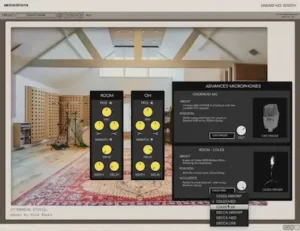
The switchable microphone perspectives have a more direct production consequence than their recording terminology suggests. A close perspective can behave like a discrete instrument layer, while overhead and room perspectives introduce more of the acoustic environment captured with the original source.
That gives producers another way to decide where a Zenith part sits in the arrangement. A tighter source can reinforce a rhythmic or low-frequency element without adding as much spatial information; a room-heavy version can function as atmosphere, transition material or a wide background layer.
It also changes the mixing workload. Because some of the spatial character is already present in the source, the producer does not have to create all of that depth with additional reverb or ambience processing. The trade-off is that room-heavy material can consume more headroom and occupy more of the stereo field, so the perspective should be chosen as part of the arrangement rather than added indiscriminately. That same distinction becomes important when working with dedicated spatial tools: our Tunary Thalm review looks at a different approach to acoustic perspective, where the spatial environment itself becomes part of the production workflow.
What Changed in Dream Kit: Zenith v2 — and What Actually Matters
Zenith v2 is not a new instrument built around a different synthesis engine. The underlying concept remains the same: drum components are sampled, tuned and presented as playable sound sources. The meaningful changes are concentrated in how those sources are accessed and shaped.
The most important v2 workflow changes are the added sample-start control, expanded envelope and modulation options, microphone-perspective switching, and revised preset navigation. These controls matter because they operate on complex acoustic recordings rather than simple oscillator shapes. Moving the sample start can remove an obvious transient; shaping pitch, filter, or volume can turn a resonant drum component into a pluck or impact; and modulation can introduce movement into a sustained metallic or percussive source.
Version 2 puts more direct control over the Overhead and Room perspectives into the instrument. This is more than a cosmetic perspective change. The microphone balance can determine whether a source behaves like a discrete production element or a spatial texture, which means the decision can be made during sound selection rather than recreated later with additional ambience processing.
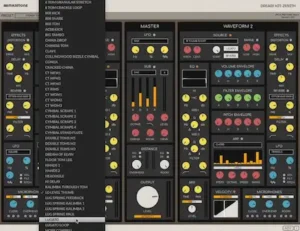
The revised preset navigation matters for a different reason. Zenith contains a very large collection of sounds, so browsing efficiency becomes part of the instrument’s usefulness. A huge library is only valuable when a producer can move through it quickly enough to find something that belongs in the arrangement.
The updated interface is the least technically interesting change, but it still matters when the instrument is used as a production tool rather than a preset player. The important question is not whether the interface looks newer; it is whether the new layout makes source selection and sound shaping faster.
In that sense, Zenith v2 is best understood as a workflow-focused revision of an unusual sample-based instrument. The core sound-generation idea remains intact, while more of the work required to turn its raw material into a finished production element has moved inside the instrument.
What Does Dream Kit Zenith v2 Actually Sound Like?
Zenith’s sounds tend to retain traces of their acoustic origin without behaving like conventional acoustic instruments. The most convincing results are often the ones where the source identity becomes ambiguous: a cymbal can turn into a sustained metallic voice, a drum shell can become a pitched low-frequency body, and small mechanical components can produce unstable or inharmonic textures.
The important characteristic is not simply that the sounds are “organic.” Plenty of sample-based synthesizers can provide organic material. Zenith’s stronger trait is the combination of identifiable physical source behavior with chromatic tuning, multisampling and synthesis-style shaping. That is what makes its patches useful when a conventional oscillator-based sound feels too clean or predictable.
In practical terms, expect the library to work better for textural basses, tuned percussion, impacts, evolving layers, transitions, cinematic material and unusual rhythmic elements than for bread-and-butter synth duties.
Dream Kit: Zenith Is a Sampling Innovation, Not a New Synthesis Architecture
Zenith is best described as a synthesizer from a production standpoint, but its underlying technology is sample based. The distinctive part is not a new oscillator model or processing algorithm; it is the way Majetone captures, maps and manipulates physical drum components as playable sources.
There is no indication that Zenith v2 introduces a new DSP architecture, physical-modeling system, neural synthesis engine or fundamentally different synthesis method. The second version is primarily a refinement of the existing instrument: more control over sample playback, additional modulation, revised source selection and a more efficient way to navigate the library.
That distinction matters when evaluating the update. Zenith v2 should not be judged against synthesizers on the novelty of its synthesis engine. Its technical value lies earlier in the chain, where unusual acoustic recordings are turned into chromatically mapped, deeply multisampled material that can then be shaped like a synth patch.
That is a legitimate form of innovation, but a narrower one. Zenith’s originality is in source design and sound-design workflow, not in inventing a new method of synthesis.
How to Use Zenith v2 in a Mix Without Making the Arrangement Busier
 Zenith makes more sense in a mix when it is treated as a supporting source rather than the sound responsible for carrying the entire musical part. Its strongest contribution is often a layer of resonance, texture or movement that changes the character of an existing element without replacing its fundamental function.
A straightforward example is drum layering. Keep the conventional kick, snare or tom responsible for the recognizable transient and use a Zenith patch to add a different tonal body or decay. The result can be more distinctive than processing the original drum with another round of EQ, saturation and reverb, because the added layer brings a different source character rather than simply changing the same recording.
The same approach works beyond drums. A pitched Zenith source can sit underneath a bass line, reinforce a transition between sections, or provide a short tonal impact at the end of a phrase. Sustained patches can fill gaps between arrangement elements, while more rhythmic sources can add movement without introducing another obvious synth part.
The important mixing decision is usually how much of the source to leave intact. Zenith patches can contain substantial low-mid resonance, upper-frequency detail and stereo information, particularly when the Overhead or Room perspective is prominent. A patch that sounds expansive in solo can quickly compete with guitars, vocals, pads or percussion when it is left full-range.
That makes filtering, level automation and selective editing more useful than simply turning the layer down. In a dense production, the Zenith part may only need its initial attack, a narrow resonant band or the final portion of its decay. Treating it as an arrangement component rather than another full-range instrument keeps the unusual character while preventing it from becoming another source of mix congestion.
For a mixing engineer, this is the more interesting application of Zenith: not replacing established processing tools, but giving the arrangement a source with enough inherent character that less corrective processing may be required later.
What Zenith v2 Means for the Mastering Stage
Zenith is not a mastering tool, but its source material can have consequences that become obvious once the mix reaches the mastering stage. Sustained resonances, cymbal-derived high-frequency content, room information and long decays can contribute energy that is easy to overlook while the instrument is being judged on its own.
The risk is less about Zenith itself than about how its sounds are arranged. Several sustained or room-heavy layers can build up low-mid density, persistent upper-frequency energy or a wide stereo field without producing obvious peaks. A limiter may then respond to a mix that feels reasonably controlled dynamically but carries more continuous spectral energy than expected. These are the kinds of issues that are easier to diagnose at the mix stage than to chase later as mastering problems.
This is why Zenith parts should be judged in context, particularly when they are used as pads, bass textures or wide atmospheric layers. Solo playback can make a large room component sound impressive while masking how much space it occupies once vocals, guitars, synths and drums are present.
A mastering engineer will ultimately deal with the result rather than the instrument. Before the mix leaves the production stage, it is worth checking critical Zenith layers in mono, watching their effect on the mix bus and listening to the decay at low monitoring levels. If a part is contributing substantial low-frequency sustain or broadband ambience, reducing its level or shortening its decay at the mix stage is usually a cleaner solution than trying to correct the accumulated energy during mastering. Producers sending a track to an engineer should also make these checks part of their broader mix preparation for mastering. Once that preparation is done, the mastering stage becomes a question of controlled tonal refinement rather than repairing production decisions; our TK Audio TK-Lizer 3 review examines that finishing-stage approach through broad tonal balance, stereo control, and restrained mastering EQ.
Zenith v2, Loudness and Mix Translation
Zenith does not require any special streaming or codec treatment. The relevant issue is what its sustained, resonant and spatial sources do to the finished mix once compression, limiting and loudness normalization enter the picture.
A cymbal-derived or metallic source can carry substantial high-frequency content even when its peak level is modest. Long decays can also add continuous energy that becomes more obvious after mix-bus compression or limiting. The result may be a denser-sounding master without a corresponding increase in musical impact.
The Room and Overhead perspectives create a separate translation concern. A wide Zenith layer may sound impressive in stereo but contribute less useful information when the mix is collapsed toward mono or reproduced on a narrower monitoring system. That does not make wide sources inherently problematic; it means their contribution needs to survive outside the main stereo listening position.
A practical check is to bypass the Room or Overhead component and match the overall mix level before comparing the two versions. Then check the part in mono and at low monitoring volume. If removing the spatial component changes the perceived balance more than the musical role of the part warrants, the room information is probably doing more work than the arrangement needs.
The same principle applies to loudness. Zenith is not inherently difficult to master, but sustained low-frequency resonance, metallic decay and broadband ambience can consume headroom without producing a large transient peak. If those elements are structurally important, deal with their level, decay or spectral balance during mixing rather than relying on the limiter to absorb the accumulated energy at the end of the chain.
Codec testing belongs at the finished-mix stage, where the interaction between the entire arrangement and the delivery format can actually be judged. There is little value in trying to make an individual Zenith patch “codec safe” in isolation. The broader issue is how the finished master behaves after normalization and platform delivery, which is why mastering for streaming platforms needs to be considered at the release stage rather than at the individual plugin level.
The Trade-Off: Zenith v2 Gives You Character Instead of Breadth
Zenith’s biggest limitation is also its defining feature: the instrument has a narrow sonic identity. It is built around a specific class of drum-derived sources, so it cannot compete with a general-purpose synthesizer on synthesis depth or with a dedicated drum library on acoustic realism.
That is not a flaw if the source material is what you are looking for. It becomes a problem when the purchase is being justified by versatility. A conventional wavetable or hybrid synthesizer will cover a much wider range of synthesis tasks, while a dedicated drum instrument will be far better suited to realistic kit programming. Granular instruments also provide deeper control when the goal is to manipulate arbitrary samples rather than work within a curated sonic palette.
Zenith therefore makes more sense as a complementary instrument than as a foundation for a new plugin collection. For a producer with a limited budget, a versatile synth or sampler will generally solve more production problems. Zenith becomes easier to justify once the basic toolkit is already covered and the remaining requirement is a distinctive source rather than additional flexibility.
The same distinction applies to the preset count. More than 1,000 factory presets is useful for browsing, but it does not necessarily represent 1,000 genuinely different production ideas. Because the library is built around a tightly defined family of sources, some patches inevitably occupy related sonic territory. The better test is whether the preset browser consistently produces sounds that have an obvious role in your current work.
Version 2 also changes the library footprint substantially. The original Zenith specification listed approximately 42,000 samples and 21.7GB installed, while the current v2 specification lists 14,000 samples and approximately 5GB installed. The public documentation does not fully explain how the sample-count reduction was achieved, so it is safer to describe this as a major change in the current library footprint rather than assume it represents a simple optimization.
Zenith v2 vs. Kontakt, Falcon, Pigments and Other Sound-Design Tools
Zenith does not have a direct clone competitor. Its closest alternatives are instruments that can reach some of the same production territory through sampling, synthesis or granular processing. The practical question is therefore not which instrument is objectively better, but how much work each approach requires to reach a similar type of sound.
| Alternative | Best for | Advantage over Zenith | Why choose Zenith instead |
|---|---|---|---|
| Kontakt | Sample-based production and large instrument libraries | Much broader ecosystem, realistic instruments and far more available content | Zenith provides a tightly curated drum-derived palette without building the source architecture yourself |
| UVI Falcon | Advanced synthesis and sample manipulation | Far deeper synthesis, modulation and sound-design control | Zenith reaches its specific acoustic-textural character with considerably less setup |
| Arturia Pigments | Hybrid synthesis, sampling and modulation | More flexible synthesis architecture and broader tonal coverage | Zenith starts with distinctive recorded sources that are difficult to reproduce from conventional oscillators |
| Kilohearts Phase Plant | Modular synthesis and custom sound design | Much greater flexibility for building complex synthesis chains | Zenith is faster when the desired result depends on its specific drum-derived source character |
| Granular instruments | Extreme manipulation of arbitrary samples | Deeper control over grain position, density, timing and sample transformation | Zenith provides curated, chromatically mapped material without requiring the user to build the source library |
| Acoustic drum libraries | Realistic drum programming and replacement | Far better for conventional kick, snare, tom and cymbal production | Zenith is designed for melodic, harmonic and textural applications rather than acoustic realism |
The trade-off is straightforward. Kontakt, Falcon, Pigments and Phase Plant are more versatile platforms, but that versatility does not automatically make them faster for Zenith’s particular job. Recreating the same kind of drum-derived texture from a generic sampler or synthesizer can require sourcing the right recording, mapping it, pitching it, shaping the envelopes and building the modulation yourself.
Zenith removes much of that setup by making the source itself the starting point. If that source character is central to the production, the narrower instrument can actually be the faster tool.
For a producer buying one instrument to cover the widest possible range of sounds, Zenith is not the logical choice. For someone who already has the general-purpose tools and wants a distinctive source library that can generate material outside the usual synth palette, its specialization becomes the advantage.
Who Should Buy Dream Kit Zenith v2 — and Who Should Skip It?
 Zenith makes the strongest case for producers who already have the conventional parts of their toolkit covered and need a source with a more distinctive sonic identity. Its value increases when the alternative is spending time building that character from ordinary samples, synthesis and effects.
Electronic producers are an obvious fit. Zenith can provide bass textures, tuned percussion, transitions and background movement that sit outside the familiar territory of standard wavetable and analog-style presets. It is particularly useful when a track needs an identifiable sound without adding another obviously synthetic layer.
Film and game composers are another strong match. Drum-derived resonances, unusual pitch behavior, room perspectives and evolving modulation can produce hybrid material that works between acoustic and electronic scoring. The instrument is especially useful when a cue needs organic source material without sounding like a conventional orchestral or percussion library.
Sound designers are arguably the clearest target. Zenith packages a highly specific source library into an instrument that is immediately playable and editable. That can eliminate a substantial amount of preparation compared with sourcing individual recordings and building the same playable instrument from scratch.
Mixing engineers only benefit directly if production or arrangement is also part of their work. Zenith does not replace any mixing processor; its contribution is upstream, where it can supply layers, textures and tonal material that change the balance and character of the production.
Mastering engineers have little reason to buy it specifically for mastering. Its relevance to mastering is indirect, through the spectral density, decay and spatial information its sounds can introduce into a mix.
Beatmakers can find useful material in Zenith, but it should be approached as a source for melodic percussion, textures, bass elements and ear candy rather than as a replacement for a dedicated drum workstation.
Beginners with a limited plugin budget should generally look elsewhere first. A versatile synthesizer, sampler and conventional drum instrument will cover substantially more production tasks. Zenith becomes easier to justify once the basic toolkit is already in place and the remaining problem is finding a source with a specific character rather than adding another general-purpose instrument.
What Independent Reviews and User Feedback Actually Tell Us
One of the most useful independent sources on the original Zenith is Sound On Sound’s June 2025 coverage of the instrument. It examined Majetone’s approach to turning drum and percussion recordings into a chromatic, synthesizer-style sound source, including extensive multisampling and drum components far beyond conventional kit sounds. That coverage is useful evidence for the underlying instrument, but it should not be treated as an independent test of every change introduced in v2.
Community discussion remains relatively limited compared with larger synthesizer releases. KVR contains little accumulated user-review data, and the original Gearspace launch thread generated modest discussion. Majetone’s current product page does include positive user comments, but those are not a substitute for broad independent testing. There is still not enough community evidence to claim a consensus about long-term reliability, CPU performance or everyday use.
That distinction matters. The available evidence supports the conclusion that the instrument’s underlying concept works and that its sound library has professional appeal. It does not support stronger claims about how Zenith performs across thousands of real-world systems or how it holds up over years of heavy studio use.
The purchasing proposition has nevertheless improved since the original release. Early prospective users noted the lack of a demo, while the current version offers a 14-day unrestricted trial. For a highly specialized instrument, that is significant: the decision depends far more on whether the source material fits a producer’s work than on specifications, preset counts or screenshots.
Dream Kit: Zenith — CPU Load, Storage and Session Workflow
There is not enough independent benchmark data to assign Zenith v2 a meaningful CPU or RAM figure. Processor load will vary with the preset, polyphony, active modulation and sample configuration, so any universal CPU claim without a controlled test would be misleading. The same applies to render speed and plugin loading time.
Storage is easier to quantify. Majetone currently lists a 2.4GB download and approximately 5GB installed, with an SSD recommended. The original Zenith specification was approximately 16.7GB for the download and 21.7GB installed. The reduction is substantial and makes the current version much easier to accommodate alongside larger sample-based instruments.
It is important not to confuse a smaller library footprint with lower CPU or RAM usage, however. The published specifications do not establish that relationship, and the available documentation does not explain in detail how the current 14,000-sample library was derived from the original 42,000-sample version. A smaller disk footprint is therefore a storage benefit, not evidence of lower processor or memory requirements.
In a large production session, the sensible approach is to treat Zenith as a source instrument rather than leave unnecessary instances active throughout the project. Once a part is finalized, freezing or printing it can remove the instrument from the live processing path while preserving the sound-design decision. That is particularly practical in scoring sessions, where multiple sample-based instruments can accumulate quickly.
Dream Kit: Zenith v2 Compatibility, DAWs and System Requirements
| Platform | Formats |
|---|---|
| Windows | VST3 |
| macOS | VST3, AU, AAX |
Dream Kit: Zenith v2 runs on Windows through VST3 and on macOS through VST3, AU and AAX. The current minimum requirement for Mac is macOS 11 Big Sur. Majetone lists Reaper, Ableton, Logic, Nuendo and Pro Tools among its tested DAWs, with 64-bit programs required. AAX support is available on macOS, making the v2 release relevant to Pro Tools users, while Windows users should use the VST3 version.
Because Zenith is a sample-heavy instrument, storage is a more meaningful consideration than the plugin format itself. Producers running large sample-based sessions should account for the library alongside their existing instrument collection rather than treating Zenith like a lightweight synthesizer.
Is Dream Kit: Zenith Worth the Price?
The value of Dream Kit: Zenith depends less on the size of the library than on how often its particular source character is useful in your productions. It is a specialized sound-design instrument rather than a general-purpose synthesizer, so its return is highest when the alternative would be spending significant time building unusual organic textures from conventional samples and synthesis tools.
If you are looking for a general-purpose synthesizer, the answer is no. A flexible synth or sampler will cover substantially more sounds and production tasks for the same budget. Zenith earns its price when its specialized source material saves you from building similar sounds elsewhere.
That time saving is the strongest argument for the purchase. Creating a comparable drum-derived texture from scratch could involve finding the right sample, pitching or stretching it, editing the playback point, shaping the envelope, filtering the result, adding modulation and then building the spatial character around it. Zenith packages much of that starting point into a playable instrument.
That does not mean every preset replaces an effects chain or another plugin. It means the instrument can shorten the path from “I need an organic but unfamiliar texture” to a usable production element.
At the current $80 introductory price, Zenith v2 is easy to justify for producers who regularly need this kind of unusual source material. At the $120 regular price, the decision becomes more dependent on how often that specialized sound-design workflow actually appears in your projects.
Overall Rating
| Category | Rating |
|---|---|
| Sound Quality | 9/10 |
| Workflow | 9.5/10 |
| Mix Translation | 8.5/10 |
| Session Efficiency | 8/10 |
| Sound Design Flexibility | 7.5/10 |
| Value for Money | 9/10 |
| Overall | 8.6/10 |
Sound Quality — 9/10. Zenith’s strongest asset is the source material itself. Drum shells, cymbals, hardware and other physical components retain enough acoustic complexity to produce tones that are difficult to reproduce from conventional oscillators or generic samples. The instrument is particularly convincing when used for bass textures, tonal percussion, impacts and sustained sound-design elements rather than conventional drum reproduction.
Workflow — 9.5/10. This is where v2 earns most of its score. The revised sample-playback controls, expanded shaping and modulation options, microphone-perspective control and improved preset navigation make the underlying library considerably more practical to use.
Mix Translation — 8.5/10. Zenith can produce sources with strong identity, but that character comes with mix consequences. Room-heavy patches, sustained resonances, metallic high-frequency content and wide stereo information can occupy more space than expected once the full arrangement is playing. The score reflects that balance: the sources can translate extremely well when shaped as arrangement elements, but they are not inherently mix-neutral.
Session Efficiency — 8/10. Zenith is practical enough for normal production use, but there is not enough independent benchmark data to claim exceptional CPU performance. The score reflects workflow and library management rather than a measured processor-efficiency advantage. In larger sessions, freezing or printing completed parts remains a sensible approach.
Sound Design Flexibility — 7.5/10. Zenith can move surprisingly far from its drum origins, but its flexibility is bounded by its deliberately narrow source concept. A general-purpose synthesizer, sampler or granular instrument will provide deeper control across a wider range of sound-generation tasks. Zenith’s advantage is speed and character within its particular territory, not universal synthesis depth.
Value for Money — 9/10. At the current $80 introductory price, the value is strong for producers who regularly need organic but unfamiliar sound sources. The instrument can shorten a process that might otherwise involve sample hunting, pitching, editing, filtering, modulation and spatial processing. At the $120 regular price, the case depends much more heavily on how often that specialized workflow appears in your projects.
Overall — 8.6/10. Zenith v2 earns its score by solving a specific production problem unusually well. It is not the most flexible synthesizer, the most realistic drum instrument or the deepest sample-manipulation environment. Its strength is getting from an unusual acoustic source to a distinctive, playable production sound with relatively little setup. For the right workflow, that specialization is an advantage rather than a limitation.
Verdict: Zenith v2 Is Worth Owning for the Right Production Jobs
Majetone Dream Kit Zenith v2 is not a replacement for a general-purpose synthesizer, a realistic drum library or any conventional mixing or mastering tool. Its value comes from a narrower proposition: it gives producers a curated collection of unusual acoustic sources that can be shaped into playable electronic, cinematic and textural material with relatively little setup.
Zenith’s strength is therefore better understood as a workflow and source-design decision than as a technological reinvention. Its unusual drum-derived material gives producers a starting point that would be difficult to reproduce from conventional oscillators or generic samples, while the instrument’s playable architecture makes that material practical inside a modern DAW.
The strongest case for Zenith is therefore not versatility. It is speed to a distinctive result. If a production regularly calls for organic textures, unusual percussion, tonal impacts, hybrid scoring elements or sounds that do not immediately identify themselves as conventional synth patches, Zenith can shorten a sound-design process that would otherwise involve considerably more experimentation.
If those requirements are rare, the instrument is difficult to justify over a more flexible synth or sampler. Mixing and mastering engineers who do not also produce have even less reason to buy it.
Zenith v2 succeeds because it is specific, not because it tries to do everything. The underlying concept remains distinctive, the v2 workflow is more mature, and the current price makes the instrument easier to justify for producers who can identify an actual place for its sound palette in their work.
Give Your Mix a Final Reality Check
A mix can sound impressive in the studio and still lose impact, clarity, or balance when it reaches real playback systems. Professional mastering is about making those final decisions in context—controlling low-end buildup, preserving punch and depth, and making sure the finished track translates without stripping away the character of the mix.
You don’t have to guess what your mix still needs. Upload up to 35 seconds and hear how a real mastering engineer would approach the track before you commit to a full mastering session.
Get your free mastering demo →
Frequently Asked Questions About Dream Kit: Zenith
Is Dream Kit Zenith v2 compatible with Pro Tools?
Yes. Zenith v2 supports AAX on macOS, so it can run in Pro Tools on Mac. Windows users are supported through VST3. Majetone lists Pro Tools among the tested 64-bit DAWs.
Does Dream Kit Zenith v2 work with Logic Pro and Ableton Live?
Yes. Majetone lists Logic and Ableton among the tested DAWs. On macOS, Zenith v2 runs as VST3 or AU; Windows support is provided through VST3.
Can Dream Kit Zenith v2 be used as a conventional drum instrument?
It can produce drum and percussion parts, but realistic acoustic kit programming is not its main purpose. Its source material is designed to be pitched, reshaped and used as melodic, harmonic and textural material.
How much disk space does Dream Kit Zenith v2 require?
Majetone lists 14,000 samples, a 2.4GB download and approximately 5GB installed, with an SSD recommended. The original Zenith specification was substantially larger at approximately 16.7GB for the download and 21.7GB installed.
Is Zenith v2 CPU intensive?
There is no reliable independent benchmark establishing a universal CPU figure. Load will vary with the preset, polyphony, modulation and sample configuration, so performance should be evaluated on the system and DAW where the instrument will actually be used.
Does Zenith v2 make sense for a mixing engineer?
Only when production or arrangement is also part of the job. Zenith can provide unusual layers, tonal percussion and textures, but it does not replace mixing processors. Its value is in generating source material before the mix reaches the processing stage.
Is Zenith v2 useful for film scoring and game audio?
Yes. Its drum-derived sources, unusual pitch behavior, room perspectives and modulation make it well suited to hybrid textures, impacts, transitional elements and other sounds that sit between acoustic percussion and electronic synthesis.
What is the closest alternative to Dream Kit Zenith v2?
There is no exact equivalent. Kontakt and Falcon offer broader sample-based environments, while Pigments and Phase Plant provide more flexible synthesis architectures. Granular instruments can reach related textural territory, but Zenith’s curated drum-component source library is its main point of difference.
Is Zenith v2 worth buying if I already own several synthesizers?
It can be, if those instruments leave a gap for organic and unfamiliar source material. Zenith is less compelling when you need broader synthesis coverage; its advantage is getting to a specific drum-derived character without constructing the source and processing chain yourself.

Yurii Ariefiev evaluates audio instruments from the perspective of the finished production, focusing on how source character, arrangement, dynamics, stereo information, and frequency balance affect a mix before it reaches mastering.
This review examines Dream Kit: Zenith as a drum-derived sound-design instrument, with particular attention to its role in electronic production, layering, mix translation, and the practical consequences of its sounds at the mastering stage.
☕ Buy me a coffee