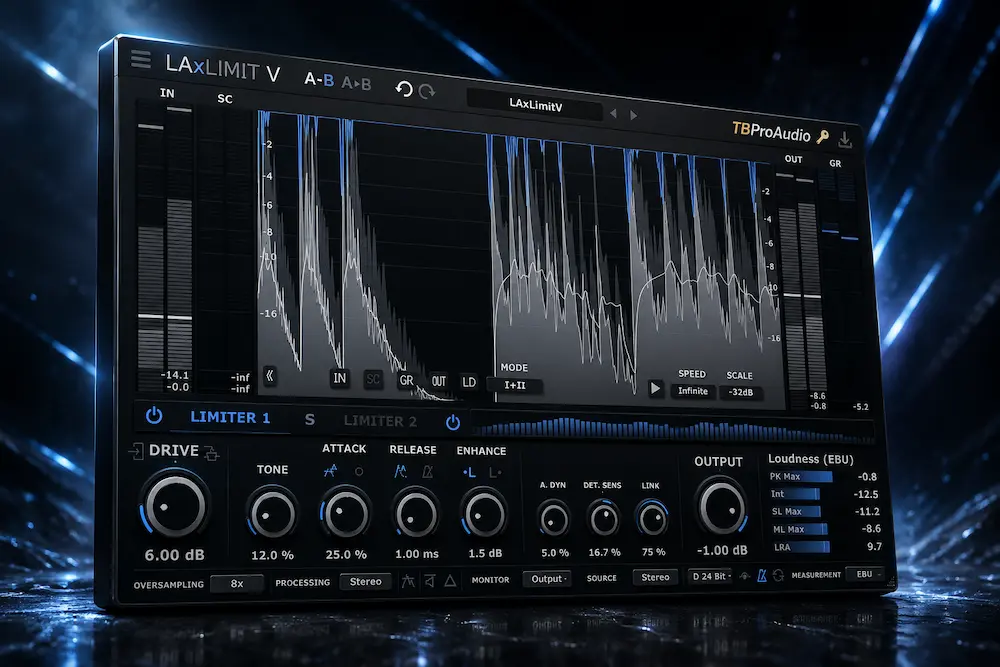
TBProAudio LAxLimit V (LAxLimit5) is a wideband look-ahead mastering limiter designed for peak control, loudness management, and final-stage dynamics processing. This review looks at its two independent limiter engines, serial and parallel operation, ISP/true-peak detection, oversampling, transient control, clipping, and monitoring tools to determine where LAxLimit V actually makes sense in a professional mastering workflow. The current release is version 5.0.4, following several V5 updates that expanded the dual-limiter workflow and added Adaptive Attack, dithering, revised processing, and lower latency.
The feature list is substantial, but that is not the useful way to judge a mastering limiter. The real question is whether LAxLimit5 gives an experienced mixing or mastering engineer better control over peak reduction, transient preservation, and final loudness than the limiter already in the chain.
That distinction matters because most of the underlying technologies are already established. True-peak limiting, oversampling, clipping, adaptive dynamics, and dithering are not new categories of DSP. LAxLimit V’s more interesting contribution is the way these functions are organized around its two-limiter architecture and the amount of control offered at a €99 price point.
Current version: LAxLimit5 v5.0.4 — updated August 8, 2026.
The current release includes serial/parallel operation of the second limiter, parameter undo/redo, Limiter 1 ↔ Limiter 2 setting copy, Adaptive Attack, dithering, revised oversampling, and lower-latency processing.
How We Evaluated LAxLimit V
This LAxLimit V review evaluates the plugin as a mastering limiter, with the analysis centered on peak reduction, transient preservation, loudness control, clipping, true-peak behavior, and workflow efficiency. The emphasis is on practical mastering decisions and level-matched evaluation rather than treating the specification sheet as proof of sonic superiority.
In This Review
TBProAudio LAxLimit V Dual-Limiter Architecture
 A modern mastering chain often asks the final dynamics processor to do more than simply stop peaks. The same stage may be expected to increase average level, control inter-sample peaks, preserve transient impact, and work alongside clipping or other nonlinear processing. Push one limiter hard enough and those jobs start competing with each other.
That is the problem LAxLimit V approaches differently. V5 makes its two-limiter architecture fully usable in serial and parallel configurations, allowing the engineer to distribute gain reduction across separate stages instead of relying on one limiter path to handle the entire loudness target.
In a practical mastering chain, the first stage can deal with occasional peaks while the second handles the remaining level increase. Neither stage has to work as hard as a single limiter doing the same amount of reduction. This does not automatically produce a better master—two stages can just as easily over-process a mix—but it gives the engineer more control over where and how gain reduction is applied.
That distinction is important. LAxLimit V is not valuable simply because it replaces two plugin instances with one. Its advantage is the ability to treat peak control and final loudness as separate processing decisions while keeping both stages inside the same limiter architecture.
Hear What Professional Mastering Can Change
A limiter can control peaks and raise level, but it cannot compensate for problems already present in the mix. If you want to hear how an experienced mastering engineer can improve balance, punch, clarity, and translation without simply making the track louder, upload up to 35 seconds of your mix and get a free mastering demo. You can compare the result directly before deciding whether the full master needs professional treatment.
Request your free mastering demo →
What the Dual-Limiter Architecture Changes in Practice
Separating Peak Control From Final Loudness
The second limiter becomes useful when a single stage starts doing too much work. A dense pop master is a good example: the kick may contain the highest short-term peaks while the vocal and instrumentation determine the average level. Driving one limiter hard enough to reach the final loudness can make those kick transients dictate the entire gain-reduction envelope.
With two stages, the engineer can take a smaller amount of peak energy out early and leave the second limiter to handle the remaining level increase. The result is not inherently more transparent—the added stage can introduce its own envelope changes—but it gives the engineer another way to distribute the reduction instead of forcing one detector and release behavior to handle everything.
This is already a familiar mastering approach: distribute peak reduction across separate nonlinear and dynamics stages rather than asking one processor to absorb the entire crest-factor reduction. The advantage is not automatically lower distortion; it is greater control over where the waveform is being reshaped and where gain reduction is being applied.
The important qualification is that two stages are not automatically better than one. If a master needs only 1–2 dB of transparent peak control, adding another limiter can make the processing less clean, not more. The dual architecture earns its place when it gives you a result that a single stage cannot reach as cleanly or predictably.
Serial vs Parallel Limiting: What Each Mode Is For
Serial limiting is the more obvious mastering application. The first limiter can remove a controlled amount of peak energy, leaving the second stage to handle the remaining level increase. This distributes gain reduction across two envelopes instead of asking one detector to perform the entire job.
Parallel operation serves a different purpose from serial limiting. In this configuration, the second limiter provides an additional processing path for stereo control rather than simply extending the first limiter’s gain-reduction stage. Serial operation is more directly suited to distributing gain reduction across successive stages, while parallel operation gives the engineer another way to combine the two limiter engines within the final dynamics workflow.
Neither mode is inherently better. Serial processing is mainly useful for distributing gain reduction; parallel operation is useful when the relationship between the original signal and the additional limiting path is itself part of the processing decision. The important V5 improvement is having both approaches available inside the same limiter rather than treating the second stage as a hidden technical function.
Adaptive Attack: Useful DSP or Just Another Automatic Mode?
Adaptive Attack is one of the more technically relevant V5 additions. It uses internal transient detection to automatically adjust the relationship between clipping and limiting levels, with the goal of reducing the distortion and crackling that can appear when aggressive peak shaping is applied to fast transient material.
That matters most when a master contains a mixture of very different peak shapes. A kick, snare, vocal consonant, and sustained synth can present the limiter with very different demands. A fixed strategy that works well on one may soften the attack or introduce distortion on another. Adaptive processing gives the limiter more freedom to change its response when those conditions change.
The important question is whether that extra decision-making produces a better result at the same loudness. “Adaptive” is not inherently more transparent. Automatic dynamics processing can preserve one transient while making another less convincing, particularly on dense or highly processed material.
For mastering, the most useful evaluation is level-matched A/B testing. Compare the same amount of gain reduction with Adaptive Attack on and off, then focus on kick and snare definition, vocal consonants, cymbal attacks, and low-frequency punch. If the adaptive mode lets you reach the same loudness with less audible flattening, it has a practical advantage. If it mainly changes the character of the limiter, the benefit is more subjective.
Adaptive Release: More Than a Fixed Recovery Time
Adaptive Release is one of LAxLimit V’s important dynamics features. Instead of applying one fixed release curve throughout the signal, the processor recalculates its release behavior for each sample. TBProAudio describes this approach as a way to reduce typical aliasing during the limiting process.
From a mastering perspective, the useful question is not whether adaptive release is automatically better than a fixed value. The release behavior still changes how the limiter interacts with kick drums, bass sustain, vocals, cymbal decay, and overall density. A recovery curve that works on one master can make another feel unstable or unnecessarily held down.
LAxLimit V also provides tempo-based release times, which serve a different purpose. Instead of adapting continuously to the signal, the release can relate to the DAW tempo when a rhythmic relationship is desirable. Compare both approaches at matched loudness and listen for pumping, modulation, low-frequency movement, and changes in groove before deciding which behavior belongs in the chain.
Detector Sensitivity Can Change Which Peaks Control the Limiter
Another control worth taking seriously is the detector’s frequency sensitivity. The limiter does not have to treat every part of the spectrum as equally important when deciding how much gain reduction to apply.
That can matter on bass-heavy masters where a kick or sub peak repeatedly determines the limiter envelope. Adjusting detector sensitivity can change which spectral regions have the strongest influence on gain reduction, potentially allowing the engineer to keep the low end from dominating the entire dynamics response without simply turning the limiter down.
This is not a substitute for fixing an unbalanced mix. If the bass is consistently consuming excessive headroom, the better solution may still be upstream. The value of detector sensitivity is that it gives the mastering engineer another way to control how the limiter reacts when the mix is already close to the intended balance.
DC Blocker: Small Feature, Relevant in Critical Dynamics Processing
LAxLimit V also includes a DC blocker that can remove sub-audible DC offset before the limiter circuit. This is not a loudness feature and it will not make a balanced mix sound better by itself, but it can prevent unwanted low-frequency offset from influencing a peak-sensitive dynamics processor.
For normal mastering material, the DC blocker may never become a decisive part of the workflow. Its value is mainly preventative: when the source contains measurable DC offset or unusual low-frequency asymmetry, removing it before limiting can keep the dynamics stage from reacting to information that has no useful musical contribution.
Sidechain Control Adds Another Layer of Peak Management
LAxLimit V also supports sidechain processing, giving the engineer another way to control what drives the limiting response. This can be useful when the signal being limited and the signal influencing the detector should not be treated as exactly the same source.
In mastering, that is a specialized rather than everyday application. The important point is that the sidechain option expands the processor beyond a simple final ceiling control and makes it more useful in complex dynamics workflows where detector behavior needs to be separated from the output signal itself.
The Enhancer Is a Nonlinear Peak-Shaping Stage
The Enhancer uses custom soft-clipping algorithms driven by adaptive compression and can be placed either before or after the limiter. Its purpose is not simply to raise peak level, but to increase perceived volume and density while controlling how much nonlinear processing reaches the final output.
That can be useful in a mastering chain where a few aggressive transients are consuming most of the limiter’s headroom. Controlled clipping can reduce those peaks and leave the limiter with a more manageable signal, potentially allowing higher average level with less continuous gain reduction.
The trade-off is the same as with any clipper. More peak reduction means more nonlinear distortion, and the artifacts become easier to hear as the processing gets heavier. High-frequency material, kick transients, and heavily encoded streaming files are particularly useful places to check for problems.
The advantage of having the Enhancer inside LAxLimit V is therefore workflow control rather than a new form of loudness processing. The same principle applies to dedicated distortion tools: our W.A. Production Make Me Scream 2 review looks at how an integrated nonlinear signal path can reduce the setup required to reach a usable result. In LAxLimit V, that convenience is more specific—it puts peak shaping directly inside the limiting workflow, where the engineer can judge clipping and gain reduction as one connected process.
Oversampling: Useful DSP, Not a Quality Score
 LAxLimit V supports up to 64x internal oversampling, which is an unusually high setting for a mastering limiter. The number is technically impressive, but it should not be confused with a direct measure of audio quality.
Fast limiting and clipping are nonlinear processes, so they can generate frequency components above the host sample rate’s Nyquist frequency. Oversampling moves that processing to a higher internal sample rate, giving the plugin more room to filter those components before the signal is returned to the project sample rate. The practical benefit is reduced aliasing, particularly when the limiter or Enhancer is working aggressively.
Higher oversampling also has costs. CPU usage rises, and processing latency can increase depending on the implementation and operating mode. At modest gain reduction, the audible difference between moderate and extreme oversampling may be negligible; with heavy clipping or limiting, the difference can become easier to hear.
That makes the 64x option best viewed as additional processing headroom for demanding material and offline rendering, rather than proof that LAxLimit V is inherently more transparent than a competing limiter running at 4x, 8x, or 16x.
In practice, the right question is not whether 64x sounds better on paper. It is whether the higher setting produces a measurable or audible improvement on the material you are mastering, and whether that improvement justifies the additional CPU and latency.
Monitoring and Level-Matched Evaluation
One of LAxLimit V’s more useful professional features is its monitoring section. The plugin provides input, side-chain, and output monitoring, along with left/right and mid/side views, unity-gain comparison, delta monitoring, gain-reduction metering, and true-peak metering.
For mastering, these controls matter because limiter decisions are easy to misjudge when the processed signal is simply louder. Unity-gain monitoring helps separate actual improvement from a level increase, while delta monitoring makes it easier to hear what the processor is removing or changing. Mid/side and channel monitoring are also useful when a limiter appears to react differently to the center and sides of a dense master.
This makes the monitoring section more than a convenience feature. It supports a more reliable A/B process: match the output level, isolate the processing when necessary, and judge transient definition, low-frequency stability, stereo behavior, and distortion rather than relying on loudness alone.
Loudness Metering: RMS, EBU R128, DIAL and True Peak
LAxLimit V is not limited to gain-reduction metering. Its monitoring section also provides RMS, EBU R128, and DIAL dialog-gated loudness measurements, alongside true-peak metering. That makes the plugin more useful when the limiter is being evaluated as part of a final delivery workflow rather than simply as a peak-control device.
For music mastering, EBU-style loudness measurement can provide useful context around the overall level of a finished master, while RMS remains useful for comparing density and average energy. DIAL is more specialized for dialogue-oriented material, so it is not a decisive feature for most music releases. The important distinction is that LAxLimit V combines loudness information with the actual limiting process instead of requiring a completely separate metering stage for every measurement task.
These meters should still be treated as measurement tools rather than targets. A numerical loudness value does not determine whether a master sounds balanced, dynamic, or competitive. The engineer still has to evaluate the result at matched level and in the context of the intended delivery format.
LAxLimit V Sound Examples: What the Processing Actually Reveals
TBProAudio provides level-matched sound examples for LAxLimit V, including Drum Mix1 and Master1. The published examples list a loudness difference of +5.7 LUFS for Drum Mix1 and +7.1 LUFS for Master1, while the original and processed files are matched for listening.
The examples are particularly relevant when evaluating the relationship between the Enhancer, clipping, and final limiting. Those stages are designed to increase perceived level and density without relying entirely on conventional gain reduction, so the useful question is not whether the processed file sounds louder. It is whether the added density comes with acceptable changes to transient definition, low-frequency stability, and high-frequency texture.
For an independent evaluation, level-matched listening should remain the standard. Drum-heavy material is useful for exposing changes in attack and crest factor, while a finished master reveals whether the limiter can increase density without making the entire mix feel smaller or more constrained. These examples therefore provide a useful reference for judging the processing approach, although they should not be treated as proof that the same settings will produce the same result on every master.
Where LAxLimit V Makes Sense in a Production Chain
Mastering: Its Strongest Use Case
Mastering is where LAxLimit V’s feature set makes the most sense. The plugin can handle final peak control on its own, but its deeper value appears when clipping and limiting need to work together as part of a deliberate mastering chain rather than a stack of loosely related processors.
A practical chain could use the Enhancer to trim selected peaks before the limiter, followed by one or both limiter stages for the remaining level control. The exact order is less important than assigning a specific job to each stage. If the first limiter is already removing several dB continuously, the chain is probably asking too much of the final dynamics section.
This approach is particularly useful on dense pop, hip-hop, and electronic masters where short transient peaks can consume significant headroom. The engineer can decide whether those peaks should be clipped, limited, or left intact rather than relying on one limiter envelope to make every decision.
Mix Bus: Useful When Limiting Is Part of the Sound
LAxLimit V is also capable of mix-bus work, but its complexity only pays off when the limiter is doing more than catching occasional peaks.
For light bus control—say, a small amount of gain reduction used to keep the mix contained—a simpler limiter may be faster and easier to manage. LAxLimit V becomes more interesting when the mix bus is deliberately being pushed toward a denser, more controlled presentation. In that situation, the Enhancer, Adaptive Attack, and multiple limiting stages give the engineer more ways to shape the envelope before the final master is printed.
The distinction is important: LAxLimit V is most useful when dynamics processing is an intentional part of the production, not when a limiter is simply being used as a safety net.
Individual Tracks and Buses: Capable, but Often Overkill
LAxLimit V can be useful on drum, bass, vocal, and synth buses when the job is specifically peak containment rather than conventional compression. A drum bus, for example, may benefit from controlled clipping followed by a small amount of limiting when individual hits are creating excessive headroom without contributing much to the perceived level.
For ordinary track compression, however, LAxLimit V is usually more processor than the job requires. A compressor gives more direct control over envelope, ratio, attack, and release, while a dedicated clipper may be the better choice when the goal is simply to reshape a few peaks before a downstream compressor or limiter.
The plugin earns its place on an individual bus when peak management is the problem you are actually trying to solve. If the task is envelope shaping, tone, or basic dynamics control, a simpler processor will usually get there faster.
What’s New in LAxLimit V (LAxLimit5) Compared With LAxLimit IV?
LAxLimit V is more than a GUI refresh, but the important changes are not evenly distributed. The current V5 generation adds full serial/parallel functionality around the second limiter, Adaptive Attack, revised oversampling, lower-latency processing, dithering, and a more flexible internal workflow. Version 5.0.4 then adds parameter undo/redo and direct copying between Limiter 1 and Limiter 2.
The distinction from LAxLimit IV is therefore architectural and workflow-oriented rather than a complete reinvention of the limiter algorithm. Engineers upgrading should pay most attention to the way the two limiter paths can now be configured, because that is the change most likely to alter an established mastering chain.
The distinction is straightforward: the second limiter with serial/parallel operation, Adaptive Attack, upgraded oversampling, and reduced latency are the reasons to investigate V5 as an upgrade.
LAxLimit V vs LAxLimit IV: The Practical Differences
| Area | LAxLimit IV | LAxLimit V | Practical Impact |
|---|---|---|---|
| Limiter architecture | Linked-stereo limiter architecture | Two independent brickwall/look-ahead limiters with serial/parallel operation | V5 expands the workflow from linked stereo limiting to a dedicated dual-limiter architecture with separate serial and parallel configurations. |
| Adaptive Attack | Not listed as a V4 feature | Yes | Allows clipper/limiter behavior to respond to detected transient activity. |
| Oversampling | Lower maximum oversampling than V5 | Up to 64x linear-phase oversampling | Provides more internal processing headroom for demanding nonlinear limiting, although the highest setting is not automatically the best-sounding one. |
| Latency | Adjustable latency modes | Reworked for significantly lower latency | Makes V5 more practical outside strictly offline mastering. |
| Dithering | Not listed as a V4 feature | Dither and noise shaping | Useful when the limiter is the final processing stage. |
| Limiter workflow | Previous parameter workflow | Undo/redo and Limiter 1 ↔ Limiter 2 copying | Reduces setup time when working with two limiter paths. |
| Interface | Previous GUI | Updated layouts, themes and scaling | Improves usability without changing the underlying mastering decisions. |
The upgrade is therefore easiest to justify for engineers who will actually use the new architecture. If LAxLimit IV is already being used for modest peak control and the workflow is working, the higher oversampling ceiling and refreshed interface alone are not strong reasons to upgrade.
Where LAxLimit V’s Feature List Needs Some Perspective
LAxLimit V has an unusually deep feature set for a €99 limiter, but feature count is a poor measure of mastering performance. True-peak limiting, oversampling, dithering, M/S processing, adaptive dynamics, and clipping are all established techniques. None of them, on its own, gives V5 a fundamental advantage over a mature competing limiter.
The more defensible advantage is the combination of those tools with two independently configurable limiter engines. That architecture can simplify a staged clipping-and-limiting workflow and gives the engineer more control over where gain reduction occurs. It is a practical distinction, not a new category of DSP. The same distinction matters across modern production software: our Mastering The Mix MIXVAULT review examines a different example of a processor whose main contribution is workflow design rather than a fundamentally new processing technology.
The other area that deserves restraint is performance. LAxLimit IV has accumulated independent testing, including detailed measurements of CPU usage and latency, but those results cannot simply be transferred to V5. The current V5 release is too new for a comparable body of third-party measurements covering CPU scaling, latency, aliasing, and distortion.
That matters when assessing claims around the revised oversampling engine and reduced latency. The underlying engineering approach is credible, but the strongest V5 performance claims still need independent measurement. Until those tests exist, the sensible approach is to treat the new processing as promising rather than proven superior to established mastering limiters.
LAxLimit V vs Pro-L 2, Limitless, Elevate and Oxford Limiter: Which Limiter Makes More Sense?
LAxLimit V enters a crowded mastering-limiter market, but the comparison is not really about which processor has the longest feature list. Pro-L 2 is the mature all-purpose reference, Limitless offers unusually deep dynamics control, Elevate takes a frequency-dependent approach to loudness, and Oxford Limiter remains a familiar professional option. LAxLimit V’s argument is different: it puts more emphasis on internal routing and staged peak control at a substantially lower price.
| Limiter | Best reason to use it | Where LAxLimit V is stronger | Why you might still choose it |
|---|---|---|---|
| TBProAudio LAxLimit V | Flexible two-stage limiting at a relatively low price | Two limiter engines, serial/parallel routing, integrated clipping, extensive peak-control options | V5 is newer and has less independent testing and long-term user history |
| FabFilter Pro-L 2 | Mature all-purpose mastering workflow | Flexible limiting styles, true-peak processing, metering and a highly refined interface | Established workflow, extensive metering, surround support, and widespread professional adoption |
| DMG Audio Limitless | Deep control over mastering dynamics | More integrated workflow for staged limiting and clipping | Existing users may already have a highly refined workflow and sound with Limitless |
| Newfangled Audio Elevate | Intelligent frequency-dependent loudness processing | More direct wideband peak-control architecture | Better choice when independent spectral dynamics are central to the mastering approach |
| Sonnox Oxford Limiter | Established mastering workflow and familiar sonic behavior | More flexible internal routing and modern peak-shaping options | Long professional track record and a workflow many engineers already know extremely well |
For an engineer already getting reliable results from Pro-L 2, Limitless, or Oxford Limiter, there is no strong reason to switch simply because LAxLimit V has a longer feature list. A controlled, level-matched comparison is the only useful way to establish a sonic advantage.
The stronger case for LAxLimit V is workflow rather than replacement. If you regularly build chains around clipping followed by two stages of limiting, V5 can consolidate that architecture and give you more direct control over how the gain reduction is distributed. That is a specific reason to add it to a mastering toolkit, even when an established limiter remains the primary choice.
True Peak, Streaming Codecs, and the Final Master
LAxLimit V is ultimately being judged on a file that may not remain in its original PCM form. A master can pass the DAW’s sample-peak meter and still produce higher reconstructed peaks during digital-to-analog conversion or additional overshoot after lossy encoding. That is why true-peak behavior matters at the final limiting stage, particularly in mastering for streaming platforms.
For mastering, ISP or true-peak detection is useful because it gives the limiter information that a conventional sample-peak ceiling does not. This becomes particularly relevant when the master is heavily limited or clipped, where small peak errors can become audible as distortion or codec-related harshness.
That does not justify treating a particular ceiling such as -1 dBTP as a universal rule. Delivery requirements, program material, loudness target, and the amount of nonlinear processing all affect the appropriate setting. The useful approach is to monitor reconstructed peak behavior and audition the actual master at its intended loudness and delivery format.
The same principle applies when comparing LAxLimit V with another limiter. Level-match the outputs before judging transient response, clarity, or distortion. A limiter that produces an extra fraction of a dB can sound more impressive simply because it is louder. Once level is matched, differences in envelope behavior and peak handling become much easier to identify.
CPU, Latency, and Real-Time Use
 LAxLimit V is primarily a mastering processor, so latency is rarely a problem during offline rendering. It becomes more important when the limiter is placed on a mix bus, used during live monitoring, or inserted into a workflow where the engineer needs to play through the session in real time.
V5’s revised processing is designed to reduce latency while retaining high oversampling options. The trade-off remains familiar: more intensive oversampling generally means more CPU work, and using two limiter engines simultaneously can increase the processing load further.
64x should therefore be treated as a specialist setting, not a default. For most real-time work, a moderate oversampling mode is likely to provide a better balance between processing quality, CPU load, and latency. Higher settings make more sense during critical evaluation or offline rendering when the additional processing time no longer affects the workflow.
The important point is that LAxLimit V’s processing depth should be used selectively. A mastering limiter does not sound better simply because the CPU meter is working harder; the setting is justified only when the additional processing produces a result you can actually hear or measure.
LAxLimit5 Settings for Mastering: A Practical Starting Point
There is no universal LAxLimit V setting that works across every master. A more reliable approach is to decide what each stage is supposed to accomplish before increasing the input drive. If the first limiter is already removing several decibels continuously, the second stage is unlikely to solve the underlying problem; it will simply add another layer of envelope modification.
For a relatively transparent master, start with conservative gain reduction and use the first stage primarily for peak containment. If more level is required, let the second limiter handle part of the remaining gain increase rather than forcing one stage to do all of the work. This makes the gain-reduction behavior easier to evaluate and can reduce the tendency of one transient to dominate the entire limiter envelope.
Oversampling should be treated as a quality control parameter rather than a badge of performance. Moderate settings are generally the sensible starting point for real-time work, while higher settings are better reserved for critical evaluation and offline rendering when the additional processing can be justified by what you actually hear or measure.
For final delivery, monitor true-peak behavior rather than relying only on sample peaks. If clipping or the Enhancer is part of the chain, check the result after encoding as well: the combination of nonlinear peak shaping and lossy conversion is often where an apparently clean master reveals its weaknesses.
LAxLimit V Formats and DAW Compatibility
LAxLimit V is available in the main plugin formats used by current DAWs. On Windows, TBProAudio lists VST, VST3, AAX, and CLAP; on macOS, the plugin is available in VST, VST3, AAX, AU, and CLAP. The current release supports both Intel and Apple Silicon on Mac.
This makes LAxLimit V suitable for modern mixing and mastering setups across major DAW environments. The choice of format does not change the limiting architecture itself, so the more important compatibility questions are whether the host supports the required plugin format and whether the chosen processing mode fits the session’s latency requirements.
Who Should Buy LAxLimit V—and Who Should Skip It?
Mastering engineers are the strongest fit. The dual-limiter architecture becomes useful when peak control, clipping, and final loudness need to be handled as separate decisions. Engineers who regularly build staged dynamics chains have the most to gain from V5.
Mixing engineers should consider it for mix-bus and stem work where limiting is part of the sound rather than simple peak protection. The ability to combine clipping and multiple stages of limiting can be useful when a mix needs more density without relying on a single limiter for the entire reduction.
Experienced home-studio producers are another strong audience. At €99, V5 offers enough control to cover serious production and mastering work without requiring a large collection of specialized processors. The trade-off is that it rewards users who already understand gain staging, transient behavior, and loudness management.
Beginners should probably start elsewhere. The plugin is capable of straightforward limiting, but its deeper architecture can encourage unnecessary processing before the fundamentals of dynamics control are understood. A simpler limiter makes it easier to hear what compression, clipping, and limiting are actually doing.
Engineers who already own Pro-L 2, Limitless, Elevate, or Oxford Limiter should demo V5 rather than buy it on specifications. There is no compelling reason to replace a familiar limiter simply because LAxLimit V offers more routing options. The upgrade makes sense when its two-stage architecture or integrated clipping workflow solves a problem the existing setup does not.
Is LAxLimit V Worth the €99 Price?
At €99, LAxLimit V is priced aggressively for a limiter with this level of internal routing and peak-control options. The real value, however, depends on whether you would otherwise build the same workflow from several separate processors.
If your mastering chain already relies on a clipper followed by one or two limiters, V5 can consolidate much of that setup without giving up control over the individual stages. That is a more meaningful cost advantage than simply counting features.
The calculation changes if you already own a mature limiter that handles the job cleanly. A Pro-L 2 user, for example, may gain little from switching unless the dual-engine architecture solves a specific problem. The same applies to Limitless, Elevate, Oxford Limiter, and other established processors: the €99 price makes V5 easy to audition, but it does not create a reason to replace a tool that already works.
For a new purchase, though, LAxLimit V offers unusually broad coverage at this price. It can handle clipping, staged limiting, true-peak control, and final loudness management within a single plugin, making it a practical option for engineers building a mastering toolkit from scratch.
Overall Rating
| Category | Rating |
|---|---|
| Sound Quality | 8.5/10 |
| Workflow | 9.5/10 |
| Transient Control | 9/10 |
| Peak & Loudness Control | 9.5/10 |
| CPU Efficiency | 8.5/10 |
| Professional Flexibility | 9.5/10 |
| Value for Money | 9.5/10 |
| Overall | 8.9/10 |
Sound Quality — 8.5/10: LAxLimit V is capable of clean, controlled limiting at serious mastering levels, with enough control over clipping, transient behavior, and true-peak management to work on demanding material. The score remains below the top tier because this review does not establish a universal sonic advantage over mature references such as Pro-L 2 or Limitless, and the current V5 generation still has a relatively limited body of independent measurements.
Workflow — 9.5/10: This is where V5 makes its strongest case. The two limiter engines, serial/parallel routing, integrated peak shaping, and detailed control let the engineer distribute gain reduction instead of forcing one limiter stage to do everything. The architecture is genuinely useful rather than simply feature-rich.
Transient Control — 9/10: LAxLimit V gives the engineer several ways to shape transient behavior, including Adaptive Attack, adaptive release curves, limiter character, and detector sensitivity. That makes it unusually flexible when kicks, snares, vocals, and dense instruments compete for the same headroom. The score remains below 10 because these controls increase decision-making flexibility rather than guaranteeing more transparent results on every master.
Peak & Loudness Control — 9.5/10: This is arguably the plugin’s strongest technical area. Two limiter stages, the Enhancer, true-peak/ISP detection, and high oversampling options give the engineer considerable control over the relationship between peak reduction and final level. The architecture is especially well suited to staged clipping and limiting.
CPU Efficiency — 8.5/10: TBProAudio describes LAxLimit V as a low-CPU limiter, and V5 also introduces significantly reduced latency. The practical workload still rises with heavier oversampling and more complex dual-limiter configurations, so the plugin should not be judged from the 64x setting alone. Because this review does not include controlled CPU benchmarking across DAWs and sample rates, the score reflects workflow efficiency rather than a laboratory performance measurement.
Professional Flexibility — 9.5/10: LAxLimit V covers a wide range of mastering situations without forcing the engineer into a single processing philosophy. Serial and parallel limiter configurations, dual-mono and M/S processing, detector sensitivity, adaptive attack and release, clipping, sidechain support, true-peak control, oversampling, dithering, and extensive monitoring make it adaptable to very different mastering chains.
Value for Money — 9.5/10: At €99, V5 offers an unusually deep mastering workflow for the price. Its value is strongest when it replaces part of a conventional clipper-plus-limiter setup or gives an engineer a second approach to staged dynamics processing. It is less compelling as a replacement for an established limiter that already delivers the required result.
Overall — 8.9/10: LAxLimit V earns a high score because its processing architecture gives the engineer unusually broad control for the price. The rating is deliberately below the top tier because V5 does not establish a universal sonic advantage over mature mastering limiters, and independent measurements of the current version remain limited. Its strongest case is therefore flexibility, not technological supremacy.
Final Verdict: Is LAxLimit V Worth Buying?
LAxLimit V is a serious mastering limiter, and its strongest advantage is not that it contains more features than the competition. The important change is the way V5 turns its second limiter into a practical serial/parallel processing tool, giving the engineer more control over how peak reduction and final loudness are distributed.
Adaptive Attack, the Enhancer, 64x oversampling, true-peak detection, dithering, and the revised low-latency processing make the processor unusually complete for its price. But none of those features guarantees a better-sounding master. A limiter still has to be judged by transient preservation, distortion, low-frequency stability, stereo behavior, and the amount of gain reduction required to reach the target.
For a new buyer, LAxLimit V is worth auditioning at €99. It offers enough control to serve as a serious primary mastering limiter rather than a budget placeholder, particularly for engineers who regularly use clipping and staged limiting.
For LAxLimit IV owners, the decision is more specific. The upgrade makes sense if the new serial/parallel architecture, Adaptive Attack, revised processing, or two-limiter workflow solves a problem in the existing chain. If the current limiter is mainly being used for modest peak control, the upgrade is much harder to justify.
For engineers already using Pro-L 2, Limitless, Elevate, or Oxford Limiter, LAxLimit V should be treated as an additional tool rather than an automatic replacement. Its strongest argument is workflow flexibility and price, not a demonstrated universal sonic advantage over established professional limiters.
That leaves TBProAudio LAxLimit V (LAxLimit5) in a useful position: it is a serious €99 mastering limiter for engineers who want flexible peak control, integrated clipping, true-peak limiting, and two-stage dynamics processing without assembling the same workflow from several separate plugins. Its strongest advantage is architectural flexibility rather than a proven universal sonic advantage over established mastering limiters.
The Final Limiter Can’t Fix a Mix That Isn’t Translating
Choosing the right limiter matters, but the final master is judged by much more than peak level. If the low end is masking the mix, transients are already compromised, or the stereo balance changes from system to system, another plugin setting will not solve the underlying problem. Professional mastering is about making those decisions in context and getting the finished track to translate reliably beyond the studio.
If you want to hear what that difference means on your own music, upload up to 35 seconds of your mix and receive a free mastering demo prepared by a real mastering engineer. Compare it with your original at matched level and judge the difference for yourself.
Get your free mastering demo →
FAQ: TBProAudio LAxLimit V
Does LAxLimit V support VST3, AU, AAX, and CLAP?
Yes. LAxLimit V is available on Windows in VST, VST3, AAX, and CLAP formats, and on macOS in VST, VST3, AAX, AU, and CLAP. TBProAudio also lists native support for both Intel and Apple Silicon Macs.
Is LAxLimit V the same as LAxLimit5?
Yes. TBProAudio currently identifies the product as LAxLimit5 while the product description refers to it as LAxLimit V. The current release is version 5.0.4.
What is new in LAxLimit V compared with LAxLimit IV?
The major workflow change is the full serial/parallel functionality around the second limiter. V5 also adds Adaptive Attack, revised oversampling, lower-latency processing, dithering and noise shaping. Version 5.0.4 adds parameter undo/redo and direct copying between Limiter 1 and Limiter 2.
Is LAxLimit V good for mastering?
Yes. Mastering is one of LAxLimit V’s strongest use cases because the plugin combines wideband peak limiting, true-peak detection, oversampling, clipping, adaptive dynamics, loudness metering, and two limiter engines in one processor. Its deeper advantage appears when the engineer needs to distribute peak reduction across more than one stage rather than relying on a single limiter for the entire loudness increase.
Is LAxLimit V good for loud mastering?
Yes, particularly when loudness is built through staged peak control rather than forcing one limiter to perform all of the gain reduction. The Enhancer and two-limiter architecture give the engineer additional ways to manage peak energy before the final level is reached.
Is LAxLimit V better than LAxLimit IV?
It is a more capable workflow for engineers who need serial/parallel limiting, Adaptive Attack, revised processing and the newer parameter controls. If LAxLimit IV already handles modest peak control cleanly, however, there is no reason to upgrade purely for the higher oversampling number or redesigned interface.
Is LAxLimit V suitable for final mastering delivery?
Yes. True-peak/ISP detection, dithering, noise shaping, oversampling, and loudness metering make it suitable for use at the end of a mastering chain. The appropriate settings still depend on the delivery specification and the amount of processing being applied.
Can LAxLimit V be used without oversampling?
Yes. Oversampling is a processing option rather than a requirement for basic operation. Lower settings can be preferable during mixing or real-time work when CPU load and latency matter, while higher settings are more appropriate when critical offline rendering justifies the additional processing.
Does LAxLimit V add significant latency?
Latency depends on the processing configuration and oversampling mode. V5 is designed with reduced latency compared with the previous generation, but the highest-quality processing modes can still introduce latency that is more noticeable on a mix bus or during real-time monitoring than in offline mastering.
Is LAxLimit V CPU intensive?
The current V5 specification is designed for low CPU usage, but the real load depends on oversampling, limiter configuration, and how much of the dual-limiter architecture is active. Running extreme oversampling with both limiter paths is a very different workload from using a moderate setting with a single stage. For mastering, the CPU cost is generally less important than the resulting gain-reduction behavior.
Can LAxLimit V replace a dedicated clipper?
It can replace a dedicated clipper in some workflows, particularly when moderate soft clipping is all that is required before or after limiting. A dedicated clipper may still be preferable when its specific clipping curve, tone, or transient behavior is central to the sound.
Is LAxLimit V useful at 96 kHz or higher sample rates?
Yes. Higher project sample rates can reduce the amount of internal oversampling required for some processing tasks, although the audible benefit depends on the limiter settings and source material. Oversampling should still be evaluated by result rather than by the highest available number.
Is LAxLimit V suitable for live or low-latency monitoring?
It can be, provided the processing configuration keeps latency within the requirements of the session. For live monitoring, tracking, or performance use, moderate oversampling and a simpler limiter setup are generally more practical than running both engines at extreme processing settings.
Does LAxLimit V include dithering for final export?
Yes. V5 includes dithering and noise-shaping options, which can be useful when the plugin is the final processing stage and the signal is being reduced to a lower delivery bit depth.
Is LAxLimit V a good choice for mastering engineers who already own a high-end limiter?
It is worth testing, but not necessarily replacing an established tool. The strongest reason to add V5 is its dual-limiter architecture and the ability to combine staged limiting with integrated peak shaping in one processor.
Is LAxLimit V worth buying at €99?
For a new limiter purchase, the price is compelling given the processing depth and routing flexibility. For engineers who already own Pro-L 2, Limitless, Elevate, or another mature limiter, the purchase makes sense only if V5 solves a specific workflow or processing problem that the existing setup does not.

Yurii Ariefiev evaluates mastering processors from the perspective of real production decisions: peak control, transient behavior, loudness, clipping, and translation beyond the studio.
This LAxLimit V review focuses on the practical consequences of its dual-limiter architecture, Adaptive Attack, integrated clipping, oversampling, and true-peak processing rather than treating a longer feature list as evidence of better mastering.
☕ Buy me a coffee