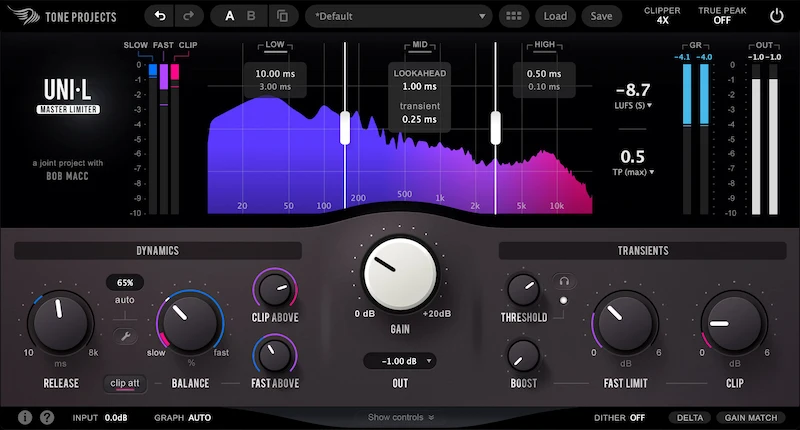
Tone Projects Uni-L Review: Loudness, Translation and Modern Mastering Workflow
Few categories in audio production are harder to disrupt than the mastering limiter plugin market. FabFilter Pro-L2 remains the reference point in many professional workflows, DMG Limitless continues to appeal to engineers who want extensive control over loudness behavior, and Weiss-based solutions still dominate discussions around transparency. Every year brings new contenders promising more level, fewer artifacts, and better transient preservation. Most disappear from serious mastering conversations within months.
Tone Projects Uni-L enters a market that is already crowded with technically capable options. What separates it from many recent releases is the reputation behind it. Tone Projects built its standing among mixing and mastering engineers through tools like Unisum and Michelangelo, processors known less for feature lists than for how they influence decision-making during a session. That context changes how Uni-L should be evaluated. The real question is not whether it can make a master louder. Nearly every modern limiter can achieve competitive loudness. The more relevant question is whether Uni-L improves the balance between level, punch, density, and translation without forcing engineers into increasingly complex workflows.
That question has become more important than loudness itself. Modern masters are expected to survive streaming normalization, lossy codec conversion, Bluetooth playback, earbuds, cars, and smart speakers while maintaining impact. In that environment, the most valuable limiter is rarely the one that produces the highest numbers. It is the one that preserves musical intent after the track leaves the studio.
Contents
Why the Mastering Limiter Market Matters More Than Ever
A decade ago, limiter discussions were largely centered around loudness. Engineers compared gain reduction figures, chased competitive levels, and evaluated processors by how far they could be pushed before obvious artifacts appeared.
That approach no longer reflects how modern records are made.
Many mixes now arrive at the mastering stage with clipped drum buses, multiple layers of saturation, transient enhancement, soft clipping, and various forms of peak management already baked into the production. By the time a limiter sees the signal, much of the available headroom has already been strategically consumed. The limiter is not shaping a raw mix. It is making final decisions on material that has been heavily optimized for density and impact.
As a result, the criteria for evaluating a mastering limiter have changed. Transparency remains important, but it is no longer enough. Engineers need to know how a limiter affects punch, low-end stability, stereo depth, vocal placement, and perceived energy as level increases. Small differences in limiter behavior can significantly alter how a master translates outside the studio.
Streaming platforms accelerated that shift. Loudness normalization reduced the value of chasing higher playback levels, while codec conversion introduced another layer of unpredictability. A master that sounds impressive during a short studio comparison can lose weight, transient definition, or spatial depth once it reaches real-world playback systems.
The strongest mastering limiters today are not necessarily the loudest. They are the ones that preserve impact after normalization, compression, encoding, and consumer playback have already taken their share of the signal. That is the context in which Uni-L enters the conversation.
Tone Projects Uni-L and the Shift Toward Perceptual Limiting
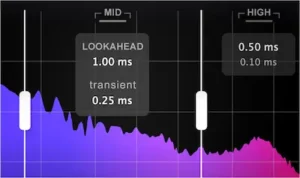 What separates Uni-L from many modern brickwall limiter releases is not the promise of more loudness. It is the way the plugin frames the limiting process itself.
Over the past decade, limiter design has moved toward greater sophistication. Engineers now have access to multistage processing, advanced oversampling, transient reconstruction, adaptive release behavior, spectral management, and increasingly detailed metering. Those tools can be powerful, but they also create a workflow where technical adjustments often outnumber meaningful listening decisions.
Uni-L takes a noticeably different direction. Instead of positioning limiting as a battle against distortion, it focuses on the relationship between loudness and perception. The emphasis shifts away from peak reduction metrics and toward questions that mastering engineers actually face during a session: Does the chorus still expand? Does the kick retain authority? Does the vocal stay anchored as level increases? Does the record feel more exciting or simply more compressed?
That distinction is more significant than it may initially appear. In professional mastering environments, successful limiting decisions are rarely driven by meters alone. Engineers evaluate how a record feels as loudness increases. A master can remain technically clean while losing depth, momentum, transient contrast, or emotional impact. Conversely, a small amount of measurable distortion may be entirely acceptable if it preserves energy and translates more effectively across playback systems.
Viewed through that lens, Uni-L is less about maximizing output and more about controlling the side effects that emerge when pushing a mix toward commercial levels. The plugin’s design appears aligned with a broader industry shift away from loudness as a target and toward translation as the primary objective.
Whether that approach ultimately delivers better results than established competitors will depend on the source material and the engineer behind it. What makes Uni-L interesting is that it prioritizes the same questions experienced mastering engineers ask when evaluating a limiter: not how loud a track becomes, but what remains intact once it gets there.
What Actually Makes Uni-L Different?
Most limiter releases promise better loudness, cleaner transients, or lower distortion. Uni-L’s differentiation appears less focused on absolute output and more focused on how limiting decisions are presented to the engineer.
Instead of exposing users to increasingly complex technical workflows, Uni-L emphasizes the relationship between level, punch, density, and perceived impact. This may sound subtle, but it represents a meaningful departure from the parameter-heavy philosophy found in many mastering limiters.
That distinction becomes easier to understand when comparing real-world mastering decisions. Engineers rarely ask whether a limiter achieved another decibel of loudness. More often they ask whether the vocal remained stable, whether the kick retained authority, whether the chorus still expanded, and whether the track continued to translate after codec conversion.
Whether that ultimately proves superior will depend on individual workflows, but it creates a noticeably different user experience from many established alternatives.
How Uni-L Approaches Limiting Decisions
One of the more notable aspects of Uni-L is that it appears designed to reduce the gap between technical processing and audible outcomes. Rather than encouraging engineers to evaluate limiting primarily through gain reduction values or numerical targets, the workflow emphasizes listening decisions.
That may sound like a subtle distinction, but it affects how a limiter is used in practice. Many mastering sessions involve repeated comparisons between density, punch, vocal stability, low-end control, and perceived depth. A limiter that keeps those priorities visible throughout the process can influence decision quality just as much as the underlying algorithm.
This places Uni-L closer to a mastering-oriented decision tool than a traditional loudness maximizer. The focus is not simply on achieving level. The focus is on understanding what changes as level increases.
A Different Approach to User Interaction
Many modern mastering limiters offer increasingly detailed control over detection, release behavior, transient handling, oversampling, and spectral management. While that flexibility can be valuable, it also shifts attention toward parameter management.
Uni-L appears to take a different path. Rather than expanding the number of decisions an engineer must make, it attempts to reduce the distance between what is heard and what is adjusted. The interface encourages evaluation through listening rather than through constant reference to numerical feedback.
For mastering engineers working under deadlines, decision speed often matters as much as technical flexibility. Uni-L appears designed to favor that balance. In professional mastering environments, decision speed and decision confidence often matter more than feature count.
Workflow Implications for Mixing and Mastering Engineers
The best mastering limiters do more than control peaks. They shorten the path between hearing a problem and making a decision.
That matters because modern mastering sessions are rarely limited to a single deliverable. Engineers may move between album sequences, streaming masters, instrumentals, clean versions, alternate mixes, and client revisions within the same project. In that environment, a limiter that requires constant parameter management can become a bottleneck, regardless of its technical capabilities.
Uni-L is built around a different priority: reducing the amount of time spent managing the limiter itself. Rather than encouraging engineers to chase settings, it attempts to keep attention on the musical consequences of level adjustment. The workflow is less about optimizing individual parameters and more about evaluating whether the record becomes stronger or weaker as loudness increases.
That approach may be especially relevant for mixing engineers handling their own mastering. One of the most common mistakes in self-mastered releases is using a limiter to compensate for unresolved mix decisions. A kick that lacks definition, a vocal that struggles to stay forward, excessive upper-mid buildup, or unstable low-end interaction often becomes more obvious once the limiter starts working. The processor gets blamed for problems that were already present in the mix.
No limiter can fix those issues. In many cases, pushing harder simply exposes them faster. Many of the problems engineers attribute to a limiter are actually rooted elsewhere in the production chain, a topic explored in our mastering problems guide.
This is where workflow design becomes important. A limiter that clearly reveals the difference between loudness-related artifacts and underlying mix problems can save significant time during production. Instead of endlessly adjusting threshold, release behavior, or transient controls, engineers can identify whether they are facing a mastering decision or a mixing decision. Similar workflow considerations have emerged in dynamics processing more broadly, including the recent PSP auralComp Atmos compression update.
As the line between mixing and mastering continues to blur—particularly among independent producers and small studios—that distinction becomes increasingly valuable. The most useful limiter is often not the one that reaches the highest loudness, but the one that makes the next decision obvious.
Where Uni-L Fits Within Contemporary Mastering Chains
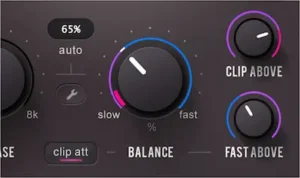 Evaluating a mastering limiter in isolation rarely reflects how it will be used in practice. Most professional mastering chains already contain multiple stages influencing dynamics, tone, and peak behavior before the limiter ever sees the signal.
A modern master may pass through broadband compression, dynamic EQ, saturation, clipping, stereo enhancement, or dedicated low-frequency control before reaching its final loudness stage. Engineers interested in how these stages interact can explore our detailed mastering chain explained breakdown. By that point, many of the most important tonal and dynamic decisions have already been made.
That context is important when assessing Uni-L. The plugin does not appear to be designed as a rescue processor for problematic mixes. Its role is closer to final optimization—managing the last few decibels of loudness while preserving the qualities established earlier in the chain.
This is often where mastering succeeds or fails. A mix can survive compression, EQ, and saturation only to lose depth, punch, or movement during the final stage of peak control. Conversely, a well-designed limiter can help maintain the balance between loudness and musical impact without drawing attention to itself.
Engineers expecting dramatic transformations may be disappointed. Uni-L is unlikely to turn a weak mix into a competitive release, just as a premium mastering converter will not compensate for poor monitoring decisions. The plugin’s value lies elsewhere. It operates at the stage where small changes become highly audible and where the difference between a loud master and a convincing master is often determined.
Viewed from that perspective, Uni-L belongs alongside other high-end mastering limiters that focus on refinement rather than correction. Its success will depend less on how aggressively it can control peaks and more on how effectively it preserves punch, depth, and listener engagement as loudness increases.
The Reality of Loudness in 2026
Many discussions about mastering limiters still revolve around loudness numbers. Much of that conversation centers on LUFS targets, despite the fact that loudness alone rarely predicts how a master will translate in the real world. For a deeper examination of loudness measurement, see our LUFS mastering guide. In practice, loudness stopped being the primary challenge years ago.
Most modern tools can push a mix to commercially competitive levels. The harder problem is preserving the qualities that made the record engaging before loudness processing was applied. A master that measures well but loses punch, depth, or low-frequency movement rarely survives repeated listening, regardless of its LUFS value.
This shift has changed how experienced engineers evaluate limiting. The question is no longer how much gain reduction a processor can achieve before audible distortion appears. The more relevant question is what happens to the musical relationships inside the mix as level increases.
Every additional decibel comes with a cost. Transients become less distinct. Low-end motion can flatten into a static mass. Vocal placement may shift forward or backward. Stereo depth often narrows as density increases. None of these changes are necessarily dramatic in isolation, but together they determine whether a master feels powerful or simply louder.
Streaming platforms reinforced this reality. Normalization has reduced the competitive advantage of extreme loudness, while codec conversion continues to expose weaknesses in aggressively limited material. A master that sounds impressive during a short A/B comparison may lose clarity, punch, or spatial definition after distribution processing. The tracks that consistently translate well are usually not the loudest. They are the ones that retain their internal balance under less-than-ideal playback conditions.
That is where Uni-L faces its most important test. Conventional peak control, true peak protection, and loudness generation are no longer differentiators. Every serious mastering limiter can control peaks. What separates the strongest designs is how they manage the compromises that accompany loudness. If Uni-L can preserve impact, depth, and movement more effectively than established alternatives, it has a legitimate place in professional mastering workflows. If it reaches similar loudness levels while making similar sacrifices, the innovation becomes far less significant.
Critical Evaluation: Where the Marketing Meets Reality
Limiter marketing tends to follow a familiar pattern. Every new release promises greater transparency, higher loudness, cleaner transients, and fewer compromises. The implication is often that previous technical limitations have somehow been solved.
In practice, limiting remains an exercise in managing tradeoffs.
No algorithm can completely eliminate the tension between loudness and dynamics. No limiter can increase density without influencing transient relationships. No processor can push level indefinitely while preserving every aspect of a mix. The variables may change from one design to another, but the compromises never disappear.
This is particularly important when evaluating Uni-L. Much of the discussion surrounding modern mastering limiters focuses on what the processor can do. A more useful question is what it cannot do.
Uni-L will not compensate for poor gain staging earlier in the production chain. It will not resolve low-end masking between a kick and bass. It will not correct unstable vocal balance, excessive brightness, or arrangement decisions that create density problems before mastering even begins. If those issues become more obvious as the limiter works harder, the limiter is exposing the problem rather than creating it.
There is also the issue of context. A limiter that performs exceptionally well on dense electronic productions may produce different results on acoustic recordings, jazz ensembles, orchestral material, or dynamic singer-songwriter projects. Short-term A/B comparisons often exaggerate the appeal of louder playback, while long listening sessions reveal subtler factors such as fatigue, depth, and spatial realism.
Transparency itself is frequently misunderstood. What one engineer describes as transparent may sound restrained to another. Some listeners prefer a limiter that leaves transient structure largely untouched. Others accept a degree of saturation or density if the result feels more energetic. There is no universal definition, only preferences shaped by genre, monitoring environment, and production goals.
For that reason, Uni-L should be viewed less as a technological breakthrough and more as a refinement of limiter workflow and decision-making. That may sound less dramatic than typical marketing language, but it is also how many meaningful advances in mastering actually occur. The most valuable tools rarely remove the compromises. They help engineers navigate them more effectively.
Tone Projects Uni-L vs Popular Limiter Alternatives
Comparing mastering limiters by feature count rarely tells the full story. Most flagship processors can achieve competitive loudness, transparent peak control, and professional results when used correctly. The more meaningful differences appear in workflow, decision-making speed, and how each limiter responds when pushed toward the edge of what the material will tolerate.
| Plugin | Position in the Market | Where It Excels | Potential Limitation |
|---|---|---|---|
| Tone Projects Uni-L | Modern mastering-focused limiter | Prioritizes listening decisions over parameter management | Still building a long-term track record against established leaders |
| FabFilter Pro-L2 | Industry-standard all-purpose limiter | Extremely versatile across genres and workflows | Its flexibility can encourage endless tweaking rather than decisive listening |
| DMG Limitless | Advanced mastering platform | Exceptional control over complex loudness requirements | Requires more technical engagement than many engineers need |
| Weiss MM-1 | Simplified premium mastering solution | Fast path to polished results with minimal adjustment | Less adaptable when a project demands detailed intervention |
| Ozone Maximizer | Integrated production ecosystem limiter | Fits naturally into self-mastering and all-in-one workflows | Often used as part of a broader suite rather than a dedicated mastering strategy |
FabFilter Pro-L2 remains the benchmark most engineers will compare Uni-L against. Years of adoption have made it a default choice in commercial studios, educational content, and independent production environments. Its greatest strength is versatility. Whether mastering rock, EDM, pop, hip-hop, podcasts, or broadcast material, Pro-L2 rarely feels out of place.
DMG Limitless occupies a different category. It appeals to engineers who want precise control over how loudness is achieved rather than simply achieving it. In demanding mastering situations, particularly where aggressive level targets must coexist with transient preservation, Limitless remains one of the most sophisticated options available.
Weiss MM-1 approaches the problem from the opposite direction. Instead of maximizing control, it prioritizes speed and predictability. For engineers who value rapid results and minimal parameter management, that simplicity remains a major advantage.
Ozone Maximizer continues to dominate among producers who prefer integrated workflows. Its strength comes from being part of a larger mastering ecosystem rather than operating as a standalone destination for limiter specialists.
Uni-L enters this field with a different proposition. It does not appear to compete on complexity, feature density, or technical experimentation. Its position is closer to workflow optimization—helping engineers reach reliable loudness decisions without becoming distracted by the mechanics of limiting itself.
Whether that approach proves compelling will depend on the individual engineer. Users who enjoy deep technical control may continue gravitating toward platforms like Limitless. Engineers looking for maximum versatility may remain loyal to Pro-L2. Uni-L’s strongest appeal is likely to come from professionals who value efficient decision-making and judge a limiter primarily by how confidently it reaches a finished master.
Who Should Consider Uni-L?
 Uni-L is unlikely to be most valuable to users searching for their first mastering limiter. Its strengths become more apparent once an engineer already understands the compromises involved in loudness processing.
For mastering engineers, the appeal is relatively straightforward. The plugin is positioned around workflow efficiency and listening-based decision making rather than exhaustive parameter control. Professionals who spend their days evaluating small differences in punch, density, depth, and translation are the audience most likely to appreciate that approach.
Mixing engineers may find a different kind of value. As more mixers are expected to deliver release-ready masters, the ability to evaluate loudness without becoming distracted by technical complexity becomes increasingly relevant. In that context, Uni-L can function as a practical bridge between mixing and mastering, helping engineers focus on how level changes affect the musical balance of a record.
That does not mean the plugin is limited to advanced users. It means its advantages are easier to recognize when there is already a frame of reference. An engineer who has spent time with Pro-L2, Limitless, Ozone Maximizer, or other high-end limiters will immediately notice whether Uni-L improves decision-making speed, translation confidence, or overall workflow.
Beginners should approach it with realistic expectations. No limiter, regardless of price or reputation, can compensate for weak monitoring, unresolved mix issues, poor arrangement choices, or an incomplete understanding of mastering fundamentals. Those limitations exist upstream from the limiter and remain there regardless of the algorithm being used.
Ultimately, Uni-L is most relevant for engineers who already know what they are listening for and want a limiter that supports that process rather than dominating it. Its value is unlikely to come from making mastering easier. It comes from making experienced decisions easier to reach.
Real-World Production Perspective: Translation Matters More Than Loudness
The final verdict on any mastering limiter is delivered outside the studio.
A processor can sound impressive on full-range monitors in an acoustically treated room and still produce disappointing results once the record reaches everyday playback systems. This has always been true, but the challenge has become more complex as music consumption continues to fragment across platforms, devices, and listening environments.
Today’s masters are expected to survive streaming normalization, lossy encoding, Bluetooth transmission, smart speakers, phones, cars, earbuds, laptops, and countless combinations of playback hardware that engineers will never hear firsthand. Every stage introduces another opportunity for subtle mastering decisions to become more audible than intended.
Limiting is particularly vulnerable to this problem because many of its side effects emerge gradually. A master may retain its apparent loudness while losing transient contrast, low-end articulation, depth, or vocal focus during distribution processing. These changes are often small enough to escape attention in a controlled studio comparison yet large enough to affect how listeners perceive the record over time.
This is one reason why short loudness comparisons can be misleading. A limiter that initially sounds bigger or more aggressive is not necessarily producing a master that translates better. In many cases, the most successful releases are not the loudest examples in a genre. They are the records that preserve clarity, energy, and musical balance across the widest range of playback conditions. Similar translation challenges also appear in low-frequency design, as discussed in our UVI Rumble review and bass translation analysis.
For Uni-L, this may ultimately be the most important measure of success. Peak control, loudness generation, and distortion management are no longer rare capabilities. The professional question is whether a master processed through Uni-L remains convincing after normalization, encoding, and consumer playback have already altered the signal.
If the answer is yes, the plugin earns relevance beyond feature lists and marketing claims. If not, its technical achievements become far less important than they appear inside the studio.
Where Uni-L May Not Be the Best Choice
Not every mastering engineer is looking for the same thing from a limiter. Users who prefer extensive technical control, multiband loudness management, or highly customizable limiting architectures may still gravitate toward platforms such as DMG Limitless.
Similarly, engineers already deeply invested in established workflows may find fewer reasons to switch. Limiter adoption tends to be conservative because consistency often matters more than novelty in professional mastering environments.
For those users, Uni-L may function as an alternative perspective rather than a replacement. Its value appears strongest when workflow simplicity and listening-focused decision making are prioritized over maximum configurability.
Verdict
Uni-L enters one of the most mature categories in audio production. That alone makes differentiation difficult. Professional engineers already have access to excellent limiting options, and few are actively searching for a replacement unless a new tool offers a meaningful advantage in either results or workflow.
What makes Uni-L noteworthy is that it does not appear focused on winning the loudness race. Most flagship limiters can already deliver competitive levels. The more difficult challenge is preserving punch, depth, transient integrity, and musical balance while approaching those levels. That is the problem modern mastering engineers spend their time solving, and it is the area where Uni-L appears most focused.
The plugin is unlikely to replace Pro-L2, Limitless, or Weiss-based workflows overnight. Those processors earned their positions through years of proven performance across thousands of projects. Uni-L still has to establish that same track record. Long-term adoption will depend less on marketing claims and more on how consistently it performs across different genres, production styles, and mastering scenarios.
The more relevant question is whether Uni-L continues to deliver consistent results across different genres, monitoring environments, and loudness targets. That long-term reliability—not headline specifications—will determine whether it earns a permanent place in professional mastering workflows. That is a more difficult problem to solve, but also a more relevant one for modern mastering.
Engineers looking for deeper technical complexity may continue to prefer alternatives such as Limitless. Engineers who value established workflows may remain with Pro-L2. Uni-L’s strongest appeal is likely to come from users who evaluate a limiter by the quality of decisions it encourages rather than the number of controls it provides.
In a market crowded with technically competent limiters, that may ultimately be its most meaningful distinction.

Yurii Ariefiev is a mastering engineer specializing in loudness optimization, playback translation, and release-ready audio delivery. His editorial work focuses on the practical realities of mastering decisions, including limiting behavior, codec translation, streaming platform playback, and the factors that influence how records perform outside the studio.
This analysis examines Tone Projects Uni-L from the perspective of modern mastering workflows, focusing on limiter behavior, loudness tradeoffs, translation reliability, and real-world production use rather than feature lists or marketing claims.
FAQ
How does Tone Projects Uni-L differ from traditional brickwall limiters?
Most brickwall limiters focus primarily on peak control and loudness generation. Uni-L places greater emphasis on how loudness affects the perceived balance of a mix, encouraging engineers to evaluate punch, depth, and musical impact rather than loudness alone.
Can Uni-L compete with FabFilter Pro-L2 for professional mastering?
It can compete for the same users, but the two plugins approach limiting differently. Pro-L2 is known for flexibility and extensive control, while Uni-L appears more focused on streamlining critical mastering decisions without overwhelming the user with options.
Should Uni-L be used with clipping before the limiter?
In many modern mastering chains, yes. Clipping and limiting often serve different purposes, and combining them can distribute peak management more effectively than relying on a limiter alone. Engineers evaluating that relationship in more detail may find our guide to loudness and clipping in mastering useful.
What types of music are most likely to benefit from Uni-L?
Genres that depend on competitive loudness while retaining punch and low-end definition—such as EDM, pop, hip-hop, rock, and modern metal—are likely to reveal its strengths most clearly.
Is Uni-L suitable for transparent mastering?
That depends on how transparency is defined. Some engineers associate transparency with minimal audible processing, while others prioritize maintaining energy and impact. Uni-L appears designed to balance both objectives rather than maximize one at the expense of the other.
Does Uni-L help with streaming platform optimization?
Not directly. Streaming performance depends on the entire production chain. A limiter can influence how a master survives normalization and codec conversion, but it cannot guarantee consistent results across every platform and playback environment.
Can Uni-L fix problems in a mix?
No. It can expose mix issues more clearly as loudness increases, but problems such as masking, tonal imbalance, excessive harshness, or weak low-end relationships must be addressed earlier in the production process.
How does Uni-L compare to Ozone Maximizer?
Ozone Maximizer is part of a larger mastering ecosystem designed for broad production workflows. Uni-L takes a more specialized approach, concentrating specifically on final-stage loudness and limiting decisions.
Is Uni-L a good choice for stem mastering?
Engineers working with stems often need to evaluate density, impact, and loudness across multiple sources simultaneously. Uni-L’s workflow may fit well within those environments, particularly when preserving balance is more important than maximizing level.
Who is the ideal user for Tone Projects Uni-L?
The plugin is likely to appeal most to mastering engineers, professional mixers, and experienced self-mastering producers who already understand limiting fundamentals and are looking for a workflow-oriented alternative to more technical limiter designs.
Can Uni-L achieve competitive streaming loudness levels?
Yes. The more relevant question is how much punch, depth, and transient integrity remain once those loudness levels are reached.
Is Tone Projects Uni-L suitable for mastering engineers or producers?
Mastering engineers are likely to benefit most from its workflow philosophy, but experienced producers who regularly master their own releases may also find it useful.
Does Tone Projects Uni-L support true peak limiting?
True peak protection remains an important consideration for streaming distribution and codec conversion. Engineers should evaluate Uni-L’s true peak behavior using their own delivery requirements and monitoring workflow.
Is Tone Projects Uni-L CPU intensive?
CPU consumption depends largely on oversampling settings and session configuration. In most mastering sessions, a single limiter instance is unlikely to become a significant performance bottleneck.