UVI Rumble Review: A Different Approach to Modern Bass Design for Mixing and Production
Modern bass production is no longer limited by synthesis technology. Most producers already have access to powerful instruments capable of generating virtually any low-end sound imaginable. The bottleneck appears later, when those sounds enter a mix.
A bass patch that feels massive in solo can quickly become a liability. The kick loses definition. Low-mid congestion builds up. Limiters react harder than expected. What sounded impressive during production starts creating problems during mixing, mastering, and playback on consumer systems.
Those issues have become increasingly common across electronic music, hip-hop, trap, pop, and cinematic production. As arrangements grow denser and loudness expectations remain high, low-frequency content carries more responsibility than ever. Bass is expected to provide weight, energy, translation, and competitive impact without overwhelming the rest of the record.
UVI Rumble approaches that challenge differently from most bass-focused instruments. Rather than treating the low end as a single synthesis task, the plugin divides bass construction into separate functional layers that can be shaped independently. The goal is not simply to create larger bass sounds, but to create bass sounds that remain manageable throughout the rest of the production process.
That workflow-oriented approach makes Rumble more interesting than another synth release competing on oscillator count, modulation depth, or preset volume. The real question is whether its architecture solves practical production problems—or simply repackages techniques experienced producers already use.
Jump to:
- Why Bass Design Has Become a Workflow Problem
- The Core Design Philosophy Behind UVI Rumble
- How UVI Rumble Fits Into Modern Mixing Workflows
- What UVI Rumble Actually Feels Like to Use
- Where UVI Rumble May Have Genuine Advantages
- The Marketing Narrative Versus Production Reality
- Critical Evaluation: Where UVI Rumble Falls Short
- Competitive Positioning
- Should You Choose UVI Rumble Over Other Bass Tools?
- Who Should Consider UVI Rumble?
- Who May Not Need UVI Rumble?
- Real-World Production Perspective
- Mastering Perspective
- Streaming Platforms and Codec Reality
- Verdict
- FAQ
Why Bass Design Has Become a Workflow Problem
Low-end production has become significantly more complicated over the past decade. Not because synthesizers are lacking, but because modern bass sounds are expected to solve multiple problems simultaneously.
A contemporary bass part is rarely judged on sub-frequency weight alone. It must remain audible on phone speakers, survive streaming codecs, support competitive loudness targets, coexist with aggressive drum programming, and maintain clarity across a wide range of playback systems. The same sound is often expected to deliver physical impact on a club system while retaining enough harmonic information to remain recognizable on small consumer devices.
This creates conflicting design priorities from the start. Additional distortion can improve audibility but increase midrange congestion. More sub energy can add perceived power while reducing available headroom. Harmonic layering may improve translation yet create masking issues around vocals, synth leads, guitars, or transient-heavy percussion.
Many low-end problems discovered during mixing and mastering are not caused by poor processing decisions. They originate much earlier, during sound design. This is one reason why engineers frequently discover that bass-related issues are difficult to solve once a track reaches the final stage of release preparation, even when attempting to fix bass problems during mastering. Producers build bass patches that sound impressive in isolation but become increasingly difficult to integrate as arrangements grow denser.
Monitoring conditions often make the situation worse. Headphones, compact nearfields, untreated rooms, and mobile production setups can hide problems that only become obvious once a project reaches professional evaluation or release preparation.
The typical solution involves a growing chain of corrective tools: saturation, multiband processing, dynamic equalization, parallel distortion, transient control, and various routing workarounds. While effective, these workflows often address symptoms rather than the underlying structure of the sound itself.
That production reality helps explain the thinking behind UVI Rumble. Instead of asking producers to solve low-end translation problems after a bass sound has been created, the plugin attempts to make those considerations part of the design process from the beginning.
The Core Design Philosophy Behind UVI Rumble
 Looking at UVI Rumble through the lens of traditional synthesizers can lead to the wrong conclusion. This is not a direct competitor to Serum, Phase Plant, Pigments, or Massive X. Those instruments are designed as broad synthesis environments capable of handling everything from bass design to complex sound creation.
Rumble is built around a narrower objective: controlling how bass functions inside a production.
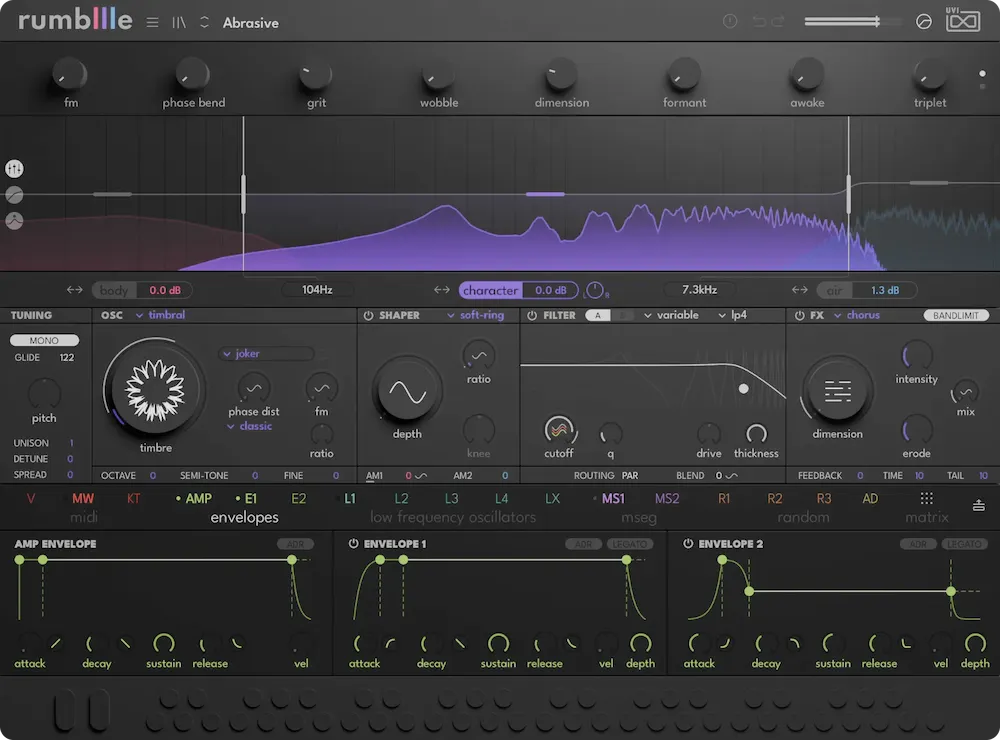
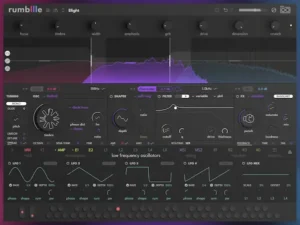
Its architecture separates sound generation into three independent layers—Body, Character, and Air. While the terminology may initially sound marketing-driven, the underlying concept mirrors a workflow many experienced engineers already use when evaluating low-end translation.
- Body focuses on fundamental energy and perceived weight.
- Character generates the harmonic information that allows bass to remain audible beyond large monitoring systems.
- Air introduces upper-frequency content that can improve definition and perceived presence without relying on additional sub-frequency energy.
In conventional workflows, these responsibilities are often handled across multiple stages of production. A bass sound is created first, then modified through saturation, layering, parallel processing, dynamic equalization, or distortion to improve translation. Rumble effectively moves part of that decision-making process upstream into the instrument itself.
The significance of this approach becomes clearer during mixing. Engineers rarely struggle because a bass sound lacks low-frequency energy. More often, the problem is that the sound contains plenty of energy but lacks the harmonic structure needed to remain intelligible across different playback environments.
By separating weight, audibility, and definition into distinct elements, Rumble encourages producers to think about bass as a translation system rather than a single sound source. That shift may not change the final sonic result in every project, but it changes where critical production decisions are made—and often reduces the amount of corrective work required later in the process.
How UVI Rumble Fits Into Modern Mixing Workflows
Rumble’s most compelling feature is not its synthesis engine. It is the way the instrument influences decision-making before a mix ever begins.
Many low-end problems encountered during mixing originate during sound design. By the time a project reaches the mix stage, engineers are often dealing with bass sounds that contain excessive sub energy, inconsistent harmonic content, unstable low-mid balance, or frequency masking that was built into the patch from the start.
Correcting those issues is possible, but it usually requires additional processing, more automation, and a growing number of compromises elsewhere in the arrangement.
This pattern appears frequently in modern productions. A bass sound that feels impressive on its own begins competing with kick drums, vocals, synth layers, guitars, or percussion once the arrangement reaches full density. The result is often a series of corrective decisions aimed at preserving clarity without sacrificing impact.
Traditional synthesizers prioritize flexibility above all else. That freedom is valuable, but it also allows producers to create sounds that become increasingly difficult to manage as a project develops. Rumble approaches the problem from a more production-oriented perspective. Its architecture encourages users to consider the functional role of different frequency components while the sound is being built rather than after the fact.
That distinction will not automatically produce better mixes, nor does it eliminate the need for proper arrangement, monitoring, or engineering judgment. What it can do is reduce the amount of corrective work required later in the workflow.
For mix engineers, particularly those working with client material, this is where the concept becomes relevant. Bass sounds that arrive with a clearer separation between weight, harmonic presence, and definition tend to integrate more predictably into dense productions than heavily layered patches assembled through multiple processing chains and routing workarounds.
Viewed through that lens, Rumble functions less like a traditional synthesizer and more like a workflow tool designed to improve the quality of low-end decisions before they become mixing problems.
What UVI Rumble Actually Feels Like to Use
The most noticeable aspect of Rumble is how quickly it reveals whether a bass patch will survive mixing, mastering, and real-world playback, not just how it sounds in isolation. Instead of building a patch first and solving translation problems later, producers are encouraged to make decisions about weight, audibility, and definition during sound creation.
Many synthesizers encourage exploration. Rumble encourages decisions. Producers spend less time building complex routing structures and more time evaluating how a bass sound functions inside a track.
That workflow will feel restrictive to some users and efficient to others. Producers who enjoy deep synthesis may find the structure limiting. Producers who regularly fight translation, headroom, and low-end balance issues may appreciate how quickly the plugin reaches practical results.
In daily production work, that difference is often more important than another oscillator, modulation source, or synthesis mode.
Where UVI Rumble May Have Genuine Advantages
Rumble becomes most relevant in productions where bass is expected to perform multiple jobs at once. The plugin’s layered architecture is less valuable when creating simple supporting bass parts and more valuable when low-end content is carrying a significant portion of the record’s energy, impact, and perceived size.
Trap and modern hip-hop are obvious examples. Many 808-based productions rely on a delicate balance between sub-frequency power and harmonic information. Too much emphasis on the fundamental can make the bass disappear on smaller playback systems. Too much harmonic enhancement can reduce weight and create midrange congestion. Producers often address this balance through additional saturation, layering, and parallel processing after the sound has already been created. Rumble moves part of that workflow directly into the instrument.
The same logic applies to EDM, bass music, and other loudness-driven genres where low-end content must remain aggressive without overwhelming the rest of the arrangement. As productions become denser, maintaining separation between kick drums, bass elements, synth layers, and transient-heavy material becomes increasingly difficult. Bass sounds that are built with translation in mind tend to require fewer corrective decisions later in the mix.
Cinematic and trailer-oriented production presents a different challenge. Here, low frequencies often need to create scale and physical impact while leaving room for dialogue, orchestral information, sound effects, and dynamic transitions. Excessive low-mid buildup can quickly make large arrangements feel smaller rather than bigger. A workflow that allows different bass functions to be managed independently can streamline that balancing process.
Similarly, layering and harmonic control are critical when designing cinematic vocal elements, as discussed in our Wavelet Audio Louisa Arc Review: Cinematic Vocals for Film, Trailer & Hybrid Scoring review.
Rumble may also appeal to producers who rely heavily on templates and repeatable workflows. In professional environments, small efficiencies compound over time. Reducing the need for additional routing, parallel chains, or corrective processing may not transform a single project, but across dozens of productions it can significantly simplify session management and low-end decision-making.
The common thread across all of these scenarios is not genre. It is the importance of bass translation. The more critical low-end consistency becomes to the final release, the more relevant Rumble’s design philosophy starts to look.
The Marketing Narrative Versus Production Reality
 One of the recurring themes in modern audio production is the belief that better tools will solve structural problems. Bass instruments are particularly vulnerable to this expectation because low-end issues often reveal themselves late in the workflow, long after the original sound design decisions have been made.
Rumble’s architecture addresses some legitimate production challenges, but its effectiveness depends heavily on the decisions surrounding it. A well-organized bass patch can still struggle inside a poorly balanced arrangement. A carefully designed low end can still create problems if the kick occupies the same space, if monitoring conditions are misleading, or if loudness targets push the mix beyond its available headroom.
This distinction becomes increasingly important as projects move toward release. Many low-frequency problems that appear to be synthesis issues are actually arrangement, monitoring, or gain-structure issues. Engineers routinely encounter sessions where the bass itself is not the problem; the problem is how that bass interacts with everything around it.
Rumble does not remove those variables. Separating fundamental energy from harmonic content can improve control, but it does not eliminate the need to evaluate phase relationships, mono compatibility, transient interaction, or low-frequency masking. Nor does it guarantee that a bass sound will survive aggressive limiting, streaming normalization, or real-world playback environments.
This is where some of the marketing surrounding low-end tools can become misleading. Bass translation is not the result of a single plugin or processing technique. It emerges from a chain of decisions that begins with sound design and continues through arrangement, mixing, mastering, and playback.
Viewed from that perspective, Rumble is best understood as a workflow tool rather than a solution. Its value lies in helping producers make better low-end decisions earlier in the process. The final result still depends on engineering judgment, monitoring accuracy, and the quality of the production itself.
Critical Evaluation: Where UVI Rumble Falls Short
The biggest limitation of UVI Rumble is also the reason many producers will be interested in it: specialization.
Rumble is designed around a specific low-end workflow. That focus makes it efficient, but it also narrows its usefulness compared to broader synthesis platforms.
Producers approaching the plugin as an alternative to Serum, Phase Plant, Pigments, Falcon, or other flagship synthesizers may quickly encounter its boundaries. Those instruments are designed to function as complete sound design environments. They support deep modulation systems, complex routing structures, unconventional synthesis methods, and experimental workflows that extend far beyond bass production.
Rumble is not attempting to compete in that space. Its value proposition is built around faster low-end decision-making rather than unlimited sound design flexibility.
The distinction becomes more apparent in projects that rely on evolving textures, advanced modulation, unconventional timbral movement, or highly customized synthesis architectures. Producers working in experimental electronic music, modern sound design, game audio, or modular-inspired workflows will likely reach those limits sooner than users focused primarily on bass-centric production.
As with many newly released instruments, early user feedback has been mixed. Some producers praise the workflow-oriented design, while others question whether the architecture provides enough advantages over established bass-production techniques. The discussion highlights an important point: Rumble’s value depends more on workflow preference than on raw synthesis capability.
There is also a broader creative consideration. Workflow-oriented tools often produce better results faster because they impose useful constraints. The tradeoff is that constraints can influence creative outcomes. When a plugin encourages users to organize bass sounds around predefined functional categories, production decisions may become more predictable across projects.
That is not necessarily a flaw. Many professional workflows depend on repeatability and consistency. However, producers who view sound design as an exploratory process may find the structure less inspiring than the open-ended environments offered by larger synthesizers.
Rumble also enters a market that has become increasingly crowded. Dedicated low-end tools are no longer unusual. Producers already have access to specialized instruments such as SubLab XL, Bass-Mint, and a growing number of bass-focused workflow products. As a result, the plugin is not competing solely on sound quality. It is competing on efficiency.
The practical question is whether its architecture genuinely reduces the amount of time spent building, processing, and correcting bass sounds inside real projects. For users already working with established low-end templates and mature synthesis workflows, that advantage may be smaller than the marketing suggests.
Viewed critically, Rumble’s success is likely to depend less on what sounds it can create and more on how much friction it removes from the production process. Producers seeking maximum flexibility will find stronger options elsewhere. Producers looking for a faster route to controlled, mix-ready low end may reach a different conclusion.
Competitive Positioning
Comparing bass instruments purely by features often leads to misleading conclusions because most of them are designed to solve different production problems.
Some prioritize synthesis depth. Others focus on speed. Some are built around 808 creation, while others function as full-scale sound design environments. Rumble belongs to a smaller category of tools that focus on managing low-end structure rather than maximizing synthesis flexibility.
The comparison below reflects real-world production priorities rather than marketing specifications.
| Plugin | Primary Focus | Best Suited For | Workflow Efficiency | Synthesis Flexibility |
|---|---|---|---|---|
| UVI Rumble | Low-end architecture and translation | Producers focused on bass control | High | Medium |
| Serum | Advanced wavetable synthesis | Sound designers and EDM producers | Medium | Very High |
| SubLab XL | 808 creation and layering | Trap and hip-hop producers | Very High | Medium |
| Phase Plant | Modular sound design | Experimental and advanced users | Medium | Extremely High |
| Pigments | Hybrid synthesis workflows | Electronic music producers | Medium | Very High |
| Massive X | Complex digital synthesis | EDM and bass music producers | Medium | High |
The most accurate comparison may not be between Rumble and traditional synthesizers at all. A producer choosing between Serum and Phase Plant is usually deciding how much sound design flexibility they need. A producer considering Rumble is often trying to reduce the amount of time spent building processing chains, layering harmonics, and correcting low-end translation issues later in the project.
That difference places the plugin in a somewhat unusual position. It is not the most flexible instrument in its category, and it is unlikely to become the centerpiece of an advanced sound design workflow. At the same time, it is more ambitious than dedicated 808 generators that focus primarily on speed and preset-driven production.
Its closest competitors are not necessarily the products with similar synthesis engines. They are the workflows producers have already built around existing tools. Anyone comfortable creating bass sounds in Serum, adding harmonic layers through saturation, controlling dynamics with multiband processing, and managing translation manually may see only incremental benefits. Producers looking to consolidate those stages into a more streamlined workflow may view the value proposition differently.
Ultimately, Rumble’s competitive position depends less on sonic quality than on workflow preference. The plugin is strongest when evaluated as a low-end production system rather than as another synthesizer competing for the largest feature set.
Should You Choose UVI Rumble Over Other Bass Tools?
Producers often ask whether Rumble should replace tools they already use. The straightforward answer depends on workflow priorities.
If your priority is deep synthesis flexibility, instruments like Serum, Pigments, or Phase Plant offer broader modulation and sound design capability. However, those tools require more routing and post‑processing to manage translation, headroom, and mix stability.
Rumble’s niche is workflow efficiency: it structures bass design around practical production concerns rather than open‑ended sound design. When low‑end stability and translation speed matter more than creating unusual timbres, Rumble becomes a compelling choice.
A clear way to understand this is: Rumble does not replace synthesis platforms — it complements them in projects where predictable bass behavior matters more than synthesis complexity.
Who Should Consider UVI Rumble?
 Rumble is most likely to appeal to producers who regularly encounter low-end translation issues rather than those searching for a new sound design playground.
The plugin makes the strongest case in workflows where bass is responsible for a significant portion of a track’s perceived energy. That includes modern hip-hop, trap, bass music, EDM, cinematic production, and other styles where low-frequency content must remain impactful across a wide range of playback systems.
What connects these workflows is not genre but responsibility. In many contemporary productions, the bass is expected to carry weight, maintain definition, survive loudness processing, and remain audible on everything from studio monitors to smartphones. Achieving all of those objectives simultaneously often requires extensive layering, saturation, routing, and corrective processing.
Producers who already spend a considerable amount of time balancing sub energy against harmonic content are the users most likely to appreciate Rumble’s design philosophy. The plugin is built around organizing those decisions earlier in the production process rather than solving them later through additional processing.
It may also appeal to engineers who build repeatable production templates and prioritize consistency across projects. In those environments, workflow efficiency can be just as valuable as access to additional synthesis features.
The less time a producer spends experimenting with unconventional synthesis techniques and the more time they spend managing bass behavior inside finished arrangements, the stronger Rumble’s value proposition becomes.
Who May Not Need UVI Rumble?
Rumble offers limited benefit in workflows where bass translation is not a primary concern. Producers focused on experimental synthesis, advanced wavetable manipulation, or modular environments already rely on tools designed for maximum flexibility and unconventional sound creation. In these cases, the plugin’s structured low-end architecture may feel restrictive rather than helpful.
Similarly, composers or producers whose projects rarely depend on heavy low-frequency content—ambient textures, certain acoustic-based productions, or minimalist arrangements—may find the tool adds unnecessary constraints without speeding up workflow.
In essence, the value of Rumble scales with the proportion of a project dedicated to controlled, translation-sensitive bass. The more a production depends on predictable low-end behavior, the more its design philosophy becomes relevant.
Real-World Production Perspective
In professional projects, the listener never hears the raw session—they hear a translated version processed through monitoring systems, streaming codecs, and playback devices. This reality is especially critical for bass sounds. A patch that feels massive inside a DAW can lose definition or disappear entirely on smartphones, Bluetooth speakers, car systems, or consumer headphones. Loudness processing and lossy compression often amplify these issues.
Many producers judge bass based on perceived impact in the studio. Experienced engineers evaluate it based on how well it survives outside the production environment. Rumble’s layered architecture—separating fundamental energy from harmonic content—directly supports this translation-focused approach. While it does not guarantee perfect results, it encourages decisions that reduce corrective work later in mixing and mastering.
For those interested in broader translation workflows, we also analyzed phase alignment for drums in a separate session review: Forward Audio faSmartAlign Review: Automatic Phase Alignment for Modern Drum Mixing.
Mastering Perspective: What Happens to Rumble Bass at Competitive Loudness?
Most bass synth reviews evaluate a sound in isolation. Mastering exposes how that sound behaves under pressure.
Low-frequency content has a disproportionate impact on headroom. This relationship becomes increasingly important when pursuing competitive loudness targets, since low-end energy often determines how far a mix can be pushed before the tradeoff between loudness and distortion becomes apparent. The topic is explored in greater detail in our guide to loudness vs clipping in mastering. A bass patch that feels powerful during production can become a liability once a mix is pushed toward commercial loudness levels. Excessive sub energy often forces limiters to react to information that contributes little to perceived loudness while consuming a significant portion of the available dynamic range.
These symptoms rarely appear in isolation. They are often part of a larger chain of translation issues that become obvious only during mastering. Many of the most common examples are covered in this guide to mastering problems and their underlying causes. In many cases, the problem is not a lack of bass. The problem is that too much of the bass energy exists in frequency regions that listeners perceive poorly compared to the amount of headroom they consume.
This is where harmonic structure becomes important. Bass sounds that derive some of their perceived weight from upper harmonics often translate more effectively than sounds relying almost entirely on sub-frequency dominance. They remain audible at lower playback levels, survive smaller speakers more successfully, and generally require less corrective intervention during mastering.
Rumble’s architecture aligns with that philosophy by treating harmonic content as a core component of bass design rather than a processing stage added later. The underlying principle is not new. Engineers have used saturation, layering, and harmonic enhancement to improve bass translation for decades. What Rumble does differently is encourage those decisions during sound creation rather than during damage control later in the production chain.
From a mastering perspective, that approach is often easier to work with. Bass sounds built around a balance of weight and audibility tend to remain more stable as loudness increases, making the final stages of release preparation more predictable.
Streaming Platforms and Codec Reality
While producers often focus on normalization numbers, perceived loudness and low-frequency behavior are closely connected. Understanding how streaming platforms evaluate playback level helps explain why bass-heavy mixes sometimes behave differently after release. For a deeper explanation, see our LUFS mastering guide. By the time a track reaches the listener, it has passed through encoding algorithms, normalization systems, consumer playback hardware, and listening environments that rarely resemble a studio.
Low-frequency content is particularly vulnerable in that process. Deep sub energy that feels impressive on full-range monitors may contribute far less to listener perception once a track is reproduced through earbuds, portable speakers, laptops, car systems, or other bandwidth-limited devices. In practical terms, the bass that dominates a studio session is not always the bass that dominates the listening experience.
This is one reason why experienced engineers place significant emphasis on harmonic structure. Audibility often depends less on how much sub-frequency energy exists in a sound and more on whether listeners can identify that sound once playback conditions become less than ideal.
The tracks that translate most consistently across streaming platforms are rarely the ones with the largest low end. More often, they are the ones where bass remains recognizable, balanced, and intelligible regardless of playback system.
Rumble’s design philosophy aligns closely with that reality. By separating fundamental energy from the harmonic information responsible for audibility, the instrument encourages bass construction that remains effective beyond the controlled conditions of a production environment. For modern releases competing primarily on streaming platforms, that perspective is arguably more valuable than simply generating additional low-frequency energy.
Verdict: Is UVI Rumble Worth Adding to a Professional Production Workflow?
UVI Rumble is best understood as a workflow-focused bass instrument rather than a general-purpose synthesizer. Evaluating it against platforms such as Serum, Phase Plant, Pigments, or Falcon misses the point because those products are designed around synthesis flexibility first and production efficiency second.
Rumble reverses that priority. Its architecture is built around a practical problem that many modern producers encounter every day: creating bass sounds that remain manageable throughout mixing, mastering, and real-world playback.
That approach inevitably comes with compromises. Producers who value deep sound design, extensive modulation systems, and unrestricted experimentation will find more capable options elsewhere. Rumble is not trying to replace those environments.
Its strongest appeal lies with producers who spend less time exploring synthesis and more time solving low-end problems inside finished arrangements. For those users, the plugin’s structured approach may reduce the amount of layering, saturation, routing, and corrective processing required to achieve reliable bass translation.
The most compelling aspect of Rumble is not any individual feature. It is the underlying assumption that modern bass production is no longer just a synthesis challenge. In many genres, it is a translation challenge. The ability to create low-end content that survives mixing decisions, mastering processes, streaming delivery, and consumer playback systems often matters more than access to another modulation source or oscillator type.
For producers evaluating whether UVI Rumble deserves a place in an existing toolkit, the answer depends less on sound quality and more on workflow. Users already comfortable building complex bass chains may gain only incremental benefits. Producers looking for a faster route to controlled, mix-ready low end are likely to see the strongest value.

Yurii Ariefiev is a mastering engineer and audio production editor whose work focuses on translation reliability, low-frequency behavior, and release-ready audio. His evaluations are based on how sounds perform after mixing and mastering—not how they appear in isolated plugin demonstrations.
This review examines UVI Rumble from the perspective of bass translation, loudness efficiency, streaming playback, and real-world production workflow. The goal is not to catalog features, but to assess whether the instrument helps create low-end content that remains controllable throughout mixing, mastering, and final release preparation.
FAQ
Is UVI Rumble worth it for professional producers?
That depends on how much time is spent managing low-end translation. Producers who regularly build bass-heavy tracks may benefit from its workflow-focused design, while users primarily interested in unrestricted sound design may find more value in broader synthesis platforms.
Can UVI Rumble replace a dedicated 808 plugin?
That depends on the workflow. Producers focused exclusively on modern 808 creation may still prefer specialized tools such as SubLab XL. Rumble offers a broader approach to bass construction and is not limited to hip-hop-oriented workflows.
Is UVI Rumble better suited for mixing or sound design?
It remains a sound-design instrument, but its architecture is heavily influenced by production and mixing considerations. Much of its value comes from helping users make low-end decisions that require less correction later.
Does UVI Rumble work well for bass-heavy genres outside of hip-hop?
Yes. Electronic music, cinematic production, trailer music, bass music, and modern pop can all benefit from the plugin’s focus on low-frequency structure and translation.
Can UVI Rumble help reduce low-end masking?
Not directly. Masking is primarily an arrangement and mixing issue. However, separating fundamental energy from harmonic content can make bass elements easier to position within a dense production.
Is UVI Rumble worth buying if you already own Serum?
For pure synthesis flexibility, Serum remains the stronger platform. Rumble becomes interesting when workflow efficiency and low-end management are higher priorities than unlimited sound-design options.
How does UVI Rumble perform on small speakers?
The plugin encourages the creation of bass sounds that rely on both sub-frequency energy and audible harmonics. This generally improves playback consistency on bandwidth-limited systems compared to heavily sub-focused bass patches.
Does UVI Rumble eliminate the need for bass saturation plugins?
No. Many professional productions will still use saturation, clipping, dynamic processing, and equalization. The difference is that some of those decisions can be addressed earlier during sound creation.
Can UVI Rumble improve mastering results?
Indirectly. Bass sounds with stronger harmonic structure often translate more predictably through limiting and loudness optimization. The plugin can support that outcome, but mastering results still depend on the entire mix.
Who is most likely to benefit from UVI Rumble?
Producers who regularly spend time solving bass translation, loudness, and playback-consistency issues are likely to gain more value than users primarily interested in experimental synthesis.
What separates UVI Rumble from other bass synthesizers?
Most bass instruments are evaluated by the sounds they can create. Rumble is unusual because much of its design is focused on how those sounds behave later in mixing, mastering, loudness processing, and real-world playback environments. That workflow emphasis is what separates it from many competing bass tools.
Can UVI Rumble replace multiple bass-processing plugins?
Not entirely. Most professional productions still rely on saturation, equalization, dynamics control, and mastering processing. However, Rumble can reduce the amount of corrective work required by encouraging better bass architecture during sound creation.