Forward Audio faSmartAlign Review: Automatic Phase Alignment for Modern Drum Mixing
Forward Audio faSmartAlign is designed to address one of the most persistent challenges in multi-microphone recording: managing phase relationships without spending hours on manual correction. Multi-microphone drum recordings, live ensembles, orchestral setups, and broadcast productions all face the same challenge: small timing and phase discrepancies between microphones can alter transient definition, low-frequency coherence, stereo imaging, and overall mix clarity.
Managing those relationships manually is rarely difficult on a four-track recording. Managing them across a modern drum session with close microphones, overheads, rooms, and spot mics is another matter. The more sources involved, the harder it becomes to identify which phase interactions are helping the sound and which are quietly reducing impact.
Most phase-alignment plugins approach the problem from a single angle. Some focus on sample-level timing correction. Others concentrate on polarity or phase rotation. Forward Audio faSmartAlign takes a broader approach by combining alignment, gating, and frequency-dependent correction within the same plugin.
The underlying technology is not the story. Automatic phase alignment is already well established. The more relevant question is whether consolidating several corrective processes into one environment produces faster, more reliable results in real mixing sessions. For engineers working with drum-heavy productions and multi-microphone recordings, that question has far greater practical value than any claim about intelligent processing.
Why Phase Alignment Has Become a Bigger Production Issue
Phase alignment has always been part of professional recording. What has changed is the scale of modern productions. A contemporary drum session may include multiple kick microphones, top and bottom snare microphones, stereo overheads, room microphones, close tom mics, ambience channels, and sample layers before mix processing even begins.
Every additional microphone introduces another relationship that can either reinforce or undermine the source. A few samples of timing difference between close mics and overheads may seem insignificant during tracking, yet those same interactions often become obvious once compression, saturation, clipping, or parallel processing are applied.
The issue extends beyond drums. Multi-microphone guitar cabinets, orchestral recordings, live sessions, podcasts, and broadcast productions all depend on coherent phase relationships to maintain clarity and localization. As track counts increase, identifying problematic interactions manually becomes increasingly time-consuming.
The rise of streaming has added another layer of scrutiny. Modern mixes are routinely pushed through multiple stages of dynamic processing before release. Unstable low-frequency content and inconsistent transient behavior can trigger compressors and limiters in unpredictable ways, making phase issues more noticeable than they were in less aggressive production environments.
For many engineers, phase alignment is no longer a cleanup task reserved for editing. It has become part of mix preparation. A drum bus built on coherent source relationships typically responds more predictably to processing than one affected by phase cancellation, uneven low-end buildup, or shifting transient energy.
That shift helps explain the growing demand for dedicated alignment tools. Engineers are not looking for perfect waveform synchronization. They are looking for faster ways to establish a stable foundation before making creative mixing decisions.
What Makes Forward Audio faSmartAlign Different?
 Most phase-alignment plugins focus on a single task: analyzing microphone relationships and adjusting timing offsets to improve coherence. faSmartAlign targets a broader set of problems that commonly appear in the same recording session.
In practice, phase issues rarely exist in isolation. A drum recording affected by timing discrepancies often contains microphone bleed, inconsistent transient capture, overlapping frequency content, and varying arrival times between close microphones, overheads, and room channels. Addressing only one of those variables does not necessarily resolve the larger workflow problem.
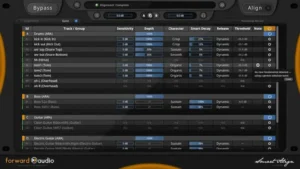
Forward Audio positions faSmartAlign as a combined correction environment rather than a dedicated alignment utility. The plugin integrates automatic alignment, phase optimization, gating, and frequency-dependent processing into a single workflow.
- Automatic microphone alignment
- Phase optimization
- Integrated gating
- Frequency-dependent corrective processing
- Multi-channel session management
Instead of treating alignment, bleed control, and corrective preparation as separate tasks, faSmartAlign attempts to bring those decisions into a single working environment. The practical advantage is reduced routing complexity during large multi-microphone sessions.
This approach addresses a practical reality of modern mixing. Large drum productions often require dozens of corrective decisions before any creative processing begins. Phase alignment, bleed management, transient cleanup, and source balancing frequently occur during the same stage of session preparation.
Whether combining those processes produces better sonic results depends on implementation and the source material. The more immediate advantage is reduced setup time during complex recording sessions. Fewer plugins, fewer routing decisions, and fewer opportunities for inconsistencies can make complex sessions easier to manage, particularly when working under tight production deadlines.
The Real Technical Challenge Behind Automated Alignment
One of the biggest misconceptions surrounding phase alignment is that better waveform alignment automatically produces a better recording. In reality, microphones do not capture identical versions of the same source. Each microphone introduces its own frequency response, off-axis coloration, transient behavior, room contribution, and timing perspective.
Because of this, phase correction is rarely a simple exercise in moving waveforms until they visually align. A correction that improves low-frequency summation may also alter depth, width, or the perceived relationship between close microphones and ambient sources.
Drum recordings provide some of the clearest examples. Aligning a kick microphone more closely with the overheads can increase low-end focus and transient definition. The same adjustment may also reduce some of the natural distance cues that help a kit feel large and three-dimensional. Room microphones present a similar challenge. What appears to be a timing error may actually be contributing to the sense of space that makes the recording feel realistic.
This is where automated alignment becomes more complicated than many product demonstrations suggest. The software can identify correlations between microphones, but it cannot determine which relationships serve the musical goal of the production. A modern metal mix, a jazz recording, and a live orchestral session may require very different alignment decisions despite sharing similar technical measurements.
The most effective alignment tools are not necessarily the ones that produce the highest correlation values. They are the ones that help engineers reach a useful balance between coherence and depth without forcing every microphone toward the same timing reference.
That distinction is particularly relevant to faSmartAlign. The plugin is positioned around broader source optimization rather than waveform alignment alone, reflecting a reality many experienced engineers encounter regularly: technical accuracy and musical effectiveness are not always the same thing.
A Typical Drum Phase Alignment Workflow with faSmartAlign
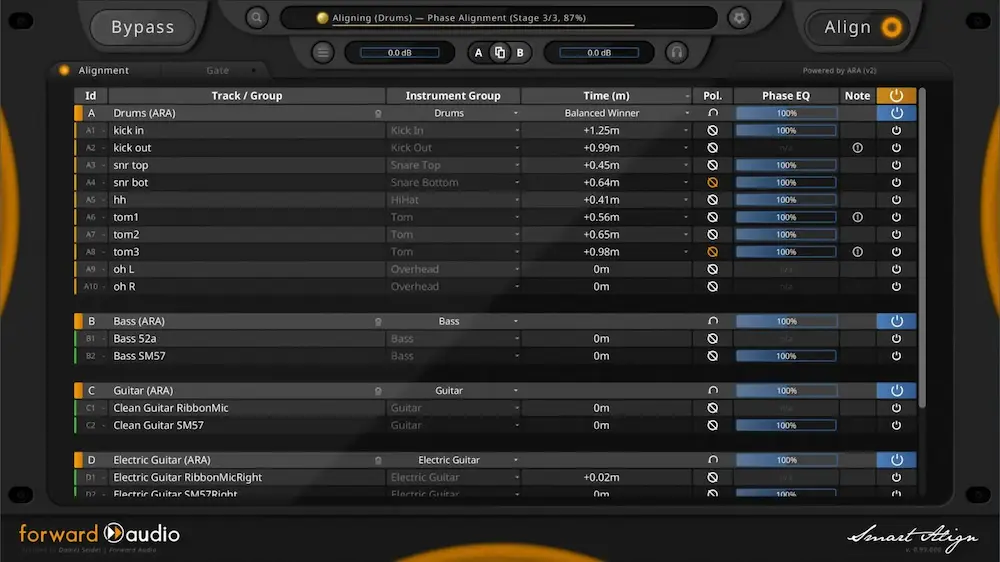
A typical drum recording may contain kick in, kick out, snare top, snare bottom, stereo overheads, stereo rooms, and close tom microphones.
Without dedicated alignment software, engineers typically spend time checking polarity relationships, manually adjusting timing offsets, evaluating low-frequency summation, and comparing multiple microphone combinations before processing begins.
faSmartAlign attempts to shorten that process by identifying timing discrepancies and phase interactions across the recording simultaneously. Rather than evaluating every microphone pair individually, engineers can establish a starting point for further listening and refinement.
The important distinction is that the software does not eliminate decision-making. It reduces the amount of manual analysis required before those decisions can be made.
In large drum productions, the reduction in manual analysis can become more significant than the alignment process itself.
Where Automated Systems Still Fall Short
Automatic alignment has become remarkably effective at identifying timing and phase relationships between microphones. What it cannot do is determine whether those corrections serve the musical objective of the mix.
Software can analyze correlations, measure delays, and suggest technically coherent microphone relationships. It cannot evaluate whether a production benefits from tighter low-end focus, a larger sense of space, a more aggressive transient response, or a less controlled presentation. Those decisions remain subjective, and they often vary from one project to the next.
A drum sound designed for modern metal may benefit from alignment choices that would feel overly constrained in a jazz recording. Room microphones that appear problematic from a technical perspective may contribute depth and realism that an engineer deliberately wants to preserve. The software can identify the relationship. It cannot determine its artistic value.
This limitation is not unique to faSmartAlign. It applies to every alignment platform on the market. Automatic correction works best when treated as an analytical tool rather than an unquestioned authority.
The most reliable workflow still involves verification by ear. Engineers typically evaluate how alignment changes affect transient impact, low-frequency stability, stereo localization, and the balance between direct and ambient sources before committing to a decision. Measurements may reveal opportunities, but monitoring ultimately determines whether those changes improve the recording.
That distinction explains why automated alignment has not replaced engineering judgment. It has simply reduced the amount of manual work required to reach the decision-making stage.
Forward Audio faSmartAlign vs Existing Alternatives
| Plugin | Primary Focus | Best Fit | User Involvement | Approach |
|---|---|---|---|---|
| Forward Audio faSmartAlign | Alignment, gating, and phase management | Multi-mic drum and recording sessions | Moderate | Integrated correction workflow |
| Sound Radix Auto-Align 2 | Automatic phase and time alignment | Professional tracking and mixing environments | Low | Dedicated alignment platform |
| Waves InPhase | Manual phase correction | Detailed troubleshooting and fine adjustment | High | User-controlled correction |
| Melda MAutoAlign | Automatic alignment | Project studios and budget-conscious users | Low | Simplified automated workflow |
| Voxengo PHA-979 | Phase and delay manipulation | Advanced engineering applications | High | Precision manual control |
The phase-alignment category is no longer defined by a single type of tool. Some products are designed to automate routine corrective work, while others provide detailed manual control for engineers who prefer to make every adjustment themselves.
faSmartAlign sits between those two approaches. It is neither a specialized utility focused exclusively on alignment nor a deep manual processor intended for forensic phase correction. Its distinguishing feature is the attempt to combine several session-preparation tasks inside a single environment.
That positioning makes it easier to compare with Auto-Align 2 than with tools such as Waves InPhase or Voxengo PHA-979. Auto-Align remains one of the most established solutions for automatic microphone alignment, particularly in professional recording and mixing environments. Engineers looking for a dedicated alignment platform may still view it as the category benchmark.
Manual tools occupy a different role. Plugins such as InPhase and PHA-979 offer a level of control that automated systems cannot fully replicate, but they require significantly more user involvement and technical decision-making. Their strengths become most apparent when dealing with unusual microphone setups, complex routing scenarios, or situations where automated analysis produces less-than-ideal results.
faSmartAlign appears aimed at engineers who value efficiency as much as control. Rather than competing solely on alignment accuracy, it attempts to reduce the amount of time spent moving between separate utilities during session preparation. Whether that approach proves more effective than specialized tools will depend largely on how often an engineer encounters complex multi-microphone recordings and how much of the corrective process they prefer to handle manually.
faSmartAlign vs Sound Radix Auto-Align 2
| Category | Forward Audio faSmartAlign | Sound Radix Auto-Align 2 |
|---|---|---|
| Primary Goal | Alignment plus broader session preparation | Dedicated microphone alignment |
| Workflow Focus | Alignment, gating, and corrective management | Fast phase and time alignment |
| Best For | Drum-heavy and multi-microphone productions | Large professional recording sessions |
| User Control | Moderate | Moderate |
| Session Organization | Strong emphasis | Secondary consideration |
| Learning Curve | Moderate | Low to moderate |
For many engineers, the most relevant comparison is not between faSmartAlign and manual phase-correction tools. It is between faSmartAlign and Sound Radix Auto-Align 2, which remains one of the most widely adopted alignment platforms in professional recording environments.
Auto-Align 2 focuses primarily on solving timing and phase relationships between microphones as quickly as possible. Its reputation was built around doing that specific task efficiently and reliably across complex recording sessions.
faSmartAlign approaches the problem from a different direction. Rather than concentrating exclusively on alignment, it attempts to combine several preparation-stage tasks inside a single environment. Engineers dealing with microphone bleed, source cleanup, and broader drum-session management may find that approach appealing because it reduces the number of separate tools required before mixing begins.
Neither philosophy is inherently better. Engineers seeking a dedicated alignment solution may still gravitate toward Auto-Align 2. Engineers looking to consolidate multiple corrective processes may find faSmartAlign more attractive. The choice depends less on alignment accuracy and more on how each plugin fits into an existing recording and mixing workflow.
Who Should Consider faSmartAlign — And Who Probably Shouldn’t
 faSmartAlign is not a plugin that benefits every production workflow equally. Its usefulness depends largely on how recordings are captured and how frequently microphone relationships become part of the mixing process.
Producers working primarily with virtual instruments, sample libraries, drum programming, synthesizers, and DI sources may have limited need for dedicated phase-alignment tools. While phase issues can still occur in layered productions, they are typically easier to identify and resolve than the complex interactions created by multiple microphones capturing the same acoustic source.
The situation changes considerably in recording-based workflows. Drum tracking, multi-microphone guitar cabinets, live ensembles, orchestral recordings, and acoustic sessions introduce a level of complexity that grows with every additional microphone. Small timing differences that seem insignificant during tracking can accumulate across an entire session, affecting low-frequency coherence, stereo imaging, and transient definition in ways that are not always immediately obvious.
This is where faSmartAlign is likely to deliver the greatest value. Engineers regularly working with large drum sessions, live recordings, or acoustic productions spend substantial time evaluating microphone relationships before meaningful mix decisions can begin. Any tool that reduces that preparation stage has the potential to improve efficiency across an entire project rather than a single processing task.
For mastering engineers, the equation is different. Most mastering projects arrive as stereo files, stems, or print-ready mixes. This highlights one of the practical distinctions between mixing and mastering: microphone-level decisions are typically addressed long before a project reaches the mastering stage. Once phase-related decisions have been baked into those files, there is little a microphone-alignment tool can do to reverse them. While mastering engineers may occasionally encounter stem-based projects where alignment issues remain accessible, faSmartAlign is fundamentally a recording and mixing tool rather than a mastering processor.
That distinction is worth emphasizing because phase correction delivers the greatest benefit when applied closest to the source. The earlier microphone relationships are addressed, the less likely those issues are to influence EQ decisions, dynamic processing, stereo balance, and other mix-stage choices later in production.
The Production Reality: Better Alignment Does Not Guarantee Better Translation
Phase alignment is often discussed as if it were a direct path to better mix translation. In practice, translation depends on a much larger set of variables. Monitoring accuracy, tonal balance, dynamics, stereo distribution, arrangement density, and low-frequency control all play a role in how a mix performs across different playback systems.
Improving microphone coherence can certainly help. Better alignment often produces a more stable low end, clearer transient definition, and fewer phase-related inconsistencies between microphones. Those improvements can make subsequent processing easier to manage, particularly in dense drum productions where compression, saturation, clipping, and limiting magnify weaknesses in the source material.
The key distinction is that alignment improves conditions rather than outcomes. A more coherent drum recording gives compressors more consistent information to react to. It can reduce low-frequency instability and make transient behavior more predictable. Many of the bass-related issues that become obvious during mastering actually originate much earlier in the production process, particularly when microphone relationships are working against each other. None of that guarantees a mix will translate well, but it can remove obstacles that make translation more difficult to achieve.
This becomes particularly relevant in modern production environments where mixes often pass through multiple stages of dynamic processing before release. Source material with unstable phase relationships can trigger compressors and limiters differently from one section of a song to the next, creating inconsistencies that become increasingly difficult to control later in the chain.
Tools such as faSmartAlign are most valuable when viewed through that lens. They do not solve translation problems directly. They help establish a more reliable foundation for the decisions that ultimately determine translation, including balancing, EQ, dynamics, stereo imaging, and mix preparation for mastering.
Engineers expecting automatic alignment to compensate for monitoring issues, arrangement problems, or weak mix decisions are likely to be disappointed. Engineers using it to improve source consistency before the heavy lifting begins will generally see more meaningful results.
Loudness, Compression, and Why Alignment Matters More Than Many Engineers Realize
The benefits of phase alignment often become more apparent after processing than during the initial recording stage. A drum kit may sound acceptable on its own, yet reveal inconsistencies once compression, saturation, clipping, or limiting begin shaping the mix.
Dynamic processors respond to the information they receive. When microphones interact unpredictably, low-frequency energy can fluctuate from one hit to the next, transient peaks may vary in amplitude, and stereo information may become less stable. Those variations can influence how compressors and limiters react, particularly on drum buses and mix buses where multiple sources are being processed together.
In some cases, what appears to be a compression issue is actually a symptom of inconsistent source relationships. Engineers may spend time adjusting attack and release settings, modifying thresholds, or changing processor chains when the underlying problem originates much earlier in the recording path.
A well-aligned drum recording generally produces more consistent behavior under processing. Low-end information tends to remain more stable, transient response becomes easier to predict, and bus processors receive a cleaner representation of the source. The result is not necessarily a dramatic sonic transformation. More often, it is a reduction in the small inconsistencies that accumulate throughout a mix.
This is one reason alignment remains relevant even in productions where obvious phase problems are absent. The goal is not simply to eliminate audible artifacts. It is to improve the reliability of the source material before multiple stages of processing begin amplifying existing weaknesses.
Viewed from that perspective, faSmartAlign functions less as a repair tool and more as a preventive one. Its greatest value may come from reducing problems that would otherwise emerge later, when they become significantly harder to identify and correct.
Common Phase Problems faSmartAlign Can Help Identify
Many phase issues remain hidden until a mix reaches the processing stage. What sounds acceptable during tracking can behave very differently once compression, saturation, transient shaping, and limiting begin emphasizing inconsistencies between microphones.
One of the most common examples involves kick drums and overheads. A kick microphone may sound powerful on its own, while the overheads capture a slightly different arrival time. The result can be reduced low-frequency impact, inconsistent punch, or a kick drum that seems to change character as processing is applied throughout the mix.
Snare top and snare bottom microphones present another frequent challenge. Polarity correction alone is not always enough. Small timing differences between the two microphones can influence transient definition, body, and perceived attack. Engineers often discover that seemingly minor alignment adjustments produce noticeable changes in how the snare interacts with compression and parallel processing.
Room microphones create a different set of decisions. Their timing offsets are often part of what makes a recording feel large and spacious. The challenge is determining whether a particular delay relationship contributes useful depth or simply reduces clarity. Automated analysis can help identify those relationships, but listening remains essential when deciding how much correction is appropriate.
Multi-microphone guitar cabinets introduce similar complications. Combining microphones placed at different distances from a speaker can produce comb filtering, inconsistent midrange response, and shifts in perceived tone. Identifying those interactions manually can become surprisingly time-consuming, particularly in dense productions where guitars occupy a large portion of the mix.
Bass recordings that combine a DI signal with a miked amplifier often benefit from careful alignment as well. Small timing differences between the direct and amplified signals can affect low-frequency consistency, transient response, and how the bass interacts with kick drums. Problems that appear later as EQ or compression issues sometimes originate from source relationships established much earlier in the recording chain.
These scenarios illustrate why phase alignment remains relevant even in well-recorded sessions. The goal is rarely to maximize correlation values. It is to identify source relationships that may create unnecessary complications once the mix becomes more complex.
Monitoring Considerations and Decision-Making Risks
One of the unintended consequences of modern audio software is the tendency to treat measurable improvements as musical improvements. Phase-alignment tools provide increasingly sophisticated analysis, but better measurements do not automatically translate into better-sounding recordings.
Visual feedback can be extremely useful for identifying potential problems. Correlation meters, waveform displays, delay measurements, and phase-analysis tools often reveal relationships that would otherwise take longer to diagnose. The risk emerges when those measurements begin driving decisions that should be made through monitoring.
Drum recordings illustrate this particularly well. An overhead pair that appears imperfect on a meter may contribute a wider stereo image. A room microphone that falls outside an algorithm’s preferred alignment range may help preserve depth and realism. Correcting every measurable inconsistency can sometimes remove characteristics that listeners perceive as natural and engaging.
This challenge extends beyond phase alignment. Engineers routinely encounter situations where technically cleaner results are not necessarily musically stronger results. The most effective workflows use analysis tools to identify options, then evaluate those options through listening rather than numerical targets.
That distinction becomes especially important when working with automated systems. Software can identify timing relationships, suggest corrections, and quantify changes. It cannot determine whether a particular drum sound should feel larger, tighter, more aggressive, or more spacious within the context of a production.
For that reason, monitoring remains the final authority. Alignment decisions that improve transient definition, low-frequency stability, or stereo coherence on paper still need to survive critical listening before they become part of the mix. The best results typically come from combining analysis with judgment rather than allowing either one to operate in isolation.
CPU Load and Session Management
When evaluating a utility plugin such as faSmartAlign, processing efficiency is only part of the equation. Session complexity often becomes a larger concern than raw CPU consumption, particularly in projects built around large track counts, multiple routing layers, parallel buses, and extensive automation.
Modern drum productions frequently rely on a collection of specialized tools before mixing even begins. Alignment utilities, gates, phase processors, cleanup tools, and corrective plugins can quickly accumulate across a session. Each additional processor increases not only CPU usage but also the complexity of troubleshooting, revision management, and long-term project maintenance.
faSmartAlign attempts to address that issue by consolidating several related tasks within a single environment rather than distributing them across multiple plugins. Whether this results in lower CPU consumption will vary depending on the session and the host system. The more meaningful advantage may be organizational rather than computational.
Large sessions become progressively harder to manage as corrective processing spreads across dozens of channels. Tracing a problem through multiple plugin chains, identifying outdated settings, or preparing alternate versions can consume far more time than the processing itself. Consolidated workflows reduce the number of places where errors, inconsistencies, or overlooked settings can hide.
This becomes particularly relevant during revisions. Mixes are often revisited weeks or months after delivery for alternate edits, stem exports, remasters, broadcast versions, or live-performance preparation. Projects built around a cleaner processing structure are generally easier to navigate and modify than sessions where corrective tasks are scattered across numerous independent tools.
It is not the most exciting aspect of phase-alignment software, but it may be one of the most practical. For engineers managing large volumes of work, session organization and maintainability often have a greater impact on productivity than small differences in CPU performance.
Verdict
Forward Audio faSmartAlign enters a category that is already well served by established alignment tools, which makes simple automation alone an insufficient selling point. Its distinguishing characteristic is the ability to combine several corrective processes that engineers often perform separately during session preparation.
That approach is likely to resonate most with engineers working in recording-heavy workflows. Drum tracking, live sessions, multi-microphone instrument recording, and complex acoustic productions all create situations where phase relationships, bleed control, and source preparation intersect. In those environments, reducing the number of separate corrective steps can be just as valuable as improving the correction itself.
The plugin is less compelling for producers whose work relies primarily on virtual instruments, programmed drums, software synthesizers, and DI sources. Those workflows typically encounter fewer microphone-related problems and therefore have less to gain from dedicated alignment software. For studios working with live recordings on a regular basis, the value proposition is easier to justify because even small reductions in preparation time accumulate across dozens of projects over the course of a year. For those users, the purchasing decision is less about alignment accuracy and more about whether the time saved across repeated sessions justifies the investment.
Perhaps the most important takeaway is that faSmartAlign should not be evaluated solely as a phase-alignment tool. Its potential value lies in how it fits into the broader recording and mixing process. Engineers looking for absolute manual control may still prefer specialized solutions. Engineers looking to streamline session preparation without sacrificing oversight may find the integrated approach more appealing.
Ultimately, the success of a tool like this is unlikely to be measured by alignment accuracy alone. The more meaningful question is whether it reduces the time spent on repetitive technical corrections while preserving the flexibility required for critical listening and informed decision-making. For many recording and mixing professionals, that may be the more relevant benchmark.

Yurii Ariefiev is a mastering engineer and audio production editor whose work regularly involves evaluating how recording-stage decisions affect mixing behavior, low-frequency stability, transient control, and final master translation. His editorial research focuses on the technical relationship between source quality, mix preparation, and release-ready audio production.
This article examines Forward Audio faSmartAlign from the perspective of real-world recording, mixing, and mastering workflows, with particular attention to phase relationships, multi-microphone recordings, drum production, and the downstream consequences of source-level decisions.
FAQ
Is Forward Audio faSmartAlign a replacement for Sound Radix Auto-Align 2?
Not necessarily. Auto-Align 2 remains one of the most established dedicated alignment platforms, while faSmartAlign takes a broader approach by combining alignment with additional corrective tools. The better fit depends on whether your priority is specialized alignment or a more consolidated session-preparation workflow.
Can faSmartAlign improve a master?
Only indirectly. Better phase relationships during recording and mixing can lead to more stable low-frequency behavior, cleaner transients, and fewer processing complications later in production. By the time a project reaches mastering, most microphone-level decisions have already been committed.
Does phase alignment make a mix louder?
No. Phase alignment does not increase loudness on its own. What it can do is improve source consistency, making compression, clipping, and limiting behave more predictably. In some cases, that may allow a mix to tolerate louder processing with fewer side effects, although the relationship between loudness and clipping involves factors far beyond phase alignment alone, as discussed in Loudness vs Clipping in Mastering.
Is faSmartAlign useful for electronic music production?
It depends on the source material. Producers working primarily with virtual instruments, samples, and synthesizers may encounter relatively few situations that require microphone alignment. The plugin becomes far more relevant when live instruments and multi-microphone recordings are involved.
Can automatic phase correction make a recording sound worse?
Yes. Aggressive correction can reduce room depth, alter stereo width, or remove timing relationships that contribute to a natural sense of space. Technical alignment should always be evaluated against the musical result rather than treated as an objective improvement.
Does phase alignment still matter if a drum recording already sounds good?
Sometimes. Minor phase inconsistencies may not be obvious during tracking but can become more noticeable once bus compression, saturation, parallel processing, and limiting are introduced. Alignment often reveals its value later in the production chain rather than immediately.
Are phase-alignment plugins still relevant when modern DAWs offer track-delay controls?
Yes. Manual delay compensation remains effective, but dedicated alignment software can significantly reduce setup time in large sessions while providing analysis tools that are difficult to replicate with basic DAW functions alone.
Can faSmartAlign reduce microphone bleed?
It may help manage some aspects of bleed through its integrated processing features, but microphone placement, polar patterns, room acoustics, and recording technique remain the primary factors influencing bleed control.
How much does monitoring accuracy matter when making phase-alignment decisions?
Monitoring is critical. Small changes in phase relationships can affect stereo localization, transient response, and low-frequency balance in ways that are difficult to judge without a reliable monitoring environment.
Is faSmartAlign worth it for a home studio?
For producers regularly recording drum kits, guitar cabinets, acoustic instruments, or live ensembles, the time savings may justify the investment. For studios built primarily around MIDI instruments and DI recording, the practical benefits are likely to be smaller.
Can phase alignment improve drum bus compression?
Often, yes. Better microphone coherence can produce more stable low-frequency energy and more predictable transient behavior, allowing drum bus compressors to react more consistently across the performance.
Should phase alignment be done before EQ and compression?
In most workflows, yes. Correcting microphone relationships before major processing helps ensure that EQ, compression, saturation, and transient shaping are reacting to a more coherent source signal.
What is the difference between polarity correction and phase alignment?
Polarity correction flips the waveform by 180 degrees, while phase alignment adjusts timing relationships between sources. Both influence how signals combine, but they address different aspects of microphone interaction and are often used together during multi-microphone recordings.