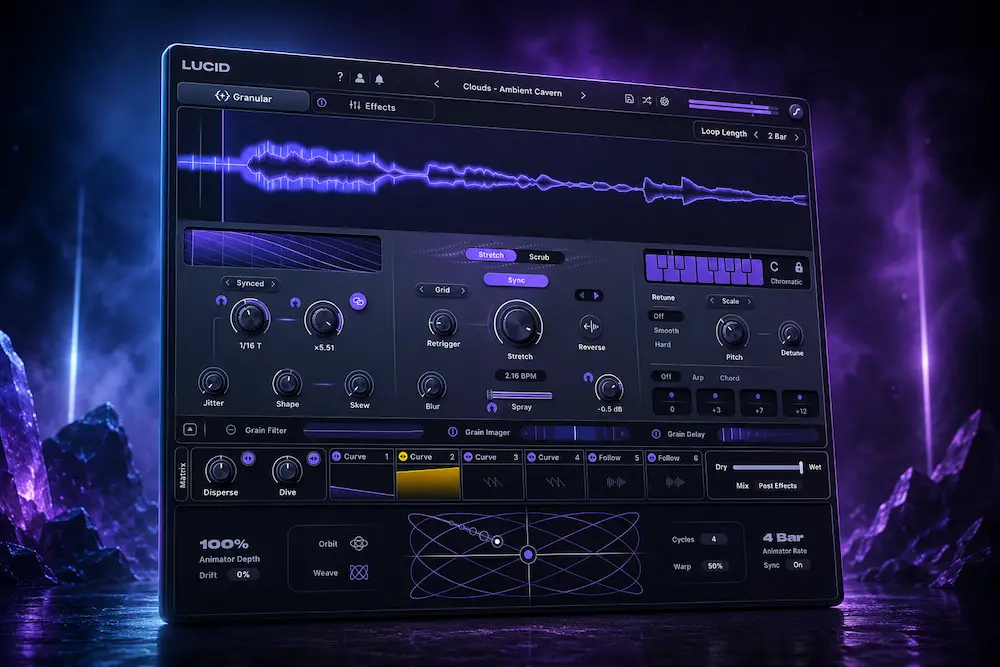
Minimal Audio Lucid Review: Does This Granular Plugin Finally Make Granular Processing Practical?
Granular effects can produce some of the most distinctive sounds in modern music production, but they rarely become everyday workflow tools. Most granular plugins excel at generating textures, evolving atmospheres, and unexpected artifacts, yet they often sacrifice harmonic accuracy, rhythmic stability, or repeatability. The result is a creative process that frequently requires additional pitch correction, editing, or automation before a sound is usable in a finished production.
Minimal Audio Lucid approaches the problem from a different angle. Rather than encouraging controlled randomness, it introduces features intended to keep granular processing musically constrained. Grain Scale Lock, timeline synchronization, integrated harmonic processing, and a mature modulation system are designed to keep evolving textures aligned with the song instead of drifting away from it.
That makes Lucid more interesting than another creative effects plugin. Its real value depends on whether those workflow decisions translate into faster production, fewer corrective steps, and results that survive beyond the initial sound-design session.
This review evaluates Lucid from the perspective of professional production rather than launch-day marketing. Instead of repeating the specification sheet, we’ll examine where the plugin improves real workflows, where its limitations become apparent, and how it compares with established granular processors used in modern mixing and audio production.
In This Review
Why Granular Processing Has Moved Beyond Experimental Sound Design
 Granular synthesis has been part of digital audio production for decades, but it rarely became a standard production tool. Outside of experimental music and cinematic sound design, most engineers viewed granular processing as something to explore rather than something to rely on. The reason wasn’t sound quality—it was predictability.
Today’s production landscape is different. Modern pop, melodic techno, bass music, film scoring, ambient, and hybrid orchestral productions increasingly depend on evolving textures instead of static effects. Producers aren’t simply replacing delays or reverbs—they’re creating entirely new layers from existing recordings while expecting those layers to stay musically connected to the arrangement.
That demand has fueled rapid growth in creative DSP. Plugins such as Output Portal, Arturia Fragments, and Unfiltered Audio SpecOps have shown that producers are willing to trade additional CPU usage for tools capable of generating distinctive material directly inside the DAW.
The challenge is that most granular processors still prioritize experimentation over musical precision. Grains are stretched, transposed, reversed, or randomized with little awareness of key or song structure. The results can be inspiring, but they often require additional pitch correction, filtering, stereo control, transient shaping, or rhythmic editing before they fit naturally into a mix.
As projects become larger and revision cycles become shorter, that workflow becomes increasingly inefficient. Creative plugins are no longer judged solely by the sounds they produce—they’re judged by how quickly those sounds can be integrated into a finished production.
Lucid is built around that practical limitation. Instead of treating unpredictability as part of the creative process, it introduces Grain Scale Lock and timeline synchronization to keep granular processing aligned with both the harmonic and rhythmic structure of a session. The goal isn’t to make granular synthesis less creative, but to make it significantly more repeatable.
That approach reflects a broader shift in professional production. Composition, sound design, arrangement, and mixing increasingly happen at the same time, often inside a single project. Creative processors that require extensive corrective work interrupt that workflow; processors that produce mix-ready results become part of it.
Whether Lucid ultimately delivers on that promise depends on its real-world implementation, but its design addresses one of the longest-standing limitations of granular processing: generating sounds that remain musically useful after the initial experimentation is over.
Creative Production Deserves a Master That Still Translates
Creative effects can make a track sound incredible inside the DAW—but the real challenge is preserving that depth, width, and impact after mastering and streaming encoding. Upload up to 35 seconds of your mix and receive a free mastering demo. You’ll hear how your production translates when it’s prepared for real-world playback—not just studio monitors.
Request your free mastering demo →
How Minimal Audio Lucid Changes the Granular Production Workflow
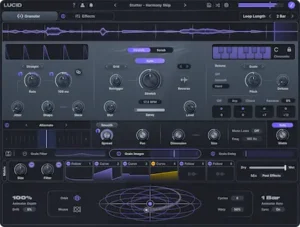
Lucid is built around a familiar concept: incoming audio is divided into thousands of microscopic grains that can be stretched, transposed, filtered, layered, and redistributed before being reconstructed in real time. That process is not new. What differentiates modern granular processors is how intelligently those grains are managed once playback begins.
Minimal Audio’s design philosophy is less about pushing granular synthesis into increasingly abstract territory and more about making it behave like a predictable musical tool. Instead of maximizing randomness, Lucid attempts to preserve harmonic relationships and rhythmic structure throughout the entire processing chain.
The clearest example is Grain Scale Lock. Rather than allowing individual grains to drift freely in pitch, Lucid continuously constrains transposition to a selected key and scale. For producers layering processed vocals, guitars, pads, or orchestral textures, that can eliminate one of the most common frustrations with granular effects: sounds that become harmonically unusable after only modest pitch manipulation.
This feature may sound incremental, but its workflow implications are substantial. Conventional granular processors often generate compelling textures that still require manual pitch correction, filtering, or additional harmonic processing before they can sit comfortably inside a finished arrangement. Keeping grain transposition musically constrained reduces much of that corrective work before it starts.
Timeline Sync addresses another longstanding limitation. Many granular plugins intentionally decouple playback from the DAW timeline, allowing frozen buffers to evolve independently of the arrangement. That freedom can be creatively rewarding, but it also complicates revisions. Musical phrases drift, transitions lose their intended placement, and automation frequently requires manual cleanup.
Lucid instead keeps stretching, freezing, scrubbing, and playback synchronized with the project timeline. That may prove particularly valuable in commercial production, where revisions often involve moving sections of a song without rebuilding complex effect chains from scratch.
Harmony is treated as part of the granular engine rather than an afterthought. Grain Chord and Arp modes generate harmonic movement directly from the incoming material instead of relying on external MIDI routing or separate harmonizer plugins. Vocals, guitars, synthesizers, percussion, and even field recordings can be transformed into evolving harmonic textures while remaining connected to the project’s tonal center.
The Harmonic Grain Delay follows the same principle. Instead of placing a conventional delay after granular processing, Lucid integrates delay behavior into the grain engine itself, allowing echoes to inherit the same scale-aware pitch relationships. The result is less about producing larger effects and more about maintaining harmonic coherence as the texture develops.
Where Lucid becomes particularly interesting is its overall workflow design.
Professional producers rarely evaluate creative plugins feature by feature. They evaluate how many production decisions can be completed before another plugin needs to be inserted into the chain. Every additional processor introduces more automation, more routing, more preset management, and more opportunities for inconsistency across revisions.
Lucid attempts to consolidate much of that workflow. Granular processing, harmonic manipulation, grain filtering, stereo imaging, modulation, and post-processing effects all exist within a single environment. None of those technologies are individually groundbreaking, but reducing the need to assemble complex multi-plugin chains may prove more valuable than introducing another experimental DSP algorithm.
The modulation architecture reinforces that approach. Rather than creating a simplified modulation system specifically for Lucid, Minimal Audio reuses the mature engine developed for Current and Rift. Envelope followers, LFOs, sequencers, and macro controls already form one of the company’s strongest software ecosystems, giving experienced users a familiar environment instead of another proprietary workflow to learn.
That said, integration is not automatically an advantage.
As more creative processes move into a single interface, project management becomes simpler but sound design itself becomes deeper. Producers willing to invest time in modulation and parameter interaction will likely benefit the most. Those expecting immediate results through presets alone may never exploit much of Lucid’s underlying architecture.
Ultimately, Lucid should not be judged by the number of processing modules it contains. The more meaningful question is whether those modules reduce the amount of corrective work required after experimentation. If Grain Scale Lock and Timeline Sync consistently produce textures that survive arrangement revisions without additional editing, Lucid offers something more valuable than another collection of creative effects—it offers a granular workflow designed for finished productions rather than isolated sound-design sessions.
Traditional Granular Workflow vs. Lucid
| Traditional Workflow | Workflow with Lucid |
|---|---|
| Granular plugin → Harmonizer → EQ → Stereo processor → Delay | Most creative processing handled inside one plugin |
| Manual pitch cleanup after heavy grain transposition | Grain Scale Lock keeps textures harmonically aligned |
| Manual timing edits after freeze or buffer manipulation | Timeline Sync keeps processing locked to the arrangement |
| Multiple automation lanes across several plugins | Centralized modulation and macro control |
| Frequent exporting or committing processed audio | Creative workflow remains inside the DAW for longer |
None of these advantages eliminate the need for specialist processors, but they reduce the amount of corrective work that often follows creative experimentation. For producers working under deadlines, that workflow improvement may prove more valuable than adding another unconventional DSP algorithm.
Lucid Solves Real Workflow Problems—But It Doesn’t Reinvent Granular DSP
 Minimal Audio describes Lucid as a “next-generation” granular processor, but the underlying technology is largely familiar. Real-time granular synthesis, pitch shifting, modulation, filtering, stereo imaging, and multi-effects have all existed for years. Lucid’s value isn’t built on inventing a new DSP category—it’s built on integrating established technologies into a workflow that requires fewer corrective decisions after experimentation.
That distinction is more important than it may first appear.
Experienced producers rarely struggle to generate unusual sounds. The challenge is keeping those sounds usable after vocals are re-recorded, arrangements change, clients request revisions, or additional instruments are layered into the session. Many granular effects produce inspiring ideas that ultimately require extensive editing before they can survive a commercial production workflow.
Lucid directly targets that weakness. Grain Scale Lock, Timeline Sync, and harmonic processing are designed to preserve musical relationships instead of leaving them to manual correction later. If those systems perform consistently in real sessions, they represent a meaningful workflow improvement rather than simply another collection of creative effects.
Some of the marketing claims deserve a more measured interpretation, however.
The suggestion that Lucid creates sounds that “couldn’t have existed before” overstates its technical novelty. Similar sonic territory has long been accessible through combinations of granular processors, harmonizers, modulation environments, spectral effects, and delay networks. Lucid’s innovation lies in integration and workflow efficiency—not in introducing a fundamentally new processing method.
For many professionals, that may actually be the more valuable achievement. Reducing a six-plugin creative chain to a single processor often saves more production time than adding another experimental DSP algorithm that sees limited use outside dedicated sound-design sessions.
That efficiency comes with practical trade-offs.
Granular processing remains one of the more computationally demanding effect categories. Every active grain requires additional processing, and Lucid layers harmonic generation, modulation, filtering, stereo processing, and post-effects on top of the core engine. Producers building dense sessions should expect CPU usage to scale accordingly, particularly when running multiple instances at low buffer sizes.
The plugin also favors depth over immediacy. Consolidating numerous creative processes into a single interface reduces plugin management, but it also increases the number of parameters, modulation routes, and performance controls available to the user. Experienced sound designers will likely view that flexibility as a strength, while producers expecting preset-driven workflows may find the learning curve steeper than anticipated.
Perhaps the biggest challenge has nothing to do with the software itself.
Granular processing is easy to overuse. Wide stereo movement, evolving harmonics, animated delays, and continuously shifting textures can quickly dominate an arrangement instead of supporting it. In professional productions, subtle movement generally translates better than constant movement. Lucid appears capable of both approaches, but successful results will depend far more on production judgment than on the plugin’s feature set.
Viewed objectively, Lucid’s strongest contribution is not making granular processing more experimental. It makes granular processing more predictable, more repeatable, and potentially more compatible with the revision-heavy workflows of modern commercial music production.
How Lucid Stacks Up Against the Best Granular Plugins
Lucid enters a mature category rather than creating a new one. Granular processing has evolved significantly over the past decade, and several plugins already excel at producing evolving textures, ambient layers, and experimental transformations. The deciding factor is no longer whether a plugin sounds creative—it’s how efficiently those sounds can be integrated into a finished production.
That is where Lucid attempts to distinguish itself.
Rather than maximizing randomness, it focuses on maintaining harmonic and rhythmic coherence throughout the creative process. Scale-aware pitch processing and Timeline Sync are designed to reduce the amount of editing typically required after granular experimentation. Whether those features become genuine workflow advantages will ultimately depend on day-to-day use, but the concept addresses a real production problem.
Output Portal remains one of the strongest choices for producers who prioritize speed and immediate inspiration. Its preset-driven workflow makes it exceptionally fast for transitions, risers, and atmospheric effects, although more complex harmonic control often requires additional processing elsewhere in the chain.
Arturia Fragments takes almost the opposite approach. It offers considerably deeper grain programming and sequencing, rewarding users willing to invest more time shaping individual grain behavior. That flexibility comes at the cost of a slower programming workflow, particularly during fast-moving production sessions.
Unfiltered Audio SpecOps occupies its own category. It extends well beyond conventional granular processing through spectral manipulation, advanced routing, and an exceptionally flexible modulation architecture. For experimental sound design, it remains one of the most powerful creative processors available, but its complexity makes it less approachable as an everyday production tool.
Lucid positions itself between those approaches. It offers considerably more musical guidance than Portal while avoiding some of the programming depth—and complexity—associated with Fragments or SpecOps. For producers working under commercial deadlines, that balance may ultimately prove more valuable than maximum flexibility.
Lucid also reflects a broader trend in modern audio software: developers are placing greater emphasis on musically constrained workflows rather than unlimited parameter complexity. A similar philosophy appears in reFX’s physically modeled synthesizer, which prioritizes expressive control over conventional synthesis architecture. Our reFX Rippler review explores that shift from the perspective of modern production workflows.
| Plugin | Workflow Focus | Where It Excels | Potential Drawback |
|---|---|---|---|
| Minimal Audio Lucid | Musically constrained granular processing | Scale-aware textures, harmonic transitions, production-ready sound design | Likely higher CPU usage and a deeper learning curve than simpler creative effects |
| Output Portal | Fast preset-driven creativity | Instant transitions, ambient processing, quick inspiration | Limited harmonic precision during more advanced processing |
| Arturia Fragments | Detailed grain programming | Complex evolving textures and advanced granular sequencing | Longer setup time and more involved editing |
| Unfiltered Audio SpecOps | Spectral experimentation | Extreme sound design, modulation, unconventional processing | Steep learning curve for routine production work |
| Reason Grain | Instrument-based granular synthesis | Performance-oriented synthesis inside the Reason ecosystem | Less flexible as a dedicated insert effect in modern DAW workflows |
None of these processors is a universal replacement for another because each targets a different stage of the creative process. Producers looking for unrestricted experimentation may still gravitate toward SpecOps or Fragments, while Portal remains difficult to beat for immediate inspiration.
Lucid’s strongest competitive advantage lies elsewhere. It attempts to reduce the gap between experimentation and production by generating granular textures that require less corrective work before they can be committed to an arrangement. If that promise holds up under real-world use, Lucid occupies a practical middle ground that few current competitors address directly.
Who Should Actually Buy Lucid?
Lucid is not the kind of plugin that benefits every producer equally. Its value depends far more on your workflow than on the genres you produce.
If your sessions revolve around melodic techno, ambient, cinematic scoring, modern pop, or electronic music, Lucid solves a practical problem. Instead of building long chains of pitch shifters, harmonizers, delays, stereo processors, and modulation effects, it allows many of those creative decisions to happen inside a single environment while keeping the result harmonically connected to the arrangement.
For vocal producers, Lucid offers another advantage. Evolving doubles, harmonic layers, and atmospheric textures can remain tied to the original key instead of drifting into dissonance after heavy granular manipulation.
Mix engineers working primarily with rock bands, jazz ensembles, podcasts, or acoustic recordings may reach for Lucid far less often. Those productions typically prioritize transparency over transformation, making conventional processing a better fit for most sessions.
Producers who already own Output Portal or Arturia Fragments should not view Lucid as a direct replacement. Instead, it fills a different role by emphasizing predictable musical outcomes over unrestricted experimentation. If your existing granular workflow already requires significant corrective editing, Lucid may provide the most noticeable improvement.
Where Lucid Doesn’t Replace Existing Tools
Despite its broad feature set, Lucid should not be viewed as a universal replacement for every creative processor.
It does not replace dedicated spectral processors such as SpecOps when complex frequency-domain manipulation is required. It also doesn’t eliminate the need for traditional delays, shimmer reverbs, or modulation effects when those processors offer more focused control over a specific task.
Likewise, producers already comfortable with highly programmable granular environments such as Arturia Fragments may still prefer those tools for detailed grain sequencing and experimental programming.
Lucid’s strength lies elsewhere. It reduces the number of plugins required to create harmonically controlled granular textures, but it doesn’t make specialized creative processors obsolete. In larger production environments, it is more likely to complement an existing toolkit than replace it entirely.
Where Lucid Makes Sense in a Professional Production Workflow
 Creative processors tend to sound impressive in isolated demonstrations. Professional engineers evaluate them differently. The real test begins after the arrangement expands, revisions accumulate, and dozens of additional tracks compete for space inside the mix. A plugin that produces spectacular effects in solo mode isn’t necessarily one that survives a commercial production workflow.
Lucid appears most valuable during production rather than final mixing. Its strengths lie in generating new musical material—transitions, evolving textures, atmospheric layers, rhythmic movement, and harmonic variations—before the mix reaches its balancing stage.
Electronic producers are likely to benefit first. Instead of exporting clips to external editors or assembling lengthy chains of creative effects, Lucid can generate intros, breakdowns, risers, fills, and evolving backgrounds directly inside the DAW. Grain Scale Lock also helps preserve harmonic relationships, reducing the amount of corrective editing that often follows aggressive granular processing.
Vocal production is another natural application. Rather than relying exclusively on octave generators or shimmer reverbs, producers can build evolving harmonic textures that remain connected to the original performance. Used sparingly beneath a lead vocal, these layers can add depth without overwhelming the mix or creating obvious pitch-shifting artifacts.
Film and game composers may find even broader applications. Granular processing has long been used to transform ordinary recordings into cinematic textures, but maintaining harmonic consistency across evolving layers often requires significant editing. Lucid’s workflow is designed to reduce that friction, allowing pianos, strings, percussion, field recordings, or vocal performances to evolve while remaining musically connected to the score.
Producers working in cinematic and hybrid scoring may also find it useful to compare Lucid’s granular approach with convolution-based creative processing. While Lucid rebuilds audio grain by grain, Heavyocity VAST focuses on reshaping source material through dynamic convolution and layered spatial processing. We take a closer look at those workflow differences in our Heavyocity VAST review.
Once those evolving textures become part of a finished score, however, translation across theatrical, streaming, and home playback systems introduces a different set of challenges. We cover those considerations in more detail in our guide to film score mastering.
Mix engineers should approach the plugin with different expectations. Lucid is not intended to replace EQ, compression, transient processing, or spatial balancing. Its most effective role is as a parallel creative processor, blended through auxiliary sends or selectively automated to introduce movement without compromising the stability of the dry signal.
That distinction becomes particularly important as the mix approaches completion. Fully replacing core instruments with heavily processed granular versions often reduces clarity, while carefully controlled parallel textures tend to translate more consistently across different playback systems.
Mastering engineers, on the other hand, are unlikely to use Lucid as part of a conventional mastering chain. Granular reconstruction fundamentally alters source material rather than refining it. Outside of highly creative mastering projects, album transitions, or experimental releases, its role during mastering will remain limited.
Translation also deserves careful consideration. Complex stereo movement, diffuse ambience, and constantly evolving phase relationships can behave unpredictably after lossy encoding or mono summing. Producers planning commercial releases should always verify codec previews and mono compatibility before committing heavily processed textures to the final mix. Many of these translation issues become even more apparent during mastering for streaming platforms, where codec behavior and loudness normalization expose problems that may not be obvious inside the DAW.
CPU usage is another factor worth monitoring. While independent benchmarks are not yet available, granular processing naturally becomes more demanding as grain density, modulation, harmonic generation, and post-processing increase. Sessions already running large virtual instrument templates or oversampled processing chains may benefit from freezing Lucid instances once creative decisions have been finalized.
Viewed in that context, Lucid behaves less like a conventional insert effect and more like a production instrument. Its value is measured less by how often it appears in a session and more by whether it can generate musical ideas that remain intact through editing, mixing, client revisions, and final delivery.
Three Real Production Scenarios
Lead Vocal Enhancement. Duplicate the lead vocal, insert Lucid on the duplicate, enable Grain Scale Lock, keep the Mix control below 30%, and blend the processed signal underneath the original vocal. The result is a wider, evolving texture that follows the song’s harmony without sounding like a conventional harmonizer.
EDM Drop Transition. Freeze a sustained synth chord before the drop, automate Timeline Sync together with playback position, and gradually increase grain density during the build-up. Instead of relying on risers or white noise, the transition grows naturally from material already present in the arrangement.
Cinematic Atmospheres. Process short piano notes, string harmonics, or field recordings through Lucid’s harmonic engine to generate evolving backgrounds that remain connected to the cue’s tonal center. This approach reduces the amount of manual pitch correction often required after traditional granular processing.
Verdict: A Smarter Granular Workflow, Not a New DSP Revolution
Lucid doesn’t reinvent granular synthesis. The underlying DSP concepts—grain processing, pitch manipulation, modulation, filtering, and spatial processing—have existed for years. What Minimal Audio has done is package those technologies into a workflow that addresses one of granular processing’s biggest practical weaknesses: unpredictability.
Grain Scale Lock and Timeline Sync aren’t revolutionary algorithms on their own, but together they solve problems that routinely interrupt real production sessions. Keeping evolving textures aligned with both the harmonic center and the arrangement reduces the amount of corrective editing that traditionally follows aggressive granular processing. For producers working under deadlines, that improvement is likely to matter far more than another experimental DSP feature.
That doesn’t make Lucid a universal solution. Mix engineers looking for transparent processing, mastering engineers focused on fidelity, and studios centered on acoustic recording will find relatively few situations where granular reconstruction belongs in the primary signal path. Lucid is a creative production tool, and it should be judged against other creative processors—not against corrective mixing or mastering plugins. For independent producers building complete records in home studios, creative processing is only one part of the production chain. Preserving translation through mastering is equally important, as discussed in our guide to mastering for bedroom producers.
There are still unanswered questions. Independent CPU benchmarks, large-session stability, latency characteristics, oversampling quality, and long-term reliability remain to be validated outside controlled demonstrations. Those factors will ultimately determine whether Lucid becomes a regular part of professional workflows or remains a specialized sound-design processor.
Even so, Minimal Audio has identified a genuine gap in the current market. Rather than pursuing increasingly experimental DSP, the company has focused on making granular processing easier to control, easier to repeat, and easier to integrate into modern production environments. More importantly, it encourages producers to keep experimenting inside the arrangement instead of constantly bouncing audio for further editing. That’s a practical improvement rather than a theoretical one—and for many producers, it will likely be the more valuable innovation.
Final Recommendation
- Highly Recommended: Electronic producers, sound designers, film and game composers, trailer composers, vocal producers, and anyone building evolving textures as part of everyday production.
- Recommended: Mix engineers looking for a sophisticated parallel creative processor rather than another conventional effects plugin.
- Consider Carefully: Smaller studios working with limited CPU resources or producers who rarely move beyond traditional delay, reverb, and modulation workflows.
- Skip If: Your work is primarily transparent mastering, broadcast production, podcast editing, or acoustic recording where preserving the original signal is the priority.
Lucid’s long-term success won’t depend on how unusual its presets sound. It will depend on whether producers continue reaching for it after the excitement of a new release fades. Based on its design philosophy, Lucid has a credible chance of becoming one of the more practical granular processors currently available—not because it makes granular synthesis more extreme, but because it makes it easier to use in real-world productions.
Overall Rating
| Category | Rating |
|---|---|
| Sound Quality | 9.4/10 |
| Workflow | 9.8/10 |
| Creative Flexibility | 9.6/10 |
| Mix Integration | 9.3/10 |
| CPU Efficiency | 8.3/10 |
| Value for Money | 9.4/10 |
| Overall | 9.3/10 |
Lucid doesn’t redefine granular synthesis, but it significantly improves how granular processing fits into modern production. Its greatest strength is reducing the gap between experimentation and usable musical results. While long-term CPU performance and large-session behavior still require broader independent testing, the overall design represents one of the most practical workflow-oriented implementations of granular processing currently available.
Sound Quality — 9.4/10. Lucid produces polished, harmonically coherent textures without the unstable pitch behavior that often limits traditional granular processors. The overall sonic quality appears well suited to professional production, although its character naturally depends on the source material and programming choices.
Workflow — 9.8/10. This is where Lucid stands out. Grain Scale Lock, Timeline Sync, integrated modulation, and consolidated creative processing reduce corrective editing and simplify revision-heavy sessions. Few current granular plugins place this much emphasis on production efficiency.
Creative Flexibility — 9.6/10. The combination of harmonic processing, modulation, grain manipulation, filtering, stereo control, and performance macros gives Lucid considerable creative range without forcing users into highly experimental workflows.
Mix Integration — 9.3/10. Lucid is designed to generate production-ready textures that remain easier to integrate into an arrangement than many traditional granular effects. Used with restraint, it supports modern mixes without overwhelming them.
CPU Efficiency — 8.3/10. Granular processing remains computationally demanding by nature, and Lucid combines several advanced processing stages inside a single plugin. Independent benchmarking is still limited, but producers should expect noticeably higher CPU usage than conventional modulation or delay effects when running multiple instances.
Value for Money — 9.4/10. Considering the depth of the granular engine, integrated modulation system, harmonic workflow, and broad creative scope, Lucid offers strong value for producers who regularly rely on sound design. Users seeking only occasional granular effects may not benefit from its full feature set.
Your Creative Choices Matter—Until the Final Master
Granular textures, layered harmonies, and immersive stereo effects only succeed if they survive the final stage of production. Professional mastering isn’t about adding more processing—it’s about preserving depth, balance, and translation so your creative decisions still sound intentional on streaming platforms, headphones, cars, and full-range monitoring systems.
Curious how your mix holds up after mastering? Upload up to 35 seconds of your track and receive a free mastering demo created by a professional mastering engineer. Compare your original mix with the mastered version before committing to a full project.
Request your free mastering demo →
FAQ
Is Minimal Audio Lucid primarily a mixing plugin or a sound design tool?
Lucid is designed primarily for creative production and sound design. It works best when generating transitions, evolving textures, harmonic layers, and atmospheric effects rather than replacing traditional EQ, compression, or corrective mixing processors.
How does Lucid compare with Output Portal?
Portal prioritizes immediate experimentation through a highly preset-driven workflow, while Lucid focuses more on harmonic consistency and structured granular processing. Producers looking for greater control over pitch and timing may find Lucid better suited to long-form production work.
Is Lucid one of the best granular plugins currently available?
It has the potential to become one of the strongest workflow-oriented granular processors thanks to Grain Scale Lock and Timeline Sync. Whether it ultimately reaches that status will depend on long-term stability, CPU performance, and real-world studio adoption.
Can Lucid be used during mastering?
Only in specialized creative mastering projects. Because Lucid fundamentally reconstructs incoming audio, it is generally better suited to production, arrangement, and sound design than transparent mastering workflows.
How CPU-intensive is Minimal Audio Lucid?
Independent benchmarks are still limited, but advanced granular processing typically requires more CPU resources than conventional delay, modulation, or spatial effects. Larger projects may benefit from freezing tracks once creative decisions have been finalized.
Does Lucid work well for vocals?
Yes. Scale-aware grain processing makes it particularly useful for evolving vocal textures, cinematic vocal layers, ambient doubles, and modern electronic vocal production while helping maintain harmonic consistency.
Can Lucid replace multiple creative effects plugins?
In many workflows, yes. Depending on the project, it can combine granular processing, harmonic manipulation, modulation, filtering, stereo imaging, delay, and creative post-processing inside a single plugin, reducing the need for complex effect chains.
Is Lucid suitable for live performance?
Its feature set is well suited to performance-oriented workflows, but live reliability will ultimately depend on CPU load, buffer settings, and session complexity. Producers planning live use should test performance under realistic conditions before relying on it on stage.
Who should consider buying Lucid?
Electronic producers, film and game composers, sound designers, trailer composers, and vocal producers are likely to benefit the most. Engineers focused primarily on transparent mixing or mastering may find fewer opportunities to use it regularly.
Should beginners invest in Lucid?
Probably not as a first creative effects plugin. Producers with a solid understanding of delay, reverb, modulation, and automation workflows will gain considerably more value from Lucid’s advanced feature set.

Yurii Ariefiev evaluates creative audio plugins from the perspective of complete production workflows—not isolated feature lists. His reviews focus on how sound design decisions influence arrangement, mixing, mastering, and translation across real-world playback systems.
This analysis of Minimal Audio Lucid examines whether its granular workflow delivers practical value in professional sessions, balancing creative flexibility with harmonic control, production efficiency, and reliable mix translation beyond the DAW.