Pulsar Modular P21 Atlas Review: Rethinking Limiting for Dolby Atmos and Modern Mastering Workflows
Most mastering limiters are evaluated on a familiar set of criteria: loudness, transparency, and peak control. Those benchmarks remain important, but they no longer tell the entire story. Modern release workflows extend far beyond stereo playback. Engineers are expected to deliver masters that translate across streaming platforms, immersive formats, live systems, headphones, soundbars, and increasingly complex monitoring environments.
That shift exposes a limitation in how peak management is typically discussed. Keeping a signal below a ceiling is relatively straightforward. Preserving the relationships that make a mix feel connected is far more difficult. A limiter can maintain technical compliance while subtly changing depth cues, transient balance, spatial localization, and the perceived distance between elements.
Those changes often go unnoticed in stereo until the mix leaves the studio. In Dolby Atmos and other immersive formats, they become considerably easier to hear. Small variations in gain reduction can influence how a soundstage holds together over time, particularly in dense productions built around movement, ambience, and layered spatial information.
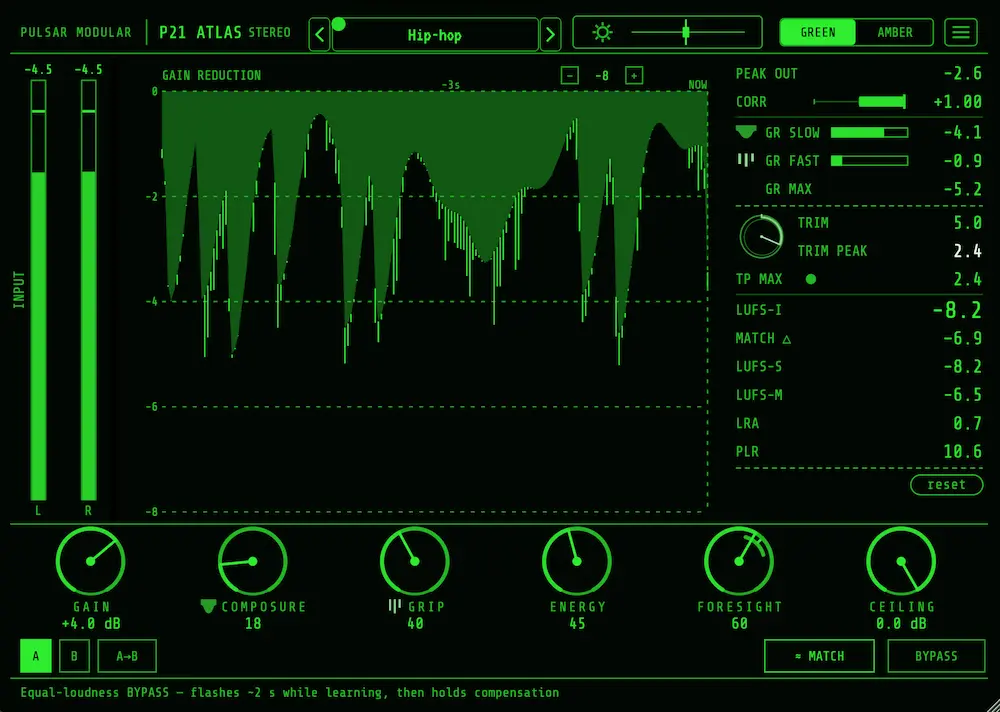
Pulsar Modular P21 Atlas is built around that specific problem. Rather than focusing its message on loudness alone, the plugin introduces the idea of stabilization limiting: controlling peaks while attempting to preserve the coherence of the overall program. The concept sounds ambitious, but it addresses a concern many mastering and Atmos engineers already recognize. Peak control and mix stability are not necessarily the same objective.
The real question is whether Atlas offers a meaningful alternative to conventional limiter design, or whether it simply describes familiar behavior using new terminology.
Contents
Why Program Stability Has Become a Bigger Issue in Modern Audio Production
For years, limiter design followed a relatively straightforward path. The objective was to increase level while minimizing audible artifacts. Developers refined lookahead algorithms, improved oversampling, reduced distortion, and pushed transparency further with each generation of processors.
Those improvements solved many of the problems engineers struggled with twenty years ago. They did not solve every problem engineers face today.
The modern production environment places different demands on master-bus processing. A single project may require stereo delivery, Dolby Atmos versions, streaming distribution, broadcast compliance, and playback across systems that reveal spatial inconsistencies far more readily than traditional studio monitors.
As immersive formats gained traction, engineers began paying closer attention to something that loudness measurements cannot capture: whether a mix continues to feel like a single coherent performance after final dynamics processing.
Anyone who spends enough time mastering complex productions has encountered the phenomenon. The limiter behaves correctly. Peak control is clean. Loudness targets are achieved. Yet something subtle changes. A vocal feels slightly separated from its ambience. Depth relationships become less convincing. Elements that previously occupied a stable position in the soundstage feel less anchored during dense passages.
These outcomes are not necessarily signs of poor processing. They are often the result of dynamic decisions affecting multiple layers of information simultaneously. The more complex the arrangement, the more difficult it becomes to manage level without influencing spatial relationships.
That challenge becomes significantly more apparent in Atmos and other immersive formats. In stereo, listeners may perceive a slight loss of depth or cohesion without identifying its source. In a multichannel environment, changes in localization, movement, and image stability are often easier to detect because the soundstage itself carries more information.
This shift in production priorities helps explain why some engineers have become less interested in how much loudness a limiter can extract and more interested in how effectively it preserves the relationships that define the mix in the first place.
What Makes Pulsar Modular P21 Atlas Different From Traditional Limiters?
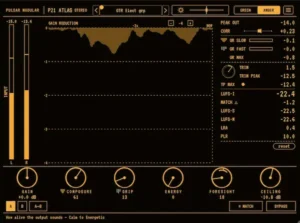 Pulsar Modular describes Atlas as a stabilization limiter rather than a conventional loudness processor. Behind the terminology is a specific architectural decision: gain reduction is linked across the primary channels while the LFE is handled independently in immersive formats.
That may sound like a technical detail, but it addresses a genuine challenge in multichannel mastering. When dynamic processing reacts differently across a surround or immersive soundfield, the result is not always obvious distortion or pumping. More often, the effect appears as a gradual loss of spatial consistency.
Consider a dense Atmos production where lead vocals remain anchored at the front while reverbs, orchestral layers, textures, and effects occupy the sides, rear channels, and height speakers. If gain reduction is not sufficiently coordinated across those elements, the mix can begin to feel less unified as level management becomes more aggressive.
The mix may still measure correctly. Localization may remain technically accurate. Yet the presentation can become less convincing. Ambience no longer feels connected to its source. Movement feels less deliberate. Depth relationships become harder to follow during busy sections.
This is the problem Atlas is attempting to solve. Rather than treating peak events as isolated incidents, the plugin is designed to evaluate how gain reduction affects the behavior of the overall program.
That approach should not be confused with a completely new concept. Linked dynamics processing has existed for decades in broadcast, live sound, and various multichannel control systems. What differentiates Atlas is not the existence of linked gain reduction itself, but the decision to place program coherence at the center of the limiter’s design philosophy.
Whether that translates into a meaningful advantage will depend on the material. The potential benefits are likely to be more apparent in Atmos mastering, film music, orchestral productions, and complex spatial mixes than in a straightforward stereo session built around a handful of elements. Still, Atlas enters a category where most products are primarily evaluated by loudness, transparency, and peak control. Framing a limiter around stability instead of level extraction is a noticeably different proposition.
P21 Atlas Specifications and Supported Formats
Beyond its stabilization-focused architecture, P21 Atlas includes support for a wide range of professional production environments. The plugin is available in VST3, AU, and AAX formats for both macOS and Windows systems. Atlas Stereo supports conventional mastering and mixing workflows, while Atlas Immersive extends support to multichannel configurations ranging from mono and stereo through 5.1, 7.1.4, and 9.1.6 layouts.
One of the more unusual specifications is its reported 4-sample latency, making it suitable not only for mastering environments but also for certain live sound, broadcast, and immersive playback applications where traditional lookahead-based limiters become impractical.
For Atmos engineers, the combination of multichannel support and ultra-low latency may be more significant than the loudness capabilities themselves. Most mastering limiters were never designed with immersive monitoring, renderer-based workflows, or live multichannel applications as primary use cases.
| Developer | Pulsar Modular |
| Plugin Type | Limiter |
| Formats | VST3, AU, AAX |
| Platforms | macOS, Windows |
| Atmos Support | Up to 9.1.6 |
| Latency | 4 samples |
Why the Atmos Market Needed a Different Type of Limiter
Dolby Atmos has expanded faster than the toolset surrounding it. While immersive production is no longer a niche reserved for film and high-end post facilities, many of the processors used in Atmos mastering still originate from stereo workflows.
That is not necessarily a problem. Some stereo processors perform remarkably well in immersive environments. The challenge is that most were never designed around maintaining relationships across an entire multichannel soundfield.
In stereo mastering, small shifts in dynamic behavior may slightly affect depth, width, or transient perception. In Atmos, the same processing decisions can influence how listeners perceive location, movement, and spatial continuity. A result that feels perfectly acceptable in stereo may become more noticeable once information is distributed across multiple speaker layers.
This has led many Atmos engineers toward a cautious approach to final dynamics processing. Rather than pushing a limiter until it reveals its character, the safer option is often to apply less processing and preserve the integrity of the mix.
That strategy reduces risk, but it also limits flexibility. Engineers may leave additional headroom, accept lower overall density, or avoid processing decisions that would be routine in a stereo mastering session. In other words, the limitations of available tools can begin influencing mastering choices long before technical limits are reached.
P21 Atlas appears to be aimed directly at that workflow reality. Its design prioritizes coordinated gain reduction across immersive channel layouts, with support extending from mono and stereo through 9.1.6 configurations. More importantly, it treats spatial consistency as a primary design consideration rather than a secondary benefit.
P21 Atlas for Dolby Atmos Mastering
For Atmos mastering engineers, the primary concern is often preserving spatial relationships rather than maximizing loudness. P21 Atlas was designed around multichannel gain management, making it one of the few modern limiters positioned specifically for immersive mastering workflows. Instead of treating Atmos as an extension of stereo production, the plugin attempts to maintain consistency across an entire multichannel soundfield while final dynamics processing is applied.
Engineers working in Dolby Atmos typically evaluate final processing decisions through the Dolby Atmos Renderer, where even small changes in dynamics can influence perceived localization, depth, and movement across different playback render modes.
That distinction matters because Atmos mastering is increasingly moving beyond major-label releases and large post-production facilities. As immersive delivery becomes more common across music production, engineers need processors that are designed around multichannel decision-making rather than adapted to it after the fact.
Whether P21 Atlas becomes a standard Atmos mastering tool will depend on long-term adoption by engineers rather than launch positioning. What is already clear is that immersive production exposes limitations in traditional stereo-oriented limiting workflows, creating demand for processors designed around multichannel consistency rather than stereo adaptation.
The potential audience extends beyond music mastering. Film scores, immersive post-production, and large-format streaming content often place greater emphasis on spatial continuity than commercial music releases. As a result, workflows that appear niche in stereo mastering can become far more relevant in Atmos-oriented production environments.
Mastering Implications Beyond Dolby Atmos
Although Atlas is being positioned heavily toward immersive production, its long-term relevance may depend just as much on what it does in stereo.
Most mastering engineers are not struggling to achieve loudness. Modern limiters solved that problem years ago. The more difficult challenge is preserving the qualities that made a mix compelling before it reached the final stage of processing. That distinction becomes easier to understand when examining how professional mastering decisions are made throughout an entire release workflow, not just inside the limiter itself. See our guide to how professional mastering works.
Every mastering decision affects relationships inside the record. A lead vocal is tied to its ambience. Drum transients define the perceived size of the room around them. Low-frequency energy influences how the entire mix breathes and moves. When gain reduction begins altering those relationships, the result is not always obvious distortion or pumping. More often, the master simply feels flatter, smaller, or less engaging than the mix that preceded it.
This is where the concept behind Atlas becomes interesting outside the Atmos conversation. Rather than focusing exclusively on peak containment, the plugin is built around the idea that preserving internal balance may be just as important as controlling level.
That perspective aligns with a broader shift occurring in professional mastering. As streaming normalization has reduced the practical advantage of excessive loudness, engineers have become increasingly focused on translation, depth, punch, and long-term listening impact. The goal is no longer to make a record louder than everything around it. The goal is to ensure that the record remains convincing after level normalization, codec encoding, and playback on consumer systems.
One of Atlas’s more interesting claims involves preserving contrast between musical events rather than continuously elevating low-level information. This distinction matters because many modern loudness workflows gradually reduce the separation between foreground elements and the spaces around them. The master becomes denser, but not necessarily more engaging.
Experienced mastering engineers often hear this effect as a loss of depth rather than a loss of dynamics. Reverb tails appear closer. Silence feels less silent. Layered arrangements become more congested because subtle spatial cues that previously created separation are partially masked.
If Atlas can maintain those relationships more effectively during peak management, its relevance may ultimately extend beyond immersive production. Atmos may be the feature that attracts attention, but stereo mastering remains the environment where most engineers will decide whether the underlying concept delivers meaningful results.
Critical Evaluation: Where the Marketing Claims Meet Real-World Engineering
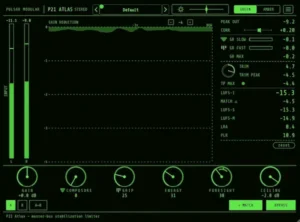 Limiter development has reached a point where meaningful differentiation is increasingly difficult. Most flagship processors already deliver transparent peak control, sophisticated oversampling, and distortion performance that would have been considered exceptional a decade ago. As a result, manufacturers have shifted their attention toward workflow advantages and processing philosophy rather than purely technical specifications.
Atlas follows that pattern, but its positioning deserves careful scrutiny.
The plugin’s central premise is that preserving program stability can be as important as maximizing loudness. That is a reasonable argument. The mistake would be assuming that stabilization somehow removes the tradeoffs that accompany dynamic processing.
It does not.
Every limiter alters the material once gain reduction begins. The only variables are how those changes occur, where they become audible, and which aspects of the program are prioritized. Atlas may prioritize spatial consistency over aggressive loudness extraction. Another limiter may prioritize transient preservation. Another may focus on maximizing level while minimizing distortion. Each approach involves compromise.
This is why the most important question is not whether Atlas is transparent. Virtually every modern mastering limiter claims transparency. The more useful question is whether its design choices produce results that engineers consistently prefer on real-world material.
There is also a risk that some users will misunderstand the problem Atlas is designed to solve. The plugin is not a shortcut to better mixes. Many issues that users attempt to solve during mastering actually originate earlier in production, which is one reason mastering engineers spend considerable time identifying the real source of a problem before processing begins. See common mastering problems and what actually causes them. If a production already suffers from unstable depth relationships, inconsistent ambience, masking issues, or poorly defined spatial placement, those decisions need to be addressed during mixing. No limiter can rebuild a soundstage that was never properly established.
This distinction is not unique to Atlas. Many modern processors promise workflow improvements rather than corrective magic. Recent tools such as PSP Levelizer target automation and consistency problems during mixing, but even the most advanced processing cannot replace strong production decisions made earlier in the workflow.
The most reliable way to evaluate P21 Atlas is not through short A/B comparisons. Engineers should compare complete masters across multiple playback systems, paying close attention to depth relationships, localization stability, and translation after codec encoding. Those are the areas where any meaningful advantage is most likely to emerge, particularly on complex Atmos and multichannel productions.
A particularly revealing test would involve a dense Atmos production containing front-anchored vocals, layered reverbs, moving objects, and wide ambient information. In that scenario, engineers can compare whether spatial relationships remain consistent as gain reduction increases. Material with limited depth or simple stereo arrangements is far less likely to expose the differences P21 Atlas is designed to address.
In practice, Atlas appears best suited to projects that are already working. The value proposition is not correction. It is preservation. Engineers who spend significant time refining balance, depth, and spatial relationships are more likely to appreciate a processor designed to maintain those qualities during final level management.
That distinction narrows the audience considerably. Producers looking for dramatic loudness gains or a transformational mastering processor may find the benefits difficult to justify. Engineers focused on maintaining the integrity of a finished mix are far more likely to understand what Atlas is trying to accomplish.
Viewed through that lens, Atlas is less a replacement for conventional mastering limiters and more a specialized option for situations where preserving cohesion matters more than extracting the last fraction of a decibel.
Limitations and Practical Constraints
The strongest criticism of Atlas is not that its underlying concept lacks merit. It is that some users may expect it to solve problems that originate far outside the mastering stage.
Terms such as stability, coherence, and glue are frequently used in audio production, but they often describe outcomes created long before a limiter is inserted on the master bus. Arrangement decisions, automation, effects routing, object placement, reverb design, and monitoring accuracy all contribute to how connected a mix feels. Once those variables are baked into the production, the options available during mastering become significantly narrower.
That reality places practical limits on what Atlas can accomplish. A limiter may preserve existing relationships more effectively than another processor, but it cannot create relationships that were never established in the mix.
The plugin also faces a challenge common to many Atmos-focused products: the benefits are easier to demonstrate in immersive environments than in stereo. Spatial inconsistencies that become obvious across a multichannel soundfield may be subtle enough in stereo that some engineers simply prioritize different characteristics. Depending on the material, punch, transient impact, perceived energy, or loudness efficiency may remain higher priorities than program stability.
Adoption presents another obstacle. Mastering engineers tend to be cautious about replacing final-stage processors that have proven reliable across hundreds of releases. Trust in a limiter is rarely built through specifications alone. It develops through repeated use on different genres, monitoring systems, and delivery formats.
This creates a higher barrier to entry than many plugin categories face. An EQ or creative effect can be evaluated quickly. A mastering limiter often earns its place only after months of comparison against established tools.
The final question is whether the problem Atlas addresses is relevant to a particular workflow. Many independent artists, producers, and mixing engineers operate exclusively in stereo and rarely encounter the types of spatial challenges that inspired the plugin’s design. For those users, a well-established stereo limiter may deliver similar practical results while fitting more comfortably into existing workflows.
None of this diminishes the value of the concept. It simply narrows the audience. Atlas is most compelling when program coherence is already a priority. Engineers who are not actively evaluating those relationships may find its advantages difficult to distinguish from other high-end limiters.
How Atlas Compares to Major Limiter Alternatives
Comparing Atlas to established mastering limiters is not entirely straightforward because it enters the market with a different set of priorities. Most flagship limiters compete on some combination of loudness, transparency, transient retention, workflow efficiency, and metering. Atlas shifts the conversation toward program coherence and spatial consistency, particularly in immersive environments.
| Plugin | Core Strength | Best Fit | Potential Tradeoff |
|---|---|---|---|
| P21 Atlas | Program coherence and multichannel stability | Atmos mastering, immersive music, transparent final-stage control | Less focused on aggressive loudness extraction |
| FabFilter Pro-L 2 | Versatility, metering, workflow speed | General mastering, mixing, modern commercial production | No dedicated architecture for immersive stabilization |
| iZotope Ozone Maximizer | Loudness optimization and intelligent processing | Fast mastering workflows and commercial release preparation | Can encourage louder-than-necessary mastering decisions |
| Newfangled Elevate | Spectral peak management and adaptive loudness control | Dense contemporary productions requiring high loudness | Steeper learning curve and more variables to manage |
| Weiss MM-1 | Transparency and simplicity | Mastering engineers seeking minimal intervention | Less flexible than full-featured limiter platforms |
| Sonnox Limiter | Reliable peak control and predictable behavior | Broadcast, post-production, mastering | Feature set reflects an earlier generation of limiter design |
The more revealing comparison is not feature versus feature. It is philosophy versus philosophy.
P21 Atlas vs FabFilter Pro-L 2
FabFilter Pro-L 2 remains one of the most versatile mastering limiters available, offering multiple limiting algorithms, detailed metering, and workflows that adapt easily to different genres. P21 Atlas approaches limiting from a different perspective. Rather than maximizing flexibility, it focuses on preserving program coherence during gain reduction. For engineers working primarily in stereo, Pro-L 2 will likely remain the more universal tool. For immersive mastering and Atmos workflows, P21 Atlas introduces considerations that Pro-L 2 was not specifically designed to address.
This shift in philosophy has become increasingly common among newer limiter designs. Rather than competing solely on loudness extraction, developers are exploring ways to preserve depth, dynamics, and mix integrity during peak control. A good example is Tone Projects Uni-L, which approaches modern mastering limiting from a very different angle while pursuing many of the same goals.
P21 Atlas is attempting to solve a different problem. Rather than asking how much level can be extracted from a mix, it asks how much of the mix’s internal structure can be preserved while level is being controlled.
That distinction becomes more relevant as productions become more complex. In a straightforward stereo master, the practical differences between high-end limiters may be relatively subtle. In immersive music, orchestral recordings, film scores, or spatially dense productions, preserving relationships across the soundfield can become a more important objective than gaining another decibel of loudness.
Atmos engineers may view the competitive landscape somewhat differently. Products such as NUGEN ISL have long been used for multichannel compliance and true-peak control, while Dolby Atmos workflows frequently rely on a combination of renderer monitoring and conventional mastering tools rather than processors designed specifically around spatial stability. P21 Atlas enters a relatively small category of products attempting to address multichannel coherence directly rather than treating immersive delivery as an extension of stereo mastering.
For that reason, Atlas should not be viewed as a direct replacement for every limiter already established in professional workflows. Many engineers will continue reaching for Pro-L 2, Ozone, Elevate, or Weiss depending on the material. The more realistic question is whether Atlas earns a place alongside those tools when spatial consistency becomes a priority.
P21 Atlas vs Ozone Maximizer
Ozone Maximizer is often chosen for speed, loudness efficiency, and integrated mastering workflows. P21 Atlas approaches the final stage from a different angle. Rather than focusing primarily on loudness optimization, it emphasizes preservation of spatial relationships and overall program stability. Engineers looking for a fast path to competitive release levels may prefer Ozone. Engineers evaluating complex Atmos productions or depth-sensitive stereo masters may find the stabilization-focused philosophy of P21 Atlas more relevant.
Who Should Consider Atlas?
P21 Atlas is unlikely to appeal to every mastering engineer, nor was it designed to. Its strengths become most relevant in workflows where maintaining spatial relationships is a critical part of the final deliverable.
Atmos mastering engineers are the most obvious audience. The plugin’s architecture is built around multichannel environments where image stability, localization, and consistency across the soundfield are not secondary considerations but core requirements of the format itself.
The same applies to immersive music mixers, film scoring engineers, and post-production facilities working with complex multichannel content. In these environments, preserving the integrity of spatial decisions often carries more weight than achieving the highest possible loudness.
Atlas may also attract a smaller segment of stereo mastering engineers. Not because stereo mastering suddenly requires immersive processing concepts, but because some engineers place a premium on maintaining depth, separation, and continuity throughout the final stage of processing. For them, a limiter designed around preservation rather than maximum level extraction presents an interesting alternative to more conventional approaches.
Another potential audience includes engineers responsible for multiple delivery formats. Comparing stereo, Atmos, broadcast, and streaming versions of the same project often reveals subtle differences in translation that are difficult to identify while working within a single format. Tools that prioritize consistency across those deliverables can become valuable even when their advantages are not immediately obvious in isolation.
FOH engineers represent a separate use case. The combination of multichannel support and extremely low latency makes Atlas more relevant to live applications than many mastering-oriented processors, particularly in situations where maintaining overall program stability matters more than aggressive dynamics control.
Ultimately, Atlas makes the strongest case for itself in professional environments where preserving existing balance is often more important than pushing level further. Engineers who routinely evaluate spatial coherence, translation, and long-term listening consistency are likely to find its design philosophy more compelling than those focused primarily on loudness optimization.
Who Probably Doesn’t Need Atlas?
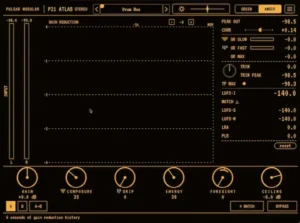 One of the easiest mistakes to make with a specialized processor is assuming that a narrow design focus automatically makes it a better choice for every workflow. In reality, Atlas appears most valuable when its specific strengths align with the demands of the material.
Producers whose primary objective is maximizing loudness may find stronger value elsewhere. Many established limiters are specifically optimized for extracting competitive level while maintaining acceptable transparency, and those tools have years of proven results behind them. If loudness efficiency is the primary metric, Atlas may not offer a compelling advantage.
The same applies to producers building their first mastering chain. A processor designed around preserving spatial relationships is unlikely to solve the challenges that occupy most early-stage users, such as tonal balance, dynamics control, monitoring limitations, or translation issues. Broader mastering tools often provide greater practical value at that stage of development.
Stereo-only workflows present another consideration. While Atlas may offer benefits beyond immersive production, many engineers working exclusively in stereo will need to determine whether those benefits are significant enough to justify adding another specialized limiter to an already crowded category.
Real-World Production Perspective: Translation Matters More Than Loudness
A limiter’s performance is ultimately judged outside the studio.
Peak control, gain reduction curves, and loudness measurements can reveal how a processor behaves technically, but they cannot fully predict how a master will survive real-world playback. The more important question is whether the record maintains its impact once it leaves the controlled environment in which it was created.
This is where discussions about program stability become more relevant. Translation problems are often attributed to tonal balance or loudness decisions, yet many mastering issues emerge from something less obvious: changes in the relationships between elements inside the mix.
A master can meet every technical target and still feel less convincing than the version that existed before final limiting. Depth may appear reduced. Ambience can become less integrated with its source. Dense arrangements may feel more congested because subtle spatial cues that previously created separation are no longer as effective.
Listeners rarely describe these outcomes in technical terms. They simply perceive the record as flatter, narrower, smaller, or less engaging. The underlying cause may not be frequency balance or loudness at all. In many cases, it is the cumulative effect of small changes that alter how the mix is organized perceptually.
This is why translation remains one of the most demanding aspects of mastering. A processor can sound impressive under controlled monitoring conditions while producing less convincing results once the master reaches earbuds, consumer headphones, automotive systems, smart speakers, streaming playback chains, or immersive listening environments.
Each of those systems emphasizes different aspects of the mix. Spatial information that appears stable in the studio may behave differently after codec encoding, level normalization, or playback through speakers with limited bandwidth and compromised listening geometry.
This becomes particularly important for Atmos releases, where binaural rendering and device-specific playback modes can alter how listeners perceive spatial information outside a calibrated monitoring environment.
If Atlas delivers a meaningful advantage, it will likely become apparent in these scenarios rather than during isolated A/B comparisons. Engineers evaluating the plugin should pay less attention to loudness numbers and more attention to whether depth, separation, localization, and overall cohesion remain intact across multiple playback environments.
That is ultimately the standard by which any mastering limiter succeeds or fails. The goal is not simply to control peaks. The goal is to ensure that the record continues to communicate effectively after it leaves the room where it was mastered.
Streaming Services, Codec Encoding, and Delivery Reality
Streaming platforms have changed how mastering decisions are evaluated. Loudness remains important, but normalization systems have made it far more difficult to gain a meaningful advantage simply by pushing level higher. Engineers unfamiliar with modern loudness standards often overestimate the value of additional level, which is why understanding LUFS remains important even when discussing tools such as Atlas. See our LUFS mastering guide.
As a result, competitive mastering increasingly depends on how well a record survives the delivery chain that follows export. That chain includes codec encoding, loudness normalization, sample-rate conversion, consumer playback hardware, and listening environments that bear little resemblance to a professionally treated control room.
These stages can reveal weaknesses that are not immediately obvious during mastering. Dense arrangements may lose separation. Ambience can become less distinct. Spatial information may feel less stable as lossy codecs simplify and redistribute information that was carefully balanced in the original production.
This is particularly relevant for productions that rely heavily on depth, atmosphere, layered reverbs, or immersive spatial design. In these cases, preserving the relationships between elements can be just as important as preserving frequency balance or peak integrity.
It would be an overstatement to suggest that a limiter alone determines how a master survives streaming delivery. Translation is influenced by countless factors throughout the production process, including arrangement, mixing decisions, monitoring accuracy, and codec behavior itself.
However, the philosophy behind Atlas is consistent with the direction modern mastering has taken over the last decade. Engineers are increasingly concerned with preserving clarity, separation, and spatial integrity across a wide range of playback conditions rather than pursuing loudness for its own sake.
Whether Atlas delivers a measurable advantage in that regard will depend on the material. The more complex the spatial information within a mix, the more relevant its stabilization-focused approach may become. Simpler productions may reveal smaller differences compared to established mastering limiters.
Latency and FOH Applications
Much of the discussion surrounding Atlas focuses on immersive mastering, but the plugin’s low-latency design may be equally relevant in live production environments.
Many processors that perform well on a mastering chain are difficult to integrate into FOH workflows because their lookahead requirements introduce latency that becomes unacceptable in real-time applications. In a mastering session, additional latency is usually a minor inconvenience. In a live environment, it can quickly become a workflow limitation.
P21 Atlas takes a different approach. With a reported latency of just four samples, the processor can operate in situations where traditional mastering limiters would be impractical. That opens the door to applications beyond studio mastering, particularly for engineers responsible for managing consistency across complex live programs.
This does not necessarily mean Atlas will replace dedicated live sound processing platforms. FOH workflows involve challenges that extend far beyond peak management, including system optimization, loudspeaker management, venue acoustics, and real-time operational demands.
However, the combination of multichannel support and extremely low latency gives Atlas a use case that many mastering-oriented limiters simply do not address. Engineers working in immersive installations, live productions, broadcast environments, or hybrid events may find that characteristic more compelling than some of the plugin’s mastering-specific features.
While low-latency dynamics processing is not a new concept, it remains relatively uncommon among products marketed primarily toward mastering engineers. In that respect, Atlas occupies an interesting position between studio and live production workflows rather than fitting neatly into either category.
How Atlas Fits Into a Modern Mastering Chain
Most engineers are unlikely to place Atlas in the middle of a mastering chain. Its design makes the most sense near the end of the signal path, after corrective EQ, tonal shaping, compression, saturation, and any stereo or immersive image adjustments have already been completed.
In a conventional stereo workflow, Atlas would typically function as the final dynamics processor responsible for peak containment and overall program consistency before export. In Atmos mastering, its role becomes slightly different. Rather than serving purely as a loudness tool, Atlas is positioned as a stabilization stage intended to maintain spatial relationships while final level management is applied.
This distinction matters because immersive mastering often involves balancing competing priorities. Engineers need sufficient level control without introducing image instability, localization shifts, or changes in perceived depth. Atlas appears specifically designed for that final stage where technical compliance and spatial integrity must coexist.
That workflow position also highlights an important limitation. Engineers evaluating P21 Atlas should avoid comparing it in isolation. Any processor placed at the end of a mastering chain inherits the decisions made earlier in the process. Tonal balance, compression strategy, stereo imaging, and low-frequency management will often influence the final result more than the limiter itself.
For that reason, Atlas is best evaluated inside complete mastering workflows rather than through isolated loudness tests. The engineers most likely to benefit from its design are those already satisfied with their tonal and dynamic decisions and looking for a final-stage processor that minimizes disruption to those choices.
Is P21 Atlas Worth Buying?
The answer depends heavily on workflow rather than genre. P21 Atlas is not competing to become the loudest limiter available, which immediately narrows its audience.
For Atmos mastering engineers, the value proposition is relatively straightforward. Maintaining spatial consistency while managing peaks is a genuine challenge in immersive production, and P21 Atlas is one of the few processors designed specifically around that requirement.
For professional mastering engineers working primarily in stereo, the decision becomes more nuanced. The plugin is most appealing to engineers who prioritize depth, translation, and internal mix relationships over maximum loudness extraction. Those already satisfied with established limiter workflows may find the differences subtle enough to justify careful evaluation before making a switch.
For stereo-only producers and project studios, the benefits may be harder to justify. Many productions simply do not reach the level of complexity where stabilization-focused limiting becomes a meaningful bottleneck. In those situations, conventional mastering limiters may provide a more obvious return on investment.
Verdict
P21 Atlas enters a limiter market that is already crowded with highly capable tools. Competing on loudness, transparency, or peak control alone would make differentiation difficult. Instead, Pulsar Modular has focused on a problem that receives far less attention: maintaining coherence as dynamic processing is applied to increasingly complex productions.
That focus gives Atlas a clearer identity than many recent limiter releases. Rather than promising more loudness or more features, it is built around preserving relationships within a mix, particularly in immersive and multichannel environments where those relationships are easier to disrupt and easier to hear.
The strongest case for Atlas exists in Atmos mastering, immersive music production, film scoring, and other workflows where spatial consistency is part of the deliverable. In those applications, the plugin addresses a genuine challenge that conventional stereo-oriented limiters were never specifically designed to solve.
For Atmos mastering engineers, the buying decision is relatively easy to justify because P21 Atlas addresses a clearly defined workflow challenge. For stereo-only producers, the decision is less obvious and depends on how much value is placed on translation, depth preservation, and long-term mix stability compared with traditional loudness-focused limiting approaches.
Its role in stereo mastering is less straightforward. Some engineers will appreciate the emphasis on depth, separation, and program stability. Others may continue to prioritize loudness efficiency, transient impact, workflow familiarity, or existing mastering chains that already produce reliable results. The differences are likely to become more apparent on complex material than on simple productions with limited spatial information.
What Atlas does not appear to be is a universal replacement for established mastering limiters. Most professionals will evaluate it as an additional option rather than a complete workflow overhaul. Whether it earns a permanent place in that workflow will depend less on specifications and more on how consistently it preserves translation across real projects and delivery formats.
Even so, the broader idea behind Atlas is difficult to dismiss. As immersive production continues to expand and mastering workflows become increasingly format-agnostic, preserving spatial integrity may become a more important consideration than maximizing another decibel of output. P21 Atlas may ultimately be remembered less for its loudness performance than for forcing a broader discussion about what modern limiters should preserve once peak control is no longer the industry’s primary challenge.

Yurii Ariefiev is a mastering engineer specializing in mix translation, release preparation, and real-world playback consistency across stereo and immersive formats. His work involves evaluating how processing decisions affect depth, loudness, spatial balance, and listener perception beyond the studio environment.
This analysis examines P21 Atlas from a mastering and delivery perspective, focusing on program stability, translation reliability, Dolby Atmos workflows, and the practical limitations engineers encounter when moving from controlled monitoring environments to real-world playback systems.
FAQ
Does P21 Atlas require a Dolby Atmos workflow to be useful?
No. Although the plugin was clearly designed with immersive production in mind, its stabilization-focused approach can also be applied to stereo mastering. The practical value depends on whether preserving depth, separation, and internal balance is a priority within a particular workflow.
How is P21 Atlas different from FabFilter Pro-L 2?
Pro-L 2 is built around flexibility and adapts easily to a wide range of mastering scenarios. Atlas takes a more specialized approach, emphasizing program coherence and multichannel stability rather than offering multiple limiting styles and loudness-oriented workflows.
Can Atlas replace a traditional mastering limiter?
For some engineers it may. Others will likely use it alongside established tools rather than in place of them. The decision depends less on specifications and more on whether its approach produces better translation on real projects.
Is P21 Atlas worth considering for stereo mastering?
Potentially. Stereo engineers working with dense arrangements, orchestral recordings, ambient productions, or material that relies heavily on depth cues may find the concept particularly relevant. Simpler productions may reveal smaller differences between Atlas and other high-end limiters.
Does P21 Atlas support Dolby Atmos 7.1.4 mastering?
Yes. Atlas Immersive supports multiple multichannel formats, including 7.1.4 configurations commonly used in Dolby Atmos music production and mastering workflows.
Can P21 Atlas be used as the final limiter before Dolby Atmos delivery?
That is one of its most logical applications. Atlas is designed to operate at the final dynamics stage where level control must be balanced against preservation of spatial relationships and overall program coherence.
Can a limiter improve spatial coherence in a mix?
A limiter can help preserve existing relationships, but it cannot create them. Spatial coherence is largely established during production and mixing. Mastering processors can influence how well those relationships survive final level management, but they cannot replace good mix decisions. For a deeper explanation of where mixing ends and mastering begins, see Mixing vs Mastering — What Actually Sets Them Apart in Real Projects.
Is P21 Atlas suitable for live sound applications?
Its extremely low latency makes it more practical for FOH and broadcast environments than many mastering-oriented processors. Whether it fits a specific live workflow depends on the broader processing requirements of the system.
Will Atlas help a master translate better on streaming platforms?
Not directly. Translation depends on numerous factors throughout production and mastering. However, if Atlas preserves depth, separation, and internal balance more effectively during limiting, those qualities may remain more consistent across different playback systems.
How does Atlas compare to loudness-focused limiters?
Many modern limiters prioritize maximum level while minimizing audible side effects. Atlas appears to prioritize maintaining the integrity of the mix during gain reduction. Those goals are related, but they are not identical.
Is P21 Atlas primarily intended for mastering engineers?
Mastering engineers are the most obvious audience, but the plugin may also appeal to immersive mixers, post-production professionals, broadcast engineers, and FOH engineers working with complex multichannel material.
What type of project is most likely to reveal the benefits of Atlas?
Large Atmos productions, film scores, orchestral recordings, immersive releases, and densely layered mixes are the environments where program stability becomes easiest to evaluate. On simple stereo productions, the differences may be considerably less dramatic.
Is P21 Atlas CPU intensive?
P21 Atlas is not positioned as a heavy spectral processor, and its resource demands are unlikely to be a primary concern in most mastering sessions. Session complexity, channel count, and immersive routing will typically have a greater impact on system performance than the limiter itself.