PSP Levelizer Review: Auto-Fader Processing, Vocal Riding and Mixing Workflow Analysis
PSP Levelizer targets a problem that every mixing engineer encounters: level inconsistency. Vocals drift forward and backward in a mix, bass notes vary in apparent loudness, and dialogue recordings often require extensive gain automation before they respond predictably to compression. Most dynamics processors address the symptoms by reducing peaks. PSP Levelizer takes a different approach, continuously adjusting gain to keep a signal closer to a target level.
That may sound like a small distinction, but it changes the role of the processor entirely. The question is not whether PSP Levelizer can control dynamics. Modern mixing workflows already have no shortage of compressors, limiters, dynamic EQs, and clip-gain tools. The more relevant question is whether automatic gain riding can solve problems that conventional dynamics processing leaves behind, and whether it can do so without replacing the judgment that still separates a finished mix from an automated one.
Contents
Why Auto-Fader Processing Is Becoming More Relevant
The growing interest in auto-fader processing reflects a broader shift in production workflows. Engineers are expected to deliver mixes that remain stable across streaming platforms, mobile playback systems, smart speakers, broadcast environments, and long-form content formats. That expectation has increased the importance of level management long before a signal reaches a compressor or limiter.
Vocals are a clear example. Modern productions often combine intimate verses, heavily layered choruses, ad-libs, doubles, and wide dynamic performances within the same arrangement. A compressor can reduce peaks, but it cannot always solve the underlying problem of inconsistent vocal placement. A vocal that sinks into the mix during one phrase and dominates the next may still require extensive automation even after compression has been applied.
The same issue extends beyond music production. Podcast editors, dialogue mixers, and post-production engineers routinely face recordings with large level variations that compromise intelligibility and listener comfort. In these situations, maintaining a stable perceived level is often more important than aggressively reducing dynamic range.
None of this is new. Broadcast and post-production workflows have relied on gain-riding techniques for decades. What has changed is that modern processing power and detector design have made automatic level management practical inside everyday mixing sessions. As a result, more engineers are beginning to treat level control and dynamic control as separate tasks rather than expecting a compressor to handle both.
That distinction is exactly where PSP Levelizer attempts to position itself. The plugin is not competing with traditional compression as much as it is addressing the work that typically happens before compression becomes effective.
The Fundamental Difference Between PSP Levelizer and a Compressor
One of the biggest misconceptions surrounding auto-fader plugins is that they are simply compressors with different controls. In practice, they solve a different problem.
A compressor reacts to level excursions. Once a signal exceeds a threshold, gain reduction is applied according to the chosen attack, release, ratio, and knee settings. The result is dynamic range control, but often with audible changes to transient response, envelope shape, and perceived energy.
PSP Levelizer is designed to manage signal level rather than reshape dynamics. Instead of waiting for peaks to trigger gain reduction, it continuously adjusts gain to keep a source operating around a target level. The goal is not to suppress loud moments. The goal is to reduce level variation before it becomes a mixing problem.
This difference becomes particularly relevant on vocals. A compressor may keep peaks under control while leaving quieter phrases buried beneath the arrangement. Engineers often solve that problem manually through clip gain editing or volume automation long before reaching for additional compression. PSP Levelizer attempts to automate part of that workflow by bringing low-level material closer to the intended position in the mix before downstream processors become involved.
That distinction has practical consequences. When a vocal enters a compressor at a more consistent level, the compressor itself tends to behave more predictably. Gain reduction becomes less erratic, tonal balance remains more stable, and fewer extreme settings are required to maintain vocal presence throughout a performance.
For that reason, PSP Levelizer is best viewed as a complement to compression rather than an alternative. Its strongest application is not replacing compressors. It is reducing the amount of corrective compression needed in the first place.
Three Situations Where PSP Levelizer Makes More Sense Than Compression
Not every level-management problem requires another compressor. In some situations, automatic gain riding addresses the source of the problem more directly.
Lead vocals are the most obvious example. A singer may alternate between whispers, conversational phrases, and full-power choruses. Compression can reduce the level difference, but it often forces the processor to work harder than necessary. Gain riding can narrow the gap before compression is introduced.
Bass instruments present a different challenge. A compressor reacts to peaks, while listeners often perceive consistency through average note energy. When certain notes disappear and others dominate, gain riding may produce a more transparent result than aggressive compression.
Dialogue and spoken-word production represent another strong use case. Listener fatigue is frequently caused by unstable speech levels rather than excessive dynamic range. In these situations, maintaining a stable perceived level often matters more than preserving wide dynamics.
Where PSP Levelizer Fits in a Professional Mixing Workflow
The most obvious application for PSP Levelizer is vocal level management. Long before a mix reaches the mastering stage, engineers are often dealing with performances that fluctuate enough to create problems for every processor that follows. Manual volume rides, clip gain adjustments, and automation passes remain standard practice because compression alone rarely keeps a vocal consistently positioned within a dense arrangement.
That is where an auto-fader can provide practical value. Rather than forcing a compressor to react to large performance swings, PSP Levelizer can be used early in the signal chain to narrow the level range before EQ, compression, saturation, and limiting are applied. A more stable input level generally leads to more predictable processing decisions throughout the rest of the chain.
This becomes particularly useful on vocals with significant dynamic variation. Instead of asking a compressor to absorb every quiet phrase and every loud peak, gain riding can bring the performance closer to a workable range before dynamic control is introduced. The result is often a more natural vocal presentation with less audible compression.
Spoken-word production may be an even stronger use case. Podcasts, audiobooks, narration, and broadcast dialogue are judged primarily on intelligibility and listening comfort rather than musical dynamics. In those environments, maintaining stable perceived level is often more important than preserving wide dynamic contrast. Auto-fader processing can achieve that goal with fewer of the artifacts commonly associated with aggressive compression.
Bass instruments present another practical application. Many bass performances contain significant note-to-note level variation caused by playing technique, instrument resonance, pickup response, or inconsistent low-frequency buildup. Compression can reduce those differences, but it may also alter transient character and sustain behavior. A gain-riding approach can sometimes produce a more transparent result because it addresses level variation before compression becomes necessary.
The external sidechain mode extends PSP Levelizer beyond conventional track processing. Because the detector can follow a separate source, the plugin can be used for tasks that would normally require detailed automation or complex routing. In post-production environments, for example, dialogue levels can be influenced by another signal without relying on traditional ducking behavior. In music production, external sidechain control creates opportunities for adaptive level management that do not fit neatly into the categories of compression, gating, or automation.
Viewed from a workflow perspective, PSP Levelizer is not attempting to replace existing dynamics tools. Its role is closer to automated gain staging: reducing level instability before it triggers a chain of corrective decisions further downstream. That approach aligns with the broader goal of preparing a mix for later stages of production, where consistency often matters more than processing intensity. Prepare Mix for Mastering: What Actually Matters Before You Send It.
The Importance of Detector Design
For an auto-fader, detector design is often more important than the gain engine itself. The quality of the level adjustments depends entirely on what the detector interprets as meaningful information. If the detector focuses on the wrong parts of a signal, even a sophisticated gain algorithm can produce distracting and unnatural results.
This is where many automatic level-control systems succeed or fail. A detector that reacts equally to every frequency may be influenced by events that have little relevance to perceived loudness. Vocal sibilance, plosives, low-frequency resonance, cymbal transients, or isolated peaks can all trigger unnecessary gain changes, causing the processor to chase momentary events rather than the actual performance.
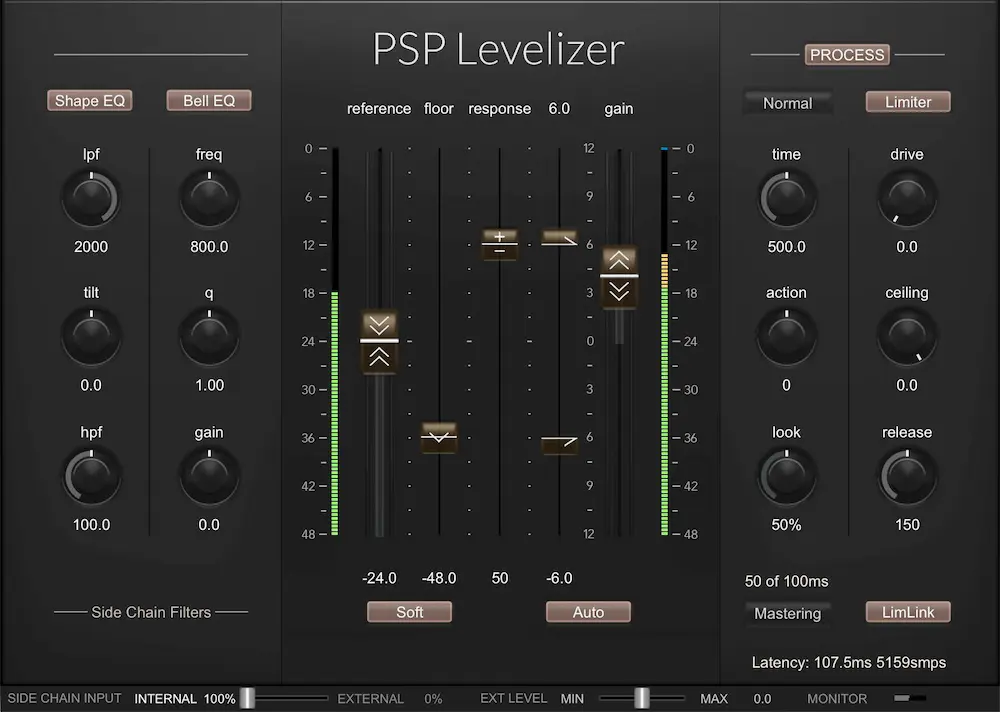
PSP Levelizer addresses this through dedicated detector shaping controls. Its Shape EQ and Bell EQ sections allow engineers to define which parts of the spectrum influence gain decisions. Rather than treating all frequencies equally, the detector can be weighted toward the information that matters most for a particular source.
On vocals, for example, detector emphasis can be shifted toward the frequency range responsible for intelligibility instead of allowing plosives and low-end energy to dominate the control signal. The result is often smoother gain movement because the processor responds more closely to the words being spoken or sung rather than to isolated low-frequency events.
The same principle applies to bass instruments. A detector focused on fundamental note energy may produce more stable level control than one reacting primarily to transient attack information. This becomes particularly important in modern bass-heavy productions where translation depends on consistent low-frequency perception rather than peak level alone. Similar challenges appear in synthesizer-based bass design, where note-to-note consistency can affect both mixing decisions and playback translation. UVI Rumble Review: Bass Translation, Mixing & Mastering Workflow Analysis. In both cases, the objective is not more gain reduction. The objective is more meaningful gain decisions.
This aspect of PSP Levelizer deserves more attention than headline features such as lookahead or reaction modes. In practical mixing situations, detector behavior often determines whether an auto-fader feels transparent enough to leave active throughout an entire session. If the detector consistently identifies the right information, the processor becomes easier to trust. If it does not, engineers quickly return to manual automation.
Reaction Modes and the Reality of Automation Behavior
Reaction speed is one of the most important variables in any auto-fader system because it determines how aggressively the processor responds to changing signal conditions. PSP Levelizer provides Sharp, Normal, and Smooth response modes, but the real consideration is not speed itself. It is how natural the resulting gain movement feels within a mix.
A detector that reacts too quickly can create a technically controlled signal while introducing a different problem: audible gain movement. When level adjustments begin tracking every transient, syllable, or performance nuance, the processor can start drawing attention to itself. The source may appear more consistent on a meter while feeling less natural to a listener.
Moving in the opposite direction creates a different compromise. Slower gain-riding behavior tends to preserve phrasing, musical dynamics, and performance intent, but it also allows larger level variations to remain. The challenge is finding a response profile that corrects meaningful level changes without reacting to every short-term fluctuation.
This balance is particularly important on vocals. Experienced engineers rarely automate every word with identical precision. Some level variation contributes to expression, intensity, and perceived realism. An effective auto-fader should support that performance rather than flatten it into a perfectly uniform signal.
From that perspective, Smooth mode may ultimately prove more useful for music production than the faster alternatives. Broadcast dialogue, voiceover work, and utility-focused applications often benefit from aggressive level control, but musical material generally requires more restraint. The most successful gain-riding systems tend to operate almost invisibly, correcting obvious level inconsistencies without making their presence obvious.
That limitation applies to every automatic level-management tool, regardless of manufacturer. No detector understands arrangement context, lyrical emphasis, or emotional intent. Those decisions remain the responsibility of the engineer. The role of an auto-fader is not to replace automation; it is to reduce the amount of routine automation required before creative decisions begin.
Critical Evaluation: Where PSP Levelizer’s Limitations Become Apparent
 The strongest criticism of PSP Levelizer is not related to its processing quality. It is related to the expectations surrounding automatic mixing tools in general.
Gain riding and mix automation are often discussed as if they serve the same purpose, but they solve different problems. Gain riding is primarily corrective. Automation is often creative. One aims to reduce level inconsistencies. The other shapes how a listener experiences a performance.
That distinction becomes obvious on lead vocals. Experienced mix engineers do not automate vocals solely to maintain a stable level. Automation is frequently used to emphasize important lyrics, increase intensity before a chorus, create contrast between song sections, or deliberately alter the relationship between a vocal and the instrumental. Those decisions depend on arrangement context, musical intent, and emotional impact rather than signal level alone.
PSP Levelizer can assist with the corrective portion of that work, but it cannot determine which words deserve emphasis or how a vocal should evolve throughout a song. A technically consistent level is not necessarily the same thing as an effective vocal balance.
The limitation becomes even more apparent in dense productions. A vocal may need to sit lower during an intimate verse and noticeably forward during a chorus with layered instrumentation. From the perspective of an auto-fader, both situations may appear to be level inconsistencies requiring correction. From the perspective of a mix engineer, they are often intentional production decisions.
This is where automatic level management reaches its practical boundary. The processor can evaluate signal behavior, but it cannot evaluate musical context. It has no awareness of arrangement density, lyrical importance, section transitions, or audience perception. Those variables remain outside the scope of any detector-based system.
None of this diminishes the value of PSP Levelizer. In fact, it defines where the plugin is most useful. The strongest workflow involves allowing the processor to handle routine level correction while reserving manual automation for decisions that affect the emotional and structural impact of a mix.
Engineers looking for a faster path to cleaner gain management may find significant value here. Engineers expecting autonomous mix decisions will quickly discover the limits of what automatic level control can realistically accomplish.
PSP Levelizer vs Competing Solutions
PSP Levelizer enters a category that is smaller than the compression market but far more specialized. Most engineers evaluating the plugin are unlikely to compare it against a limiter or channel strip. The more relevant question is how it fits alongside established gain-riding and automatic level-management tools.
Its closest conceptual competitor is Waves Vocal Rider, which remains one of the most widely recognized solutions for automatic vocal level control. Vocal Rider built its reputation on simplifying vocal automation workflows, but its design remains heavily centered around vocal mixing. PSP Levelizer appears to take a broader approach, positioning itself as a general-purpose level-management processor for vocals, dialogue, bass, and other sources where consistent signal level matters more than dynamic shaping.
Hornet AutoGain Pro approaches the problem from a different angle. Rather than functioning primarily as a vocal-riding tool, it focuses on automatic gain compensation and level balancing across a wider range of mixing scenarios. Users looking for straightforward gain normalization may find overlap between the two products, although PSP Levelizer appears more focused on continuous gain-riding behavior.
Melda MAutoVolume occupies the opposite end of the spectrum. It offers extensive control and routing flexibility, but that flexibility comes with additional complexity. Engineers who prefer deep customization may appreciate that approach, while others may prefer a workflow that reaches useful results more quickly.
The more interesting comparison may be with traditional compression. Many engineers attempt to solve level-management problems exclusively through compressors because compressors are already integrated into every mixing workflow. The limitation is that compression and gain riding are not interchangeable processes. Compression controls dynamic range. Gain riding manages average level. They frequently complement each other, but neither fully replaces the other.
| Solution | Primary Focus | Most Effective On | Key Limitation |
|---|---|---|---|
| PSP Levelizer | Continuous gain riding | Vocals, dialogue, bass, spoken word | Still requires manual automation for creative balance decisions |
| Waves Vocal Rider | Automatic vocal level control | Lead vocals | More narrowly focused workflow |
| Hornet AutoGain Pro | Automatic gain management | General mix balancing | Less emphasis on dedicated riding behavior |
| Melda MAutoVolume | Advanced level automation | Complex routing and custom workflows | Higher learning curve |
| Traditional Compression | Dynamic range control | Virtually any source | Cannot perform true gain riding |
Ultimately, the decision is less about replacing one processor with another and more about identifying the source of the problem. If the challenge is excessive dynamic range, compression remains the appropriate tool. If the challenge is inconsistent average level, an auto-fader may address the issue more directly. PSP Levelizer becomes most compelling when viewed through that distinction rather than as another alternative to conventional dynamics processing.
Why PSP Levelizer Is Not Just Another Vocal Rider Alternative
At first glance, PSP Levelizer appears to compete directly with products such as Waves Vocal Rider. Both tools automate level management, both reduce automation workload, and both target similar workflow problems.
The distinction is that Vocal Rider was designed primarily around vocal balancing, while PSP Levelizer appears to position itself as a broader level-management system. Its detector architecture, sidechain flexibility, reaction controls, and gain-limiting options suggest a wider range of applications beyond lead vocals.
Whether that flexibility translates into better results depends entirely on implementation. However, PSP Levelizer enters the market as a more ambitious attempt to solve level-management problems across multiple production environments rather than focusing exclusively on vocal mixing.
Real-World Production Perspective
The value of automatic level management is often easier to appreciate in a full production chain than in isolation. A source with fewer level swings tends to produce more predictable results across every processor that follows. Compressors respond more consistently, saturation stages become easier to control, dynamic EQs trigger more reliably, and limiters encounter fewer unexpected level spikes. This relationship becomes particularly noticeable when evaluating modern mastering limiters, where input consistency often influences transparency as much as the limiter itself. Tone Projects Uni-L Review: Is This the Future of Mastering Limiting?.
This does not mean every track should be aggressively leveled before processing. Excessive gain riding can remove natural performance dynamics and create a static, over-managed sound. The benefit comes from reducing unnecessary level variation while preserving the movement that contributes to musical expression.
Vocals illustrate this balance particularly well. When large level differences are addressed before heavy processing begins, subsequent EQ and compression decisions often become simpler. Engineers spend less time compensating for unpredictable behavior and more time shaping tone, space, and impact.
In mastering workflows, PSP Levelizer is unlikely to become a routine processing tool. By the time a project reaches mastering, level management decisions should already be largely resolved within the mix. However, the underlying concept remains relevant because many translation issues that appear during mastering are actually symptoms of level instability introduced earlier in production. This distinction often becomes clearer when comparing the responsibilities of mixing and mastering, since many problems blamed on mastering are introduced long before a track reaches the final stage of production. Mixing vs Mastering — What Actually Sets Them Apart in Real Projects.
This distinction becomes important when discussing streaming delivery. Loudness normalization can reduce playback level differences between releases, but it cannot correct an unstable vocal balance, inconsistent bass presentation, or a mix that changes character from section to section. Platform normalization addresses playback gain. It does not repair internal balance decisions. Engineers frequently confuse normalization with loudness optimization, even though the two involve different production decisions and measurement targets. LUFS Mastering Guide — What LUFS Really Means in Audio Mastering.
The same principle applies to codec conversion. Data compression may expose existing weaknesses in a mix, but it rarely creates them. If a vocal struggles to maintain position before encoding, AAC or Ogg conversion will not solve the problem. In many cases, translation issues begin with inconsistent level relationships long before a file reaches Spotify, Apple Music, YouTube, or any other distribution platform.
Viewed from a broader production perspective, PSP Levelizer is not a loudness tool, a mastering processor, or a replacement for mix automation. Its primary purpose is reducing level instability early enough that the rest of the production chain can operate under more predictable conditions.
Verdict
PSP Levelizer succeeds when evaluated as a level-management processor rather than a conventional dynamics tool. Engineers approaching it as an alternative to compression may struggle to justify its place in a session. Engineers dealing with time-consuming vocal rides, inconsistent dialogue recordings, or uneven bass performances are likely to understand its value much more quickly.
The plugin addresses a production task that often falls into an uncomfortable gap between manual automation and traditional dynamics processing. Compression can reduce dynamic range, but it does not necessarily solve level inconsistency. Manual automation solves the problem effectively, but at the cost of time. PSP Levelizer is designed to occupy that middle ground.
Its success ultimately depends less on the feature list and more on the quality of its detector behavior. An auto-fader lives or dies by the accuracy of its gain decisions. If the processor consistently reacts to the information that matters, it can remove a meaningful amount of repetitive corrective work from a mix. If it reacts to the wrong information, engineers will reach for automation instead.
For vocal-centric productions, spoken-word content, dialogue editing, and sources that require substantial level correction before compression, PSP Levelizer appears to offer a practical workflow advantage. It is unlikely to replace automation, and it is not intended to replace compression. Its value comes from reducing the amount of routine level-management work required before those tools become necessary. In many cases, the quality of those early decisions has a greater impact on the final result than the processing applied later in the mastering chain. Mastering Chain Explained — How It Really Works in Real Tracks.
Viewed through that lens, PSP Levelizer is not a revolutionary processor. It is a specialized utility aimed at a specific production problem. For engineers who regularly encounter that problem, it may become one of the more useful workflow tools released this year. For everyone else, it is likely to remain a situational processor rather than a permanent fixture in every mix template.

Yurii Ariefiev is a mastering engineer and audio production editor whose work focuses on mix translation, mastering diagnostics, playback consistency, and real-world release preparation. His technical reviews analyze how audio tools affect production decisions rather than simply listing features or specifications.
This article evaluates PSP Levelizer from a workflow perspective, examining where automatic gain riding fits alongside compression, automation, mix preparation, and the processes that ultimately influence mastering and playback translation.
FAQ
Can PSP Levelizer eliminate the need for manual vocal automation?
No. It can reduce the amount of corrective automation required, but it cannot make arrangement-based or artistic balancing decisions. Engineers will still need manual automation to shape energy, emphasize lyrics, and manage section-to-section transitions.
How does PSP Levelizer differ from Waves Vocal Rider?
Both tools are designed around automatic gain riding, but PSP Levelizer offers broader detector-shaping options and appears less focused on vocal-specific workflows. The practical difference depends on how flexible the detector and sidechain implementation prove to be in real sessions.
Should PSP Levelizer be inserted before or after a compressor?
In most cases, placing it before compression makes more sense. Stabilizing the incoming level allows compressors to react more consistently and often reduces the amount of gain reduction required.
Can PSP Levelizer replace clip gain editing?
Not entirely. Clip gain remains useful for correcting obvious recording issues, excessive level jumps, and problematic sections before processing. PSP Levelizer is better suited to continuous level management throughout a performance.
Is PSP Levelizer useful during mastering?
Its primary application is mixing, dialogue production, and pre-master preparation. Most mastering engineers would rather address level instability in the mix than rely on automatic gain-riding during the final stage of production.
Can PSP Levelizer improve bass consistency without heavy compression?
Potentially. Bass instruments often exhibit significant note-to-note level variation. Gain riding can sometimes produce a more natural result because it addresses average level differences without relying entirely on dynamic-range reduction.
Does PSP Levelizer affect loudness measurements such as LUFS?
It can influence integrated loudness indirectly, but its primary objective is level consistency rather than loudness optimization. Any change in LUFS is a consequence of gain management rather than the purpose of the processor.
Can PSP Levelizer be used for podcast and dialogue production?
Yes. Dialogue is one of the most practical applications for automatic level management because listener fatigue is often caused by inconsistent speech levels rather than insufficient loudness.
How important is detector EQ when using an auto-fader?
Detector tuning is often more important than reaction speed. If the detector responds to plosives, resonances, or transient spikes instead of the information that determines perceived level, gain-riding accuracy can suffer significantly.
Can an auto-fader replace sidechain compression or ducking?
Not completely. While external sidechain control can achieve some similar results, gain-riding systems and ducking processors are designed to solve different workflow problems and do not always produce the same behavior.