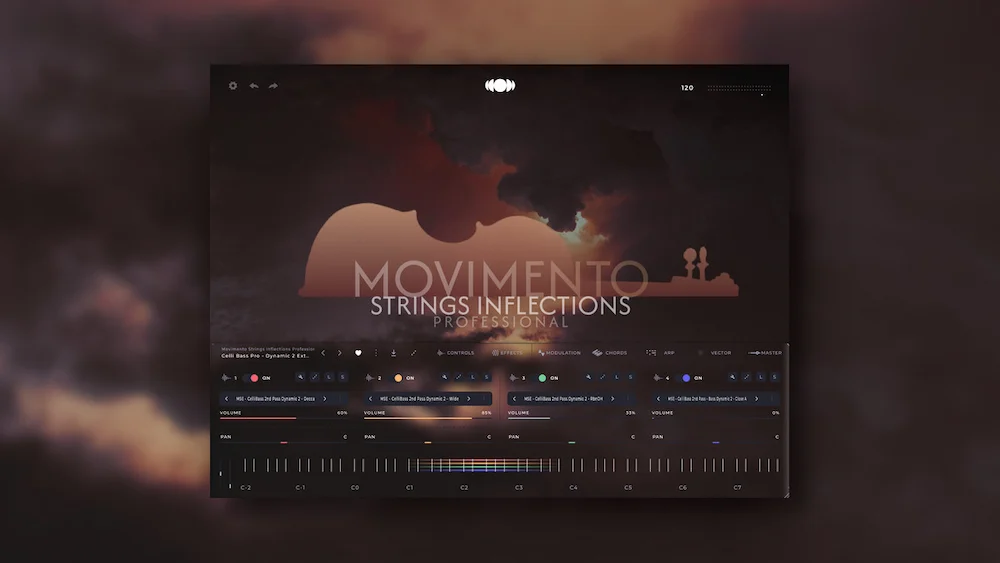
Movimento Strings Inflections Review: Performance-Driven Motion for Modern Cinematic Strings
Most cinematic string libraries are built around expansion: larger ensembles, more articulations, additional microphone positions, and increasingly detailed sampling. Yet one of the most persistent problems in virtual orchestration has little to do with library size. It is movement.
Static sustains remain a common weakness in sampled strings. A chord can be perfectly voiced, balanced, and technically convincing, yet still feel synthetic because every player behaves identically. Real sections never operate that way. Individual musicians constantly introduce small variations in timing, bow pressure, dynamics, and intonation, creating subtle instability that gives an ensemble depth and realism.
Movimento Strings Inflections, developed specifically around evolving ensemble behavior, approaches the problem from a different angle. Rather than expanding articulation counts or pursuing larger ensemble recordings, it focuses on internal motion within sustained textures. The goal is not bigger strings, but more active ones.
That design choice places the library in a different category than most cinematic string releases. Instead of functioning as a primary orchestral foundation, Inflections is built to solve a specific production challenge: keeping long string passages alive without relying on automation, layered modulation, or constant arrangement changes. For composers working in modern film, television, and game scoring, that distinction may be more significant than another collection of traditional articulations.
Why Motion Matters in Modern Cinematic Scoring
Modern cinematic scoring places far greater emphasis on texture than traditional orchestral writing. Across film, television, game audio, and trailer production, sustained material is rarely expected to remain static for long. Even simple harmonic beds are often required to generate tension, momentum, or emotional development without drawing attention away from the narrative.
This shift has changed how composers approach orchestration. In many contemporary productions, strings no longer operate as isolated orchestral elements. They share space with synthesizers, sound design layers, processed ambiences, drones, and hybrid textures. Under those conditions, conventional sustains can feel lifeless, particularly when competing against sources that contain constant spectral or dynamic movement.
As a result, composers have increasingly moved away from static sampling workflows. Instead of relying solely on note changes to create development, many productions generate motion within the sustain itself. That movement may come from performance variation, articulation morphing, expression programming, or layered orchestration techniques.
Building those textures manually is possible, but it often requires significant programming. Multiple articulation layers, automation passes, dynamic crossfades, and modulation systems can quickly become part of the writing process. The more realistic the movement needs to feel, the more complex the workflow typically becomes.
This production environment has created demand for libraries designed around behavioral movement rather than traditional articulation depth. Instead of simulating evolution through programming, these instruments embed motion directly into the recorded performances.
That is the space Movimento Strings Inflections occupies. Rather than expanding the scope of a conventional string library, it focuses on a specific challenge in modern audio production: sustaining listener engagement during long orchestral passages without relying on constant arrangement changes or extensive automation.
What Movimento Strings Inflections Actually Sounds Like in a Real Mix
The most noticeable characteristic of Inflections is not the movement itself but the absence of static repetition. Instead of hearing obvious modulation or programmed dynamics, the listener perceives a section that feels slightly unsettled and continuously evolving.
In practice, the effect is often more subtle than product demonstrations suggest. The articulations rarely dominate a cue. Their contribution is usually felt as depth, instability, and ongoing activity underneath the primary musical material.
That distinction matters because many composers evaluating the library for the first time may expect dramatic motion. Inflections is generally more effective when treated as a supporting layer than as the focal point of an arrangement.
What Makes Movimento Strings Inflections Different From Traditional String Libraries
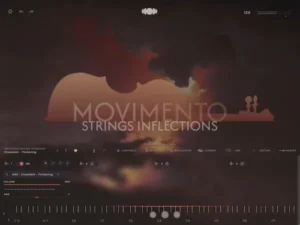 Most orchestral libraries pursue realism through sampling depth. More velocity layers, additional articulations, and expanded microphone options are all intended to create a more convincing representation of a recorded ensemble. Movimento Strings Inflections approaches realism from a different direction.
Its focus is not on how a section sounds at a single moment, but on how that section behaves over time.
This distinction is easy to overlook until multiple string libraries are compared inside an actual production. Many sustain patches sound convincing when triggered individually. The illusion often weakens during longer passages, where every player appears locked into identical dynamic and timing behavior. Real ensembles rarely operate with that level of consistency.
Inflections is built around four performance concepts—Flickering, Ricochet Gestures, Dynamic, and Dynamic Flautando. Rather than introducing internal activity through external modulation or extensive MIDI programming, these articulations generate variation from within the recorded performances themselves.
The underlying principle is simple: individual musicians do not react identically. Small differences in timing, dynamics, bow pressure, and performance intensity create constant fluctuations across a section. Those fluctuations may be subtle, but they contribute significantly to the sense of depth and realism listeners associate with live players. Similar questions of realism and performance behavior appeared in our VSL Synchron Solo Violin 1 & Cello Sordino review, although that library approaches authenticity through solo performance detail rather than evolving ensemble motion.
By allowing performers to evolve independently instead of moving as a perfectly synchronized block, Inflections produces textures that feel less deterministic than conventional sustain libraries. That unpredictability will not suit every arrangement. In exposed orchestral writing it can occasionally draw attention to itself. In atmospheric scoring, tension beds, and hybrid productions, however, it often creates the kind of organic movement that composers typically spend considerable time programming by hand.
Flickering: Controlled Instability as a Creative Tool
Flickering is arguably the articulation that best illustrates the design philosophy behind Movimento Strings Inflections.
Instead of maintaining a stable sustain, individual players introduce brief quarter-tone acciaccaturas at unpredictable moments throughout a held note. The result is a constantly shifting texture that never fully settles into harmonic stability.
In a traditional orchestral context, this type of pitch deviation would often be treated as a performance flaw. In contemporary cinematic scoring, the same behavior can become a valuable source of tension. The articulation creates unease without relying on overt dissonance, aggressive dynamics, or obvious orchestration techniques.
What makes Flickering particularly effective is its restraint. It does not behave like a cluster patch, nor does it resemble exaggerated vibrato. The movement exists below the level of conscious attention, creating subtle friction inside the section rather than announcing itself as a special effect.
From a production standpoint, this has practical advantages. Sustained orchestral layers often become static once they are surrounded by modern cinematic elements such as drones, synthesizers, impacts, atmospheres, and sound design textures. Even well-recorded string libraries can lose definition when multiple layers compete for the same emotional role.
Flickering introduces internal activity without increasing arrangement density. Instead of adding another layer to generate internal activity, the movement is already embedded within the performance itself. That allows the string section to retain a sense of motion while preserving valuable space in the arrangement.
The articulation is particularly effective in suspense scoring, psychological drama, horror soundtracks, and atmospheric game music, where emotional tension often develops gradually rather than through dramatic orchestral gestures. In those situations, Flickering can create a persistent sense of instability that feels musical rather than engineered.
Its value becomes even more apparent in dense productions. Once compression, saturation, limiting, and additional production layers begin shaping the mix, subtle performance variation often survives more naturally than automation-driven ensemble variation. That gives Flickering a practical advantage beyond sound design aesthetics: it continues contributing depth and tension even after the production becomes heavily processed.
Ricochet Gestures and the Problem of Loop Fatigue
One of the persistent limitations of sampled orchestral writing is repetition. Sustained articulations may sound convincing at first, but during extended passages the underlying sample behavior often becomes apparent. The issue is not necessarily audio quality. It is predictability.
Real string sections are constantly changing. Individual musicians adjust bow speed, articulation intensity, timing, and physical energy in ways that rarely align perfectly across an ensemble. Sample libraries typically struggle to reproduce that behavior over long durations.
Ricochet Gestures address the problem by introducing independent performance evolution within the section. Rather than sustaining a static texture indefinitely, players gradually move into ricochet-based activity before naturally dissipating. Because these changes occur independently across the ensemble, the articulation avoids the synchronized feel that often reveals a programmed performance.
The result is less about rhythmic definition and more about continuous variation. The texture remains active without becoming repetitive, making it particularly useful for cues that need to sustain tension over extended periods.
From a workflow perspective, this can reduce the amount of manual programming required to maintain interest within a static harmonic structure. Composers often build similar movement through layered articulations, automation curves, expression programming, or additional sound design elements. Ricochet Gestures achieve much of that complexity within a single performance layer.
It is also important to view the articulation for what it is. Ricochet Gestures function more like a developing texture than a conventional orchestral articulation. They are not intended to replace traditional short notes, ostinatos, or rhythmic writing. Their role is to create motion inside sustained material where conventional orchestration techniques might otherwise require additional layers.
That specialization will inevitably narrow the audience. Composers looking for standard orchestral building blocks may find limited use cases. Those working in suspense scoring, atmospheric television music, psychological drama, hybrid orchestral production, or game audio are more likely to appreciate the way the articulation introduces ensemble variation without increasing arrangement density.
Dynamic and Dynamic Flautando: Subtle Motion Instead of Obvious Movement
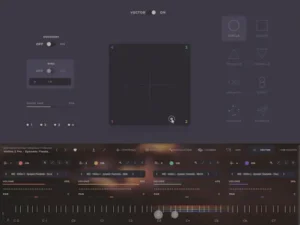 Not every form of movement needs to announce itself. In many scoring situations, the most effective textures are the ones listeners never consciously notice.
Dynamic and Dynamic Flautando are built around that principle. Rather than producing dramatic swells or clearly identifiable performance gestures, both articulations rely on independent crescendos and decrescendos distributed across the ensemble. The changes are intentionally restrained, creating a texture that evolves continuously without drawing attention to the mechanism behind it.
The effect is particularly relevant in modern screen scoring, where music often operates below the level of conscious focus. Dialogue-driven dramas, atmospheric television productions, and emotionally restrained film scores frequently require a sense of motion without obvious orchestral activity. Under those conditions, large dynamic gestures can feel intrusive, while static sustains risk sounding lifeless.
Dynamic articulations occupy the space between those extremes. The texture continues to breathe and shift, yet the movement remains embedded within the ensemble rather than appearing as a compositional event.
Dynamic Flautando extends the concept through timbre as much as dynamics. By moving the bow closer to the fingerboard, the articulation produces a softer, more diffuse tone with less upper-midrange emphasis than a conventional sustain. That tonal profile can be particularly useful in dense arrangements where multiple layers are already competing for attention.
Modern cinematic productions rarely consist of orchestral instruments alone. String sections frequently coexist with pads, synthesizers, drones, ambient textures, low-frequency design elements, and extensive spatial processing. In those environments, adding another sustained layer can create masking issues long before it contributes anything musically useful.
Dynamic Flautando addresses that problem by occupying space differently. Rather than competing for definition and presence, it contributes atmosphere, depth, and motion while maintaining a relatively low perceptual footprint. The articulation remains audible, but it rarely demands focus.
From a mixing perspective, that behavior can be more valuable than dramatic orchestral effects. A texture that integrates naturally into a complex arrangement often requires less corrective EQ, less automation, and fewer compromises elsewhere in the production. For composers working in hybrid orchestral workflows, that practical advantage may ultimately matter more than the articulation itself.
Where Movimento Strings Inflections Fits Inside a Modern Mixing Workflow
Sample libraries are typically evaluated in isolation. Real productions are not. The more relevant question is how a library behaves once it enters a mix filled with dialogue, percussion, synthesizers, low-frequency design elements, reverbs, and multiple orchestral layers competing for the same space.
This is where many cinematic string libraries reveal their limitations. Large ensembles often sound impressive in demonstrations but require significant intervention once a project reaches production scale. Additional EQ, automation, layering, and spatial processing become necessary to preserve textural development and separation inside increasingly dense arrangements.
Movimento Strings Inflections approaches the problem differently. Rather than generating interest through larger sonic footprints, its articulations derive movement from performance behavior. The texture evolves internally instead of relying on additional layers, modulation effects, or aggressive orchestration techniques.
From a mixing standpoint, that distinction matters. Every new layer introduced to create motion also introduces additional frequency content, spatial information, and potential masking. As arrangements become more complex, maintaining clarity often becomes more difficult than generating excitement.
Because Inflections embeds movement directly into the performance, composers can often achieve a sense of development without continuously expanding the arrangement. The result is a workflow that favors internal complexity over structural complexity.
This can simplify mix decisions considerably. A string section that remains active on its own typically requires less automation, fewer supporting layers, and less corrective processing than a static sustain that depends on external movement sources to remain engaging.
Many of the problems introduced at this stage eventually surface during mastering rather than mixing, particularly when excessive layering begins to create masking, depth, or tonal balance issues. Those scenarios are examined in greater detail in Mastering Problems Guide.
There is also a translation advantage. Performance-driven textural development tends to survive processing more naturally than movement created through modulation plugins, extensive automation, or layered effects chains. Once compression, saturation, bus processing, and mastering enter the signal path, subtle variations in performance often remain intact while artificially generated movement can become exaggerated, flattened, or unpredictable.
For composers and mixing engineers working in hybrid orchestral productions, that behavior may be one of the library’s most practical strengths. The value is not simply that the articulations move. It is that they continue to move after the production process becomes significantly more complex.
Critical Evaluation: Where the Concept Is Strong and Where It Becomes Niche
Movimento Strings Inflections succeeds precisely because it refuses to solve every orchestration problem. Its scope is deliberately narrow, which makes the library more useful in some workflows and far less relevant in others. The library is built around a highly specific production objective: introducing organic movement into sustained orchestral textures. Outside that role, its usefulness becomes significantly more situational.
Composers looking for a primary string library, a comprehensive articulation collection, or a traditional orchestral foundation will need to look elsewhere. Inflections is not designed to cover the full range of orchestral writing. It addresses a narrower problem that many conventional libraries leave largely unsolved.
That specialization inevitably reduces its audience. In practice, most users are unlikely to build entire scores around these articulations. Instead, the library functions more effectively as an enhancement layer within an established orchestral template.
This should not be interpreted as a weakness. Many of the most valuable tools in professional production environments solve specific problems exceptionally well rather than attempting to cover every possible use case. The question is whether the problem being solved exists within your workflow.
For composers working in film, television, game audio, and atmospheric hybrid scoring, the answer may be yes. Long-form tension cues, evolving underscore, ambient orchestral textures, and psychologically driven soundtracks often benefit from the type of internal movement Inflections provides.
The library becomes less convincing when removed from those contexts. Some articulations derive much of their effectiveness from how they interact with surrounding layers. Inside a completed cinematic mix, the movement can feel organic and naturally integrated. Exposed on their own, certain textures may appear more stylized than realistic.
This is particularly relevant for composers working in sparse arrangements. The same performance characteristics that create subtle depth within a dense orchestral environment can become more obvious when fewer elements compete for attention. Whether that behavior is desirable depends largely on the aesthetic goals of the project.
Viewed through a production lens, Inflections is at its strongest when treated as part of a larger orchestral ecosystem rather than as a standalone solution. Its role is not to carry an arrangement on its own, but to introduce complexity, instability, and movement into sections that might otherwise remain static.
Marketing Claims vs Production Reality
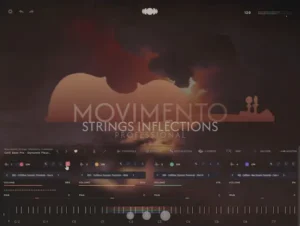 Most orchestral libraries are marketed around realism, but realism alone is rarely the deciding factor in professional workflows. The more important question is whether a library continues to work once it becomes part of a finished production.
Many products sound impressive in demonstrations because they are presented under ideal conditions. Sparse arrangements, carefully selected examples, and minimal competition from other elements make it easy for a library to showcase its strengths. Real scoring environments are considerably less forgiving.
What separates Inflections from many cinematic releases is that its primary value is not tied to scale, processing, or sheer sonic impact. The library’s defining characteristic is behavioral variation rather than sheer sonic impact. That distinction becomes more valuable as arrangements grow denser and production complexity increases. A texture that remains active inside a dense arrangement often provides more long-term value than a patch that sounds impressive in isolation.
That does not mean the library solves orchestration problems on its own. Evolving articulations can enhance a cue, but they cannot compensate for weak musical decisions. Harmonic development, voicing, dynamic structure, orchestral balance, and arrangement density still determine whether a piece feels convincing.
There is sometimes a tendency to treat movement-based libraries as shortcuts to realism. In practice, they function more like force multipliers. When the composition is already working, subtle performance variation can increase depth, tension, and perceived realism. When the writing itself is underdeveloped, additional movement rarely changes the outcome.
This distinction is important because Inflections is most effective when viewed as an orchestration tool rather than a solution. The articulations introduce behavior that would otherwise require significant programming effort, but they do not replace the compositional decisions that give that behavior context.
From a production perspective, that may be the most realistic way to evaluate the library. Its strongest contribution is not that it makes strings sound bigger or more dramatic. It makes sustained material feel less static, which is often a more difficult problem to solve in modern cinematic scoring.
Standard vs Professional: Which Version Makes More Sense?
The difference between the Standard and Professional editions goes beyond convenience features. The decision largely comes down to how much control a composer wants during the mixing stage.
The Standard version is built for speed. The included patches are designed to work immediately, allowing users to focus on writing rather than managing microphone balances, routing decisions, or template complexity. For many composers, particularly those producing smaller-scale projects or working under tight deadlines, that approach will be entirely sufficient.
The Professional edition becomes more relevant once projects demand greater control over depth, space, and ensemble size. Additional microphone perspectives are not simply tonal variations. They provide independent control over how the section occupies a mix, making it possible to shape perceived distance, stereo width, and spatial placement with far greater precision.
This flexibility becomes increasingly valuable in larger productions. As arrangements grow more complex, orchestral sections often need to be positioned carefully against dialogue, sound design, percussion, and synthetic elements. Access to multiple microphone signals creates opportunities that are difficult to replicate convincingly with EQ and reverb alone.
The additional performance pass may appear secondary compared to the microphone options, but it addresses a practical orchestration challenge. Expanding the perceived size of a section without introducing obvious duplication artifacts is rarely as simple as stacking identical performances. Independent performance variation helps preserve the natural inconsistencies that make larger ensembles feel believable.
For composers building dense templates, mixing their own projects, or delivering material for immersive and surround-oriented workflows, the Professional edition offers meaningful advantages beyond the extra presets. The added flexibility can influence both arrangement decisions and downstream mix preparation.
By contrast, users focused on atmospheric cues, lighter productions, or streamlined writing workflows may find that the Standard version captures most of the library’s value without introducing additional complexity. In those situations, ease of use may outweigh the benefits of deeper control.
Competitive Positioning
Comparing Movimento Strings Inflections directly to traditional orchestral libraries misses the point of the product. It is not attempting to compete with comprehensive string collections, deep articulation catalogs, or large-scale scoring packages. Its role is far more specific.
The more relevant comparison is between Inflections and the techniques composers already use to create movement inside sustained material.
In many professional workflows, evolving textures are not generated by a single library. They emerge from layered articulations, expression programming, automation curves, dynamic morphing, sound design processing, and combinations of multiple orchestral sources. The end result can be highly effective, but it often comes at the cost of increased programming time and template complexity.
Inflections offers an alternative approach. Rather than building movement through multiple stages of manipulation, it incorporates movement directly into the recorded performances. The value proposition is less about sonic exclusivity and more about workflow efficiency.
This distinction places the library in a relatively uncommon position within the market. Its primary competition is not necessarily another product. In many cases, its competition is the amount of time a composer is willing to spend constructing similar behavior manually.
That does not automatically make Inflections a better solution. Advanced users with established orchestral templates may already have sophisticated methods for generating evolving textures. For those composers, the question becomes whether the library produces results that are faster, more convincing, or more flexible than an existing workflow.
For others, particularly composers working under production deadlines, the appeal is easier to understand. Internal movement is available immediately, without additional routing, layered programming, or extensive automation. The library effectively shifts part of the complexity from the composition stage to the performance stage, allowing users to focus more on writing and less on constructing motion artificially.
Movimento Strings Inflections vs Popular Alternatives
| Solution | Primary Focus | Production Strength | Best Workflow Use | Potential Limitation |
|---|---|---|---|---|
| Movimento Strings Inflections | Performance-driven motion within sustained textures | Creates organic movement with minimal programming | Tension beds, atmospheric scoring, evolving sustains | Specialist rather than a complete orchestral solution |
| Spitfire Chamber Strings | Detailed chamber ensemble realism | Strong for expressive orchestral writing and traditional scoring | Traditional orchestration and intimate ensemble work | Movement typically requires additional programming and articulation management |
| Orchestral Tools Berlin Strings | Comprehensive orchestral depth and realism | Highly detailed control for traditional orchestration workflows | Realistic mockups and detailed orchestral scoring | Less focused on evolving textures as a core design objective |
| EastWest Hollywood Strings | Large-scale cinematic ensemble sound | Effective for broad, powerful orchestral arrangements | Blockbuster-style cinematic productions | Can require more mix management in dense hybrid productions |
| Custom Layering and Automation Workflows | Composer-built movement systems | Maximum flexibility and customization | Fully customized motion design and texture building | Higher programming overhead and greater template complexity |
The comparison highlights why Inflections occupies an unusual position in the orchestral market. Most competing products focus on realism, articulation depth, ensemble size, or recording detail. Inflections focuses on behavior.
That difference becomes more apparent during long-form writing. Traditional libraries provide the raw materials needed to create movement, but the movement itself often has to be programmed through expression control, articulation switching, layered performances, or additional processing. Inflections shifts part of that workload into the source material.
For composers working primarily in conventional orchestral styles, libraries such as Chamber Strings, Berlin Strings, or Hollywood Strings will remain far more versatile. They cover a broader range of musical situations and can function as primary orchestral foundations.
Inflections is better viewed as a complementary tool. Its value is highest when a project already contains a strong orchestral framework and requires additional motion, tension, or textural development within sustained passages. In that role, it solves a different problem than most of the libraries it might initially be compared against.
How Composers Are Most Likely to Use It in Real Templates
Most composers will not load Movimento Strings Inflections as a replacement for their main string library. A more realistic workflow is to pair it with an existing orchestral foundation.
A common approach is keeping traditional sustains, legatos, and shorts inside the primary template while introducing Inflections selectively during moments that require evolving tension, emotional ambiguity, or atmospheric development.
For example, a composer might build the core harmonic structure using Berlin Strings, Synchron Strings, or Chamber Strings, then layer Flickering or Dynamic articulations beneath the arrangement to introduce movement that would otherwise require additional programming.
In hybrid scores, Inflections often functions closer to a sound-design layer than a conventional orchestral section. The library can provide motion inside drones, ambient beds, and long-form tension cues while preserving the organic character of acoustic players.
That role is important because it clarifies what the product actually replaces. In many workflows, Inflections competes less with another string library and more with hours of automation, articulation switching, and texture design.
Who Should Consider It — And Who Probably Shouldn’t
Movimento Strings Inflections is easiest to justify in workflows where sustained textures play a significant role in the storytelling process. Composers working in film, television, game audio, and hybrid orchestral production are the most obvious audience because they frequently need music to evolve without relying on overt melodic or rhythmic development.
In those environments, subtle internal movement can be more valuable than additional articulations. Atmospheric underscore, psychological tension, ambient orchestration, and long-form dramatic cues often depend on gradual change rather than obvious musical events. Inflections is specifically designed to support that type of writing.
The library is less compelling as a primary orchestral investment. Users building a first orchestral template will generally benefit more from comprehensive string collections that cover a wider range of articulations, ensemble styles, and scoring scenarios. Inflections works best when those foundations are already in place.
Its appeal may also be limited for composers focused on traditional orchestral mockups, classical repertoire, or highly exposed symphonic writing. The performance behaviors that make the library attractive in cinematic contexts can feel stylistically out of place when realism is defined by precision, consistency, and conventional orchestral technique.
Similarly, producers looking for aggressive trailer energy, dominant ensemble statements, or large-scale orchestral impact are unlikely to find that this library addresses their primary needs. Its strengths are subtler and more textural by design.
Ultimately, Inflections occupies a space between orchestration and sound design. The closer a composer’s workflow moves toward evolving textures, atmospheric storytelling, and behavioral movement within sustained material, the more relevant the library becomes.
Real-World Production Perspective
A sample library’s behavior inside a finished production is often more important than its sound in isolation. Promotional demonstrations typically present instruments under ideal conditions. Real projects introduce a very different set of variables.
By the time a cue reaches its final form, orchestral material may have passed through bus processing, saturation, dynamic control, spatial treatment, stem mastering, and platform-specific encoding. Every stage has the potential to alter the way movement is perceived. Understanding how those processing stages interact is part of the broader mastering workflow discussed in How Professional Mastering Works.
This is where performance-driven libraries often have an advantage over movement generated through processing. Modulation effects, automated filters, stereo enhancement, and layered sound design can produce impressive results, but they do not always survive downstream processing gracefully. Compression may exaggerate them. Limiting may flatten them. Additional layers may obscure them entirely. Similar translation concerns appear outside orchestral production as well. Our UVI Rumble review examined how movement, articulation, and low-frequency design behave once real-world mixing and mastering processing enter the signal chain.
Inflections takes a different approach because the movement originates within the recorded performances rather than being imposed afterward. As a result, much of the library’s character remains tied to natural variations in timing, dynamics, articulation, and ensemble behavior.
From a mixing perspective, that can reduce the need for artificial enhancement. The articulations already contain a degree of internal activity, making it easier to maintain depth and separation without relying heavily on widening processors, modulation plugins, or excessive automation.
The advantage often becomes more apparent as arrangements grow denser. Modern cinematic productions frequently combine orchestral recordings with synthesizers, drones, impacts, atmospheres, and dialogue. Under those conditions, subtle performance variation tends to remain perceptible longer than movement created solely through effects processing.
The same principle extends into mastering. While any form of dynamic control will inevitably alter low-level detail, performance-based movement often retains its character more effectively than heavily processed alternatives. Small fluctuations embedded within the ensemble remain part of the performance rather than existing as an external effect that can be exaggerated or diminished by later processing stages.
For streaming-oriented productions, that distinction is particularly relevant. Loudness normalization, data reduction, and playback on consumer systems can reduce the impact of delicate production techniques. Textures that derive their movement from the source material itself generally stand a better chance of preserving their character across different listening environments.
Monitoring, Translation, and Streaming Considerations
Translation remains one of the more difficult challenges in cinematic production. A texture that feels rich and detailed on full-range studio monitors may behave very differently once it reaches consumer playback systems.
Most listeners experience film, television, and game music through headphones, televisions, soundbars, laptops, mobile devices, or streaming platforms operating under conditions that reveal far less detail than a professional monitoring environment. As a result, not every production technique survives the transition equally well.
Highly nuanced automation, subtle stereo enhancement, and delicate spatial effects can lose impact as playback quality decreases. In some cases, the listener may no longer perceive the intended movement at all.
Performance-driven movement tends to be more resilient because it is embedded within the musical material itself rather than dependent on playback-dependent effects. Even when individual details become less audible, the overall texture can still feel active and evolving.
This characteristic aligns well with the type of environments where cinematic music is commonly consumed. The listener may not consciously recognize independent dynamic shifts, pitch fluctuations, or evolving articulations, but the accumulated effect often contributes to a stronger sense of depth and realism.
That does not mean every nuance survives translation. No orchestral library is immune to the limitations of playback systems, codec compression, or streaming delivery. However, movement derived from performance behavior generally relies less on fragile production techniques than movement created through extensive automation or stereo manipulation.
For composers working primarily in streaming-oriented workflows, that distinction may be more relevant than raw sonic detail. The question is not simply how a library sounds inside a studio. It is how much of its musical character remains intact once the production leaves the studio environment altogether. Similar translation challenges appear during mastering, particularly when releases are optimized for platform normalization and streaming delivery, a topic explored further in this LUFS Mastering Guide.
Template Size, CPU Usage, and Workflow Impact
Libraries built around evolving performances often introduce a different type of resource demand than conventional sustain patches. The challenge is not necessarily raw CPU consumption but template management.
Composers working with large orchestral setups must decide whether motion should come from additional layers, automation systems, or dedicated performance libraries. Inflections shifts some of that workload from programming to playback.
The Professional edition can become significantly heavier when multiple microphone positions are active simultaneously, particularly inside larger hybrid templates.
That tradeoff will be familiar to most orchestral composers. Additional realism almost always increases resource requirements somewhere in the production chain.
The practical advantage is that many users may reduce automation complexity and auxiliary texture layers, partially offsetting the additional footprint introduced by the library itself.
Who Should Skip Movimento Strings Inflections
Not every composer needs a movement-focused library. Writers focused primarily on traditional orchestral mockups, concert music, or highly exposed symphonic realism may gain more value from expanding their core orchestral collection first.
Inflections delivers its strongest results when atmospheric development, tension building, hybrid scoring, and evolving textures play a central role in the composition. Outside those workflows, its specialization can become difficult to justify.
Verdict
Movimento Strings Inflections succeeds because it addresses a specific production problem rather than attempting to become a universal orchestral solution. Its focus is narrow, but the focus is intentional.
Many string libraries provide convincing recordings, extensive articulation sets, and detailed microphone options. Far fewer address what happens after a chord is played. Inflections is built around the idea that sustained material should continue evolving rather than remaining static, and that concept shapes every aspect of the library.
The strongest articulations are not necessarily the most dramatic. Their value comes from introducing subtle performance variation that would otherwise require additional programming, layered orchestration, or external processing. In the right context, that can simplify workflows while producing more organic results.
At the same time, the library’s specialization defines its limitations. It is not a replacement for a primary string collection, nor is it intended to cover the full range of orchestral writing. Composers seeking versatility will find stronger options elsewhere. Composers looking for movement, tension, and evolving textures inside sustained passages will find a much smaller field of direct alternatives.
Ultimately, the decision comes down to workflow rather than sound quality. Most modern orchestral libraries are capable of producing excellent recordings. The more relevant question is how much time and effort a composer is willing to invest in creating movement after the notes have already been written.
For film scoring, television, game audio, atmospheric orchestration, and hybrid cinematic production, Movimento Strings Inflections offers a focused solution to a problem that many composers encounter regularly but few libraries address directly. As with any production tool, however, the quality of the final result still depends on the decisions made during arrangement, mixing, and the final mastering stage. Readers unfamiliar with that process may find additional context in What Is Audio Mastering.

Yurii Ariefiev is a mastering engineer and audio production editor who evaluates music software, sample libraries, and production tools through the lens of real-world mixing, mastering, and playback translation. His reviews focus on workflow impact, mix integration, and how production decisions hold up beyond isolated demonstrations.
This analysis examines Movimento Strings Inflections from a production perspective rather than a feature-list perspective, focusing on orchestral workflow efficiency, mix behavior, streaming translation, and the practical role of performance-driven movement inside modern cinematic productions.
FAQ
Can Movimento Strings Inflections function as a primary orchestral string library?
Not realistically. The library is designed to complement an existing orchestral setup rather than replace one. Its value comes from adding movement and evolving behavior to sustained passages, not from providing comprehensive orchestral coverage.
How useful is it for film and television scoring?
It is particularly well suited to underscore, tension-building cues, atmospheric scenes, and emotionally restrained writing where gradual evolution is more important than overt orchestral gestures.
Does it work for trailer music production?
It can be effective in suspense-driven and atmospheric trailer cues, but it is not designed around the aggressive rhythmic writing, large impacts, or high-energy ensemble performances commonly associated with modern trailer music.
How does it compare to building movement through automation?
Automation can achieve similar results, but it requires additional programming and ongoing refinement. Inflections places much of that movement inside the recorded performance, reducing the amount of manual control needed to create evolving textures.
Will the articulations hold up inside dense hybrid orchestral mixes?
That is arguably where they are most effective. The library was designed for situations where strings must coexist with synthesizers, sound design elements, percussion, and atmospheric layers without becoming static.
Does the Professional edition make a noticeable difference during mixing?
For users who actively shape depth, stereo placement, and spatial perspective, the additional microphone positions provide significantly more control. Composers working with simpler templates may see less benefit.
Can Movimento Strings Inflections reduce orchestral programming time?
In many cases, yes. Because movement is embedded within the performances, composers may spend less time creating activity through automation, articulation switching, or layered programming techniques.
How demanding is the library on CPU and system resources?
Resource usage depends largely on project complexity and microphone configuration. Sessions using multiple microphone perspectives will naturally place greater demands on both memory and processing resources.
Is it a better choice than buying another traditional string library?
That depends on what is already available in the template. Composers lacking a solid orchestral foundation will usually benefit more from a comprehensive string collection. Those who already own several orchestral libraries may find that Inflections solves a problem their existing tools do not address directly.
Who is most likely to benefit from this library?
Composers working in film, television, game audio, ambient orchestration, and hybrid scoring environments are the most natural audience. The library is at its strongest when movement, atmosphere, and gradual development are central parts of the musical language.
Does Movimento Strings Inflections work well alongside Spitfire, Berlin Strings, or Synchron libraries?
Yes. In fact, many composers will likely achieve the best results by combining Inflections with a traditional orchestral foundation. The library was designed to complement existing templates rather than replace them.