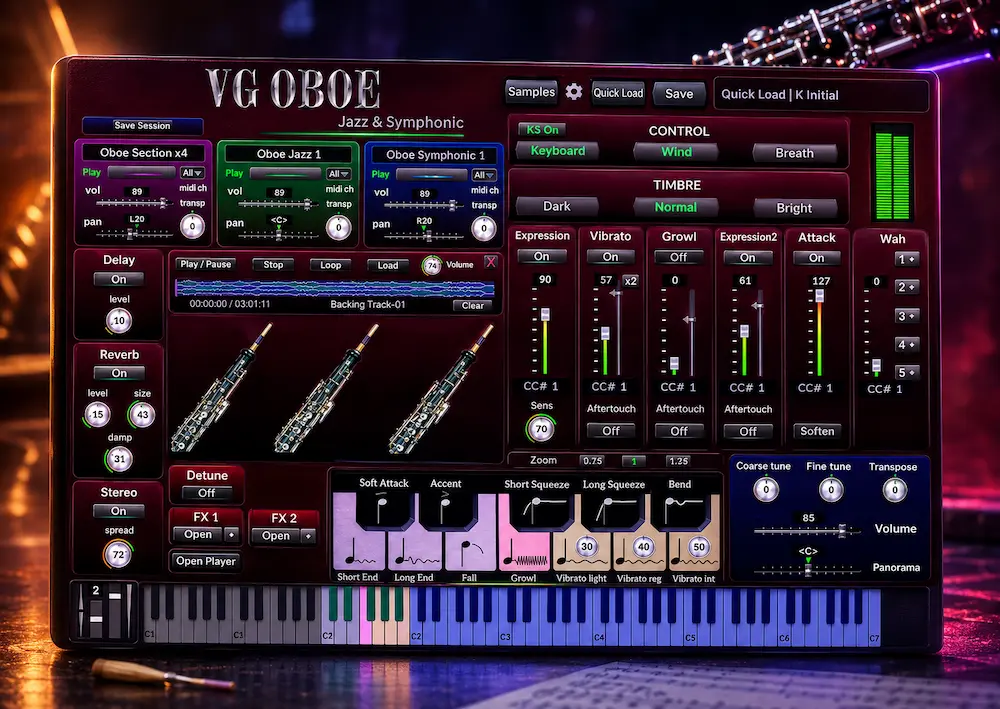
Most oboe VSTs are built around the same basic workflow: load a patch, play the MIDI part, then shape the performance with automation. VG Oboe is an oboe plugin that takes a more performance-oriented approach. Its three sampled oboe layers can be blended in real time, while expression, vibrato, attack, articulations and other parameters are exposed to MIDI controllers.
VGTrumpet includes a jazz oboe, a symphonic oboe and a four-oboe section in the same instrument. All three can remain loaded simultaneously, allowing the performer to move between different tonal densities without changing patches or rebuilding the MIDI arrangement. Wind controllers and breath controllers are a particular focus, although the instrument also supports conventional MIDI keyboards, aftertouch, modulation and keyswitches.
The package is deliberately compact by orchestral-library standards: the installed library is approximately 840 MB, the samples are 24-bit/44.1 kHz, and VG Oboe runs independently without Kontakt or another sampler. At $44.95, it sits well below the cost of most dedicated orchestral and physically modeled oboe instruments.
That price makes the instrument easy to dismiss as a budget sample library. The more relevant question is whether its performance architecture actually reduces the work required to turn an oboe MIDI part into a convincing musical performance. The samples are conventional; the workflow is where VG Oboe has something to prove.
VG Oboe At a Glance
| Developer | VGTrumpet |
| Type | Sample-Based Oboe Instrument |
| Formats | VST, VST3, AU, Standalone |
| Library Size | 840 MB |
| Kontakt Required | No |
| Price | $44.95 |
| Best For | EWI Players, Wind Controllers, Composers |
VG Oboe Review Navigation
Key Features
- Three simultaneous oboe layers
- Real-time Morph Mixer
- EWI and breath-controller support
- Built-in Harmonizer
- Standalone operation
- No Kontakt required
- 24-bit sample library
- Built-in effects section
- MIDI CC performance control
Three Oboe Layers, One Performance: Where VG Oboe Actually Differs
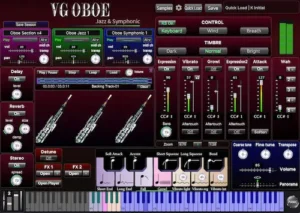 VG Oboe’s most useful design decision is its three-layer architecture: Oboe Jazz 1, Oboe Symphonic 1, and Oboe Section x4. All three remain available simultaneously, and the Morph Mixer can move between them via MIDI CC without interrupting a sustained note.
That is more useful than treating the three sounds as separate presets. The performer can change the apparent size and character of the instrument while the phrase is in progress, rather than stopping to load another patch or building separate MIDI tracks for each layer.
In a film cue, for example, an exposed oboe line can begin with the solo-oriented layer and gradually acquire more orchestral density as the arrangement develops. In an electronic production, the same control can turn a relatively dry melodic voice into a broader, section-like texture without introducing another instrument track.
The practical benefit is reduced editing. A conventional layered setup would typically require additional tracks, level automation or manual patch changes to create the same movement. With VG Oboe, the transition can be recorded as part of the performance and refined later as ordinary MIDI CC data.
None of this represents a new sampling or DSP technique. Layered playback and crossfading are well-established. The distinction is in the implementation: VG Oboe treats timbral layering as a performance parameter rather than simply a preset-management function.
Professional Mastering Starts With Better Production Decisions
Virtual instruments, orchestral libraries and expressive MIDI performances all influence how a mix behaves long before it reaches mastering. If you want to hear how your production translates when finished by an experienced engineer, send up to 35 seconds of your mix and receive a free mastering demo. It is a practical way to evaluate balance, depth, clarity and musical impact before committing to a full release.
Request your free mastering demo →
Built for Wind Controllers, Not Just MIDI Keyboards
VG Oboe’s strongest point is its controller workflow. This is not simply a sampled oboe with MIDI compatibility added to the specification sheet; the instrument is designed around wind and breath controllers, where continuous physical input can shape the performance as it happens.
VGTrumpet lists compatibility with EWI instruments, Roland Aerophone and Yamaha WX/YDS controllers, as well as systems from Berglund, Robkoo, EMEO, NuEVI, NuRad and several breath-controller manufacturers. The specific hardware matters less than the underlying workflow: the instrument exposes expressive parameters to MIDI control instead of treating the note trigger as the entire performance.
That distinction becomes obvious when programming a sustained wind part from a keyboard. Notes may be easy to enter, but expression, vibrato, attack, dynamics, articulation and pitch movement usually have to be shaped separately with automation. A wind controller can capture much of that information during the performance itself.
For an experienced EWI or breath-controller player, that can mean less MIDI cleanup after the take. Instead of drawing every crescendo, vibrato movement or timbral change into automation lanes, the player can generate those changes through the controller and then make only targeted corrections.
That is the strongest practical reason to choose VG Oboe. If the instrument is being played from a conventional keyboard or programmed note by note, much of its performance-oriented design becomes less relevant.
Where VG Oboe Actually Saves Time
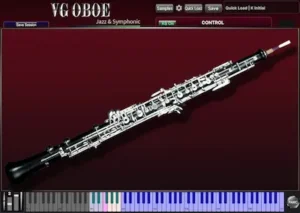 A useful virtual instrument should be judged by the work it removes from a session, not by the length of its feature list. VG Oboe’s workflow advantages are fairly specific, but several of them can eliminate steps that otherwise end up as MIDI editing or session management.
No Kontakt dependency keeps the instrument self-contained. You do not need a separate sampler environment or a larger orchestral library just to get an oboe into the session.
Three layers stay loaded at once. Switching between the jazz, symphonic and section sounds does not require loading separate patches, and the Morph Mixer can turn those changes into continuous MIDI performance data.
Controller mapping moves expression upstream. Attack, expression, vibrato, growl and other parameters can be performed rather than drawn manually after the take. For a wind-controller player, that can be a meaningful reduction in MIDI cleanup.
Standalone operation is useful for auditioning sounds, configuring a controller or rehearsing a part without opening a DAW. It is a convenience rather than a major production feature, but it can matter in a live or composing workflow.
The remaining utilities — the backing-track player, waveform display, quick-load browser and session recall — are useful session features, but they should not be overstated. They improve access and organization; they do not materially change how an oboe part is produced.
Why the Morph Mixer Matters More Than the Built-In Effects
VG Oboe includes the usual production utilities — chorus, phaser, filter, LFO modulation, reverb, delay and stereo controls. They are useful for auditioning and quick sound shaping, but they are not a compelling reason to choose this instrument. A professional mix already has access to more capable processors.
The Morph Mixer affects something more fundamental: the musical role of the instrument during the performance.
Because the jazz, symphonic and four-oboe layers remain available simultaneously, a MIDI controller can move continuously from an exposed solo character toward a broader orchestral sound and then into the denser section layer. The transition can become part of the phrase rather than a separate arrangement or sound-design step.
For example, a composer could map the Morph Mixer to a continuous controller and perform a gradual transition from solo oboe to orchestral weight within a single sustained line. The movement is captured as MIDI CC data, so it remains editable after recording without requiring additional instrument tracks.
That is a modest feature technically, but a meaningful one musically. VG Oboe’s Morph Mixer changes how the instrument can be performed; the built-in effects mostly change how it can be processed.
The Harmonizer Adds Density — Not Four Independent Players
VG Oboe’s built-in Harmonizer can generate additional voices from a played note, with control over the interval and blend of each voice. It is useful when the goal is to make a single performance occupy more harmonic or textural space without creating additional MIDI parts.
That works well for thicker melodic lines, cinematic layers and deliberately synthetic ensemble textures. The limitation becomes obvious when the arrangement exposes the individual voices.
Four real oboists will never produce identical attacks, pitch trajectories, vibrato, articulation or breath behavior. A harmonizer derives its additional voices from the same source performance, so those relationships remain strongly correlated. The result can sound convincingly dense in a busy mix but noticeably synthetic when the section is exposed.
That makes the Harmonizer a creative layering tool rather than a substitute for an independently performed oboe section. For production, it is most useful when density and speed matter more than reproducing the small timing and tonal variations of multiple players.
VG Oboe Is a Workflow Innovation, Not a New DSP Platform
VG Oboe does not introduce a new synthesis architecture, physical-modeling engine or AI-based audio system. Its sound generation is fundamentally sample-based, and the individual control mechanisms — MIDI CC, aftertouch, modulation, keyswitches, layered playback and real-time harmonization — are all established techniques.
The technical value is in how those elements are combined. VGTrumpet puts three distinct oboe layers inside a single instrument, keeps them available simultaneously, and exposes their relationship to continuous MIDI control. For wind-controller players, that turns timbral movement from a patch-management task into part of the performance.
That distinction matters when evaluating the product. There is no evidence here of a new approach to physical modeling, synthesis or DSP. The stronger achievement is workflow design: established technologies assembled around a specific performance problem.
That makes VG Oboe a well-focused instrument rather than a technological breakthrough. For a producer or performer, that can still be valuable; a better workflow does not need a novel algorithm to save time in a real session.
VG Oboe vs. Physical Modeling: Sampled Character or Continuous Control?
The most relevant alternative to VG Oboe is not another compact sample library. It is a physically modeled instrument such as Audio Modeling’s SWAM Oboe, because the two products approach expressive performance from opposite directions.
SWAM models the instrument’s behavior rather than playing back a fixed set of recorded performances. That gives it a major advantage when the player needs continuous control over dynamics, articulation, pitch movement and other aspects of the performance. For wind-controller work, that level of response is a central part of the instrument rather than an additional control layer.
VG Oboe makes a different tradeoff. Its sonic identity comes from recorded oboe samples, while the performance system provides MIDI control over expression, articulation, vibrato and the relationship between its three layers. The result can be fast and convincing without requiring the user to work with a physical-modeling engine.
That distinction is important when choosing between them. SWAM is the stronger choice when continuous instrument behavior is the priority; VG Oboe is more compelling when a producer wants a compact, inexpensive sampled oboe with a straightforward wind-controller workflow.
Neither approach is inherently better for every production. A solo line exposed in a sparse arrangement will put more pressure on performance realism, while a layered film cue, electronic track or fast mockup may benefit more from VG Oboe’s immediate access to three distinct oboe textures.
VG Oboe vs. AcousticSamples VWinds: Focused Instrument or Double-Reed Collection?
AcousticSamples’ VWinds Double Reeds is a closer comparison for composers who want more than a single oboe. Its approach combines sampled material with modeling-oriented processing and extends the instrument set to other double reeds, including English horn and bassoon.
That broader scope is the main reason to choose VWinds. If a scoring template needs several related woodwinds, a larger instrument ecosystem can justify the additional cost and complexity. VG Oboe takes the opposite approach: it concentrates on one instrument and puts the available budget into a simpler, faster performance workflow.
The distinction is therefore less about which library sounds “better” and more about what the session actually requires. VWinds makes more sense when double-reed coverage is the priority; VG Oboe makes more sense when the job is simply to get a playable oboe into the session without buying into a larger ecosystem.
VG Oboe vs. Full Orchestral Libraries: Do You Need an Oboe or an Orchestra?
Full orchestral libraries win on breadth. They can provide multiple articulations, dynamic layers, microphone positions and extensive ensemble coverage across an entire scoring template. If the project depends on a consistent orchestral ecosystem rather than one specific instrument, that depth is difficult for a focused plugin to match.
Dedicated oboe libraries from established developers such as Vienna Symphonic Library, Cinesamples, Orchestral Tools and 8Dio also offer substantially more sampling depth than VG Oboe. That additional content can matter when an exposed orchestral part requires detailed articulation control, multiple perspectives or integration with a larger template.
VG Oboe is solving a different problem. Its approximately 840 MB footprint, standalone operation and lack of a Kontakt requirement make it easier to deploy when the production does not justify another large orchestral ecosystem.
The buying decision is therefore straightforward. If you are building a complete orchestral template, VG Oboe is too narrow. If you need a playable, expressive oboe without adding gigabytes of orchestral content to the session, its specialization becomes the advantage.
VG Oboe vs. the Main Alternatives
The alternatives differ less by sample quality than by the production workflow they are built around. VG Oboe prioritizes a compact, controller-friendly setup; SWAM prioritizes continuous modeled response; AcousticSamples targets a broader double-reed palette; and full orchestral libraries prioritize depth and template integration.
| Instrument | Approach | Wind Controller Support | Instrument Scope | Best Fit | Key Limitation |
|---|---|---|---|---|---|
| VG Oboe | Sample-based | Strong | Jazz, symphonic and 4-oboe layers | Fast, inexpensive expressive oboe workflow | Less continuous behavior than physical modeling |
| SWAM Oboe | Physical modeling | Excellent | Dedicated modeled oboe | Wind-controller performance and continuous expression | Higher cost and a more specialized modeling approach |
| AcousticSamples VWinds Double Reeds | Sample/modeling hybrid | Strong | Multiple double-reed instruments | Composers needing broader double-reed coverage | Requires the UVI Workstation ecosystem |
| Full orchestral libraries | Multisampling | Varies | Complete orchestral palettes | Detailed scoring and large templates | Greater cost, storage and session complexity |
The comparison makes the positioning clear: VG Oboe is not trying to win on library depth or physical-modeling sophistication. Its advantage is getting a specialized oboe performance into a production quickly, with less infrastructure around it.
Is VG Oboe One of the Best Oboe VST Plugins in 2026?
For composers searching for the best oboe VST plugin, the answer depends largely on workflow priorities. Large orchestral libraries still provide greater articulation depth, while physical-modeling instruments such as SWAM deliver more continuous performance behavior. VG Oboe is not trying to replace either category. Instead, it focuses on delivering a realistic oboe VST experience with a smaller footprint, lower cost and faster setup.
What makes VG Oboe competitive is its combination of three playable oboe layers, real-time Morph Mixer control and strong wind-controller integration. Many oboe plugins offer high-quality samples, but relatively few are designed around live expressive performance using EWI and breath controllers. In that area, VG Oboe occupies a more specialized position than many larger orchestral products.
As a result, VG Oboe deserves consideration among the best oboe VST plugins for composers, EWI performers and producers who need expressive oboe parts without investing in a complete orchestral ecosystem. It may not be the deepest oboe library available, but it offers one of the strongest workflow-to-price ratios currently available in the category.
Mixing VG Oboe: Performance First, Processing Second
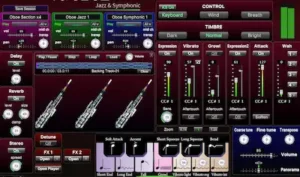 An oboe has enough upper-midrange presence to expose problems quickly. In a sparse arrangement, an overly bright attack, static dynamics or excessive vibrato can make the instrument feel artificial long before a mix engineer reaches for EQ.
For producers working with complex orchestral arrangements, many of the same translation challenges also appear during the final production stage, particularly when preparing material for orchestral mastering.
That makes the performance more important than the processing chain. A well-shaped phrase may need little more than level control, appropriate ambience and a few targeted EQ moves. If the underlying MIDI performance is stiff, adding EQ, compression, stereo widening or reverb only changes the presentation of the problem.
The same principle applies to keyboard-based virtual instruments. As noted in our Rhodes Clav Pro review, realism often comes less from processing and more from how convincingly the instrument responds to performance dynamics, articulation and player interaction before the mix stage even begins.
The four-oboe section needs particular attention. Four voices can add useful density, but if they are driven by identical MIDI data, their timing, dynamics and articulation remain closely correlated. The result can sound larger without actually sounding like four independent players.
For exposed orchestral passages, the better solution is usually to introduce small differences in the performances rather than reaching immediately for stereo processing. Slightly offset timing, independent dynamics and varied articulation can create more believable separation than simply widening the image or adding chorus.
This is not a flaw unique to VG Oboe. It is a basic limitation of synchronized sampled ensembles. The more exposed the section becomes, the more important independent performance information is.
Where VG Oboe Fits Best in Real Production
Film scoring and game music are among the strongest applications. Composers creating orchestral mockups, cinematic cues and soundtrack material may also be interested in the specific challenges covered in our article about film score mastering. The ability to move between a solo oboe, a symphonic voice and a four-player section gives composers a compact way to create changing orchestral density without loading multiple instruments.
Jazz production is another natural fit because VG Oboe includes a dedicated jazz oboe layer rather than treating jazz as an afterthought to an orchestral patch. That makes it more relevant to arrangements where the oboe needs to function as a characterful melodic voice rather than simply an orchestral color.
Electronic production is where the instrument becomes more interesting than a conventional orchestral library. Morphing between the three layers and using the Harmonizer can turn the sampled oboe into a moving texture, transition element or deliberately exaggerated ensemble sound. Producers building hybrid arrangements may find that approach complementary to instruments that blur the line between rhythm and synthesis, as discussed in our Dream Kit Zenith v2 review, where drum-derived synthesis is used as a compositional tool rather than a traditional percussion source.
Live wind-controller performance is arguably the clearest use case. The instrument’s controller mapping and continuous expression are directly aligned with the way EWI and breath-controller players perform.
Pop can benefit when an arrangement needs a recognizable acoustic woodwind without the overhead of a full orchestral template. Hip-hop, trap and conventional EDM are more situational: the instrument can work for hooks, melodic accents and hybrid textures, but an oboe is rarely central to those workflows.
Who VG Oboe Is Actually For
EWI and wind-controller players are the clearest target. The instrument’s controller mapping, continuous expression and Morph Mixer are built around a performance workflow that makes much less sense if the part is being entered note by note with a mouse.
Composers who regularly need oboe are another strong fit. The combination of jazz, symphonic and four-oboe layers provides useful coverage without adding a large orchestral library or sampler dependency to the template.
Jazz, hybrid orchestral and electronic producers can also get real value from it. The three-layer design is flexible enough to move beyond straightforward orchestral mockups, particularly when morphing and harmonization are used as sound-design tools.
There is less reason to buy VG Oboe if you need a complete orchestral system or want the continuous behavioral realism of a dedicated physical-modeling instrument such as SWAM. Likewise, it has no meaningful role in a mastering-only setup. A mastering engineer who does not also produce or compose MIDI-based material has little reason to own it.
VG Oboe: The Trade-Offs That Matter
What works: VG Oboe is inexpensive for a dedicated oboe instrument, keeps three useful tonal configurations in one plugin, and gives the performer real-time control over their relationship through the Morph Mixer. The wind-controller focus is a genuine strength, while the standalone architecture, lack of a Kontakt requirement and approximately 840 MB library keep the setup simple.
What doesn’t: The instrument does not introduce a new synthesis or DSP method, and its sample-based architecture cannot reproduce the same continuous behavior as a physical-modeling engine. Independent CPU and latency data are also too limited to make strong performance claims. The Harmonizer can add useful density, but it does not create the independent timing, pitch and articulation of a real ensemble.
The built-in effects are convenient rather than decisive, and the instrument’s value falls quickly for producers who rarely use oboe. It is also a specialist tool, not a replacement for a full orchestral library.
Technical Specifications
| Developer | VGTrumpet |
| Instrument Type | Sample-Based Oboe Virtual Instrument |
| Formats | VST, VST3, AU, Standalone |
| Sample Resolution | 24-bit / 44.1 kHz |
| Library Size | Approximately 840 MB |
| Kontakt Required | No |
| Supported Controllers | EWI, Aerophone, WX, YDS, Breath Controllers |
| Price | $44.95 |
Pros and Cons
Pros
- Excellent wind controller integration
- Three playable oboe layers
- No Kontakt required
- Compact installation size
- Affordable price
Cons
- Limited articulation depth
- No physical modeling engine
- Few independent performance benchmarks available
- Not a replacement for full orchestral libraries
Overall Rating
| Category | Rating |
|---|---|
| Sound Quality | 8.5/10 |
| Workflow | 9.5/10 |
| Performance Realism | 8.5/10 |
| Wind Controller Integration | 9.5/10 |
| CPU & System Efficiency | 8.5/10 |
| Feature Set | 8/10 |
| Value for Money | 9.5/10 |
| Overall | 8.7/10 |
VG Oboe succeeds not because it introduces new sampling technology, but because it solves a specific performance problem efficiently. The combination of three playable oboe layers, strong wind-controller integration and an unusually low price creates a workflow that is difficult to find elsewhere. While it cannot match the continuous realism of physical modeling or the depth of large orchestral libraries, it delivers excellent practical value for composers and performers who need expressive oboe parts without unnecessary complexity.
Is VG Oboe Worth Buying?
For EWI players, breath-controller users and composers who regularly write oboe parts, VG Oboe offers exceptional value. The combination of expressive control, compact size and low price makes it one of the most accessible dedicated oboe instruments currently available.
Users seeking deep orchestral articulation sets or advanced physical modeling may find stronger alternatives elsewhere, but for practical day-to-day production work, VG Oboe delivers more functionality than its price suggests.
Is VG Oboe Worth It for Modern Composers?
VG Oboe is not the deepest orchestral oboe library on the market, nor is it the most advanced physically modeled instrument. However, it competes surprisingly well as a realistic oboe VST for composers who prioritize workflow, controller support and affordability.
For film scoring, game music, hybrid orchestral production and wind-controller performance, VG Oboe delivers a combination of expressive control, low system requirements and fast deployment that many larger libraries cannot match. Users searching for the best oboe VST under $50 will find very few alternatives offering the same balance of realism, performance flexibility and value.
VG Oboe Verdict: A Strong Specialist Instrument at a Low Price
VG Oboe does not redefine sampled woodwind instruments, and it does not need to. Its underlying technology is familiar: sample playback, MIDI control, layered sounds and conventional effects. The value comes from how those elements are organized around expressive performance.
The Morph Mixer is the most consequential feature. Keeping the jazz, symphonic and four-oboe layers available at the same time lets a performer change the instrument’s apparent size and character without switching patches or building additional instrument tracks. For an EWI or breath-controller player, that can turn timbral changes into part of the performance rather than another editing task.
The controller support reinforces that design. VG Oboe is clearly aimed at players who want to perform expression, vibrato, articulation and dynamics rather than reconstruct every movement with MIDI automation afterward. That makes it considerably more compelling for wind-controller users than its modest sample-library size might suggest.
At $44.95, the economics are straightforward. You are not buying a comprehensive orchestral system or a physical-modeling benchmark. You are buying a focused oboe instrument that is inexpensive, compact and quick to put into a session. For a composer or performer who actually needs that workflow, the price makes the limitations easy to accept.
The decision changes for users at the opposite end of the market. If continuous acoustic behavior is the priority, a physical-modeling instrument such as SWAM remains the stronger option. If the project requires deep orchestral coverage, a full orchestral library is a more rational investment.
VG Oboe earns its place as a specialist tool rather than a technology showcase: it offers a practical performance workflow, unusually low entry cost and enough expressive control to make sampled oboe parts easier to produce. It is worth buying when that workflow matches your work; otherwise, there is little reason to add another niche instrument to the template.
Great Sounds Deserve a Professional Final Release
Choosing the right virtual instruments is only part of the production process. Even the most expressive performances, realistic orchestral libraries and carefully balanced mixes can lose impact if the final master lacks clarity, depth, punch or consistency across playback systems. Mastering is where those production decisions are translated into a finished, release-ready record.
If you’ve invested time shaping every detail of your track, don’t leave the final result to guesswork. Upload up to 35 seconds of your mix and receive a free mastering demo prepared by an experienced mastering engineer. Hear exactly how much additional polish, focus and translation your music can achieve before placing an order.
Get your free mastering demo →
VG Oboe FAQ: Compatibility, Performance and Value
Is VG Oboe a good oboe VST for wind controllers?
Yes, particularly for players who want continuous control over expression, articulation and timbral changes. The instrument is designed around wind and breath-controller workflows rather than simply adding MIDI compatibility to a conventional sample library.
Can VG Oboe run without Kontakt?
Yes. VG Oboe is self-contained and can run standalone or as a VST, VST3 or AU plugin. No Kontakt or separate sampler is required.
Does VG Oboe support Akai EWI and other wind controllers?
Yes. VGTrumpet lists support for multiple Akai EWI models, Roland Aerophone, Yamaha WX/YDS systems and controllers from manufacturers including Berglund, Robkoo, EMEO, NuEVI and NuRad. Compatibility ultimately depends on the controller’s MIDI configuration.
How much disk space does VG Oboe need?
The installed sample library is approximately 840 MB. That is relatively small for a dedicated orchestral-style instrument, particularly compared with full orchestral libraries that can require many gigabytes of storage.
Does the 840 MB library mean VG Oboe uses very little RAM or CPU?
No. Library size does not provide a reliable indication of runtime RAM allocation or CPU load. Independent benchmark data is currently insufficient to make a quantitative performance claim.
Is VG Oboe more realistic than SWAM Oboe?
They use different technologies, so the comparison depends on the performance. VG Oboe uses recorded samples with expressive MIDI control, while SWAM uses physical modeling. SWAM is the stronger choice when continuous modeled instrument behavior is the priority; VG Oboe is more attractive for a compact sampled workflow.
Can VG Oboe replace a full orchestral oboe library?
No. It can cover a focused oboe role, but it does not provide the articulation depth, microphone options or broader orchestral coverage of a full scoring library.
Does VG Oboe make sense for a mixing engineer?
Only if the engineer also produces, edits or mocks up MIDI arrangements. Its value is upstream of mixing: a more controllable performance can reduce corrective automation and processing in the mix.
Does VG Oboe have any real use in mastering?
Not as a mastering tool. Its only relevance is indirect: better source performances can produce cleaner, easier-to-balance mixes before they reach the mastering stage.
What is the best oboe VST plugin for EWI players?
VG Oboe is one of the strongest budget options for EWI players because it was designed around wind-controller performance rather than traditional keyboard programming.
Is VG Oboe a realistic oboe VST?
VG Oboe delivers realistic results when expression, breath control and MIDI CC performance data are used effectively. Its realism comes more from performance workflow than from library size alone.
Is VG Oboe worth $44.95?
For producers who regularly need oboe or wind-controller players, yes. The combination of three oboe layers, expressive control, standalone operation and a compact library makes the price easy to justify. For users who rarely use oboe, it is still a specialist purchase rather than a general-purpose production tool.

Yurii Ariefiev reviews virtual instruments from a production-engineering perspective, focusing on performance realism, MIDI workflow efficiency, and how sampled instruments behave inside real-world mixes. His analysis extends beyond features and specifications to examine how expressive control translates into usable musical results.
At AREFYEV Studio, virtual instruments are evaluated not only by their sound but also by how they affect arrangement quality, mix translation and downstream mastering decisions. Expressive MIDI performance, realistic dynamics and convincing articulation often determine whether a production feels musical long before the mastering stage begins.
☕ Buy me a coffee