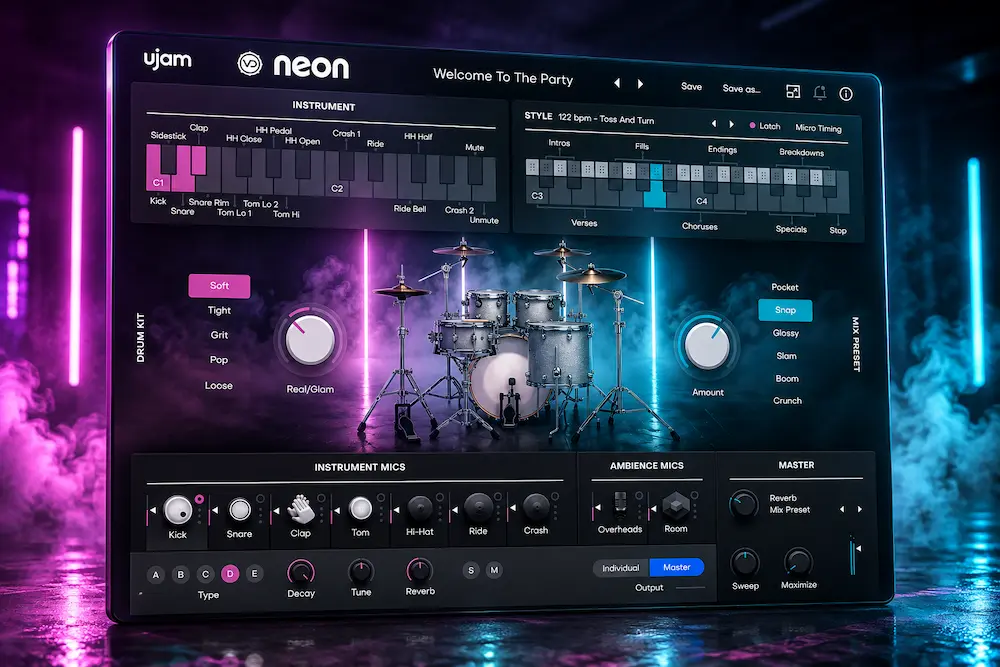
Virtual drum production has largely split into two categories. At one end are comprehensive drum production platforms built around detailed sampling, extensive mixer control, microphone routing, bleed management, and deep performance editing. At the other are workflow-driven instruments designed to generate production-ready drum parts with minimal setup.
UJAM Virtual Drummer Neon clearly targets the latter approach. Rather than competing with drum production environments such as Superior Drummer 3 or BFD, it focuses on a different problem: reducing the time required to build convincing drum performances for modern commercial productions.
That distinction matters because today’s pop, synth-pop, nu disco, and electronic productions rarely fail due to a lack of drum options. Most producers already have access to more samples, virtual instruments, and processing tools than they realistically need. The bottleneck is usually workflow. Building grooves, programming variations, shaping transitions, and maintaining momentum across an arrangement can consume far more time than selecting sounds.
Virtual Drummer Neon enters the market as a workflow solution rather than a drum-production powerhouse. The key question is not whether it can replace high-end drum platforms. It cannot. The more relevant question is whether it can deliver usable, mix-ready performances quickly enough to justify a place in a professional production workflow. That is where Neon becomes far more interesting than its feature list initially suggests.
Contents
What Is UJAM Virtual Drummer Neon and Is It the Right Drum Plugin for Modern Producers?
 The modern production landscape has created an unusual contradiction. Producers have access to more drum samples, virtual instruments, and editing tools than ever before, yet many commercial releases are built under tighter deadlines than the productions of a decade ago.
As a result, the limiting factor is rarely sound quality. It is time.
Modern pop, synth-pop, indie dance, nu disco, and electronic crossover records increasingly rely on drum parts that combine the impact and consistency of programmed drums with the movement of a live performance. Achieving that balance manually requires considerably more work than many producers initially expect.
Creating a convincing drum track involves more than selecting a kit and drawing notes into a MIDI editor. Groove development, velocity relationships, fill placement, arrangement dynamics, and kick-to-bass interaction all contribute to whether a performance feels musical or mechanical. Even experienced programmers can spend hours refining details that listeners never consciously notice but immediately feel when they are missing.
This reality has helped drive the popularity of workflow-oriented drum instruments. Rather than maximizing editing depth, these tools focus on reducing repetitive production tasks while preserving enough control to fit professional projects. The goal is not to replace drum programming entirely. The goal is to reach a musically convincing starting point faster.
That is the production environment Virtual Drummer Neon is designed for. Its value is tied less to drum sounds themselves and more to how quickly it can generate performances that already behave like finished parts inside a modern arrangement.
Strong Productions Start Before Mastering
Even the best mastering cannot fully compensate for weak arrangement decisions, unstable low end, or drums that never properly lock into the mix. If you want to hear how far your production can be pushed before release, upload up to 35 seconds of your track and receive a free mastering demo. You’ll hear how a professional master responds to your mix, translation, punch, and overall balance before investing in the full project.
Try a free mastering demo →
What’s New in UJAM Virtual Drummer Neon?
Virtual Drummer Neon expands the UJAM Virtual Drummer lineup with a stronger focus on modern electronic production styles, including synth-pop, indie dance, nu disco, commercial pop, and hybrid electronic genres. While previous releases often balanced acoustic and electronic influences, Neon leans more heavily toward contemporary programmed drum aesthetics.
The instrument combines performance generation, mix-ready drum sounds, genre-focused grooves, MIDI export functionality, and workflow-oriented controls inside a simplified production environment. The objective is not to provide a detailed drum engineering platform but to help producers reach arrangement-ready results with minimal setup.
One of the more notable additions is the Glam control, which allows users to move quickly between cleaner drum presentations and more polished commercial production styles without building complex processing chains manually. Combined with UJAM’s established performance-generation workflow, Neon is designed to reduce programming time while maintaining enough flexibility for professional projects.
Rather than introducing a radically new drum-production technology, Neon focuses on improving production efficiency for creators working under tight deadlines, fast release schedules, and high-content-output environments.
Where Virtual Drummer Neon Creates Real Value
Strip away the genre branding and preset names, and Neon is fundamentally a performance-generation tool. Its strongest feature is not a particular kick drum, snare, or processing chain. It is the ability to generate arrangements that already contain the rhythmic decisions many producers would otherwise spend significant time programming manually.
Most drum instruments provide sounds and expect the user to create the performance. Neon reverses that workflow. The performance comes first, while sound selection and refinement become secondary decisions.
That distinction becomes increasingly relevant in modern production environments. A producer working on a synth-pop, indie dance, or commercial pop track may spend less time choosing samples than developing groove variations, transitions, fills, and arrangement movement. Those decisions often determine whether a production feels finished.
Neon accelerates this stage by starting with complete musical performances rather than empty MIDI clips. Instead of building a drum part hit by hit, producers can evaluate whether the groove supports the song, then make adjustments from a functional starting point.
In practical terms, this changes how sessions develop. A songwriter sketching ideas can move from chords and a basic hook to a convincing rhythmic foundation within minutes. A producer working against a client deadline can establish arrangement energy early instead of spending the first hour programming drums. The time savings are not theoretical; they occur at one of the most repetitive stages of modern music production.
This is also where Neon separates itself from traditional drum samplers. The instrument is less concerned with forensic control and more concerned with maintaining creative momentum. That tradeoff will not appeal to everyone, but it aligns with how many commercial productions are actually built today.
The included kits further support this approach. Rather than pursuing the realism of a multi-microphone drum recording session, they are voiced to sit quickly inside dense modern arrangements. Kicks prioritize consistency and low-end focus, snares emphasize presence without excessive processing, and cymbal content is restrained enough to avoid creating unnecessary masking during mixing.
One of the more useful additions is the Glam control. Although it is not a major technical innovation, it serves a practical purpose. Instead of constructing multiple processing chains to move between natural and polished drum aesthetics, users can quickly push the instrument toward a more produced, radio-ready presentation. For producers working across multiple projects, that kind of shortcut often provides more value than another page of deep-edit parameters.
The result is not a revolutionary drum platform. It is a focused production tool designed to remove friction from one of the most time-consuming parts of modern arrangement building. Whether that matters depends largely on how much value a producer places on speed versus control.
Why Neon Can Save More Time Than a Better Drum Library
Most drum instrument marketing revolves around sample quality, genre coverage, and the size of the included library. In practice, those factors rarely determine whether a plugin becomes part of a daily production workflow.
What matters is how much work remains after loading it.
This shift toward workflow-driven production tools is not limited to traditional drum libraries. As modern music production becomes increasingly deadline-driven, producers are looking for tools that reduce repetitive programming tasks without sacrificing usable results. Instruments such as Dream Kit Zenith v2 approach rhythm creation from a completely different angle, combining drum synthesis and sound design into a single environment. While Neon accelerates groove construction, hybrid instruments increasingly focus on generating entirely new rhythmic textures rather than recreating conventional drum performances.
The biggest advantage of Virtual Drummer Neon is not the drum sounds themselves. It is the reduction of repetitive production tasks that typically occur before a track reaches the mixing stage.
Traditional drum programming often requires building a groove, refining velocity relationships, creating transitions between song sections, adjusting fills, and introducing enough variation to prevent repetition from becoming obvious. None of these tasks are particularly difficult, but together they consume a significant amount of production time.
Neon approaches the problem differently. Instead of presenting an empty programming environment, it starts with performances that already contain many of those decisions. The result is less time spent constructing a functional drum part and more time evaluating how that part supports the arrangement.
This workflow becomes especially valuable in commercial production environments where deadlines matter more than absolute customization. Producers creating multiple client revisions, advertising music, sync cues, podcast themes, or production music libraries often need reliable results quickly. In those scenarios, saving thirty minutes on every project can have a larger impact than gaining access to another hundred drum samples.
The MIDI export functionality is equally important because it prevents the instrument from becoming a closed ecosystem. A groove generated inside Neon can be exported, edited, reassigned to another drum instrument, layered with additional samples, or rebuilt entirely inside a DAW’s MIDI editor.
That flexibility dramatically increases the practical value of the software. Many workflow-focused instruments become limiting once a project moves beyond the sketch phase. Neon avoids much of that problem by allowing producers to separate the performance from the sound source whenever deeper customization becomes necessary.
Viewed through that lens, the product’s biggest contribution is not drum generation. It is decision reduction. By eliminating a series of low-value production tasks, Neon allows more attention to remain focused on arrangement, songwriting, and mix development—the areas where creative and commercial results are usually determined.
The Tradeoffs Behind Neon’s Fast Workflow
 Virtual Drummer Neon becomes less convincing once it is evaluated as a full-scale drum production platform rather than a songwriting and arrangement tool.
Its workflow is intentionally designed around speed, which inevitably limits how much control users have over the underlying performance and drum architecture. That compromise is easy to accept during composition. It becomes more noticeable when a project reaches the detailed editing and mixing stages.
Producers coming from Superior Drummer 3, BFD, or advanced Kontakt-based environments will quickly notice the difference. Neon is not built around deep microphone management, detailed bleed control, extensive routing options, or the kind of articulation-level editing that allows engineers to shape every aspect of a performance. Those platforms treat drum production as an engineering process. Neon treats it as a production shortcut.
Whether that limitation matters depends entirely on the workflow. For a songwriter, media composer, or producer building commercial arrangements under deadline, the reduced complexity may be an advantage. For engineers who routinely customize drum performances at a granular level, the streamlined approach can become restrictive.
The same trend can be seen across other composition-focused instruments. Tools like Sonuscore The Sculpture prioritize instant movement, texture generation, and scoring efficiency over deep technical editing. In both cases, the objective is not maximum control but reducing the time required to move from an idea to a usable musical result.
UJAM Virtual Drummer Neon vs Superior Drummer 3, EZdrummer 3 and BFD
Comparing Neon directly to every major drum platform can be misleading because these products are often solving different problems. The more useful comparison is understanding where each tool sits within a modern production workflow.
| Product | Primary Focus | Where It Excels | Main Limitation |
|---|---|---|---|
| UJAM Virtual Drummer Neon | Fast arrangement building | Immediate results, low-friction workflow, production-ready grooves | Limited deep editing and engineering control |
| EZdrummer 3 | Songwriting and production | Strong groove ecosystem, flexible editing, broad genre coverage | Requires more user involvement to reach final results |
| Superior Drummer 3 | Professional drum production | Detailed performance editing, advanced mixer architecture, extensive realism | Steeper learning curve and longer setup time |
| Addictive Drums 2 | Production and mixing | Efficient workflow, balanced customization, mix-friendly sounds | Smaller expansion ecosystem than Toontrack |
| BFD | Acoustic drum engineering | Deep microphone control, detailed drum realism, extensive routing | Slower workflow and greater production overhead |
Neon occupies a niche that has become increasingly relevant in modern music production. Many producers are no longer looking for the most detailed drum environment available. They are looking for the fastest path from an idea to a convincing arrangement.
That distinction explains why comparisons based purely on features can be misleading. Superior Drummer 3 offers dramatically deeper editing capabilities. BFD provides significantly greater control over the engineering side of drum production. EZdrummer offers a broader songwriting ecosystem. None of those advantages automatically translate into a faster workflow.
Neon’s strongest competitor is arguably not another drum library but the amount of time a producer is willing to spend programming drums manually. For creators working on commercial pop, sync music, advertising projects, content production, or high-volume release schedules, reducing production time often delivers a greater return than gaining access to another layer of customization.
That does not make Neon the best choice for every studio. Engineers whose workflow depends on detailed articulation editing, advanced routing structures, or highly realistic acoustic drum productions will likely find more value in Toontrack or BFD ecosystems. Neon is better viewed as a production-first instrument built for speed, not a replacement for dedicated drum engineering platforms.
Virtual Drummer Neon vs EZdrummer 3
Although both products target songwriters and producers, they approach drum production differently.
| Feature | Virtual Drummer Neon | EZdrummer 3 |
|---|---|---|
| Speed | Excellent | Very Good |
| Editing Depth | Limited | Strong |
| MIDI Ecosystem | Moderate | Extensive |
| Learning Curve | Very Low | Moderate |
| Best Use Case | Fast production workflows | Songwriting and detailed customization |
How Neon Holds Up Once a Track Reaches Mixing and Mastering
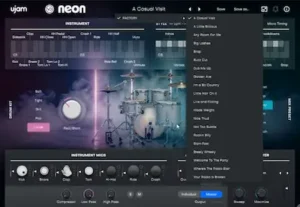 A drum instrument should not be judged solely by how it sounds in solo mode. The more important question is how those sounds behave once they are competing for space inside a finished mix.
This is where many modern drum products reveal their weaknesses. Cymbals that sound exciting during production can become brittle after mastering. Overbuilt low-end can create conflicts with bass instruments and limit available headroom. Aggressive transient shaping may initially feel impressive but can lead to fatigue, harshness, or codec-related artifacts once a track reaches streaming platforms.
Based on its design philosophy and available audio demonstrations, Neon avoids many of the exaggerated frequency and transient decisions that often create problems later in production. Its drum kits appear to be voiced for contemporary production environments rather than demonstration purposes. The low end remains focused enough to integrate with modern bass-heavy arrangements, while the top end avoids the exaggerated brightness often found in electronic drum libraries that are designed to impress during quick auditions.
From a mixing perspective, this translates into fewer corrective decisions. The drum sounds appear to be voiced for predictable placement within dense arrangements, potentially reducing the amount of corrective work required during mixing. That does not eliminate the need for proper EQ, dynamics processing, or balance decisions, but it reduces the amount of troubleshooting that often follows poorly voiced virtual instruments. The distinction becomes even more important once a project moves beyond production and into the realities of mixing vs mastering, where source quality often determines how aggressively later processing must be applied.
That design philosophy may also offer advantages during mastering. Source material that arrives with controlled low-frequency energy, sensible transient behavior, and balanced high-frequency content is generally easier to push toward competitive loudness targets without introducing unwanted side effects. This is one of the reasons experienced engineers place so much emphasis on how you prepare a mix for mastering before the final stage even begins. While Neon does not directly improve mastering outcomes, it avoids creating many of the problems mastering engineers are routinely asked to solve.
Many of these challenges are directly related to the relationship between loudness and clipping during the final stages of production.
Translation is another area where Neon appears thoughtfully voiced. The drum sounds are clearly voiced to maintain impact across headphones, nearfields, consumer speakers, and streaming-focused playback systems without relying on excessive brightness or exaggerated low-end weight. For producers targeting Spotify, Apple Music, and other major platforms, many of the same translation issues discussed in mastering for streaming platforms begin long before the mastering stage itself. For producers targeting Spotify, Apple Music, YouTube Music, and other streaming platforms, that balance is often more valuable than a more dramatic sound that falls apart outside the studio.
System efficiency is another area where the platform appears competitive. Unlike large multi-microphone drum environments that can place significant demands on CPU, RAM, and storage bandwidth, the Virtual Drummer platform has historically been positioned as a relatively lightweight solution. That makes Neon particularly useful in laptop-based production setups, mobile writing sessions, and larger projects where multiple virtual instruments are already competing for system resources.
In practical use, Neon’s workflow advantage extends beyond drum creation itself. Faster loading times, lower resource consumption, and mix-ready source material collectively reduce the amount of friction that accumulates throughout a production cycle.
UJAM Virtual Drummer Neon Price and Value
Price is often where workflow-focused tools either become an easy recommendation or a difficult sell. Virtual Drummer Neon is positioned as a productivity instrument rather than a premium drum-production environment, which means its value should be measured by the amount of time it saves rather than by the size of its sample library.
Producers comparing Neon to platforms such as EZdrummer 3, Superior Drummer 3, or BFD may initially focus on feature counts. In practice, the more relevant comparison is how quickly each platform allows a project to move from an idea to a finished arrangement. For users who regularly build demos, production music, sync cues, podcast themes, social media content, or commercial pop productions, saving even thirty to sixty minutes per project can justify the investment very quickly.
Neon is therefore best evaluated as a workflow accelerator. Producers who prioritize speed, fast arrangement building, and reliable results are likely to see considerably more value than users whose workflow depends on deep drum engineering, advanced routing, and detailed performance customization.
Overall Rating
The ratings below reflect workflow efficiency, practical usability, sound quality, and production value relative to other workflow-oriented drum instruments in the current market.
| Category | Rating |
|---|---|
| Sound Quality | 8.5/10 |
| Workflow | 9.5/10 |
| Mix Translation | 9/10 |
| CPU Efficiency | 9/10 |
| Editing Flexibility | 7/10 |
| Value for Money | 9/10 |
| Overall | 8.7/10 |
Virtual Drummer Neon is not trying to compete with full-scale drum production environments such as Superior Drummer 3 or BFD. Its strength lies in workflow acceleration, mix-ready drum sounds, and the ability to generate convincing performances with minimal effort. While deep editing remains limited compared to engineering-focused platforms, Neon delivers substantial value for producers who prioritize speed, consistency, and reliable commercial results over maximum customization.
Why These Scores?
Sound Quality — 8.5/10
The drum kits are intentionally voiced for modern commercial productions rather than absolute realism. Kicks, snares, and cymbals generally sit well in contemporary pop and electronic arrangements without excessive processing. While the sounds are polished and usable, they do not reach the depth and realism offered by larger multi-microphone drum environments.
Workflow — 9.5/10
This is where Neon earns its strongest score. The ability to generate complete performances, fills, and arrangement-ready grooves dramatically reduces programming time. For producers working under deadlines, the workflow advantage is immediately noticeable and often more valuable than additional editing options.
Mix Compatibility — 9/10
From a production and mastering perspective, the drum sounds appear balanced enough to adapt well to a variety of monitoring environments and streaming-focused workflows. The frequency balance avoids many of the exaggerated lows and highs that frequently create problems later in production.
CPU Efficiency — 9/10
Compared with large drum production systems featuring extensive microphone architectures, Neon is designed for efficient day-to-day use. It integrates comfortably into larger sessions without placing significant demands on system resources.
Editing Flexibility — 7/10
The streamlined workflow comes at the cost of deeper control. Users who require detailed articulation editing, microphone management, routing customization, or engineering-level drum production tools may find the platform restrictive compared to Superior Drummer 3, BFD, or advanced Kontakt-based environments.
Value for Money — 9/10
For producers focused on songwriting, content creation, sync work, commercial pop production, and high-volume workflows, Neon offers a strong return on investment. The time saved during arrangement and groove development can easily outweigh the limitations in deep editing.
Who Should Use Virtual Drummer Neon?
- Buy it if: You need fast drum production, commercial songwriting workflows, sync production efficiency, or quick arrangement building.
- Consider alternatives if: You require deep drum editing, advanced routing, detailed microphone control, or realistic acoustic drum engineering.
- Best for: Pop producers, electronic musicians, content creators, media composers, and producers working under tight deadlines.
Who Should Not Buy Virtual Drummer Neon?
- Producers who require detailed drum articulation editing.
- Engineers who depend on extensive microphone routing and bleed control.
- Users building highly realistic acoustic rock and metal productions.
- Superior Drummer 3 and BFD users who regularly customize performances at a granular level.
- Mix engineers looking for a complete drum-production environment rather than a songwriting tool.
Neon is optimized for speed. Producers who prioritize maximum control over every drum performance detail may find more value in traditional drum-production ecosystems.
Pros and Cons
Pros
- Extremely fast workflow for songwriting and arrangement building
- Production-ready grooves that require minimal setup
- Useful MIDI export for further customization
- Low CPU consumption compared to large drum libraries
- Mix-friendly drum sounds with controlled low end
- Strong fit for pop, synth-pop, indie dance and sync production
Cons
- Limited deep editing compared to Superior Drummer 3
- Not designed for realistic acoustic drum production
- Restricted routing and engineering options
- Less flexible than advanced drum production ecosystems
- Workflow-first philosophy may feel limiting to experienced programmers
Final Verdict: Who Should Use Virtual Drummer Neon?
Virtual Drummer Neon is at its best when evaluated as a production tool rather than a drum engineering platform.
Producers looking for deep microphone control, extensive articulation editing, advanced routing, or highly detailed acoustic drum realism will find more capable solutions elsewhere. Products such as Superior Drummer 3 and BFD remain stronger choices when maximum control is the primary objective.
Neon targets a different stage of the production process. Its purpose is to shorten the distance between an idea and a workable arrangement. Based on its design goals and feature set, it appears well suited to that role.
Its most compelling aspect is not necessarily the sound library, genre focus, or feature set. It is the reduction of repetitive work. By handling many of the groove-building and performance-development decisions that typically slow down a session, Neon allows producers to spend more time on arrangement, songwriting, sound design, mixing, and other tasks that have a greater impact on the finished record.
That positioning makes the software particularly attractive for modern pop production, synth-pop, indie dance, commercial songwriting, sync music, content creation, and high-volume production environments where speed directly affects output.
Its limitations are easy to identify. Editing depth remains relatively shallow compared to dedicated drum production platforms. The underlying technology is evolutionary rather than revolutionary. Producers seeking complete control over every performance detail may eventually outgrow its workflow-focused approach.
Those limitations, however, are largely a consequence of the product’s design priorities rather than flaws in execution. Neon deliberately favors efficiency over complexity, and it remains consistent with that philosophy throughout the entire user experience.
Ultimately, Virtual Drummer Neon is not the best drum plugin for every studio, but it is one of the most efficient workflow-oriented drum plugins currently available. It is a specialized tool designed for producers who value speed, consistency, and reliable results over extensive customization. For that audience, the software delivers a practical return on investment. Not because it redefines drum production, but because it removes friction from one of the most time-consuming stages of modern music creation.
Great Productions Still Need a Final Reality Check
Modern productions can sound impressive inside the studio yet lose impact once they reach Spotify, Apple Music, YouTube Music, headphones, cars, and consumer speakers. Low-end balance, transient control, stereo width, and overall translation issues often remain hidden until release day. Professional mastering is the stage where those problems are identified and corrected before they reach listeners. Understanding how those issues are addressed often starts with knowing what happens inside a professional mastering chain.
If you want to hear how your track performs under professional evaluation, upload up to 35 seconds and receive a free mastering demo prepared by a real mastering engineer. Compare your original mix against a professionally mastered version and judge the difference on your own system before committing to a full project.
Get your free demo →
FAQ
Is Virtual Drummer Neon good enough for commercial music releases?
Yes. The instrument is capable of producing release-ready drum tracks for pop, synth-pop, indie dance, nu disco, and other modern electronic genres. The deciding factor is less about sound quality and more about whether its workflow matches the production process. For many commercial productions, the included sounds require surprisingly little corrective work during mixing.
How does Virtual Drummer Neon compare to EZdrummer 3?
EZdrummer 3 offers a broader ecosystem, deeper editing capabilities, and greater flexibility when developing custom performances. Neon focuses on reducing production time. Producers who prioritize speed and arrangement building may prefer Neon, while users seeking more control will likely gravitate toward EZdrummer.
Can Virtual Drummer Neon replace Superior Drummer 3?
No. The two products serve different purposes. Superior Drummer 3 functions as a comprehensive drum production environment with extensive editing, routing, and engineering capabilities. Neon is designed to generate convincing performances quickly and with far less setup.
Does Neon work well for mixing-focused workflows?
It can. The drum sounds are generally balanced enough to fit into modern productions without excessive corrective EQ or transient processing. That can reduce the amount of cleanup required before a mix reaches the finishing stage.
How demanding is Virtual Drummer Neon on CPU and system resources?
Compared with large multi-microphone drum libraries, Neon is relatively lightweight. Most modern systems should handle multiple instances without difficulty, making it practical for larger sessions and mobile production environments.
Can exported MIDI files be used with other drum plugins?
Yes. MIDI export is one of the platform’s strongest workflow features. Producers can use Neon to generate performances, then route those MIDI parts into other drum instruments for additional customization or layering.
Is Virtual Drummer Neon suitable for rock and metal productions?
Not as a primary solution. While some hybrid rock productions may benefit from its workflow and drum character, producers pursuing realistic acoustic rock or metal drums will generally find more suitable options in dedicated drum production platforms.
How well do Neon drum sounds translate to streaming platforms?
The drum kits appear to be voiced for contemporary production standards, with controlled low end and balanced top-end content. This helps maintain consistency across Spotify, Apple Music, YouTube Music, and consumer playback systems without relying on excessive processing.
Is Virtual Drummer Neon useful for film scoring and sync production?
Potentially. Composers working under tight deadlines may appreciate the ability to create convincing rhythmic foundations quickly. The workflow is often better suited to production music and sync work than highly detailed, performance-driven scoring projects.
What are the system requirements for Virtual Drummer Neon?
Virtual Drummer Neon is available for both Windows and macOS in VST3, AU, and AAX formats. Exact requirements depend on the operating system version and DAW, but most modern production systems should run the instrument comfortably due to its relatively lightweight architecture.
Is Virtual Drummer Neon one of the best drum plugins for fast workflow?
For producers who prioritize speed over deep editing, it is one of the strongest workflow-oriented drum plugins currently available. Its primary advantage is reducing the amount of manual drum programming required to build a complete arrangement.
How much does UJAM Virtual Drummer Neon cost?
Pricing may vary depending on promotions and regional offers. UJAM typically positions Virtual Drummer products within the affordable-to-midrange software instrument category, making Neon accessible to both hobbyists and professional producers.
Is Virtual Drummer Neon a good drum plugin for beginners?
Yes. Its workflow is intentionally designed around fast results and minimal setup. Producers with little experience in MIDI drum programming can create convincing performances quickly, while more advanced users can export MIDI for additional editing inside their DAW.
Who gets the most value from Virtual Drummer Neon?
Songwriters, pop producers, electronic music creators, content composers, and producers managing high project volumes are likely to see the greatest return. The software delivers the most value when production speed is a higher priority than deep technical customization.

Yurii Ariefiev analyzes music production software through the lens of real-world workflow efficiency, focusing on how virtual instruments affect arrangement speed, mix preparation, and long-term production decisions. His reviews examine whether a tool genuinely improves the creative process or simply adds another layer of complexity.
At AREFYEV Studio, drum instruments are evaluated beyond sound quality alone. Particular attention is given to groove development, mix translation, low-end management, streaming readiness, and how production choices influence the final mastering stage. In modern releases, workflow efficiency often has as much impact on the finished record as the sounds themselves.
☕ Buy me a coffee