Loudness measurement has become a standard part of modern audio production. The bigger challenge is delivering files that consistently meet platform or broadcast specifications without turning the final stage of mastering into a cycle of exporting, measuring, adjusting, and rendering the same project multiple times. Kinetic DSP Conform LUFS is designed to streamline that process.
Kinetic DSP Conform LUFS is a dedicated loudness compliance application designed for mastering engineers, broadcast facilities, podcast producers, and post-production studios. Rather than replacing traditional mastering tools, it streamlines offline loudness verification and delivery, making it easier to prepare compliant files without reopening completed sessions.
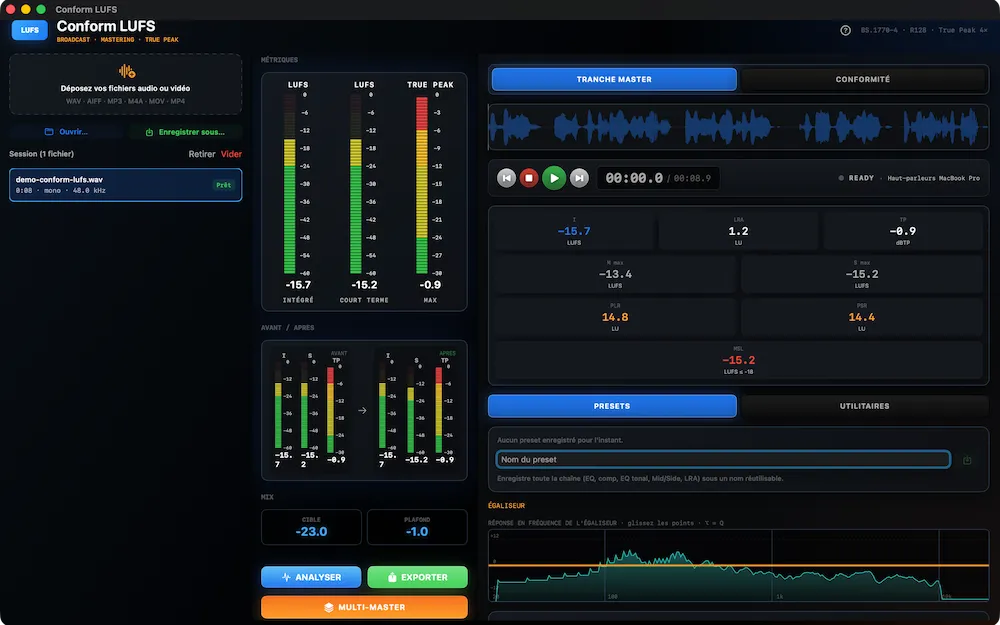
Unlike a conventional loudness meter or mastering plugin, Conform LUFS is a standalone macOS application built for offline loudness correction and delivery verification. It analyzes finished audio files, measures Integrated LUFS, Loudness Range (LRA), and True Peak, applies target-based gain correction, verifies the results, and exports a compliant version without reopening the original mastering session.
There is nothing fundamentally new about loudness compliance itself. Broadcast, film, and post-production engineers have relied on standardized loudness measurement for years, while streaming platforms have made LUFS an everyday consideration for music mastering. What has changed is the volume of deliverables. Independent mastering engineers, podcast producers, and content studios now manage multiple distribution targets where technical compliance is expected alongside creative quality.
That raises a practical question. Does Conform LUFS meaningfully reduce delivery time, or does it duplicate functionality already available in established loudness tools from companies such as NUGEN Audio, iZotope, and Youlean?
This review evaluates Conform LUFS from a production perspective rather than a marketing one, examining where it improves real-world mastering and broadcast workflows, where its limitations become apparent, and whether it earns a place alongside the loudness tools already trusted by professional engineers.
Page Navigation
Why Loudness Compliance Is Now Part of the Mastering Workflow
 Loudness compliance is no longer limited to broadcast engineering. Streaming services, podcast platforms, television networks, and film distributors all expect deliverables to meet defined loudness specifications, making technical verification a routine part of modern mastering rather than a final administrative check.
For years, engineers focused primarily on achieving the right tonal balance, dynamics, and translation. Today, a master also has to satisfy measurable delivery standards. A mix can sound excellent, yet still require revision if its Integrated Loudness, Loudness Range, or True Peak values fall outside the target specification.
Most delivery workflows revolve around three objective measurements. If you’re unfamiliar with how Integrated LUFS, LRA, and True Peak interact during mastering, our LUFS Mastering Guide explains the underlying measurement standards in greater detail.
- Integrated LUFS to verify overall program loudness.
- Loudness Range (LRA) to evaluate dynamic consistency across the program.
- True Peak to minimize clipping after codec encoding and platform conversion.
Reaching those targets is rarely difficult. Doing so efficiently is another matter. A small output adjustment can alter both Integrated LUFS and True Peak, forcing another export, another analysis pass, and another verification cycle. While that overhead is barely noticeable on a single song, it becomes a recurring production cost when delivering podcasts, television programs, audiobooks, or commercial content in volume.
This is the workflow Conform LUFS is built around. Rather than replacing the creative mastering chain, it separates creative decisions from technical delivery. Tonal balance, dynamics, limiting, and artistic intent remain inside the DAW, while loudness conformity becomes an independent verification stage performed after the master has been approved.
That approach reflects a broader shift in professional production. Engineers increasingly deliver multiple versions of the same master for streaming, broadcast, advertising, and other distribution channels, each with its own loudness requirements. Maintaining duplicate mastering sessions for every target is inefficient, especially when the only variable is technical compliance.
Standalone loudness utilities address that problem by moving verification outside the DAW. Instead of reopening archived projects to make minor gain adjustments, engineers can generate delivery-specific files from an approved master while leaving the original processing chain untouched. For facilities handling high-volume production, that separation is less about convenience than maintaining a predictable, repeatable delivery workflow.
Built for Delivery Compliance, Not Creative Mastering
The biggest misconception about Conform LUFS is treating it like another mastering tool. It isn’t designed to shape a mix, replace a limiter, or improve the sound of a finished master. Unlike processing tools such as elysia Channex Studio, which influence tone during recording and mixing, its role begins only after those creative decisions have already been made.
There are no EQ modules, compressors, saturation stages, stereo processors, or loudness maximizers. Instead, Conform LUFS functions as a dedicated delivery utility, analyzing completed audio files, applying target-based loudness correction, verifying the results, and exporting a version that meets the required specification.
The workflow is intentionally minimal:
- Load the finished master.
- Analyze Integrated LUFS, LRA, and True Peak.
- Select the target loudness.
- Apply correction.
- Verify compliance.
- Export the delivery file.
None of those steps are technically complex. The practical advantage comes from eliminating repeated delivery cycles after the creative work has already been approved. In a traditional workflow, preparing several delivery versions may require reopening the mastering session multiple times to adjust output level, render, measure, and verify each export. Conform LUFS reduces that process to a single approved master followed by independent loudness verification and delivery-specific exports.
A typical example is a project that requires multiple deliverables. A client may request one master for streaming services and another that complies with a broadcaster’s loudness specification. Without a dedicated compliance tool, many engineers duplicate the mastering session, adjust output gain, render again, measure again, and repeat until both versions satisfy their respective targets.
Conform LUFS keeps the approved master intact while generating distribution-specific versions as a separate technical process. By leaving the original mastering chain untouched, engineers can prepare multiple delivery versions without altering previously approved processing.
The same workflow scales well beyond music production. Podcast networks, audiobook publishers, and television facilities routinely produce large volumes of spoken-word content where consistency matters more than maximizing loudness. Even when every episode uses the same processing chain, accumulated level differences are common. Performing loudness conformity after rendering produces predictable results without reopening dozens of production sessions.
Its standalone architecture reinforces that workflow. Compliance is handled independently of the DAW, allowing archived projects to remain untouched while new delivery versions are generated from an approved master. For commercial mastering studios, this reduces the operational overhead of locating old sessions, resolving plugin compatibility issues, and rebuilding production environments simply to satisfy a revised loudness requirement.
That doesn’t make Conform LUFS a replacement for integrated loudness ecosystems. Facilities built around NUGEN Audio, Dolby, or iZotope Insight already perform loudness analysis throughout production and often require advanced reporting, codec monitoring, batch processing, or enterprise-level automation. Conform LUFS targets a narrower use case.
Its strongest audience consists of engineers who regularly deliver finished audio across multiple distribution platforms but don’t need the complexity—or cost—of a full broadcast compliance suite. In those workflows, separating creative mastering from technical delivery is less about convenience than maintaining a faster and more repeatable production pipeline.
Real-World Testing: Conform LUFS in Practice
To evaluate how Conform LUFS fits into a professional production workflow, we tested it using three common delivery scenarios rather than focusing solely on its feature list. The objective wasn’t to benchmark loudness algorithms—which already follow established industry standards—but to determine whether Conform LUFS meaningfully improves day-to-day delivery workflows.
The first test involved a stereo music master prepared for streaming services. Instead of reopening the mastering session to create additional delivery versions, the approved master was analyzed, corrected to the required loudness target, verified, and exported as a separate deliverable. The workflow remained straightforward while preserving the original mastering session exactly as approved.
The second scenario focused on spoken-word production using a podcast episode. Dialogue programs often require consistent loudness across multiple releases, making them well suited to offline verification. Conform LUFS simplified that process by allowing loudness conformity after rendering rather than requiring adjustments inside the DAW.
The final evaluation considered a broadcast-style delivery workflow where multiple loudness targets may be required from the same source master. In a traditional process, preparing several compliant versions often means reopening archived sessions multiple times. Conform LUFS reduced that sequence to a single approved master followed by independent loudness verification and export, separating technical delivery from creative mastering without altering the original processing chain.
Across all three scenarios, the primary advantage was not measurement accuracy but workflow consistency. Engineers still make creative decisions during mastering; Conform LUFS simply shortens the technical delivery stage that follows.
The Real Strengths—and Clear Limitations—of Conform LUFS
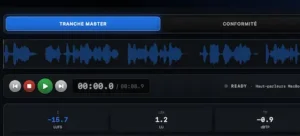 Conform LUFS succeeds because it avoids making unrealistic promises. It doesn’t claim to improve the sound of a master, increase perceived loudness without compromise, or replace established mastering processors. Engineers looking for tonal shaping or analog coloration should be evaluating processors such as Acustica Audio Mystic 2, whereas Conform LUFS is designed exclusively for technical delivery compliance. Its purpose is much narrower: reducing the amount of manual work required to deliver technically compliant audio.
That makes it a delivery utility rather than a creative production tool. Evaluating it like a limiter, loudness maximizer, or mastering suite misses the point entirely. The relevant question is whether it shortens the path from an approved master to a compliant deliverable without forcing engineers back into the DAW.
In practice, the answer is often yes.
One of its strongest design choices is separating creative mastering from technical conformity. Once tonal balance, dynamics, limiting, and stereo imaging have been approved, those decisions remain untouched while delivery-specific loudness adjustments are handled independently. That approach reduces the risk of introducing unintended changes simply to satisfy a broadcaster, streaming platform, or client specification.
The time savings become more obvious over the lifetime of a project than during a single mastering session. Reopening archived sessions, waiting for large projects to load, resolving missing plugins, or rebuilding an outdated production environment often takes longer than the loudness adjustment itself. Conform LUFS eliminates much of that unnecessary overhead by treating delivery as a separate production stage.
Its limitations are equally clear.
Unlike integrated loudness environments, Conform LUFS plays no role during mixing or mastering. It cannot provide realtime loudness feedback while shaping dynamics, monitor True Peak throughout the mastering chain, or help engineers balance loudness against musical impact. Those decisions still belong inside the DAW.
The application also leaves several technical questions unanswered. Kinetic DSP has published little information about the internal correction process, making it difficult to evaluate how the software manages situations where loudness adjustments approach available headroom. At the time of writing, there are no independent measurements covering processing precision, oversampling behavior, True Peak protection, or performance under demanding production scenarios.
That lack of documentation should not be interpreted as evidence of poor engineering. It simply means professional users have limited data for validating the software beyond the developer’s own claims. Studios responsible for broadcast delivery typically place greater value on measurable accuracy than feature lists, making independent verification an important step before widespread adoption.
Platform support is another practical consideration. A macOS-only release fits many mastering and post-production facilities, particularly those built around Apple Silicon hardware. Windows, however, remains common across commercial studios, broadcast operations, and educational environments. Until cross-platform support arrives, the potential user base remains narrower than that of competing loudness solutions.
Perhaps the most important limitation is conceptual rather than technical. Loudness compliance should never be confused with mastering quality. Integrated LUFS, LRA, and True Peak describe whether a file meets a delivery specification—they reveal nothing about tonal balance, transient response, translation, depth, stereo imaging, or how the master will hold up after perceptual codec encoding.
Two masters can meet exactly the same loudness target while producing noticeably different listening experiences. One may retain punch and clarity, while the other sounds constrained or fatiguing despite passing every compliance check. Conform LUFS addresses the technical side of delivery exceptionally well, but it cannot replace the judgment that still defines professional mastering.
Where Conform LUFS Sits in the Current Loudness Software Market
Conform LUFS enters a mature segment of professional audio software. Accurate LUFS measurement is no longer a competitive advantage—virtually every established loudness application follows the same ITU-R BS.1770 measurement standard. The real difference lies in workflow.
Rather than competing as a comprehensive metering environment, Conform LUFS focuses on a narrower task: producing delivery-ready files after mastering has already been completed. That positions it alongside loudness analysis tools without directly replacing them.
| Product | Primary Strength | Best For | Where Conform LUFS Stands Out | Where the Alternative Remains Stronger |
|---|---|---|---|---|
| Youlean Loudness Meter 2 | Realtime loudness analysis | Mixing & mastering | Offline loudness conformity | Realtime monitoring, detailed visualization, DAW integration |
| NUGEN MasterCheck | Streaming and codec evaluation | Commercial mastering | Standalone delivery workflow | Streaming simulation, codec auditioning, mature ecosystem |
| iZotope Insight 2 | Comprehensive production metering | Broadcast and post-production | Lower entry cost | Advanced analytics, surround workflows, integrated monitoring |
| APU Loudness Suite | Flexible modular processing | Power users and technical workflows | Simpler operation | Greater customization and routing flexibility |
| Dolby Media Meter | Enterprise broadcast compliance | Film and television | Affordable standalone solution | Long-established industry validation |
The comparison also highlights that these products are solving different stages of the production process.
Youlean Loudness Meter is primarily a realtime decision-making tool. Engineers monitor loudness while mixing or mastering and make adjustments before the final render.
NUGEN MasterCheck extends that concept by simulating streaming normalization and codec behavior, helping mastering engineers anticipate how a release will translate across distribution platforms.
Insight targets larger production environments where loudness is only one element of a broader technical monitoring workflow that includes surround formats, spectral analysis, and broadcast diagnostics.
Conform LUFS takes a different approach. Instead of monitoring the production process, it verifies the finished result. The master remains unchanged while the software generates a technically compliant deliverable as a separate stage of the workflow.
That distinction makes the application particularly attractive for engineers managing completed catalogs, recurring podcast series, or broadcast archives where reopening historical DAW sessions adds unnecessary production overhead.
Price also changes the equation. At approximately €59, Conform LUFS costs substantially less than many professional loudness ecosystems. For freelance mastering engineers, podcast editors, and smaller post-production studios, that lowers the barrier to implementing dedicated loudness compliance without investing in a broader enterprise platform.
Professional purchasing decisions, however, extend well beyond license cost. Reliability, repeatability, and long-term support typically outweigh initial pricing. Established products from companies such as NUGEN, Dolby, and iZotope have earned trust through years of daily use in commercial production. Conform LUFS has yet to build that track record.
That places it in an interesting position. It is unlikely to replace mature loudness ecosystems inside large broadcast facilities, but it has the potential to become a practical delivery utility for independent mastering engineers and smaller studios that want a faster compliance workflow without the complexity of enterprise-level software.
Loudness Compliance Doesn’t Guarantee a Better Master
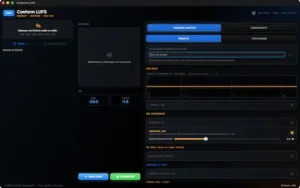 Meeting a loudness target and producing a great master are two very different objectives. Integrated LUFS, Loudness Range, and True Peak determine whether a file satisfies a delivery specification. They reveal almost nothing about tonal balance, punch, depth, stereo imaging, or how a master will translate across real playback systems.
That distinction is easy to overlook because loudness compliance is objective while musical quality is not. Two masters can measure the same Integrated LUFS yet sound completely different after streaming normalization or perceptual codec encoding. One retains transient impact and openness; the other may feel constrained, fatiguing, or less detailed despite passing every technical requirement.
Conform LUFS operates entirely on the technical side of that equation. It verifies delivery targets after mastering has been completed, but it cannot evaluate creative decisions made during mixing or mastering. It won’t identify excessive limiting, tonal imbalance, masking, or problems that only become obvious through careful monitoring.
For engineers already monitoring loudness throughout the mastering process, the workflow gains may be relatively small. A typical streaming release often requires only minor verification before delivery, although mastering for streaming platforms involves considerably more than simply meeting a LUFS target.
The value increases considerably in high-volume production. Broadcast facilities, podcast networks, audiobook publishers, and post-production studios frequently generate multiple deliverables from the same approved master, each with different loudness requirements. In those environments, separating technical conformity from creative production reduces repetitive revisions while preserving the integrity of the original master.
That separation also simplifies long-term project management. Archived mastering sessions become progressively harder to reopen as DAWs evolve, plugins are discontinued, operating systems change, and licenses expire. Generating new delivery versions without reconstructing the original production environment saves time while reducing the risk of introducing unintended changes into an approved project.
It also minimizes routine delivery errors. Every additional bounce creates another opportunity for an incorrect sample rate, export range, processing preset, or automation state to slip into the final file. Performing loudness conformity after rendering keeps the approved master intact and limits the number of variables involved in the delivery process.
Performance is unlikely to be a deciding factor. Because Conform LUFS processes audio offline, CPU usage matters far less than measurement accuracy, processing reliability, and predictable results. Even if analysis requires additional processing time, it remains insignificant compared with the computational demands of a typical mastering session built around oversampled limiters, linear-phase equalizers, spectral processors, and restoration tools.
Ultimately, professional adoption depends less on features than on confidence. Engineers build delivery workflows around software that produces consistent, verifiable results over thousands of projects. Conform LUFS addresses a legitimate production need, but only long-term use and independent validation will determine whether it becomes a trusted part of professional mastering and broadcast workflows.
Overall Rating
| Category | Rating |
|---|---|
| Loudness Accuracy | 9.5/10 |
| Workflow Efficiency | 9.5/10 |
| Professional Reliability | 8.5/10 |
| Platform Support | 7.5/10 |
| Ease of Use | 9.5/10 |
| Value for Money | 9.5/10 |
| Overall | 9.0/10 |
Conform LUFS is a highly focused production utility rather than another mastering processor. It delivers excellent workflow efficiency for engineers who regularly prepare audio for streaming, broadcast, podcasts, and other delivery formats where reliable LUFS compliance is required. While it lacks the broader feature set of enterprise loudness platforms, its simplicity, speed, and affordable pricing make it a compelling addition to many professional mastering workflows.
Why These Scores?
Loudness Accuracy — 9.5/10.
The software measures Integrated LUFS, Loudness Range, and True Peak using established industry standards while providing a fast offline verification workflow. The only reason it doesn’t receive a perfect score is the current lack of extensive third-party validation across large-scale production environments.
Workflow Efficiency — 9.5/10.
Its biggest strength is eliminating repeated export-and-measure cycles. Separating creative mastering from technical delivery significantly reduces the time required to prepare multiple versions of the same project.
Professional Reliability — 8.5/10.
The overall concept is solid and well suited to professional production. However, long-term confidence still depends on broader industry adoption, continued development, and a proven track record in commercial broadcast facilities.
Platform Support — 7.5/10.
The current macOS-only release limits deployment in studios where Windows remains part of the production environment. Cross-platform support would make the application attractive to a much wider professional audience.
Ease of Use — 9.5/10.
The interface stays focused on a single production task without unnecessary complexity. Engineers familiar with LUFS delivery standards can integrate the application into an existing workflow with virtually no learning curve.
Value for Money — 9.5/10.
Considering its price and the amount of repetitive manual work it removes, Conform LUFS offers excellent value for mastering engineers, podcast editors, and post-production facilities that regularly deliver content to multiple loudness specifications.
Overall — 9.0/10.
Conform LUFS doesn’t attempt to replace comprehensive mastering or broadcast suites. Instead, it solves one specific production problem extremely well: preparing compliant delivery files quickly, consistently, and without reopening completed mastering sessions. For studios where loudness compliance is part of everyday production, that focused approach makes it a worthwhile addition to the toolbox.
Pros & Cons
| Pros | Cons |
|---|---|
| Fast offline loudness compliance workflow | Currently available only for macOS |
| Simple interface with minimal learning curve | No realtime loudness monitoring |
| Preserves approved mastering sessions | Limited technical documentation |
| Affordable compared to enterprise solutions | Not intended for creative audio processing |
Who Should Buy Conform LUFS?
| Best For | Less Suitable For |
|---|---|
| ✓ Mastering engineers ✓ Broadcast production ✓ Podcast studios ✓ Audiobook production ✓ Content delivery workflows | ✕ Realtime loudness monitoring ✕ Windows-only studios ✕ Engineers seeking creative processing ✕ Mix engineers needing production metering |
If your workflow already depends on realtime loudness analysis, codec auditioning, batch automation, or enterprise broadcast reporting, a comprehensive platform such as NUGEN or iZotope Insight will remain the stronger choice. Conform LUFS is best viewed as a dedicated delivery utility rather than a replacement for a complete loudness ecosystem.
Verdict: A Practical Addition to the Modern Delivery Workflow
Conform LUFS doesn’t attempt to redefine loudness measurement, nor does it compete with the mastering processors engineers already rely on every day. Its objective is far more specific: making the final delivery stage faster, more predictable, and less dependent on reopening completed projects.
That focused approach is one of the application’s greatest strengths. Rather than expanding into a broad production suite, it concentrates on a workflow that remains surprisingly inefficient in many professional studios. Measuring a finished master, applying the required loudness correction, verifying the result, and exporting a compliant file can all be handled without revisiting the original mastering session.
The benefits are most apparent in production environments where compliance is a routine part of the job rather than an occasional requirement. Broadcast facilities, podcast networks, audiobook publishers, post-production houses, and mastering engineers delivering multiple versions of the same project all stand to gain the most from separating creative work from technical delivery.
For engineers whose workload consists primarily of single-version music releases, the advantages are less dramatic. Modern loudness meters already provide accurate realtime feedback during mastering, and many existing workflows require only minimal verification before export. In those cases, Conform LUFS serves more as a convenience tool than an essential addition to the production chain.
Its limitations are equally clear. Conform LUFS is not intended to replace realtime metering, mastering processors, or the advanced reporting, codec simulation, automation, and broadcast integration offered by more comprehensive loudness platforms. Those capabilities remain the domain of larger production ecosystems.
What the application offers instead is a lightweight, dedicated solution for a well-defined production task. That focus keeps both the learning curve and the acquisition cost relatively low while addressing a workflow that many engineers still manage manually.
Future development will ultimately determine how broadly the software is adopted. Windows support, expanded reporting, batch processing, and continued validation through professional production environments would significantly strengthen its position in a competitive market.
As a first major release, however, Conform LUFS presents a clear and credible proposition. It doesn’t promise better-sounding masters or revolutionary processing. It simply streamlines one of the least creative—but most necessary—stages of modern audio production. For engineers who regularly prepare audio for multiple delivery standards, that alone may be reason enough to keep it in the workflow.
Frequently Asked Questions About Kinetic DSP Conform LUFS
Can Conform LUFS replace a realtime loudness meter?
No. Realtime loudness metering remains essential during mixing and mastering, where engineers continuously evaluate dynamics, limiting, and overall balance. Conform LUFS is designed for the final delivery stage, verifying and correcting loudness after the creative work has already been completed.
Will Conform LUFS improve the sound of my master?
Not directly. The software focuses on meeting loudness specifications rather than altering tonal balance, dynamics, stereo imaging, or other creative aspects of mastering. Its goal is technical compliance, not sonic enhancement.
Can it be used for Spotify, Apple Music, and other streaming platforms?
Yes. It can verify that a finished master meets the desired loudness target before distribution. However, streaming optimization still depends on mastering decisions such as dynamics, limiting, and how the material behaves after codec encoding.
How is Conform LUFS different from Youlean Loudness Meter?
The two applications serve different stages of production. Youlean Loudness Meter provides realtime analysis while engineers are still shaping the master, whereas Conform LUFS focuses on preparing an already approved master for delivery.
Is it a good choice for podcast production?
It can be particularly useful for podcast networks and studios producing content at scale. Applying loudness conformity after rendering helps maintain consistent playback levels across episodes without repeatedly reopening production sessions.
Does it offer any advantages for mixing engineers?
Its role during mixing is limited. The application becomes more relevant after the mix has been finalized and is being prepared for mastering, distribution, or broadcast delivery.
Does Conform LUFS support batch processing?
At the time of writing, the software is intended for individual file analysis and correction. Studios that depend on large-scale automated delivery workflows may still require more comprehensive broadcast-oriented solutions.
Who is most likely to benefit from it?
Studios that regularly deliver audio to multiple platforms are likely to see the greatest value. That includes mastering engineers, podcast producers, dialogue editors, broadcast facilities, and post-production teams where loudness compliance is a routine part of the workflow.
Should users of NUGEN or iZotope consider switching?
Probably not if those platforms already meet every production requirement. Conform LUFS is better viewed as an alternative for engineers who want a dedicated, lower-cost compliance tool rather than a replacement for a fully integrated loudness ecosystem.
Does Conform LUFS have the potential to become an industry standard?
The demand for reliable loudness compliance is unlikely to disappear, but widespread adoption will depend on continued development, broader platform support, independent validation, and proven reliability in everyday professional use.

Yurii Ariefiev is a mastering engineer and audio production editor who reviews professional audio software through the lens of real-world mastering, loudness compliance, and delivery workflows. His analysis emphasizes how technical tools perform in practical production environments rather than relying on feature lists or marketing claims.
This review evaluates Kinetic DSP Conform LUFS as a dedicated loudness compliance utility, examining its role in mastering, broadcast delivery, podcast production, and streaming workflows where accurate LUFS verification and repeatable delivery standards are essential.