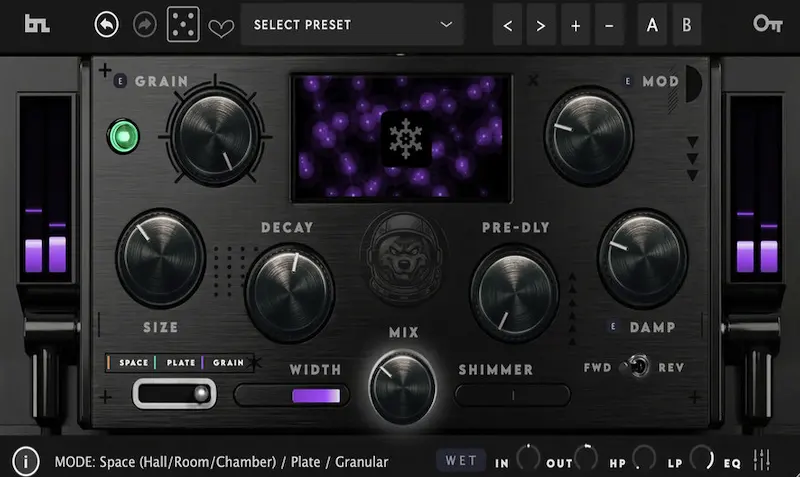
BeatSkillz SpaceWolf Reverb Plugin Blurs the Line Between Reverb and Granular FX
BeatSkillz SpaceWolf reverb plugin has entered the market with a clear positioning shift: this is not a conventional reverb designed for placement and depth. It’s a hybrid processor that merges algorithmic space with granular manipulation, effectively turning reverb tails into a controllable sound design layer.
That distinction matters. In a plugin landscape dominated by precision tools for mixing and mastering, SpaceWolf is targeting a different workflow—one where reverb is not just spatial glue, but a compositional element.
Where SpaceWolf Fits in the Current Reverb Plugin Landscape
The reverb category is already saturated. You have:
- clean algorithmic engines (FabFilter Pro-R 2)
- character reverbs (Eventide Blackhole)
- ambient specialists (Valhalla Supermassive)
BeatSkillz SpaceWolf reverb plugin doesn’t attempt to outperform these on realism or transparency. Instead, it collapses multiple processing concepts—reverb, pitch shifting, and granular diffusion—into a single interface.
This reflects a broader shift in audio production: fewer plugins, more hybrid processors, faster creative decisions.
What Actually Defines BeatSkillz SpaceWolf Reverb Plugin
Underneath the marketing language, SpaceWolf is built around three independent engines:
- Hall — wide, long-decay spatial model
- Plate — denser reflections with shorter diffusion curves
- Granular engine — time-sliced particles with pitch and scatter control
These are not variations of a single algorithm. Each mode behaves differently in terms of modulation response, decay structure, and tonal density.
The functional layer is where things get more interesting:
- Freeze — locks the tail into an infinite sustain state
- ±1 octave pitch shifting — enabling shimmer-style processing and sub-harmonic layers
- Tempo-synced reverse reverb — aligned to DAW grid for predictable transitions
- 7-band EQ on wet signal — internal spectral shaping
- Deep edit panel — access to diffusion, damping crossover, modulation depth, grain density
From a DSP perspective, this moves SpaceWolf closer to a modular FX processor than a standard reverb plugin.
Real-World Use: Where It Adds Value in Mixing
In practical mixing workflows, SpaceWolf is not a primary reverb. Treating it as one is a mistake.
Effective use cases:
- Parallel vocal processing — shimmer layers and extended tails on sends
- Synth enhancement — turning static patches into evolving textures
- Transition design — tempo-locked reverse reverb for build-ups
- Ambient layering — creating sustained, modulated backgrounds
The key advantage is control over the tail as an independent sonic object. You’re not placing a sound in space—you’re reshaping the space itself.
However, this comes with a trade-off. Once these tails enter a dense mix, they quickly accumulate low-end energy and smear transients. Without aggressive filtering, they interfere with clarity and headroom.
This becomes even more critical before final processing. Overly complex reverb tails complicate translation during track mastering, where phase coherence and spectral balance are non-negotiable.
Where the Plugin Falls Short
Despite its feature set, BeatSkillz SpaceWolf reverb plugin has clear limitations.
- Hall and plate modes lack depth — diffusion and decay behavior don’t match top-tier algorithmic reverbs
- Over-complex parameter space — too many controls without a strong default state
- Preset dependency — 700+ presets suggest inconsistent baseline tuning
The granular engine is the real core. Everything else feels secondary.
This creates a mismatch between marketing and reality. It’s presented as a multi-mode reverb, but in practice, it’s a granular FX tool with added reverb modes.
Comparison: What You Should Use Instead (and When)
In terms of audio production plugin selection, SpaceWolf sits in a niche:
- Use Valhalla Supermassive if you need cleaner, more predictable ambient tails
- Use Eventide Blackhole for controlled extreme spaces with better density
- Use FabFilter Pro-R 2 for precision in vocal and mix placement
- Use SpaceWolf when you want to break the rules and design textures
It’s not competing head-on with these tools. It’s filling the gap between them.
Who Should Actually Use SpaceWolf
BeatSkillz SpaceWolf reverb plugin makes sense for:
- Electronic producers (ambient, trap, cinematic)
- Sound designers building transitions and textures
- Engineers who already have a primary reverb and need a creative layer
It does not make sense for:
- Mix engineers needing reliable spatial placement
- Mastering engineers requiring transparency
- Beginners looking for a single all-purpose reverb
Pricing and Market Position
SpaceWolf launches at $29 intro price (regular $79), available via Plugin Boutique.
This pricing is not accidental. It positions the plugin as an impulse add-on rather than a core tool.
At $29, it’s an easy entry into hybrid processing. At $79, it competes directly with more refined products and loses that comparison.
Verdict: A Creative Tool, Not a Core Reverb
BeatSkillz SpaceWolf reverb plugin succeeds in one area: it turns reverb into a playable, shapeable effect.
It fails in another: it cannot replace established reverbs for mixing or mastering.
Bottom line:
- Strong for sound design and creative FX
- Weak as a primary reverb solution
- Worth it at intro pricing, questionable long-term value
If used with intent, SpaceWolf expands a production toolkit. If misused, it will degrade clarity faster than it adds depth.