Samplicity ScoreStage Launches With a Focus on Instrument Placement Rather Than Traditional Reverb Design
Samplicity ScoreStage has entered the market with a different proposition than most recent reverb releases. Instead of concentrating primarily on room emulation, decay characteristics, or vintage hardware recreation, the new plugin is designed around a broader production challenge: creating believable spatial relationships between instruments inside a shared acoustic environment.
The release targets composers, producers, and mixing engineers working in orchestral, cinematic, trailer, and acoustic production. While spatial positioning has traditionally required a combination of panning, multiple reverbs, delay processing, and extensive automation, ScoreStage attempts to consolidate much of that workflow into a single environment.
The announcement arrives during a period when virtual orchestration workflows continue to become more sophisticated. Modern sample libraries increasingly offer detailed microphone options and advanced room simulations, yet many producers still spend significant time trying to make independently recorded instruments sound like they occupy the same physical space. ScoreStage appears designed specifically to address that challenge.
What Was Announced
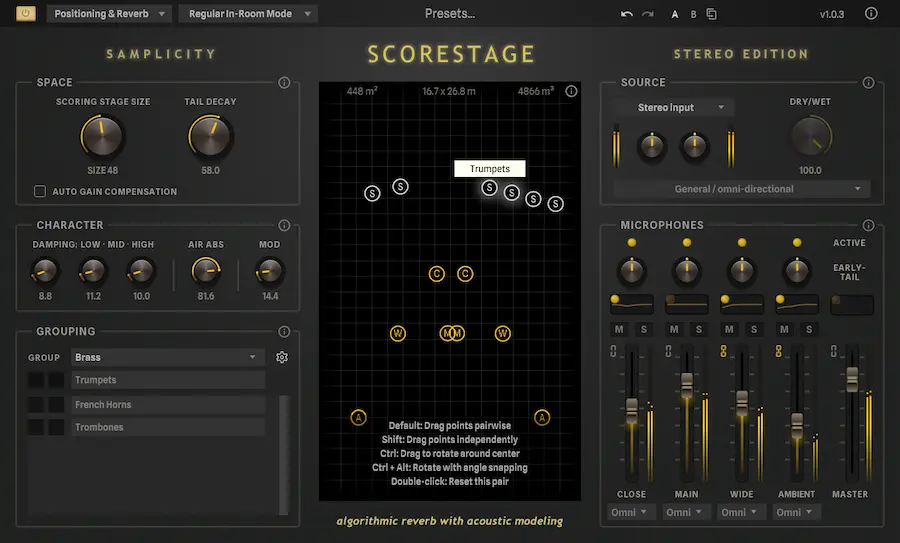
ScoreStage is a new algorithmic positioning reverb developed by Samplicity for macOS and Windows. Unlike conventional reverbs that primarily generate reflections and ambience, the plugin combines source positioning, early reflection modeling, microphone perspective management, and room simulation inside a unified workflow.
At the center of the system are four parallel true-stereo reverb engines representing different microphone perspectives within the same virtual environment. Rather than simply adjusting wet and dry levels, users can alter how individual sound sources interact with multiple microphone positions to shape depth, distance, and spatial perception.
The plugin allows users to position instruments on a virtual stage while adjusting microphone balance to influence how close or distant those sources appear. Additional parameters include room size, decay time, surface absorption, air absorption, and modulation controls.
From a technical perspective, the most notable aspect of the release is that Samplicity is not presenting ScoreStage as a traditional hall, room, or plate reverb. Instead, the company is positioning it as a stage-building environment intended to solve spatial organization problems inside complex productions.
That distinction may seem subtle, but it represents a different workflow philosophy. Traditional reverbs often focus on adding ambience after placement decisions have already been made. ScoreStage appears designed to make positioning itself part of the reverb process.
Why It Matters
The release is noteworthy because it addresses a problem that many orchestral and cinematic producers encounter long before they begin thinking about reverb tails or room character. In large arrangements, the challenge is often not creating more ambience but creating believable spatial relationships between dozens of competing elements.
Modern sample libraries provide increasingly detailed recordings captured in world-class scoring stages. However, combining libraries from different developers frequently creates inconsistencies in depth, perspective, and room perception. A close-miked string section from one library may feel disconnected from brass recorded in a different environment, even when both are processed through the same reverb.
This issue becomes even more apparent in hybrid orchestral productions where acoustic instruments must coexist with synthesizers, percussion layers, sound design elements, and heavily processed effects. Traditional reverb workflows can add cohesion, but they do not always solve placement problems.
ScoreStage enters a market where producers are looking for tools that help organize space rather than simply decorate it. The distinction reflects a broader industry shift toward workflow solutions that address production realism at the arrangement level rather than through post-processing alone.
For mixers, the potential appeal lies in reducing the number of separate tools required to build convincing depth. Instead of combining panning decisions, multiple reverbs, delay compensation techniques, and automation moves, users may be able to establish spatial relationships from a single environment.
Editorial Analysis
The strongest aspect of the ScoreStage concept is its focus on perception rather than effect generation. Many reverb releases compete by advertising longer decays, more presets, larger spaces, or increasingly detailed room simulations. ScoreStage appears to focus on something arguably more important: helping listeners perceive where instruments exist within a mix.
This focus on perception rather than raw processing power mirrors a broader trend visible across recent plugin releases. For example, Three-Body Technology’s Transi-Q approaches equalization through transient behavior rather than traditional frequency shaping, reflecting the industry’s growing interest in workflow-specific problem solving instead of feature accumulation.
That approach aligns with how engineers often think about orchestral productions in practice. When listeners describe a mix as sounding realistic, immersive, or cinematic, they are frequently responding to depth relationships rather than reverb quality alone. A technically impressive reverb can still produce an unrealistic soundstage if instrument positioning feels inconsistent.
The multiple microphone perspective concept is particularly interesting because it mirrors real recording workflows. In scoring stages, engineers rarely rely on a single microphone position. The interaction between close microphones, section microphones, room microphones, and distant perspectives plays a major role in how listeners perceive scale.
However, some of the marketing claims surrounding spatial realism will ultimately require independent verification. Virtual positioning systems have existed for years in various forms, and their effectiveness often depends heavily on source material. Instruments recorded with strong baked-in ambience can be difficult to reposition convincingly regardless of the sophistication of the processing.
There is also the question of workflow complexity. While combining multiple spatial processes into a single plugin may streamline production, it can also create a steeper learning curve. Engineers accustomed to separating panning, reverb, and depth decisions may need time to adapt to a more integrated approach.
Another consideration is that realistic positioning does not automatically translate into better mixes. In commercial music production, realism is frequently sacrificed in favor of impact, clarity, and translation. What works exceptionally well for orchestral scoring may not always benefit modern pop, rock, EDM, or hip-hop productions where exaggerated spatial presentation is often intentional.
As a result, ScoreStage appears most compelling for users who prioritize acoustic realism, cinematic immersion, and orchestral depth rather than those searching for a general-purpose creative reverb.
Industry Context
The launch of ScoreStage reflects a broader trend that has been developing across the audio industry for several years. Developers are increasingly moving beyond traditional reverb design and focusing on spatial production systems that combine positioning, depth management, and acoustic simulation.
As virtual orchestral production becomes more sophisticated, expectations around realism continue to rise. Modern composers routinely work with sample libraries recorded in world-class scoring stages, often containing multiple microphone perspectives and extensive environmental detail. The challenge is no longer obtaining realistic sounds individually. The challenge is making those sounds coexist convincingly inside the same production.
At the same time, software developers are expanding in different directions. While products such as Carbon Electra 2 focus on faster sound design workflows for electronic music production, tools like ScoreStage demonstrate how another segment of the market is prioritizing acoustic realism, spatial accuracy, and virtual stage construction.
Several companies have attempted to address this problem from different angles. Vienna Symphonic Library’s MIR Pro introduced advanced positioning concepts years ago by allowing instruments to be placed inside virtual venues. Dear Reality’s spatial processing tools focused on immersive positioning workflows. FLUX:: and SPAT Revolution targeted professional spatial audio environments, while various immersive production platforms expanded the concept into Dolby Atmos and multi-speaker formats.
At the same time, premium reverb developers such as LiquidSonics, FabFilter, and iZotope have continued refining room simulation and depth creation, often emphasizing realism, workflow efficiency, or CPU optimization.
ScoreStage appears to sit somewhere between these categories. It is not attempting to become a full immersive-audio platform, nor is it simply another hall reverb. Instead, it occupies a niche focused specifically on stage construction and spatial organization inside stereo production environments.
That positioning may prove advantageous. Many producers do not require a complete immersive-audio ecosystem, but they do need better tools for controlling depth relationships in increasingly complex arrangements.
Practical Production Perspective
From a real-world production standpoint, the potential value of ScoreStage depends less on its reverb quality and more on whether it can reduce workflow friction.
Large orchestral templates often contain dozens or even hundreds of tracks spread across multiple sample libraries. Engineers frequently spend significant time managing perceived depth through a combination of volume balancing, EQ adjustments, panning decisions, pre-delay settings, multiple reverbs, and automation.
If ScoreStage can reliably establish depth relationships through a centralized stage environment, it could simplify part of that process. Rather than continuously adjusting separate plugins across numerous channels, users may be able to manage spatial perception from a more unified perspective.
Mix engineers working on film scores may find particular value in maintaining consistent stage placement throughout large sessions. In these projects, listeners often expect a coherent acoustic image where sections occupy stable positions rather than constantly shifting perspectives.
For mastering engineers, the direct relevance is naturally more limited. Spatial positioning decisions are generally made during production and mixing rather than mastering. However, the plugin could indirectly influence mastering outcomes by helping mixes arrive with more stable depth relationships and improved spatial balance before the final stage of production.
One area worth monitoring is CPU efficiency. Running four parallel true-stereo engines simultaneously suggests a potentially more demanding processing architecture than conventional algorithmic reverbs. Until independent testing becomes available, it remains unclear how comfortably large sessions will handle multiple instances.
Latency performance may also become an important consideration for composers working with large templates. Even relatively small delays can affect workflow when hundreds of tracks and real-time MIDI performance are involved.
Another practical question concerns translation. Spatial effects that sound impressive in highly controlled studio environments do not always translate predictably across headphones, consumer speakers, laptops, and streaming platforms. The success of ScoreStage will depend partly on whether its positioning model remains convincing outside ideal monitoring conditions.
These are not criticisms of the concept itself. They are simply the kinds of questions experienced engineers typically ask whenever a new spatial-production tool enters the market.
Availability And Pricing
Samplicity ScoreStage is available immediately for both macOS and Windows systems in VST3, AU, and AAX formats.
The plugin is currently being offered at an introductory price of €169, with the regular retail price set at €199 after the launch promotion concludes. Samplicity is also providing a fully functional 14-day trial version, allowing users to evaluate the workflow before purchasing.
At its current price point, ScoreStage enters the premium segment of the reverb market. However, the company is clearly positioning the product as a specialized production tool rather than a general-purpose effects plugin.
For composers and orchestral producers already investing heavily in sample libraries, virtual instruments, and professional mixing tools, the pricing falls within the range typically associated with advanced spatial-processing solutions.
The more important consideration will likely be workflow impact rather than purchase cost. If the plugin meaningfully reduces the time required to build convincing acoustic depth and stage placement, many users may view the investment differently than they would a conventional reverb purchase.
Conclusion
Samplicity ScoreStage stands out because it is attempting to solve a different problem than most reverb releases currently entering the market. Rather than focusing exclusively on room simulation, vintage hardware emulation, or increasingly elaborate ambience generation, the plugin centers its workflow around instrument placement and spatial organization.
That focus aligns with a growing demand among composers and orchestral producers who are less concerned with adding more reverb and more concerned with creating believable acoustic relationships between sources recorded under different conditions.
The concept itself appears well suited to cinematic, orchestral, trailer, and acoustic production environments where depth perception plays a critical role in the listener experience.
At the same time, some of the broader claims surrounding realism and positioning accuracy will require independent testing across a variety of workflows, monitoring systems, and source materials. Spatial processing tools often reveal their true strengths only after extended use inside complex production sessions.
For now, ScoreStage looks less like another entry in the crowded reverb category and more like an attempt to redefine how stage construction is handled inside modern virtual production environments. Whether it becomes a widely adopted workflow solution remains to be seen, but it is one of the more technically interesting spatial-production releases of the year.
FAQ
When was Samplicity ScoreStage released?
ScoreStage was officially released in 2026 as Samplicity’s latest spatial-production plugin focused on virtual stage placement and acoustic positioning.
What formats does ScoreStage support?
The plugin is available in VST3, AU, and AAX formats for both Windows and macOS systems.
Is Samplicity ScoreStage a convolution reverb?
No. ScoreStage is an algorithmic reverb system that combines positioning, microphone perspective control, and room simulation rather than relying on impulse responses.
Who is ScoreStage designed for?
The primary audience includes orchestral composers, film and television composers, trailer music producers, acoustic music producers, and mixing engineers working with large virtual instrument arrangements.
How does ScoreStage differ from traditional reverb plugins?
Traditional reverbs primarily focus on generating ambience and decay. ScoreStage integrates source positioning and microphone perspective management into the reverb workflow, making spatial placement a central feature rather than a secondary consideration.
Are there alternatives to Samplicity ScoreStage?
Potential alternatives include Vienna MIR Pro, SPAT Revolution, Dear Reality spatial tools, LiquidSonics reverbs, and other advanced positioning or acoustic-environment solutions depending on the intended workflow.
Does ScoreStage require a paid upgrade from existing Samplicity products?
At launch, ScoreStage is being sold as a separate product. Users should check Samplicity’s licensing policies for any future crossgrade or upgrade options.
Is there a free trial available?
Yes. Samplicity offers a fully functional 14-day trial, allowing users to test the plugin inside their own production environment before making a purchasing decision.