Universal Audio Launches UAD Topline Vocal Tune Pitch Correction Plugin
Universal Audio has introduced UAD Topline Vocal Tune, a new native pitch-correction plugin aimed at modern vocal production workflows. The release adds a dedicated tuning tool to the company’s growing software ecosystem and signals a more direct move into a category long dominated by Antares Auto-Tune, Celemony Melodyne, Waves Tune Real-Time and a growing number of integrated vocal-production suites.
Although pitch correction is one of the most mature segments of the audio software market, demand for vocal processing tools continues to grow across modern pop, hip-hop and R&B production. For Universal Audio, the launch represents more than another plugin release. It is an attempt to strengthen the company’s position among producers who increasingly work entirely inside native environments without relying on DSP hardware.
The timing is notable. Over the past several years, developers have focused heavily on streamlining vocal workflows, reducing latency and combining corrective and creative processing into single tools. UAD Topline Vocal Tune enters a crowded market where speed, monitoring performance and ease of use often matter as much as tuning accuracy itself.
Universal Audio Targets Modern Vocal Production Workflows
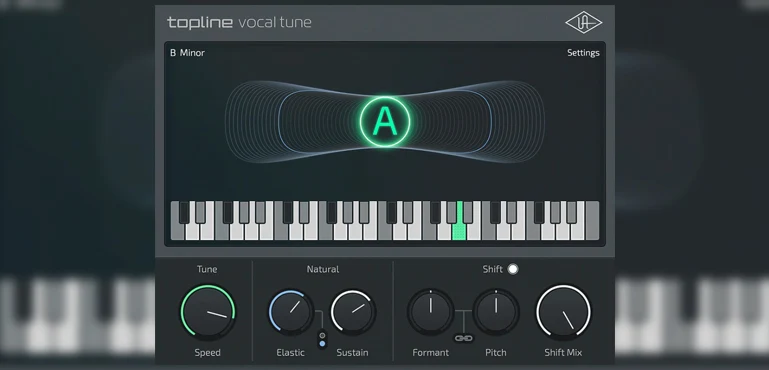
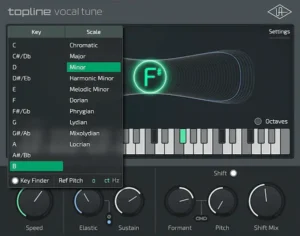
Unlike traditional offline pitch-editing systems, UAD Topline Vocal Tune has been designed primarily around real-time operation. The plugin offers instant pitch correction, automatic key detection, formant manipulation and MIDI-controlled pitch processing while maintaining low enough latency for use during tracking sessions.
According to Universal Audio, users can move from subtle pitch refinement to heavily processed vocal effects with a single control adjustment. The company is also highlighting a dedicated section intended to preserve the natural character of a vocal performance while correction is applied.
Beyond standard tuning functions, the inclusion of MIDI repitching allows producers to transform vocal recordings into melodic elements, harmonies and synthetic vocal hooks without leaving the plugin environment.
The release is available as a standalone native plugin and is also included in the company’s UAD Spark subscription platform.
Why This Release Matters Beyond Another Pitch Correction Plugin
Pitch correction software is no longer a niche category. For many contemporary productions, tuning tools have become a standard part of recording, editing and mixing workflows.
What makes this launch noteworthy is not necessarily the existence of another vocal tuner but the company behind it. Universal Audio has traditionally been associated with analog emulation, DSP-powered processing and premium studio workflows. Entering the dedicated vocal tuning market more aggressively places the company into direct competition with products that have become deeply embedded in modern production culture.
The market has also shifted significantly. Producers increasingly expect a single plugin to handle transparent correction, aggressive tuning effects, creative vocal manipulation and real-time monitoring simultaneously. Rather than specializing in one area, newer products are being designed as complete vocal-production environments.
UAD Topline Vocal Tune appears to reflect that trend.
The Competitive Landscape Is Already Crowded
 Universal Audio is entering a segment where several mature solutions already exist.
Antares Auto-Tune remains the most recognizable name in real-time vocal tuning and continues to dominate commercial pop and hip-hop workflows. Melodyne retains a strong position among engineers who require detailed note-level editing and surgical correction capabilities. Waves Tune Real-Time offers a lower-cost alternative that remains popular among project studios, while iZotope Nectar integrates pitch correction into broader vocal-processing chains.
This means UAD Topline Vocal Tune faces a difficult challenge. Success will likely depend less on introducing completely new functionality and more on how efficiently the plugin integrates into existing production workflows.
For many engineers, switching pitch-correction platforms requires a compelling advantage in speed, monitoring performance, workflow simplicity or sound quality. Universal Audio appears to be focusing primarily on the workflow side of that equation.
The obvious benchmark remains Antares Auto-Tune, which continues to dominate commercial vocal production. Any new entrant in this category will inevitably be judged against Auto-Tune’s tracking performance, tuning behavior and workflow speed, making direct comparisons almost unavoidable as engineers begin testing UAD Topline Vocal Tune in real sessions.
While Auto-Tune remains the standard for real-time correction, Celemony Melodyne continues to dominate detailed vocal editing workflows where engineers need note-level control and transparent pitch manipulation after recording.
Waves Tune Real-Time remains a popular option among project studios and budget-conscious producers, largely because it delivers low-latency pitch correction without requiring a significant investment.
Meanwhile, iZotope Nectar takes a broader approach by combining pitch correction with vocal processing, dynamics control and effects inside a single production environment.
Separating Marketing Claims from Practical Studio Reality
Several aspects of the announcement deserve attention, while others will require independent verification.
Many producers searching for an early UAD Topline Vocal Tune review are likely less interested in feature lists and more interested in how the plugin performs against established tuning platforms in real recording and mixing environments.
The promise of ultra-low-latency monitoring is potentially significant. Singers often perform more confidently when hearing corrected vocals in real time, particularly in genres where tuning has become part of the expected vocal aesthetic. If latency remains genuinely low across a wide range of systems, the plugin could become attractive for tracking sessions as well as mixing work.
At the same time, low-latency claims are difficult to evaluate without real-world testing. Actual performance depends on factors such as audio interfaces, buffer settings, DAW implementation and overall session complexity.
The automatic key detection feature may also prove useful for producers working quickly, although similar functionality is already available in several competing products. The real question is how accurately and consistently the system identifies keys in less straightforward musical material.
MIDI repitching is arguably one of the more interesting additions. While not unique, it reflects a broader industry trend toward treating vocals as flexible melodic sources rather than fixed recordings.
Ultimately, the plugin’s long-term reputation will depend less on feature lists and more on tuning quality, artifact management and reliability under professional workloads.
A Reflection of Larger Industry Trends
The launch of UAD Topline Vocal Tune aligns with several broader developments in audio production.
First, software developers continue moving toward integrated vocal-production ecosystems. Instead of using separate tools for tuning, harmonies, effects and editing, producers increasingly expect unified workflows.
Second, native processing continues gaining ground. Companies historically associated with proprietary hardware are investing heavily in software products that operate independently of dedicated DSP systems.
Third, modern production styles continue driving demand for creative pitch manipulation. In many genres, vocal tuning is no longer viewed solely as corrective processing but as a core element of the artistic sound itself.
This trend extends beyond vocal processing. Developers across the audio industry are increasingly building tools that focus on workflow efficiency and spatial decision-making rather than traditional signal processing alone. A recent example is Samplicity ScoreStage, a new orchestral positioning reverb designed to simplify spatial placement inside complex mixes. While targeting a different production stage, both releases reflect the industry’s growing emphasis on reducing technical friction during modern music production.
Universal Audio’s latest release fits directly into all three trends.
Potential Workflow Implications for Engineers and Producers
For recording engineers, the most immediate benefit could be improved artist monitoring during vocal sessions. Real-time pitch correction can help performers maintain confidence and stay focused on delivery rather than technical imperfections.
For mixers, the plugin may serve as a faster alternative for routine vocal cleanup where detailed note-by-note editing is unnecessary. Quick corrections often represent a significant portion of commercial vocal work, particularly in deadline-driven production environments.
Mastering engineers are less likely to interact directly with the software, but the broader trend toward heavier vocal processing remains relevant. More sophisticated pitch-correction tools continue shaping the sonic character of modern releases long before they reach the mastering stage.
CPU efficiency may also become a deciding factor for adoption. Large sessions frequently contain dozens of vocal tracks, and resource consumption can influence workflow decisions as much as audio quality.
Launch Pricing, Availability and Platform Support
UAD Topline Vocal Tune is available immediately.
Universal Audio is currently offering the plugin at an introductory price of $79, reduced from its standard retail price of $99. The plugin is also included as part of the company’s UAD Spark subscription service.
Compatibility includes:
- Windows 10 and newer
- macOS 11 and newer
- VST3
- AU
- AAX
The release coincides with Universal Audio’s UAD Half Yearly Sale, which runs through June 30, 2026, and includes discounts across the company’s broader software portfolio.
Conclusion
UAD Topline Vocal Tune is unlikely to redefine pitch correction overnight, but it represents a strategically important release for Universal Audio. Rather than introducing a radically new concept, the company is targeting one of the most active areas of contemporary music production with a workflow-focused solution designed for both recording and mixing applications.
The plugin enters a highly competitive market where established products already enjoy strong loyalty among professionals. As a result, its success will depend less on feature counts and more on practical performance, tuning quality and day-to-day usability.
For producers, recording engineers and vocal specialists already working within the UAD ecosystem, the release is worth watching. However, independent testing will ultimately determine whether the plugin can establish itself as a serious alternative to the market leaders it is challenging.

FAQ: UAD Topline Vocal Tune
When was UAD Topline Vocal Tune released?
The plugin became available on June 2, 2026, as a native software release from Universal Audio.
Does UAD Topline Vocal Tune require UAD hardware?
No. The plugin runs in native format and does not require Apollo interfaces or UAD DSP hardware.
Is UAD Topline Vocal Tune included with UAD Spark?
Yes. Subscribers to UAD Spark can access the plugin as part of their subscription package.
What are the main alternatives to UAD Topline Vocal Tune?
Major alternatives include Antares Auto-Tune, Celemony Melodyne, Waves Tune Real-Time and iZotope Nectar.
Can the plugin be used during recording sessions?
Universal Audio designed the plugin for low-latency operation, making it suitable for monitoring corrected vocals while tracking.
Does UAD Topline Vocal Tune support MIDI control?
Yes. MIDI repitching functionality allows users to create harmonies, melodic vocal effects and alternative pitch arrangements.
Which plugin formats are supported?
VST3, AU and AAX versions are available for supported Windows and macOS systems.
How much does UAD Topline Vocal Tune cost?
At launch, the plugin is available for an introductory price of $79, with a regular retail price of $99.