Ableton has announced Live 13, the next major version of its digital audio workstation. The update adds ARA 2 support, new mixing and dynamics processors, an expanded Step Sequencer, and new performance features for Push 3. The full release is scheduled for early 2027. A limited beta is available to selected Live Standard and Suite owners.
ARA 2 Support and Melodyne Essential
Live 13 introduces ARA 2 support, allowing compatible plug-ins to exchange audio and timeline information directly with the DAW. This is particularly relevant to workflows involving pitch correction, vocal editing, and timing adjustments.
Live 13 Suite will include Melodyne Essential, Celemony’s pitch and timing editing software. The integration has some restrictions: ARA 2 works only in Arrangement View, not Session View, and VST3 plug-in sources must be enabled in Live’s settings. Ableton also limits ARA use to one plug-in at a time across clips and tracks.
New Mixing and Dynamics Tools
Live 13 Suite adds two native processors for mixing: Clipper and Transient Shaper.
Clipper offers hard and soft clipping curves, a clipping display, Delta monitoring, and a Lift control. Transient Shaper provides Attack and Sustain controls, frequency emphasis, Dry/Wet adjustment, clipping control, and external sidechain support.
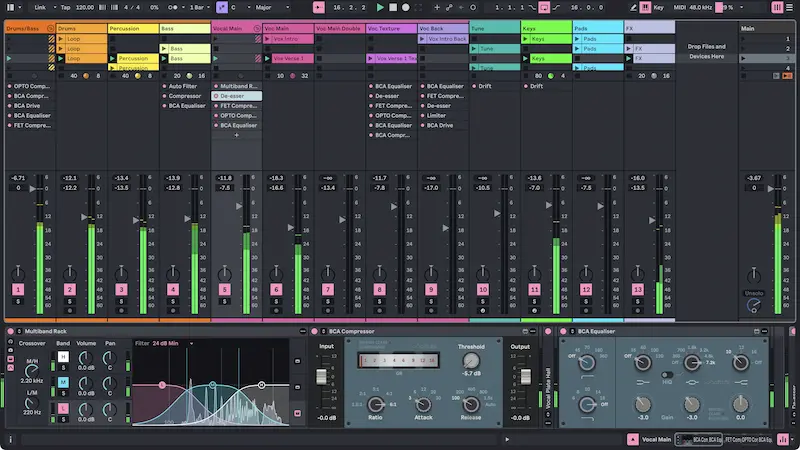
Live 13 also introduces Mid-Side and Multiband Racks. The Mid-Side Rack splits a stereo signal into separate mid and side processing chains. The Multiband Rack divides audio into low, mid, and high-frequency bands, with 24 dB and 6 dB minimum-phase crossover options and a 24 dB linear-phase option with adjustable latency.
Live 13 Suite also includes Softube Classic Dynamics & EQ, a collection of five Max for Live effects: FET Compressor, Opto Compressor, BCA Compressor, BCA Equaliser, and BCA Drive.
Step Sequencer and Automation Updates
The updated Step Sequencer supports patterns of up to 128 steps, with independent settings for each row. Users can change step rates and playback directions, as well as adjust velocity, note offset, length, repeat, pitch, and probability.
Patterns can be converted between Step Sequencer patterns and MIDI note clips, allowing users to switch between step-based programming and standard MIDI editing.
Live 13 also adds Capture Automation, which records automation changes alongside MIDI notes. It captures parameter movements made with a mouse, keyboard, Push, or MIDI controller. The feature works on audio and return tracks and can record changes to multiple parameters on the same track.
Push 3 Adds Custom Performance Layouts
Push 3 now supports Custom Layouts, letting users create and save up to eight layouts per Set. The new Performance Mixer layout combines clip and scene launching in the top four rows with volume control in the bottom four.
The Step Sequencer also gains more detailed editing controls, while Device Mode has been updated to support more complex Rack setups. Custom Layouts work in both Connected and Standalone modes.
Ableton Live 13 Release Date and Pricing
Ableton plans to release Live 13 in early 2027. The current beta has limited availability for Live Standard and Suite owners; it is not an unrestricted public download. Ableton’s beta release notes also list compatibility issues affecting several third-party plug-ins, so support is still being refined.
The official shop lists these prices in euros:
- Live 13 Intro: €99
- Live 13 Standard: €279
- Live 13 Suite: €599
US dollar pricing has not been confirmed. Ableton is also offering 20% off eligible Live 12 licenses and upgrades, Live 13 pre-orders, and Packs. Qualifying Live 12 purchases include a free upgrade to the corresponding Live 13 edition when it is released. Eligibility and upgrade pricing depend on the existing license, and the promotion runs until Live 13 launches.
Further details are available in Ableton’s official Live 13 announcement, shop information, and beta release notes.
ARA 2 support, new dynamics processors, and expanded sequencing and automation give Live 13 several additions relevant to both production and mixing. The beta’s documented plug-in compatibility issues are an important consideration for anyone planning to use it in an established studio workflow.