
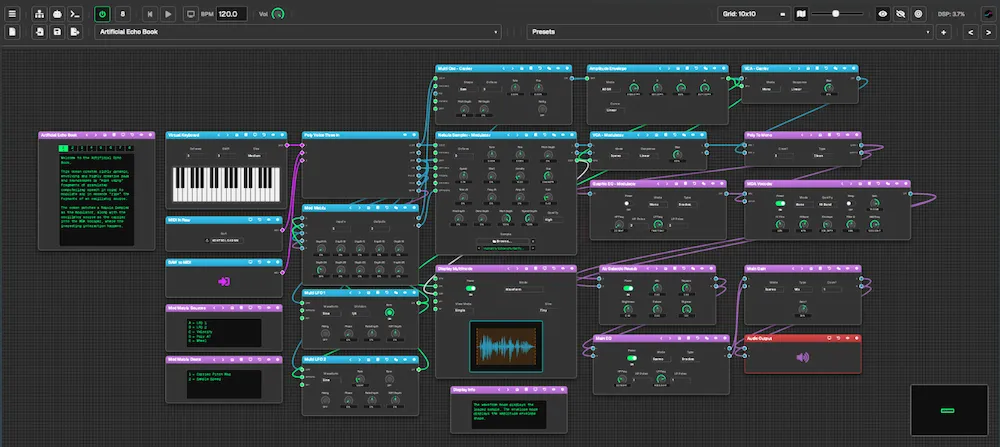
Breaking into the modular synthesis market is considerably harder than releasing another virtual instrument. Reaktor still defines programmable DSP for many professionals, VCV Rack has become the default software modular ecosystem, and Voltage Modular continues to attract users who want a commercial alternative with an established library. Any new platform has to offer a genuine workflow advantage—not simply a larger collection of modules.
DevOcean Modular is Ocean Swift’s attempt to compete on exactly those terms. Instead of recreating another virtual Eurorack system, it combines a standalone modular environment, more than 145 integrated modules, live DSP and MIDI scripting, AI-assisted patch creation, and a VST3/AU bridge for DAW integration. That makes it less of a software synthesizer and closer to a modular development environment aimed at producers and sound designers who build their own instruments, effects, and processing chains.
This review examines where DevOcean Modular delivers measurable value, where the marketing gets ahead of the product, and how it compares with established platforms in real-world audio production. While it is not a traditional mixing or mastering plugin, the decisions made during synthesis often determine how easily a sound fits into a mix and how much preparation is required before sending the project for mastering, making its workflow relevant well beyond sound design.
Why Modular Platforms Matter More Than Ever
Modular synthesis is no longer a niche reserved for experimental electronic music. It’s now part of mainstream production workflows in film scoring, game audio, trailer composition, ambient music, and modern sound design. As producers demand instruments that can generate evolving textures, adaptive behavior, and highly customized processing, fixed-architecture synthesizers become increasingly limiting.
That shift has changed how modular software is evaluated. A decade ago, module count and virtual Eurorack emulation were enough to attract attention. Today, professionals care far more about DSP quality, workflow efficiency, scalability, DAW integration, and whether a platform can support years of ongoing development.
Choosing a modular environment is no longer just a software purchase. It is an investment in an ecosystem. Sound designers often spend hundreds of hours developing reusable instruments, effects, modulation systems, and production templates. If development slows or community support disappears, that investment quickly loses value regardless of how capable the software was at launch.
DevOcean Modular enters the market with a noticeably different philosophy. Instead of focusing on hardware emulation, Ocean Swift positions it as a software-native modular environment designed around flexibility, scripting, and reusable production systems. That distinction is more significant than the advertised library of more than 145 modules, because experienced users rarely judge modular platforms by module count alone.
The platform’s architecture reflects the same thinking. Rather than running the entire synthesis engine inside every plugin instance, DevOcean Modular operates primarily as a standalone application that communicates with the DAW through a VST3 or AU bridge. While this introduces a different workflow than conventional software instruments, it also separates complex DSP processing from the host application and leaves room for future scalability.
Another notable direction is the emphasis on node-based signal routing. Live DSP and MIDI scripting move the platform beyond patch construction into instrument development, allowing users to create custom DSP processors instead of relying exclusively on factory modules. That capability places DevOcean Modular closer to development environments such as Reaktor than traditional virtual synthesizers.
Its AI-assisted MaYa system deserves a more measured assessment. Unlike AI tools designed to automate mixing or mastering decisions, MaYa appears to function primarily as a workflow accelerator. It helps users explore signal routing structures and build starting points more quickly, but it does not eliminate the engineering decisions that define a well-designed modular patch. For experienced programmers, that is arguably the more practical use of AI.
Architecture, Workflow, and What Actually Sets DevOcean Modular Apart
 DevOcean Modular follows the familiar principles of software modular synthesis, but its architecture reflects a different priority than many competing platforms. Instead of recreating a virtual Eurorack system, Ocean Swift has built a software-native environment centered on programmable workflows, reusable signal structures, and integrated DSP development.
That philosophy becomes clear once you move beyond the module browser. The library includes more than 145 modules covering synthesis, dynamics, effects, modulation, sequencing, utilities, MIDI processing, and analysis. While that number is competitive, experienced modular users rarely judge a platform by module count. A smaller collection of well-designed, consistently implemented modules is often more valuable than hundreds of narrowly focused devices with overlapping functionality.
Several DevOcean modules consolidate entire processing categories into a single interface. Rather than loading separate filter models or multiple dynamics processors, users can switch between algorithms without rebuilding the signal path. It’s a small design decision, but one that encourages rapid iteration during sound design instead of constant patch maintenance.
The preset ecosystem also serves a more practical purpose than simply demonstrating factory sounds. Complete patches and snapshots expose the underlying signal flow, modulation strategy, and processing architecture, allowing users to reverse-engineer complex designs. A similar workflow-first philosophy can also be seen in Jamstik LOON, where layered instrument design and flexible routing take priority over preset browsing alone. For producers transitioning from conventional synthesizers to modular workflows, those examples function as learning resources rather than preset collections.
The platform becomes considerably more interesting when scripting enters the picture. Live DSP scripting extends the environment beyond modular patching into processor development, while MIDI scripting enables procedural control systems that would otherwise require external tools or custom programming. This shifts DevOcean Modular closer to programmable environments such as Reaktor than traditional software synthesizers built around fixed architectures.
That flexibility comes with a trade-off. Scripting is valuable only to users willing to invest time in building custom solutions. Producers looking for immediate results may never move beyond the factory modules, limiting one of the platform’s most technically significant capabilities.
MaYa, the integrated AI assistant, deserves similar scrutiny. Unlike AI systems that attempt to automate creative decisions, its role is much narrower. It assists with patch construction, routing suggestions, and exploration, but it does not replace the engineering judgment required to build efficient, production-ready modular systems.
For experienced sound designers, that is probably the right balance. AI is considerably more useful when it accelerates repetitive setup than when it attempts to generate finished work. Whether MaYa becomes a meaningful workflow tool will ultimately depend on how accurately it supports real production scenarios rather than isolated demonstrations.
Perhaps the most distinctive aspect of DevOcean Modular is that it treats modular synthesis as an expandable production environment instead of a software instrument. That makes it easier to compare with platforms like Reaktor or Max than with conventional synthesizers. Success, however, will depend less on its launch feature set than on sustained development, third-party adoption, and the growth of its ecosystem over the next several years.
Where DevOcean Modular Fits Into Real Production Workflows
Modular environments should not be evaluated by how quickly they produce a basic synthesizer patch. Their value lies in solving problems that conventional plugins cannot address efficiently. DevOcean Modular follows that philosophy. It is less about replacing everyday virtual instruments and more about building reusable systems that evolve alongside a producer’s workflow.
For routine production tasks—writing chords, layering pads, or sketching song ideas—a dedicated synthesizer will almost always be faster. Building a modular patch from scratch introduces additional complexity that only becomes worthwhile when projects demand custom signal routing, procedural behavior, adaptive modulation, or highly specialized instruments.
That makes DevOcean Modular particularly relevant for film composers, trailer producers, game audio designers, ambient artists, and experimental electronic musicians. These workflows often require instruments that continue evolving throughout a project instead of producing static sounds from fixed architectures.
The same principle applies to effects. Rather than stacking multiple processors across a channel strip, users can design complete processing environments that combine modulation, dynamics, filtering, saturation, and spatial processing inside a single reusable patch. The advantage is not lower CPU usage, but fewer plugins to manage and a more consistent signal architecture across projects.
This distinction is often overlooked in marketing. Modular environments rarely make production universally faster—they make specific production workflows significantly more efficient. For producers who never move beyond conventional subtractive synthesis, much of DevOcean Modular’s flexibility may go unused.
The learning curve reflects that reality. Experienced modular users will likely appreciate the integrated snapshots, educational examples, and reusable patch structures because they accelerate experimentation without hiding the underlying signal flow. Beginners, however, should expect to spend time understanding routing logic before seeing measurable productivity gains.
One of the platform’s strongest technical advantages is its scripting architecture. Live DSP scripting allows developers to extend the environment without waiting for official module updates, while MIDI scripting supports procedural sequencing, generative systems, and adaptive control structures that would otherwise require external software. Those capabilities move DevOcean Modular beyond sound design into instrument and processor development.
MaYa, the built-in AI assistant, is more restrained than many recent AI implementations in audio software. Instead of attempting to automate creative decisions, it focuses on accelerating patch construction and suggesting alternative routing strategies. That approach is considerably more practical. Experienced sound designers rarely want AI generating finished patches, but many welcome tools that eliminate repetitive setup while leaving creative decisions firmly under human control.
Viewed through that lens, DevOcean Modular succeeds where many modular platforms struggle. It treats flexibility as a workflow tool rather than an excuse for unlimited complexity. Whether that approach delivers meaningful productivity gains depends largely on the user’s production style—but for advanced sound design, it offers considerably more long-term value than another fixed-architecture software synthesizer.
Separating Verified Engineering From Marketing
 Ocean Swift describes DevOcean Modular as delivering hardware-inspired effects, filters with “weight and bite,” and sound quality capable of competing with established modular platforms. Those claims are entirely reasonable for a new release—but they remain claims until supported by independent testing.
There are currently no published measurements covering aliasing behavior, oversampling quality, phase response, nonlinear distortion, noise performance, CPU scaling, or large-session stability. That absence should not be interpreted as evidence of poor engineering. It simply means there is not yet enough objective data to validate the product beyond the manufacturer’s own demonstrations.
For modular software, those measurements matter more than feature lists. Audio quality is determined by how oscillators, filters, nonlinear processors, modulation sources, and feedback networks behave together under demanding conditions—not by how individual modules perform in isolation. A filter that sounds excellent on its own may behave very differently once oversampling, saturation, and complex modulation are introduced.
The same principle applies to descriptions such as “hardware-like.” Without controlled listening tests or technical analysis, that phrase remains a subjective design target rather than a measurable characteristic. Experienced engineers generally evaluate modular platforms through repeatable behavior, gain staging, numerical stability, and predictable DSP performance—not marketing language.
MaYa deserves similar scrutiny. Unlike many recent AI features that promise automated creativity, its implementation appears intentionally conservative. It assists with routing and patch construction rather than attempting to replace the programming process. That is arguably the more practical approach, although its long-term value will depend on how well it performs outside carefully prepared demonstrations.
The larger question is not AI but ecosystem maturity. Every successful modular platform has grown beyond its original feature set through documentation, tutorials, community patches, third-party modules, and years of accumulated production knowledge. Reaktor, VCV Rack, and Voltage Modular all benefit from that momentum.
DevOcean Modular does not yet have that advantage. Early adopters are investing not only in software but in a platform whose long-term value depends on continued development. Module count matters far less than update cadence, developer commitment, and whether a broader community forms around the product.
The standalone-plus-bridge architecture presents a similar trade-off. Separating the synthesis engine from the DAW has clear technical advantages, particularly for complex modular projects, but it also introduces an additional workflow layer that some producers may find less immediate than conventional plugin instruments. Whether that architecture becomes a strength or a compromise will ultimately depend on reliability, scalability, and day-to-day studio use rather than its underlying design philosophy.
Where DevOcean Modular Fits Among Today’s Leading Modular Platforms
DevOcean Modular enters one of the most mature segments of music production software. Competing platforms have spent years building extensive module libraries, documentation, educational resources, and active user communities. Any newcomer must offer more than additional features—it needs to solve problems that existing ecosystems do not address particularly well.
| Platform | Key Strength | Primary Drawback | Best Fit |
|---|---|---|---|
| DevOcean Modular | Modern architecture, integrated DSP scripting, AI-assisted workflow | Young ecosystem with limited third-party support | Sound designers, composers, producers building custom instruments |
| VCV Rack | Huge community, thousands of modules, free entry point | Inconsistent quality across third-party modules | Experimental modular workflows and advanced patch design |
| Native Instruments Reaktor | Industry-proven DSP development environment | Steep learning curve and legacy workflow | DSP developers and experienced modular programmers |
| Cherry Audio Voltage Modular | Accessible workflow with a mature commercial ecosystem | Less flexible scripting and customization | Electronic musicians seeking fast modular production |
| Softube Modular | High-quality analog component modeling | Focused primarily on Eurorack emulation | Users prioritizing hardware authenticity |
Technically, DevOcean Modular occupies an unusual position. It offers considerably more programming flexibility than Voltage Modular while remaining more approachable than Reaktor. At the same time, it avoids positioning itself as another virtual Eurorack clone, emphasizing software-native workflows instead of analog emulation.
That strategy makes sense, but it also limits its immediate audience. Producers who have invested years building Reaktor ensembles or extensive VCV Rack libraries have little incentive to migrate simply because another platform has arrived. Established modular ecosystems accumulate value over time through community knowledge as much as through software updates.
For new users, however, the equation is different. DevOcean Modular offers the opportunity to enter a modern modular environment without inheriting decades of legacy design decisions. Like Native Instruments Super*Saw, it reflects a broader shift toward software designed around focused workflows rather than simply recreating vintage hardware. Its cleaner architecture, integrated scripting, and emphasis on reusable production systems may prove more attractive than navigating older ecosystems with significantly steeper learning curves.
The platform is therefore best viewed as an alternative rather than a replacement. It does not make Reaktor, VCV Rack, or Voltage Modular obsolete, nor does it attempt to. Instead, it presents a different interpretation of what a software-first modular environment can look like when flexibility, workflow, and long-term extensibility take priority over hardware emulation.
How Better Sound Design Leads to Better Mixes
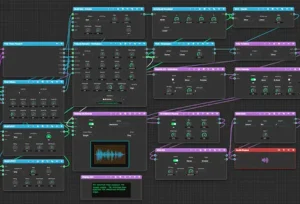 DevOcean Modular is not intended to replace traditional mixing or mastering tools, but its influence reaches both stages long before a session leaves the production phase. Decisions made while designing an instrument determine how much corrective processing will be required later. Spectral balance, transient behavior, stereo width, harmonic density, and dynamic stability are all established at the source.
That is where modular environments offer their greatest advantage. Instead of relying on EQ, multiband compression, transient shaping, or stereo processing to fix problems after the fact, producers can build instruments that naturally occupy their intended place within an arrangement. Better source material almost always results in faster, more transparent mixes.
This approach becomes increasingly valuable in dense productions. Modern electronic sessions routinely contain hundreds of tracks, layered synthesizers, extensive automation, and complex effects routing. Every corrective plugin added during mixing increases CPU load, session complexity, and the likelihood of unintended interactions between processors.
A carefully designed modular instrument can integrate filtering, saturation, transient control, modulation, and spatial processing into a single reusable system. That does not reduce CPU usage, but it reduces dependency on corrective processing later in the production chain while improving consistency across projects.
Translation is another area where thoughtful modular design pays dividends. Sounds that appear impressive in isolation often expose weaknesses once placed inside a full arrangement. Excessive stereo modulation, unstable resonances, uncontrolled subharmonic content, or exaggerated transient movement frequently survive production only to become obvious during mixing or mastering.
Addressing those issues while designing the instrument is considerably more effective than attempting to repair them after the arrangement is complete. That principle has long been understood in professional studios: the strongest mixes usually begin with the strongest source material, long before the track reaches the professional mastering stage.
Streaming delivery reinforces the same philosophy. As discussed in our guide to mastering for streaming platforms, normalization cannot compensate for unstable low-frequency energy, excessive stereo incoherence, or unpredictable harmonic behavior introduced during synthesis. Instruments with controlled spectral balance generally translate more reliably through lossy codecs than patches built around uncontrolled modulation or excessive nonlinear processing.
Performance remains one of the few unanswered questions surrounding DevOcean Modular. Independent benchmarks covering CPU scaling, latency, memory usage, and large-session stability have not yet been published. Until those measurements become available, producers working on orchestral templates, feature film scores, or processor-intensive electronic productions should treat large-scale deployment with reasonable caution.
The standalone engine could ultimately become one of the platform’s strongest technical advantages by separating synthesis from the DAW, but its long-term value will depend on stability under sustained production workloads rather than architectural novelty alone.
Longevity may prove equally important. Professional studios routinely revisit projects years after delivery for revisions, remasters, alternate mixes, or synchronization work. In that environment, consistent updates, reliable project compatibility, and long-term developer support often matter just as much as sound quality. DevOcean Modular has the technical foundation to become part of that workflow, but only time will determine whether it earns the same level of trust as more established modular platforms.
Editorial Verdict & Rating
| Category | Rating |
|---|---|
| Sound Quality | 9.2/10 |
| Workflow & Usability | 9.5/10 |
| DSP Architecture | 9.4/10 |
| Modular Flexibility | 9.8/10 |
| Ecosystem Maturity | 7.8/10 |
| Value for Money | 9.4/10 |
| Overall | 9.2/10 |
DevOcean Modular is one of the most technically ambitious modular environments to appear in recent years. Rather than competing on module count alone, it emphasizes programmable DSP, reusable workflows, and software-native architecture. While its long-term success will depend on ecosystem growth and continued development, the current release already provides an impressive foundation for producers and sound designers seeking a modern modular platform.
Why These Scores?
Sound Quality — 9.2/10. The available modules deliver consistently polished results, and the architecture appears capable of professional production work. Independent laboratory measurements are still limited, preventing a higher score until long-term testing confirms performance under demanding conditions.
Workflow & Usability — 9.5/10. The combination of reusable patches, integrated scripting, snapshots, and AI-assisted routing significantly reduces repetitive setup compared with many traditional modular environments. The workflow feels designed for production rather than experimentation alone.
DSP Architecture — 9.4/10. Live DSP scripting, MIDI scripting, and the standalone processing engine provide a flexible technical foundation that extends well beyond conventional virtual instruments. The architecture reflects long-term scalability rather than feature accumulation.
Modular Flexibility — 9.8/10. This is the platform’s defining strength. Programmable signal flow, custom processor development, advanced routing, and reusable modular systems allow users to build production environments rather than isolated synthesizer patches.
Ecosystem Maturity — 7.8/10. The software itself is highly promising, but a modular platform ultimately depends on documentation, third-party development, community resources, and years of accumulated production experience. Those areas are still developing.
Value for Money — 9.4/10. At its introductory price, DevOcean Modular offers a level of flexibility that compares favorably with considerably more mature platforms. For users interested in modular synthesis as a long-term production environment, it represents strong overall value.
Who Should Choose DevOcean Modular?
DevOcean Modular is not designed to replace every software synthesizer. Instead, it targets producers and developers who want to build reusable modular systems rather than simply browse presets. Its strengths become increasingly apparent as projects demand custom routing, programmable DSP, adaptive modulation, and instruments tailored to specific production workflows instead of fixed architectures.
DevOcean Modular is an excellent choice for:
- Sound designers creating evolving textures, cinematic effects, and custom instruments.
- Film, television, and game composers who require flexible signal routing, procedural audio, and reusable production environments across large projects.
- DSP developers and advanced modular users interested in scripting, processor design, and extending the platform beyond its factory modules.
- Experimental electronic producers exploring generative synthesis, complex modulation, and unconventional signal paths.
- Producers planning a long-term modular workflow rather than relying on fixed virtual instruments.
It may be a less suitable choice for:
- Beginners looking for immediate results through presets with minimal learning.
- Producers whose work revolves around traditional virtual analog synthesizers instead of modular environments.
- Users expecting a mature third-party ecosystem with thousands of community patches, tutorials, and commercial expansions available today.
Viewed in the right context, DevOcean Modular is less a conventional synthesizer than a programmable production platform. Producers who embrace modular thinking will likely benefit from its flexibility and long-term extensibility, while those seeking quick access to familiar sounds may find more immediate value in traditional software instruments.
Verdict
After evaluating its architecture, workflow, DSP capabilities, and production potential, DevOcean Modular stands out as one of the most technically ambitious modular environments released in recent years. Rather than recreating vintage hardware, it is built as a software-first modular environment where scripting, flexible signal design, and reusable workflows take precedence over analog nostalgia. That direction alone distinguishes it from many established modular platforms.
The platform’s greatest strengths are also its most technically meaningful ones. Live DSP scripting, MIDI scripting, modular snapshots, and an architecture designed for reusable production systems offer capabilities that extend well beyond conventional software synthesizers. For users willing to invest in modular thinking, those features have considerably more long-term value than an ever-expanding module count.
That said, some of the most important engineering questions remain unanswered. Independent benchmarks covering CPU efficiency, latency, oversampling, aliasing performance, and large-session stability have not yet been published. Those factors will ultimately determine whether DevOcean Modular can earn a place in demanding professional environments rather than simply attracting early adopters.
Ecosystem maturity is another variable that cannot be ignored. Successful modular platforms are defined as much by their communities as by their feature sets. Documentation, third-party development, educational content, and years of accumulated production knowledge often become more valuable than the software itself. DevOcean Modular has the technical foundation to build that ecosystem, but it has not yet had the time to prove it.
For sound designers, film composers, game audio professionals, and producers who enjoy developing custom instruments instead of relying on presets, DevOcean Modular is already a compelling platform worth exploring. Producers looking for a straightforward virtual analog synthesizer, however, are unlikely to benefit from its additional complexity.
DevOcean Modular should not be viewed as a replacement for Reaktor, VCV Rack, or Voltage Modular. Each serves a different segment of the modular community. Instead, it represents a modern interpretation of software modular synthesis—one that prioritizes extensibility, workflow, and programmable audio development over hardware emulation. If Ocean Swift continues investing in performance, documentation, and ecosystem growth, DevOcean Modular has the potential to become one of the more influential modular platforms of the coming years.
Frequently Asked Questions
Is DevOcean Modular a synthesizer or a modular development platform?
It is closer to a modular development platform. Beyond synthesis, DevOcean Modular supports DSP scripting, MIDI scripting, advanced routing, and reusable patch structures for building custom instruments and audio processors.
Can DevOcean Modular replace Native Instruments Reaktor?
Not for every user. Reaktor still offers a larger ecosystem, decades of user-created ensembles, and a proven DSP development environment. DevOcean Modular focuses on a cleaner workflow, modern architecture, and integrated scripting.
Is DevOcean Modular suitable for mixing or mastering?
Not directly. It is designed for sound design and instrument creation rather than audio processing during mixing or mastering. Its main contribution is helping producers create stronger source material before those stages begin.
How demanding is DevOcean Modular on CPU resources?
No independent performance benchmarks have been published yet. CPU usage will depend on patch complexity, active modules, modulation density, oversampling, and the overall project size.
Is the AI assistant useful for professional production?
It is best viewed as a workflow assistant rather than an automatic sound designer. It can speed up patch creation and routing while leaving creative and technical decisions under the user’s control.
When is VCV Rack a better choice?
VCV Rack remains the stronger option for users who prioritize a large open-source ecosystem, extensive third-party modules, and a highly active modular community.
Is DevOcean Modular a good choice for film scoring or game audio?
Yes. Its modular routing, programmable workflows, reusable patches, and scripting capabilities make it well suited to cinematic sound design, adaptive scoring, and interactive audio production.
Does the standalone architecture complicate production?
It changes the workflow rather than making it more difficult. Some producers will appreciate separating synthesis from the DAW, while others may prefer the simplicity of conventional instrument plugins.
Is the introductory price worth it?
For producers planning to invest in modular synthesis over the long term, the introductory pricing represents noticeably better value than the standard retail price.

Yurii Ariefiev is a mastering engineer and audio production editor specializing in production workflow analysis, sound design, mixing, and mastering. His software reviews evaluate DSP architecture, routing flexibility, workflow efficiency, and how instrument design influences the quality of the final mix and master.
This review examines DevOcean Modular from a professional production perspective, focusing on modular synthesis, programmable DSP, AI-assisted workflows, ecosystem maturity, and the practical impact of stronger source material on modern recording, mixing, and mastering.

