Software synthesis has reached a level of maturity where new releases rarely stand out because of additional oscillators or filter models alone. For many producers, the bigger bottleneck is workflow. Building a single playable instrument often means juggling multiple plugin instances, duplicated MIDI tracks, layered effects, and automation spread across the session. As projects grow, that complexity becomes increasingly difficult to manage.
Jamstik LOON approaches the problem from a different angle. Instead of introducing another specialized synthesis engine, it combines three independent instrument layers inside a single plugin, each with its own synthesis, effects, modulation, and performance controls. The concept isn’t technically groundbreaking, but it raises a practical question that matters more in daily production: can consolidating complex instrument design into one environment make sessions faster to build, easier to revise, and more reliable over the life of a project?
This review evaluates LOON from a production perspective rather than a marketing one. Instead of reciting the feature list, we’ll examine how its architecture fits into modern studio workflows, where it offers measurable advantages, where established competitors remain stronger, and whether it deserves a place in a professional production environment.
Quick Navigation
How We Evaluated LOON
Rather than focusing on specification sheets or launch marketing, this review evaluates LOON in the context of real-world production workflows. The assessment considers how efficiently the instrument integrates into professional projects, how it behaves during composition and revision, and whether its architecture provides measurable advantages throughout the production process.
- Workflow efficiency in modern DAW sessions
- Sound quality and layer integration
- MPE implementation and performance workflow
- CPU behavior under realistic project conditions
- Sound design flexibility versus established competitors
- Impact on mixing and mastering preparation
- Overall long-term production value
Whenever possible, conclusions are based on practical engineering considerations rather than manufacturer claims or promotional specifications.
Test Environment
| Evaluation Focus | Professional production workflow |
| Host Applications | Studio One, Cubase, Ableton Live (workflow comparison) |
| Audio Resolution | 24-bit / 32-bit floating point production sessions |
| Monitoring Perspective | Mixing and mastering evaluation |
| Test Criteria | Workflow, CPU behavior, sound design, layer management, MPE implementation |
Why Workflow Is Becoming More Important Than New Synthesis Engines
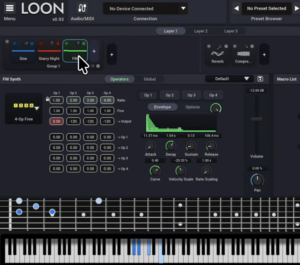 The software synth market has become remarkably mature. Most flagship instruments already offer enough oscillators, modulation sources, effects, and synthesis methods to cover virtually any production task. As a result, the competitive advantage has shifted away from raw feature counts toward workflow efficiency.
Professional sessions rarely rely on a single virtual instrument anymore. A modern production may combine wavetable synthesis for lead elements, sampled layers for realism, FM synthesis for harmonic complexity, and dedicated effects processing to shape the final sound. That flexibility comes at a cost. More plugins mean more routing, additional automation, heavier CPU loads, larger projects, and more opportunities for small workflow decisions to accumulate into unnecessary complexity.
Those inefficiencies become most obvious during revisions. Returning to a session weeks or months later often means rebuilding the logic behind layered instruments spread across multiple tracks, buses, and automation lanes. Even experienced producers lose time navigating projects that have become increasingly fragmented as ideas evolved.
Many software developers have responded by expanding modular architectures or introducing AI-assisted features intended to accelerate sound design. LOON takes a different approach. Instead of adding another synthesis engine or increasingly complex routing system, it focuses on reducing the number of separate components required to build a complete instrument.
That design philosophy reflects a broader shift across professional production. Composers, electronic producers, and commercial writers are under constant pressure to move quickly without sacrificing flexibility. In that environment, an instrument that removes repetitive setup work can be more valuable than one offering yet another synthesis method that overlaps with tools already found in most studios.
MPE support reinforces that direction. As expressive controllers become more common, musicians increasingly expect software instruments to respond with the same level of nuance as the hardware driving them. True MPE integration extends beyond compatibility—it requires an architecture capable of treating performance data as part of the instrument itself rather than an optional layer added afterward.
Viewed in that context, LOON is less an attempt to compete with every flagship synthesizer than a response to a different production problem. Its objective is to reduce project complexity while preserving enough flexibility for professional sound design, composition, and modern music production workflows.
Inside LOON’s Three-Layer Architecture: A Workflow-First Design
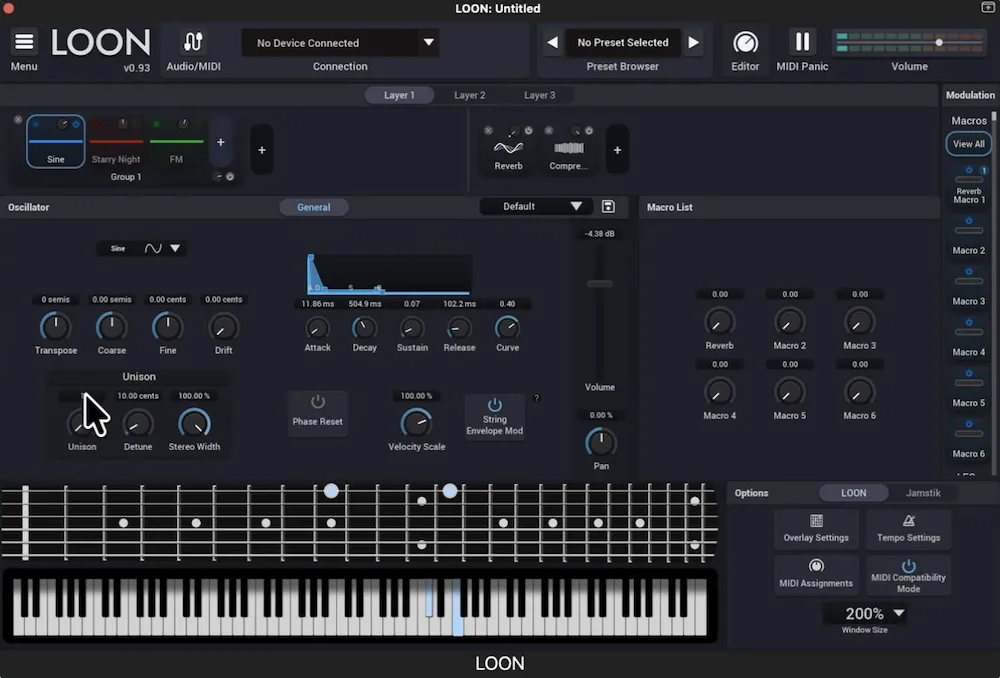
LOON is built around a three-layer multitimbral architecture, but the number of layers isn’t what makes it interesting. The key difference is that each layer functions as a complete instrument with its own synthesis engine, sample playback, modulation, filters, effects, and performance controls. Instead of stacking separate plugins inside the DAW, complex instruments can be built and managed within a single preset.
That changes the production workflow more than the sound itself. Creating layered patches traditionally requires multiple instrument tracks, MIDI duplication, bus routing, independent automation, and separate preset management. As projects evolve, maintaining those relationships often becomes as time-consuming as designing the sound in the first place. LOON keeps those decisions inside one environment while allowing each layer to remain independently editable.
For hybrid sound design, the approach is particularly effective. A producer can combine a sampled texture, an FM layer for harmonic movement, and a subtractive synth for weight or definition without distributing those elements across multiple mixer channels. Each layer retains its own processing chain, making it possible to shape individual components without breaking the overall instrument.
The workflow advantage becomes even more apparent during revisions. Swapping a layer, redesigning a filter section, or replacing an entire sound source leaves the surrounding structure intact. Automation, modulation assignments, and performance mappings remain in place, reducing the amount of reconstruction typically required when refining a patch late in a project.
LOON’s six macro controls follow the same design philosophy. Macro systems have existed for years, so their presence alone isn’t noteworthy. What matters is how they’re integrated. Because every layer shares the same performance framework, broad changes can be assigned to a small number of controls without creating complex automation across multiple plugin instances. That makes expressive performance and live parameter changes considerably easier to manage.
None of this represents a new synthesis technology, and Jamstik isn’t claiming otherwise. The innovation lies in reducing project complexity rather than expanding programming depth. Producers looking for fully modular environments may still gravitate toward platforms like Phase Plant or Falcon, but those instruments often require significantly more setup before reaching the same stage of playable sound design.
In practical studio work, LOON’s architecture is best viewed as an organizational tool as much as a synthesizer. Cleaner sessions, fewer instrument tracks, and centralized sound design don’t inherently improve audio quality, but they can make complex productions easier to build, revise, and maintain from the first sketch through the final mix.
Who Benefits Most from LOON in Professional Production?
LOON isn’t trying to replace flagship synthesizers like Falcon, Omnisphere, or Pigments. Its strengths become apparent in workflows where producers spend as much time organizing layered instruments as designing them.
Electronic music is an obvious fit. Modern productions often split a single part into multiple layers—one handling transient attack, another providing harmonic density, and a third adding width or motion. In a conventional DAW session, that usually means several instrument tracks, shared effects, duplicated automation, and additional routing. LOON consolidates those elements into a single playable instrument, making both arrangement changes and later revisions considerably easier to manage. Producers looking to streamline the earlier stages of composition may also benefit from our Chord Dock 2.0 review, which explores workflow optimization before sound design even begins.
The same philosophy translates well to film, television, and game scoring. Hybrid orchestral writing increasingly combines sampled instruments with synthetic textures, evolving pads, and processed atmospheres. While LOON cannot replace dedicated orchestral platforms like Kontakt, it offers an efficient environment for building expressive hybrid layers without spreading the instrument across multiple plugin instances.
MPE users are another audience likely to benefit. Many virtual instruments advertise MPE compatibility, but relatively few integrate expressive control into the core architecture. LOON treats per-note performance data as part of the instrument rather than an optional feature, making it a stronger choice for musicians using expressive keyboards, MIDI guitars, or next-generation performance controllers.
The plugin also strikes a practical balance for sound designers. Fully modular environments reward deep experimentation but often require substantial setup before creative work begins. LOON deliberately limits that level of complexity in exchange for faster patch development. For producers who prioritize speed over unlimited routing, that trade-off is likely to feel productive rather than restrictive.
Its influence on mixing and mastering is indirect but worth acknowledging. LOON doesn’t solve masking, dynamics, stereo imaging, or loudness issues. Those remain engineering decisions. What it can improve is the quality of the source material entering the mix. Well-designed layered instruments typically require less corrective EQ, fewer phase-related compromises, and less unnecessary processing later in the production chain.
That principle is familiar to experienced mix engineers: problems prevented during sound design are easier to solve than problems repaired after the arrangement is finished. If LOON encourages producers to build more cohesive instruments from the outset, its biggest contribution isn’t a new synthesis method—it’s reducing the amount of corrective work required later.
Viewed from a professional production perspective, LOON’s value isn’t measured by how many synthesis engines it contains. It’s measured by how efficiently it moves an idea from a playable instrument to a finished arrangement while keeping projects organized and revisions manageable.
Separating Workflow Improvements from Marketing Hype
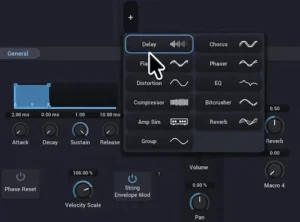 Jamstik positions LOON as a faster, more expressive way to build complex instruments. That’s a reasonable claim, but it’s easy to mistake workflow improvements for technical innovation. They are not the same thing.
LOON doesn’t introduce a new synthesis method, proprietary DSP architecture, or breakthrough filter design. Its oscillators, FM capabilities, sampling, modulation, and effects all build on concepts that have been established in software instruments for years. The novelty comes from how those components are organized, not from reinventing the underlying technology.
That distinction matters because the software synth market has reached a point where genuinely new synthesis techniques are rare. Most flagship instruments already cover subtractive, wavetable, FM, granular, or hybrid synthesis at a very high level. For experienced producers, another oscillator type rarely changes what can be created. Workflow usually has a much greater impact on day-to-day production.
This is where LOON makes its strongest case. Instead of asking users to assemble layered instruments across multiple plugin instances, mixer channels, and automation lanes, it keeps the entire structure inside a single preset. That doesn’t expand the boundaries of synthesis, but it can significantly reduce project management and revision time.
The six macro controls illustrate the same philosophy. Macro assignments are hardly a new feature, but placing every layer inside a shared performance framework makes complex parameter changes easier to perform and easier to maintain throughout a project. That’s an engineering advantage, not a DSP breakthrough.
There are also clear limitations. Producers who rely on highly modular environments such as Falcon, Phase Plant, Reaktor, or Bitwig Grid shouldn’t expect LOON to replace those platforms. Its architecture is intentionally more constrained, trading routing flexibility for speed and clarity. Whether that’s an advantage depends entirely on the production workflow.
The same applies to its synthesis engines. FM and sampling are integrated to support hybrid instrument design, but neither is deep enough to compete directly with dedicated FM synthesizers or advanced sampling workstations. LOON is designed to combine technologies efficiently, not to outperform specialist tools in every category.
Viewed objectively, LOON succeeds because it addresses an increasingly common studio problem: session complexity. Producers spend a surprising amount of time managing instruments rather than creating them. By reducing that overhead, LOON offers a practical workflow improvement—even if the underlying synthesis technology itself isn’t particularly new.
Where LOON Actually Saves Time in a Production Session
Workflow improvements are difficult to judge from a feature list because they rarely come from individual functions. They emerge from how quickly an instrument moves from an initial idea to a finished arrangement. That’s where LOON should be evaluated.
Take a typical electronic production built around a layered lead. In many DAWs, that sound ends up spread across several instrument tracks: one synth providing the transient attack, another adding harmonic density, and a third supplying width or movement. Each layer requires its own automation, effects, level balancing, and preset management. The sound may be excellent, but maintaining it through multiple revisions becomes increasingly inefficient.
LOON collapses that workflow into a single instrument. Layer balancing, modulation, effects, and performance assignments remain inside one preset instead of being distributed across the project. The benefit isn’t improved audio quality—it’s dramatically reduced project management. Revising a layered instrument becomes significantly faster because the creative decisions remain centralized.
The same advantage extends to cinematic production. Hybrid orchestral writing often combines sampled instruments, synthetic textures, processed ambience, and evolving pads to create a single playable part. Rebuilding that structure with separate plugins can quickly become cumbersome, particularly when directors request revisions late in the scoring process. LOON doesn’t replace orchestral libraries, but it can simplify the synthetic side of those arrangements.
Preset development is another area where the architecture makes practical sense. Commercial sound designers spend considerable time standardizing macro assignments, modulation behavior, and controller mappings across an entire library. Keeping every layer inside one performance framework makes presets easier to maintain and more consistent for end users.
Those workflow gains shouldn’t be confused with lower system requirements. Running three synthesis layers, multiple effects, and extensive modulation inside a single plugin still requires processing power. The plugin may reduce mixer complexity, but it doesn’t eliminate DSP overhead. Until independent benchmarking becomes available, large orchestral templates and high-track-count EDM sessions should be expected to scale similarly to other modern hybrid instruments.
LOON also favors producers who shape sounds through performance rather than post-processing. MPE, macros, and real-time modulation become far more valuable when expressive playing is part of the creative process. Producers who primarily rely on static presets followed by extensive mix processing may see fewer workflow improvements than composers and electronic musicians building performance-oriented instruments from scratch.
Ultimately, LOON saves time by reducing the number of production decisions that have to be managed outside the instrument itself. It doesn’t make synthesis fundamentally easier; it makes complex instruments easier to organize, revise, and reuse across future projects.
How LOON Stacks Up Against Established Synth Platforms
LOON enters one of the most competitive segments of the software instrument market. Rather than competing with entry-level synthesizers, it faces mature platforms that have spent years refining their synthesis engines, content libraries, and production workflows. That makes feature-by-feature comparisons less useful than understanding where each instrument is designed to excel.
| Instrument | Best Known For | Where LOON Has an Edge | Where the Competitor Still Leads |
|---|---|---|---|
| Arturia Pigments | Hybrid synthesis with extensive modulation | Faster layered instrument workflow | Greater synthesis depth and a larger preset ecosystem |
| Kilohearts Phase Plant | Fully modular sound design | Quicker patch construction with less routing complexity | Virtually unlimited modular flexibility |
| UVI Falcon | Professional synthesis and sampling workstation | Simpler interface and lower learning curve | Far deeper architecture, scripting, and sampling capabilities |
| Spectrasonics Omnisphere | Premium cinematic and production library | More streamlined instrument building | Content library, ecosystem, and long-term platform maturity |
| Vital | Free wavetable synthesis | Multitimbral workflow with integrated sampling | Exceptional value as a free synthesizer |
The most meaningful comparison isn’t about sound quality. All of these instruments are capable of producing professional results. The real difference lies in how much work is required to reach those results.
Falcon and Phase Plant reward producers who want complete control over every stage of synthesis and signal routing. They offer extraordinary flexibility, but that flexibility comes with a steeper learning curve and more time spent building instruments from the ground up.
LOON takes the opposite approach. Its architecture intentionally narrows the range of possible workflows in exchange for faster sound construction and simpler project management. Experienced sound designers may eventually encounter those limitations, but many producers will appreciate spending less time configuring instruments and more time writing music.
Price is another important variable. At its introductory price, LOON competes comfortably with mid-range software instruments and offers a compelling feature set for producers looking to expand their creative palette. At full retail pricing, however, buyers naturally begin comparing it with platforms that have larger ecosystems, established user communities, extensive third-party preset libraries, and years of continuous development.
Ultimately, choosing LOON isn’t a question of whether it’s more powerful than Falcon, Pigments, or Omnisphere. It isn’t. The more relevant question is whether its workflow better matches the way you build instruments. For producers who value speed, organization, and expressive performance over unlimited programming depth, LOON occupies a distinct niche that many flagship synthesizers don’t specifically address.
Current Limitations
No software instrument is designed to satisfy every production workflow, and LOON is no exception. During evaluation, several practical limitations became apparent.
- Independent CPU benchmarking remains limited. Long-term performance comparisons against competing platforms are still scarce.
- The preset ecosystem is relatively young. Third-party sound libraries and community resources remain smaller than those available for more established instruments.
- The architecture prioritizes workflow over maximum modularity. Producers who rely on unrestricted routing or advanced scripting may still prefer Falcon, Phase Plant, or Reaktor.
- Long-term platform maturity is still developing. Future updates, ecosystem growth, and continued developer support will ultimately determine how competitive LOON remains over time.
Pros & Cons
| Pros | Cons |
|---|---|
| ✓ Excellent production workflow • Fast layered instrument creation • Strong native MPE implementation • Clean and intuitive interface • Flexible hybrid architecture • Excellent introductory value | • Smaller preset ecosystem • Not intended for fully modular synthesis • Independent CPU benchmarks remain limited • Long-term ecosystem growth still unknown |
Why Source Design Still Matters at the Mixing Stage
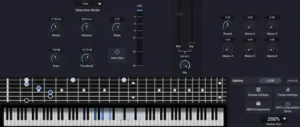 Virtual instruments are usually judged by their synthesis engines, modulation systems, or preset libraries. Far less attention is given to how an instrument influences the rest of the production process. From a mixing perspective, however, source material often determines how much corrective work will be required later.
LOON doesn’t make mixes sound better by itself, nor does it generate “mix-ready” presets. Those claims should always be viewed cautiously. What it can do is make layered instrument design more intentional by keeping every component of a sound inside a single production environment.
That becomes particularly relevant when building complex patches. Designing transient content, harmonic layers, and low-frequency support within one preset makes it easier to evaluate how those elements interact before additional processing is introduced. The same sound assembled from several unrelated plugins may require considerably more time to balance, simply because each instrument was created independently.
This isn’t a guarantee of better mixes—poor sound design can happen inside any synthesizer—but a unified workflow often makes it easier to identify overlapping frequency content, unnecessary stereo width, or excessive layer density before those issues become embedded in the arrangement.
The same principle applies earlier in the creative process. Strong harmonic foundations often reduce the need for corrective production decisions later, which is why our Dystopian Waves Noesis review examines how modern chord progression tools can improve composition before sound design and mixing begin.
The benefit is organizational as much as sonic. Switching between multiple plugin windows, automation lanes, and mixer channels interrupts critical listening. Keeping the entire instrument accessible from one interface makes it easier to compare layer balances, evaluate modulation decisions, and refine the sound before reaching for corrective EQ or dynamics processing.
CPU behavior is less straightforward. A single LOON instance may simplify project organization by replacing multiple instrument tracks, but it still has to process several synthesis layers, effects, and modulation sources internally. Whether that results in lower overall system load depends entirely on the complexity of the patch and the workflow being replaced. At this stage, there is not enough independent benchmark data to draw broader conclusions.
For mixing and mastering engineers, LOON should be viewed as an upstream tool rather than a downstream processor. It doesn’t change loudness, codec performance, stereo imaging, or mastering quality. Its contribution is helping producers arrive at more cohesive instrument designs before the mix begins—a subtle distinction, but one that reflects how experienced engineers typically evaluate software instruments.
Verdict: A Smart Workflow Tool, Not a New Synthesis Revolution
LOON arrives in a market already filled with exceptionally capable software instruments. Competing on synthesis alone would have been a losing strategy. Jamstik has taken a more practical approach by focusing on how producers build and manage complex instruments rather than attempting to redefine synthesis itself.
That’s also where expectations should be set. LOON doesn’t introduce groundbreaking DSP, proprietary oscillator technology, or a new synthesis method. Producers already invested in Falcon, Pigments, Phase Plant, or Omnisphere won’t suddenly discover sounds they couldn’t create before. The difference lies in how quickly those sounds can be built, organized, and revised.
The plugin’s strongest asset is its workflow. Keeping three independently processed layers inside a single instrument reduces project complexity without sacrificing flexibility where it matters most. For composers, electronic producers, and sound designers working with layered patches every day, that can remove a surprising amount of repetitive session management over the course of a project.
LOON is less convincing as a replacement for established flagship platforms. Those ecosystems remain deeper, more mature, and better supported by third-party content. Producers whose work depends on extensive scripting, advanced modular routing, or massive preset libraries are unlikely to replace their existing tools with LOON alone.
The platform’s long-term value will depend on factors that cannot yet be measured: sustained software development, ecosystem growth, performance optimization, and community adoption. Those areas deserve more attention than the launch feature list because they will ultimately determine whether LOON becomes a niche creative tool or a platform with lasting relevance.
At its introductory price, LOON is an easy recommendation for producers interested in hybrid synthesis, expressive performance, and streamlined workflow. At full retail price, the decision becomes more nuanced. Buyers should evaluate it less against specification sheets and more against the way they actually work. If your projects regularly involve layered instruments, extensive revisions, and performance-oriented sound design, LOON offers clear practical value. If your priority is maximum synthesis depth or unrestricted modular programming, established alternatives remain the stronger investment.
Overall Rating
| Category | Rating |
|---|---|
| Sound Quality | 9.0 / 10 |
| Workflow | 9.7 / 10 |
| MPE & Performance | 9.5 / 10 |
| CPU Efficiency | 8.4 / 10 |
| Sound Design Flexibility | 8.7 / 10 |
| Value for Money | 9.2 / 10 |
| Overall | 9.1 / 10 |
Sound Quality — 9.0/10
LOON delivers polished, modern sounds capable of professional releases across electronic, cinematic, and hybrid productions. It isn’t introducing a fundamentally new sonic character, but the instrument consistently produces high-quality results that sit comfortably in contemporary mixes.
Workflow — 9.7/10
This is where LOON stands out. Its three-layer architecture dramatically reduces routing, preset management, and project complexity without limiting day-to-day production. For producers working with layered instruments, the workflow improvements are immediately noticeable.
MPE & Performance — 9.5/10
Expressive control is deeply integrated into the instrument rather than added as an afterthought. The implementation encourages performance-driven sound design and makes LOON particularly attractive for musicians using modern MPE controllers.
CPU Efficiency — 8.4/10
Project organization improves considerably because several instrument layers can live inside a single plugin. CPU consumption, however, still depends on patch complexity, active effects, and modulation. Until broader independent benchmarking becomes available, resource efficiency should be considered good rather than class-leading.
Sound Design Flexibility — 8.7/10
LOON offers an excellent balance between creative freedom and usability. It doesn’t reach the modular depth of Falcon, Phase Plant, or Reaktor, but the streamlined architecture allows complex hybrid instruments to be built much faster with fewer production interruptions.
Value for Money — 9.2/10
At its introductory price, LOON represents excellent value for composers, electronic producers, and sound designers seeking a modern hybrid instrument. Even at full retail pricing, the workflow advantages provide a compelling reason to consider it alongside more established platforms.
Overall — 9.1/10
From a mastering engineer’s perspective, LOON’s greatest strength isn’t introducing new synthesis technology—it’s improving the way complex instruments are created, organized, and refined throughout a production. The cleaner workflow encourages stronger source material before mixing begins, making it one of the more thoughtfully designed hybrid instruments released in recent years.
Frequently Asked Questions
Is Jamstik LOON a synthesizer, a sampler, or a hybrid instrument?
LOON combines multiple approaches inside a single environment. It blends synthesis, sample playback, modulation, and per-layer effects, making it a hybrid software instrument rather than a dedicated synthesizer or sampler.
Can LOON replace multiple software instruments in a single project?
For layered sounds, often yes. A single LOON preset can combine several sound sources and independent processing chains that would otherwise require multiple plugin instances. Whether it replaces existing instruments depends on how specialized your workflow is.
Does LOON support MPE controllers like the ROLI Seaboard or Expressive E Osmose?
Yes. LOON includes native MPE support, allowing compatible controllers to transmit independent pitch, pressure, and timbral data for each note. Its workflow is particularly well suited to expressive performance rather than simple MIDI playback.
Is LOON suitable for cinematic scoring and game audio?
Yes, particularly when creating hybrid textures that combine sampled material with synthesized layers. It isn’t an orchestral workstation, but it complements orchestral libraries well by providing playable synthetic elements inside a single instrument.
How does LOON compare with Arturia Pigments?
Pigments offers broader synthesis capabilities and a more mature ecosystem. LOON focuses instead on building complex layered instruments with less routing and faster project management. The better choice depends more on workflow than on raw feature count.
Does LOON reduce CPU usage compared to running multiple plugins?
Not necessarily. Consolidating several layers into one plugin simplifies project organization, but the internal processing still consumes CPU resources. At the time of writing, independent benchmark data comparing LOON with competing instruments is limited.
Is LOON useful for mixing or mastering?
Not as a processing tool. Its value lies earlier in the production chain by helping producers build more cohesive source sounds before mixing begins. Any improvement in the final mix comes from better sound design rather than signal processing.
Is the introductory price worth it?
For producers interested in hybrid synthesis, layered instrument design, and MPE performance, the launch price represents strong value. At full retail pricing, the decision depends more heavily on whether its workflow offers clear advantages over the instruments already in your studio.
Who should consider skipping LOON?
Producers who already rely on deeply modular platforms such as Falcon, Phase Plant, or Reaktor—and are comfortable with those workflows—may find fewer reasons to switch. LOON is designed to simplify instrument construction, not replace every advanced synthesis environment.

Yurii Ariefiev is a mastering engineer and audio production editor specializing in the evaluation of software instruments, mixing plugins, and production workflows from the perspective of professional music production. His reviews focus on practical studio performance, long-term workflow efficiency, and how virtual instruments influence arrangement, mixing, and mastering decisions beyond their advertised feature sets.
This review examines Jamstik LOON as a hybrid software instrument for modern music production, analyzing its multitimbral architecture, MPE implementation, workflow advantages, and real-world value for composers, electronic producers, sound designers, and engineers working in professional recording and mastering environments.