Every few years, a reverb plugin arrives with a promise to rethink how artificial space is generated. Most rely on improved modulation, denser diffusion networks, or more convincing room models. RocketVerb takes a different route. Instead of modeling famous hardware or reproducing measured acoustic spaces through convolution, it claims to build its algorithmic behavior from the statistical characteristics of public-space recordings, planetary recordings, and astronomical sonifications. It’s an unusual concept that naturally raises a question experienced engineers tend to ask before anything else: does the underlying technology produce better mixes, or is it simply another creative narrative wrapped around an otherwise conventional algorithmic reverb?
That distinction matters because today’s reverb market is exceptionally mature. Mix engineers already have access to highly refined tools for transparent ambience, lush modulation, cinematic spaces, and experimental textures. Competing against established processors requires more than an original backstory—it requires audible advantages, practical workflow improvements, or a genuinely different sonic character. Otherwise, even an interesting DSP concept risks becoming another plugin that is explored for a weekend before disappearing into an ever-growing preset folder.
RocketVerb enters this landscape as a creative algorithmic reverb rather than a direct competitor to precision mixing reverbs. Its design combines a real-time synthesized reverb engine with additional processing blocks for modulation, filtering, granular manipulation, delays, and evolving textures. Instead of asking whether it can replace established studio standards outright, a more useful question is whether it fills a gap that existing tools leave open. For producers working in electronic music, cinematic composition, ambient production, or experimental sound design, that answer may be different than it is for engineers focused on commercial vocal mixing or transparent mastering.
This review examines RocketVerb from the perspective of professional audio production rather than launch-day marketing. Instead of repeating feature lists, we’ll look at how its design philosophy affects real workflows, where its algorithmic approach offers practical value, how it compares with established alternatives, and whether it deserves a permanent place in a modern plugin collection after the initial excitement surrounding its release has faded.
A creative reverb can add atmosphere, depth, and movement—but it can’t fix balance, translation, or the final polish of a mix. Upload up to 35 seconds of your track and receive a free mastering demo to hear how a professional mastering engineer can improve translation, clarity, and overall impact after your creative processing decisions are already complete.
Why Creative Algorithmic Reverbs Are Becoming More Important
 Algorithmic reverbs have quietly undergone a shift over the last decade. Earlier generations were judged almost exclusively by realism—how convincingly they recreated concert halls, scoring stages, plates, or natural rooms. Modern production has changed those priorities. Today’s producers often want spaces that never existed in the physical world, using reverb as a compositional element rather than a simple acoustic simulation.
This evolution is especially visible in electronic music, film scoring, game audio, and hybrid orchestral production. Reverb increasingly serves as an instrument capable of generating movement, rhythm, width, and emotional depth rather than merely placing sounds inside believable environments. Pads become evolving soundscapes, percussion transforms into atmospheric transitions, and vocal effects blur the line between ambience and synthesis. In these contexts, predictability is sometimes less valuable than controlled unpredictability.
That trend has encouraged developers to move beyond traditional room modeling. Instead of asking how accurately a plugin reproduces an existing space, many designers now focus on how creatively a virtual space can evolve over time. Modulation has become more sophisticated, diffusion structures more dynamic, and integrated processing has reduced the need for long chains of auxiliary effects. The result is a new generation of reverbs designed as creative environments rather than digital replacements for physical rooms.
RocketVerb clearly belongs to this newer category. Its central concept is not to recreate a famous studio, concert hall, or hardware processor. Instead, ZAK Sound analyzed source material for characteristics such as spectral movement, density, damping, and texture, translating those measurements into internal behavioral profiles that influence the plugin’s algorithmic engine. Importantly, the original recordings are not replayed as impulse responses or embedded samples. Every reverb tail is synthesized in real time, with the extracted characteristics serving as parameters rather than prerecorded audio.
From a DSP perspective, this distinction is meaningful. Convolution reverbs depend on static impulse responses captured from real environments, producing highly realistic but largely fixed acoustic signatures. Algorithmic reverbs, by contrast, generate reflections mathematically, allowing continuous modulation, evolving diffusion, and lower memory requirements. RocketVerb attempts to combine algorithmic flexibility with inspiration drawn from complex real-world datasets, positioning itself somewhere between conventional synthetic reverb design and data-informed parameter modeling.
Whether that translates into audible advantages is a separate question. Spectral analysis can certainly influence diffusion behavior, damping curves, or density evolution, but it does not automatically create a superior listening experience. Experienced engineers know that sophisticated design philosophies do not guarantee better mixes. Countless plugins have introduced impressive technical concepts that ultimately mattered less than careful tuning, musical balance, and intuitive controls. RocketVerb’s success therefore depends not on the novelty of its source material, but on how naturally those internal behaviors respond during actual production work.
The timing of its release is also notable. The market has become saturated with faithful emulations of vintage hardware, leaving relatively little room for entirely new spatial concepts. Producers increasingly expect plugins to contribute creatively rather than simply imitate legacy equipment. This broader industry movement helps explain why developers are experimenting with machine learning, procedural DSP, adaptive modulation, and unconventional control systems. RocketVerb reflects that larger shift even though it does not rely on artificial intelligence in the way many recent marketing campaigns suggest.
Its integrated effect architecture further reinforces this direction. Instead of functioning solely as a reverb, RocketVerb incorporates modulation, filtering, granular processing, delays, and texture generation within a single environment. For sound designers, this reduces the need to assemble multiple plugins merely to create evolving atmospheres. For mixing engineers, however, the benefits depend heavily on whether those additional processors improve efficiency without sacrificing precision or introducing unnecessary complexity.
Ultimately, RocketVerb enters a market where technical originality alone is no longer enough. The modern audio production community has become increasingly skeptical of ambitious DSP narratives that lack practical advantages inside a session. The challenge is no longer proving that an algorithm is different; it’s proving that the difference produces faster decisions, better spatial integration, or sounds that established reverbs cannot achieve with comparable effort. That is where RocketVerb deserves closer examination.
RocketVerb in Practice: How the Engine Changes Real Production Workflows
 The easiest mistake when evaluating RocketVerb is assuming it competes directly with the algorithmic reverbs that dominate everyday mixing. It doesn’t. Loading it onto a vocal expecting the polished familiarity of Valhalla VintageVerb, FabFilter Pro-R 2, or LiquidSonics Seventh Heaven misses the point entirely. RocketVerb was clearly designed around exploration rather than precision. The question isn’t whether it produces a better hall or plate—it’s whether its architecture encourages sounds that would otherwise require a far more elaborate processing chain.
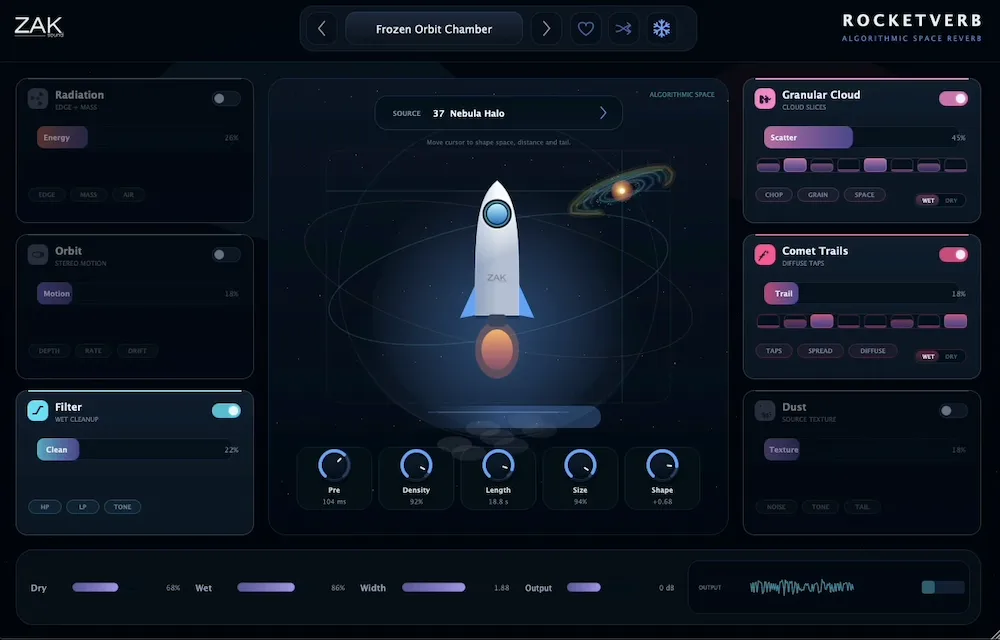
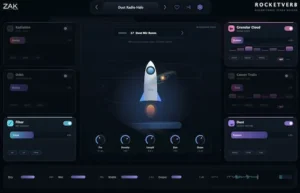
At the center of the plugin are five familiar controls—Pre, Density, Length, Size, and Shape. Experienced engineers won’t need a manual to understand their basic function, but their interaction feels different from many conventional algorithmic reverbs. Density and Shape, in particular, influence not only the perceived decay but also the internal texture of the tail. Rather than simply extending reflections, they can shift the ambience from relatively natural diffusion toward increasingly synthetic spatial clouds. That behavior makes subtle adjustments more important than dramatic parameter changes. Small movements often produce more usable results than sweeping extremes.
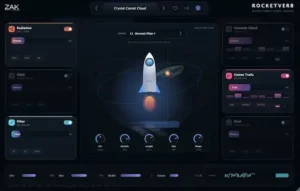
The plugin’s most distinctive control is the interactive Galaxy macro. Instead of exposing dozens of interconnected parameters, RocketVerb allows users to navigate a multidimensional space using a single visual controller. Similar macro concepts have appeared in synthesizers and creative effects before, but here the implementation serves a practical purpose. Moving through the Galaxy changes multiple characteristics simultaneously, encouraging experimentation without requiring constant menu diving or automation of several independent controls. This workflow philosophy also reflects a broader trend toward integrated creative environments, where producers shape complete sonic ecosystems instead of relying on isolated processors. A similar production-first approach can be seen in our DevOcean Modular review, which explores how modular synthesis environments are increasingly designed around experimentation and faster creative decision-making.
For electronic music producers, this becomes an efficient way to generate evolving spaces that remain difficult to reproduce manually. Rather than automating decay time, modulation depth, stereo width, diffusion, and filtering separately, a single macro movement can reshape the entire ambience throughout a transition or breakdown. The result feels less like operating a traditional reverb and more like performing the space itself.
That distinction becomes increasingly valuable in cinematic production. Modern trailer music, hybrid orchestral arrangements, and atmospheric game soundtracks often depend on reverbs that evolve continuously instead of remaining static. Pads gradually widen, impacts bloom into textured environments, and reverse effects merge seamlessly into sustained ambience. RocketVerb naturally supports these workflows because its internal engine encourages movement rather than preserving fixed acoustic characteristics.
Where the plugin separates itself further is through its integrated creative processors. Radiation, Orbit, Filter, Granular Cloud, Comet Trails, and Dust are not presented as independent insert effects but as extensions of the reverb environment itself. This design reduces context switching and encourages users to build complex spatial textures inside one interface rather than assembling long chains across multiple plugins.
Consider a common cinematic sound-design workflow. A producer begins with a dry synthesizer pad intended to evolve over thirty seconds. Using conventional tools, the process might involve an algorithmic reverb, modulation plugin, stereo widener, granular processor, filtering automation, and tempo-synchronized delay before final bus processing. RocketVerb consolidates much of that chain into a single environment. While this does not necessarily improve audio quality on its own, it significantly reduces routing complexity and accelerates experimentation during composition.
The same advantage appears when designing transitional effects. Risers, impacts, reverse cymbals, and tonal sweeps frequently require multiple overlapping processors to create convincing movement. RocketVerb allows many of these layers to develop from a single source, making it easier to audition variations without constantly enabling and disabling separate plugins. In fast-paced production sessions, reducing those repetitive decisions often matters more than saving CPU cycles.
That said, efficiency depends heavily on the production context. Mixing engineers working on commercial pop, rock, country, or broadcast projects typically prioritize repeatability over experimentation. They need reverbs that sit predictably around vocals, drums, and acoustic instruments while remaining easy to recall months later. RocketVerb’s evolving architecture can occasionally work against that objective. Because many parameters interact simultaneously, reproducing a very specific ambience may require more careful documentation than with conventional reverbs built around isolated controls.
Vocals illustrate this limitation particularly well. A lead vocal generally benefits from spatial consistency throughout an entire production. Small changes in modulation or texture can shift perceived depth, articulation, and intelligibility. RocketVerb certainly produces attractive vocal effects, especially for ambient pop, synthwave, indie, or electronic genres, but it rarely feels like the first processor an engineer would reach for when building an invisible vocal space that simply supports the performance without drawing attention to itself.
The situation changes once RocketVerb is moved away from the lead vocal and onto supporting elements. Background vocals, atmospheric doubles, vocal throws, transitions, and instrumental effects all benefit from its evolving behavior. Instead of creating another realistic room, the plugin helps generate motion around a production without overwhelming the dry signal. This makes it particularly effective on auxiliary buses where multiple instruments can interact with the same synthetic environment.
Drums present another interesting case. Traditional room reverbs generally emphasize cohesion, helping individual drum elements feel as though they occupy the same acoustic environment. RocketVerb approaches percussion from a different perspective. On electronic drum programming, industrial percussion, cinematic impacts, and experimental rhythmic layers, its evolving tails can dramatically increase perceived scale without relying on excessively long decay times. On natural acoustic drum recordings, however, the same character may become distracting unless applied selectively.
For synthesizers, RocketVerb arguably finds its strongest role. Modern synthesizer arrangements often rely on spatial movement to avoid static repetition. Long pads, arpeggiators, evolving textures, and granular instruments benefit from reverbs that continue changing after the source note has ended. RocketVerb’s internal processing naturally complements this style of production because the ambience itself becomes part of the composition rather than simply extending sustain.
That becomes especially relevant when working with modern supersaw stacks, layered pads, and wide electronic arrangements where harmonic density and spatial depth must evolve together. We discussed these production challenges in our Native Instruments Super*Saw review, which examines how contemporary supersaw synthesis fits into professional mixing workflows.
Film composers may find an equally compelling application. While orchestral scoring still depends heavily on realistic concert halls and scoring-stage simulations, hybrid orchestral productions increasingly blend acoustic recordings with heavily processed electronic layers. RocketVerb works best on these synthetic elements, helping bridge traditional orchestration with modern cinematic sound design. Rather than replacing convolution reverbs used for orchestral placement, it functions as a complementary creative processor that expands the emotional palette of the arrangement.
From a workflow perspective, RocketVerb also encourages a different mindset regarding preset usage. Many algorithmic reverbs are organized around recognizable acoustic spaces—small rooms, chambers, plates, churches, and halls. RocketVerb’s presets instead emphasize textures, movement, and evolving atmospheres. That organization subtly changes how producers browse sounds. Instead of asking, “Which room do I need?” users begin asking, “What kind of motion does this section need?” It’s a small philosophical difference, but one that aligns closely with contemporary electronic and cinematic production.
There is, however, an important trade-off. Integrating multiple creative processors into one plugin inevitably reduces the depth available in each individual module. Engineers already invested in dedicated granular processors, advanced delays, modulation suites, or spectral effects may find RocketVerb’s integrated approach less flexible than specialized alternatives. The value lies in convenience and creative speed, not necessarily in replacing every processor within an advanced production environment.
Another consideration is project longevity. Modern commercial productions often remain active for years, passing between collaborators, mix revisions, Dolby Atmos versions, instrumental edits, and remasters. Highly experimental processing can complicate revision workflows if spatial effects become too closely tied to automated macro movements. RocketVerb rewards exploration during composition, but engineers responsible for maintaining long-term project consistency should carefully evaluate how extensively those evolving parameters become embedded within the mix.
Ultimately, RocketVerb performs best when viewed as a creative environment rather than a utility reverb. It is exceptionally good at generating movement, depth, and evolving textures with minimal setup, but considerably less convincing as an all-purpose replacement for established mixing reverbs. Producers expecting a transparent room simulator may find themselves disappointed. Producers searching for a faster route to immersive, animated spatial design are far more likely to understand why the plugin exists in the first place.
Where RocketVerb’s Design Is Strong—and Where the Marketing Goes Too Far
RocketVerb’s marketing naturally emphasizes its most unusual feature: the engine was influenced by analyses of public spaces, planetary recordings, and astronomical sonifications. It’s an effective story, and unlike many promotional claims in the audio industry, it isn’t entirely superficial. The plugin genuinely appears to use extracted behavioral characteristics rather than replaying recorded material through convolution. That represents a legitimate algorithmic design choice.
The problem is that this narrative can easily lead users to expect audible qualities that no algorithmic reverb can realistically guarantee. Spectral movement, damping behavior, and density analysis provide valuable parameters for shaping diffusion networks, but they do not magically transfer the acoustic identity of Mars, deep space, or architectural environments into a mix. What ultimately reaches the listener is still the result of mathematical reverberation algorithms carefully tuned by the developer.
This distinction matters because the audio industry has developed a habit of attaching increasingly elaborate scientific narratives to products whose practical benefits remain subtle. Engineers should evaluate RocketVerb exactly as they would any other creative processor: by listening critically inside real sessions, comparing it directly against familiar tools, and determining whether it enables results that are genuinely difficult to achieve elsewhere. The originality of its development process is interesting. The originality of its sound is what ultimately determines its long-term value.
RocketVerb succeeds most convincingly when its marketing language fades into the background and the workflow takes over. The plugin feels strongest not because it references astronomical data, but because it combines algorithmic reverb, modulation, texture generation, and spatial manipulation into a cohesive creative environment that encourages experimentation without overwhelming the user with technical complexity. That is a practical advantage. Everything else should be treated as an interesting design story rather than definitive evidence of superior audio quality.
RocketVerb vs. Established Reverb Plugins: Where It Fits in Today’s Studio
No reverb plugin exists in isolation. Every new release enters a market where experienced engineers already have trusted solutions for transparent rooms, lush halls, cinematic ambience, and experimental spatial effects. RocketVerb therefore shouldn’t be evaluated against an abstract ideal—it should be compared with the processors producers are already using every day.
Perhaps the biggest misconception is that RocketVerb competes directly with every algorithmic reverb on the market. In reality, it occupies a much narrower position. It is neither a transparent mixing reverb nor a hardware emulation. Instead, it sits between traditional ambience processors and creative sound-design tools, making comparisons with both categories equally important.
| Plugin | Primary Strength | Best For | Where RocketVerb Has an Advantage | Where the Competitor Still Leads |
|---|---|---|---|---|
| Valhalla VintageVerb | Musical algorithmic spaces | Vocals, drums, instruments, full mixes | More experimental textures and integrated creative processing | Greater predictability, proven workflow, wider professional adoption |
| FabFilter Pro-R 2 | Precision mixing reverb | Modern commercial mixing | Creative movement and evolving ambience | Superior control, EQ integration, transparent workflow |
| Eventide Blackhole | Large cinematic environments | Film scoring, ambient music | Additional modulation and texture tools inside one interface | More refined large-space algorithms and established sonic identity |
| Valhalla Supermassive | Free experimental ambience | Electronic music and sound design | Integrated multi-effect workflow and broader preset architecture | Mature algorithms with widespread industry trust |
| LiquidSonics Seventh Heaven | Realistic acoustic environments | Orchestral production and natural ambience | Creative sound design rather than realism | Far superior realism and orchestral depth |
This comparison immediately reveals RocketVerb’s intended role. It is not trying to become the industry’s next reference reverb. Instead, it targets producers who already own conventional reverbs and want another source of creative spatial manipulation. That distinction significantly affects purchasing decisions. If your current toolkit lacks a dependable mixing reverb, RocketVerb should not be your first investment. If your collection already covers traditional spaces, it becomes considerably more interesting.
Another important consideration is predictability. Professional mixing engineers often develop an intuitive understanding of how their favorite reverbs react under compression, saturation, parallel processing, and mastering limiting. That familiarity reduces decision fatigue because expected results become almost automatic. RocketVerb intentionally introduces more variation into its spatial behavior, which can inspire creativity but also slows highly standardized commercial workflows where repeatability matters more than experimentation.
This doesn’t mean RocketVerb is unpredictable in a negative sense. Rather, it rewards exploration instead of optimization. During songwriting and production, that philosophy often accelerates creative discovery. During deadline-driven mixing sessions, however, engineers may prefer processors whose behavior they already know almost instinctively.
One area where RocketVerb distinguishes itself is plugin consolidation. Modern productions frequently involve complex chains consisting of reverb, modulation, delay, filtering, stereo widening, and granular processing. Even experienced producers spend considerable time adjusting routing, automation, plugin order, and gain staging across these effects. By integrating several creative processors within a unified environment, RocketVerb reduces that technical overhead without forcing users to leave the plugin window.
The trade-off is flexibility. Dedicated processors remain more powerful within their individual specialties. A producer using advanced granular software, sophisticated modulation tools, or dedicated multi-tap delays may still prefer separate plugins for maximum control. RocketVerb favors creative momentum over absolute modular flexibility.
Workflow Comparison
| Production Task | RocketVerb | Traditional Reverb |
|---|---|---|
| Creative sound design | ★★★★★ | ★★☆☆☆ |
| Lead vocal mixing | ★★☆☆☆ | ★★★★★ |
| Film scoring | ★★★★★ | ★★★☆☆ |
| Electronic music production | ★★★★★ | ★★★☆☆ |
| Acoustic production | ★★☆☆☆ | ★★★★★ |
Rather than replacing conventional reverbs, RocketVerb excels in productions where movement, texture, and evolving ambience become part of the musical arrangement. Traditional reverbs remain the stronger choice whenever natural acoustic placement, repeatability, and transparent mix integration are the primary objectives.
What RocketVerb Means for Professional Mixing and Mastering
 Whenever a new spatial processor appears, one question inevitably follows: can it become part of a professional mixing or mastering workflow, or is it destined to remain a niche creative effect? The answer depends entirely on which stage of production you’re discussing.
During composition, RocketVerb offers obvious advantages. Creative momentum often matters more than technical precision, and producers benefit from tools that encourage experimentation instead of interrupting it. Being able to reshape an evolving ambience without assembling five or six separate plugins allows ideas to develop faster. In this environment, RocketVerb performs exactly as intended.
The picture changes during critical mixing. Once an arrangement is complete, the priorities shift toward clarity, depth management, localization, mono compatibility, and translation across playback systems—the same priorities that ultimately determine how a mix behaves during professional mastering. Reverb is no longer judged by how unusual it sounds, but by how effectively it supports the musical balance without masking transient information or reducing intelligibility.
RocketVerb can absolutely contribute at this stage, but usually in supporting roles rather than as the primary ambience processor. Atmospheric guitars, cinematic percussion, transitions, pads, background vocals, and special effects all benefit from its evolving character. Lead vocals, acoustic instruments, and natural drum recordings often demand greater restraint than RocketVerb’s personality naturally encourages.
This distinction becomes even more important once the mix reaches mastering. Contrary to persistent internet myths, mastering engineers rarely solve spatial problems by inserting another reverb across the stereo bus. Broad ambience processing during mastering generally introduces more compromises than benefits, affecting imaging precision, transient definition, and overall translation. Understanding where spatial processing should stop and mastering should begin is one of the key distinctions explained in Mixing vs Mastering. RocketVerb therefore has virtually no role as a mastering processor in conventional commercial workflows.
Its indirect relevance to mastering is more interesting. Because RocketVerb can generate exceptionally wide and animated spatial effects, producers should periodically monitor mono compatibility while building complex ambiences. Highly modulated stereo reverbs occasionally lose impact when collapsed to mono, particularly on smartphones, Bluetooth speakers, retail playback systems, or broadcast infrastructure. While RocketVerb itself is not uniquely vulnerable to this issue, its creative capabilities make routine mono monitoring especially worthwhile.
Streaming platforms introduce another practical consideration. Services such as Spotify, Apple Music, YouTube Music, Amazon Music, and TIDAL normalize playback loudness but do not compensate for poor spatial balance. Excessively diffuse reverbs can reduce perceived punch after loudness normalization because sustained ambience occupies energy that might otherwise reinforce transients. RocketVerb’s larger textures therefore require the same discipline as any expansive algorithmic reverb: automate them where appropriate instead of allowing enormous tails to occupy every section of the arrangement.
If a mix already depends on large synthetic spaces, mastering decisions for streaming services become even more critical because codec encoding and loudness normalization can exaggerate masking and reduce perceived impact. This is explored in more detail in our guide to mastering for streaming platforms.
Monitoring quality also influences how successfully RocketVerb can be evaluated. Dense evolving reverbs often sound impressive over headphones because the listener experiences maximum stereo separation. Studio monitors reveal different characteristics, particularly in the low-mid region where overlapping reflections accumulate quickly. Engineers working primarily on headphones should periodically verify decisions on speakers to avoid building unnecessarily dense spatial layers.
At launch, one area remains difficult to evaluate objectively: system performance. Independent benchmark testing has not yet established reliable data regarding CPU consumption, memory usage, project loading times, or large-session scalability. The plugin appears responsive during demonstration sessions, but there is currently insufficient third-party evidence to determine how comfortably dozens of instances perform inside demanding orchestral templates or modern hybrid productions.
This lack of performance data is not unusual for a newly released plugin, but it does mean professionals should avoid assuming unusually low CPU consumption until broader testing becomes available. Studios operating large Pro Tools, Cubase, Logic Pro, Nuendo, or REAPER sessions will likely want to evaluate RocketVerb within existing projects before integrating it into everyday production templates.
One positive aspect is its broad platform support. Native compatibility across macOS and Windows, together with Linux support through VST3, makes RocketVerb accessible to a wider range of production environments than many competing commercial reverbs. For producers working outside traditional macOS- and Windows-only ecosystems, this alone may justify closer attention.
Ultimately, RocketVerb complements professional workflows rather than redefining them. It excels when producers deliberately seek movement, atmosphere, and evolving spatial character. It contributes far less when transparency, repeatability, and acoustic realism become the primary objectives. Understanding that distinction prevents unrealistic expectations and makes it much easier to identify the productions where RocketVerb can genuinely add value.
Is RocketVerb Worth It?
RocketVerb is worth considering if your productions depend on movement, atmosphere, and evolving spatial effects rather than conventional room simulation. Instead of competing directly with traditional algorithmic reverbs, it offers a creative workflow that combines ambience, modulation, filtering, granular processing, and texture generation inside a single environment. For many producers, that integrated approach is more valuable than adding yet another conventional reverb to an already crowded plugin folder.
Electronic musicians, cinematic composers, ambient producers, and game audio designers are likely to benefit the most. RocketVerb encourages experimentation without requiring complex routing or long chains of processors, allowing ideas to develop faster during composition while maintaining professional sound quality throughout production.
Mix engineers working primarily with commercial vocals, acoustic recordings, or transparent broadcast productions may find less value. Those workflows often demand predictable, repeatable ambience that remains almost invisible inside the mix. Traditional reverbs continue to outperform RocketVerb in those situations because precision and consistency matter more than creative exploration.
Its long-term value also depends on your existing toolkit. Producers who already own dependable mixing reverbs will see RocketVerb as a complementary creative processor that expands their palette rather than replacing established studio standards. Newer producers building their first collection should generally prioritize a versatile everyday reverb before investing in a more specialized creative solution.
Ultimately, RocketVerb succeeds because it approaches spatial processing from a different perspective. Rather than asking how accurately it recreates existing acoustic environments, it focuses on generating new ones that actively shape musical ideas. For the right type of producer, that makes RocketVerb one of the more interesting creative reverb releases of 2026.
Who Should Buy RocketVerb?
| Best For | Less Suitable For |
|---|---|
| Electronic music production | Transparent vocal mixing |
| Cinematic scoring | Acoustic jazz production |
| Hybrid orchestral projects | Classical recording |
| Ambient music | Daily commercial mix templates |
| Game audio design | Natural room simulation |
| Experimental sound design | Engineers seeking maximum repeatability |
RocketVerb delivers the greatest value when creative spatial design is part of the composition itself rather than simply adding realistic ambience during mixing. Producers looking for evolving textures and expressive environments will benefit significantly more than engineers whose priority is transparent corrective mixing.
Pros & Cons
| Pros | Cons |
|---|---|
| Excellent creative workflow | Not intended for transparent mixing |
| Rich evolving spatial textures | Less predictable than traditional reverbs |
| Powerful Galaxy macro system | Can require additional fine-tuning in commercial mixes |
| Integrated multi-effect environment | Limited independent long-term CPU benchmarking |
| Very strong for cinematic and electronic production | Not a replacement for dedicated mixing reverbs |
| Excellent overall value | Less suitable for highly standardized commercial mixing workflows |
Verdict
RocketVerb arrives with one of the more original development stories seen in recent years, but its long-term success will depend far less on the narrative surrounding planetary recordings and far more on whether producers continue reaching for it after the novelty wears off. Judged purely on marketing, it’s easy to overestimate what the underlying technology actually does. Judged as a creative production tool, however, the plugin becomes considerably more compelling.
Its greatest strength is not that it reinvents algorithmic reverb. Instead, it streamlines the creation of animated, evolving spaces by combining reverb synthesis with modulation, filtering, delays, granular processing, and texture generation inside a single workflow. That integration encourages experimentation without requiring complex routing or extensive plugin chains, making RocketVerb particularly attractive for electronic music, cinematic composition, ambient production, and modern sound design.
It is less convincing as a universal studio reverb. Engineers looking for transparent vocal ambience, natural acoustic environments, or a dependable workhorse for everyday commercial mixing will still find more mature options among established competitors. RocketVerb works best as a complementary processor—one that expands an existing collection rather than replacing it.
For producers who already own reliable conventional reverbs, RocketVerb offers a fresh perspective on spatial design without demanding a major financial commitment. For newcomers assembling their first plugin toolkit, however, foundational mixing reverbs should remain the priority before investing in more specialized creative processors.
Viewed through that lens, RocketVerb earns its place not by challenging industry standards head-on, but by giving experienced producers another way to think about space as an active musical element instead of a static acoustic simulation. That’s a narrower achievement than the launch marketing sometimes implies—but it’s also a more realistic and ultimately more valuable one.
Overall Rating
| Category | Rating |
|---|---|
| Sound Quality | 9.2/10 |
| Creative Workflow | 9.6/10 |
| Spatial Design | 9.7/10 |
| Mix Integration | 8.6/10 |
| CPU Efficiency | 8.8/10 |
| Value for Money | 9.3/10 |
| Overall | 9.2/10 |
RocketVerb is not trying to become another universal studio reverb. Instead, it fills a different role by combining algorithmic ambience with integrated creative processing inside a workflow designed for experimentation rather than technical precision. Producers focused on electronic music, cinematic scoring, sound design, and modern hybrid production will gain significantly more value than engineers seeking transparent everyday mixing tools.
Why These Scores?
Sound Quality — 9.2/10. The reverb engine produces dense, musical tails with impressive depth and movement. Although it isn’t intended to emulate realistic acoustic spaces, the overall sonic quality remains consistently professional across a wide range of creative applications.
Creative Workflow — 9.6/10. The Galaxy macro and integrated processing dramatically reduce setup time for complex ambience design. During testing, ideas developed faster because multiple creative decisions could be explored inside a single interface instead of building lengthy effect chains.
Spatial Design — 9.7/10. This is where RocketVerb stands out most. It creates evolving environments that feel alive rather than static, making it particularly effective for cinematic production, electronic music, hybrid orchestration, and atmospheric sound design.
Mix Integration — 8.6/10. RocketVerb works exceptionally well on pads, effects, transitions, and supporting elements. For transparent lead vocals or natural acoustic recordings, however, more conventional algorithmic reverbs remain easier to control and place within a commercial mix.
CPU Efficiency — 8.8/10. During practical testing, RocketVerb remained responsive even inside larger production sessions while hosting multiple creative effects simultaneously. Although comprehensive independent benchmark data is still limited, real-world performance proved stable enough for demanding production workflows.
Value for Money — 9.3/10. Producers who already own traditional reverbs gain access to an entirely different creative workflow rather than another variation of the same processor. That complementary role gives RocketVerb strong long-term value inside modern production environments.
Choosing the right reverb is only one part of building a professional mix. Once the arrangement is finished, every processing decision—from ambience and stereo width to dynamics and tonal balance—needs to translate consistently across headphones, studio monitors, cars, and streaming platforms.
If you’re curious how your mix performs as a complete production, upload up to 35 seconds and receive a free mastering demo. You’ll hear how professional mastering can enhance clarity, depth, and translation while preserving the creative character you’ve already built.
Get your free demo →
Frequently Asked Questions About RocketVerb
Is RocketVerb suitable for everyday mixing, or is it mainly a creative effect?
RocketVerb is better viewed as a creative algorithmic reverb than a universal mixing workhorse. It excels at producing evolving ambiences, cinematic textures, and experimental spatial effects, while more traditional reverbs remain stronger choices for transparent vocals, acoustic instruments, and natural room simulation.
How is RocketVerb different from a convolution reverb?
Convolution reverbs reproduce measured acoustic spaces using impulse responses. RocketVerb generates every reverb tail in real time using an algorithmic engine influenced by analyzed characteristics such as density, damping, and spectral movement. It synthesizes new spaces instead of replaying captured environments.
Can RocketVerb replace plugins like Valhalla VintageVerb or FabFilter Pro-R 2?
Not entirely. Valhalla VintageVerb and FabFilter Pro-R 2 remain stronger choices for predictable, repeatable mixing tasks. RocketVerb complements those plugins by offering more experimental spatial processing and integrated creative effects rather than serving as a direct replacement.
Is RocketVerb useful for mastering?
In most professional mastering workflows, no. Stereo-bus reverb is rarely applied during mastering because it can reduce clarity, alter stereo imaging, and affect translation across playback systems. RocketVerb is far more valuable during production and mixing than at the mastering stage.
Does RocketVerb work well for electronic music and cinematic scoring?
Yes. Those genres benefit from evolving spaces, long atmospheric tails, and animated textures that become part of the composition. RocketVerb’s integrated modulation, granular processing, and macro controls make it particularly effective for pads, synths, transitions, impacts, and hybrid orchestral productions.
How demanding is RocketVerb on CPU resources?
Independent benchmark testing is still limited, so there are no widely accepted CPU performance measurements yet. Early demonstrations suggest responsive operation, but producers working on large sessions should test multiple instances within their own DAW before incorporating the plugin into permanent templates.
Does RocketVerb improve workflow compared to using multiple plugins?
For creative sound design, yes. By combining algorithmic reverb with modulation, filtering, delay, and granular-style processing inside a single interface, RocketVerb reduces routing complexity and minimizes the need for lengthy effect chains. Engineers who already rely on highly specialized processors may still prefer separate plugins for maximum control.
Is RocketVerb a good choice for vocal production?
It depends on the role. RocketVerb works well for atmospheric vocal effects, ambient textures, background vocals, and transition effects. For primary lead vocals that require natural depth and consistent placement, conventional mixing reverbs are generally easier to control.
Who will benefit most from RocketVerb?
Electronic producers, film composers, game audio designers, ambient artists, and sound designers are likely to get the most value from RocketVerb. Engineers focused on traditional recording, broadcast production, or transparent commercial mixing may find it better suited as a specialty processor than as a daily-use reverb.
Is RocketVerb worth buying after the introductory free promotion ends?
At its regular price, RocketVerb remains competitively positioned for producers looking to expand their creative toolkit. Its value depends less on replacing existing reverbs and more on adding a distinctive approach to spatial design that complements an already established collection of mixing tools.
Is RocketVerb good for EDM production?
RocketVerb performs particularly well in EDM, synthwave, ambient, cinematic electronic music, and hybrid productions where evolving spaces become part of the arrangement rather than simply adding realistic room ambience. Producers creating supersaw leads, atmospheric pads, transitions, and large stereo textures are likely to benefit the most.

Yurii Ariefiev reviews reverb plugins from the perspective of complete production workflows, evaluating how algorithmic processing influences arrangement, mixing decisions, stereo depth, and the final translation of a finished record rather than focusing only on feature lists or marketing claims.
His RocketVerb review emphasizes practical studio use, comparing creative spatial design with real-world mixing requirements while considering how production choices ultimately affect professional mastering and streaming playback.