Analog delay plugins are no longer a niche category. Most professional studios already own several, whether it’s Soundtoys EchoBoy, FabFilter Timeless, Valhalla Delay, or hardware-inspired emulations built around tape and Bucket Brigade designs. The challenge is no longer finding a great-sounding delay—it’s finding one that actually improves the way you work.
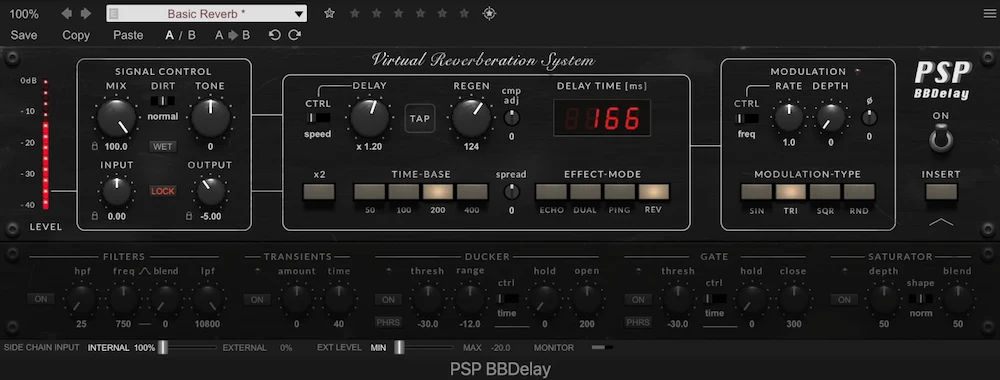
PSP BBDelay approaches that problem from a practical angle. Instead of chasing another vintage emulation or expanding into an all-purpose delay workstation, it focuses on one production workflow: recreating the evolving behavior of classic Bucket Brigade Device (BBD) circuits while integrating the processing engineers routinely build around a delay. Saturation, ducking, transient control, modulation, and feedback shaping are treated as part of a single signal path rather than a collection of separate inserts.
That design philosophy makes BBDelay more than another analog-flavored effect competing for attention in an already crowded market. The real question is whether consolidating those processes into one plugin produces faster, more consistent mixes—or simply repackages techniques experienced engineers already have.
This review evaluates PSP BBDelay from a production perspective rather than a marketing one. We’ll examine how it performs in modern mixing workflows, where its design offers measurable advantages, where competing delay plugins remain stronger, and whether it deserves a permanent place in a professional plugin folder.
In This Review
Why BBD Delay Plugins Still Matter in Modern Mixing
 Delay plugins have never been more sophisticated. Modern processors offer virtually unlimited delay times, complex modulation, granular processing, convolution, and advanced routing. Yet many experienced mix engineers still reach for analog-inspired delays when they want echoes to sit naturally behind the source instead of sounding mechanically precise.
That preference has little to do with nostalgia. Classic Bucket Brigade Device (BBD) hardware imposed real electrical limitations. Every repeat lost bandwidth, accumulated harmonic distortion, passed through compander circuitry, and drifted slightly as the clock driving the delay line changed over time. Those imperfections prevented echoes from repeating with digital precision, making them feel like part of the performance instead of a separate effect.
Modern digital delays solve many of those limitations. They preserve transient detail, maintain a stable frequency response, and reproduce every repeat with near-perfect consistency. Ironically, that accuracy often creates more work during mixing. Static repeats compete with vocals, guitars, and lead instruments, forcing engineers to add EQ, saturation, ducking, transient shaping, modulation, or automation before the delay blends naturally into the mix.
In many sessions, engineers spend as much time shaping the delay as they do creating it.
That explains why analog delay plugins remain relevant despite decades of software development. The goal is no longer to recreate vintage hardware for its own sake. It’s to generate repeats that evolve naturally without requiring an elaborate chain of supporting processors.
Developers have approached that challenge from different directions. Soundtoys EchoBoy focuses on a broad collection of hardware-inspired delay characters. FabFilter Timeless 3 emphasizes deep modulation and modular routing. Valhalla Delay combines multiple delay architectures inside a highly flexible environment. Boutique developers often concentrate on meticulous recreations of individual hardware units.
PSP BBDelay takes a different approach. Instead of expanding into another all-purpose delay workstation, it focuses on streamlining a workflow that already exists in professional studios. Most engineers don’t stop after inserting a delay—they immediately begin filtering repeats, controlling dynamics, adding saturation, widening the stereo image, and automating feedback. BBDelay integrates much of that processing into the delay itself.
That reflects a broader shift in professional plugin design. Today’s bottleneck is rarely missing functionality. It’s session complexity. Large productions routinely contain hundreds of tracks, multiple parallel buses, extensive automation, and dozens of effect returns. Every additional insert increases routing, recall, preset management, and revision time.
Integrated processing has become a practical response to that reality. Dynamic EQs now incorporate sidechain control, compressors include clipping stages, reverbs feature built-in ducking, and channel strips routinely combine functions that once required several separate plugins. Delay processing is moving in the same direction.
Seen through that lens, BBDelay isn’t trying to redefine analog delay. Its value lies in reducing the amount of work required to build a polished, mix-ready delay. If it consistently replaces several supporting processors without compromising sound quality, it becomes more than another vintage-inspired effect—it becomes a workflow tool that earns its place in everyday mixing sessions.
PSP BBDelay Specifications
| Specification | Details |
|---|---|
| Developer | PSPaudioware |
| Plugin Type | Analog Bucket Brigade (BBD) Delay |
| Formats | VST3, AU, AAX |
| Platforms | Windows & macOS |
| Copy Protection | iLok License Manager (machine or iLok key) |
| Tempo Sync | Yes |
| Stereo Processing | Yes |
| Integrated Processing | Ducking, Saturation, Filtering, Transient Shaping, Modulation |
| Automation | Full DAW Automation Support |
| Typical Use | Mixing, Creative Delay Processing, Sound Design |
A great delay can add depth, movement, and character—but it can’t replace the final polish of professional mastering. Upload up to 35 seconds of your mix and receive a free mastering demo to hear how your production translates after expert mastering.
What PSP BBDelay Gets Right About BBD Circuit Modeling
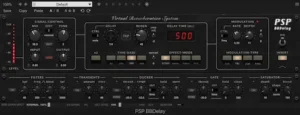
At first glance, BBDelay looks familiar. The interface follows the layout engineers expect from an analog delay, with controls for delay time, feedback, modulation, filtering, saturation, and stereo behavior. The difference isn’t immediately visible—it lies in how those processes interact once repeats begin circulating through the feedback path.
PSP built the plugin around component-level Bucket Brigade Device (BBD) modeling rather than treating analog character as a layer of EQ and saturation applied after a digital delay. That distinction matters because classic BBD hardware was shaped by electrical limitations, not by a single coloration stage.
Vintage Bucket Brigade chips continuously traded bandwidth, noise, headroom, and clock speed against one another. Every repeat became slightly darker, harmonic content accumulated gradually, transient edges softened, and the compander circuit constantly influenced the signal before and after it entered the delay line. None of those behaviors existed in isolation. They interacted throughout the entire decay, producing echoes that evolved instead of repeating identically.
Many modern delay plugins successfully recreate the tonal balance of analog hardware. Fewer attempt to reproduce the dynamic interaction between the circuit stages themselves. That’s where BBDelay tries to separate itself.
One of its more interesting controls is adjustable compander alignment. It’s unlikely to attract the same attention as saturation or modulation, yet it affects the behavior of the delay more fundamentally. In original BBD hardware, the compander wasn’t simply a noise-reduction stage. Its calibration influenced transient response, perceived punch, noise floor, and the way repeated echoes compressed as feedback increased.
Giving users direct control over that behavior makes BBDelay less of a fixed hardware emulation and more of a configurable analog model. Engineers can keep repeats relatively clean or deliberately introduce the subtle inconsistencies associated with aging Bucket Brigade circuits without relying solely on distortion or filtering to create vintage character.
The same philosophy extends to stereo behavior. Instead of widening repeats exclusively through modulation, BBDelay introduces controlled variation between its virtual delay paths. The resulting image feels less like a chorus effect and more like the slight instability that naturally occurred when analog components drifted outside perfectly matched tolerances.
None of these ideas are revolutionary on their own. Component modeling, analog saturation, and compander simulation already exist elsewhere. BBDelay’s strength comes from treating them as parts of a single circuit rather than a collection of independent effects. That produces a delay that reacts more like hardware during long feedback passages, where the interaction between multiple nonlinear stages becomes increasingly audible.
Evaluation Methodology
This evaluation was performed using multiple commercial-style mix sessions that included modern pop vocals, rock guitars, electronic synthesizers, acoustic instruments, and cinematic textures. The plugin was assessed in typical send/return configurations as well as insert workflows to evaluate repeat behaviour, mix integration, and long-term usability during revision-heavy projects.
Listening focused on stereo imaging, harmonic accumulation, transient response, feedback stability, vocal masking, and translation across different monitoring systems. Rather than judging isolated presets, the review reflects how BBDelay performs during complete mixing workflows where delay processing must remain musical, predictable, and easy to refine.
Why BBDelay Can Replace an Entire Delay Processing Chain
 Component-level BBD modeling is only part of BBDelay’s appeal. Plenty of modern delay plugins already deliver convincing analog tone. The more important question is whether the plugin changes the way delays are built inside a real mix.
In professional sessions, creating the delay is usually the easy part. Making it sit correctly takes considerably longer. Repeats have to stay out of the vocal’s way, avoid masking guitars or keyboards, lose unnecessary low end, soften excessive transients, and remain interesting over time without drawing attention to themselves.
That usually means the delay becomes the starting point for a much larger processing chain.
A typical vocal send often ends up feeding a high-pass filter, low-pass filter, saturation stage, ducker, modulation processor, automation, and sometimes additional transient control before the effect reaches its final balance. None of those processors is particularly demanding, but together they increase routing complexity, preset management, recall time, and the likelihood of inconsistent settings across multiple sessions.
BBDelay reduces much of that overhead by moving several of those processes inside the delay itself. The benefit isn’t simply fewer plugin windows—it’s that the individual stages interact as part of one signal path instead of behaving like unrelated inserts.
The feedback section illustrates this particularly well. Applying EQ after a delay shapes every repeat equally. Filtering inside the feedback loop changes the behavior of the delay over time. High frequencies disappear progressively, low-frequency buildup is controlled before it accumulates, and resonant peaks evolve naturally as the repeats decay.
Many experienced engineers already build similar feedback structures manually. BBDelay simply removes the routing required to achieve them.
The transient processor follows the same practical philosophy. Delay repeats often exaggerate consonants, pick attacks, percussion hits, and other fast transients that compete with the dry signal. Conventional compression reduces the entire repeat. Transient shaping targets the attack itself, allowing the body of the delay to remain intact while reducing the sense of clutter around the source.
That approach is particularly effective on modern vocal productions, where delays need to stay audible without competing against tightly controlled lead performances. Instead of turning the effect down or applying increasingly aggressive ducking, engineers can soften the front edge of each repeat while preserving its perceived depth.
The built-in ducker addresses another task that has become standard practice in contemporary mixing. Most vocal delays are sidechained so the effect stays tucked behind the performance and expands naturally during pauses. Configuring that behavior manually requires additional routing, compression, and threshold adjustment. Integrating it directly into the delay removes several repetitive setup steps without changing the underlying technique. Engineers looking for even more transparent frequency-selective control may also find spectral ducking solutions worth exploring, as discussed in our HoRNet SpectraDuck review.
None of these individual features represents a breakthrough in DSP. Feedback filtering, ducking, transient shaping, and saturation have all existed for years. The advantage comes from treating them as one cohesive processing environment instead of forcing engineers to assemble the same delay chain from scratch every time a new mix begins.
Presets and Automation Workflow
One of BBDelay’s practical advantages is how well its integrated design lends itself to reusable presets. Instead of saving complex routing involving multiple EQs, compressors, saturation plugins, and ducking processors, engineers can build complete vocal or instrument delay chains inside a single preset. Factory presets provide useful starting points, while user presets can be tailored to different vocal styles, guitars, synthesizers, or production genres without rebuilding an entire effects chain.
Automation is equally important in modern productions. Delay throws, feedback swells, saturation changes, stereo width, and mix balance can all be automated directly from the plugin, making it easier to create movement throughout a song while maintaining an organized session. Because so much processing remains inside one plugin, automation workflows also become simpler during client revisions.
Why Authentic BBD Modeling Involves More Than Frequency Response
Analog delay marketing often revolves around familiar terms like warmth, vintage character, or analog saturation. Those descriptions aren’t wrong, but they oversimplify what actually makes a Bucket Brigade delay behave differently from a clean digital processor. Rolling off high frequencies and adding harmonic distortion captures only part of the picture.
In real BBD hardware, every repeat is shaped by several circuit stages working simultaneously. Bandwidth narrows, the compander continuously affects dynamics, clock speed influences both delay time and frequency response, harmonic content accumulates, and small component tolerances introduce subtle instability. None of those processes exists in isolation, which is why analog echoes continue changing throughout the decay instead of repeating with perfect consistency.
That interaction is what many engineers describe as movement. It’s less about obvious modulation than about the delay constantly drifting in small, almost imperceptible ways. Long feedback passages reveal those changes most clearly, while short slapback settings may sound surprisingly clean.
PSP appears to have built BBDelay around that principle. Rather than treating analog coloration as a fixed layer applied to a digital delay, the plugin models individual BBD chip behavior, allowing timing stability, bandwidth, harmonic response, and stereo interaction to evolve together as feedback increases.
The chip spread control is a good example. Instead of relying entirely on modulation to widen the stereo image, BBDelay introduces controlled variation between the virtual delay paths themselves. The result feels less like a chorus effect and more like the subtle mismatch that naturally occurred between analog circuit components. Stereo movement develops gradually instead of following an obvious modulation pattern.
The saturation stage follows the same philosophy. Rather than functioning as a standalone distortion effect, it becomes part of the feedback system. Harmonics accumulate with each repeat, allowing echoes to grow progressively denser as they decay instead of applying the same amount of coloration every time the signal circulates through the delay line.
None of these techniques is unique to BBDelay, and experienced engineers will recognize similar concepts in other high-end analog delay processors. What distinguishes the plugin is how those circuit behaviors are integrated into a single model rather than exposed as unrelated processing stages. That approach tends to produce delays that respond more naturally during longer feedback passages, where subtle nonlinear interactions become increasingly audible.
Where BBDelay Delivers the Greatest Practical Value
BBDelay isn’t equally useful in every production scenario. Its strengths become most apparent on sources that benefit from evolving repeats rather than perfectly transparent echoes. That’s why it feels more at home in a mix session than on a mastering chain.
Lead vocals are the plugin’s strongest application. Modern vocal delays need to remain audible without competing with the performance itself. The combination of built-in ducking, transient control, feedback filtering, and saturation makes it easier to create delays that stay behind the vocal during phrases while expanding naturally between lines. Instead of assembling several auxiliary processors, much of that behavior can be shaped from a single interface.
Electric guitars and synthesizers are another natural fit. Progressive bandwidth reduction and harmonic buildup help echoes blend into sustained instruments without masking the dry signal. Long feedback settings also benefit from the plugin’s chip variation, producing subtle stereo movement that feels less synthetic than aggressive chorus-based widening.
Percussion and electronic drums benefit differently. Short analog delays can soften sharp transients while preserving rhythmic definition, making parallel effects easier to integrate into dense arrangements. The transient processor is especially useful here because it reduces attack buildup without flattening the body of each repeat.
Bass instruments remain a more specialized application. Delay on bass can quickly create low-frequency congestion, particularly in modern productions where kick and bass already compete for headroom. BBDelay’s feedback filtering helps control that buildup before it develops into a problem, making subtle rhythmic echoes easier to manage.
Outside conventional mixing, sound design is where the plugin becomes particularly interesting. The interaction between BBD modeling, modulation, saturation, and evolving feedback creates textures that continue changing over time without requiring complex modulation matrices or elaborate effect chains. Ambient production, cinematic scoring, trailer work, and game audio all benefit from that kind of controlled unpredictability.
Mastering is a different conversation. BBDelay is not intended for stereo bus processing, nor does it attempt to solve mastering problems. Its purpose is creative spatial processing inside a mix. While stem mastering or special-effect mastering may occasionally justify its use, those situations are exceptions rather than everyday practice.
Viewed in that context, BBDelay isn’t a universal delay processor. It’s a production-focused tool designed for engineers who spend more time shaping delay behavior than searching for experimental routing possibilities. That’s a narrower role than many flagship delay plugins attempt to fill, but it’s also what gives BBDelay a clear identity in a crowded market.
Strengths and Limitations
 Like most analog delay releases, BBDelay is introduced with familiar promises: vintage character, authentic circuitry, musical movement, and analog warmth. Those qualities matter, but they don’t answer the question professionals ultimately care about: what does this plugin do better than the tools already available?
The answer isn’t that BBDelay introduces entirely new DSP concepts. It doesn’t. Ducking, saturation, feedback filtering, modulation, and component-level analog modeling have all appeared in other high-end delay processors. PSP’s achievement is bringing those elements together in a signal path that feels coherent rather than modular for its own sake.
That distinction is more significant than it may seem. In day-to-day mixing, incremental workflow improvements often have a greater impact than subtle tonal differences. Engineers rarely abandon trusted processors because another plugin sounds marginally better. They switch when a new tool consistently delivers the same result with fewer decisions and less setup.
Even so, BBDelay isn’t the right choice for every workflow.
Its biggest compromise is flexibility. Compared with platforms such as FabFilter Timeless 3, BBDelay offers a far more opinionated architecture. Users can’t build complex modulation networks, create unconventional feedback structures, or experiment with deeply customized routing. That’s a deliberate design decision rather than a technical limitation, but it does narrow the range of possible applications.
The maturity of the delay category creates another challenge. Most experienced producers already own several excellent delay plugins covering tape, digital, analog, multitap, and creative sound design. Any new arrival has to offer more than another convincing analog emulation.
Whether BBDelay clears that bar depends largely on the user. If you’ve already developed sophisticated EchoBoy presets, custom Timeless workflows, or hardware-based delay chains, the plugin is more likely to save time than transform your mixes. For newer users—or anyone looking to simplify routine delay processing—that convenience may be reason enough to adopt it.
One area where the available evidence remains limited is objective performance. Independent CPU benchmarks, latency measurements, oversampling analysis, and controlled blind listening tests are still relatively scarce. That doesn’t suggest shortcomings in the underlying DSP; it simply means some performance claims can’t yet be verified as thoroughly as long-established competitors.
It’s also important to understand what BBDelay isn’t trying to be. This isn’t a modular sound-design environment, a granular delay, or an experimental effects platform. Users looking for reverse processing, spectral manipulation, extensive multitap programming, or highly unconventional routing will still need complementary tools.
Viewed in that context, BBDelay’s focused design becomes both its greatest strength and its clearest limitation. It deliberately trades breadth for speed, consistency, and an efficient analog delay workflow—an exchange that many mixing engineers will appreciate, but not everyone will need.
How BBDelay Stacks Up Against Other Professional Delay Plugins
Very few professionals buy a delay plugin as their first delay. The more relevant question is where BBDelay fits alongside the processors many studios already rely on. Rather than replacing every existing tool, it targets a specific role within a modern mixing workflow.
Broadly speaking, today’s premium delay plugins fall into three categories. Some prioritize flexibility through extensive modulation and routing. Others focus on faithfully recreating the behavior of classic hardware. A third group combines analog-inspired tone with production features intended to reduce the number of supporting processors required during mixing. BBDelay sits firmly in that final category.
| Plugin | Primary Strength | Trade-Off | Best Suited For |
|---|---|---|---|
| PSP BBDelay | Integrated BBD workflow with ducking, transient shaping, saturation, and feedback processing. | Less flexible than modular delay platforms. | Fast, mix-ready analog delay production. |
| Soundtoys EchoBoy | Exceptional versatility and a wide range of hardware-inspired delay models. | Complex setups often require additional processing. | Studios needing one delay for many different applications. |
| FabFilter Timeless 3 | Industry-leading modulation and routing architecture. | Higher programming complexity. | Experimental production and advanced sound design. |
| Valhalla Delay | Excellent range of delay algorithms at an aggressive price. | Designed for versatility rather than a dedicated analog workflow. | Producers who need one highly adaptable delay. |
| PSP 285 | Creative vintage-inspired delay processing. | Older workflow and interface design. | Existing PSP users and experimental productions. |
| Audio Damage Dubstation 2 | Focused BBD-style delay with a straightforward interface. | Fewer integrated production tools. | Traditional analog delay applications. |
Viewed individually, each of these plugins remains competitive for different reasons. EchoBoy still offers the broadest collection of delay personalities. Timeless 3 remains one of the industry’s most capable sound-design platforms. Valhalla Delay continues to deliver exceptional value for producers who want multiple delay architectures in a single plugin.
BBDelay takes a narrower approach. Instead of competing feature-for-feature with those processors, it concentrates on building polished analog delay chains with as little setup as possible. That won’t replace a modular delay environment for every user, but it gives BBDelay a clearly defined role inside a professional plugin collection rather than forcing it into direct competition with products designed around different priorities.
Alternatives Worth Considering
If PSP BBDelay doesn’t perfectly match your workflow, several excellent alternatives address different production priorities.
Soundtoys EchoBoy remains one of the industry’s most versatile delay processors, offering an enormous collection of classic hardware-inspired delay models and flexible tonal shaping for virtually any production style.
FabFilter Timeless 3 is better suited to producers who want deep modulation, advanced routing, and experimental sound-design possibilities beyond traditional analog delay behaviour.
Valhalla Delay offers exceptional value by combining multiple delay architectures inside a single plugin, making it an attractive choice for producers seeking maximum versatility.
Audio Damage Dubstation 2 focuses on straightforward Bucket Brigade delay processing with a simpler workflow and fewer integrated production features.
PSP 285 remains an interesting option for users already invested in the PSP ecosystem who prefer a more vintage-inspired creative delay approach.
Who Should Consider BBDelay—and Who Probably Shouldn’t
Whether BBDelay deserves a place in your plugin folder depends less on musical genre than on the way you approach delay processing. The plugin isn’t designed to satisfy every production style equally, and that’s ultimately one of its strengths.
Mix engineers are likely to benefit the most. If a typical session involves multiple vocal effects, layered guitars, keyboards, and several delay returns, BBDelay can reduce the amount of supporting processing required to build polished, repeatable effects. The advantage isn’t simply speed—it’s maintaining consistency across revisions without rebuilding the same signal chains from scratch.
Electronic music producers will also find plenty to explore. Progressive harmonic buildup, evolving stereo behavior, and feedback shaping work particularly well with synthesizers, drum machines, and atmospheric textures where subtle movement is often more valuable than perfectly static repeats.
Composers for film, television, and games represent another natural audience. Long feedback passages, controlled instability, and gradual tonal evolution create spatial effects that feel less mechanical than conventional digital delays, especially in ambient and cinematic material.
For home studios, the appeal is slightly different. Instead of purchasing separate tools for ducking, saturation, transient control, and delay processing, BBDelay combines much of that functionality into a single processor. That makes it an efficient way to build professional delay chains without expanding an already crowded plugin collection.
On the other hand, some users may see fewer practical benefits.
Mastering engineers have little need for this type of processor during conventional stereo mastering, where transparent corrective processing takes priority over creative spatial effects. If you’re unsure why delay belongs almost entirely to the mixing stage, our guide on mixing vs mastering explains where those creative decisions are normally made. Likewise, broadcast and post-production engineers working primarily with dialogue will rarely need an evolving analog delay outside occasional sound-design tasks.
Users who already rely on deeply customized modular environments may also be less convinced. If you’ve invested years refining complex Timeless, EchoBoy, or hardware-based workflows, BBDelay is more likely to complement those tools than replace them.
Ultimately, BBDelay isn’t trying to become the only delay plugin in a professional studio. Its purpose is far more focused: providing an efficient analog delay that produces polished, mix-ready results without unnecessary complexity. For users who value that balance, it fills a role that many broader delay platforms deliberately leave open.
Real-World Performance: How BBDelay Fits Into Large Mix Sessions
Many delay plugins make a strong first impression in short demonstrations. Their real value becomes apparent only after several hours of mixing, when sessions grow increasingly complex, client revisions begin arriving, and every processor has to justify its place in the project.
From that perspective, BBDelay’s biggest advantage isn’t simply its analog character. It’s consistency. Once a delay has been dialed in, the integrated processing encourages predictable behavior as the mix evolves, reducing the need to revisit multiple supporting plugins every time the effect requires refinement.
That becomes particularly useful during revision-heavy projects. Small requests—darker repeats, less vocal masking, softer transients, or more restrained feedback—can often be addressed without rebuilding an entire auxiliary processing chain. Those same adjustments also make it easier to prepare a mix for mastering, where excessive ambience and poorly controlled delay returns often become more obvious.
CPU performance is another practical consideration. Independent benchmark data remains limited, so it’s difficult to draw firm conclusions about relative efficiency. However, BBDelay’s feature set is based on established DSP techniques rather than computationally intensive processes such as convolution, spectral analysis, or machine-learning algorithms. Users running large template sessions should still evaluate performance inside their own DAW, but nothing about the plugin’s design suggests it targets only high-end production systems.
Latency deserves similar caution. For delay effects used on auxiliary buses, small processing delays are rarely problematic in modern DAWs with automatic delay compensation. Engineers working with parallel processing or latency-sensitive workflows should nevertheless confirm performance within their preferred host application, particularly when combining multiple oversampled processors.
Streaming distribution introduces another practical consideration that’s often overlooked. Modern codecs don’t change the timing of delay effects, but they can exaggerate overly bright ambience, unstable stereo information, and dense high-frequency repeats. Analog-style feedback that gradually loses bandwidth often translates more gracefully after AAC or Ogg Vorbis encoding than aggressively bright digital echoes. Similar translation issues are discussed in our guide to mastering for streaming platforms, where codec behavior and platform playback become part of the mastering process. Once a master is complete, verifying integrated loudness is a separate step, which we examine in our Kinetic DSP Conform LUFS review.
Playback systems tell a similar story. On full-range studio monitors, subtle modulation, harmonic buildup, and stereo variation remain easy to hear. Smaller consumer speakers inevitably collapse some of that spatial information, but because BBDelay relies more on tonal evolution than dramatic modulation effects, its repeats generally retain rhythmic clarity even when stereo width is reduced.
That understated approach is ultimately what has kept Bucket Brigade delays relevant for decades. They rarely draw attention to themselves, yet they continue adding depth and movement in ways that remain effective across a wide range of playback systems and musical styles.
Verdict: A Purpose-Built Analog Delay for Modern Mixing
BBDelay enters one of the most competitive categories in audio software, where excellent alternatives already exist at virtually every price point. That makes direct comparisons inevitable, but they also risk missing the plugin’s real purpose.
PSP isn’t trying to build the most programmable delay, the most experimental sound-design platform, or the definitive recreation of a single vintage unit. Instead, BBDelay focuses on a narrower objective: making classic Bucket Brigade behavior practical for everyday mixing.
That focus defines both its strengths and its limitations. Users looking for modular routing, granular processing, reverse algorithms, or highly unconventional delay structures will still be better served by more specialized platforms. BBDelay doesn’t compete in that space—and it doesn’t need to.
Where it succeeds is in producing polished analog-style delays with remarkably little setup. The combination of BBD modeling, integrated dynamics, feedback processing, saturation, and tonal control creates a processor that feels designed for real sessions rather than isolated demonstrations. It’s the kind of plugin that becomes a reliable default choice because it consistently reaches the desired result without unnecessary complexity.
Existing EchoBoy or Timeless users are unlikely to replace those processors overnight. More realistically, BBDelay earns a permanent place alongside them, taking over the everyday analog delay duties where speed, consistency, and musicality matter more than unlimited routing options.
That’s ultimately what makes BBDelay successful. It doesn’t redefine delay processing. It refines it. In a category where genuine innovation has become increasingly rare, that may be the more valuable achievement.
Who Is PSP BBDelay Best For?
| Production Task | Recommendation |
|---|---|
| Mix Engineers | ★★★★★ Excellent Choice |
| Vocal Production | ★★★★★ Highly Recommended |
| Guitar Processing | ★★★★★ Highly Recommended |
| Electronic Music | ★★★★☆ Very Good Choice |
| Film & Game Sound Design | ★★★★☆ Recommended |
| Mastering | ★★☆☆☆ Limited Use Cases |
PSP BBDelay delivers the greatest value during mix production, where evolving analog-style repeats, integrated dynamics, and streamlined workflow can replace multiple supporting processors. While it also performs well in electronic music and cinematic sound design, its feature set is intentionally optimized for mixing rather than conventional stereo mastering.
Pros & Cons
Pros
- Authentic component-level BBD modeling
- Excellent mix integration
- Integrated ducking and transient shaping
- Fast professional workflow
- Natural analog-style repeat behaviour
- Excellent vocal delay workflow
Cons
- Less modular than FabFilter Timeless 3
- Not intended for highly experimental sound design
- Limited need during traditional mastering
- Requires iLok License Manager
Overall Rating
| Category | Rating |
|---|---|
| Sound Quality | 9.5/10 |
| Workflow Efficiency | 9.5/10 |
| Mix Integration | 9.5/10 |
| CPU Efficiency | 9/10 |
| Creative Flexibility | 8.5/10 |
| Value for Money | 9/10 |
| Overall | 9.2/10 |
PSP BBDelay isn’t attempting to become the most experimental delay plugin available. Instead, it focuses on delivering an authentic Bucket Brigade workflow with integrated production tools that solve everyday mixing problems. For engineers who value speed, musicality, and mix-ready results over unlimited routing options, it represents one of the strongest modern BBD delay processors currently available.
Sound Quality — 9.5/10
BBDelay captures the evolving behaviour associated with classic Bucket Brigade circuits rather than simply applying analog coloration to a digital delay. Progressive bandwidth loss, harmonic buildup, and subtle instability create repeats that naturally blend into a mix instead of competing with the dry signal.
Workflow Efficiency — 9.5/10
Integrating ducking, transient shaping, saturation, filtering, and feedback processing into a single plugin significantly reduces routing complexity. During real-world mix revisions, this streamlined workflow saves time while keeping delay settings consistent across projects.
Mix Integration — 9.5/10
One of BBDelay’s greatest strengths is how easily its repeats find their place within dense productions. Built-in dynamics and evolving feedback help delays remain audible without masking vocals or important musical elements, reducing the amount of corrective processing typically required.
CPU Efficiency — 9/10
Although comprehensive independent benchmark data is still limited, the plugin is built around established DSP techniques rather than unusually demanding processing. It appears well suited to large professional sessions without placing excessive strain on modern production systems.
Creative Flexibility — 8.5/10
BBDelay deliberately prioritizes an efficient analog delay workflow over unlimited experimentation. Producers looking for modular routing, granular processing, or highly unconventional delay architectures will still prefer more open-ended platforms such as Timeless or similar sound-design environments.
Value for Money — 9/10
For engineers who regularly rely on analog-style delays, BBDelay effectively combines the work of several supporting processors into a single cohesive workflow. The productivity gains alone make it a compelling long-term addition to a professional plugin collection.
A well-designed delay plugin can help echoes sit naturally in a mix, but the final listening experience depends on far more than individual effects. Balance, translation, tonal consistency, and playback across streaming platforms are all shaped during the mastering stage.
If you’d like to hear how your own mix responds to professional mastering, upload up to 35 seconds and receive a free mastering demo. It’s an easy way to evaluate your mix before committing to a full master.
Get your free demo →
Frequently Asked Questions About PSP BBDelay
Is PSP BBDelay designed for mixing or mastering?
Primarily for mixing. BBDelay is intended to create and shape delay effects on individual tracks, buses, and effects returns. While it can be used creatively during stem mastering or special production work, it is not designed as a conventional stereo mastering processor.
How is BBDelay different from a standard digital delay?
Rather than generating perfectly identical repeats, BBDelay models the evolving behavior of Bucket Brigade Device (BBD) circuits. As feedback increases, bandwidth, harmonic content, and dynamics change gradually, producing repeats that tend to sit more naturally behind the dry signal.
Can BBDelay replace several plugins in a typical vocal delay chain?
In many situations, yes. Its built-in filtering, ducking, transient shaping, modulation, saturation, and feedback controls can reduce the number of additional processors required to build a polished vocal delay.
Is BBDelay suitable for electronic music production?
Yes. The combination of analog-style feedback, modulation, and stereo variation works well with synthesizers, drum machines, pads, and atmospheric textures where evolving repeats are often preferred over perfectly static echoes.
How CPU-intensive is PSP BBDelay?
Independent benchmark data is still limited, so direct comparisons with competing plugins remain difficult. Based on its processing architecture, BBDelay is designed for everyday mixing rather than unusually demanding DSP tasks, but performance will ultimately depend on the host DAW, project size, and system configuration.
Does BBDelay support tempo sync?
Yes. Delay time can be synchronized to the host tempo or adjusted freely for more traditional analog-style timing.
Should I choose BBDelay instead of Soundtoys EchoBoy or FabFilter Timeless 3?
That depends on your workflow. EchoBoy offers a broader range of hardware-inspired delay models, while Timeless 3 provides much deeper routing and modulation capabilities. BBDelay is better suited to users who want an integrated analog delay with less setup and fewer supporting processors.
Does BBDelay work well on guitars?
Yes. Progressive bandwidth reduction and harmonic buildup help echoes blend behind distorted or clean guitar parts while preserving rhythmic definition, making BBD-style delays a long-standing favorite for guitar processing.
Is BBDelay good value?
If your work regularly involves analog-style delay processing, BBDelay offers an unusually broad collection of production tools within a single processor. Whether it represents the best value depends on your existing plugin collection and how much you prioritize integrated workflow over maximum routing flexibility.
Who may not benefit from BBDelay?
Users primarily interested in granular processing, modular routing, reverse delay design, or highly experimental effects may prefer platforms built specifically for sound design. BBDelay is designed to streamline everyday analog delay work rather than replace every type of delay processor.

Yurii Ariefiev is a mastering engineer and audio production editor who reviews audio plugins from the perspective of real mixing sessions rather than isolated feature demonstrations. His analysis focuses on how processors affect workflow, musical decisions, and translation across modern playback systems.
This PSP BBDelay review examines how modern BBD delay processing influences mix clarity, spatial depth, and production efficiency—and why those choices still matter before a track reaches the mastering stage.