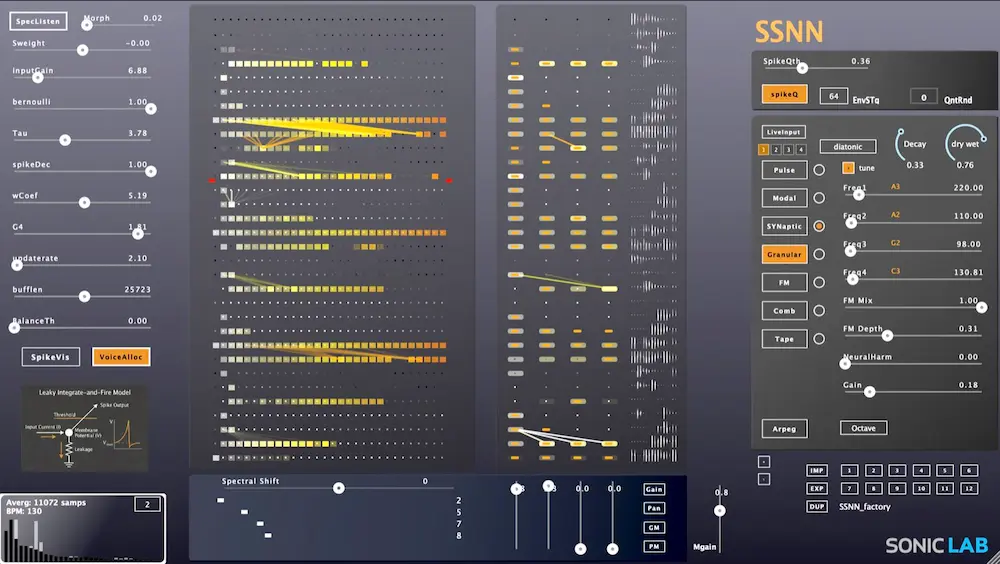
sonicLAB SSNN Review: Is This Neural Synthesis Plugin Worth Using for Music Production?
Most AI-powered audio tools begin with a trained model. Their behavior is largely defined before the user loads a session, shaped by datasets, training methods, and decisions made during development. sonicLAB SSNN follows a different path. Instead of recalling information from a pre-trained model, it continuously builds and modifies its internal neural network from incoming audio, using the source signal as both input material and network data.
That design places SSNN in a category of its own. It is neither a conventional software synthesizer nor another AI-assisted production tool promising automated creativity. The plugin functions as a real-time neural system whose behavior changes according to the material feeding it, producing results that can range from subtle spectral transformations to highly complex generative textures.
The important question is not whether SSNN can create unusual sounds. Most experimental instruments can. The real question is whether a continuously adapting neural network can deliver meaningful results inside a modern audio production workflow, where repeatability, mix translation, CPU efficiency, and project recall often matter as much as sonic innovation.
Key Takeaways
- Unlike most AI-powered audio tools, SSNN continuously builds its neural network from incoming audio instead of relying on a pre-trained model.
- Its adaptive architecture excels at generating evolving textures, experimental timbres, and non-linear sonic behavior that conventional synthesizers rarely produce.
- The generated material frequently requires additional editing, mix refinement, and translation checks before release.
- SSNN is better suited to sound designers, film composers, and experimental producers than to fast-paced commercial production workflows.
- Rather than replacing traditional synthesizers, SSNN works best as a source of unique material that can later be edited, mixed, and mastered.
Navigation
Why Neural Synthesis Matters for Modern Music Production
 Generative systems have moved well beyond research labs and university music departments. Today, procedural audio, modular synthesis, algorithmic composition, and adaptive sound generation are part of professional workflows across ambient music, film scoring, game audio, experimental electronics, and immersive media production. As these workflows mature, producers are increasingly searching for tools that generate behavior rather than simply reproduce programmed sounds.
That shift has exposed a limitation shared by many AI-based audio tools. While trained models can produce impressive results, their behavior is ultimately constrained by the data and assumptions embedded during development. Over time, experienced users often learn where those boundaries exist. The output may vary, but the underlying logic remains largely fixed.
SSNN approaches the problem from a different direction.
Instead of recalling patterns from a pre-trained model, the plugin continuously reshapes its neural network using the audio currently entering the system. The incoming signal influences connection weights while simultaneously supplying material to the synthesis architecture itself. As a result, the system’s behavior is tied to the immediate characteristics of the source rather than decisions made during an offline training process.
From a production perspective, this makes SSNN less comparable to conventional software synthesizers and more comparable to a self-evolving signal environment. The goal is not precise sound design or repeatable patch construction. The appeal lies in creating interactions that emerge from the relationship between the source audio and the neural network as it develops in real time.
That distinction places SSNN closer to advanced modular workflows, custom Max/MSP systems, and experimental Reaktor environments than to the software instruments typically found in commercial music production. Whether that approach is practical depends entirely on the user’s priorities, but it represents a genuinely different design philosophy from most AI-driven audio tools currently on the market.
How sonicLAB SSNN’s Neural Architecture Works
Neural network terminology has become common in audio software marketing, but the underlying implementation often has little impact on how a tool behaves in a production environment. SSNN is different. Its architecture directly influences the way audio is generated, processed, and controlled, making the technical design relevant to anyone considering it for real-world use.
At the core of the system are 960 neurons distributed across 32 layers. Rather than serving as a background analysis engine, neural activity acts as the primary driver of the synthesis process. Spike events generated throughout the network feed eight synthesis engines operating simultaneously, creating a signal path that behaves very differently from conventional software instruments.
The most important aspect of the design is how incoming audio is handled. The source signal does not simply trigger events or provide modulation data. It actively reshapes network connection weights while simultaneously populating the layer-based audio buffers used by the synthesis engines. In other words, the same material that influences the network’s internal behavior also becomes part of the synthesis process itself.
This distinction has practical consequences. Most audio plugins maintain a clear separation between analysis and generation. A signal is analyzed, interpreted, and then used to control a separate processing stage. SSNN removes that separation. The network is continuously adapting to incoming material while generating output from data derived from the same source.
The result is a system whose behavior can evolve significantly as the input changes. Small variations in spectral content, dynamics, or timing may produce outcomes that would be difficult to predict using conventional synthesis methods. That characteristic is likely to appeal to sound designers interested in emergent behavior, adaptive textures, and complex generative processes.
It also introduces a tradeoff that becomes increasingly relevant in professional production workflows. The same architecture that enables unexpected sonic results can make repeatability, project recall, and precise sound recreation more difficult than with traditional synthesizers. Whether that tradeoff is a strength or a limitation depends largely on the role the instrument is expected to play within a production workflow.
How SSNN Performs in Real-World Production Workflows
 The neural network itself is only part of the story. What ultimately determines whether SSNN is useful in production is how neural activity is translated into audio. This is where the plugin moves beyond being a technical experiment and becomes a practical sound-generation system.
SSNN combines multiple synthesis methods, including Pulse Gen, Modal synthesis, and Synaptic FM, all driven by spike activity generated within the network. Rather than relying on traditional note-triggered signal paths, sound generation emerges from the behavior of the neural structure itself. The synthesis engines are responding to network activity, not simply to MIDI events or predefined modulation sources.
The more consequential design choice is the per-neuron processing architecture. Granular processing, waveshaping, FM processing, comb filtering, and tape delay are not applied globally across a signal chain. Processing can occur independently at the neuron level, allowing hundreds of simultaneous micro-events to influence the final output.
From a sound-design perspective, this dramatically increases the density of possible interactions within the system. A conventional synthesizer typically routes multiple sources through a limited number of processors. SSNN distributes processing activity throughout the network, creating layers of modulation and transformation that can evolve continuously as the neural state changes.
The practical result is rarely a clean, predictable instrument. Instead, SSNN tends to generate highly detailed textures, unstable harmonic structures, shifting transients, and complex spectral movement. These characteristics are often difficult to reproduce deliberately with traditional synthesis workflows, which helps explain the plugin’s appeal among experimental composers and generative music creators.
At the same time, the same qualities that make SSNN creatively interesting can complicate mixing decisions. Dense spectral activity, rapidly changing resonances, and overlapping processing events can occupy significant space within an arrangement. Sounds that appear compelling in isolation may require substantial editing, filtering, or dynamic control before they integrate effectively into a full production.
That tradeoff defines much of the SSNN experience. The plugin’s greatest strength is its ability to generate material that feels genuinely difficult to predict. Its biggest challenge is ensuring that those results remain usable once they leave the sound-design stage and enter a professional mixing workflow.
Where sonicLAB SSNN Excels
SSNN is at its best when the objective is generating material that would be difficult—or impractical—to design deliberately. This is not a plugin built around precision, recallability, or efficient patch construction. Its value comes from producing behaviors and sonic relationships that emerge from the interaction between incoming audio and the neural network itself.
That makes the instrument particularly relevant for ambient production, electroacoustic composition, experimental electronic music, generative systems, installation work, and cinematic sound design. In these contexts, the goal is often not to program a specific sound but to discover source material that can serve as the foundation for a composition, texture layer, or evolving atmosphere.
One of SSNN’s more compelling characteristics is its ability to generate structure without relying on conventional sequencing methods. Rhythmic patterns can emerge from spike quantization, harmonic relationships can develop from activity distributed across the network, and timbral changes can evolve continuously as the incoming signal alters the system’s internal state. The resulting behavior often feels less like operating a synthesizer and more like interacting with a process that is constantly reorganizing itself.
For experienced sound designers, this distinction matters. Most modern synthesizers offer enormous flexibility, but their behavior remains fundamentally deterministic. Given enough time, an experienced programmer can usually trace every modulation source and predict the outcome. SSNN introduces variables that are significantly harder to anticipate, allowing it to produce textures, transitions, and spectral interactions that may not emerge from traditional synthesis workflows.
The strongest use case is not replacing existing instruments. It is generating source material that can later be edited, arranged, processed, and integrated into a larger production. Viewed through that lens, SSNN functions less as a synthesizer in the traditional sense and more as a creative system for producing raw sonic material that would be difficult to obtain elsewhere. Producers interested in adaptive sound-design workflows may also want to compare this approach with Rast Sound Evolver 2 Review: A Motion FX Plugin Built Around Smarter Automation, which explores procedural modulation from a very different production perspective.
The Mixing Challenges Most Reviews Ignore
Most coverage of experimental instruments stops at sound generation. That approach overlooks a more important question: what happens when those sounds need to function inside a finished production?
SSNN can produce material with a level of spectral complexity that is difficult to encounter in conventional synthesis workflows. Because synthesis, modulation, and processing activity are distributed throughout hundreds of active neural nodes, the resulting audio often contains continuously shifting harmonic relationships, evolving resonances, and highly variable transient behavior.
From a mixing perspective, the challenge is not simply frequency balance. The structure of the sound itself can remain in motion long after it has been recorded. Elements that occupy a controlled spectral range at one moment may expand into entirely different regions of the spectrum seconds later. Stereo information can become increasingly diffuse, while transient density may fluctuate enough to affect perceived punch, depth, and separation.
These characteristics are often responsible for the qualities that make SSNN-generated material interesting in the first place. The problem is that they rarely exist in isolation. Once multiple tracks compete for space within an arrangement, continuously evolving textures can begin masking important musical information or drawing attention away from primary elements.
This is where conventional mixing techniques become less predictable. Static EQ decisions may solve one issue while exposing another later in the performance. While these challenges originate during the mix stage, they should not be confused with mastering-specific decisions. The distinction becomes particularly important when dealing with complex generative material, as discussed in Mixing vs Mastering — What Actually Sets Them Apart in Real Projects. Compression settings that stabilize one section can produce unintended artifacts as the neural output changes over time. Even stereo enhancement requires careful evaluation, particularly when complex spatial information is already embedded within the source material.
In practice, successful integration often depends less on aggressive processing and more on selective control. Filtering unnecessary spectral content, managing low-frequency accumulation, automating problem areas, and reducing excessive complexity can be more effective than attempting to preserve every detail generated by the system.
That does not represent a weakness in SSNN’s design. It is the natural consequence of an instrument built around emergent behavior rather than deterministic sound generation. The same architecture that produces unusual and compelling textures also demands more critical decision-making during the mixing stage.
Critical Evaluation: Is sonicLAB SSNN Practical for Professional Production?
The most distinctive aspect of SSNN is its ability to learn directly from incoming audio rather than relying on a pre-trained model. That architectural choice separates it from many AI-driven audio tools currently entering the market, but it should not be confused with an automatic advantage in music production.
Removing a fixed training dataset does not eliminate limitations. It simply shifts them elsewhere. Instead of inheriting constraints from pre-existing data, SSNN inherits the unpredictability of a system whose behavior is continuously shaped by whatever audio is feeding the network at a given moment.
This design philosophy also highlights an important distinction within today’s AI-assisted production tools. While SSNN adapts continuously to live audio, other modern plugins apply machine learning to solve highly focused production tasks with far greater predictability. A good example is IK Multimedia ReSing Doubling Review: Can AI Vocal Doubles Replace Real Double Tracking?, where AI is used to improve a specific workflow rather than generate continuously evolving behavior.
For some users, that unpredictability is the primary attraction. For others, it is likely to be the biggest obstacle.
Most professional production environments depend on repeatability. Producers expect patches to behave consistently, automation to remain reliable, and project recalls to produce the same result weeks or months later. Traditional synthesizers are designed around those expectations. Every modulation route, envelope, oscillator, and processing stage can be inspected, adjusted, and reproduced with a high degree of precision.
SSNN follows a different philosophy. Rather than giving users complete control over every stage of sound generation, it introduces a system where part of the creative process comes from observing how the network responds to changing input. The workflow often feels closer to directing a process than programming an instrument.
That distinction is important because it defines who will benefit from the plugin. Producers looking for surgical control over timbre, harmony, and repeatable performance behavior may find the system unnecessarily unpredictable. Sound designers and experimental composers, on the other hand, may view that same unpredictability as a source of creative value.
The hardware requirements further reinforce SSNN’s specialized positioning. Running a 960-neuron network across 32 layers while maintaining oversampled processing places a meaningful load on modern systems. A single instance may be manageable on contemporary multi-core hardware, but large projects containing multiple neural environments can quickly become resource-intensive. This is particularly relevant in sessions that already include orchestral libraries, convolution reverbs, advanced spatial processing, or CPU-heavy virtual instruments.
Ultimately, SSNN should not be evaluated using the same criteria applied to mainstream synthesizers. It is not attempting to compete with production-focused instruments optimized for speed, predictability, or efficient sound design. Its value lies in generating behaviors and sonic relationships that are difficult to anticipate and even harder to reproduce deliberately. Whether that represents a breakthrough or a limitation depends almost entirely on the production goals of the user.
SSNN vs Traditional Synthesizers: Where Does It Fit?
Evaluating SSNN against traditional software instruments quickly becomes problematic because most established synthesizers are designed to solve different production challenges. Comparing it directly to wavetable, virtual analog, or hybrid synthesizers often says more about the comparison category than about the plugin itself.
Instruments such as Phase Plant, Pigments, Falcon, and Massive X are built around controllable sound design. They provide deep modulation systems, extensive routing options, and highly predictable behavior. The objective is to help users create a desired result efficiently and reproduce it consistently throughout a project.
SSNN operates from a different premise. Rather than maximizing control, it prioritizes interaction between an evolving neural system and incoming audio. The emphasis is placed on emergent behavior, adaptive processes, and the generation of outcomes that may not be fully predictable in advance.
For that reason, the closest comparisons are often found outside the conventional plugin market. Advanced Reaktor environments, Max/MSP patches, SuperCollider systems, and complex modular synthesis setups share a similar goal: creating frameworks that generate behavior rather than simply producing sounds. In each case, the user is designing conditions under which events occur rather than defining every result directly.
This distinction has practical implications for potential users. A producer looking for a versatile synthesizer capable of handling basses, leads, pads, keys, and everyday production tasks will likely find more value in established instruments optimized for speed and control. Those tools are easier to integrate into commercial workflows, easier to recall, and easier to manage across large projects.
SSNN becomes more compelling when viewed as a specialized sound-design environment. Its strongest use cases involve exploratory composition, generative systems, experimental electronic music, immersive audio projects, and cinematic texture creation—areas where unpredictability can be an advantage rather than a problem.
| Platform | Primary Focus | Workflow Style | Repeatability | Sound Design Depth | Experimental Potential |
|---|---|---|---|---|---|
| SSNN | Adaptive neural synthesis | Generative | Low | High | Very High |
| Phase Plant | Modular software synthesis | Controlled | High | Very High | High |
| Pigments | Hybrid synthesis | Controlled | High | High | Moderate |
| Reaktor | Custom instrument ecosystems | Semi-generative | Variable | Very High | Very High |
| Max/MSP | Custom audio systems | Development-oriented | Variable | Extremely High | Extremely High |
| Eurorack Modular | Hardware signal ecosystems | Patch-based | Variable | Very High | Extremely High |
Viewed through this lens, SSNN occupies a relatively uncommon position in the market. It is not attempting to outperform mainstream synthesizers on efficiency, flexibility, or workflow speed. Its appeal comes from offering a different relationship with sound generation altogether—one where the behavior of the system becomes part of the creative process rather than merely a tool for achieving a predefined result.
Who Should Buy sonicLAB SSNN?
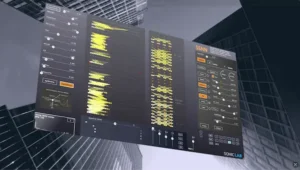 SSNN is not the kind of instrument that fits naturally into every production environment. Its value depends heavily on whether the user is searching for control or discovery.
The plugin is most likely to appeal to producers and composers who treat sound generation as part of the creative process rather than simply a means of creating parts for an arrangement. Experimental electronic musicians, ambient composers, electroacoustic artists, advanced sound designers, generative music developers, and creators working in film, game audio, or immersive media are the most obvious audience. In these fields, unexpected behavior is often viewed as a source of inspiration rather than a workflow problem.
SSNN is particularly effective when the objective is to generate source material that can later be edited, manipulated, layered, or developed into a larger composition. Producers who routinely build projects around evolving textures, procedural systems, and non-linear sonic structures are more likely to benefit from its neural architecture than those searching for conventional instrument design.
The plugin becomes less convincing when evaluated against the requirements of mainstream production work. Commercial pop, radio-focused electronic music, songwriting sessions, advertising production, and deadline-driven client projects generally reward speed, predictability, and reliable recall. In those environments, an instrument that continuously adapts its behavior can introduce complications that outweigh its creative advantages.
Mix engineers may also find limited direct value in SSNN. While it can generate unique material for a production, it is not a workflow tool designed to improve mixing efficiency or solve engineering problems. Its primary role remains sound creation rather than production optimization.
Ultimately, SSNN is best suited to users who are comfortable treating a software instrument as an evolving system rather than a predictable sound source. Producers expecting immediate results may find the workflow unnecessarily demanding. Those willing to explore, experiment, and curate the output are more likely to discover where the plugin’s strengths truly lie.
Mix Translation, Streaming, and Mastering Considerations
One of the biggest challenges with neural and generative synthesis appears long after the sound-design stage is finished. Creating unusual textures is relatively easy. Making those textures translate across real-world playback systems is considerably harder.
SSNN is capable of generating exceptionally dense material. Complex harmonic movement, continuously evolving resonances, granular artifacts, and highly active stereo information can create a strong sense of depth and detail inside a controlled studio environment. The problem is that perceived complexity does not always survive the transition to consumer playback systems.
What sounds expansive on full-range monitors may collapse on earbuds, become unfocused on Bluetooth speakers, or lose definition after streaming platform encoding. This issue becomes even more apparent on platforms that apply loudness normalization and codec conversion, which can expose weaknesses in highly complex source material. Similar translation problems are common in streaming releases and are explored in detail in Spotify Mastering — Why Tracks Fall Apart After Normalization. This is particularly relevant when a sound derives much of its character from subtle spectral activity and fine-grained spatial information. The more complex the source becomes, the more opportunities there are for translation issues to emerge.
Lossy codecs present an additional challenge. Streaming formats are generally optimized for efficient delivery rather than preserving every low-level detail within dense synthetic material. Complex textures containing rapidly changing harmonics, diffuse stereo information, and overlapping transient activity can expose artifacts that were not obvious during production.
For that reason, evaluating SSNN-generated content requires a more critical approach than simply monitoring on a primary studio system. Mono compatibility, low-frequency stability, stereo coherence, transient behavior, and consistency across multiple playback environments become increasingly important as neural complexity increases.
This is also where mastering takes on a more significant role. Neural synthesis can produce sounds that immediately attract attention, but novelty often makes objective evaluation more difficult. A texture may feel impressive because it is unfamiliar, not because it serves the arrangement effectively. The distinction is important, particularly in productions where clarity, emotional impact, and translation matter more than technical complexity.
Mastering often exposes issues that remain hidden during the creative stage. Many of these issues are best addressed before mastering begins, particularly when working with complex neural-generated material. For a deeper breakdown, see Prepare Mix for Mastering: What Actually Matters Before You Send It. Excessive spectral density, unstable low-end behavior, exaggerated stereo movement, and accumulated masking become easier to identify once the focus shifts from experimentation to playback consistency. In many cases, the most effective solution is not additional processing but selective reduction of unnecessary complexity.
This may sound counterintuitive given the capabilities of a system like SSNN, but it reflects a broader reality of modern audio production. Generating complexity is relatively easy. Preserving impact across streaming platforms, consumer devices, and real-world listening environments remains the harder task.
Final Verdict: Is sonicLAB SSNN Worth It?
SSNN stands apart from most contemporary audio software because it is not trying to make sound design more efficient, more predictable, or more accessible. Its purpose is fundamentally different. The plugin is designed to generate behavior, not simply sounds, and that distinction shapes both its strengths and its limitations.
In an industry increasingly focused on automation, presets, and AI-assisted workflows, SSNN takes a less conventional approach. Rather than reducing creative decisions, it introduces a system whose output remains partially influenced by the interaction between incoming audio and an evolving neural structure. For some producers, that uncertainty will be frustrating. For others, it may be the entire reason to use the instrument.
The plugin is unlikely to become a staple of mainstream music production. It demands significant computational resources, requires a willingness to experiment, and often generates material that needs careful evaluation before it can be integrated into a finished mix. Producers searching for efficient workflows, rapid sound design, or highly repeatable results will find stronger options elsewhere.
Its value becomes clearer in areas where exploration matters more than efficiency. Experimental electronic music, generative composition, advanced sound design, immersive audio, and cinematic production are all environments where unpredictable behavior can contribute meaningful creative value. In those contexts, SSNN offers possibilities that are difficult to replicate with conventional synthesizers or production-oriented virtual instruments.
Ultimately, SSNN is best understood as a specialized creative system rather than a general-purpose synthesizer. For independent producers working entirely inside a DAW, the bigger challenge is often not generating complex material but ensuring that it translates outside the studio. That issue extends far beyond neural synthesis and is one of the central topics covered in Mastering for Bedroom Producers — Fix Translation, Not Just Loudness. It will not appeal to every producer, nor is it intended to. The users most likely to benefit are those willing to trade a degree of control and repeatability for access to sonic outcomes that are difficult to design deliberately through traditional synthesis methods.
Overall Rating
| Category | Rating |
|---|---|
| Creative Sound Design | 9.8/10 |
| Innovation | 10/10 |
| Workflow Efficiency | 6.8/10 |
| Mix Integration | 7.4/10 |
| Commercial Production Suitability | 7.3/10 |
| CPU Efficiency | 6.2/10 |
| Value for Experimental Producers | 9.4/10 |
| Overall | 8.4/10 |
Pros & Cons
Pros
- Truly original neural synthesis architecture
- Produces highly organic and evolving sonic textures
- Generates sonic behaviors that are difficult to recreate with conventional synthesis
- OSC and MIDI integration expand creative workflows
- Unlike dataset-driven AI tools, behavior evolves from live audio input
Cons
- Steep learning curve for conventional producers
- Heavy CPU usage in larger sessions
- Project recall can be challenging in repeatable production workflows
- Complex output often requires additional mix preparation
- Less practical for deadline-driven commercial production
SSNN is one of the most original software instruments currently available, introducing a genuinely different approach to adaptive sound generation rather than another variation of established synthesis methods. Its neural architecture delivers exceptional creative potential for experimental production, cinematic sound design, and generative composition.
The trade-off is practical usability. High CPU demands, limited repeatability, and continuously evolving output make SSNN less suitable for fast commercial workflows than conventional synthesizers. As a specialized creative instrument, however, it succeeds in offering sonic possibilities that remain difficult to reproduce with traditional software.
Final Recommendation
| Production Scenario | Recommendation |
|---|---|
| Experimental Sound Design | ★★★★★ |
| Film & Game Audio | ★★★★★ |
| Ambient & Generative Music | ★★★★★ |
| Cinematic Production | ★★★★☆ |
| Electronic Music Production | ★★★☆☆ |
| Commercial Pop / EDM | ★★☆☆☆ |
| Fast Client Sessions | ★☆☆☆☆ |
SSNN is not designed to replace mainstream synthesizers or accelerate conventional production workflows. Its greatest value lies in generating material that would be difficult to create deliberately using traditional synthesis methods. Producers working in experimental music, immersive audio, cinematic scoring, and advanced sound design are likely to benefit the most, while commercial production environments that prioritize speed, repeatability, and predictable recall will generally be better served by more conventional instruments.

Yurii Ariefiev writes technical editorial reviews from the perspective of real-world mixing and mastering workflows rather than software announcements. His analysis focuses on how new audio tools behave inside complete productions, including translation, spectral balance, streaming delivery, CPU efficiency, and long-term usability in professional studio environments.
This SSNN review evaluates the plugin as a production system rather than a standalone synthesizer, emphasizing practical workflow, mix integration, mastering implications, and playback reliability instead of feature lists or marketing claims.
FAQ
Can SSNN be used as a primary instrument in a production?
It depends on the project. SSNN is capable of generating complete musical material, but its strengths are most apparent when used to create textures, atmospheres, evolving layers, and unconventional sonic elements. Most producers will likely combine it with more traditional instruments rather than rely on it exclusively.
How difficult is it to reproduce the same result in SSNN?
More difficult than with conventional synthesizers. Because the network continuously responds to incoming audio, recreating identical behavior may require controlling not only the plugin settings but also the source material feeding the system.
Is SSNN suitable for commercial music production workflows?
It can be, but usually in a supporting role. Genres that depend on highly repeatable sounds, strict arrangement structures, and fast production cycles may benefit less from SSNN than projects that prioritize experimentation and sound exploration.
How demanding is SSNN compared to traditional software synthesizers?
The computational load is substantially higher than most conventional synth plugins. Running a neural network with hundreds of active processing nodes, multiple synthesis engines, and oversampled output requires modern multi-core hardware, particularly in larger sessions.
Can SSNN-generated material create mixing and mastering challenges?
Yes. Dense spectral content, evolving harmonic structures, complex stereo information, and shifting transient behavior can make balancing a mix more difficult. Additional editing, automation, and spectral control may be required before mastering.
Does SSNN work well for film scoring and game audio?
These are arguably among its strongest applications. Continuously evolving textures, adaptive behaviors, and unconventional timbres can be valuable when creating environmental sound design, cinematic atmospheres, and interactive audio assets.
How does SSNN compare to Reaktor, Max/MSP, or modular synthesis?
All of these environments encourage experimentation and emergent behavior. The difference is that SSNN uses a neural architecture as the core creative engine, allowing users to access complex adaptive processes without building an entire system from scratch.
Can SSNN control external synthesizers or virtual instruments?
Yes. Through OSC transmission and the included NNnotes utility, neural activity can be converted into MIDI data and routed to external hardware, software instruments, or additional DAW tracks.
Is SSNN useful for mixing engineers?
Not as a mixing processor. Its value lies in sound generation and creative experimentation. Mix engineers may encounter SSNN-generated material in client projects, but the plugin itself is not designed to perform traditional mixing tasks.
What is the biggest limitation of SSNN?
For many users, it will be predictability. The same adaptive behavior that makes the instrument creatively interesting can make it more difficult to control, reproduce, and integrate into fast-moving commercial production workflows.