XLN Audio DB-30 Drum Butter — a faster way to shape drums without breaking your mix
Modern drum processing is overloaded. Producers stack EQs, compressors, saturators, transient shapers, and limiters — and end up fighting their own signal chain. DB-30 Drum Butter by XLN Audio is built to solve that exact issue: not by adding more tools, but by restructuring how you use them.
This is not just another multi-FX plugin. It’s a workflow tool designed for speed, experimentation, and controlled results — especially when working with drum loops, programmed beats, or live recordings.
Why traditional drum processing slows you down
The classic chain looks familiar: EQ → compression → saturation → transient shaping → limiting. On paper, it’s correct. In practice, it creates conflicts.
Typical issues:
- compression kills transients
- saturation muddies low-end
- layered processing introduces phase problems
- gain staging becomes unpredictable
You’re no longer shaping sound — you’re constantly fixing it. DB-30 flips that approach by combining key processes into a modular system with unified control.
Inside DB-30: modular processing, not plugin stacking
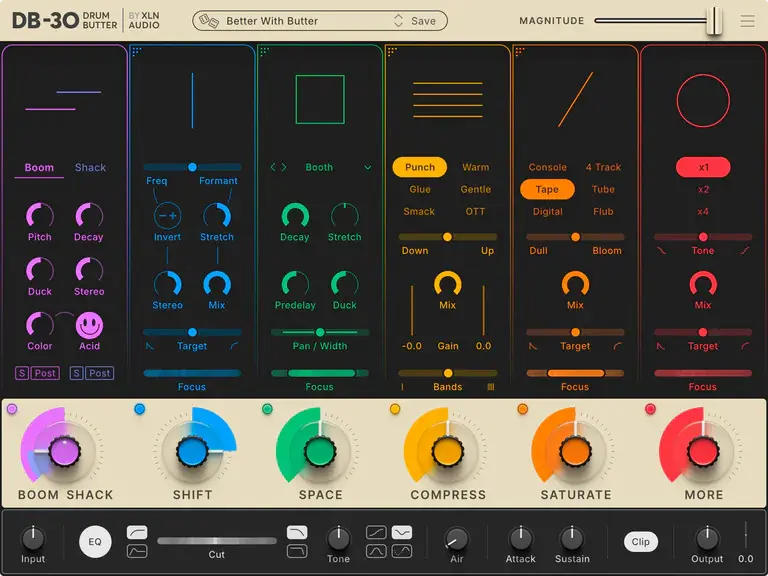
DB-30 is built around six modules that can be freely reordered:
- Boom Shack
- Shift
- Space
- Compress
- Saturate
- More
This matters more than it sounds. Processing order defines tone. Saturation before compression behaves completely differently than after — and here, you can test both instantly.
The Magnitude control is the real power move: it scales all modules at once, letting you dial in intensity globally instead of tweaking each parameter individually.
Boom Shack: low-end weight and top-end attitude
This module splits into two distinct layers. Boom enhances the low-end foundation — especially useful for kick-heavy genres — without smearing the transient response.
Shack introduces controlled noise and texture, adding bite to snares and hi-hats. Instead of stacking samples or layering noise manually, you get immediate character with minimal effort.
Acid Mode pushes things further, adding aggressive harmonic content suitable for electronic and club-oriented productions.
Shift: reshape tone without touching timing
Shift allows independent control over frequency and formant. This is not just pitch shifting — it’s tonal reshaping.
Use cases include:
- altering drum tone without affecting groove
- creating transitions and drops
- reshaping attack vs sustain behavior
Normally, this would require automation across multiple plugins. Here, it’s centralized and fast.
Space: depth that doesn’t kill punch
Reverb on drums is notoriously tricky. Too much — and you lose clarity. Too little — and everything feels flat.
Space gives you controlled ambience with detailed parameters like width, decay, and stereo placement. The key advantage: it preserves transient definition while adding depth.
Compress: punch and control without complexity
Instead of exposing dozens of parameters, DB-30 offers compression modes tailored specifically for drums.
This allows you to:
- add punch quickly
- tighten grooves
- apply parallel-style compression without routing
It’s essentially a simplified front-end to complex compression workflows.
Saturate: from subtle warmth to aggressive edge
Saturation in DB-30 is designed with separation between transients and sustain. That’s critical.
You can thicken the body of the sound without crushing the attack — something many saturation plugins fail to handle properly.
Multiple modes cover everything from analog-style warmth to heavy distortion.
More: perceived loudness and density
The “More” module is not just gain — it’s psychoacoustic enhancement. It increases perceived loudness, density, and energy without destroying the signal.
This is where drums start to feel “finished” in the mix.
Master section: final tone shaping
The master section ties everything together with tools for final polish:
- Air — high-frequency enhancement
- Attack — transient recovery
- Sustain — tail shaping
Loudness Match ensures level consistency between input and output, preventing false judgments based on volume.
Where DB-30 actually works (and where it doesn’t)
DB-30 is not a replacement for full mixing. It’s a speed tool.
Best use cases:
- drum loops and samples
- electronic drum programming
- quick demo production
- creative sound design
But if your source material is weak or your mix lacks structure, no multi-FX plugin will fix that.
For professional, release-ready results, it makes more sense to order mixing and mastering, where every stage is controlled individually instead of relying on a single processing chain.
Final verdict
DB-30 Drum Butter is about efficiency. It reduces friction, speeds up decisions, and keeps you focused on results instead of settings.
But like any tool, it doesn’t replace expertise. The outcome still depends on how you use it.
And that’s the difference between a polished track and a processed one.