NovelSimple LUFS Matrix: A Fast Loudness Preview Tool for Spotify and YouTube—Useful, But Not a Mastering Solution
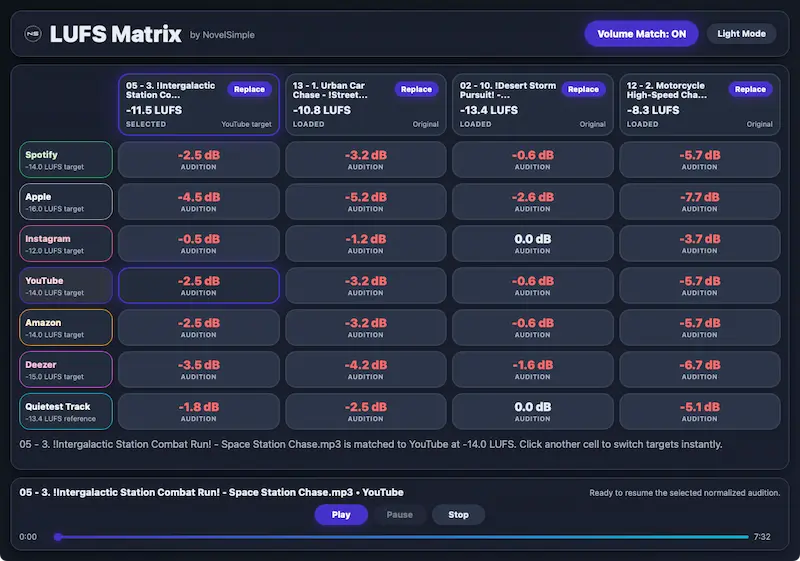
NovelSimple LUFS Matrix is a newly released desktop loudness tool designed to preview how your mix will translate after normalization on streaming platforms like Spotify, YouTube, and Apple Music. It doesn’t process audio—it simulates what happens after upload.
Quick facts:
— Type: standalone loudness simulation tool
— Price: $29 (intro $5)
— Platforms: Spotify, YouTube, Apple Music, Instagram, Amazon, Deezer
— Use case: pre-release loudness check and A/B comparison
— Verdict: fast and practical, but technically limited
What LUFS Matrix Actually Does
NovelSimple LUFS Matrix sits in a narrow but relevant gap: it shows how loudness normalization will affect your track before distribution. Instead of guessing or uploading test versions, you can preview the outcome locally.
How it works:
— Measures integrated LUFS
— Applies gain compensation to match platform targets
— Lets you A/B original vs normalized playback
— Displays deviation from each platform’s target loudness
There’s no processing, no limiting, no tonal shaping. It’s strictly a level simulation layer.
Why This Tool Exists (And Why Now)
Loudness normalization has been standardized for years, but workflows haven’t caught up. Engineers still rely on export → upload → check cycles, especially outside high-end mastering environments.
NovelSimple LUFS Matrix removes that loop. It’s not solving a new problem—it’s reducing friction around an old one.
That matters more than it sounds. Speed is becoming a competitive advantage in modern audio production, especially for creators publishing directly to streaming platforms.
Streaming Loudness Targets (What You’re Actually Matching)
Each platform normalizes differently. That’s the root issue this tool addresses.
Typical targets:
— Spotify: ~ -14 LUFS
— YouTube: ~ -13 LUFS
— Apple Music: ~ -16 LUFS
— Amazon Music: ~ -14 LUFS
— Deezer: ~ -14 LUFS
If your master exceeds these levels, it will be turned down. That often collapses perceived punch and changes balance—especially in aggressively limited mixes.
Real-World Use in Mixing and Mastering
NovelSimple LUFS Matrix is not a creative tool—it’s a validation tool.
Where it’s actually useful:
— Comparing multiple mastering versions under normalization
— Checking if loud masters lose impact after attenuation
— Verifying dialogue/music balance for YouTube delivery
— Auditing loudness consistency across content libraries
It’s fast enough to be used at the end of every export cycle. That’s its main advantage.
Where LUFS Matrix Falls Apart
This is where the marketing oversells the product.
It does not simulate real playback conditions.
Limitations:
— No codec simulation (AAC, OGG, etc.)
— No post-encoding true peak prediction
— No intersample peak modeling
— No spectral or dynamic analysis
So while NovelSimple LUFS Matrix shows loudness changes, it ignores what often matters more: how encoding alters transients and frequency balance.
That gap is critical. A mix can pass LUFS normalization and still degrade after compression.
LUFS Matrix vs Existing Tools
This isn’t a new category—it’s a simplified entry point.
vs NUGEN MasterCheck
MasterCheck offers codec-aware simulation and deeper control. LUFS Matrix is faster but far less accurate.
vs Youlean Loudness Meter
Youlean delivers precise measurement. LUFS Matrix adds platform simulation but sacrifices analytical depth.
vs ADPTR Metric AB
Metric AB integrates directly into DAW workflows. LUFS Matrix operates externally with less flexibility.
Conclusion:
LUFS Matrix trades precision for speed and simplicity.
Is NovelSimple LUFS Matrix Worth It?
Yes, if:
— you need fast loudness checks before release
— you work outside complex mastering chains
— you produce content for streaming or social platforms
No, if:
— you require codec-accurate simulation
— you already use professional metering suites
— you rely on detailed mastering decisions
Verdict:
NovelSimple LUFS Matrix is a workflow accelerator—not a mastering upgrade.
Where to Download LUFS Matrix
NovelSimple LUFS Matrix is available directly from the NovelSimple website as a one-time purchase.
— Standard price: $29
— Intro offer: $5 (first 200 users, code: LUFS)
No subscription, no cloud processing—everything runs locally.
Why Loudness Alone Doesn’t Fix Translation
Matching LUFS doesn’t guarantee consistent playback.
Translation depends on:
— dynamic range
— transient response
— spectral balance
— codec interaction
This is where most mixes fail after upload—not at the loudness stage, but in how they respond to platform processing.
That’s why tools like NovelSimple LUFS Matrix are useful for validation, but insufficient for final decisions. Reliable results still come from controlled mastering workflows, including calibrated monitoring and reference-based processing, as outlined in professional approaches like quality track mastering.
Final Verdict
NovelSimple LUFS Matrix doesn’t introduce new audio technology. It simplifies access to an existing concept.
That makes it valuable—but only if you understand its limits.
Used correctly, it speeds up decision-making and reduces guesswork before release. Used as a replacement for mastering, it creates false confidence.
This is a utility tool. Nothing more—and nothing less.