
Slate Digital Bus Clipper review: a fast loudness tool that cuts peaks—but not corners
Slate Digital Bus Clipper has landed as a new mastering-focused plugin, positioned somewhere between a clipper, a saturator, and a loudness tool. It’s not trying to replace a limiter—and that distinction matters more than the marketing suggests.
This is a two-stage processor built for a very specific job: shave off transient spikes, then redistribute signal energy to push perceived loudness. The idea isn’t new. The execution is what decides whether it’s useful—or just another clipper with a clean UI.
Why Slate Digital Bus Clipper matters right now
The current mastering landscape is saturated with limiters promising transparency. At the same time, more engineers are moving toward hybrid workflows—clip first, limit later—to squeeze extra loudness without destroying transients.
Slate Digital Bus Clipper enters directly into that shift. It doesn’t compete with tools like Pro-L2 on dynamics. Instead, it sits earlier in the chain, targeting peak control before limiting even begins.
This reflects a broader trend in audio production: separating transient shaping from loudness maximization rather than relying on a single processor to do both.
What the plugin actually does (beyond the marketing)
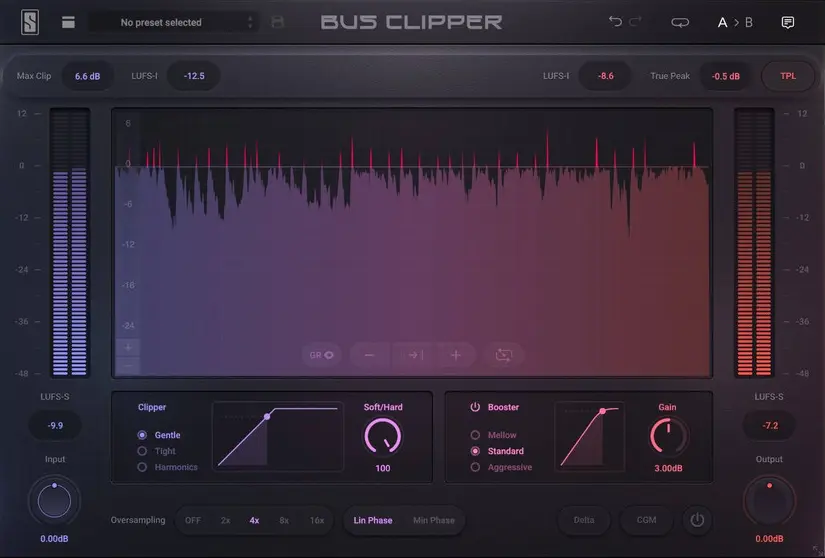
At its core, Slate Digital Bus Clipper is a dual-stage processor:
Stage 1: Clipper
Sample-level clipping with no attack, release, or lookahead. Anything above the ceiling is reduced instantly. No smoothing, no time-based response—just direct waveform alteration.
Stage 2: Booster
A waveshaping stage designed to increase perceived loudness without raising peak levels. Instead of compressing, it lifts quieter content while leaving peaks largely intact.
There are three clipping modes and three booster modes, along with a Shape/Harmonics control that adjusts distortion character. Add to that real-time transfer curve visualization, LUFS metering, and true peak monitoring, and the workflow is clearly designed for speed.
But let’s be precise: nothing here is fundamentally new. This is clipping plus nonlinear processing—just tightly integrated.
How Slate Digital Bus Clipper behaves in a real mastering chain
In practice, Slate Digital Bus Clipper works best in a very narrow window of use.
Typical chain:
EQ → Compression → Bus Clipper → Limiter
The goal is simple—remove transient spikes before they hit the limiter. This allows the limiter to operate more gently, often yielding an extra 1–2 dB of loudness without introducing pumping or distortion.
In controlled scenarios, clipping around 1–2 dB can tighten a mix without obvious artifacts. Push beyond 3 dB, and you start reshaping transients in a way that becomes audible—especially on wideband material.
Outside mastering, the plugin holds up on:
- Drum bus (tightening snare peaks)
- Kick and 808 control
- Parallel clipping for density
But it’s not forgiving. There’s no adaptive behavior. No safety net.
Where it works—and where it falls apart
Where it works:
- Electronic genres (EDM, trap, hip-hop)
- Pre-limiter peak control
- Fast loudness workflows
Where it struggles:
- Acoustic or dynamic material
- Full-range mixes with complex transients
- Situations requiring transparency over impact
The key limitation is obvious: Slate Digital Bus Clipper is static. It doesn’t react—it just cuts. That makes it powerful in the right context and destructive in the wrong one.
If you’re relying on it to “fix” a mix, it will expose problems faster than it solves them. Proper mastering still depends on balance, dynamics, and translation across systems—something no clipper can replace. In more controlled workflows, engineers typically integrate clipping as part of a broader process, not the core solution, as outlined in approaches to final mastering balance and dynamic control.

Slate Digital Bus Clipper vs established tools
This is where positioning becomes clearer.
StandardCLIP
More precise, more configurable, less approachable. Better for engineers who want full control over clipping curves.
Kazrog KClip
Deeper saturation shaping and more tonal flexibility. Bus Clipper trades that for speed.
FabFilter Pro-L2
Not a clipper, but often used in similar workflows. Pro-L2 adapts dynamically—Bus Clipper does not.
In short: Slate Digital Bus Clipper is faster, but less flexible. It favors workflow over precision.
What’s overstated—and what actually matters
The “Booster” stage is essentially waveshaping. It’s not a new loudness algorithm. It redistributes signal energy in a way that can feel louder—but it doesn’t bypass the physics of peak-limited audio.
The oversampling claim (16x vs 256x equivalents) is more about efficiency than sonic superiority. It’s useful—but not revolutionary.
What does matter:
- Integrated metering (LUFS + true peak)
- Delta listen for critical decisions
- Low latency for real-time work
Those are practical advantages, not marketing noise.
Verdict
Slate Digital Bus Clipper is not redefining mastering. It’s refining a workflow that already exists.
It’s effective when used with intent: small amounts of clipping, placed correctly in the chain, followed by controlled limiting.
It’s ineffective when treated as a shortcut to loudness.
Bottom line: a fast, well-designed clipper for engineers who already understand clipping. For everyone else, it’s an easy way to damage a mix.
At $49.50 intro pricing ($99 regular), it’s positioned as a mid-tier tool—useful, but far from essential.