TONEX ONE+ Review: Does Capture-Based Guitar Modeling Hold Up in Professional Production?
Most TONEX ONE+ reviews stop at tone. They compare amp captures, browse presets, and debate how closely the platform reproduces real hardware. That discussion is useful, but it ignores the stage where guitar sounds are actually judged: the mix.
A guitar tone can feel inspiring in solo mode and still create problems once drums, bass, vocals, and bus processing enter the session. The challenge is not making a guitar sound impressive by itself. The challenge is making it survive a commercial production workflow.
That distinction matters because TONEX ONE+ enters a market that has largely moved beyond traditional amp simulators. Modern guitarists can choose from Neural DSP plugins, Quad Cortex captures, Kemper profiles, Neural Amp Modeler libraries, and an expanding ecosystem of AI-driven solutions. The question is no longer whether convincing digital guitar tones are possible. The question is which platform delivers usable results with the least friction.
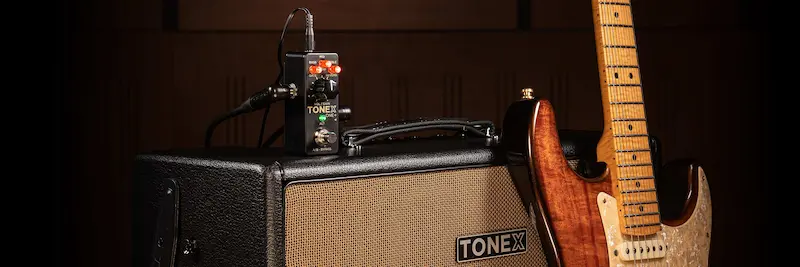
TONEX ONE+ positions itself as a shortcut to authentic amplifier tones without microphones, isolation rooms, speaker cabinets, or complex recording chains. For home studios and remote production environments, that proposition is compelling.
However, production value is not determined by how a guitar sounds during tracking. It is determined by how that sound translates through editing, mixing, mastering, loudness optimization, and streaming delivery.
Viewed through that lens, TONEX ONE+ becomes more than another guitar modeling product. It becomes a test of whether modern capture technology can consistently produce guitar tracks that hold their place in professional releases rather than simply impressing during preset auditions.
- Why TONEX ONE+ Matters in Today’s Guitar Production Market
- How TONEX ONE+ Actually Performs Inside a Mix
- The Hidden Strength of TONEX ONE+
- Why Some TONEX Guitar Tracks Fall Apart During Mixing
- How TONEX ONE+ Performs in High-Gain Production
- Where TONEX ONE+ Falls Short
- TONEX ONE+ vs The Competition
- TONEX ONE+ Hardware Workflow in Real Recording Sessions
- TONEX ONE+ vs TONEX ONE
- Translation Matters More Than Authenticity
- How TONEX Guitar Tracks Behave During Mastering
- Streaming Platforms, Codec Conversion, and Guitar Tone Stability
Why TONEX ONE+ Matters in Today’s Guitar Production Market
 TONEX ONE+ arrives at a point when guitar recording is undergoing a fundamental shift. For years, the conversation centered on whether software could convincingly replace a miked amplifier. That debate is largely over. Modern modeling platforms are already capable of producing release-quality guitar tracks. The real competition now revolves around workflow efficiency, consistency, and translation.
Traditional guitar recording remains one of the most variable processes in audio production. Amplifiers, speaker cabinets, microphones, mic placement, room acoustics, preamps, and converters all influence the final result. Small changes in any part of the chain can significantly alter how a guitar sits in a mix.
Capture-based modeling changes the equation. Instead of recreating an amplifier through component-level simulation, the system captures the behavior of an existing signal chain and makes it instantly recallable. A tone that once required expensive hardware, a treated room, and careful microphone placement can now be loaded in seconds.
That advantage extends beyond convenience. Modern production increasingly happens outside traditional studio environments. Albums are tracked in home studios, overdubs are recorded remotely, and collaborators exchange sessions across multiple countries and time zones. In these workflows, repeatability often becomes more valuable than absolute authenticity.
This is where TONEX has gained traction. The platform offers access to a massive ecosystem of amplifier captures while eliminating many of the logistical barriers associated with conventional guitar recording. Engineers no longer need to document microphone positions, maintain identical hardware chains, or recreate sessions weeks later for revisions.
The broader significance of TONEX ONE+ is not that it makes guitar recording easier. Plenty of products already do that. Its relevance comes from addressing a modern production requirement: obtaining consistent, mix-ready guitar sounds that can move through recording, editing, mixing, mastering, and streaming delivery without rebuilding the signal chain at every stage.
For producers working under deadlines, consistency is often more valuable than endless flexibility. TONEX ONE+ is positioned directly at that intersection.
Core Analysis: How TONEX ONE+ Actually Performs Inside a Mix
The easiest way to misjudge TONEX ONE+ is to evaluate it in isolation.
Most modern guitar platforms can produce impressive standalone tones. A preset loaded through studio monitors often sounds larger, wider, and more detailed than what ultimately works in a finished record. The problem is that listeners never hear isolated guitar tracks. They hear guitars competing with kick drums, bass guitars, lead vocals, synth layers, and bus processing.
That is where TONEX ONE+ becomes more interesting than a typical modeling solution.
High-quality captures tend to preserve the dynamic behavior that often disappears in conventional amp simulations. Pick attack feels more connected to the performance, gain transitions react more naturally to playing intensity, and harmonic content tends to evolve in a way that resembles a recorded amplifier rather than a software approximation.
These differences are subtle in solo mode. They become more noticeable once multiple guitar layers are stacked together.
In dense productions, poor digital guitar tones often reveal themselves through smeared transients, congested upper mids, and a tendency to lose separation when additional instruments enter the arrangement. Strong TONEX captures generally avoid those problems better than many older-generation modeling platforms.
However, the strengths of capture technology create their own workflow tradeoffs.
Unlike traditional amp simulators that allow extensive manipulation of virtual components, TONEX is fundamentally built around recorded snapshots of existing signal chains. The capture includes not only the strengths of the source rig, but also its flaws. Cabinet resonances, microphone coloration, low-mid accumulation, and problematic frequency peaks can all become part of the profile.
As a result, successful TONEX workflows depend less on tweaking and more on selection.
Engineers approaching the platform as a traditional amp simulator may find this limiting. Engineers who treat it like a library of recorded amplifiers will likely adapt much faster. The workflow resembles choosing between different microphone setups in a studio rather than redesigning the amplifier itself.
This distinction becomes important during mixing. A well-captured profile can require very little corrective processing because many of the tonal decisions were effectively made during the capture process. A poorly captured profile often moves in the opposite direction, demanding EQ cuts, resonance control, and additional shaping before it earns its place in the arrangement.
Consequently, the quality gap between captures matters more than many marketing discussions acknowledge. The platform itself is only part of the equation. The production outcome is heavily influenced by the quality of the source profile and the engineer’s ability to identify tones that complement the mix rather than dominate it.
The Hidden Strength of TONEX ONE+: It Reduces Decision Fatigue
Most discussions around TONEX ONE+ focus on realism. In practice, its biggest advantage may be efficiency.
Modern guitar production suffers from a problem that rarely existed in traditional studios: excessive optionality. Today’s musicians can spend hours comparing amp models, cabinets, microphones, impulse responses, power amp settings, oversampling modes, and post-processing chains before recording a single take.
More control does not always produce better results. In many cases, it simply delays decisions. This problem extends far beyond guitar production. Whether the tool generates guitar tones, effects chains, or cinematic sound design material, excessive choice often slows creativity more than technical limitations. We observed a similar workflow tradeoff in our SoundMorph PHUZE review, where speed of execution ultimately proved more valuable than unlimited sound-generation options.
TONEX ONE+ takes a different approach. Rather than presenting the user with dozens of variables to manipulate, it presents complete guitar sounds that can be evaluated immediately in the context of a song.
This changes the psychology of the workflow.
Instead of building tones piece by piece, users are selecting finished starting points. The process feels closer to choosing between professionally miked amplifiers in a studio than constructing a virtual signal chain from scratch.
That distinction becomes valuable during real production work. Commercial sessions are rarely limited by a lack of tonal options. They are limited by time, deadlines, revision cycles, and creative momentum.
When guitarists spend forty minutes refining a tone that was already usable after five, the issue is no longer sound quality. It is workflow inefficiency.
TONEX ONE+ helps eliminate part of that problem. Strong captures allow players to commit earlier, record sooner, and keep the focus on performance rather than endless parameter adjustments.
For engineers, this often translates into cleaner sessions and fewer last-minute tonal revisions. For musicians, it means spending more time creating tracks and less time auditioning possibilities.
That may not be the most marketable feature of TONEX ONE+, but in professional production environments it is often one of the most valuable.
Why Some TONEX Guitar Tracks Fall Apart During Mixing
 One of the more interesting criticisms of capture-based guitar modeling has nothing to do with realism. In many cases, the problem is the opposite.
Some captures sound so polished during tracking that they leave very little room for the rest of the production.
This is particularly common among guitarists building tones in isolation. A profile with huge low mids, extended top end, and aggressive cabinet character can feel impressive through studio monitors. Once drums, bass, vocals, and additional guitar layers enter the arrangement, those same characteristics often become liabilities.
The issue is not unique to TONEX. It appears across nearly every modern modeling platform. However, capture-based workflows expose the problem differently because many tonal decisions are already baked into the profile.
In real-world mixes, several patterns appear repeatedly.
Some captures accumulate excessive energy in the low-midrange, creating competition with bass guitars, floor toms, and lower vocal fundamentals. In severe cases, this buildup follows the track all the way into mastering, creating the same type of low-frequency congestion discussed in our guide on fixing muddy masters. Others contain microphone resonances that seem harmless during tracking but become increasingly aggressive as mix bus compression and mastering processing raise overall program density.
High-gain captures can present another challenge. Profiles designed to impress during solo playback often contain more saturation than a mix actually needs. Additional layers of guitars, drums, and vocals can quickly turn that saturation into congestion, reducing clarity rather than increasing impact.
Stereo processing introduces a separate concern. Certain captures achieve their sense of size through width-enhancing techniques that sound impressive in headphones but lose stability when summed toward mono or played through consumer devices. The result is a guitar tone that feels enormous in the studio yet noticeably smaller in real-world playback environments.
This is where capture quality and source selection become more important than the platform itself.
Traditional amp simulators often encourage engineers to solve problems through parameter adjustments. TONEX encourages a different mindset. The fastest solution is frequently replacing the capture rather than attempting to repair it.
That workflow can feel restrictive to users who prefer extensive editing. At the same time, it rewards engineers who make decisions at the source and understand that a mix-friendly guitar tone rarely sounds as exciting in solo mode as one designed purely for demonstration purposes.
The strongest TONEX productions are usually built around captures that leave space for the rest of the arrangement. Those profiles may sound smaller on their own, but they tend to produce larger, more stable mixes once the entire record comes together.
How TONEX ONE+ Performs in High-Gain Production
High-gain recording remains one of the fastest ways to expose weaknesses in any guitar platform.
Modern metal and hard rock productions demand far more than distortion. Rhythm guitars must stay aggressive without overwhelming the vocal, maintain articulation under heavy bus processing, and survive loudness optimization without turning into a wall of undefined midrange.
This is where TONEX ONE+ performs better than many engineers might expect.
Strong captures tend to retain a sense of attack that is often lost in heavily processed digital rigs. Palm-muted passages remain percussive, fast picking patterns preserve definition, and dense rhythm stacks generally separate more naturally than they do in many older modeling environments. The result is a guitar track that often requires less corrective work before entering the mix.
The advantage becomes most noticeable when layering multiple rhythm guitars. Poor digital tones frequently create a buildup of upper-mid congestion as tracks accumulate. Well-made TONEX captures typically hold together more effectively, allowing layered performances to sound larger without becoming excessively harsh.
That said, high-gain performance on TONEX is heavily dependent on capture quality.
One of the platform’s biggest strengths is also one of its biggest risks: the size of the ecosystem. Access to thousands of captures sounds appealing until engineers discover that not all captures were created with the same standards, monitoring conditions, or production goals.
Some profiles feel immediately usable in a commercial mix. Others contain excessive saturation, exaggerated low-end extension, or aggressive resonances that become problematic once loud drums and bass enter the arrangement.
This creates a workflow that differs from traditional amp simulation. Success comes less from tweaking and more from curation.
Experienced users eventually stop searching for more profiles and start building a shortlist of trusted captures that consistently translate across projects. In practice, many professional productions rely on a handful of proven tones rather than endless exploration through massive libraries.
That reality is worth acknowledging because the value of TONEX ONE+ is not measured by the number of available captures. It is measured by how quickly users can identify the few captures that continue working after editing, mixing, mastering, and streaming delivery.
In high-gain production, those are rarely the most extreme or impressive profiles. They are usually the captures that preserve clarity, leave room for the rest of the arrangement, and remain stable when the record reaches competitive loudness levels.
Critical Evaluation: Where TONEX ONE+ Falls Short
The biggest weakness of TONEX ONE+ is not sound quality.
It is inconsistency.
The platform’s appeal is built around access to an enormous capture ecosystem, but scale comes with a tradeoff. Unlike tightly controlled plugin environments where every preset is created under the supervision of a single development team, TONEX relies heavily on captures produced by different engineers, studios, monitoring systems, and recording methodologies.
The result is a library where quality varies significantly from one profile to another.
Some captures sound remarkably close to professionally recorded amplifiers. Others exhibit excessive low-end buildup, harsh microphone resonances, poor gain staging, or tonal imbalances that become obvious once the guitar enters a real mix. The platform provides access to outstanding sounds, but it does not guarantee them.
This shifts part of the engineering responsibility onto the user.
With traditional recording, engineers evaluate amplifiers, microphones, cabinets, and room acoustics. Within TONEX, the same evaluation process still exists, but it happens at the profile level. Users who assume that every capture represents a production-ready tone often end up spending more time fixing problems downstream.
Another limitation is the sheer volume of available options.
At first glance, access to thousands of captures appears to be a competitive advantage. In practice, it can become a distraction. Many users spend hours comparing nearly identical profiles while making little actual progress on the song itself.
This phenomenon is common throughout modern audio production. Unlimited choice often slows decision-making rather than improving results.
TONEX does not create that problem, but its ecosystem can amplify it.
The platform tends to reward engineers who commit quickly and trust their decisions. Users who constantly search for a slightly better profile may find themselves trapped in an endless cycle of comparison instead of recording.
Revision-heavy projects expose another practical challenge.
When a production is built around a specific capture, changing that capture late in the process can have consequences that extend far beyond the guitar track itself. Frequency relationships, automation moves, bus processing, and mastering decisions may all need adjustment. A profile swap that seems minor during tracking can create unexpected mix revisions later.
Traditional amplifier recording naturally encourages commitment because changing the source often requires re-recording. Digital ecosystems make those changes easy, which is both an advantage and a liability.
TONEX ONE+ sits directly in the middle of that tension. It offers extraordinary flexibility while simultaneously demanding more discipline from the engineer using it.
For experienced producers, that tradeoff is manageable. For less experienced users, it can become one of the platform’s most overlooked challenges.
Marketing Claims vs Production Reality
 Few phrases are repeated more often in modern guitar marketing than “indistinguishable from the real thing.”
Capture technology has undoubtedly narrowed the gap between digital and analog workflows, but the claim itself misses the point.
Professional productions are not judged on isolated guitar tracks. They are judged on finished records.
Once a guitar passes through editing, layering, mix bus processing, mastering, data compression, and consumer playback systems, the factors that determine success change dramatically. At that stage, arrangement quality, performance consistency, frequency balance, and mix translation usually have a greater impact on the final result than whether the source originated from a real amplifier or a capture.
This is where many marketing discussions become disconnected from production reality.
The industry often treats amplifier authenticity as the ultimate benchmark. Engineers working on commercial releases tend to evaluate a different set of criteria. They want to know whether the guitar sits correctly against the vocal, survives loudness processing, remains intelligible on consumer playback systems, and maintains separation when the arrangement becomes dense.
Those questions are far more relevant to the finished product than microscopic differences between profiling technologies.
TONEX ONE+ does not remove the need for critical decision-making. It simply relocates those decisions earlier in the workflow.
With a traditional recording chain, engineers choose amplifiers, cabinets, microphones, placement strategies, and room interactions. Within TONEX, those choices are largely embedded inside the capture itself. The responsibility shifts from building the recording chain to selecting the right recording chain.
That distinction is important because it highlights a reality that marketing rarely emphasizes: accuracy alone does not guarantee a better mix.
A technically flawless capture can still create frequency conflicts, occupy the wrong space in an arrangement, or require significant corrective processing. Conversely, a capture that is slightly less authentic may fit the production perfectly and require almost no intervention.
Ultimately, records succeed because of engineering decisions, not because of profiling technology. TONEX ONE+ provides access to excellent source material, but the outcome still depends on the producer’s ability to choose tones that serve the song rather than simply impress the guitarist.
In commercial production, translation consistently outweighs authenticity. The listener never hears the capture process. They hear the final record.
TONEX ONE+ vs The Competition
Comparing TONEX ONE+ to competing platforms is not as straightforward as comparing amp tones.
Most buyers assume these products are solving the same problem. In reality, they are optimized for different workflows.
Some platforms prioritize deep editing. Others focus on live performance, ecosystem integration, or capture accuracy. The best choice often depends less on tone quality and more on how the product fits into the recording process.
| Platform | Best At | Primary Limitation | Ideal User |
|---|---|---|---|
| TONEX ONE+ | Capture-based realism and rapid recording workflows | Variable profile quality across the ecosystem | Recording-focused guitarists and producers |
| Neural DSP Plugins | Mix-ready tones with minimal setup | Less variety compared to large capture libraries | Modern rock and metal production |
| Quad Cortex | Premium all-in-one hardware ecosystem | Higher cost of entry | Professional touring and studio users |
| Kemper Profiler | Established capture workflow and long-term reliability | Less modern user experience | Engineers with existing profiling libraries |
| Neural Amp Modeler | Open-source flexibility and community development | Steeper learning curve | Technical users and power users |
| Line 6 Helix | Routing flexibility and hybrid studio/live use | Less convincing amp realism than modern captures | Session musicians and live performers |
Hardware Ecosystem Comparison
| Platform | Recording Workflow | Capture Technology | Live Performance | Value |
|---|---|---|---|---|
| TONEX ONE+ | Fast and streamlined | Excellent | Limited | Very High |
| TONEX ONE | Simple and compact | Excellent | Limited | High |
| Quad Cortex | Professional all-in-one ecosystem | Excellent | Excellent | Premium-priced |
| Kemper Player | Mature profiling workflow | Very Good | Good | Moderate |
The most direct comparison is often made between TONEX and Neural DSP, but they approach guitar production from opposite directions.
Neural DSP products are highly curated. Users receive a controlled environment where most tones are designed to work immediately inside modern productions. The workflow is streamlined, predictable, and optimized for quick results.
TONEX takes a broader approach. Instead of delivering a carefully limited collection of sounds, it provides access to an enormous capture ecosystem. The upside is greater tonal variety. The downside is that finding exceptional captures requires more evaluation and experience.
Quad Cortex occupies a different category altogether. It combines capture technology, hardware integration, live performance functionality, and studio workflow into a single ecosystem. For touring professionals, that integration can justify the higher investment. For purely studio-based users, TONEX often delivers much of the same capture philosophy at a significantly lower cost.
Kemper remains relevant despite its age because it established many of the profiling concepts that modern platforms continue to refine. However, newer systems generally offer more streamlined workflows and broader ecosystem development.
Perhaps the most interesting competitor is Neural Amp Modeler. NAM has demonstrated that capture technology itself is no longer exclusive to commercial platforms. Its sound quality can be exceptional, but the workflow demands more technical involvement than many musicians want during active production.
This ultimately defines TONEX ONE+’s position in the market.
It sits between the simplicity of curated plugin ecosystems and the complexity of open-ended capture platforms. It offers enough flexibility for experienced engineers while remaining approachable for musicians who want professional guitar tones without building an entire production environment around them.
Its competitive advantage is not that it sounds dramatically better than every alternative. The modern market is too mature for that claim. The advantage is that TONEX combines strong capture quality, a massive ecosystem, fast recall, and accessible pricing in a way that few competing platforms currently match.
TONEX ONE+ Hardware Workflow in Real Recording Sessions
Most discussions around TONEX ONE+ focus on capture quality, but hardware workflow often determines whether a product becomes part of a daily recording setup or ends up collecting dust on a shelf.
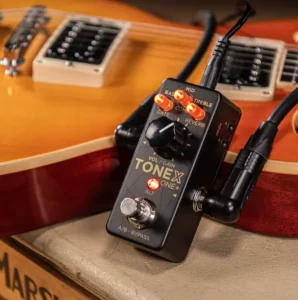
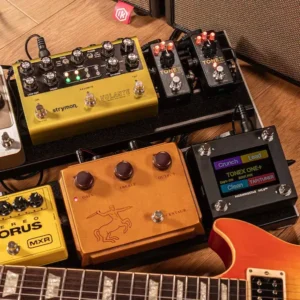
Unlike rack-sized modelers or larger floor processors, TONEX ONE+ is designed around a compact pedal format. That physical footprint makes it easier to integrate into existing studio desks, hybrid guitar rigs, and mobile recording setups where space is often limited.
In practical studio use, TONEX ONE+ is designed around speed. Preset recall is immediate, allowing engineers and musicians to move between sounds without rebuilding signal chains or reopening software sessions. For revision-heavy projects, this can save considerably more time than chasing marginal tonal improvements.
The footswitch implementation also deserves attention. Unlike larger modeling systems designed around complex stage control, TONEX ONE+ prioritizes simplicity. For recording applications, that approach often makes more sense than extensive live-performance functionality. Most studio users need reliable preset changes rather than elaborate switching architectures.
USB integration further supports modern workflows. Presets can be managed quickly, captures can be organized efficiently, and sessions can maintain consistency across multiple projects. In remote collaboration environments, that repeatability becomes particularly valuable.
Latency perception is another area where real-world use matters more than specifications. While modern digital guitar platforms generally operate within acceptable ranges, musicians tend to judge latency emotionally rather than mathematically. During testing and day-to-day production work, TONEX ONE+ feels responsive enough that the technology rarely becomes the focus of the performance.
Reamping workflows remain possible, although the platform is arguably most effective when decisions are made early. Engineers who commit to strong captures during tracking often find themselves spending less time revisiting guitar tones later in production.
From a studio integration standpoint, TONEX ONE+ fits comfortably into hybrid workflows that combine software instruments, traditional recording techniques, and modern mastering pipelines. The platform’s greatest operational advantage is not flexibility. It is the ability to reach a usable production sound quickly and recall it consistently.
Unlike many software-only solutions, TONEX ONE+ can remain part of a long-term recording workflow even as DAWs, operating systems, and plugin ecosystems evolve. Hardware-based recall often provides greater project continuity than relying exclusively on software environments that may change over time.
TONEX ONE+ vs TONEX ONE: Is the Upgrade Worth It?
For existing TONEX users, the most relevant question is often not whether TONEX technology is effective, but whether TONEX ONE+ offers enough practical advantages to justify replacing the original unit.
From a sound-quality perspective, the difference is smaller than many buyers expect. Both products operate within the same capture ecosystem and both can deliver professional guitar tones when paired with high-quality profiles.
The distinction is primarily workflow-oriented.
For most users, the upgrade decision comes down to workflow rather than tone. Both units operate within the same capture ecosystem, meaning the core sound quality remains broadly similar. The practical differences emerge during daily use, where preset handling, session recall, hardware interaction, and overall operational convenience can have a greater impact on productivity than incremental tonal improvements.
That distinction is important because many buyers approach TONEX ONE+ expecting a major leap in audio quality. In reality, the larger benefit is often reduced friction. Engineers working across multiple projects, maintaining large capture libraries, or regularly revisiting sessions months later may find those workflow improvements more valuable than another percentage point of realism.
However, musicians who work on multiple projects, switch sounds frequently, or rely on consistent recall may find the cumulative workflow improvements worthwhile.
For new buyers entering the ecosystem, TONEX ONE+ is generally the more logical purchase. For existing TONEX ONE owners, the decision depends less on sound quality and more on whether the updated workflow solves specific production bottlenecks.
| Feature | TONEX ONE+ | TONEX ONE |
|---|---|---|
| Capture Ecosystem | Full TONEX Library | Full TONEX Library |
| Workflow Focus | Enhanced session recall and preset workflow | Basic session workflow |
| Preset Management | Designed for frequent project switching | Designed for simpler use cases |
| Studio Integration | Optimized for repeatable multi-project workflows | Suitable for straightforward recording setups |
| Project Recall | Better suited to revision-heavy productions | Adequate for stable long-term projects |
| Best For | Studio users managing multiple projects | Users satisfied with their existing workflow |
Who Should Buy TONEX ONE+
TONEX ONE+ is not simply a product for guitarists. It is a product for people who need reliable guitar tracks without turning every session into a tone-design exercise.
Its strongest appeal lies with musicians and producers who record frequently, work under deadlines, and value repeatability. In these environments, the ability to recall a proven guitar sound instantly is often more important than having unlimited editing options.
Home studio owners are likely to benefit the most. Recording convincing amplifier tones traditionally requires space, volume, microphones, and an environment that can support loud monitoring. TONEX removes much of that infrastructure while preserving a workflow that still feels connected to real amplifier behavior.
The platform also fits naturally into remote production. Session musicians, songwriters, and producers working across multiple locations can maintain tonal consistency without shipping hardware, documenting microphone positions, or rebuilding signal chains weeks later.
For engineers, the value proposition is equally practical. A curated collection of trusted captures can provide immediate access to sounds that would otherwise require extensive setup time. In commercial work, reducing setup friction often creates more value than adding additional tonal flexibility.
TONEX ONE+ is particularly effective for users who already understand what they are looking for. The platform rewards decisive choices, strong source selection, and a production mindset focused on the final mix rather than endless experimentation.
Who Should Consider Alternatives
TONEX ONE+ is less compelling for users who view guitar production as a process of continuous adjustment.
Some engineers prefer complete control over every stage of the signal path. They want to modify amplifier behavior, swap virtual components, experiment with routing configurations, and reshape tones throughout the entire production cycle. Those workflows may be better served by platforms designed around deep editing rather than capture selection.
The same applies to users who struggle with option overload.
While the TONEX ecosystem is one of its greatest strengths, it can also become its biggest distraction. Access to thousands of captures creates the temptation to keep searching for a better profile instead of committing to a sound and finishing the track.
For some musicians, a smaller and more curated environment can actually accelerate productivity.
There is also a practical consideration for engineers who regularly make major tonal revisions late in a project. Because capture-based workflows place so much emphasis on source selection, replacing a profile after the mix has already developed can create ripple effects throughout the session.
Ultimately, TONEX ONE+ rewards commitment. Users who prefer making strong decisions early will likely appreciate the workflow. Users who enjoy endless refinement may find themselves fighting against the very philosophy that makes the platform effective.
Real-World Production Perspective: Translation Matters More Than Authenticity
The guitar industry spends a remarkable amount of time debating authenticity.
Engineers, meanwhile, spend most of their time dealing with translation.
Those are not the same thing.
A capture can reproduce an amplifier with impressive accuracy and still create problems once the record leaves the studio. The listener never experiences the guitar in isolation. They experience the finished production through earbuds, car speakers, Bluetooth devices, laptops, smart TVs, and streaming services that introduce their own limitations.
Those playback systems do not reward authenticity. They expose imbalance.
This is where many guitar evaluations become disconnected from real-world production. A profile that sounds massive in a controlled monitoring environment often achieves that impression by occupying excessive spectral space. It may contain more low mids, more saturation, or more width than a finished mix can realistically support.
Inside a full arrangement, those same characteristics frequently become liabilities.
The strongest guitar tones are rarely the ones that dominate a solo audition. More often, they are the tones that leave room for lead vocals, preserve separation from bass instruments, and remain stable after bus compression and mastering processing increase overall density.
TONEX ONE+ generally performs best when approached from that perspective.
The platform’s most effective captures are not necessarily the most dramatic. They are the captures that continue working after additional guitars are layered, after drums are introduced, and after the mix reaches commercial loudness levels.
That distinction becomes increasingly important in modern production environments. Streaming services, data compression, and consumer playback systems tend to exaggerate existing tonal problems. A guitar track that is already occupying too much space in the mix often becomes even more problematic once the record reaches its final distribution format.
Engineers who evaluate TONEX captures inside the context of a complete arrangement usually arrive at very different conclusions than those making decisions in solo mode. The goal shifts from finding the biggest tone to finding the tone that contributes most effectively to the finished record.
In that respect, TONEX follows the same rules as every other recording tool. The technology may be different, but the production objective remains unchanged: create guitar tracks that translate reliably beyond the studio and continue serving the song regardless of where the listener presses play.
How TONEX Guitar Tracks Behave During Mastering
Mastering is where many guitar tones receive their final reality check. Even tracks that appear balanced during mixing can reveal hidden problems once they enter a professional mastering chain and are pushed toward release-level loudness.
Mastering also tends to reveal how guitars interact with downstream dynamics processing. Subtle low-mid buildup, transient density, and harmonic saturation can behave very differently once a mix encounters bus compression, particularly in variable-mu designs similar to those discussed in our Softube Bus Processor 670 review.
In mastering sessions, profiles that initially impressed during tracking often required more corrective work than the captures that sounded comparatively restrained. The tones that translated most consistently were usually the ones that left more space for the arrangement rather than demanding attention on their own.
A profile that sounds balanced during tracking and survives mixing can still reveal weaknesses once the entire production is pushed toward commercial loudness levels. The reason is simple: mastering increases density. Subtle tonal issues that were previously masked often become much easier to hear.
TONEX is not immune to this process.
One of the most common issues involves low-mid accumulation. Certain captures are designed to sound full and authoritative during solo playback, but that same warmth can become problematic after limiting raises the average energy of the entire mix. What initially feels rich and powerful may eventually translate as congestion, particularly in arrangements built around multiple rhythm guitar layers.
Upper-mid behavior deserves equal attention.
Many modern guitar productions already operate in an aggressive frequency range between roughly 2 kHz and 5 kHz. This region contributes presence, attack, and articulation, but it is also where listener fatigue develops. A capture with excessive energy in this area may seem exciting during recording while becoming increasingly abrasive after mastering enhancement, loudness processing, and repeated playback.
The issue becomes even more apparent on consumer listening systems, where upper-midrange information often feels more pronounced than it does in a controlled studio environment.
Stereo presentation can create another challenge.
Some captures derive part of their appeal from width-enhancing techniques that sound impressive during monitoring but become less predictable once the finished master is distributed across streaming platforms and consumer playback systems. Phase relationships that appear stable in the studio do not always remain equally stable in real-world listening environments.
None of these issues are unique to TONEX. They are common throughout modern guitar production regardless of whether the source is a real amplifier, a capture platform, or a conventional amp simulator.
What makes TONEX different is the sheer range of available source material. Because capture quality varies considerably, mastering outcomes are often influenced by decisions made long before the mastering stage begins.
Engineers who consistently achieve strong results with TONEX tend to favor profiles that are controlled rather than spectacular. The captures that survive mastering most effectively are usually those with disciplined low-end behavior, restrained upper mids, and enough spectral space to accommodate the rest of the arrangement.
This often runs counter to how guitarists evaluate tones.
The most impressive profile in a browser shootout is not always the profile that produces the strongest finished record. In mastering, profiles designed to serve the mix almost always outperform profiles designed to win attention in isolation.
Streaming Platforms, Codec Conversion, and Guitar Tone Stability
One of the easiest mistakes in modern guitar production is assuming that the sound leaving the studio is the same sound reaching the listener.
It is not.
Before a release reaches Spotify, Apple Music, YouTube Music, Amazon Music, or countless other distribution platforms, it passes through multiple stages of data reduction, normalization, playback adaptation, and consumer reproduction. Each stage has the potential to expose weaknesses that were not obvious during recording or mixing.
Guitar tracks are particularly sensitive to this process because much of their perceived quality depends on complex harmonic content, upper-midrange detail, and stereo information.
Bright captures often illustrate the problem. A profile that sounds open and detailed in a controlled monitoring environment can become noticeably harsher after lossy encoding removes information and alters how high frequencies are perceived. What originally felt articulate may translate as brittle, especially on earbuds and smaller playback systems.
Stereo width presents a similar challenge.
Many modern guitar tones achieve a sense of size through layered processing, stereo enhancement, or phase-dependent information. While these techniques can create an impressive listening experience in the studio, they do not always survive real-world playback conditions. Smart speakers, phones, Bluetooth devices, and shared listening environments frequently reduce stereo separation, exposing weaknesses that were hidden during production.
This is one reason experienced mix engineers often prioritize stability over spectacle.
A guitar tone that remains balanced after codec conversion is usually more valuable than one that sounds extraordinary only under ideal monitoring conditions. The objective is not to create the largest possible sound. The objective is to create a sound that remains convincing regardless of where it is played.
TONEX ONE+ does not fundamentally change these realities. Capture technology can provide excellent source material, but it cannot guarantee successful translation across streaming ecosystems.
The responsibility still falls on the engineer to evaluate profiles beyond the studio sweet spot. That means checking mixes on multiple playback systems, monitoring at different levels, and paying close attention to how guitar tones behave after export rather than relying exclusively on real-time monitoring impressions.
Ultimately, streaming platforms reward balance more than complexity. This becomes even more important once streaming loudness targets enter the equation. A guitar tone that survives codec conversion may still create problems if the mix is built around unrealistic loudness assumptions rather than actual platform normalization behavior. The guitar tones that survive codec conversion most successfully are rarely the brightest, widest, or most aggressive captures in the library. They are typically the profiles that maintain clarity without relying on extremes.
For TONEX users, that distinction matters. A capture that sounds slightly conservative during production often proves to be the more durable choice once the music reaches actual listeners.
Verdict: Is TONEX ONE+ Worth It?
TONEX ONE+ is one of the more convincing capture-based guitar platforms currently available, but not for the reasons most marketing campaigns emphasize.
Its value is not measured by how accurately it replicates a specific amplifier. It is measured by how effectively it fits into modern production workflows.
For recording musicians, producers, and engineers working in home studios, hybrid setups, and remote collaboration environments, TONEX solves a practical problem. It provides immediate access to a wide range of guitar tones without the logistical complexity of traditional amplifier recording.
More importantly, it does so without forcing major compromises in production quality.
The platform’s greatest strength is efficiency. Strong captures can move from tracking to mixing with minimal friction, allowing engineers to spend less time building tones and more time making musical decisions. In commercial production, that advantage often matters more than incremental improvements in realism.
Its biggest weakness remains ecosystem variability. The difference between an excellent capture and a mediocre one can be substantial, which means users must develop the ability to evaluate profiles critically rather than relying on quantity alone. TONEX offers access to outstanding sounds, but it does not automatically curate them.
That distinction separates productive workflows from frustrating ones.
Engineers expecting the platform to replace judgment, experience, or mix discipline will likely be disappointed. Engineers who view TONEX as a source-selection tool will find significantly more value in the ecosystem.
The same principle applies to mastering preparation. Strong source decisions made during tracking often eliminate problems that become far more difficult to solve later in the production process.
Compared to traditional amp simulators, TONEX often delivers a more natural recording experience and stronger dynamic behavior. Compared to real amplifier recording, it sacrifices some flexibility and physical interaction while gaining speed, recallability, consistency, and convenience.
For many modern studios, that is a reasonable tradeoff.
The most important takeaway is that TONEX ONE+ should not be evaluated as a technology demo. It should be evaluated as a production tool.
Viewed through that lens, the platform succeeds. Not because it eliminates the challenges of guitar recording, but because it removes enough friction from the process to let engineers focus on the part that ultimately matters: creating better records.

Yurii Ariefiev is a mastering engineer specializing in mix translation, streaming optimization, and critical evaluation of modern audio production tools. His work focuses on how recording decisions affect mixing, mastering, and real-world playback performance across today’s distribution platforms.
This review examines TONEX ONE+ from the perspective of production efficiency, mix integration, mastering behavior, and playback translation rather than isolated tone demonstrations or marketing claims.
FAQ
Does TONEX ONE+ sound better than Neural DSP?
Not universally. TONEX often feels closer to a recorded amplifier because it is built around captured hardware behavior. Neural DSP typically offers a more controlled and polished workflow with tones that are easier to drop directly into modern productions. The better option depends on whether realism or workflow consistency is the higher priority.
Is TONEX ONE+ better than Quad Cortex for studio recording?
Not necessarily. Quad Cortex offers a broader hardware ecosystem, deeper routing capabilities, and stronger live-performance integration. TONEX ONE+ is often the more cost-effective choice for users focused primarily on recording and capture-based guitar workflows inside a studio environment.
Can TONEX ONE+ be used on commercially released records?
Absolutely. The quality ceiling is high enough for professional productions. The limiting factor is usually profile selection and engineering decisions rather than the platform itself.
How does TONEX ONE+ compare to a real amplifier in a studio environment?
A real amplifier still offers greater flexibility when microphones, cabinets, room acoustics, and performance interaction become part of the creative process. TONEX trades some of that flexibility for speed, recallability, and convenience.
Do professional mix engineers still EQ TONEX guitar tracks?
Yes. Even excellent captures often require contextual adjustments. A profile that sounds balanced on its own may need EQ moves once vocals, bass, drums, and other instruments occupy the same frequency ranges.
Is TONEX ONE+ suitable for modern metal and hard rock production?
Yes, provided the captures are chosen carefully. High-gain productions expose weaknesses quickly, and profile quality becomes far more important than the number of available tones.
How important is profile quality within the TONEX ecosystem?
It is arguably the most important factor. The difference between an average capture and an exceptional one can be greater than the difference between competing platforms.
Does TONEX ONE+ translate well to Spotify, Apple Music, and YouTube?
Well-balanced captures generally translate effectively, but profiles with excessive brightness, uncontrolled low mids, or unstable stereo information may become less reliable after codec conversion and consumer playback.
Can TONEX ONE+ replace reamping?
Not entirely. Reamping remains valuable when engineers want to revisit amplifier decisions after tracking or compare multiple tones against a finished arrangement. However, strong TONEX captures often reduce the need for extensive reamping because many tonal decisions can be made confidently during the recording stage.
Is TONEX ONE+ difficult to learn?
The basic workflow is straightforward. The larger challenge is learning how to evaluate captures critically and identify profiles that continue working once the guitar enters a full mix.
Who gets the most value from TONEX ONE+?
Producers, session musicians, home studio owners, and recording engineers who need professional guitar tones with minimal setup tend to benefit the most. The platform is at its strongest when speed, consistency, and recallability matter as much as tone quality.
Is TONEX ONE+ worth it for home studios?
For most home studio users, yes. The combination of recallability, capture realism, silent operation, and workflow speed often provides greater practical value than maintaining a traditional amplifier recording setup.
Does TONEX ONE+ reduce CPU load compared to plugin-only guitar workflows?
In many situations, yes. Offloading part of the guitar processing workflow to dedicated hardware can reduce dependency on large plugin chains and help maintain more predictable DAW performance during larger sessions.