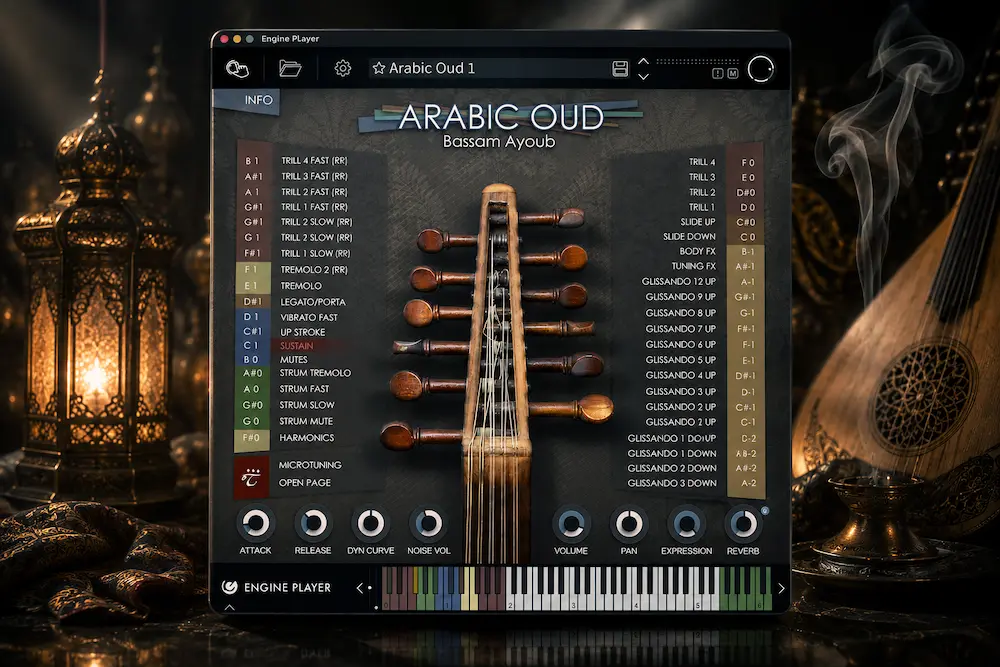
Best Service Arabic Oud is a sampled Arabic oud VST built around three recorded ouds, 39 articulations, multiple velocity layers, up to eight round robins, and integrated maqam microtuning. The 2026 release moves the library to Engine Player, adding VST3, AU, AAX and standalone support alongside native Apple Silicon compatibility.
The important distinction is that Engine Player does not introduce a new recording session. The value of this release is therefore mostly practical: compatibility, current DAW support and a more modern playback environment. In this review, we evaluate its sound, realism, articulation system, MIDI workflow, tuning options, controller requirements, mix behavior, DAW integration, pricing and alternatives—and whether Arabic Oud is still worth buying in 2026.
Best Service Arabic Oud Review: Contents
Best Service Arabic Oud VST: Features, Articulations and Specifications
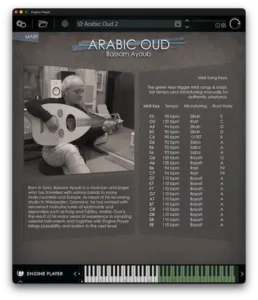
Arabic Oud is a dedicated virtual oud instrument, not a general-purpose ethnic sample collection. The library is centered on three recorded ouds performed by Syrian oud musician Bassam Ayoub, with 39 articulations covering sustained notes, tremolo, slides, glissandos, trills, harmonics, mutes, strumming and other playing techniques.
| Feature | Best Service Arabic Oud |
|---|---|
| Sampled Ouds | 3 |
| Articulations | 39 |
| Round Robins | Up to 8 |
| Velocity Layers | Multiple |
| Microtunings | Bayati, Rast, Saba, Seka |
| Microtuning Variants | Normal and Syriac Church |
| Performance Control | Latch and Hold Keyswitches |
| MIDI Content | Songs and Loops |
| Formats | VST3, AU, AAX, Standalone |
| Apple Silicon | Native support |
| Full / Lite Versions | Yes |
Those specifications tell you what is included, but they do not tell you how much work is required to turn the library into a convincing performance. The real test is how the articulations interact, how quickly a playable part can be programmed, and whether the oud remains convincing once it is placed inside a real arrangement.
Best Service Arabic Oud Engine Player Update: What Changed in 2026?
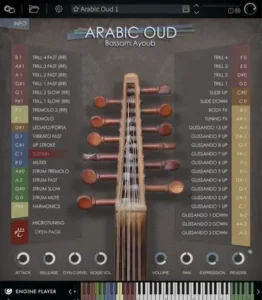 Best Service Arabic Oud started as an Engine-based sample library built around three sampled ouds, 39 articulations, multiple velocity layers and up to eight round robins. The original library was reviewed by Sound On Sound in 2020, which rated it four out of five and praised the quality of the recordings while noting that the large articulation set adds a real programming learning curve.
The 2026 release moves that same core instrument into Engine Player. The current version supports standalone operation, VST3, AU and AAX, with native Apple Silicon support on Mac. Best Service lists Engine Player 1.6.0 or later as a requirement, along with Windows 10 or later or macOS 11 or later and a minimum of 4 GB RAM.
For anyone running a recent Mac or a DAW built around current plugin formats, this is the most meaningful part of the update. Plugin format and platform support determine whether a specialist library remains practical inside modern sessions, particularly on Apple Silicon systems and in DAWs where VST3 or AAX is the preferred format. The migration also gives existing owners a path away from the older Engine environment without replacing the library.
The 2026 release does not advertise a new set of recordings or a redesigned performance system. In practical terms, this is an Engine Player migration of the existing library rather than a new generation of Arabic Oud.
What Did Not Change in Arabic Oud 2026?
The recordings themselves are not the new part of this release. The three sampled ouds, core articulation system, performance vocabulary and maqam-oriented tuning remain the foundation of the library.
That means existing owners should view the update primarily as a platform and compatibility upgrade. New buyers should evaluate Arabic Oud on the quality of the underlying instrument rather than assuming that the 2026 release introduces a substantially different sound.
Arabic Oud Compatibility: VST3, AU, AAX, Apple Silicon and DAWs
The 2026 Engine Player edition is designed for current DAW workflows and supports VST3, AU and AAX, as well as standalone operation. Native Apple Silicon support is particularly relevant for producers working on current Mac systems, where legacy plugin compatibility can become a practical limitation.
The required Engine Player version is 1.6.0 or later. Windows and macOS are supported, while the Lite instruments provide a lower-resource option when the full articulation set is unnecessary.
For existing owners, the upgrade is mainly about keeping the library usable in a current Mac and DAW setup. New buyers should treat these compatibility changes as part of the current product rather than as a reason to expect a different-sounding instrument.
Hear What Your Mix Is Leaving on the Table
A strong instrument and a carefully programmed performance still have to survive the mix. If your track is finished but the balance, depth, punch, or translation still feels uncertain, send us up to 35 seconds of your mix and hear what professional mastering can change. You get a free mastering demo before deciding whether the full master is worth it.
Request your free mastering demo →
Arabic Oud Sound: Authenticity, Articulations and Maqam Tuning
The strongest argument for Best Service Arabic Oud is not the number of samples. It is the specificity of the instrument being sampled and the performance system built around it.
Recorded with Syrian oud player Bassam Ayoub, the library includes three ouds and 39 articulations covering sustained notes, tremolo, slides, glissandos, trills, harmonics, mutes, strumming and other playing techniques. Multiple velocity layers and up to eight round robins help reduce the repeated-note patterns that can make sampled plucked instruments sound mechanical.
In an exposed arrangement, those details become much easier to hear. An oud is not simply a guitar with a different preset. Its attack, resonance, ornamentation and playing technique give it a distinct rhythmic and tonal behavior. A generic plucked-string library can reproduce the broad frequency profile, but it will not necessarily reproduce the phrasing that makes an oud sound like an oud.
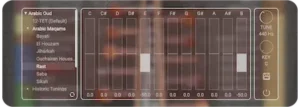
The more important technical feature is the built-in microtuning system. Arabic Oud provides Bayati, Rast, Saba and Seka tunings, with two variations for each and a selectable root note. That allows the instrument to handle maqam-oriented material directly rather than forcing the producer to approximate non-Western pitch relationships with external tuning tools.
For a pop track using a short oud phrase as texture, that level of control may never be used. In film scoring, world music and productions where the oud carries a recognizable melodic role, it can be the difference between an instrument that merely sounds Middle Eastern and one that actually supports the musical language of the arrangement.
Arabic Oud MIDI Workflow: Articulations, Keyswitches and Realism
Arabic Oud’s strongest feature set is also the main challenge when programming oud MIDI: the library gives you enough articulation depth to build a convincing performance, but it does not make the performance decisions for you.
Sound On Sound reached a similar conclusion in its original review. The recordings were strong, but adapting the instrument to a composition requires familiarity with its extensive keyswitch system. That remains relevant because a realistic oud part depends on articulation changes as much as it does on the notes themselves.
A sustained phrase may need to move into tremolo, return to a normal attack, introduce an ornament, change playing technique and finish with a slide or glissando. Those details are what separate a programmed performance from a sequence of notes triggering the same sample repeatedly.
In practice, this makes Arabic Oud closer to an instrument that has to be performed than to a library that can simply be programmed from a piano-roll grid. The difference becomes obvious on exposed melodies, where a technically correct MIDI part can still sound wrong if the articulation changes arrive at the wrong musical moment.
Engine Player’s Latch and Hold keyswitch modes reduce some of that friction. Latch keeps an articulation active until another state is selected, while Hold applies the articulation only while the keyswitch is held. In practice, that makes it easier to maintain a playing technique across a phrase and use another articulation as a temporary gesture.
The distinction matters in a DAW because articulation changes can otherwise turn a simple MIDI part into a second editing task. Latch and Hold do not automate the performance, but they make the articulation system more usable when recording or editing in real time.
There is still no shortcut around performance editing. For an exposed oud line, expect to adjust velocity, timing, articulation changes and occasionally note placement by hand. The library supplies the vocabulary; the producer still has to phrase the part. That distinction is common across expressive sampled instruments: our VG Oboe review, for example, looks at a different performance model where MIDI expression, articulation and controller input are used to reduce some of that manual programming work.
How Realistic Is Best Service Arabic Oud?
Arabic Oud is one of those virtual instruments where realism depends less on raw sample quality than on how the performance is constructed. The underlying recordings are strong, and the combination of velocity variation, round robins and 39 articulations provides enough material to avoid the static behavior associated with simpler oud VST instruments.
The strongest realism comes from the articulation system. Sustains, tremolos, slides, glissandos, trills, harmonics, mutes and strumming allow the producer to reproduce changes in playing technique rather than simply changing notes. That becomes particularly important when the oud is exposed in a solo line or melodic foreground.
There is, however, an important limitation: Arabic Oud does not automatically perform like a real oud player. The library gives the producer the vocabulary of the instrument, but convincing phrasing still depends on articulation choices, velocity, timing and note placement. A badly programmed performance can therefore sound synthetic even when the underlying samples are excellent.
Our assessment is that Arabic Oud is most convincing when treated as a playable performance instrument rather than a preset-based ethnic texture. Its realism is high, but it is earned through programming.
Arabic Oud MIDI Songs and Loops: How Useful Are They?
Engine Player includes MIDI Songs and Loops that demonstrate typical oud phrases and rhythmic patterns. The Full instruments provide 22 Songs and Loops, while the Lite versions include 14.
For production, their real value is speed. They let you audition articulations, hear how the instrument handles characteristic phrases, and establish a usable rhythmic or melodic idea before committing to detailed MIDI programming. A good phrase can also be edited, rearranged, chopped or resampled as source material.
What they do not provide is a production-ready performance on demand. A MIDI phrase that works in isolation can fall apart once it is placed against the actual tempo, meter, harmonic rhythm and arrangement. An oud part also has to respond to the instruments around it rather than simply repeat a preset pattern.
For a professional workflow, treat the included MIDI material as performance reference and raw material. It can save time at the idea stage, but the final part still needs to be shaped around the track.
Using Arabic Oud in Music Production, Film Scoring and Mixing
Arabic Oud is easiest to justify when the oud has a defined musical role rather than being used as a one-off ethnic texture.
In a score, the oud can carry a melody, reinforce another instrument, provide rhythmic punctuation or become a sound-design source after processing. Its recognizable attack and ornamentation can establish a Middle Eastern palette without requiring the composer to build that character from a generic plucked-string patch. Once that material reaches the final soundtrack, however, the mastering stage has a different job: preserving the score’s dynamic movement, spatial depth and sense of scale. Our guide to film score mastering looks at those problems in the finished release rather than at the instrument level.
The microtuning system becomes substantially more important in this context. When the oud carries a melodic role, Bayati, Rast, Saba and Seka tuning options are not just technical extras; they affect how the melody relates to the intended musical language. That makes the instrument more useful for authentic regional writing than a conventional Western-tuned oud patch.
Pop and electronic production are more situational. An oud can work as a hook, intro motif, counterline or contrasting acoustic layer, but its usefulness depends heavily on the arrangement. In dense productions, the instrument’s distinctive midrange and transient detail can become more useful as a texture than as a full-range melodic instrument.
For hip-hop and electronic work, printing the MIDI performance to audio opens up a more interesting workflow. Once rendered, the oud can be chopped, filtered, saturated, reversed, pitched, delayed or layered with synths. At that point, the value is not simply the preset sound; it is the acoustic source material and performance character being fed into the rest of the production chain.
For mixing engineers, Arabic Oud is therefore a source instrument rather than a mix processor. It does not replace EQ, compression, saturation or spatial processing. Its practical advantage is earlier in the chain: a convincing performance and believable acoustic source generally require less corrective work than a generic plucked-string substitute. The same principle applies before mastering: if the oud is already fighting guitars, strings, synths or low-mid buildup, the better solution is usually to fix the mix rather than expect mastering to separate sources that have already been printed together. That is where our guide to preparing a mix for mastering becomes relevant.
For mastering engineers, the direct relevance is minimal. The instrument affects the production and mix upstream; it does not create a distinct mastering workflow or require special treatment at the final stage.
Arabic Oud MIDI Controller Requirements and Performance Limitations
 Arabic Oud’s sound is easier to defend than its performance workflow. The library provides a deep articulation set, but accessing that depth efficiently requires more MIDI preparation than many producers will expect from a virtual instrument. The biggest practical issue is the relationship between the playable range and the keyswitch layout: Arabic Oud is considerably easier to manage on a larger MIDI controller than on a compact 25-, 37- or 49-key keyboard.
Sound On Sound identified the issue in its original review: the articulations add considerable expressive range, but adapting a performance requires familiarity with the keyswitch system. KVR users have likewise praised the underlying samples while being less enthusiastic about the older Engine environment.
The keyboard layout creates another practical constraint. A Sweetwater user specifically reported that a 61-key controller was insufficient to cover the full playable range and articulation controls simultaneously.
The limitation becomes much more obvious during live playing than during studio-based MIDI editing. In a studio session, recording the part and fixing articulation, timing and velocity afterward is a workable approach. For real-time performance on a compact controller, the same layout becomes a genuine limitation.
The Lite instruments reduce the resource footprint and narrow the available articulation set, which can make them more practical for live use. They do not, however, change the underlying keyboard-mapping model. The trade-off remains: Arabic Oud offers substantial expressive control, but getting that control under the fingers takes more setup than a simpler virtual instrument.
Best Oud VST Alternatives: Arabic Oud vs. Turkish Oud and Phrase-Based Libraries
There is no single best oud VST for every production. The main distinction is not sample count; it is the type of instrument and performance the library is designed to reproduce. Best Service focuses on Arabic/Syrian oud, while competing libraries such as Impact Soundworks Turkish Oud and Sonokinetic Oud take different approaches to regional character and MIDI performance.
| Instrument | Primary Strength | Performance Approach | Best Fit |
|---|---|---|---|
| Best Service Arabic Oud | Arabic/Syrian tone, extensive articulations, maqam microtuning | Keyswitch-based articulation control | Arabic music, film scoring, world music |
| Impact Soundworks Plectra Series 4: Turkish Oud | Detailed string sampling, fretting and voicing | Instrument-aware MIDI performance | Turkish oud and detailed solo parts |
| Sonokinetic Oud | Large phrase, improvisation and groove content | Phrase-based performance construction | Film scoring and rapid arrangement |
Impact Soundworks’ Turkish Oud is the more technically elaborate choice if the goal is detailed control over individual strings and fretting behavior. Its library includes 3,860 24-bit recordings, two microphone positions, four dynamic levels, four round robins per key and chromatically sampled strings, along with an intelligent voicing and fretting system. It also provides microtuning and oriental scale support.
But Turkish Oud is exactly that: Turkish oud. The regional distinction matters. Choosing it simply because it has deeper sampling or more elaborate string logic would miss the musical reason to choose an Arabic/Syrian instrument in the first place.
Sonokinetic Oud takes a different approach again. Its library is built around a large collection of articulations, improvisations and tempo-synced grooves, making it particularly useful when the composer needs a convincing performance quickly rather than wanting to program every gesture manually. That approach can be highly efficient for scoring, where a usable phrase may be more valuable than detailed note-by-note control.
Arabic Oud is therefore the strongest choice of these three when the production specifically calls for an Arabic/Syrian oud with integrated maqam-oriented tuning. If the priority is Turkish instrumental character, advanced string-level behavior or rapid phrase construction, one of the alternatives may be a better fit.
Mixing Arabic Oud: EQ, Low-Mid Control and Arrangement
Arabic Oud is not a mastering tool. Its practical impact is upstream, where the quality of the virtual performance and the way the source is shaped determine how easily it fits the arrangement. The same source-first principle applies to other unusual virtual instruments: our Dream Kit Zenith v2 review examines how drum-derived samples can function as basses, textures, impacts and arrangement layers before they ever become a mixing problem.
In isolation, an oud patch can sound detailed and convincing because its attack, string articulation and upper-midrange information are exposed. In a dense mix, those same characteristics can compete with guitars, percussion, strings or synths. The solution is rarely to keep adding processing. Often the better starting point is to decide which part of the oud’s detail actually needs to survive.
Low-mid buildup is an obvious place to watch, particularly when the oud is sharing space with bass instruments, guitars or orchestral low mids. In the upper mids, excessive pick or string noise can make the performance feel harder and more synthetic rather than more realistic. Placement, level and arrangement often solve problems that an EQ boost cannot.
Arabic Oud also provides control over parameters such as attack, release, dynamics, expression, noise and pan, allowing some of that shaping to happen before the instrument reaches the mix bus. That is useful when the source needs to be controlled at the performance stage rather than repaired later with corrective processing.
More samples do not automatically make the part easier to mix. A convincing acoustic source still has to behave correctly inside the arrangement. Once the performance is printed, Arabic Oud requires no special mastering treatment: normal balance, dynamics and loudness decisions apply just as they would to any other acoustic instrument. What does matter is how that finished mix survives normalization, lossy encoding and consumer playback, which is covered in our guide to mastering for streaming platforms.
How We Evaluated Best Service Arabic Oud
Our evaluation focuses on the parts of a virtual instrument that matter after the initial preset audition: performance realism, articulation control, MIDI editing requirements, tonal consistency, arrangement behavior and usefulness inside a finished production.
- Performance: sustained notes, tremolo, slides, glissandos and rhythmic techniques.
- Programming: keyswitch behavior, Latch/Hold modes and MIDI editing requirements.
- Tuning: Bayati, Rast, Saba and Seka microtunings and their practical production value.
- Arrangement: how the oud behaves as a lead instrument, supporting layer and processed source.
- Mix translation: transient detail, low-mid density, upper-mid presence and how easily the instrument fits around guitars, percussion, strings and synths.
- Workflow: compatibility, controller requirements and the practical value of the Engine Player migration.
Arabic Oud Pricing: When $89 Makes Sense — and When $129 Doesn’t
Best Service lists Arabic Oud at $129, with the Engine Player edition currently discounted to $89 through August 28, 2026. Owners of Arabic E-Oud or Qanun can also access a $49 crossgrade during the introductory promotion.
At $89, the library is reasonably priced for a composer or producer who regularly needs an Arabic oud. The cost is easier to justify because the instrument fills a specific production role that a generic plucked-string library does not necessarily cover.
At $129, the purchase requires a more deliberate use case. Competing oud libraries offer different combinations of sampling depth, articulation control and performance-oriented MIDI workflows, so Arabic Oud is competing for a place in an already specialized sample collection.
If Arabic music, film scoring or Middle Eastern-influenced production is part of your regular work, the price is defensible. If you only want an occasional “ethnic” texture, a broader orchestral or world-instrument library will usually deliver better value per dollar.
Who Should Buy Best Service Arabic Oud?
Arabic Oud makes the most sense for producers whose projects regularly require an authentic Arabic or Syrian oud. It is a specialist instrument, so the buying decision should be based on the type of work you do rather than the size of the feature list.
- Film and game composers: One of the strongest use cases. The combination of regional character, extensive articulations and maqam-oriented microtuning is directly relevant to scoring.
- World-music producers: Strong fit when the oud is part of the musical language rather than simply a tonal accent.
- Pop and electronic producers: Worth considering when the oud has a defined role as a melodic element, hook, counterline or processed source.
- Professional and serious home studios: A worthwhile specialist addition if Arabic, cinematic or Middle Eastern-influenced projects occur regularly.
- Mixing engineers: Limited direct benefit unless production and arrangement are also part of the service. The instrument is a source tool, not a mix processor.
- Mastering engineers: Little direct value. It does not materially change the mastering workflow.
- Beatmakers: Situational. It can provide distinctive melodic source material, but it is too specialized to justify the purchase solely as a general-purpose production instrument.
- Live performers: More conditional. The Lite versions are better suited to lower-resource setups, but the articulation layout and dependence on MIDI keyswitches make a larger controller more practical for full performance work.
Who Should Not Buy Best Service Arabic Oud?
Arabic Oud is a specialist instrument, and that specialization is also its biggest limitation. If you rarely work with Arabic, Middle Eastern or cinematic material, the library may spend most of its time unused.
- Do not buy it for occasional ethnic textures: a broader world-instrument collection will usually provide better value.
- Do not buy it primarily for compact-keyboard live performance: the combination of playable range and keyswitches is better suited to a larger controller or studio-based MIDI editing.
- Do not buy it expecting a revolutionary 2026 sound engine: Engine Player modernizes the platform, but the underlying sampled instrument remains the core of the product.
- Do not buy it as a replacement for a real oud player: the library can produce convincing performances, but expressive phrasing still depends on the producer.
If your projects regularly require an authentic Arabic or Syrian oud, the calculation changes. In that case, the combination of regional character, articulation depth and integrated maqam tuning makes Arabic Oud much easier to justify.
Best Service Arabic Oud: Strengths and Trade-Offs
Pros
- Authentic Arabic/Syrian character: The library is built around a specific regional instrument rather than a generic plucked-string approximation.
- Strong articulation coverage: 39 articulations provide enough performance detail for exposed melodic and rhythmic parts.
- Natural variation: Multiple velocity layers and up to eight round robins help reduce repetitive MIDI behavior.
- Maqam-oriented microtuning: Bayati, Rast, Saba and Seka tuning options add value when the melodic language requires more than Western equal temperament.
- Modern plugin support: VST3, AU and AAX make the Engine Player edition easier to integrate into current DAW setups.
- Apple Silicon support: Native compatibility keeps the library relevant on current Mac systems.
- Full and Lite instruments: Users can choose between the complete articulation set and a lighter version for more constrained systems or live work.
- Free migration for existing owners: Current Arabic Oud owners can move to Engine Player without purchasing the library again.
Cons
- Limited technological change: The 2026 release is a platform migration rather than a new sampling or synthesis generation.
- Programming overhead: The extensive articulation system requires deliberate MIDI editing to produce convincing exposed performances.
- Controller limitations: Frequent keyswitch use is less convenient on compact MIDI keyboards.
- Specialized use case: Producers who rarely need Arabic or Middle Eastern material may not get enough use from a dedicated oud library.
Best Service Arabic Oud Rating
| Category | Rating |
|---|---|
| Sound Quality | 9/10 |
| Arabic/Oud Authenticity | 9.5/10 |
| Articulation & Expression | 9.2/10 |
| MIDI Workflow | 8/10 |
| Mix & Arrangement Utility | 8.7/10 |
| Platform & DAW Integration | 9/10 |
| Value for Money | 8.5/10 |
| Overall | 8.8/10 |
Sound Quality — 9/10: The underlying oud recordings remain the strongest part of the instrument. Three sampled ouds, multiple velocity layers and up to eight round robins provide enough variation for convincing melodic and rhythmic parts, although the 2026 Engine Player release does not introduce a new sampling generation.
Arabic/Oud Authenticity — 9.5/10: This is where Arabic Oud earns its highest score. The Syrian oud character, extensive playing techniques and integrated Bayati, Rast, Saba and Seka tuning options give it a level of regional specificity that a generic plucked-string library cannot easily reproduce.
Articulation & Expression — 9.2/10: The 39 articulations cover a broad range of playing behavior, including tremolo, slides, glissandos, trills, harmonics, mutes and strumming. The system provides enough expressive vocabulary for exposed performances, with the limitation being how much of that control the producer is willing to program.
MIDI Workflow — 8/10: Latch and Hold modes improve the keyswitch workflow, but they do not eliminate the editing burden. Realistic exposed parts still require attention to articulation, velocity, timing and note placement, and the controller layout can become restrictive on smaller MIDI keyboards.
Mix & Arrangement Utility — 8.7/10: Arabic Oud works particularly well when its distinctive acoustic character has a defined role in the arrangement. Its attack and upper-mid detail can provide useful presence, but dense productions may require careful placement and low-mid management rather than additional processing.
Platform & DAW Integration — 9/10: The move to Engine Player is a meaningful practical improvement. VST3, AU, AAX, standalone operation and native Apple Silicon support make the library considerably easier to maintain in a current production environment. The score reflects compatibility and workflow longevity, not a claimed increase in processing performance.
Value for Money — 8.5/10: At the $89 introductory price, Arabic Oud is easy to justify for producers and composers who regularly need an Arabic/Syrian oud. The $129 regular price is still defensible for a specialist instrument, but much harder to justify if the library will only be used for occasional ethnic textures.
Independent engineering assessment: Arabic Oud scores highly because it solves a specific production problem unusually well: providing a convincing Arabic/Syrian oud with detailed articulation control and maqam-oriented tuning. Its main weakness is not the sound but the amount of performance editing required to extract that quality. The 2026 Engine Player migration also improves compatibility without fundamentally changing the instrument itself.
Verdict: A Strong Specialist Oud, Not a Breakthrough Instrument
 Best Service Arabic Oud earns its place when the production specifically calls for an Arabic or Syrian oud. Its value comes from the underlying recordings, broad articulation set and integrated maqam-oriented tuning—not from any major technological change in the 2026 Engine Player release.
The Engine Player migration is still useful. VST3, AAX and native Apple Silicon support bring an established library into a more current plugin environment, making the update particularly relevant for existing owners running modern Mac and DAW setups.
What it does not do is turn Arabic Oud into a general-purpose instrument. It remains a specialist library, and convincing performances still require more MIDI programming than a phrase-based or simplified virtual instrument.
There are also credible alternatives. Impact Soundworks’ Turkish Oud offers deeper instrument-level control for producers who need a Turkish instrument, while Sonokinetic takes a more phrase-driven approach that can be faster for scoring workflows.
The buying decision is straightforward: choose Arabic Oud when you specifically need an Arabic/Syrian oud, not when you simply want another plucked-string instrument. If you regularly write Arabic, Middle Eastern or cinematic material that calls for an authentic oud, Arabic Oud is a solid professional choice. If you simply want an occasional ethnic texture, a broader sample library will give you more utility for the same budget.
Bottom line: Existing owners should take the Engine Player migration. New buyers should consider Arabic Oud when they have a defined Arabic/Syrian oud use case—not because the 2026 release represents a major leap in virtual-instrument technology.
Hear How Your Finished Mix Translates Outside the Studio
A convincing virtual instrument is only one part of the production. Once Arabic Oud is competing with vocals, percussion, guitars, strings or synths, the final mix still has to preserve balance, depth and dynamics across real playback systems.
If you want an independent mastering perspective on your finished mix, send us up to 35 seconds and receive a free mastering demo prepared by a professional mastering engineer.
Get your free mastering demo →
Best Service Arabic Oud FAQ: VST, Sound, Workflow and Buying Advice
Is Best Service Arabic Oud a new virtual instrument in 2026?
No. The 2026 release is primarily a migration of the existing Arabic Oud library to Engine Player. The core sampled instrument and its performance architecture remain largely unchanged.
Does Best Service Arabic Oud support VST3, AU and AAX?
Yes. The Engine Player edition supports VST3, AU and AAX, as well as standalone operation. That makes it substantially easier to integrate into current DAW setups than an older Engine-only installation.
Is Arabic Oud compatible with Apple Silicon Macs?
Yes. The current Engine Player version supports native Apple Silicon Macs, making it suitable for current Apple-based production systems.
How much RAM does Arabic Oud need?
Best Service specifies 4 GB of RAM as the minimum for Engine Player. The Lite instruments are intended for setups where a lower resource footprint is preferable.
Is Best Service Arabic Oud useful for mixing engineers?
Only when the engineer also handles production or arrangement. Arabic Oud is a sound-source instrument, not a mixing processor. Its relevance to mixing is the quality and editability of the performance before it reaches the processing chain.
Does Arabic Oud have any direct value for mastering engineers?
Very little. It does not introduce a mastering-specific workflow or processing capability. Its value is entirely upstream in composition, production and mixing.
Should I choose Arabic Oud or Impact Soundworks Turkish Oud?
Choose Arabic Oud for Arabic/Syrian character and maqam-oriented tuning. Choose Impact Soundworks Turkish Oud when Turkish oud performance and detailed string-level control are the priority.
Is Arabic Oud a good choice for film scoring?
Yes. Film scoring is one of its strongest applications, particularly when the cue needs a recognizable Arabic or Middle Eastern instrumental identity. The combination of articulations and integrated microtuning is useful for exposed melodic and rhythmic parts.
How much MIDI editing does Arabic Oud require?
Expect little editing for simple accompaniment, but exposed melodies usually need manual articulation, velocity and timing work. The library provides the performance vocabulary; the producer still has to shape the phrasing.
Is Best Service Arabic Oud worth $129 at the regular price?
At the regular $129 price, Arabic Oud is reasonable value for producers and composers who regularly need an Arabic/Syrian oud. The current $89 introductory price makes the decision easier, but the discount is scheduled to end August 28, 2026.
Should existing Arabic Oud owners move to Engine Player?
Yes. Existing owners can migrate to the Engine Player version without purchasing the library again, gaining access to the current plugin environment and native Apple Silicon support.

Yurii Ariefiev evaluates virtual instruments from the perspective of real production workflow—with particular attention to sampled-instrument realism, MIDI articulation, performance control, tuning systems, and how efficiently a virtual instrument translates into a finished arrangement and mix. His reviews focus on what the instrument actually enables in production rather than simply listing features.
At AREFYEV STUDIO, plugin evaluation continues beyond the instrument itself. Performance quality, arrangement decisions, mix translation, and mastering are treated as connected stages of the same production process. For specialist instruments such as Arabic Oud, the quality of the programmed performance can matter as much as the samples themselves.
☕ Buy me a coffee