Drum fills are often where programmed drums stop sounding like a performance and start sounding like a production. A groove can feel convincing for an entire verse, yet a single transition can expose rigid MIDI programming, recycled sample-pack material, or AI-generated phrasing that lacks the instincts of a real player. For many producers, the fill remains the hardest part of making virtual drums feel human.
Yurt Rock’s Dr. Fill is built around that specific problem. Rather than offering another drum instrument, MIDI generator, or AI composition engine, it provides direct access to recorded drummer performances designed to drop into an arrangement with minimal editing. The concept is simple: spend less time constructing transitions and more time finishing records.
That raises a more important question than the feature list itself. In a production landscape already crowded with drum software, does faster access to authentic fills solve a meaningful workflow bottleneck, or is Dr. Fill simply repackaging content producers already own in other forms?
Quick Verdict
- Best for: Rock, Pop, Indie and Hybrid Producers
- Price: $49
- Strength: Realistic drum transitions
- Weakness: Limited by available library content
- Overall Rating: 8.9/10
In This Review
The Drum Fill Bottleneck Most Production Tools Still Haven’t Solved
 Modern producers have access to more production tools than at any point in recording history. Producers can build arrangements, generate drum patterns, separate stems, and develop ideas in minutes using modern software. Yet one part of the workflow remains stubbornly resistant to automation: the transition between sections.
Building a convincing groove is no longer difficult. Building a convincing fill still is.
The problem isn’t technical complexity. It’s musical context. A fill has to connect two sections while preserving momentum, reinforcing dynamics, and maintaining the feel established by the groove. That combination is difficult to achieve with static MIDI patterns, recycled sample-pack content, or algorithmically generated performances.
Most producers end up choosing between speed and realism. Programming fills manually offers maximum control but quickly becomes time-consuming once velocity shaping, ghost notes, cymbal articulation, and micro-timing adjustments enter the equation. MIDI libraries accelerate the process but often introduce familiar patterns that experienced listeners recognize immediately. AI-generated drums can produce usable ideas, yet transitions remain one of the areas where machine-generated performances most frequently reveal their limitations.
Many of the same transition issues also appear in machine-generated performances, a problem discussed in our guide on how to fix AI drums.
This is why otherwise polished productions often stumble during section changes. The groove feels coherent, but the fill sounds disconnected from the drummer who supposedly played it.
Mix engineers encounter the consequences regularly. Unrealistic snare accents, abrupt velocity jumps, unnatural cymbal movement, and fills that push energy in the wrong direction are rarely mix problems. They are arrangement problems. Processing can reduce the symptoms, but it rarely fixes the underlying issue.
That reality helps explain why realistic fills remain valuable despite the rapid growth of AI-assisted production tools. The challenge is no longer generating drum parts. It’s generating transitions that behave like a musician rather than a sequence editor.
Great Masters Start With Better Production Decisions
Realistic performances, stronger transitions, and cleaner arrangements make every stage of production easier. But even a well-produced mix can lose punch, depth, and translation before release. Upload up to 35 seconds of your track and receive a free mastering demo to hear how professional mastering can enhance clarity, balance, impact, and streaming readiness.
Request your free mastering demo →
What Is Dr. Fill and How Does It Work?
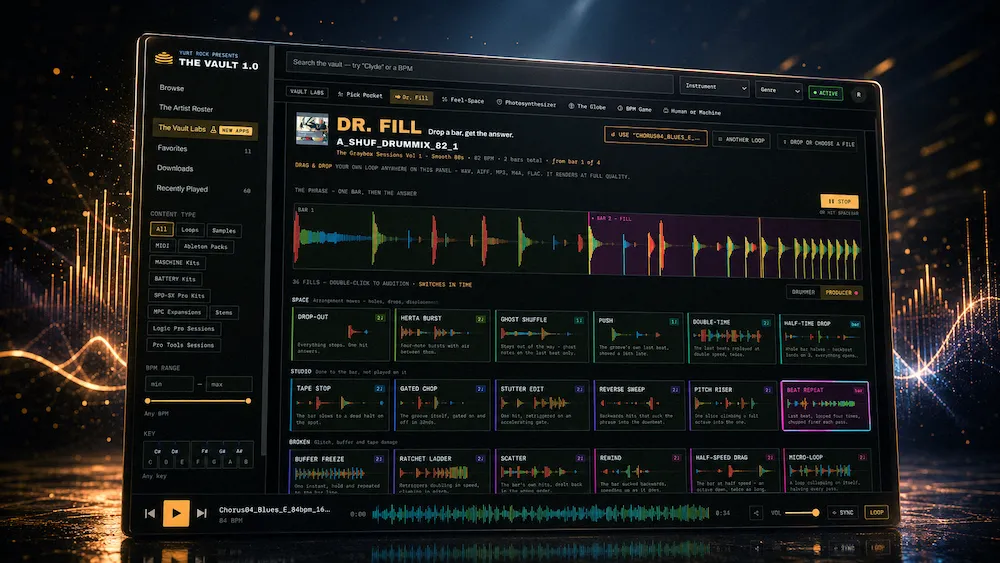
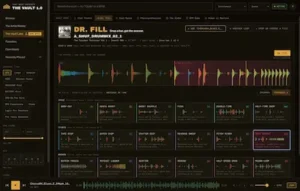
Dr. Fill is a drum-fill performance browser developed by Yurt Rock. Instead of generating drum parts through AI or virtual instruments, the software provides access to recorded drummer performances that can be auditioned, searched, and dragged directly into a DAW as audio or MIDI.
The plugin is designed to solve one specific production problem: creating realistic transitions between song sections without manually programming fills or searching through large MIDI libraries.
Unlike traditional MIDI drum fill packs, Dr. Fill combines a searchable drum fill library with performances recorded by real drummers. This approach allows producers to find realistic drum fills faster while preserving the feel and timing characteristics often lost in heavily edited MIDI programming.
Dr. Fill Features Explained
- Real drummer performances
- Audio and MIDI export
- Tempo-synced auditioning
- Fast fill search workflow
- Genre-based organization
- DAW integration
- Drag-and-drop operation
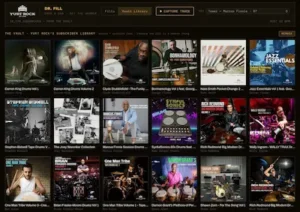
- Searchable drum fill library with real drummer performances
Why Dr. Fill Improves Drum Fill Workflow
Many producers will misunderstand Dr. Fill if they evaluate it as a drum instrument. It isn’t competing with Superior Drummer 3, EZdrummer 3, BFD, Addictive Drums, or any other platform responsible for generating complete drum performances. It occupies a much narrower space.
Dr. Fill is essentially a performance browser built around recorded drummer fills. The software allows users to audition real performances in sync with a session, then drag audio or MIDI directly into an arrangement.
The question is whether simplicity solves a meaningful production problem.
In many studios, the answer is yes. Producers routinely spend more time finding an appropriate fill than creating the section that surrounds it. A transition that lasts one or two bars can trigger fifteen minutes of auditioning MIDI files, adjusting timing, replacing articulations, editing velocities, and trying to make a programmed performance feel connected to the groove.
Dr. Fill attacks that inefficiency directly. Instead of offering deeper editing, additional processing, or more sound design options, it reduces the number of decisions between identifying a weak transition and replacing it with a usable performance.
That distinction is important because the plugin’s value has little to do with audio technology. There is no breakthrough DSP, no advanced modeling engine, and no AI-assisted performance generation. The workflow centers on organizing real drummer performances into a system that allows faster musical decisions.
From a production standpoint, that may be more valuable than adding another layer of complexity. Most workflow bottlenecks in modern DAWs are not caused by a lack of options. They are caused by too many options. Searching through hundreds of folders, MIDI packs, and sample libraries often consumes more time than the actual arrangement work.
From a workflow perspective, Dr. Fill is less a creative tool and more a decision-acceleration tool. Whether it earns a permanent place in a producer’s workflow depends largely on how often drum fills become a source of friction during a project.
Is Dr. Fill Worth It for Music Producers?
One of the most common mistakes in audio production is assuming that every new tool needs to improve sound quality to justify its existence. In practice, many of the most useful tools improve efficiency rather than audio fidelity. Dr. Fill belongs firmly in that category.
It will not make a mix wider, cleaner, louder, or more detailed. It will not improve mastering translation. It will not rescue a poorly arranged song. Producers expecting a dramatic sonic upgrade are likely to be disappointed.
Its value appears earlier in the production chain.
When a transition feels weak, the solution is rarely another plugin on the mix bus. More often, the problem originates in the performance itself. A fill that lacks momentum, dynamics, or musical intent can make an otherwise solid arrangement feel mechanical. Replacing that fill with a convincing performance often produces a greater improvement than additional processing later in the workflow.
This is particularly relevant in rock, pop, indie, country, and hybrid productions where listeners subconsciously expect drummer behavior, even when much of the track is programmed. Human fills introduce timing fluctuations, dynamic movement, and articulation choices that are difficult to recreate convincingly through editing alone.
For songwriters and producers, the biggest advantage may be creative momentum. Stopping a session to build or repair a transition can interrupt decision-making at exactly the wrong moment. A faster path from idea to arrangement often has more value than another layer of editing control.
Mix engineers benefit differently. Well-played fills generally arrive with more coherent dynamics, more believable cymbal movement, and stronger relationships between accents and groove. Those characteristics reduce the amount of corrective work needed to make transitions feel natural within a mix.
That doesn’t guarantee a better mix. It creates better source material. In professional production, those are not the same thing, but the second usually has a greater impact on the final result. Many of the issues engineers later blame on processing decisions actually begin much earlier in the arrangement stage, a reality explored in our guide to common mastering problems.
Real Drummers Don’t Automatically Fix Bad Production Decisions
 Much of Dr. Fill’s marketing revolves around a simple idea: real drummer performances are more convincing than AI-generated or heavily programmed alternatives. In broad terms, that’s difficult to argue against. Human players naturally create timing, dynamics, and phrasing relationships that remain challenging for algorithmic systems to reproduce consistently.
The problem is that realism and suitability are not the same thing.
A professionally performed fill can still feel out of place if it pushes the arrangement in the wrong direction, introduces a different energy level, or conflicts with the established groove. The fact that a drummer played it does not guarantee that it belongs in the song.
This is where the marketing message risks oversimplifying the problem. The weakest transitions in modern productions are not always caused by artificial performances. They are often caused by poor musical choices. Replacing a programmed fill with a real one may improve the feel, but it does not replace arrangement judgment.
Experienced producers understand that the most effective fills often go unnoticed. Their job is not to draw attention to themselves. Their job is to connect sections, reinforce momentum, and support the song’s structure. Selecting the right performance remains more important than selecting the most realistic one.
There is also a practical limitation that deserves attention. Dr. Fill’s long-term usefulness depends almost entirely on the depth and variety of its content library. Unlike generative systems that can create virtually unlimited variations, a performance-based platform is constrained by the material it contains. As users become familiar with the available fills, library expansion becomes increasingly important.
That does not diminish the value of the concept. It simply places the product in its proper context. Dr. Fill is not a replacement for creative decision-making. It is a tool that provides faster access to better raw material, leaving the final musical judgment exactly where it has always belonged: with the producer.
Dr. Fill vs EZdrummer 3, Superior Drummer 3 and MIDI Libraries
Comparing Dr. Fill directly to products such as EZdrummer 3, Superior Drummer 3, Addictive Drums 2, or BFD can be misleading. Those platforms are designed to build complete drum performances from the ground up. Dr. Fill addresses a far narrower problem: finding a believable transition without interrupting the creative process.
That distinction places the product in an unusual category. Its real competitors are not necessarily drum instruments. They are the existing workflows producers use to solve the same problem.
| Solution | Primary Advantage | Main Limitation | Best Fit |
|---|---|---|---|
| Dr. Fill | Fast access to recorded drummer fills | Dependent on library depth | Producers prioritizing speed |
| EZdrummer 3 | Integrated songwriting workflow | Requires more editing and navigation | Songwriters and producers |
| Superior Drummer 3 | Maximum control and realism | Greater complexity and setup time | Professional drum production |
| Addictive Drums 2 | Fast virtual drum workflow | Not focused specifically on fills | Home and project studios |
| MIDI Groove Libraries | Large pattern selection | Often require extensive humanization | MIDI-centric workflows |
| AI Drum Generators | Unlimited variation | Inconsistent transition quality | Experimental production |
Viewed from that perspective, Dr. Fill is not trying to replace a drum production platform. Most potential users already own one. The producer considering Dr. Fill is often the same producer who already has access to Superior Drummer, EZdrummer, Addictive Drums, multiple MIDI libraries, and years of accumulated drum content.
The purchase decision therefore comes down to efficiency rather than capability. Can the plugin reduce the time spent searching, editing, and second-guessing transition choices?
For producers who rarely struggle with fills, the answer may be no. Existing tools already provide more than enough material. For producers who repeatedly lose momentum while hunting for realistic transitions, the equation changes. In that scenario, Dr. Fill functions less like another drum plugin and more like a specialized productivity tool.
That positioning is both its biggest strength and its biggest limitation. The plugin solves a specific problem exceptionally well, but its value becomes much harder to justify if that problem does not exist in your workflow.
Dr. Fill vs EZdrummer 3
While EZdrummer 3 offers a complete songwriting and drum-production environment, Dr. Fill focuses specifically on transitions. Producers looking for drum creation tools may prefer EZdrummer 3, while those seeking faster access to realistic fills may find Dr. Fill more efficient for that specific task.
Dr. Fill vs Superior Drummer 3
Superior Drummer 3 delivers deeper control, larger libraries, and advanced editing capabilities. Dr. Fill sacrifices flexibility in exchange for speed and simplicity.
Dr. Fill Pros and Cons
| Pros | Cons |
|---|---|
| Extremely fast workflow | Limited by library content |
| Real drummer feel | Not a complete drum production system |
| MIDI and audio support | Less flexible than generative tools |
| Affordable pricing | Requires future library expansion |
Why Better Drum Fills Matter Long After the Production Stage
 Drum fills are usually evaluated as an arrangement tool, but their influence extends well beyond composition. A weak transition can affect how a listener perceives the entire production, even when the mix itself is technically solid.
Most listeners won’t identify a fill as the source of the problem. Instead, they hear a moment where the track briefly loses momentum, energy, or credibility. The groove feels connected, then the transition arrives and exposes the mechanical nature of the performance. Once that illusion breaks, the production often feels smaller and less polished.
This has implications for mixing as well. Fills frequently contain the highest concentration of transient activity in a song, combining snare accents, tom movement, cymbal hits, and rapid dynamic changes within a short space. When those elements are poorly programmed, engineers often spend unnecessary time controlling peaks, balancing cymbal energy, or managing transitions that fight against the groove.
Well-performed fills tend to create fewer of those problems. Dynamics behave more naturally, accents feel intentional, and the movement between sections requires less corrective processing. The benefit is not necessarily a better mix, but a mix that comes together with fewer compromises.
When drum dynamics are already behaving naturally, mix engineers can focus on enhancement rather than repair. Tools designed for musical dynamic control, such as those discussed in our Pulsar Modular P252 MDN Diode review, generally deliver better results when they are shaping a strong performance rather than compensating for weak programming decisions.
The effect can remain audible after distribution. Streaming platforms have largely eliminated loudness as a competitive advantage through normalization, placing greater emphasis on arrangement quality, performance realism, and overall production decisions. When every release is pushed toward a similar playback level, details that contribute to musical believability become easier to notice. This is one reason why modern mastering for streaming platforms increasingly depends on strong source material rather than loudness alone.
Dr. Fill does not directly improve translation, codec performance, loudness, or mastering outcomes. What it can improve is the quality of the source material feeding those stages. In professional production, that distinction is significant. Better decisions upstream often deliver greater results than additional processing downstream.
From a technical standpoint, system performance is unlikely to be a deciding factor. Dr. Fill functions primarily as a content and auditioning platform rather than a processor, so CPU demands should remain negligible compared to modern virtual instruments, neural processing tools, or complex mixing chains.
The more relevant metric is workflow efficiency. If the plugin consistently reduces the time spent searching for, editing, and replacing weak transitions, its value becomes easier to justify than any benchmark number.
Who Should Buy Dr. Fill?
| User Type | Recommendation |
|---|---|
| Rock Producers | Highly Recommended |
| Pop Producers | Highly Recommended |
| Songwriters | Recommended |
| Mix Engineers | Situational |
| Electronic Producers | Depends on workflow |
| Drummers | Situational |
Final Verdict: A Workflow Tool, Not a Drum Production Revolution
Dr. Fill is easy to underestimate because it arrives in a market obsessed with bigger claims. There is no new drum engine, no generative AI system, no breakthrough DSP architecture, and no attempt to compete with full-scale drum production platforms.
Judged as a technology release, it feels relatively modest. Judged as a workflow tool, it becomes much more compelling.
The plugin addresses a specific production problem that many producers encounter repeatedly: finding a transition that sounds like it belongs to the song without spending excessive time editing MIDI, browsing libraries, or forcing programmed fills to behave like a real performance. Its value comes from reducing friction rather than expanding creative possibilities.
That focus also defines its limitations. Dr. Fill will not replace Superior Drummer, EZdrummer, Addictive Drums, or a skilled drummer. It does not remove the need for arrangement judgment, and it cannot compensate for weak musical decisions. The quality of the outcome still depends on selecting the right performance for the track.
Long-term success will depend less on software development and more on content. The depth of the library, the variety of playing styles, and the pace of future expansion will ultimately determine whether the platform remains useful after the initial novelty wears off.
For producers who regularly work with rock, pop, indie, country, and hybrid productions, Dr. Fill solves a real workflow bottleneck. For users expecting a comprehensive drum creation environment, the product may feel narrower than its marketing initially suggests.
The strongest argument in its favor is also the simplest: it saves time in an area where many producers routinely waste it. That may not be a revolutionary achievement, but in a professional studio environment, practical efficiency often delivers more value than another headline feature.
Overall Rating
| Category | Rating |
|---|---|
| Performance Realism | 9.5/10 |
| Workflow Efficiency | 9.5/10 |
| Content Quality | 9/10 |
| Creative Flexibility | 7.5/10 |
| Long-Term Value | 8/10 |
| Value for Money | 9/10 |
| Overall | 8.9/10 |
Dr. Fill is not a revolutionary drum production platform, nor is it trying to be. Its strength lies in solving a narrow but persistent workflow problem: creating realistic drum transitions without spending excessive time editing MIDI or searching through large content libraries. For producers who regularly struggle with fills, the time savings alone can justify the investment.
Performance Realism — 9.5/10
The strongest aspect of the product. Real drummer performances provide timing variation, dynamics, articulation changes, and musical phrasing that remain difficult to reproduce consistently with programmed or AI-generated alternatives.
Workflow Efficiency — 9.5/10
Dr. Fill’s biggest achievement is reducing friction. The software dramatically shortens the path between identifying a weak transition and replacing it with a usable performance, allowing producers to maintain creative momentum.
Content Quality — 9/10
The concept depends entirely on the quality of the recorded performances, and the available material appears professionally executed. The fills generally feel musical rather than generic, which is critical for a tool built around performance content.
Creative Flexibility — 7.5/10
This is not a generative instrument or an open-ended composition environment. Users gain realism and speed, but remain limited by the performances included in the library. Producers seeking unlimited variation may prefer more programmable solutions.
Long-Term Value — 8/10
Future usefulness depends heavily on library expansion. Unlike AI systems or MIDI construction tools, the platform’s value grows primarily through additional content. Continued updates will play a major role in maintaining relevance.
Value for Money — 9/10
At $49, the cost is relatively low compared to the amount of studio time that can be recovered. For producers who repeatedly spend time searching for realistic fills, the return on investment can be immediate.
A Great Arrangement Deserves a Professional Final Master
Tools like Dr. Fill can help create more natural performances, stronger transitions, and a more convincing arrangement. But when the mix is finished, the final challenge remains the same: making the song translate consistently across streaming platforms, headphones, cars, home speakers, and professional playback systems.
Before releasing your track, hear what an experienced mastering engineer can bring to the final stage. Upload up to 35 seconds of your mix and receive a free mastering demo. Compare your original mix against a professionally mastered version and decide based on the result—not the promise.
Get your free demo →
FAQ
Does Dr. Fill save more time than traditional MIDI drum fill libraries?
For many producers, yes. Traditional MIDI libraries often require auditioning multiple patterns, adjusting velocities, editing articulations, and matching the feel of the existing groove. Dr. Fill reduces much of that process by providing ready-to-use performances that can be evaluated in musical context much faster.
Who is the ideal user for Dr. Fill?
The strongest fit is producers working with rock, pop, indie, country, singer-songwriter, and hybrid productions where realistic drummer behavior matters. Producers building tracks entirely around electronic or programmed aesthetics may see less benefit.
Can Dr. Fill replace EZdrummer 3, Superior Drummer 3, or Addictive Drums 2?
No. Those platforms are complete drum production environments. Dr. Fill addresses a specific workflow stage: finding and deploying convincing fills quickly. Most users will treat it as a complement rather than a replacement.
Does Dr. Fill generate unique fills using AI?
No. The plugin is built around recorded drummer performances rather than generative AI technology. What you gain in realism comes from actual players, not algorithmic variation.
How useful is Dr. Fill in professional mixing workflows?
Its impact is indirect. Mix engineers rarely need another fill-generation tool, but they routinely benefit from receiving productions with stronger transitions, more coherent dynamics, and fewer arrangement issues.
Is MIDI export a significant feature or just a convenience?
For many users, it is one of the most practical features. MIDI export allows producers to keep the performance feel while assigning the part to existing drum instruments, custom sample libraries, or hybrid acoustic-electronic setups.
Are there free alternatives that accomplish the same thing?
Free MIDI groove collections exist, but they typically require more editing and organization. The real comparison is not cost alone, but the amount of time required to reach a convincing result.
Will Dr. Fill become less useful if I already own large drum libraries?
Possibly. Producers who already have highly organized workflows and extensive collections of fills may find some overlap. The plugin delivers the most value when speed and convenience are recurring bottlenecks.
Does Dr. Fill improve the final mastering result?
Not directly. However, more natural transitions can improve arrangement flow and reduce performance-related issues before a mix reaches the mastering stage. Better source material generally leads to fewer compromises later in production, particularly for independent artists working in untreated rooms and DIY environments often discussed in mastering for bedroom producers.
Can Dr. Fill export MIDI drum fills?
Yes. Producers can drag MIDI drum fills directly into compatible drum instruments and modify sounds while preserving the original performance feel.
Is Dr. Fill worth $49 for professional studios?
The answer depends entirely on workflow. If engineers and producers regularly spend time searching for realistic fills, the cost is relatively minor compared to the value of recovered studio hours. If fills are already handled efficiently, the return on investment becomes less obvious.

Yurii Ariefiev evaluates drum production software from the perspective of performance realism, workflow efficiency, and arrangement quality. His analysis focuses on how drum fills, groove transitions, timing variation, and drummer phrasing influence the overall musical credibility of a production.
At AREFYEV STUDIO, tools such as Dr. Fill are assessed not by marketing claims but by their ability to reduce editing time, improve drum performance realism, and create more natural transitions between song sections. Stronger source material at the production stage often leads to better mixing and mastering results later in the workflow.
☕ Buy me a coffee