The compressor plugin market has reached a point where most new releases revisit the same handful of circuits. SSL bus compressors, 1176 variants, optical designs, and Vari-Mu emulations dominate mixing workflows, often differing more in implementation than in concept. Finding a compressor that introduces a genuinely different dynamic response has become increasingly rare.
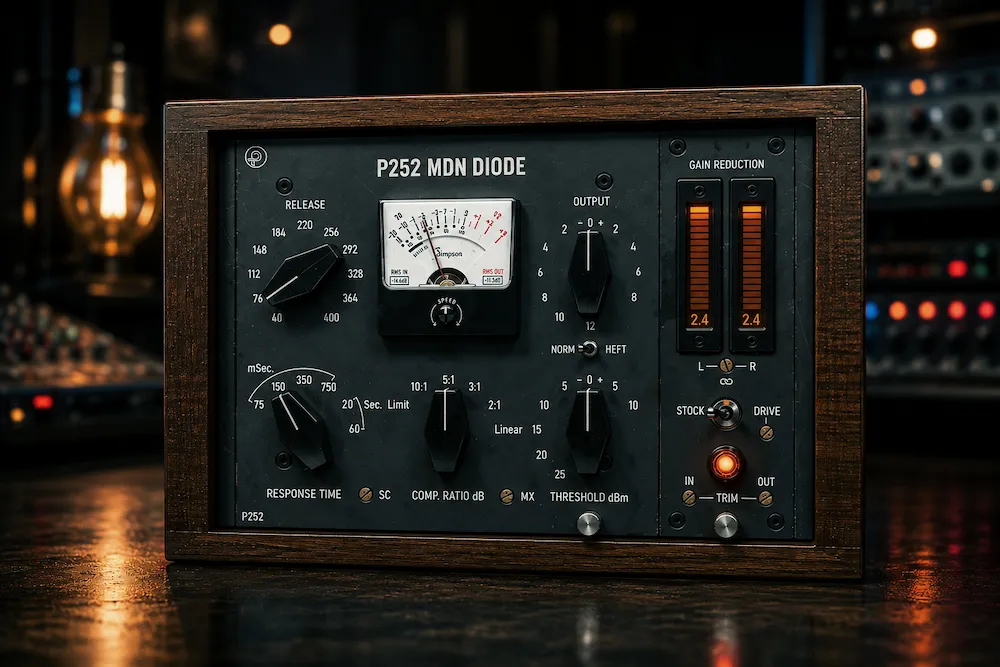
That is what makes the Pulsar Modular P252 MDN Diode noteworthy. Unlike many modern analog compressor plugin releases, it recreates the rare Neve 2252 compressor, a germanium diode bridge design that occupies a unique place in compression history.
For mixing and mastering engineers, the value of the P252 MDN Diode is not tied to the rarity of the hardware itself. The more relevant question is whether this design offers a meaningful alternative to the familiar compression archetypes that already dominate modern audio production. That distinction ultimately determines whether the plugin becomes a useful production tool or simply another analog emulation competing for attention in an already crowded category.
Quick Verdict:The Pulsar Modular P252 MDN Diode is one of the most distinctive compressor releases of the year. It excels on drum buses, guitars, and parallel processing thanks to its diode-bridge compression behavior and harmonic density. Engineers seeking transparent mastering compression should look elsewhere, but users wanting character and movement will find a genuinely different alternative to SSL, API, and VCA-style designs.
In This Review
Pros and Cons
| Pros | Cons |
|---|---|
| Unique diode-bridge compression character | Not suitable for transparent mastering tasks |
| Excellent drum bus and parallel compression performance | Less versatile than SSL or API-style compressors |
| Rich harmonic density without excessive harshness | Can become congested in already saturated mixes |
| Distinctive alternative to common compressor models | Requires careful listening and gain staging |
Why the Neve 2252 Still Matters in Modern Mixing and Mastering
 Most modern compressor plugins trace their lineage back to a surprisingly small group of hardware designs. SSL bus compressors, 1176s, LA-2As, Fairchilds, and API units have been modeled, remade, and reinterpreted so extensively that the industry has largely standardized around a handful of compression philosophies.
That is not necessarily a problem. Those circuits became classics because they work. The consequence, however, is that many software compressors solve the same problems in similar ways. Engineers may gain different controls, oversampling options, or saturation stages, but the underlying dynamic behavior often remains familiar.
The Neve 2252 comes from a different branch of compressor history. Designed during the transition from germanium to silicon electronics, it never achieved the widespread adoption of later Neve models such as the 2254 or 33609. As a result, its sonic character remained largely absent from modern plugin ecosystems.
What makes the design interesting is its combination of diode bridge gain reduction and feedback topology. Compared to typical VCA compressors, the response can feel less rigid and more program-dependent. Compared to many FET designs, it tends to generate density without the same forward aggression. The result is a type of compression that shapes both dynamics and tone in a way that does not immediately resemble the industry’s usual reference points.
That distinction is particularly relevant today. Most contemporary mixes already contain multiple stages of compression, limiting, clipping, and saturation before mastering even begins. The challenge is rarely achieving more level. The challenge is creating weight, movement, and harmonic depth without making a mix feel smaller or more congested. Rare compressor designs like the 2252 have attracted renewed attention because they approach that problem from a different angle than the processors most engineers already own.
What Is a Diode Bridge Compressor?
A diode bridge compressor is a type of analog compressor design that uses a diode network as the gain reduction element rather than the VCA, FET, or optical circuits found in many modern processors. Famous examples include the Neve 2252, Neve 2254, and several mastering compressors derived from classic British console designs.
Compared to typical VCA compressors, diode bridge compressors often produce more harmonic coloration, greater density, and a stronger sense of weight. Rather than acting as transparent level controllers, they frequently become part of the sound itself. This behavior is one reason why many engineers use diode bridge compression on drum buses, guitars, rock mixes, and parallel processing chains.
The P252 MDN Diode compressor belongs to this category. Its recreation of the Neve 2252 compressor introduces a compression style that remains relatively uncommon among modern compressor plugins despite growing interest in vintage analog workflows.
Hear What Your Mix Is Missing
Plugins can add color, density, and character, but they cannot replace an objective mastering process. If you’re unsure whether your mix needs more punch, depth, balance, or translation across streaming platforms, upload up to 35 seconds and receive a free mastering demo created by a professional mastering engineer. Compare your original mix against a mastered version before making any commitment.
Request your free mastering demo →
Inside the Compression Architecture: Why the P252 MDN Diode Behaves Differently
The defining characteristic of the P252 MDN Diode compressor is not simply its germanium coloration. As a modern diode bridge compressor plugin based on the rare Neve 2252 compressor, it combines analog compressor behavior with a highly program-dependent gain reduction topology.
The original Neve 2252 was built around a feedback topology, meaning the detector responds to the compressor’s output rather than analyzing the incoming signal directly. That distinction has a significant impact on how gain reduction develops over time. Instead of reacting with the precision and predictability associated with many modern feed-forward designs, a feedback compressor tends to interact with program material in a more dynamic way.
In practice, this affects envelope behavior more than simple gain reduction. Transients can be controlled aggressively without making the source feel clamped down, while sustained material often develops additional density as the detector continues responding to changes within the signal. The compressor becomes part of the movement of the performance rather than acting as a purely corrective tool.
That behavior is particularly useful on drum buses. Rather than simply reducing peaks, the compressor can reshape the relationship between attack, sustain, and perceived weight. Kicks often feel larger without excessive low-end buildup, while snares retain impact even under substantial compression.
The harmonic component also plays an important role. Because the diode bridge stage contributes coloration as gain reduction occurs, dynamic control and tone shaping become interconnected processes. The result is a type of compression that can add density, thickness, and midrange presence without relying on separate saturation stages to create character.
This is not a transparent compressor, nor does it attempt to be one. Engineers looking for invisible dynamics control, surgical bus compression, or mastering-grade neutrality will find more suitable options elsewhere. The P252 MDN Diode is designed for situations where compression is expected to influence the sound of the source, not simply control its level. In a modern mastering chain, it makes more sense as a deliberate color stage than as a transparent dynamics processor.
Where the P252 MDN Diode Delivers the Most Practical Value
The P252 MDN Diode compressor makes the strongest case for itself as a bus compressor plugin during mixing rather than mastering. Engineers looking for a compressor for drums, guitars, and parallel processing will generally find more value here than users seeking transparent mastering control. Its character is often too pronounced for engineers seeking transparent bus control, but that same coloration becomes an advantage when a mix needs more size, energy, or density.
Drum buses are an obvious starting point. The compressor can increase perceived weight without producing the flattened envelope commonly associated with aggressive gain reduction. Kick drums tend to retain their leading edge while developing additional sustain, and snare drums gain density without relying on added high-frequency emphasis to cut through a mix. That distinction is important because it allows the source to feel larger without becoming noticeably brighter.
In practice, this is one of the more interesting compressor for drums options released in recent years. The combination of diode bridge gain reduction and germanium harmonics allows drum buses to sound larger without relying exclusively on transient shaping or saturation processors.
This behavior can be particularly useful when working with modern virtual drum instruments. Productions created with tools such as UJAM Virtual Drummer Neon often benefit from additional bus compression that increases perceived impact and sustain while preserving the programmed groove and transient definition.
The plugin is equally effective on guitar buses, particularly in rock-oriented productions where multiple layers compete for space in the same frequency range. When paired with a channel-strip workflow such as the Harrison 32Classic Channel Strip V2, the P252 can add density and cohesion after corrective EQ and console-style tone shaping have already established the foundation of the mix. Many compressors can make stacked guitars sound thicker, but not all of them preserve internal movement once gain reduction becomes significant. The P252 often maintains separation between layers while adding the density needed to make guitars feel more connected as a single section.
Vocals require a more selective approach. On aggressive material, the compressor can add urgency and forward momentum that suits rock, punk, alternative, and certain modern pop productions. On cleaner vocal performances, however, the coloration may become part of the sound more quickly than some engineers want. This is rarely the compressor chosen when the goal is invisible dynamic control.
Parallel compression may ultimately be where the design feels most at home. Heavy gain reduction remains usable because the harmonic character contributes as much to the result as the compression itself. Instead of producing a flattened duplicate signal that must be blended carefully, the parallel path often develops additional body and texture that can be pushed surprisingly far before sounding artificial.
For that reason, the P252 MDN Diode is particularly well suited to drum parallel buses, bass enhancement chains, aggressive vocal parallel processing, and instrument groups that need more density without resorting to multiple stages of saturation and compression.
Recommended Starting Settings
| Application | Gain Reduction | Goal |
|---|---|---|
| Drum Bus | 3–5 dB | Add weight and sustain |
| Parallel Drums | 8–12 dB | Maximum density and impact |
| Rock Guitars | 2–4 dB | Increase cohesion and thickness |
| Mix Bus | 1–2 dB | Subtle color and movement |
How Much of the P252 MDN Diode Is Engineering and How Much Is Marketing?
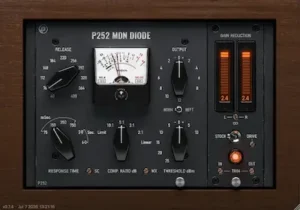 Like most premium analog-modeling releases, the P252 MDN Diode arrives with ambitious technical claims. Pulsar describes the plugin as a full-system recreation of the original hardware, including the detector circuit, feedback path, diode bridge stage, timing behavior, and nonlinear interactions between components.
On paper, those claims are difficult to verify independently. Unlike frequency response measurements or distortion analysis, the accuracy of complex circuit modeling is rarely something end users can validate from a product page. Without access to engineering documentation, source measurements, or direct hardware comparisons, most of the underlying technology remains largely a matter of trust.
Fortunately, that is not how experienced engineers evaluate compressors.
The practical question is not whether every component has been modeled perfectly. The practical question is whether the plugin behaves in a way that creates results that are difficult to achieve with other tools. In that regard, the P252 MDN Diode makes a stronger case than many recent analog emulations.
The gain reduction behavior does not feel like a generic compressor wrapped in vintage branding. Compression and harmonic coloration appear closely linked, producing changes in density and envelope shape that develop as part of the dynamic process rather than being added afterward through separate saturation stages. That distinction becomes particularly noticeable on drums, guitars, and parallel buses where the compressor actively reshapes the energy of the source instead of simply controlling peaks.
At the same time, expectations should remain realistic. The P252 MDN Diode is not a universal replacement for established studio compressors. It lacks the flexibility of an API 2500, the predictability of an SSL bus compressor, and the transparency expected from modern mastering dynamics processors. Engineers looking for a single compressor to cover every task will still need other options available.
Its value comes from providing a specific compression character that is relatively uncommon in software. Whether that justifies the purchase depends largely on the existing toolset. Studios already equipped with multiple high-end analog emulations may find areas of overlap, while engineers searching for a more distinctive alternative to the industry’s usual compressor choices will likely find a stronger argument for adding it to their workflow.
Where the P252 MDN Diode Fits Among Modern Bus Compressors
| Plugin | Compression Character | Best Applications | Where It Falls Short |
|---|---|---|---|
| Pulsar P252 MDN Diode | Dense, harmonically rich, program-dependent | Drum buses, guitars, parallel processing, rock mixes | Not ideal for transparent bus control |
| SSL Bus Compressor | Tight, controlled, cohesive | Mix bus glue, modern pop, commercial production | Less tonal personality |
| API 2500 | Punchy, flexible, highly adjustable | Drums, mix bus, modern rock, electronic music | Can sound more clinical than vintage designs |
| Neve 33609 Emulations | Smooth, weighty, familiar Neve character | Mixing, mastering, stereo bus processing | Less aggressive and less distinctive |
| Shadow Hills Mastering Compressor | Polished, transformer-driven, mastering-focused | Mastering and stereo bus finishing | Slower workflow and greater complexity |
The most relevant competitors are not necessarily other Neve recreations. In practice, the P252 MDN Diode competes with any compressor chosen primarily for tone rather than pure dynamics control.
An SSL Bus Compressor is often inserted to make a mix behave as a single unit. An API 2500 is frequently selected when punch, flexibility, and transient control take priority. A 33609 typically occupies the space between mix bus compression and mastering, offering a familiar Neve character with relatively predictable behavior.
The P252 MDN Diode approaches the task differently. It is less concerned with polish and more concerned with density. The compressor tends to influence the texture of a signal as much as its dynamics, which makes it particularly effective when a source already feels technically balanced but lacks weight, urgency, or attitude.
That distinction becomes important when evaluating whether the plugin deserves a place in an existing collection. Engineers looking for a primary mix bus compressor will often find more versatile options elsewhere. Engineers looking for a compressor that can change the personality of a drum bus, guitar section, or parallel chain may find significantly fewer direct alternatives.
The strongest argument for the P252 MDN Diode is not that it replaces established compressor classics. It is that it occupies a narrower sonic space that many modern plugin collections still leave uncovered.
P252 MDN Diode vs SSL Bus Compressor vs API 2500
The most important question for many engineers is not whether the P252 MDN Diode sounds good. The real question is whether it offers something that SSL Bus Compressor and API 2500 users cannot already achieve with tools they own. While all three processors can be used on drum buses, mix buses, and instrument groups, they approach compression from fundamentally different design philosophies.
An SSL Bus Compressor is primarily a glue compressor. Its purpose is to make multiple elements behave as a cohesive unit while preserving clarity and transient definition. When inserted across a stereo mix bus, SSL-style compression often creates the familiar sense of polish associated with commercial pop, rock, and broadcast productions. Compared to the P252 MDN Diode, the SSL generally sounds cleaner, tighter, and more predictable. However, it contributes significantly less harmonic density and tonal coloration.
The API 2500 occupies a different position. It is one of the most versatile bus compressors ever created, offering extensive control over attack behavior, punch, detector response, and stereo linking. On drums, the API 2500 often delivers more transient impact than the P252 MDN Diode. Engineers working with aggressive rock, metal, electronic music, and modern hip-hop frequently choose API-style compression because it enhances punch without necessarily increasing saturation. The tradeoff is that API compression can sound more clinical and less organically colored than a diode bridge design.
The P252 MDN Diode is less focused on glue and less focused on punch. Instead, it specializes in density, harmonic movement, and program-dependent compression behavior. Rather than emphasizing attack like an API 2500 or cohesion like an SSL Bus Compressor, it tends to increase perceived weight and texture throughout the signal. This makes it particularly effective for drum buses, parallel compression, guitars, bass groups, and productions that already have enough transient definition but lack body.
From a workflow perspective, the SSL remains the safest choice for stereo bus duties. The API 2500 remains the most flexible. The P252 MDN Diode is the most characterful. Engineers looking for transparent mix bus compression will generally prefer SSL. Engineers seeking maximum control and punch will often choose API 2500. Engineers searching for a rare diode bridge compressor character, germanium coloration, and a more vintage-style compression response may find the P252 MDN Diode the most distinctive option of the three.
| Feature | P252 MDN Diode | SSL Bus Compressor | API 2500 |
|---|---|---|---|
| Compression Type | Diode Bridge | VCA | VCA |
| Main Strength | Density & Harmonics | Glue & Cohesion | Punch & Flexibility |
| Best For | Drums, Guitars, Parallel Buses | Mix Bus | Drums, Mix Bus, Rock |
| Coloration | High | Low | Medium |
| Mastering Use | Color Compression | Light Bus Compression | Selective |
Translation, Loudness, and Real-World Mix Behavior
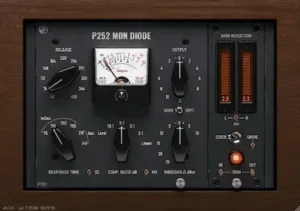 A compressor can sound impressive in a controlled studio environment and still create problems once a mix reaches streaming platforms, consumer playback systems, and loudness-normalized delivery chains. That is especially true for processors that combine dynamic control with audible harmonic coloration.
The P252 MDN Diode generally performs best when used to increase perceived density rather than chase additional loudness. That distinction matters because perceived impact and actual level are not the same thing, particularly in modern loudness-focused mastering workflows. Its character tends to reinforce the body of a signal, particularly in the low-midrange, which can make drums, guitars, and instrument buses feel more substantial without relying entirely on level increases. In practical terms, that often translates more effectively across different playback systems than simply driving a limiter harder.
That advantage comes with a tradeoff. Because the compressor contributes harmonic content alongside gain reduction, cumulative processing can build up more quickly than expected. Engineers already using tape emulations, transformer models, clipper stages, and bus saturation may find that the P252 pushes a mix toward congestion sooner than cleaner compressors would.
This becomes particularly relevant during mastering. While the plugin can be effective as a color compressor, it is less suited to applications where transparency, headroom preservation, and precise loudness management are the primary objectives. Used selectively, it can add weight and movement to a mix. Used aggressively across an already saturated signal chain, it can reduce the sense of openness that many mastering engineers work hard to preserve.
From a streaming perspective, the strongest results are likely to come from moderate gain reduction and careful gain staging. The plugin’s contribution to perceived size often remains audible after platform normalization, whereas excessive compression intended solely to increase loudness frequently does not. Engineers working on masters intended for streaming platforms will generally achieve better translation by treating the P252 as a tone-shaping tool rather than a loudness processor.
Performance considerations appear largely consistent with expectations for a modern premium analog-modeling plugin. Based on early user reports and available testing, the plugin appears practical for multi-instance use in modern mixing sessions. While comprehensive independent benchmarking remains limited, the plugin appears practical for multi-instance use in contemporary mixing sessions without creating significant workflow penalties.
Verdict: Not Essential, But One of the More Interesting Compressor Releases of the Year
The P252 MDN Diode succeeds for a simple reason: it is not trying to compete directly with the compressors that already dominate most professional sessions.
It is not a replacement for an SSL Bus Compressor. It is not an alternative to a transparent mastering compressor. It is not the most flexible dynamics processor available today. Engineers looking for a single compressor to handle every task will find stronger all-purpose options elsewhere.
Where the plugin earns its place is in applications where character matters as much as control. The combination of diode bridge compression, feedback behavior, and germanium coloration produces a type of density that feels fundamentally different from the cleaner, more predictable compression styles that define much of modern production.
That difference is most apparent on drum buses, guitar groups, parallel chains, and mix elements that need additional weight without relying exclusively on saturation or transient processing. In those situations, the P252 often contributes both tone and dynamics simultaneously, reducing the need for more elaborate processing chains.
For mixing engineers, that alone may justify the investment. For mastering engineers, the value proposition is narrower. The plugin is best viewed as a specialized color compressor rather than a primary mastering workhorse.
Ultimately, the strongest argument for the P252 MDN Diode is not historical authenticity or the rarity of the original Neve 2252. It is the fact that the compressor offers a workflow and sonic behavior that remain relatively uncommon in today’s plugin market. In an industry flooded with variations of the same compressor designs, that may be its most valuable feature.
Overall Rating
| Category | Rating |
|---|---|
| Sound Quality | 9.5/10 |
| Workflow | 8.5/10 |
| Mix Translation | 9/10 |
| CPU Efficiency | 9/10 |
| Versatility | 7.5/10 |
| Value for Money | 8.5/10 |
| Overall | 8.8/10 |
The Pulsar Modular P252 MDN Diode is not designed to replace every compressor in a professional session. Its strength comes from delivering a rare diode-bridge compression character that combines density, harmonic coloration, and program-dependent movement in a way that feels noticeably different from most SSL, API, or VCA-style alternatives. For engineers who already own the usual compressor classics, the P252 MDN Diode offers a genuinely distinct sonic option rather than another variation of a familiar concept.
Why These Scores Were Awarded
Sound Quality — 9.5/10
The plugin delivers a convincing combination of compression and harmonic enhancement without sounding artificially hyped. Drum buses, guitars, basses, and parallel chains gain density and energy while retaining musical movement. The diode-bridge behavior creates a character that stands apart from many modern compressor emulations.
Workflow — 8.5/10
The interface remains straightforward and practical, but the compressor rewards listening rather than visual adjustment. Because its behavior is highly program-dependent, it may require more experimentation than predictable SSL-style compressors before reaching the desired result.
Mix Translation — 9/10
One of the strongest aspects of the plugin is its ability to increase perceived size and weight without relying exclusively on loudness. Moderate settings tend to translate well across streaming services and consumer playback systems, provided the rest of the mix is not already heavily saturated.
CPU Efficiency — 9/10
For a premium analog-modeling processor, performance appears very reasonable. Multi-instance use on drum buses, instrument groups, and parallel chains should not create significant workflow limitations on most modern production systems.
Versatility — 7.5/10
This is the category where the P252 MDN Diode loses points. It excels within a specific range of applications but is not a universal compressor. Engineers seeking transparent mastering control, clean vocal compression, or highly surgical dynamics processing will likely need additional tools.
Value for Money — 8.5/10
The value depends heavily on the existing plugin collection. For users who already own multiple SSL, API, and Neve-style compressors, the P252 offers access to a less common compression topology that fills a genuine tonal gap. For beginners building a first compressor toolkit, broader-purpose options may provide more immediate utility.
Who Should Buy the P252 MDN Diode?
- Mix engineers looking for a distinctive compressor character.
- Rock and alternative producers working with drum buses and guitars.
- Engineers who already own SSL, API, and Vari-Mu compressors.
- Users seeking more density without stacking multiple saturation plugins.
Who should skip it? Engineers needing transparent mastering compression, invisible vocal control, or a single compressor for every possible task.
The Difference Between a Better Mix and a Better Master
A compressor can make a track sound bigger. A mastering engineer decides whether bigger is actually better. Many mixes already contain enough saturation, compression, limiting, and harmonic enhancement. The real challenge is identifying what helps the song and what simply makes it louder, denser, or more fatiguing over time.
Before buying another plugin or rebuilding your processing chain, hear what professional mastering can achieve with the mix you already have. Upload up to 35 seconds of your track and receive a free mastering demo prepared by a real mastering engineer.
Get your free demo →
FAQ
Is the P252 MDN Diode suitable for mastering applications?
It can work well as a color compressor during mastering, particularly when a mix needs additional density or harmonic character. Engineers looking for transparent gain control, precise loudness management, or minimal tonal impact will typically prefer dedicated mastering compressors.
How does the P252 MDN Diode differ from a Neve 33609 plugin?
Although both originate from the Neve family, they serve different purposes. The 33609 is generally smoother, more familiar, and more commonly used on stereo buses. The P252 delivers a more aggressive and distinctive compression character with stronger tonal influence.
What is a diode bridge compressor, and why does it sound different?
Diode bridge compressors use a gain-control topology that introduces both compression and harmonic coloration. Compared to many VCA designs, they often produce a denser, more textured sound that becomes part of the tone rather than remaining transparent.
Can the P252 MDN Diode work as a mix bus compressor?
Yes, but it should not automatically be treated as a replacement for an SSL-style bus compressor. It is generally better suited to engineers seeking character, weight, and movement rather than subtle glue.
Which genres benefit most from this compressor?
Rock, alternative, indie, punk, blues, hard rock, modern pop, and certain hip-hop productions are likely to benefit most. The plugin’s density and harmonic character tend to complement source material that already relies on energy and attitude.
Does the plugin replace saturation processors?
In some cases, it can reduce the need for additional saturation stages. Because harmonic coloration is closely tied to the compression process, the plugin often adds weight and texture without requiring separate transformer or tape emulations.
How does it perform on drums?
Drums are arguably the plugin’s strongest application. It can increase sustain, perceived impact, and overall density while preserving enough transient information to keep the performance feeling energetic rather than flattened.
Is the P252 MDN Diode a good choice for vocal compression?
It is most effective on vocals that benefit from personality and forward momentum. Engineers seeking invisible vocal control for acoustic, jazz, or highly dynamic performances may find cleaner compressors more appropriate.
What are the closest software alternatives?
The most relevant alternatives include API 2500 emulations, Neve 33609 plugins, SSL Bus Compressor models, and premium analog-modeled compressors designed for mix bus coloration. Each approaches compression differently, making workflow requirements more important than brand comparisons.
Is the P252 MDN Diode worth buying if you already own several premium compressors?
That depends on what is missing from your current collection. If you already have strong coverage of SSL, API, Vari-Mu, and Neve-style compression, the decision comes down to whether you want a more specialized diode bridge character. Engineers searching for new tonal options may find more value here than those looking for another general-purpose compressor.
Does the P252 MDN Diode emulate the Neve 2252 compressor?
Yes. The plugin is designed as a software recreation of the rare Neve 2252 diode bridge compressor, including its feedback-based gain reduction behavior, harmonic coloration, and program-dependent response.

Yurii Ariefiev evaluates compressors, equalizers, saturation tools, and mastering processors from the perspective of real-world mix translation, dynamic control, and long-term listening impact. His reviews focus on how processing decisions affect punch, depth, loudness, and balance rather than marketing claims alone.
At AREFYEV Studio, compressor plugins are assessed in practical mixing and mastering scenarios, including drum buses, stereo buses, parallel chains, and streaming-ready masters. Special attention is given to harmonic coloration, transient behavior, gain reduction characteristics, and how processing choices translate across different playback systems.
☕ Buy me a coffee