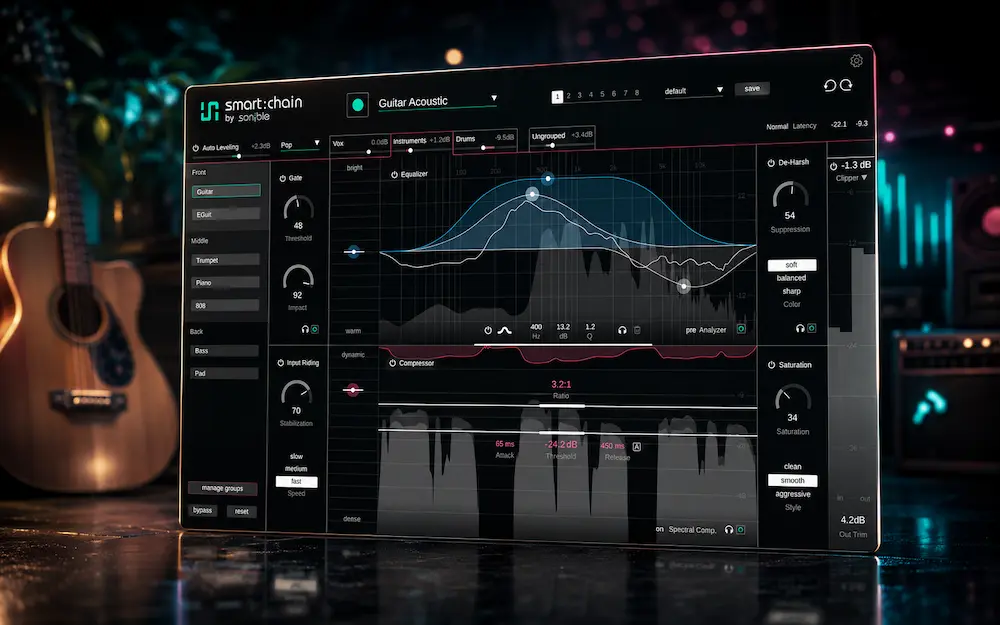
Sonible smart:chain is built around a straightforward problem in modern mixing: too much engineering time can disappear into repetitive setup before the creative work even begins. The plugin combines EQ, compression, gating, de-harshing, input riding, saturation, and leveling, but the individual processors are not the reason it stands out. Channel strips have covered most of that territory for decades.
The more interesting part is how smart:chain connects those processes across multiple instances. Instead of treating every track as an isolated channel, Sonible uses shared analysis, session-wide control, and Front/Middle/Back depth staging to make processing decisions in the context of the mix.
The practical question is therefore simple: how much of the repetitive first-pass work can smart:chain remove before an engineer has to take over manually? That is the benchmark I use throughout this review.
In This Review
Why smart:chain Treats the Mix as a System, Not a Collection of Tracks
 Most AI-assisted mixing tools start with an individual track. Analyze the vocal, generate an EQ curve, set the compressor, or suggest a starting point for dynamics. That approach can be useful, but it ignores one of the fundamental realities of mixing: tracks do not exist in isolation.
A change to one channel can alter the way another channel is perceived. Boosting the low mids on a guitar can reduce the apparent weight of a vocal. More compression on a bass can change the relationship between the bass and kick. Raising a backing vocal can make the lead feel smaller without touching the lead fader. Good mixing is largely the process of managing those relationships.
Sonible has been moving in this direction with its smart:EQ 4 architecture, which allows multiple instances to work together rather than treating each EQ as an independent processor. smart:chain takes the same basic concept further by extending it across a broader processing chain.
Instead of running separate AI routines for EQ, dynamics, level, and other corrective tasks, smart:chain is designed around a shared analysis of the source and communication between instances. Its Front, Middle, and Back controls add another layer by allowing the engineer to establish relative depth within the mix rather than processing every channel against the same generic target.
The useful part is not another collection of “smart” processors. It is the fact that the instances can be treated as parts of the same mix rather than unrelated channel strips.
Sonible smart:chain Hands-On Test: Where It Actually Saves Time
The most useful way to evaluate smart:chain is not by counting processors. It is by looking at how much engineering work remains after the plugin creates its first pass. I approached it from that perspective rather than treating the AI-generated settings as a finished mix.
The strongest results came from sessions where many tracks needed competent treatment before detailed automation and creative decisions could begin. In those situations, smart:chain can establish usable starting points for level, EQ, dynamics, harshness control, and saturation without requiring the engineer to build every channel from an empty insert.
The important difference only became obvious when I treated smart:chain as a multi-instance system. On a single channel, I could reproduce most of the basic processing with the EQ, compressor, dynamics and other tools already in a normal mix template. The time-saving argument became much stronger once several tracks were active and the session-level controls could be used to change relationships between them instead of opening each channel and rebuilding the same type of processing decision repeatedly.
I judged the first pass by the amount of manual cleanup it left behind. That is where an AI-assisted workflow either saves time or simply moves the work to a different stage. The useful result is not an impressive preset on one channel, but a session where only the important tracks need substantial refinement.
That does not mean the generated settings should be accepted without inspection. Some channels still require manual correction, and the more stylistically specific the production becomes, the less useful a generic first-pass treatment can be. The practical advantage is therefore not “one click to a finished mix.” It is getting from raw tracks to a workable mix faster.
Where smart:chain Works Best
- Large sessions: the more channels require basic setup, the more valuable the automation becomes.
- Vocal-heavy productions: input riding, EQ, compression, de-harshing, and saturation address several repetitive tasks in one chain.
- Rough mixes: Auto Leveling can provide a usable session-wide starting balance before detailed mixing begins.
- Repeated revisions: the ability to establish a new starting point quickly becomes more valuable when arrangements change frequently.
- Deadline-driven production: reducing repetitive setup can have a measurable economic benefit when engineering time is limited.
Where smart:chain Falls Short
- Small sessions: an experienced mixer may already be able to build the required processing chain almost as quickly manually.
- Highly character-driven processing: automated corrective decisions are not a substitute for deliberate tonal shaping and creative compression.
- Final vocal production: clip gain, detailed automation, breaths, consonants, effects, doubles, and creative processing still require manual work.
- Mix-bus specialization: engineers who already rely on dedicated bus processors may prefer the greater control of specialist tools.
- Large permanent templates: CPU and latency behavior should be tested in the actual DAW before deploying many instances.
How Sonible smart:chain Fits Into a Real Mixing Workflow
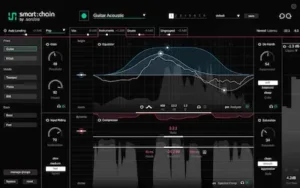
smart:chain combines EQ, compression, gating, de-harshing, saturation, input riding, and leveling within a single processing environment. The more distinctive part is the layer above those processors: multiple instances can communicate, tracks can be assigned to Front, Middle, or Back depth positions, and Auto Leveling can establish a starting balance across the session.
The workflow starts with an analysis of the source material, then uses that analysis to establish starting points across the chain. The engineer can inspect and refine those decisions instead of treating the generated settings as a finished result.
That distinction matters in a large session. The time cost in mixing rarely comes from opening an EQ or turning a compressor threshold. It comes from the accumulation of small decisions: establishing workable input levels, removing obvious tonal problems, controlling dynamics, managing harshness, deciding which tracks need riding, and bringing the channels into a usable balance before the detailed mix begins.
Those tasks are individually simple. Across dozens of channels, they become a significant part of the session.
smart:chain is designed to automate that first layer of engineering work. The potential gain is not that it eliminates the need for a mixer; it is that the mixer can start from a coherent set of processing and level decisions instead of building every channel from scratch.
The Channel-Strip Processing Is Familiar
EQ, compression, gating, saturation, and level control are established mixing tools. A conventional SSL-style channel strip, a modern digital strip, or a combination of stock DAW processors can already cover most of these tasks.
That is why the individual modules are not the strongest reason to buy smart:chain. The important question is not whether its EQ or compressor can perform a familiar job. It is how those processors work together and how much manual setup that coordination removes.
The Session-Level Workflow Is the Real Differentiator
Multiple smart:chain instances can communicate across the session, while Auto Leveling can establish a rough balance from the tracks the system has analyzed. The engineer can then refine that balance with Trim controls rather than accepting the automated result as a finished mix.
That is more useful than another set of automatic presets because level and processing decisions only become meaningful once the tracks are heard against one another. A technically competent vocal chain is of limited value if the vocal is still buried behind the guitars; a well-shaped bass is not useful if its level relationship with the kick is wrong.
A workable rough balance is therefore an important production milestone. If smart:chain can reach that point quickly, the engineer can spend less time on channel-by-channel setup and more time on the decisions that remain inherently musical: vocal emphasis, automation, arrangement changes, transitions, dynamics, and overall perspective.
Where smart:chain Can Actually Save Mixing Time
 smart:chain makes the strongest case in sessions where the number of tracks turns basic setup into a significant part of the job. On a small session with a handful of important channels, an experienced mixer can usually establish a workable balance and processing chain quickly. The economics change when the session contains dozens of sources that all need competent treatment before the detailed mix can begin.
Take a typical modern pop production: lead and background vocals, doubles, guitars, synth layers, percussion, bass, effects, and multiple supporting elements. Before working on automation or fine balances, the mixer still has to establish usable levels, deal with obvious tonal problems, control inconsistent dynamics, and decide which elements should occupy the foreground and which should sit deeper in the arrangement.
None of those decisions is particularly difficult in isolation. The problem is repetition. A few seconds spent evaluating one track becomes a substantial amount of time when the same process is repeated across an entire session.
This is where smart:chain’s automation has a credible professional use case. Instead of building every channel from an empty insert and then balancing the session manually, the engineer can use the generated processing and level relationships as a first pass, then concentrate on the channels and musical decisions that actually require judgment.
Vocals: A Strong Use Case for Automated First-Pass Processing
Vocals are one of the more convincing applications for smart:chain because several routine tasks often appear in the same chain: level control, corrective EQ, compression, harshness management, and sometimes saturation. That same demand for faster vocal setup is addressed by dedicated integrated tools such as Black Rooster Audio PS-VC1, although its fixed vocal-processing architecture solves a narrower problem than smart:chain’s session-wide approach.
Input riding is particularly useful on performances with large phrase-to-phrase level changes or inconsistent microphone distance. Bringing the vocal into a more stable dynamic range before compression can reduce the amount of corrective automation the mixer has to build manually. De-harshing can serve a similar purpose by addressing aggressive upper-mid or high-frequency energy before it becomes exaggerated by compression.
That does not eliminate the need for detailed vocal production. Clip gain, breath and consonant editing, phrase automation, parallel processing, effects throws, doubles, and creative distortion remain deliberate engineering decisions. smart:chain is most useful here as a fast technical first pass, not as a finished vocal chain.
Drums and Percussion: Where Track Count Starts to Matter
Drum sessions are another good test of the workflow because a single production can contain close microphones, rooms, samples, percussion, and auxiliary channels that all need to become workable before the detailed balance begins.
The advantage of automation is not that every drum channel needs intelligent processing. It is the opposite: not every channel deserves the same amount of engineering time. A kick, snare, overhead pair, or room bus may justify detailed transient, tonal, and dynamic decisions. A secondary percussion mic may simply need enough control to stop competing with the primary elements.
That is where smart:chain’s workflow can make sense: automate the routine channels, then spend manual attention where the arrangement and performance actually demand it.
Rough Mixes and Production Revisions: Where Speed Has Real Value
smart:chain may be most useful when a mix has to be rebuilt or rebalanced repeatedly. Producer revisions often change the arrangement enough to invalidate previous level and processing decisions: a new vocal take, additional synth layers, rewritten drums, different guitars, or a denser chorus can shift the entire balance.
In that situation, the value of an intelligent first pass is not that it produces a finished mix. It gives the engineer a workable starting point without requiring every channel to be rebuilt from scratch. The mixer can then identify what actually changed, refine the important tracks, and move directly into automation and creative decisions.
That matters even more in high-volume commercial work. Saving a few minutes on one channel is insignificant; saving the same few minutes across dozens of channels, and doing it again every time a production is revised, can materially change the economics of a session.
How to Use Sonible smart:chain in a Mix
The most efficient way to approach smart:chain is to treat its analysis as a starting point rather than a final decision. The objective is to establish a coherent technical foundation quickly and then spend manual engineering time where it has the greatest musical impact.
- Insert smart:chain on the tracks that need routine processing. Start with the channels where EQ, dynamics, level control, or harshness management are likely to be repetitive rather than highly creative.
- Run the analysis and inspect the generated chain. Check whether the initial EQ, compression, input riding, saturation, and other decisions make sense for the source rather than assuming the AI is automatically correct.
- Build the session relationship. Use Front, Middle, and Back staging to establish the intended depth hierarchy instead of treating every track as equally important.
- Use Auto Leveling to establish a rough balance. This is one of smart:chain’s most important workflow functions because it addresses relationships between tracks rather than isolated channel settings.
- Refine the important tracks manually. Lead vocals, kick, snare, bass, main guitars, and other focal elements deserve more attention than secondary supporting tracks.
- Move into automation and creative processing. Once the repetitive technical groundwork is under control, the engineer can focus on musical balance, transitions, effects, arrangement, and intentional dynamics.
The key is to avoid treating smart:chain as an “auto mix” button. Its strongest use is as an intelligent starting-point generator for the entire session.
Where AI Mixing Can Go Wrong: Optimization Is Not Musical Judgment
The central limitation of intelligent mixing is not that an algorithm cannot make technically competent decisions. It is that technical correctness and artistic intent are not the same objective.
This is where experienced mixers have an advantage. They are not simply looking for cleaner signals. They are deciding which imperfections are useful, which conflicts are intentional, and which compromises serve the arrangement. An automated system works from the characteristics it can measure; the engineer works from the record the artist is trying to make. That distinction becomes even more important when comparing automated processing with human mastering decisions, where context and listening judgment matter just as much as the processing itself.
smart:chain is more credible when treated within that boundary. Its processing remains editable, so the engineer can override the generated decisions rather than accepting them as fixed results. That makes the AI useful as a starting point without turning it into an authority over the mix.
The real risk, then, is not necessarily bad audio. It is technically polished audio that has been optimized toward the wrong aesthetic.
A mix can become cleaner, more controlled, and easier to balance while losing the imbalance, density, aggression, or tonal character that made it interesting in the first place. For a professional mixer, that is the line to watch: let the automation handle routine problems, but keep the musical decisions human.
The useful comparison is therefore not architecture alone, but what happens to the actual workflow when smart:chain is placed against another AI-assisted mixer or an established manual template.
Sonible smart:chain vs. Neutron and Traditional Mixing Workflows
| Workflow | smart:chain | iZotope Neutron | Traditional Plugin Chain |
|---|---|---|---|
| AI-assisted channel setup | Yes | Yes | No |
| Multiple instances communicate | Yes | Different workflow | No |
| Session-wide Auto Leveling | Yes | No equivalent core workflow | No |
| Front / Middle / Back depth staging | Yes | No equivalent core control | Manual |
| Central control of instances | Yes | Different workflow | No |
| Processing depth | Focused | Broader | Depends on plugins |
| Manual sound shaping | Good | Very broad | Maximum |
| Fast rough-mix creation | Excellent fit | Good | Slowest |
| Best reason to choose it | Connected, session-aware first-pass mixing | Broad AI-assisted processing toolkit | Maximum manual control |
iZotope Neutron is the closest direct alternative because both products are designed to reduce the amount of manual work required to establish a mix. The difference is in how that assistance is organized. Neutron provides a broad set of intelligent processors and a mature mixing ecosystem, while smart:chain is built more tightly around the idea of a connected channel workflow that operates across multiple instances.
That does not make smart:chain “Neutron but better.” They solve overlapping problems with different priorities. Neutron is the more established choice for engineers who want a broad AI-assisted mixing environment with extensive processing options. smart:chain is more compelling if the primary goal is to move quickly from an unprocessed session to a coherent working balance while keeping the processing architecture relatively focused.
Sonible’s own smart:EQ 4 is a different proposition. It remains the more specialized tool when spectral balancing and masking are the primary problems. smart:chain is broader: the value comes from combining tonal, dynamic, level, and depth-related decisions within the same workflow rather than trying to be the best intelligent EQ on the market.
There is also a competitor that matters more than any individual plugin: the engineer’s existing template.
If your template already has a fast corrective EQ, channel compressor, vocal rider, saturation stage, and dedicated bus processing, smart:chain does not automatically make that workflow obsolete. In my view, the real comparison is not plugin count but how many decisions remain after the first pass. If I have to inspect and undo most of smart:chain’s processing, I have gained consolidation but not much time. If the generated settings are close enough that I only refine the important tracks, the workflow advantage becomes real.
That is the real buying test: does smart:chain remove enough repetitive work to change the way you mix? If the answer is yes, its session-level architecture is meaningful. If not, specialized processors with familiar manual control remain the more efficient choice.
What Would I Actually Replace With smart:chain?
The useful question is not how many processors smart:chain contains. It is which parts of an existing mix template I would stop opening after using it. That is a much more practical way to judge whether the plugin earns a permanent place in a professional workflow.
| Existing Tool or Task | Would smart:chain Replace It? | Engineering View |
|---|---|---|
| Basic corrective EQ | Often | A good candidate for automated first-pass treatment. |
| Basic channel compression | Often | Useful when the goal is control rather than character. |
| Input riding | Potentially | One of the more practical areas for automation. |
| De-harshing | Potentially | Useful as corrective processing, but still requires listening. |
| Character EQ | Usually not | Specialist EQs remain preferable when tone and character are the objective. |
| Character compression | Usually not | Intentional attack, release, color, and nonlinear behavior still benefit from dedicated processors. |
| Creative saturation | Usually not | Automation is less important when saturation is being used as a deliberate sonic effect. |
| Mix-bus processing | No | A dedicated bus chain remains more appropriate for critical macro-dynamic and tonal decisions. |
That is why I see smart:chain less as a replacement for a professional plugin collection and more as a first-pass engineering layer. The best result may be a hybrid workflow: let smart:chain handle routine decisions, then keep specialist processors for the channels and buses where sound character and musical intent matter most.
Sonible smart:chain System Requirements and Compatibility
| Specification | Sonible smart:chain |
|---|---|
| Latest version | 1.0 |
| macOS | macOS 11 and later |
| Windows | Windows 10 64-bit and later |
| Apple Silicon | Native support |
| macOS plug-in formats | VST, VST3, AU, AAX |
| Windows plug-in formats | VST, VST3, AAX |
| Sample rates | 44.1–192 kHz |
| RAM | 4 GB |
| GPU | OpenGL 3.2+ |
| Authorization | Machine-based or iLok |
The published specifications do not answer the more useful production question: how efficiently does smart:chain scale when many instances are active? There is not yet enough independent large-session testing to establish reliable CPU, latency, or maximum-instance figures, so I would test it inside the actual DAW template before deploying it across dozens of channels.
For normal mixing, plug-in delay compensation makes moderate processing latency manageable. Tracking and live monitoring are less forgiving. A processor that is perfectly practical on a mix bus can become unsuitable in a low-latency monitoring path, particularly when several instances are active.
For that reason, smart:chain is best approached as a mixing-stage tool until its real-world latency and CPU behavior have been independently measured. Engineers working on large templates should test the plugin at the intended sample rate, with a realistic number of instances, before making it part of a permanent session template.
Is There a Sonible smart:chain Free Trial?
Yes. Sonible currently offers a 30-day fully functional demo, which is particularly useful for evaluating smart:chain against an existing mixing template rather than judging it from presets or feature lists alone.
For a professional mixer, the best test is simple: open one of your typical large sessions, compare the time required to reach a workable first pass with your existing workflow, and then measure how much manual correction is needed after smart:chain’s analysis. That gives a much more meaningful answer than comparing processor specifications on paper.
Sonible smart:chain Price and Value: What Are You Actually Paying For?
Sonible launched smart:chain at an introductory price of €99, compared with a regular price of €179. Existing Sonible customers can also receive personalized crossgrade pricing.
The more important question for an evergreen review is not the launch discount. It is whether smart:chain provides enough workflow value to justify adding another mixing tool to an already crowded plugin folder.
If you already own high-end EQs, compressors, dynamic processors, saturation tools, and vocal riders, the individual modules are unlikely to justify the purchase on their own. Most professional mixers can reproduce the same basic processing with tools they already trust.
The potential return comes from consolidating repetitive decisions: initial level management, corrective processing, dynamics, depth relationships, and session-wide balancing. If those tasks consume a meaningful amount of time in your sessions, smart:chain can justify its price even when it does not replace any of your existing plugins.
For a professional mixer working to deadlines, that distinction matters. A tool that consistently reduces setup time across large sessions can pay for itself through saved engineering hours. For a hobbyist who prefers to make every processing decision manually—or whose sessions are small enough that setup is already quick—the same automation may offer little practical return.
The value proposition is therefore workflow-dependent: smart:chain is easier to justify as a time-saving system than as a collection of processors.
Who Should Buy Sonible smart:chain—and Who Should Skip It?
| User | Fit | Why |
|---|---|---|
| Mixing engineers | Strong fit | Session-level automation can reduce repetitive channel setup and first-pass balancing. |
| Producers | Strong fit | Useful for getting large productions to a workable rough mix quickly. |
| Home-studio producers | Good fit | Can provide a coherent starting point without requiring a large collection of specialist processors. |
| Electronic music producers | Good fit | Dense sessions and high track counts make automated setup more valuable. |
| Pop and vocal producers | Strong fit | Level riding, EQ, dynamics, and de-harshing map well to repetitive vocal-processing tasks. |
| Mastering engineers | Low priority | The plugin is built around track relationships and mix-level workflow rather than mastering-specific control. |
| Live engineers | Test before use | Real-time suitability depends on the actual latency and CPU behavior of the processing configuration. |
| Beginners | Useful with caution | Fast starting points can help, but relying on automation can delay development of fundamental mixing judgment. |
The strongest audience is not simply anyone who wants an AI mixing plugin. It is the engineer or producer who regularly works with large sessions, repeated revisions, or deadline-driven production.
For those users, smart:chain addresses a measurable workflow problem: how much time is spent getting dozens of channels from “raw tracks” to a coherent starting mix. If that first pass is already fast in your existing template, the plugin has less to offer.
Mastering engineers are the clearest example of a weaker fit. They may find individual processors useful, but the product’s main advantage—coordinating track-level processing and relationships across a mix—is largely outside the core mastering workflow.
My Bottom Line After Testing smart:chain
After testing smart:chain as a multi-instance mixing workflow, I would not use it to replace a professional collection of specialist processors. I would use it to reduce the amount of routine work that happens before the important mixing decisions begin.
The deciding factor is cleanup time. If smart:chain gets a large session into a workable state and leaves only the important tracks for detailed refinement, the session-level architecture has real value. If the generated processing needs extensive correction, the time saving becomes much smaller.
Overall Rating
| Category | Rating |
|---|---|
| Workflow Efficiency | 9.5/10 |
| Mix Context & Session Integration | 9.5/10 |
| First-Pass Mix Quality | 8.5/10 |
| Processing Control | 8/10 |
| CPU & Real-Time Suitability | 7.5/10 |
| Value for Money | 8.5/10 |
| Overall | 8.6/10 |
Sonible smart:chain Pros and Cons
| Pros | Cons |
|---|---|
| Session-wide processing concept | Individual processors are not class-leading in every category |
| Multi-instance communication | Limited independent large-session CPU and latency testing |
| Fast first-pass channel setup | AI decisions still require engineering judgment |
| Project-wide Auto Leveling | Not a replacement for detailed mix automation |
| 30-day fully functional demo | Less compelling for small sessions with mature templates |
Verdict: A Serious Mixing Workflow Tool, Not an AI Mix Button
Sonible smart:chain is a useful addition to a modern mixing workflow, but its value depends heavily on session size and the amount of repetitive setup in your existing template.
The individual processors are not enough to justify replacing established EQs, compressors, saturators, or bus processors. The reason to use smart:chain is the combination of first-pass processing, multi-instance communication, depth staging, Auto Leveling, and centralized session control.
For large sessions, repeated revisions, and deadline-driven work, that can be a meaningful time saving. For small sessions or engineers with an already efficient template, the benefit is much smaller.
My recommendation is therefore simple: download the 30-day demo and test smart:chain against one of your real sessions. Measure how long it takes to reach a workable first pass and, more importantly, how much correction is required afterward. That result tells you more than any feature list can.
The Mix Is Finished. Now Hear What Is Actually There.
smart:chain can help you reach a stronger mix faster, but it cannot make the final mastering decisions for the release. Mastering is where an experienced engineer evaluates the finished mix as a whole—tonal balance, dynamics, low-end control, stereo perspective, punch, and translation—then makes only the changes the record actually needs.
You don’t have to guess whether your mix is ready or whether mastering can take it further. Upload up to 35 seconds of your mix and hear a free mastering demo prepared by a real mastering engineer before booking the full project.
Get your free mastering demo →
FAQ
Is Sonible smart:chain better than Neutron for mixing?
Neither is universally better. Neutron offers a broader and more established AI-assisted mixing environment, while smart:chain is more tightly built around connected channel processing and session-level control. The better choice depends on whether you prioritize processing depth or a more streamlined first-pass workflow.
Can Sonible smart:chain be used on a mix bus?
It can be used creatively on buses, but its strongest feature set is built around track-level and multi-instance relationships. For critical mix-bus processing, many engineers will still prefer dedicated compressors, EQs, and dynamics processors with more predictable manual control.
Is smart:chain suitable for tracking vocals?
It can be, but the actual latency of the chosen processing configuration should be tested before using it for monitoring. For recording, a simpler low-latency chain is often safer; smart:chain’s broader workflow is more naturally suited to the mixing stage.
How many smart:chain instances can a DAW run?
There is no reliable universal instance limit. CPU demand will vary with the DAW, sample rate, computer, and active processing. Because independent large-session benchmarks are still limited, the practical limit should be established with the actual session template rather than a published theoretical number.
Does smart:chain work with Apple Silicon?
Yes. Sonible lists Apple Silicon support along with current macOS and Windows compatibility and VST, VST3, AU, and AAX formats where supported by the operating system.
How much does Sonible smart:chain cost?
Sonible launched smart:chain at €99, compared with a regular price of €179. The introductory offer is scheduled through September 28, 2026. Sonible also offers crossgrade pricing for existing customers.
Does Sonible smart:chain have a free trial?
Yes. Sonible offers a 30-day fully functional demo. For a serious evaluation, test it inside a typical session and compare both the speed of the first pass and the amount of manual cleanup required afterward.
Is smart:chain CPU heavy?
There is not yet enough independent large-session testing to give a reliable universal answer. CPU use should be evaluated with the intended sample rate, DAW, number of instances, and processing configuration.

Yurii Ariefiev evaluates mixing and mastering tools from a practical engineering perspective, focusing on workflow efficiency, session-wide processing, AI-assisted mixing, and the decisions that still require human judgment. His plugin reviews examine how new tools perform inside real production workflows rather than treating feature lists as evidence of professional value.
At AREFYEV STUDIO, audio tools are assessed by what they actually change in a mix: track relationships, dynamics, tonal balance, translation, and the amount of manual work they remove. The same engineering perspective applies at the mastering stage, where automation can assist the process but final decisions still depend on critical listening and release-oriented judgment.
☕ Buy me a coffee