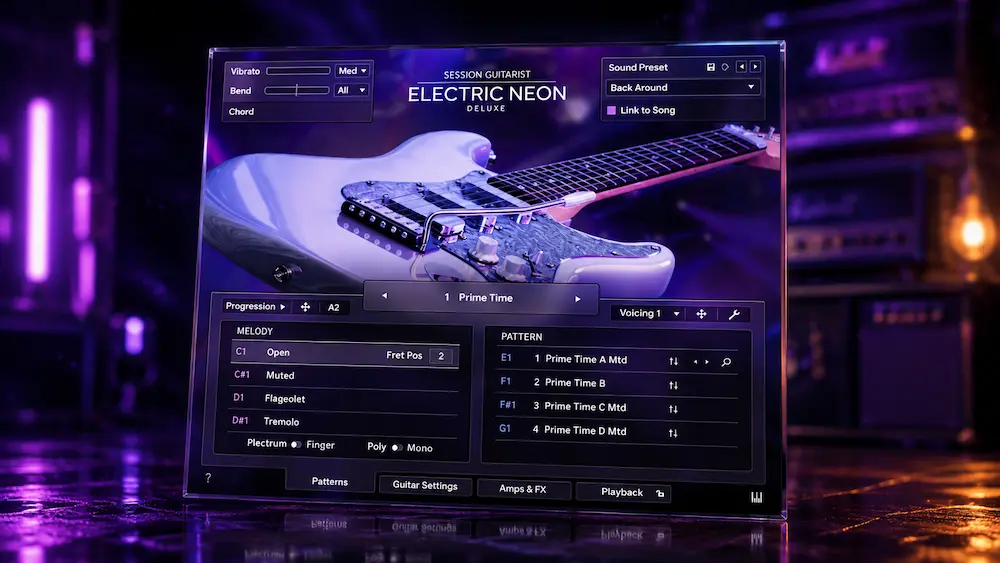
Native Instruments Session Guitarist – Electric Neon Deluxe is a Kontakt guitar instrument built specifically around modern pop, EDM, dance, and synth-heavy production. It combines 240 patterns, 31 songs, plectrum and finger articulations, a dedicated Melody instrument, and 30 amp and effects chains in a workflow that is much closer to arranging a performed guitar part than programming one note by note.
What matters in practice is how quickly those parts become usable inside a real production. Electric Neon is not trying to give you the deepest possible control over strings, fretting, or guitar technique. Its strength is the opposite: you start with recorded performances, choose a pattern that fits the groove, adjust the voicing and playback behavior, and move on with the arrangement.
For EDM and modern pop, that approach makes sense. Guitar is often a supporting layer rather than the main performance, so spending an hour building a believable part can be harder to justify than using a library that gets you close immediately. The question is whether Electric Neon is actually flexible enough once the first impressive pattern has been chosen.
At $149, Deluxe is also a direct value question for existing Electric Neon Essentials users. The Deluxe version doubles the pattern library from 120 to 240 and adds finger articulation, while keeping the same basic concept. That makes the $69 upgrade a different buying decision from purchasing Deluxe as a new user.
My main conclusion is simple: Electric Neon Deluxe is strongest when you need a convincing contemporary guitar part quickly, and weakest when the song requires a guitar performance that was never recorded for the library.
In this review:
Electric Neon Deluxe Review: How the Guitar Workflow Actually Works
 Electric Neon Deluxe is easier to understand once you stop treating it like a conventional virtual guitar. The Pattern instrument is built for fast chord-based arrangement, while the separate Melody instrument is where you get more direct control over individual guitar notes and articulations. Patterns follow the DAW tempo, and the recorded performances are triggered from MIDI rather than generated from scratch by a guitar-playing algorithm.
Native Instruments and Big Wave Audio recorded a custom Stratocaster-style guitar with active EMG pickups, capturing both DI and ribbon-microphone signals. The patterns were performed by session guitarists, so the timing, picking and articulation are derived from actual performances rather than generated entirely from MIDI notes. Deluxe expands the Electric Neon Essentials library to 240 patterns and adds finger articulation alongside the existing plectrum material.
That approach is particularly well suited to modern pop and EDM, where guitar is often an arrangement element rather than the central performance. A producer may need a tight rhythmic layer, a hook, a muted groove, or a short melodic figure that supports the drums, synths and vocal without demanding a dedicated recording session. The same balance becomes important later when the finished production is pushed toward release level, particularly in EDM mastering, where excessive density can make a track lose impact rather than gain it.
That speed comes with a clear limitation: Electric Neon Deluxe gives up some performance control in exchange for consistency and immediately usable musical material. For the production workflows it targets, that is a sensible design choice—not a substitute for the flexibility of a real guitarist or a fully programmable guitar instrument.
Strumming, Arpeggio and Riff Patterns
Electric Neon Deluxe uses three main pattern types: strumming, arpeggio, and riff patterns. They are not interchangeable. Strumming patterns are built around performed chord-based guitar parts, arpeggio patterns distribute sampled notes according to the incoming chord, and riff patterns contain more defined melodic guitar figures.
That distinction matters when building an arrangement. Strumming is useful for rhythmic reinforcement, arpeggios add movement without requiring detailed MIDI programming, while riffs are better suited to recognizable hooks and guitar figures. The pattern type therefore affects not only the sound but also how much control the producer has over the resulting part.
What Matters Once Electric Neon Is Inside a Mix
The important test is not how impressive a guitar pattern sounds on its own. It is whether the part still works after the kick, bass, vocal, synths, and main drum transients are playing.
The useful way to judge a pattern is at arrangement level, then reduce the guitar until it is no longer an obvious featured sound. If the part still contributes groove, movement, or harmonic definition at that level, the instrument is doing its job. If the guitar only sounds convincing when it is loud and wide, the preset is solving a different problem than the mix needs.
The other practical limitation appears when you try to force a pattern into a part that was not written around it. Pattern Inspector gives you useful control over timing, length, playing style, and other playback parameters, but it does not change the underlying performance into a completely new guitar take. That becomes noticeable when the arrangement calls for a very specific accent, picking pattern, or voicing that is outside the recorded material.
Hear What Professional Mastering Can Do for Your Mix
A well-produced track can still change significantly at the mastering stage. If your EDM, pop, or electronic mix feels too dense, lacks punch, or does not translate the way you expect, upload up to 35 seconds of your mix and hear a free mastering demo. It gives you a direct before-and-after reference for how professional mastering can improve clarity, balance, depth, and impact before you commit to the full project.
Request your free mastering demo →
Electric Neon Deluxe vs. Essentials: What You Actually Get
The main difference between Electric Neon Deluxe and Electric Neon Essentials is not a new playback engine or a fundamentally different instrument. Deluxe expands the existing concept with more performance material and an additional articulation system. Essentials provides 120 patterns with plectrum-based performances; Deluxe doubles that library to 240 patterns and adds finger articulation.
| Feature | Electric Neon Essentials | Electric Neon Deluxe |
|---|---|---|
| Patterns | 120 | 240 |
| Plectrum articulation | Yes | Yes |
| Finger articulation | No | Yes |
| Pattern instrument | Yes | Yes |
| Melody instrument | Yes | Yes |
| Integrated amp/FX chains | Yes | Yes |
The finger articulation is the more important addition from a performance standpoint. Pick and finger attacks produce different transient shapes and harmonic emphasis, so having both gives producers more control over the character of a part. It also helps avoid the uniformly picked attack that can make repeated sampled guitar phrases sound overly mechanical.
The Pattern Inspector is where Electric Neon becomes more than a conventional phrase player. It allows the producer to change a pattern’s start position, length, tempo, playing style, fret position, and volume. Half-time and double-time playback are also available, while Start Shift and End Step can reposition accents or shorten a pattern so that the material fits a different rhythmic structure.
These controls are particularly useful when a recorded phrase is close to what the arrangement needs but does not line up perfectly. A pattern can be shifted away from the downbeat, shortened to create a different loop length, or adapted to less conventional meters such as 3/4. The result is more usable range from the recorded material without pretending that the instrument provides unrestricted guitar programming.
There is still a hard boundary: the underlying performance has already been recorded. Pattern editing gives you control over how that material is used; it does not turn Electric Neon into a fully programmable guitar instrument. That distinction is important when deciding whether Deluxe adds enough to an existing guitar workflow to justify the upgrade.
Pattern Browser and Rhythm Search
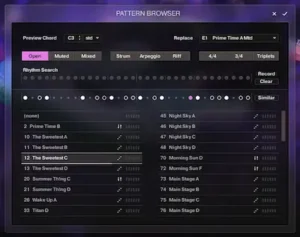
The Pattern Browser is useful because Electric Neon’s value depends heavily on finding the right performance rather than programming one from scratch. Rhythm Search makes that process more practical by letting you look for material that matches the rhythmic character of the arrangement.
That matters more than the browser itself. With 240 patterns, manual auditioning can quickly become a distraction, so anything that reduces the time between an idea and a usable guitar part directly supports the instrument’s main purpose: speed rather than unlimited guitar programming.
Is Electric Neon Deluxe Really Mix-Ready?
“Mix-ready” is a useful description of Electric Neon Deluxe, but only if it is understood as a starting-point claim, not a promise that the guitar will drop into every production untouched.
The instrument’s guitar performances and amp/FX chains are already shaped toward contemporary pop and electronic production. That removes a significant amount of corrective work compared with starting from a raw DI and building the guitar sound from scratch. The advantage is most obvious when the guitar needs to function as an arrangement layer rather than as the focal instrument.
There is a catch. A tone that sounds finished in isolation can still be difficult to place once the full arrangement is playing. Bright guitar parts can compete with vocals, synth leads, snares and cymbals through the upper mids, while wide effects can consume stereo space that the mix needs for other elements. Heavy ambience can also blur rhythmic definition when the guitar is layered with dense electronic material.
The same applies to the instrument’s stereo options. A doubled guitar can create a convincing wide image quickly, but width is not automatically an advantage in a dense production. If the vocal, synths, pads and effects already occupy a large stereo field, reducing the guitar’s width may produce a cleaner result than adding more processing.
From a mixing perspective, Electric Neon should not be judged by how little processing a preset appears to need in isolation. The more useful test is what happens when the guitar competes with the vocal and main synth elements.
A guitar that arrives already wide, bright, compressed, and effects-heavy can actually create more mix work, not less. In a dense EDM arrangement, the fastest solution may be to narrow the stereo image, reduce ambience, or remove low-mid information rather than trying to preserve the preset exactly as supplied.
In that context, Electric Neon should be treated as a prepared source, not a finished mix channel. Sometimes the supplied processing will need little more than level and placement. In other productions, an engineer may need targeted EQ, dynamic control, automation, stereo-width adjustment, or filtering to make the guitar support rather than compete with the arrangement.
That is still a meaningful advantage. The instrument moves the production closer to the desired sound before mixing begins; it does not remove the need for mixing decisions.
How the Amp and Effects Chains Hold Up in a Mix
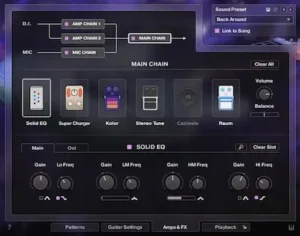
The integrated amp and effects chains are most useful when you need to make a fast tonal decision. Instead of building a guitar signal chain before you can judge whether a pattern belongs in the arrangement, Electric Neon gives you processed starting points that are already matched to the instrument.
That works particularly well for parts such as muted rhythmic figures, bright pop hooks, tremolo patterns, and ambient layers. The producer can evaluate the guitar as part of the production rather than spending time designing an amp chain for a part that may ultimately be discarded.
The 30 amp and effects chains are curated sounds, not 30 independent pieces of new processing technology. They do not turn Electric Neon into a substitute for a full guitar-processing environment such as Guitar Rig or AmpliTube. Those platforms remain preferable when you need detailed control over amps, cabinets, pedals, routing, microphones, or signal-chain behavior.
So the value of the effects section is practical rather than revolutionary: the processing is there to get the guitar into the right tonal neighborhood quickly. For detailed guitar engineering, a dedicated amp and effects setup still gives you considerably more control.
Guitar Source Controls: Pickups, DI, Ribbon Mic and Stereo Doubling
Electric Neon Deluxe provides more source-level control than its pattern-based workflow might suggest. The instrument includes bridge, middle, and neck pickup choices, separate DI controls, and a ribbon-microphone signal that can be enabled or disabled independently.
The practical advantage of these controls is that they let you change the source character without immediately rebuilding the entire effects chain. For mixing, that distinction matters: changing the pickup or DI/microphone balance can alter the guitar’s position in the arrangement before reaching for another EQ or compressor.
A stereo doubling option can also create two separate guitar performances positioned across the stereo field. This is useful when the guitar needs to function as a wide production layer, although it should be judged against the rest of the arrangement rather than treated as an automatic improvement.
Additional controls for fret noise, noise floor, tuning, muted-note decay, and the noise gate give the producer further control over how much of the sampled performance remains audible. These details are small individually, but they matter when the guitar has to sit inside a dense professional mix.
The Fundamental Limitation: Electric Neon Is Built Around Recorded Performances
 Electric Neon Deluxe gets much of its realism from avoiding the hardest problem in virtual guitar: generating convincing guitar technique from arbitrary MIDI. Its patterns are based on recorded performances by session guitarists, so picking, timing, articulation, and phrasing are captured as part of the source rather than reconstructed note by note.
The trade-off is performance freedom. You can change chords, select different patterns, adjust pattern behavior, switch articulations, and rearrange the material, but you remain within the vocabulary that was recorded for the library. You cannot freely specify a new picking pattern, unusual voicing, alternate-tuning performance, or highly specific rhythmic figure that falls outside that recorded material.
This matters once a production calls for a guitar part written around the arrangement rather than selected from an existing performance. At that point, a real guitarist or a more deeply programmable guitar instrument gives you considerably more control.
Electric Neon Deluxe prioritizes convincing recorded performance over unrestricted guitar programming. That is the right design choice for fast pop and EDM production, but it is also the boundary that determines whether the instrument fits your workflow.
Round Robin and Repeated Guitar Parts
Electric Neon uses Round Robin sample variation to reduce the mechanical repetition that can occur when the same guitar notes are triggered repeatedly. Different recorded samples can be alternated automatically, adding small performance differences between repeated notes.
For repeated rhythmic parts, this matters because a perfectly identical sample response can make a programmed guitar reveal itself quickly. Round Robin does not make every repetition completely different, but the small changes in attack and tone help prevent short repeated figures from sounding like a single sample being triggered over and over.
For production and export, this also has an engineering implication. Native Instruments provides a way to reset the Round Robin counter with MIDI CC#3, allowing a consistent sample sequence to be reproduced when deterministic playback is required. It is a small feature, but relevant when a guitar part has to remain identical across repeated playback or final bounces.
Electric Neon Deluxe Alternatives: Which Guitar Workflow Fits Better?
Electric Neon Deluxe makes the most sense when the part needs to be finished quickly. If the guitarist’s exact performance is the creative focus, its phrase-based design becomes a limitation rather than an advantage.
| Workflow | Best Fit | Strength | Trade-Off |
|---|---|---|---|
| Electric Neon Deluxe | EDM, modern pop, electronic | Fast access to performed guitar parts and processed tones | Performance is limited to the recorded library |
| Electric Neon Essentials | Producers who need the core Electric Neon workflow | Lower-cost entry into the same production approach | Fewer patterns and no finger articulation |
| UJAM SPARKLE 2 | Pop, rock, and rhythm guitar | Large phrase-based library with Player and Instrument modes | Different tonal and performance focus from Electric Neon |
| UJAM CARBON | Electronic, cinematic, and processed guitar | Deeper sound-design workflow and layered guitar textures | More stylized and less suited to clean contemporary pop guitar |
| Real Guitar Recording | Custom performances and maximum control | Unlimited phrasing, voicing, dynamics, and technique | Requires a guitarist, recording setup, editing, and engineering time |
Electric Neon Deluxe is the strongest choice when the guitar is an arrangement component rather than the performance centerpiece. A producer can audition and arrange polished guitar parts quickly without committing to the recording and editing overhead of a real session. If the production depends on a specific guitarist’s phrasing, unusual voicings, or a part that has to be written around the song rather than selected from a library, that advantage disappears.
UJAM’s alternatives are worth considering when the desired vocabulary is different. SPARKLE 2 is aimed at a broader rhythm-guitar workflow, while CARBON leans heavily into processed and sound-designed guitar. Neither is simply a better or worse version of Electric Neon; they solve different production problems.
Electric Neon is optimized for getting a convincing contemporary guitar part into the track quickly. If the performance itself is the creative focus, a deeper guitar instrument or a real recording workflow remains the better option.
Electric Neon Deluxe in a Professional Mix: From Source to Master
Electric Neon Deluxe has little direct relevance to mastering. Its professional value appears earlier in the chain, where the guitar source affects arrangement density, spectral balance, transient competition, and stereo space.
From a mixing-engineering perspective, the main advantage is consistency. The guitar comes from controlled sampled performances with an intentionally shaped production sound, so there is less corrective work associated with an inconsistent recording or poorly captured DI. But consistency does not mean the part automatically belongs in the mix. A polished guitar source can still be too bright, too wide, too sustained, or too dense for the arrangement around it.
The practical test is therefore not whether Electric Neon sounds impressive soloed. It is whether the guitar leaves enough room for the vocal, kick, bass, synths, snares, and other transient-heavy elements to remain clear. In dense EDM and pop productions, reducing guitar width, filtering unnecessary low-mid energy, or automating the part around the vocal can be more effective than adding another processing stage.
This is where Electric Neon fits into a professional workflow: it can reduce the amount of work required to create a credible guitar source, but the final result still depends on arrangement, balance, and mix translation. Those decisions also determine whether the mix is actually ready to leave the production stage; the practical issues are covered in our guide to preparing a mix for mastering.
Electric Neon Deluxe MIDI Export: What You Can Edit in a DAW
Electric Neon Deluxe can export voicings, riffs, and chord progressions as MIDI, allowing the musical material to move from Kontakt into the DAW. This is useful when the guitar part needs to become part of a broader MIDI-based production workflow rather than remaining entirely inside the instrument.
There is an important limitation. Exported MIDI preserves the rhythmic structure supplied by the Electric Neon pattern engine. The notes can be edited and transposed in the DAW, but MIDI export does not turn a recorded pattern into an unrestricted guitar-performance generator.
In practical terms, Electric Neon provides useful DAW integration without removing its core limitation: you are editing and arranging recorded performance material rather than programming every aspect of a guitarist’s technique from scratch.
CPU, RAM, Storage, and Session Performance
There is not yet enough independent testing to make a meaningful CPU or latency comparison between Electric Neon Deluxe and competing guitar instruments. What can be established is the library footprint and the supported Kontakt environment.
The installed library is 18.3 GB, and Electric Neon Deluxe requires Kontakt or the free Kontakt Player 8.12.0 or later. Native Instruments supports current macOS and Windows systems, with 64-bit VST3, AU, and AAX formats available for DAW use. The published system requirements list 4 GB of RAM as the minimum and 6 GB as the recommended amount.
The 18.3 GB figure refers to disk storage, not RAM consumption. Actual memory use depends on Kontakt’s sample-loading behavior, the number of active instances, purge settings, and the rest of the session. For a modern production computer, the library size itself is unlikely to be a problem; the more relevant consideration is how it fits alongside an already large Kontakt-based template.
For large sessions, the sensible approach is to keep the library on a fast SSD, avoid unnecessary duplicate instances, and commit or freeze parts once they are established. Until independent stress testing is available, there is no basis for calling Electric Neon Deluxe unusually CPU-heavy or unusually efficient. The more relevant practical consideration is how its sample library fits alongside other Kontakt instruments in a large session.
Electric Neon Deluxe Pricing: Is the $149 Worth It?
Electric Neon Deluxe is currently priced at $149 in the United States, while owners of Electric Neon Essentials can upgrade for $69. Native Instruments also lists Electric Neon Essentials separately at $79, giving new users a cheaper way into the same basic workflow.
| Option | Current Price | Best For |
|---|---|---|
| Electric Neon Essentials | $79 | Producers who want the core Electric Neon workflow |
| Electric Neon Deluxe | $149 | Producers who need the full pattern library and finger articulation |
| Essentials → Deluxe upgrade | $69 | Existing Essentials owners who need more performance material |
For a new buyer, Deluxe is worth the extra $70 over Essentials only if the additional patterns and finger articulation are likely to be used. If you already own Essentials, the $69 upgrade is much easier to justify because you are expanding an established workflow rather than buying into a completely different instrument.
The pricing also changes depending on whether Electric Neon is your first entry into the workflow. For a new user, the decision is effectively $79 Essentials vs. $149 Deluxe; for an existing Essentials owner, the relevant comparison is the $69 upgrade rather than the full retail price. That makes Deluxe considerably easier to justify for users who already know that the pattern-based workflow fits their production style.
At $149, Deluxe makes the most sense when electric guitar is a recurring part of your production workflow. If you only need occasional guitar layers, the cheaper Essentials edition may deliver most of the practical benefit without paying for the additional content.
The $69 upgrade is the stronger value proposition. Existing Essentials users already have the underlying workflow, so the additional cost buys a meaningful expansion: twice the pattern library and access to finger articulation. There is no new guitar engine that fundamentally changes how the instrument works.
That distinction matters when assessing value. Deluxe is primarily a content and performance upgrade, not a generational technology upgrade. The ROI comes from having more useful material available when you need it—not from replacing an existing guitar-processing system or unlocking radically deeper guitar programming.
Electric Neon Deluxe: Pros and Cons
Pros
- Excellent match for modern EDM, pop, and electronic production.
- 240 patterns give the Deluxe edition substantially more usable material than Essentials.
- Finger articulation adds a meaningful performance variation rather than simply increasing the preset count.
- Pattern editing and MIDI export fit a fast, arrangement-focused DAW workflow.
- Integrated amp and effects chains provide usable production tones without requiring a separate guitar-processing setup.
- Runs in the free Kontakt Player, so the full version of Kontakt is not required.
Cons
- The performance vocabulary is limited to the material recorded for the library.
- Its tonal and stylistic focus makes it less useful outside contemporary pop and electronic production.
- It does not provide the performance-level control of a real guitarist or a deeply programmable guitar instrument.
- The 18.3 GB library footprint is significant for a single guitar instrument.
- The supplied processing is a production starting point, not a guarantee that the guitar will sit correctly in every mix.
- Deluxe expands the existing Electric Neon concept rather than introducing a fundamentally new guitar or DSP technology.
Electric Neon Deluxe Review: Overall Rating
| Category | Rating |
|---|---|
| Sound Quality | 9/10 |
| Workflow Efficiency | 9.5/10 |
| Mix Integration | 9/10 |
| Performance Realism | 9/10 |
| Arrangement Flexibility | 8/10 |
| Value for Money | 8.5/10 |
| Overall | 8.8/10 |
Sound Quality — 9/10: The recorded guitar performances and integrated processing deliver a polished, contemporary sound that works particularly well in modern pop and EDM. The limitation is not quality but stylistic range.
Workflow Efficiency — 9.5/10: This is Electric Neon Deluxe’s strongest category. The combination of performed patterns, chord-based triggering, articulation choices, Pattern Inspector controls, and MIDI workflow removes a substantial amount of programming and recording work.
Mix Integration — 9/10: The instrument provides well-prepared guitar sources that can enter a production with relatively little corrective work. It still requires arrangement, EQ, dynamics, and stereo decisions when competing with vocals, synths, drums, and other dense elements.
Performance Realism — 9/10: Real session-guitar performances give the instrument convincing picking, timing, articulation, and phrasing. The finger articulation is particularly useful for avoiding an overly uniform picked character.
Arrangement Flexibility — 8/10: Electric Neon offers more than fixed-loop playback through chord-aware patterns, voicing options, Pattern Inspector controls, Rhythm Search, and MIDI export. It still cannot reproduce an arbitrary guitar performance, so flexibility is good within its intended workflow but not comparable with a fully programmable guitar instrument or a real guitarist.
Value for Money — 8.5/10: At $149, Deluxe is worthwhile for producers who regularly use contemporary guitar in their productions. The $69 upgrade from Essentials is even easier to justify because it adds substantial performance material and finger articulation without changing the established workflow.
From an engineering perspective, Electric Neon Deluxe earns its score by doing one job exceptionally well: turning a guitar idea into a usable production element with minimal friction. It is not the most flexible virtual guitar, but its combination of performed material, realistic articulation, fast arrangement workflow, and controlled production tones makes it a strong specialist instrument for modern pop and electronic work.
The Verdict: A Fast Production Tool, Not a Guitar-Replacement Platform
 Electric Neon Deluxe is a very specific tool, and that is ultimately its biggest strength. It is not trying to replace a guitarist or become the most flexible virtual guitar on the market. It is designed to get contemporary guitar parts into a production quickly, with the performance detail already captured in the samples.
The strongest use case is a pop or EDM arrangement where the guitar supports the track rather than carrying the entire performance. The weakest use case is a production that demands a custom guitar part with unusual phrasing, voicing, tuning, or picking that does not exist in the recorded library.
At $149, the decision is therefore straightforward. New users should choose Deluxe when they expect to use the larger pattern library and finger articulation regularly. For existing Essentials owners, the $69 upgrade is the more attractive proposition.
Final verdict: Electric Neon Deluxe is a strong specialist guitar instrument for modern pop and EDM production. Its workflow is faster than programming many guitar parts from scratch, and its recorded performances give it a convincing musical character. The limitation is equally clear: you get speed and realism by accepting a finite performance vocabulary.
Your Mix Is Finished. Now Hear What It Can Really Do.
Adding another compressor, limiter, or EQ is not necessarily going to solve the problems you hear. The final stage is about making deliberate decisions about tonal balance, dynamics, punch, depth, stereo image, and translation—without damaging what already works in the mix.
If you want to know whether your track can take another step forward, don’t guess from meters or presets. Upload up to 35 seconds of your mix and hear the difference in a free mastering demo prepared by a real mastering engineer. You get a direct reference for what professional mastering can change—and what should be left alone.
Get your free mastering demo →
Electric Neon Deluxe FAQ
Can Electric Neon Deluxe be used without owning Kontakt?
Yes. Electric Neon Deluxe runs in the free Kontakt Player 8.12.0 or later, so the full version of Kontakt is not required.
What is the main difference between Electric Neon Deluxe and Essentials?
Deluxe expands the library from 120 to 240 patterns and adds finger articulation to the existing plectrum-based material. The underlying pattern-driven workflow remains the same.
Can you edit Electric Neon Deluxe patterns in a DAW?
Yes. Pattern material can be dragged into the DAW as MIDI, allowing the producer to arrange and edit the resulting performance. However, the MIDI reflects the recorded performance vocabulary rather than providing unrestricted guitar programming.
Is Electric Neon Deluxe CPU-heavy?
There is not yet enough independent benchmarking to make a reliable CPU comparison with other guitar instruments. The more obvious resource consideration is its 18.3 GB sample-library footprint. Actual memory and CPU use depend on the Kontakt configuration, number of instances, effects, and the rest of the session.
Does Electric Neon Deluxe work well in a dense EDM mix?
Yes, provided the guitar is treated as part of the arrangement rather than as a finished mix element. Its processed tones can fit quickly, but dense EDM productions may still require control of upper-midrange energy, stereo width, and ambience.
Can Electric Neon Deluxe create completely custom guitar performances?
Not with the freedom of a real guitarist or a deeply programmable guitar instrument. You can manipulate patterns, chords, articulations, timing, and other available controls, but the underlying musical performance comes from the recorded library.
Should Electric Neon Essentials owners upgrade to Deluxe?
The upgrade makes the most sense for users who regularly run out of suitable patterns or want finger articulation. At the current $69 upgrade price, the additional content is easier to justify than replacing Essentials with a different $149 guitar instrument.
Is Native Instruments Electric Neon Deluxe worth it?
For producers working regularly in EDM, modern pop, dance, and electronic music, Electric Neon Deluxe is worth considering because its main advantage is speed: the recorded guitar performances can become usable arrangement material without programming every guitar detail from scratch. At $149, however, it is harder to justify for occasional guitar use or when you already own a guitar instrument that covers the same role.
How many patterns are included in Electric Neon Deluxe?
Electric Neon Deluxe includes 240 guitar patterns and 31 songs. The Deluxe edition doubles the pattern count of Electric Neon Essentials and adds finger articulation alongside the existing plectrum articulation.
What types of guitar patterns are included in Electric Neon Deluxe?
The pattern library includes strumming, arpeggio, and riff patterns. They serve different production purposes: strumming is suited to rhythmic chord parts, arpeggios provide more note movement, and riffs are designed around more defined melodic guitar figures.
Can Electric Neon Deluxe export MIDI to a DAW?
Yes. Voicings, riffs, and chord progressions can be exported as MIDI. The exported material can then be edited in the DAW, but the original pattern rhythm remains part of the workflow, so MIDI export does not provide unrestricted guitar-performance programming.
Does Electric Neon Deluxe use Round Robin samples?
Yes. Round Robin variation alternates recorded samples to reduce repetitive, mechanical playback. MIDI CC#3 can be used to reset the Round Robin counter when a consistent sample sequence is required for repeated playback or final bouncing.

Yurii Ariefiev evaluates virtual instruments from the perspective of real-world production, focusing on performance realism, arrangement workflow, and how sampled instruments translate into a finished mix. His reviews look beyond feature counts to determine whether an instrument actually saves production time and delivers usable musical results.
At AREFYEV STUDIO, instruments are judged by what happens after the preset is loaded: how the performance interacts with the arrangement, how much corrective mixing it needs, and whether its sonic decisions hold up when the track reaches the final mastering stage.
☕ Buy me a coffee